15/05/2020

(AU) Youth Activists Challenge Clive Palmer's Waratah Coal Mine Saying It Impacts Their Human Rights

ABC 7.30 - Peter McCutcheon

An environment group is trying to stop a proposed mine by Clive Palmer's company Waratah Coal. (ABC News: Nick Haggarty)

Key Points
  • A group called Youth Verdict is taking legal action against a coal mine project by Clive Palmer's company Waratah Coal
  • The environmental group claims it infringes on a number of rights under Queensland's Human Right Act
  • LNP Senator Matt Canavan said environmental groups have been known to try to delay projects


In an Australian legal first, an environment group has challenged a proposed mega-coal mine on the grounds that it infringes on their human rights because of its contribution to climate change.

"The link between human rights and climate change is increasingly being seen in legal actions around the world," David Morris, chief executive of the Environmental Defenders Office, said.

"It was only a matter of time before we saw one in Australia."

The action is being taken by a new group called Youth Verdict against the Galilee Coal Project in central Queensland — a project of Clive Palmer's company Waratah Coal.

Youth Verdict has lodged an objection to the mine in the Queensland Land Court, arguing it infringes on a number of their rights under the state Human Rights Act, including the right to life, the protection of children and the right to culture.

Mel McAuliffe is a co-founder of Youth Verdict. (ABC News: Chris Gillette)

"We're facing a future that is increasingly uncertain, and that impacts our right to have a safe future," Mel McAuliffe, one of the founders of Youth Verdict.

"It means we won't have access to the same opportunities that generations before us have had."

LNP Senator Matt Canavan said although he was not aware of the specifics of the court case, he says these sorts of challenges usually fail.

"We know from the strategies of other environmental groups that they have sought to use our court system just simply to delay projects, not necessarily to protect the environment or even win the court case," Senator Canavan said.

"I just don't think our court systems are set up to handle such a disputed political issue. That's not their role and purpose and [to] try to retrofit them to this will just cause more division and angst in our community."

'An unsafe future'

Lily Kerley from Youth Verdict says the case is "daunting". (ABC News: Chris Gillette)

The Galilee Coal Project involves two open pit and four underground coal mines, making it one of the biggest coal operations in Australia.

It has secured federal and state approvals but needs to be assessed by the Queensland Land Court before the final state environmental authority can be issued.

Mr Palmer and the Waratah Coal project have been approached for comment on the case but have not replied to 7.30.

Youth Verdict spokesperson Lily Kerley admits it is daunting facing a businessman who has been involved in a number of high-profile legal battles.

"But I wouldn't say as daunting as the idea of facing an unsafe future for me and my generation," she said.

Ms McAuliffe said: "We have no precedent for this type of action, which is new and exciting, but we don't know what will happen."


7.30 Report: Youth activists claim Clive Palmer's proposed coal mine could breach their human rights

Human Rights Act to lead to 'lawyers' picnic'

Queensland's Human Rights Act only came into effect in January.

The LNP Opposition voted against the bill in Parliament last year on the grounds that it was unnecessary.

"It is irresponsible law-making to enact a law, the practical meaning of which no-one knows," Shadow Attorney-General David Janetzki told the Legislative Assembly.

"It is therefore likely … to encourage the ensuing lawyers' picnic."

The LNP declined to comment on Youth Verdict's challenge.

The Queensland Resources Council's Ian Macfarlane said the action was "a novel attempt by a minority group of young activists to use the court system to delay and/or prevent economic development in Queensland and jobs for Queenslanders during these challenging times".

Links

(AU) Insuring Your Home May Get Harder And More Expensive As Climate Change Increases Risks

ABC Radio National - Antony Funnell

Increased damage to houses through fires, floods and other disasters has the global insurance market under increasing stress.(Getty: Saeed Khan/AFP)

Our homes have become sanctuaries — places of refuge in the time of coronavirus. But they can't protect us from all threats.

Analysts say the houses we've built, and where we've built them, could increase our future vulnerability as we face the ongoing effects of climate change.

With increased damage to houses through catastrophic fires, floods and other disasters, the global insurance market is under increasing stress, and there are fears whole communities could become impoverished or homeless.

Experts doubt industry players and governments have fully come to terms with the issue — and they worry about some of the financial mechanisms insurance companies have put in place to share the risk.

Too focused on past catastrophes

Insurers have a short-term focus and often fail to be proactive in assessing future problems, according to Jason Thistlethwaite, a Canada-based academic and expert on insurance practice.

He says while global climate models are forward looking, the actuarial practices used for risk modelling in the insurance industry are not.

Put bluntly, insurers still spend most of their time looking in the rear-view mirror.

Analysts fear insurers may withdraw from areas they don't believe are profitable. (ABC News: Tim Swanston)


Where there has been a shift in attitude, though, is among "reinsurers" — essentially, the insurance companies for insurance companies.

"Reinsurers are starting to grasp that these extreme events are something known as correlated risk, meaning that there is a common cause underlying them," Professor Thistlethwaite says.

"So, Australia may have a good year with very few claims in the primary insurance market, but reinsurance rates may still go up because there is bad flooding in the Philippines or the United Kingdom, for instance.

"They are operating at a global scale that allows them to pick up on data points that provide a much more coherent pattern that shows extreme weather events are getting worse and contributing to higher losses."

 He says that broader, interconnected understanding of risk is starting to filter down to primary insurers, as they themselves experience increasing reinsurance costs.

Nevertheless, he's predicting a rationalisation of the primary insurance market, with some companies going bust and others simply withdrawing from areas they don't believe profitable.

Rise of the 'red zones of risk'

Professor Thistlethwaite says it's already happening in the United States in regions regularly affected by major climate-related events, such as hurricanes and tornados.

And it's also beginning to occur in Australia, according to Karl Mallon, director of science at the organisation Climate Risk.

"If we see emissions continuing in the current direction, the level of warming continuing in the same direction, and if we continue to see a sort of blind attitude to what's happening, then our risk will rise to about one in 10 properties," he says.

"Ninety per cent of properties may be OK, as in they are still insurable, even though the costs might be elevated. [But] one in 10 may really cross into the red zone territory."

 Early last year the Insurance Council of Australia accused Dr Mallon of "scaremongering", but its president Richard Enthoven has since acknowledged that changing weather systems could potentially make some parts of Australia "uninsurable".

Dr Mallon cites parts of the Gold Coast in Queensland, the Central Coast in New South Wales, and West Lakes in South Australia as regions facing an impending crisis.

Legal expert Justine Bell-James warns that coastal communities could face a double hit: not only could their houses become uninsurable, but some homeowners could lose their entire asset due to erosion.

Erosion could cost some homeowners their entire asset, experts warn. (ABC RN: Antony Funnell)


Under Australian law any area of private land reclaimed by the sea automatically reverts to the Crown, she says.

"In those circumstances, unless there is some sort of strategic intervention, landholders will look to government to compensate them," she says.

"That might be through informal ad hoc disaster relief — the requests that always come after some sort of large-scale natural disaster.

"Or it might be by going to the court and bringing an action against a government in negligence."

Negligence because councils have approved development in known hazard zones.

According to a 2019 study conducted by the Grantham Research Institute in London, a rise in climate change litigation is already occurring in countries across the globe, from Indonesia to Norway.

How and when should the state intervene?

Dr Mallon cautions against an assumption that governments should simply pick up the role of providing insurance in disaster-prone areas.

Poorly designed interventions, he warns, can lead to perverse outcomes.

"It actually makes things worse," he says.

"What we've seen in the UK, where there is a flood pool program, is that it's had the desired effect of protecting the property values of people in those flood zones, but then you've seen a rash of development where people have said, 'well, that's OK then, I can just keep building whatever in these zones'."

 He also points to a recent experience in California, where a moratorium preventing insurers from pulling out of policies in high-fire regions ultimately backfired, because those companies became "gun-shy" about offering future cover.

The insurance bill from 2019's Townsville Floods was more than $1 billion. (Getty: Ian Hitchcock)


Instead, says Dr Mallon, there needs to be an acknowledgement that what we're facing is a planning and building problem, not just an insurance one; that too many houses continue to be built in areas that are known to be unsafe, or will be in the future.

His solution involves a rigorous tightening of building codes and convincing insurance companies that they need to begin calculating their policies on more than just the traditional criteria of "exposure to risk".

"Exposure is only half the story. The question is how resilient is the house?" he says.

"If I had a house and I put a burglar alarm in, I get a lower insurance premium. So, if I build a house, it might be in a high-hazard zone, but if I make it more resilient, I should be rewarded for making my assets safer.

"There are lots of engineering solutions, but we need insurance to reflect that."

But Dr Bell-James believes the scale and magnitude of the problem will eventually see governments forced to progressively relocate whole communities.

This occurred with the town of Grantham in Queensland, she points out, after it was inundated by floodwaters in 2011.

Their own worst enemy

Dr Bell-James believes the growing frequency and predictability of natural disasters will eventually reshape the nature of insurance available to desperate homeowners.

"The whole basis of insurance is that it is underpinned by that element of uncertainty. It's a little bit like gambling, you might win, and you might lose and that's how insurers make their money and remain solvent companies," she says.

"But if you're looking at properties that are definitely going to be inundated by sea level rise, that's at odds with the entire concept of property insurance.

"It's more akin to something like life insurance — you know that you're going to die, you just don't know when it's going to happen."

 And that kind of change, she says, will likely result in a steep rise in premiums.

Korey Pasch from Queens University, Ontario, believes many insurance companies need to be more discerning about the industries they choose to deal with.

"The industry is still heavily connected to the underlying causes exacerbating climate change and global warming," he says.

"Insurers are actually quite heavily invested in the fossil fuel industry.

"They also support the sector by providing insurance to fossil fuel projects. If those projects, like new coal power plants or fossil fuel intensive infrastructure, if they don't have insurance then those projects can't be built."

It's a point not lost on the head of Australia's largest general insurer IGA.

CEO Peter Harmer says his company has ceased insuring coal mines and is progressively phasing out insurance for other fossil-fuel related businesses.

"Over the last number of years we have significantly shifted our investment portfolio," he told ABC RN's Breakfast program earlier this year, "and we have shifted towards companies that are on a pathway towards a lower emissions environment and have a strategy, a demonstrable strategy to do that".

Cat bonds and the risk of creating risk in order to counter risk

Mr Pasch worries that some of the mechanisms insurance companies are now employing to mitigate risk could be building greater long-term instability into the industry and the financial sector more broadly.

He's warned about the rise of what are called insurance-linked securities, catastrophe securities or cat bonds, which first started appearing in the US in the mid-1990s as a way of keeping insurers afloat following a series of major natural disasters.

Catastrophe bonds work by transferring risks from an insurance provider to investors. If the pre-determined disaster doesn't eventuate over a set period of time, investors gets get their money back, with a handsome bonus.

If the disaster does occur, the insurance company can use the money to offset its losses.

"The types of investors that typically buy cat bonds are not your everyday kind of individual but institutional investors, so things like hedge funds, other reinsurance companies, pension funds, foundations, sovereign wealth funds, et cetera," he says.

"And a lot of these instruments are domiciled in tax havens and tax shelters where oversight is minimal."

Experts say part of the problem lies with poor planning and building codes. (ABC News: Allyson Horn)


He worries that while such bonds are designed to decrease the costs of reinsurance for primary insurers, they also have the potential to distort the market.

"If you lower the price of reinsurance to a degree where it becomes cheaper for insurers to buy, it can change the underwriting habits of those insurance companies," he says.

"They can underwrite properties that they may not have underwritten previously. It can lead to them taking on risks that they may not have taken otherwise."

 The end result, says Mr Pasch, could prove as damaging as the 2008 sub-prime mortgage crisis in the US, which sent the world spinning into a global financial crisis.

"It's one of the issues that has led the European Insurance and Occupational Pensions Authority to flag these instruments as a potential source of systemic financial risk," he says.

But more than that, he worries that all such financial mechanisms ultimately achieve is a deferral of the inevitable.

"All of this is predicated upon business-as-usual continuing indefinitely, and the climate crisis, in my opinion, is nature essentially saying business-as-usual can no longer continue."

Links

Are We Witnessing The Death Of The Car?

BBC Future Planet - Francesca Perry

Cities around the world are seeing dwindling numbers of fossil-fuel powered cars on their streets, and many are planning to keep it that way after lockdowns ease.


As global lockdowns keep most people at home, congestion-riddled, pollution-choked streets around the world have transformed into empty, eerily silent spaces. The most conspicuous absentee is the car, as personal vehicles remain parked in driveways and side streets.

This lack of cars has contributed to a sudden drop in emissions of carbon dioxide, pollutants like nitrogen dioxide and fine particulate matter. Its effect on oil prices has been not so much a drop as an implosion. Some cities have temporarily turned emptier streets into walking and cycling-only zones to enable socially distanced exercise.

Meanwhile, Milan – the epicentre of Italy’s coronavirus outbreak – announced it would transform 35km (21.7 miles) of its streets for cycling post-lockdown. Could this pandemic, a global emergency, actually catalyse an ongoing movement towards cleaner air – and might Milan’s scheme form a blueprint for cities that have repeatedly tried to tackle the domination of the car?

The pandemic’s impact on the environment has been staggering. Carbon emissions from the burning of fossil fuels are heading for a record 5.5-5.7% annual drop. From mid-January to mid-February, China’s carbon emissions fell by around 25%.

In Delhi, a city with often the worst air quality in the world, pollution caused by PM2.5s reduced by roughly 75% as traffic congestion dropped by 59%. A 70% reduction in toxic nitrogen oxides was reported in Paris, while satellite imagery showed nitrogen dioxide levels in Milan fell by about 40%. In the UK, road travel has decreased by as much as 73% and in London, toxic emissions at major roads and junctions fell by almost 50%.

Although car use has decreased, so has public transport use. Services have been reduced, the need for travel has declined, and a public fear of using it has grown, now that proximity to strangers has become synonymous with infection risk.

Some Chinese cities, including Wuhan – where the coronavirus outbreak began – shut down public transport entirely to reduce risk of contagion.

The urban mobility app Moovit reported that public transport ridership has dropped on average by 78% worldwide, with Milan and Rome, for example, seeing a decrease of 89%.

Images from the European Space Agency show NO2 emissions in Paris in March 2020 were down significantly compared with the same period in 2019. (Credit: Reuters)

Where car, bus and train journeys have been dwindling, bicycles have been picking up the slack. As a form of isolated transport that doubles as exercise – that is much easier given the wealth of empty streets – cycling has become more appealing in a number of cities.

In March, use of bike-share systems increased by roughly 150% in Beijing and 67% in New York, where cycling on main thoroughfares increased by 52%. Meanwhile, cycling traffic increased by 151% on trails in Philadelphia and in April Dundee saw cycling traffic increase by 94%.
Cities that seize this moment to make it easier for people to walk, bike and take public transport will prosper after this pandemic and not simply recover from it
Janette Sadik-Khan
To accommodate streets now busier with bikes, as well as facilitate social distancing, some places have installed temporary cycle lanes or closed streets to cars. Pop-up bike lanes have appeared in cities including Berlin, Budapest, Mexico City, New York, Dublin and Bogotá.

Governments from New Zealand to Scotland have made funding available for temporary cycle lanes and walkways amid the pandemic. In Brussels, the entire city core will become a priority zone for cyclists and pedestrians from early May for the forseeable future.

 Meanwhile, temporary street closures to cars have taken place in Brighton, Bogotá, Cologne, Vancouver and Sydney as well as multiple US cities including Boston, Denver and Oakland. In England, restrictions have been lifted to enable and encourage councils to more quickly close streets to cars.

But these, of course, are temporary measures. What will happen as lockdowns are lifted?

There are widespread concerns that as travel resumes, people will avoid public transport amid continuing fears of the virus and instead turn to private cars, clogging roads and causing pollution, perhaps even more so than before. Chinese cities, including Beijing and Shanghai, are already seeing this happen.

The easing of lockdowns has not meant a flood of people returning to public transport in China, where many stations remain quiet. (Credit: Getty Images)

It is with this in mind that Milan announced its plan to make changes in the wake of the pandemic that support alternatives to driving. “In order to prevent an excessive use of private cars, with the consequent increase in air pollution, the city of Milan will encourage the use of bicycles,” its announcement states. As travel restrictions are lifted, the government will begin construction on the cycle lanes – all of which take space away from cars – alongside implementing reduced speed limits and widened pavements.

This is far from a ban on cars, but it does suggest a shift towards more sustainable forms of transport in the long term, catalysed by the pandemic. So could other cities follow suit?

Janette Sadik-Khan, a former transportation commissioner for New York City and principal with Bloomberg Associates, is working with Milan and other cities on their “transport recovery” programmes. “The pandemic challenges us, but it also offers a once-in-a-lifetime chance to change course and repair the damage from a century of car-focused streets,” she says. “Cities that seize this moment to reallocate space on their streets to make it easier for people to walk, bike and take public transport will prosper after this pandemic and not simply recover from it.”

In the Colombian city of Bogotá, mayor Claudia López closed 117km (72.7 miles) of streets to cars in order to make cycling and walking easier during the coronavirus lockdown. Though these streets are typically closed every Sunday – in the long-running, pro-cycling initiative Ciclovía – Lopez has extended the closure throughout weekdays too, as well as added 80km (49.7 miles) of cycle lanes to the city’s existing network of 550km (341.7 miles).

The mayor of Bogotá, Claudia López, has extended closures of streets to cars and opened additional cycle routes during lockdown. (Credit: Getty Images)

“Covid-19 safety now piles up with all the other advantages to cycling in Bogotá, and we are exploring other measures, in addition to new cycle lanes, that should increase not only infrastructure but also access to bicycles and other safe and clean transportation alternatives,” explains Bogotá’s environment secretary Carolina Urrutia Vásquez. “Hopefully these will remain primary transportation choices, as well as ‘last mile’ alternatives, past the current crisis.”
We have the opportunity to see what would our cities look like when we are designing for people, not cars
Samu Balogh
In Paris, where mayor Anne Hidalgo’s Plan Vélo had already promised to make every street cycle-friendly by 2024 and remove 72% of Paris’s on-street car parking spaces, a post-lockdown plan was announced that includes creating temporary cycle lanes following metro line routes, for those hesitant to return to public transport. The planned construction of permanent cycle highways has also been accelerated in response to the crisis.

At the national level, Pierre Serne – president of cycling association Club des Villes et Territoires Cyclables – was asked by French minister Élisabeth Borne to coordinate a sustainable post-lockdown mobility plan. “We anticipate a lot of people will chose cycling instead of public transportation,” says Serne. “It could potentially mean millions of new bikes in streets and therefore we have to be able to provide adequate facilities. If we failed, the only alternative might be millions more cars and that would be a nightmare in terms of pollution and congestion. I am willing (and rather confident) to see these temporary measures become permanent because, pandemic or not, cycling is one of the cleanest and healthiest ways to move, especially in urban areas.”

In Budapest, new temporary cycle lanes are due to last until September – but maybe further. “We are constantly monitoring the use of the temporary bike lanes, and we are hoping that a good many of them could remain in place,” says Samu Balogh, the mayor’s chief of staff. “The pandemic has changed transport globally… We have the opportunity to see what would our cities look like when we are designing for people, not cars.” Such thinking builds upon existing efforts from the city to eliminate road deaths, which includes decreasing car numbers and lowering speed limits.

“In the long term we are working towards implementing traffic-calming measures and new bike lanes so we can create a more inviting environment for cycling and walking,” says Balogh.

Rare sights like blue skies in Delhi have shown that "dramatic change is indeed possible," says the World Institute's Claudia Adriazola-Steil. (Credit: Getty Images)

In the UK, London mayor Sadiq Khan has made clear that the capital’s cleaner air should not be temporary and that the ongoing challenge is to “eradicate air pollution permanently”. Xavier Brice, chief executive of the walking and cycling charity Sustrans, believes the country’s recovery “can be a catalyst for positive, long-lasting change in the way we live and move around” and hopes that temporary cycling and walking measures – which Sustrans lobbied for – “inform future road space planning, after lockdown is lifted”.
The future will be very different, and I’m convinced it will be much more local
Shannon Lawrence
It seems this may take effect in Manchester. “When restrictions are lifted, rather than returning to business as usual, we need to take the opportunity to see how we can support more people to choose to walk or cycle, instead of travel by car,” says city councillor Angeliki Stogia, who leads Manchester’s environment, planning and transport strategy.

There are also developments at the national level, as the government’s recently published De-Carbonising Transport report outlines a strategy for reducing car use in order to tackle climate change, in line with the country’s commitment to achieve net zero greenhouse gas emissions by 2050. It has also committed to ban the sale of new petrol, diesel or hybrid cars in the UK from 2035 to help achieve this.

Which brings up an important point: it is petrol and diesel cars, rather than electric vehicles (EVs) that contribute to carbon emissions and toxic air in cities. Electric vehicles have steadily increased in popularity over the last decade: BloombergNEF reported in 2019 that more than two million EVs were sold in 2018, up from just a few thousand in 2010. It predicts sales will rise to 56 million by 2040.

But EVs are not problem-free: they are expensive, require sufficient and widespread charging facilities, and still contribute to congestion on city streets. In a low-carbon future, however, electric cars – especially those that are shared – could form one part of a multi-modal transport infrastructure.

So in these cities’ efforts to ensure healthier air, outright bans on cars don’t feature as a core approach. But, if their plans are successful, combustion-engine cars may well become a rarer sight.

The approach in many cities has not been to ban the conventional combustion-engine car, but to make healthier and more sustainable options more convenient. (Credit: Getty Images)

It’s hard to say what will happen next, especially as we don’t know when “next” will be. But the sudden drop in pollution and improvement of air quality around the world has been a wake-up call, not least in light of studies showing that pollution makes Covid-19 more deadly and could even contribute to the spread of the virus.

 The coronavirus pandemic struck at a time of climate emergency, an emergency caused in part by the huge amount of greenhouse gas emissions released into the atmosphere – much of which comes from cars. This pandemic may have inadvertently triggered an environmental reprieve, but it has not stopped climate change.

On 22 April, Earth Day catalysed calls for the current crisis to be a turning point in our relationship with nature. “We must act decisively to protect our planet from both the coronavirus and the existential threat of climate disruption," says UN Secretary General António Guterres. "We need to turn the recovery into a real opportunity to do things right for the future.” Just like viruses, he noted, greenhouse gases do not respect national boundaries either.

Tackling air pollution and climate degradation is high on the list for the new Global Mayors Covid-19 Recovery Task Force, coordinated by C40 Cities, which sees mayors worldwide collaborate to achieve a climate-friendly economic recovery from the pandemic.

“The future will be very different, and I’m convinced it will be much more local – more cycle deliveries, more working from home and more school runs made by bike or walking,” says Shannon Lawrence, C40’s director of global initiatives. “All of which means fewer cars on the road, which in turn means improved air quality, better public health and a major contribution to tackling the climate crisis.”
This Covid-19 crisis is allowing us a glimpse of what a changed world looks like with far fewer cars and much cleaner air
Claudia Adriazola-Steil
Implementing restrictions on cars has different practical and political limitations around the world, however. In places like Milan, Bogotá and Paris, there have long been bottom-up and top-down efforts towards more sustainable mobility – from car-free days to successful bike-share systems. Change is perhaps easier in these places, although not simple.

“Space is of course political, and so supporting and ensuring sufficient space for non-motorised transport and the spectrum of users who have livelihoods dependent on space(s) is crucial,” says Rashiq Fataar, chief executive of Cape Town-based NGO Our Future Cities, which works with cities across the African continent. “Transport options which are safe, clean, less crowded and more efficient should be the benchmark, but transport planning must begin to see itself as part of a system providing economic and social ‘access’ in our cities.”

Indeed, a decline in car use cannot be expected unless people have efficient, accessible and affordable alternative options. But as Fataar points out, mobility is linked to every aspect of life in cities, and a change in car use may only be possible if issues around housing, public services and work culture are addressed too. Such huge volumes of commuting, for instance, may not be necessary if working from home is made easier, services are more equally distributed geographically or people can afford to live within walking distance of their work.

Policy and behaviour change may take a long time, but there exists a building momentum across the world that recognises car-free streets as a critical way of tackling the urgent climate crisis, as well as a strategy to improve health and wellbeing. This pandemic has resulted in countless forced changes to our lifestyles, economies and environments. Seeing what’s possible can lead to change – the question is how to ensure the change resulting from this global emergency improves health for people and planet.

We are a long way off from the demise of the car, but as the world seeks to recover from the collective trauma of the Covid-19 pandemic, perhaps the willingness to tackle another deadly emergency – outdoor air pollution causes 4.2 million deaths per year – will get stronger.
“This Covid-19 crisis is allowing us a glimpse of what a changed world looks like with far fewer cars and much cleaner air,” says Claudia Adriazola-Steil, deputy director of the Urban Mobility Program at the World Resources Institute. “Dramatic change is indeed possible.”

Links

14/05/2020

(AU) Scientists Fear Surge In Supersized Bushfires That Create Their Own Violent Thunderstorm

The Guardian -  | 

Exclusive: group of former fire and emergency services leaders tell bushfire royal commission rapid detection technologies are vital

Using a ‘fast-track strategy’, fire crews could be airlifted to new fires before they became too big, a group of former fire and emergency services leaders have told the bushfire royal commission. Photograph: Sean Davey/EPA

Australia should deploy new “fast-attack strategies” to combat bushfires and stop small remote blazes turning into unstoppable mega fires, a group of 33 former fire and emergency services leaders have said.

In a submission to the bushfires royal commission, the group said climate change was increasing the risk of extreme bushfire seasons.

New “rapid fire-detection” technologies should be trialled, with faster mid-sized and purpose-built water bombers made available to put out fires within 24 hours of them being detected.

The submission from emergency leaders for climate action, seen by Guardian Australia, includes 33 recommendations to the royal commission.

Fire crews could be airlifted to areas where new fires risked becoming too big, with faster long-range amphibious water bombers deployed in a military-style operation.

More than 20% of Australia’s forests burned during the recent fires, which destroyed thousands of homes and properties and killed at least 33 people. Smoke caused more than 400 estimated excess deaths.

The economic costs have been estimated at more than $4bn. Hundreds of endangered animals, plant and invertebrate species were affected, and some may have been driven to extinction.

Australia’s unprecedented bushfire season of 2019-20 coincided with the country’s hottest and driest year on record.

“It is not possible to ‘adapt’ to such catastrophic and escalating conditions, and they can only be partially mitigated,” said the submission, compiled by former commissioner of Fire and Rescue NSW, Greg Mullins.

“The failure of successive governments at all levels to show leadership and take credible, urgent action on the basic causal factor – greenhouse gas emissions from the burning of coal, oil and gas – will lead to further escalation in natural disaster risks.”

The submission recommended Australia develop a network of sensing technologies to detect fires in remote areas earlier, and then employ a “fast attack” approach to put them out.

Australia should trial a purpose-built water bombing aircraft long-used in other countries that can scoop up water and “achieve rapid turnaround and constant direct attack on fire fronts”.

Mullins told Guardian Australia a range of early detection technologies could be used to detect new fires, including remote cameras, satellite images and spotter flights.

“Every big fire was once a small fire,” he said. “It’s very much like a military operation with eyes in the sky, with your ground troops that are backed up with some artillery.”

The purpose-built water bombers were able to refuel quickly – either by skimming over large water storages or landing in paddocks – and that meant they were ideally suited to a rapid response strategy.

Firefighting experts have warned that while larger water-bombing aircraft could help control fires, they should not be seen as a “panacea” and that a suite of responses were needed.

The former emergency leaders said these aircraft had failed to make “appreciable difference to extreme fires on the worst fire weather days”.

Other recommendations included increasing funding for climate change research, putting more electricity cables underground, reviewing building standards, and building bushfire-safe shelters in fire-prone communities.

The submission also highlighted the increasing number of large fires that couple with the atmosphere to form their own storms, creating deadly conditions on the ground for firefighters.

There had been an “astounding and deeply concerning shift in the frequency of these events”.

Hearings for the royal commission will begin on 25 May and run for two weeks. It has held 17 community forums and received more than 400 public submissions.

The final report and recommendations are due on 31 August and Dominique Hogan-Doran SC, the senior counsel assisting, said in the inquiry’s first hearing in April that it would be narrowly focused on national coordination and the “challenges associated with walking across lines drawn on a map” so as to avoid duplication with current and previous state inquiries.

“We detect a worrying consistency in the themes explored and repetitiveness in the recommendations made,” Hogan-Doran said. “This is no time to reinvent the wheel.”

The royal commission is considering recommending Australia be granted the ability to declare a national state of emergency, and released an issues paper this month calling for advice from constitutional law experts.

National state of emergency powers may also be able to be invoked during a pandemic, although the royal commission has explicitly ruled out considering matters relating to the coronavirus.

Victoria’s response to the coronavirus crisis is anchored in its state of emergency powers, which were created after the 2009 Black Saturday bushfires.

The issues paper said if the commonwealth had powers to declare a state of emergency it would be able to deploy national resources, such as the army, without waiting for a request from the states.

But it also said there were constitutional limitations in granting such a power which may mean a national state of emergency declaration would have either a limited or a very specific practical effect.

Links

Climate Explained: What Caused Major Climate Change In The Past?

The Conversation - 

Earth had several periods of high carbon dioxide levels in the atmosphere and high temperatures over the last several million years. What caused these periods, given that there was no burning of fossil fuels or other sources of human created carbon dioxide release during those times?

Shutterstock

 is Professor, Physical Geography (climate science), Te Herenga Waka — Victoria University of Wellington.


Burning fossil fuels or vegetation is one way to put carbon dioxide  into the air – and it is something we have become very good at.

Humans are generating nearly 40 billion tons of carbon dioxide every year, mostly by burning fossil fuels.

Carbon dioxide stays in the air for centuries to millennia and it builds up over time. Since we began the systematic use of coal and oil for fuel, around 300 years ago, the amount of carbon dioxide in the air has gone up by almost half.

NOAA
Apart from the emissions we add, carbon dioxide concentrations in the air go up and down as part of the natural carbon cycle, driven by exchanges between the air, the oceans and the biosphere (life on earth), and ultimately by geological processes.

Natural changes in carbon dioxide

Every year, carbon dioxide concentrations rise and fall a little as plants grow in spring and summer and die off in the autumn and winter. The timing of this seasonal rise and fall is tied to northern hemisphere seasons, as most of the land surface on Earth is there.

The oceans also play an active role in the carbon cycle, contributing to variations over a few months to slow shifts over centuries. Ocean water takes up carbon dioxide directly in an exchange between the air and seawater. Tiny marine plants use carbon dioxide for photosynthesis and many microscopic marine organisms use carbon compounds to make shells. When these marine micro-organisms die and sink to the seafloor, they take the carbon with them.

Collectively, the biosphere (ecosystems on land and in soils) and the oceans are absorbing about half of all human-emitted carbon dioxide, and this slows the rate of climate change. But as the climate continues to change and the oceans warm up further, it is not clear whether the biosphere and oceans will continue absorbing such a large fraction of our emissions. As water warms, it is less able to absorb carbon dioxide, and as the climate changes, many ecosystems become stressed and are less able to photosynthesise carbon dioxide.

Earth’s deep climate history

On time scales of hundreds of thousands to millions of years, carbon dioxide concentrations in the air have varied hugely, and so has global climate.

This long-term carbon cycle involves the formation and decay of the Earth’s surface itself: tectonic plate activity, the build-up and weathering of mountain chains, prolonged volcanic activity, and the emergence of new seafloor at active mid-ocean faults.

Most of the carbon stored in the Earth’s crust is in the form of limestone, created from the carbon-based shells of marine organisms that sank to the ocean floor millions of year ago.

Carbon dioxide is added to the air when volcanoes erupt, and it is taken out of the air as rocks and mountain ranges weather and wear down. These processes typically take millions of years to add or subtract carbon dioxide from the atmosphere.

In the present day, volcanoes add only a little carbon dioxide to the air, around 1% of what human activity is currently contributing. But there have been times in the past where volcanic activity has been vastly greater and has spewed large amounts of carbon dioxide into the air.

An example is around 250 million years ago, when prolonged volcanic activity raised atmospheric carbon dioxide levels dramatically. These were volcanic eruptions on a vast scale - lasting for around two million years and causing a mass extinction.

In the more recent geological past, the past 50 million years, carbon dioxide levels have been gradually dropping overall and the climate has been cooling, with some ups and downs. Once carbon dioxide concentrations became low enough (around 300 parts per million) between two and three million years ago, the current ice age cycle began, but the warming our emissions are causing is larger than the natural cooling trend.

While Earth’s climate has changed significantly in the past, it happened on geological time scales. The carbon in the oil and coal we burn represents carbon dioxide taken up by vegetation hundreds of millions of years ago and then deposited through geological processes over millennia. We have burned a significant proportion within a few centuries.

If human emissions of carbon dioxide continue to increase through this century, we could reach levels not seen for tens of millions of years, when Earth had a much warmer climate with much higher sea levels and no ice sheets.

Links

Pakistan Combats Massive Unemployment By Hiring People To Plant 10 Billion Trees

My Modern Met - Megan Cooper

Though this period of uncertainty and loss has been challenging for people around the world, we’ve been able to focus on moments of compassion, renewal, and persistence to help us through the coronavirus pandemic.

Every story of an animal species returning to its habitat (which is now devoid of industrial traffic) can uplift us even in our most isolated moments.

One of these optimistically faith-restoring projects comes out of Pakistan. Prime Minister Imran Khan, who launched the 10 Billion Trees Tsunami initiative in 2018 to help the country counter the mounting effects of global climate change, has made this initiative instrumental once again; this time, it is also helping to battle the social and economic effects of the virus on Pakistan’s population.

According to the Global Climate Risk Index of 2020, Pakistan ranks fifth in a list of countries that were affected the most by planetary heating over the past twenty years.

From 1999-2018, the country reported over 150 extreme weather events (heat waves, droughts, floods, etc.), which are only projected to increase as global climate change worsens.

The 10 Billion Trees Tsunami project seeks to plant the eponymous ten billion trees across the desert landscape over a five-year period.
Although Pakistan has been on lockdown since March 23 to help mitigate the spread of the virus, the Prime Minister has issued exceptions to day laborers associated with this project. In addition, he has hired 63,000 laborers facing unemployment from these municipal lockdowns to continue afforesting.

Workers are compensated between 500-8,000 rupees (about $7 to $106) a day, which amounts to about half of their usual wages, but helps alleviate a fraction of the unemployment population in Pakistan.

To keep their workers further protected, the government has mandated that planters must wear masks and stay 6 feet apart from one another while in the field. The positive effects of these efforts are being felt, though, and about 30 million indigenous saplings have been planted in the Punjab area alone since the start of this campaign. This year, the afforestation plan hopes to have 50 million trees planted.

News of these increased efforts rides on the coat-tails of discussions about reinstating programs like the Civilian Conservation Corps in the United States—a program which was born out of FDR’s New Deal and aimed to help unemployment in the 1930s by hiring people for public works projects.

For Malik Amin Aslam, the Climate Change Advisor to the Prime Minister, this situation “has taught us the valuable lesson that when you invest in nature it not only pays you back, but also rescues you in a stressed economic situation.”
Links

13/05/2020

Australians Want Industry, And They’d Like It Green. Steel Is The Place To Start

The Conversation -  |  | 

Shutterstock

Australia has an historic opportunity to build a new, export-focused manufacturing sector based on renewable energy.

As a bonus, it could enable a less politically fraught conversation about climate change. Global action on climate change is in Australia’s national interest.

The changing climate is already reducing profits for Australian farmers. Tens of thousands of jobs depend on the again-bleached Great Barrier Reef.

But for too long, political leaders have struggled to balance the national interest with the legitimate concerns of Australians who live and work in regions that host coal mining and other carbon-intensive industries – most notably central Queensland and the Hunter Valley in NSW.

Source: Grattan Institute (2020)'Start with steel: A practical plan to support carbon workers and Out emissions.


This climate conundrum has greatly complicated the national debate about climate change: neither commitments to a “just transition” to a low-emissions future, nor promises of coal exports in perpetuity, have proven convincing, leaving regional jobs in the lurch.

Australians want industry

In the 2019 federal election, voters in these carbon regions, perhaps fearing for their livelihoods, seemingly rejected Labor’s more ambitious climate policies.

But with 85% of our black coal exported each year, decisions made in Beijing and New Delhi matter more to these communities than decisions made in Canberra.

Australia needs a credible plan to replace carbon jobs as the world decarbonises, and ideally the new jobs will offer similar salaries, need similar skills, and be located in similar places.

This is the key to cracking the climate conundrum: a plan based on sound economics that can offer hope to communities that currently depend on carbon-intensive activities.

A new Grattan Institute report, Start with steel, finds that manufacturing green steel for export is the largest job opportunity for these regions of Australia.

We can start with steel

Green steel can be made by using renewable energy to produce hydrogen, and then using that hydrogen in place of metallurgical coal in the steelmaking process.

The byproduct is water, rather than carbon dioxide.

Winding back the 7% of global emissions that come from steel production will require creating demand for low-emissions steel.

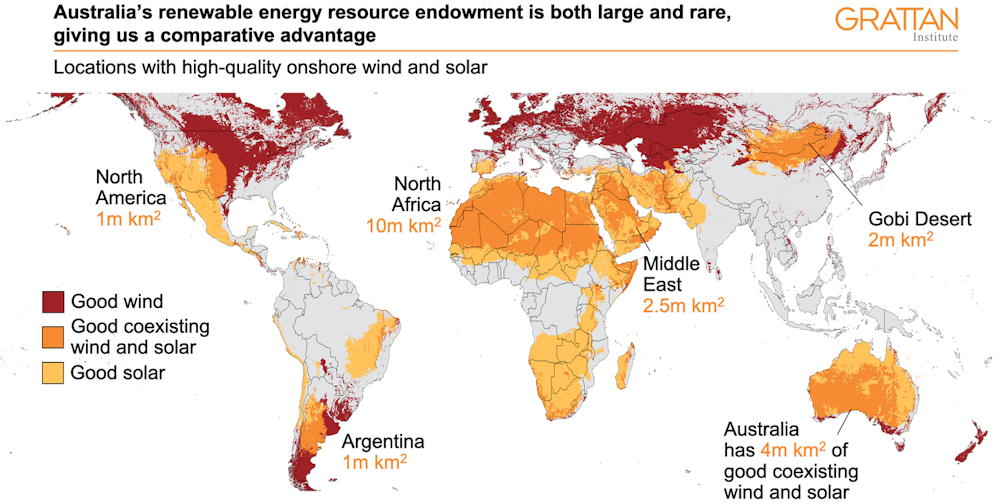
Australia has far better renewable resources than many of our major Asian trading partners, allowing us to make low-emissions hydrogen more cheaply, and therefore to make cheaper green steel.

And because hydrogen is expensive to transport, it makes sense to use it to make green steel here rather than exporting it to make green steel somewhere else.

Notes: Land higher than 3,000 metres is excluded because renewable energy resources are harder to use when they are in mountainous terrain. High-quality resources are defined to be areas with average wind power-density of at least 450 W/m2 and average daily solar photovoltaic potential of at least 4.5 kWh/kWp. North Africa includes the Horn of Africa. Sources: Grattan analysis of Global Wind Atlas (2020), Global Solar Atlas (2020) and U.S. Geological Survey and National Geospatial-Intelligence Agency (2010)

The Pilbara in Western Australia is the world’s largest iron ore province, which makes it look like the natural place to make green steel.

But it is difficult to attract workers to remote Western Australia. Making green steel for export would require large industrial workforces like those in central Queensland and the Hunter Valley.

Our calculations suggest that the availability of reasonably-priced labour on the east coast of Australia more than outweighs the cost of shipping iron ore from Western Australia to turn it into green steel there.

If Australia captured just 7% of the global steel market, it could create 25,000 ongoing manufacturing jobs.

Seven per cent is much higher than the 0.3% of globally-traded steel that Australia produces today – but it is much less than our share of iron ore production, which is 38%.

Crucially, the opportunity does not rely on leaps of faith or endless subsidies – it is one of the few economically-credible ways to make the low-emissions steel the world will need if it gets serious about tackling climate change.

We should act quickly

There are also opportunities for Australia’s regions to manufacture biofuels for aviation and use renewable hydrogen to make ammonia.

The markets for these products are less certain, but if the world moves decisively to limit emissions, the projects that respond will deliver thousands of jobs.

Governments cannot single-handedly create these industries, and nor should they.

Instead, they should focus on bringing down the cost of the key intermediate product – hydrogen – by funding pre-commercial studies of geological structures suitable for storing hydrogen cheaply.

And they should invest in Australia’s low-emissions steel making capabilities by partly funding a flagship project that uses the direct reduction technology needed to use hydrogen to make steel.

The politics of climate change skewered a decade’s worth of prime ministers. And an inability to communicate the costs of action – and why they’re justified – contributed to a would-be prime minister losing an unlosable election.

Green steel offers Australia a reset button: a chance to get bipartisan cooperation to tackle a wicked problem that threatens our national interest.

We’ve heard plenty about the climate crisis. It’s time to talk about the opportunities.

Links

Lethal Heating is a citizens' initiative