24/05/2020

(AU) Carbon Road Map Winning Few Friends, Little Influence

Sydney Morning HeraldNick O'Malley | Mike Foley

Last December, as the world's horrified attention was drawn to the worst bushfires in Australia's known history, the nation was also making news for its efforts to dilute global efforts to reduce greenhouse gas emissions during crucial climate negotiations in Madrid.

Breaking with diplomatic norms Costa Rica's environment and energy minister Carlos Manuel Rodríguez called out three countries as the chief wreckers: The US, Brazil and Australia.
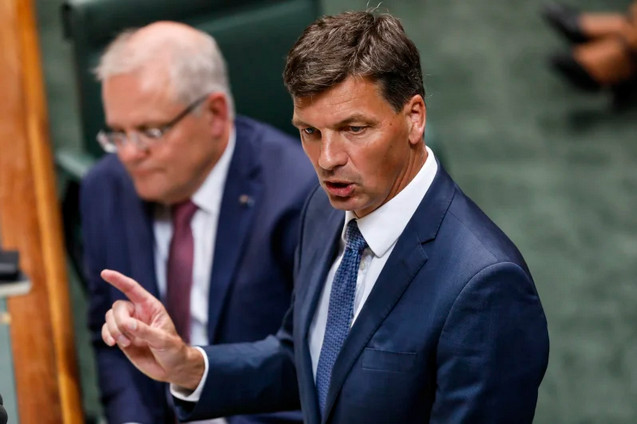
Delaying tactics? Emissions Reduction Minister Angus Taylor during Question Time. Credit: Dominic Lorrimer

"I am deeply pained by the attitude of the current Australian government: that still after the worst disaster that has ever hit the planet, the bushfires in Australia, that this government is still denying climate change and denying the fact that there is a lot that Australia can and should be doing," one of the United Nation's top climate negotiators, Christiana Figueres, later told the ABC.

In January the 2020 Climate Change Performance Index, drafted by a group of think tanks including the NewClimate Institute, the Climate Action Network and Germanwatch, was published.

Of the 61 nations whose climate policy it considered it ranked Australia as having the worst.

One of the authors of that survey was Ursula Hagen of Germanwatch. Having read the government's so-called Technology Road map released this week in draft-form Hagen told the Herald and The Age that she sees no reason why the document would cause Australia's rank to change.

"It lacks any clear targets [for emissions reduction], it has no clear policy of how it might achieve any targets," Hagen says. "It is not a strategy."


The central criticism of the road map is that it is essentially a survey of (mostly) green technologies that the government may support at the advice of an expert panel in order to create an economy that emits less carbon, but which maintains growth and jobs.

"We do not need another survey of technologies that might save us in the future," says Associate Professor Malte Meinshausen, the founding director of the University of Melbourne's climate and energy college.

"We already know what the technologies are. We need regulatory reform and a plan to use them."

In his experience, says Meinshausen, surveys of emerging technologies have been used to delay real action.

Nor does the road map contain a quantifiable set of objectives. It does not outline how much less carbon the government wants Australia to emit over the coming years, or how it might meet such targets.

This is despite the fact that the entire global effort in combating climate change is predicated on setting and meeting targets.

Scientists tell us that to stave off the worst impacts of climate change we need to keep global warming under 2 degrees and as close to 1.5 degrees as possible. Australia agreed to this at the Paris climate talks in 2015.

According to the UN the world is currently on track for a 3.2C temperature rise. In order to pull back towards 1.5 degrees of warming the world now needs to cut its emissions by 7.6 per cent annually. Each year we delay action, that figure rises.
'We have all the technology already. We don't need to look at things that might save us in 10 or 20 years.'
Malte Meinshausen, founding director of the University of Melbourne's climate and energy college.
Due to Australia's reliance on coal it is among the highest per capita carbon emitters on earth, with 0.3 per cent of the world's population we release 1.07 per cent of greenhouse gases.

Nonetheless, and despite drought and bushfires already demonstrating how susceptible Australia is to climate change, our leaders have proved to be among the least ambitious in confronting the crisis.

Emissions Reduction Minister Angus Taylor said the Paris agreement set a "joint target with other countries around the world to reduce emissions to net-zero in the second half of the century". The federal government has declined to set any earlier commitments.

Australia's global critics view this as not in keeping with the spirit of the Paris agreement.

Article two of the agreement locks signatories into following the "best available science" on emissions reduction and to pursue the "highest level of ambition" to act consistently with global action needed to keep warming in check.

This clause sets a de facto deadline on achieving net-zero emissions, Australian National University Emeritus Professor Will Steffen told the Herald and The Age earlier this year.

"To stay within two degrees we need to reach net-zero emissions by 2040-2045 at the very latest: 2050 is too late, we've already put too much carbon into the atmosphere," Professor Steffen said.

The Paris Agreement also includes an interim target. For Australia, that means reducing emissions by at least 26 per cent by 2030, based on 2005 levels, or a cumulative 695 million tonnes of carbon.

To reach this target Australia is insisting on counting the 365 million tonnes of "carryover credits" it earned by exceeding the target set in a previous international treaty – the Kyoto Protocol. It is this demand that prompted such fury at Australia in Madrid in December, and which is causing such concern around the world as nations prepare for the next round of talks in Glasgow next year.

Which brings us back to the road map announced this week.

Experts were cheered that it made no mention of coal. Some were shocked that it listed gas and carbon capture and storage as technologies that may win support, while others welcomed its recognition of the wide-scale technology reform needed to achieve net-zero emissions.

In a perfect policy world, experts argue, the government would help industry meet the target by investing in incentives for industry. That means offering subsidies to industry to adopt low-emissions technologies.

This creates a "push factor" for industry to change. The push factor would be complemented by "pull factors" – namely government-set quotas for products and services produced by the low-emissions industries.

For example, concrete produced through renewable power, low emissions heating and lighting in new buildings, electric vehicles in public transport, and so on across the economy.

"There is no space any more for any more fossil fuels," says Tim Baxter, a senior researcher with the Climate Council.

At next year's climate talks each nation is expected to present even more ambitious reduction targets, and a plan for meeting them. So far, the road map is the closest thing Australia has to such a plan.

According to Richie Merzian, who in 2013 was a lead negotiator for Australia at climate talks in Warsaw, the document will be viewed as inadequate at best.

"No one asked for this. There was no international body that wanted a technology road map, what people want is a target and a strategy," he says.

Merzian – now director of climate and energy policy at The Australia Institute, a progressive think tank – still recalls how isolating it was to represent Australia that year, shortly after Tony Abbott had come to power and denounced the UN climate system as socialism masquerading as environmentalism.

Each day during the bruising talks members of civil society groups would vote on which nation had played the most destructive role and present a representative of that nation with a "fossil of the day award". Australia took it out time and again.

"We were seen as a nation that was happy for domestic politics to undermine collective international action," he says.

Asked what a comprehensive plan would look like Meinshausen can rattle off a detailed framework from the top of his head.

It would begin with an optimistic vision of an Australia in 2030 with a bustling outwardly focused economy fuelled by renewable energy and meeting emissions reduction targets.

It would chart a course on how to achieve that goal based on four pillars:
  • Regulatory reform centred on some form of carbon price.
  • Outline how the government would help to strengthen the grid and buttress it with batteries and technologies such as pumped hydro to store and dispatch power.
  • Consider how our land management practices could arrest carbon emissions from forestry loss and boost the amount of carbon we stored in soil via agricultural practices.
  • Detail how the government would help Australia become a heavy industry powerhouse, supporting green energy intensive manufacturing.

"We have all the technology already. We don't need to look at things that might save us in 10 or 20 years," he says. "We need policy and regulatory reform and implementation now."

According to Herve Lemahieu, the director of the Lowy Institute's Asian power and diplomacy program, the cost to Australia of isolation on climate change extends far beyond climate talks.

He says Australia was facing further embarrassment at the Glasgow talks in November, before they were delayed due to COVID-19, and it has won something of a diplomatic reprieve due to its effective handling of the pandemic. He cites the support Australia was given at the World Health Assembly for its calls for an inquiry into the source of the coronavirus.

But he says soon climate change will again be the focus of the world, and Australia will again be isolated for its recalcitrant response.

"It is going to be harder for Australia to deepen its relationships with like-minded middle powers, which Australia needs to do in the absence of US global leadership."

Links

(AU) Australia's Gas And Electricity Producers Push Back On Government Intervention

The Guardian |

Subsidies should focus on early-stage clean technologies not energy sources that are already mature or commercial, Energy Council says

Gas producers have warned against the Morrison government underwriting a massive expansion of the industry, saying it could raise prices. Photograph: Carly Earl/The Guardian

Australia’s oil and gas producers have warned against the Morrison government underwriting a massive expansion of the domestic industry, saying the country does not have a gas shortage and intervention could reduce supply and raise prices.

The Australian Petroleum Production and Exploration Association said it welcomed some recommendations on gas in a leaked draft report by a manufacturing taskforce advising the National Covid-19 Coordination Commission, but it also included “ideas that just won’t work”.

The report suggested taxpayers should underwrite an increased national gas supply from multiple new fields and help build multibillion-dollar interstate gas pipelines, and the states should introduce “reverse auction” subsidy schemes for gas-fired power.

Andrew McConville, APPEA’s chief executive, did not say which recommendations he thought made sense and which he rejected, but said the country should “let gas markets work”. “Intervention is not needed and could be potentially counter-productive by discouraging investment, reducing supply and raising prices,” he said. “There’s also the question of what is the problem we are trying to solve?”

McConville said the Australian Energy Market Operator had found there was no gas shortage, and the taskforce’s recommendations would not keep prices to the historically low level of $4 a gigajoule as it hoped. He said Asian countries had managed to have strong manufacturing industries – the point of the taskforce’s report – with much higher prices.

The report to the NCCC leaked as the government kicked off the process of developing its much-vaunted technology investment roadmap with the release of a discussion paper flagging taxpayer support for innovation.

The Australian Energy Council, which represents Australia’s major electricity and downstream natural gas businesses, echoed the warning from APPEA about the perils of arbitrary government intervention. It welcomed the discussion paper, but warned the government it should reserve taxpayer support for early-stage clean technologies, not look to subsidise energy sources that are already mature or commercial.

Sarah McNamara, the chief executive of the council, said many of the directions set out in the discussion paper were sensible, including focusing potential support for carbon capture and storage (CCS) on hydrogen and gas production rather than retrofitting coal-fired power stations, which had not been commercially successful.

“But as a note of caution, funding should be reserved for genuine innovation and to help establish early-stage clean technologies,” McNamara said. “It should not subsidise already commercial or mature technologies. The latter would simply undermine private investor confidence and inhibit market efficiencies.”

She said it was a “concern” that the taxpayer-funded Clean Energy Finance Corporation and the Australian Renewable Energy Agency would be used to support already mature technologies. “Customers need to be confident that taxpayer funds are being spent on technologies that require support, not those that are already self-sufficient,” she said.

Facing sustained pressure to adopt a 2050 target of net zero emissions, pressure it is continuing to resist, the Morrison government plans instead to develop the roadmap as the cornerstone of the Coalition’s mid-century emissions reduction strategy. The discussion paper points to a role for gas, hydrogen, renewables and, potentially, nuclear power.

Angus Taylor, the energy and emissions reduction minister, and the NCCC has also focused on gas as being at the centre of economic recovery plans from the pandemic. The leaked report to the NCCC does not consider cleaner alternatives to the fossil fuel, or mention climate change or the country’s commitments to the Paris climate agreement, raising the ire of the renewable energy industry and climate activists.

Australia’s resources industry has welcomed the positive signals from the government on CCS and on nuclear. The Minerals Council of Australia – historically one of the major opponents of carbon pricing to drive the transition to low emissions – said it supported a “genuinely technology-neutral approach to reducing emissions which embraces global best practice and the adoption of CCS and advanced nuclear technology as well as renewables, gas, coal with CCS and pumped hydro”.

But the Investor Group on Climate Change, representing institutional investors managing $2tn in assets, said it would be important for the government to set clear goals through a national climate policy that made it clear Australia was heading for net zero emissions by 2050, consistent with its international obligations. It said private investors would be reluctant to invest in the transition if it did not.

Its director of policy, Erwin Jackson, queried whether new gas investments were consistent with that objective. “Private investors are already making climate risk assessments in their portfolios about carbon-intensive fuels like gas as compared to zero-carbon alternatives like renewable energy and storage technologies,” he said.

“Governments will also need to assess whether further support and investment in gas projects are resilient to continued rapid cost reductions in clean energy options and an accelerated shift to truly zero-emissions energy options”.

Prof John Quiggin, an economist at the University of Queensland, said the government’s thinking was “five to 10 years behind the times”.

“Although the idea of new coal-fired power stations seems finally to have been abandoned, the report focuses heavily on technology options that seemed promising in the past, but have now been abandoned everywhere in the developed world, such as nuclear power and carbon capture and sequestration,” he said.

But he said the roadmap’s most significant failure was that it did not recognise that gas-fired electricity generation was increasingly being supplanted by renewable energy backed by battery storage. “The policy remains fixated on extractible resources such as coal and gas, ignoring our massive endowment of solar and wind resources,” he said.

Links

Experts Urge Further Climate Action As Lockdown Triggers 'Extreme' Emissions Drop

Sydney Morning HeraldMiki Perkins

The coronavirus shutdown has triggered extraordinary reductions in global carbon emissions but the likely annual decrease is comparable only to the reductions needed year on year over decades to limit global warming to 1.5 degrees, new research finds.

Government action and economic incentives after the pandemic are likely to influence global carbon emissions for decades to come, according to new peer-reviewed research and analysis published in Nature Climate Change.

Global carbon dioxide emissions decreased by up to 17 per cent by early April. Credit: AAP

There has been much speculation about the likely impact of COVID-19 restrictions on carbon pollution, and this is the first peer-reviewed research in a scientific journal to robustly examine the decrease.

It found global carbon dioxide emissions decreased by up to 17 per cent by early April, when compared with emissions in 2019. Surface transport, power and industry were the most affected sectors, accounting for 85 per cent of the total reduction in global emissions.

The changes were largest in China, where the COVID-19 confinement started, then the US and Europe.

But while these daily and monthly decreases in carbon emissions were "extreme and probably unseen before", the authors point out the annual decrease is likely to be much lower.

The emissions outlook for the rest of 2020 will depend on the duration of pandemic confinement and the degree to which life returns to normal.

But even if some restrictions remain in place until the end of the year, the report authors estimate it will lead to a maximum decrease of carbon emissions in 2020 of only 4.2-7.5 per cent.

These figures are comparable with the rates of decrease needed year on year over the next few decades to limit climate change to 1.5 degrees of warming.

According to the most recent UN emissions gap report, a reduction of 7.6 per cent is needed year on year to reach that target.

"What has been really shocking is that although we were shutting down the whole economy, we were still emitting about 92 per cent of the emissions we emitted before COVID," said Dr Pep Canadell, a co-author of the research paper and senior research scientist at the CSIRO.

"It shows the fossil energy system is so ingrained into the fabric of our society and economy that even when we shut down a huge part of it we still emit large amounts of carbon."

The changes are likely to be temporary because they do not reflect structural changes in the economic, transport or energy systems, the authors write.

"These numbers put into perspective ... the size of the challenge we have to limit climate change in line with the Paris Climate Agreement."

Despite the significance of carbon emissions, there are few systems to monitor global emissions in real time, and usually this data is released months or even years later.

The study authors gathered all the available data – from aviation to mobile phone statistics – to determine the extent that different coronavirus confinement policies affected emissions.

There are opportunities to set structural changes in motion by ensuring economic stimuli is aligned with low-carbon initiatives, they say.

These could include changes to surface transportation, says Dr Canadell. Surface transport accounted for nearly half the decrease in emissions during confinement, and active travel (walking, cycling and using e-bicycles) have social distancing advantages.

"Now, more than ever before, we need to be careful that anything we have to do with energy is well aligned with the long-term goals of the Paris Agreement," he said.

Links

23/05/2020

Climate Change Is Turning Antarctica's Snow Green And The Effects Can Now Be Seen From Space

NEWS.com.au - Jessica Wang | AFP

What should be a wilderness of white ice caps has been invaded by an eerie green tinge so widespread it’s now visible from space.

Handout picture taken in 2018 and released by the University of Cambridge on May 20, 2020 showing green snow algae near Rothera Research Station, at Rothera Point, in Antarctica. Photo by Dr. Matt Davey / University Of Cambridge/SAMS / AFP

Warming temperatures due to climate change have resulted in a spread of "green snow" in Antarctica, the extent of which is now visible from space.

New research published on Wednesday from the University of Cambridge and the British Antarctic Survey showed the first map of these algae blooms, which help soak to soak up CO2 from the atmosphere.

Using data collected by the European Space Agency’s Sentinel 2 satellite over the past two years, they reported the spread of was particularly prominent along the Antarctic Peninsula coast and is expected to increase due to global warming.

This is because the slushy melting snow provides the perfect environment for these microscopic organisms to thrive.

More parts of the Antarctic Peninsula will change colour as global temperatures increase, new research showed on May 19, 2020. Picture: Matthew Davey/University of Cambridge/AFP


Photo taken of green snow algae near Rothera Research Station, at Rothera Point, in Antarctica. Picture: Matthew Davey/University of Cambridge/AFP

In their research, scientists identified more than 1600 separate green algae blooms on snow across the peninsula, with a combined surface area of 1.9 square kilometres.

They also calculated a total of 875,000 average car journeys worth of CO2 is currently absorbed by the algae colony. Although red and orange algae blooms have also been seen on Antarctica, this was not documented in the study.

Speaking to AFP, plant and algal physiologist from Cambridge’s Department of Plant Sciences, Matt Davey said the increase biomass is “highly significant”.

“Even though the numbers are relatively small on a global scale, in Antarctica where you have such a small amount of plant life, that amount of biomass is highly significant,” he said.

“A lot of people think Antarctica is just snow and penguins. In fact when you look around the fringe there is a lot of plant life.”

Due to warming polar regions, researchers predicted algae will gradually disappear from low-lying areas of the Antarctic due to snow-free summers.

Despite this, they hypothesised there will be “really large blooms” in the north of the peninsular due to the melting snow, the volume of which will “more than offset” lost algae.

The algae might be one symptom of global warming but it’s by no means its most dire. Picture: Matthew Davey/University of Cambridge/AFP

Although algae is highly proficient at absorbing CO2, researchers predict it could have a small but adverse impact on local albedo, or how much of the Sun’s heat is reflected back from Earth’s surface.

While white snow reflects 80 per cent of radiation that hits it, the figure for green snow is closer to 45 per cent.

The team said, however, that the reduced albedo is unlikely to impact Antarctica’s climate on any meaningful scale.

“There will be more carbon locked up in future just because you need snow to be in a slushier state for algae to bloom,” said Evans.

“We expect there to be more suitable habitat and overall more carbon sequestration.”

Links

(AU) Be Worried When Fossil Fuel Lobbyists Support Current Environmental Laws

The Conversation

Shutterstock

The fossil fuel lobby, led by the Minerals Council of Australia, seem pretty happy with the current system of environment laws.

In a submission to a review of the Environment Protection and Biodiversity Conservation (EPBC) Act, it “broadly” supports the existing laws and does not want them replaced.

True, the group says the laws impose unnecessary burdens on industry that hinder post-pandemic economic recovery. It wants delays and duplication in environmental regulation reduced to provide consistency and certainty.

But for the fossil fuel industry to broadly back the current regime of environmental protection is remarkable. It suggests deep problems with the current laws, which have allowed decision-making driven by politics, rather than independent science.

So let’s look at the resources industry’s stance on environment laws, and what it tells us.

Environment minister Sussan Ley announced the review in October last year. AAP Image/Mick Tsikas

Cut duplication

The Minerals Council’s submission calls for “eliminating or reducing duplication” of federal and state laws.

The fossil fuel lobby has long railed against environmental law - the EPBC Act in particular - disparaging it as “green tape” that it claims slows projects unnecessarily and costs the industry money.

On this, the federal government and the mining industry are singing from the same songbook. Announcing the review of the laws last year, the government flagged changes that it claimed would speed up approvals and reduce costs to industry.

Previous governments have tried to reduce duplication of environmental laws. In 2013 the Abbott government proposed a “one-stop shop” in which it claimed projects would be considered under a single environmental assessment and approval process, rather than scrutinised separately by state and federal authorities.

That proposal hit many political and other hurdles and was never enacted. But it appears to remain on the federal government’s policy agenda.

It’s true the federal EPBC Act often duplicates state approvals for mining and other activities. But it still provides a safety net that in theory allows the federal government to stop damaging projects approved by state governments.

The Commonwealth rarely uses this power, but has done so in the past. In the most famous example, the Labor party led by Bob Hawke won the federal election in 1983 and stopped the Tasmanian Liberal government led by Robin Gray building a major hydroelectric dam on the Gordon River below its junction with the Franklin River.

The High Court’s decision in that dispute laid the foundation for the EPBC Act, which was enacted in 1999.

Former environment minister Peter Garrett refused a state-approved project in 2009. AAP Image/James Ross

In 2009 Peter Garrett, Labor’s then-federal environment minister, refused the Queensland Labor government’s proposed Traveston Crossing Dam on the Mary River under the EPBC Act due to an unacceptable impact on threatened species.

The Conversation put these arguments to the Minerals Council of Australia, and CEO Tania Constable said:
The MCA’s submission states that Australia’s world-leading minerals sector is committed to the protection of our unique environment, including upholding leading practice environmental protection based on sound science and robust risk-based approaches.
Reforms to the operation of the EPBC Act are needed to address unnecessary duplication and complexity, providing greater certainty for businesses and the community while achieving sound environmental outcomes.
But don’t change the current system much

Generally, the Minerals Council and other resources groups aren’t lobbying for the current system to be changed too much.

The groups support the federal environment minister retaining the role of decision maker under the law. This isn’t surprising, given a succession of ministers has, for the past 20 years, given almost unwavering approval to resource projects.

For example, in 2019 the then-minister Melissa Price approved the Adani coal mine’s groundwater management plan, despite major shortcomings and gaps in knowledge and data about its impacts.

Independent scientific advice against the mine over the last ten years was sidelined in the minister’s final decision.

Countless more examples demonstrate how the current system works in the favour of mining interests – even when the industry itself claims otherwise.

The Minerals Council submission refers to an unnamed “Queensland open-cut coal expansion project” to argue against excessive duplication of federal and state processes around water use.

I believe this is a reference to the New Acland Coal Mine Stage 3 expansion project. I have acted since 2016 as a barrister for a local landholder group in litigation against that project.

When approached by The Conversation, the Minerals Council did not confirm it was referring to the New Acland project. Tania Constable said:
The case studies were submitted from a range of companies, and are representative of the regulatory inefficiency and uncertainty which deters investment and increases costs while greatly limiting job opportunities and economic benefits for regional communities from mining.
The New Acland mine expansion is on prime agricultural land on the Darling Downs, Queensland’s southern food bowl. Nearby farmers strongly opposed the project over fears of damage to groundwater, the creation of noise and dust, and climate change impacts.

But the Minerals Council fails to mention that since 2016, the mine has been building a massive new pit covering 150 hectares.

West Pit at the New Acland Coal Mine sprawling amid prime agricultural land in 2018. The right half of this pit is outside the area approved for mining under the EPBC Act in 2017 but no action has been taken by the Commonwealth to stop it. Oakey Coal Action Alliance Inc, Author provided

When mining of this pit began, the mine’s expansion was still being assessed under state and federal laws. Half of the pit was subsequently approved under the EPBC Act in 2017.

But the Queensland environment department never stopped the work, despite the Land Court of Queensland in 2018 alerting it to the powers it had to act.

Based on my own research using satellite imagery and comparing the publicly available application documents, mining of West Pit started while Stage 3 of the mine was still being assessed under the EPBC Act. And after approval was given, mining was conducted outside the approved footprint.

The extent of West Pit on September 30, 2016 and relevant boundaries of the New Acland Coal Mine Stage 3 expansion, then being assessed under the EPBC Act. At this time, West Pit had extended into the project area still being assessed. Stage 3 was approved in early 2017, and since then West Pit has continued south, outside the area applied for or approved under the EPBC Act. Adapted from GoogleEarth by author.

Despite these apparent breaches, the federal environment department has taken no enforcement action.

The Conversation contacted New Hope Group, the company that owns New Acland mine, for comment, and they refuted this assertion. Chief Operating Officer Andrew Boyd said:
New Hope Group strongly deny any allegations that New Hope Coal has in any way acted unlawfully.
New Acland Coal had and still has all necessary approvals relating to the development of the pit Dr McGrath refers to. It is also not correct to say that the Land Court alerted the Department of its powers to act with regards to this pit.
The Department is obviously aware of its enforcement powers and was aware of the development of the pit well before 2018. Further, the Land Court in 2018 rejected Dr McGrath’s arguments and accepted New Acland Coal’s position that any issues relating to the lawfulness of the pit were not within the jurisdiction of the Land Court on the rehearing in 2018.
Accordingly, the lawfulness of the pit was irrelevant to the 2018 Land Court hearing.
Dr McGrath also fails to mention that his client had originally accepted in the original Land Court hearing (2015-2017) that the development of the pit was lawful only to completely change its position in the 2018.
State and federal environmental laws work in favour of the fossil fuel industry in other ways. “Regulatory capture” occurs when government regulators essentially stop enforcing the law against industries they are supposed to regulate.

This can occur for many reasons, including agency survival and to avoid confrontation with powerful political groups such as farmers or the mining sector.

In one apparent example of this, the federal environment department decided in 2019 not to recommend two critically endangered Murray-Darling wetlands for protection under the EPBC Act because the minister was unlikely to support the listings following a campaign against them by the National Irrigators Council.

Holes in our green safety net

Recent ecological disasters are proof our laws are failing us catastrophically. And they make the mining industry’s calls to speed-up project approvals particularly audacious.

We need look only to repeated, mass coral bleaching as the Great Barrier Reef collapses in front of us, or a catastrophic summer of bushfires.

Both tragedies are driven by climate change, caused by burning fossil fuels. It’s clear Australia should be looking to fix the glaring holes in our green safety net, not widen them.

Links

(AU) Climate Change Should Be Recorded On Death Certificates, Doctors Argue

Sydney Morning HeraldNick O'Malley

Climate change should be recorded as a cause of death on death certificates in Australia because heat-related mortality is so vastly unreported, according to commentary published in The Lancet Planetary Health on Thursday.

Over the past 11 years in Australia, just 340 deaths have been recorded as being caused by excessive heat, but statistical analysis by two doctors with the Australian National University shows that 36,765 could have been attributed to heat.

Scarlett Rigato, 5, holds a sign during a climate change protest by parents and students in Sydney last year. Credit: Kate Geraghty

"Climate change is a killer, but we don’t acknowledge it on death certificates," co-author Arnagretta Hunter, from the ANU Medical School, said.

She said it was acknowledged that phenomena caused or exacerbated by climate change - such as drought, bushfires, floods and storms - had an impact on illness and death rates in Australia, but that there was no way to acknowledge these factors on death certificates.

"If a farmer dies at the end of a five-year drought we know that the drought probably contributed to his death, but there is no way to record that.

"Does it matter? Yes. It is going to get hotter, we are going to see increasing amounts of morbidity and mortality as a result. If we recognise and record that, we might be able to mitigate it," she said.

"Climate change is the single greatest health threat that we face globally even after we recover from coronavirus.

"We are successfully tracking deaths from coronavirus, but we also need healthcare workers and systems to acknowledge the relationship between our health and our environment."

Dr Hunter and her co-author Dr Simon Quilty, call for death certificates to include more information about factors contributing to deaths.

"Death certification needs to be modernised, indirect causes should be reported, with all death certification prompting for external factors contributing to death, and these death data must be coupled with large-scale environmental datasets so that impact assessments can be done," they wrote.

Last year was Australia’s hottest year, with the temperature reaching 1.52 degrees above the long-term average, according to the Bureau of Meteorology.

During the bushfire crisis in January a temperature of 48.9 degrees was recorded in Penrith, eclipsing the previous heat record of 47.3 degrees recorded the previous January.

Links

22/05/2020

(AU) Fossil Fuel Industry Applauds Coalition Climate Measures That Support Carbon Capture And Storage

The Guardian

Environmentalists say the Morrison government is directing emissions reduction funding to polluting companies

Chevron’s Gorgon LNG development in Western Australia. The Morrison government has agreed to 21 of 26 recommendations by an expert panel to reduce emissions, including support for CCS projects. Photograph: Ray Strange/AAP

Fossil fuel industry groups and companies have applauded new climate change measures proposed by the Morrison government, including support for carbon capture and storage developments.

The government has agreed to 21 of 26 recommendations made by an expert panel review headed by the former gas industry executive and business council president Grant King, who was asked to come up with new ways to reduce greenhouse gas emissions at low cost.

Recommendations included paying big industrial companies to keep their emissions below an agreed limit, and allowing the government’s main climate policy, the $2.5bn emissions reduction fund, to support carbon capture and storage (CCS) projects.

Angus Taylor, the energy and emissions reduction minister, said the government agreed in-principle that two publicly owned clean energy agencies, the Australian Renewable Energy Agency and the Clean Energy Finance Corporation, would be given a “technology neutral remit” – a proposal that has been interpreted as allowing more funding for projects that do not involve renewable energy.

The government’s response was welcomed by the gas and coal sectors, received qualified support from industry groups and was criticised by environmentalists, who said it directed emissions reduction funding to polluting companies and did not address Australia’s lack of an overarching climate policy.

Lethal Heating is a citizens' initiative