29/06/2020

Global Warming Is Melting Our Sense of Time

New York Intelligencer - 


Satellite image of smoke from active fires burning near the Eastern Siberian town of Verkhoyansk, Russia, on June 23, 2020. Photo: Handout/NASA Earth Observatory

On June 20, in the small Siberian town of Verkhoyansk, north of the Arctic Circle, a heat wave baking the region peaked at 38 degrees Celsius — just over 100 degrees Fahrenheit. It was the highest temperature ever recorded in the Arctic. In a world without climate change, this anomaly, one Danish meteorologist calculated, would be a 1-in-100,000-year event. Thanks to climate change, that year is now.

If you saw this news, last weekend, it was probably only a glimpse (primetime network news didn’t even cover it). But the overwhelming coverage of perhaps more immediately pressing events — global protests, global pandemic, economic calamity — is only one reason for that climate occlusion. The extreme weather of the last few summers has already inured us to temperature anomalies like these, though we are only just at the beginning of the livable planet’s transformation by climate change — a transformation whose end is not yet visible, if it will ever be, and in which departures from the historical record will grow only more dramatic and more disorienting and more lethal, almost by the year.

At just 1.1 degrees Celsius of warming, where the planet is today, we have already evicted ourselves from the “human climate niche,” and brought ourselves outside the range of global temperatures that enclose the entire history of human civilization. That history is roughly 10,000 years long, which means that in a stable climate you would only expect to encounter an anomaly like this one if you ran the full lifespan of all recorded human history ten times over — and even then would only encounter it once.

You may register temperature records like these merely as the sign of a new normal, in which record-breaking heat waves fade out of newsworthiness and into routine. But the fact of those records doesn’t mean only that change has arrived, because the records are not being set only once; in many cases, they are being set annually. The city of Houston, for instance, has been hit by five “500-year storms” in the last five years, and while the term has obviously lost some of its descriptive precision in a time of climate change, it’s worth remembering what it was originally meant to convey: a storm that had a one-in-500 chance of arriving in any given year, and could therefore be expected once in five centuries.

How long is that timespan, the natural historical context for a storm like that? Five hundred years ago, Europeans had not yet arrived on American shores, so we are talking about a storm that we would expect to hit just once in that entire history — the history of European settlement and genocide, of the war for independence and the building of a slave empire, of the end of that empire through civil war, of industrialization and Jim Crow and World War I and World War II, the cold war and the age of American empire, civil rights and women’s rights and gay rights, the end of the cold war and the “end of history,” September 11 and 2008.

One storm of this scale in all that time, is what meteorological history tells us to expect. Houston has been hit by five of them in the last five years, and may yet be hit with another this summer — which is already predicted to be a hurricane season of unusual intensity. Of course, that won’t be the end of the transformations. Climate change will continue, and those records — high temperatures, historic rainfall, drought, and wind speed and all the rest — will continue to fall. From here, literally everything that follows, climate-wise, will be literally unprecedented.

Land surface temperature anomalies from March 19 to June 20 in Eastern Siberia. The reds mark areas that were hotter than average for the same period from 2003-2018. The blues mark areas that were colder. From the Moderate Resolution Imaging Spectroradiometer (MODIS) on NASA’s Aqua satellite. Illustration: Handout/NASA Earth Observatory

The arctic numbers from June 20 are terrifying enough; with more context they become only more so. It was warmer there than it was that same day, in Miami, Florida. In fact, it was warmer north of the Arctic Circle than it has ever been, on any June day, in the entire recorded history of Miami, which has only once, in the whole tropical century for which temperatures there have been registered, reached 100.

It was about 30 degrees Fahrenheit warmer, in Verkhonaysk, than the average high temperature in the region for June, which means the arctic record was the equivalent, in terms of temperature anomaly, of a 110-degree June day in New York or a 115-degree June day in Washington, D.C. According to preliminary satellite data, land surface temperature in parts of arctic Siberia reached that level last week, too — 45 Celsius, or 113 Fahrenheit. In terms of temperature anomaly, that’s the equivalent of a 130-degree day in D.C. On Capitol Hill, that would be, very comfortably, lethal heat.

Thankfully, for Americans at least, that isn’t how global warming works — its punishing effects are distributed unequally around the globe, and, at the moment, the Arctic is being punished most vindictively, warming at three times the rate of the rest of the planet. In Siberia, in May, temperatures averaged as much as 10 degrees Celsius higher than normal. The arrival of the arctic summer reignited “zombie fires” that had, improbably, burned through the arctic winter, smoldering in peat rather than burning out.

 Those fires, like all fires, released carbon, which is stored in trees as surely as it is in coal, in this case releasing as much CO2 in the last 18 months as had been produced by Siberian wildfires in the last 16 years. In early June, an industrial-scale oil-storage facility there collapsed when the melting permafrost on which it had been built finally destabilized, releasing about 21,000 tons of oil and turning local rivers red. That spill was about two-thirds the scale of the Exxon Valdez spill, which horrified an entire generation; this one, we’ve hardly read about, though it befell a far more ecologically degraded planet, with more than half of all carbon emissions ever produced by the burning of fossil fuels in the entire history of humanity coming since the Valdez spill.

Perhaps though is a less precise word than because, the intervening generation of environmental calamity having quite thoroughly normalized horrors like these. Even Vladimir Putin — presiding over a petrostate which, so far north, actually stands to benefit from some amount of global warming — declared it an emergency. All told, the planet’s melting permafrost contains twice as much carbon as hangs in the planet’s atmosphere today, and it’s expected that over the course of the century, at least 100 billion tons of it will be released through melt, about three years worth of global emissions and functionally enough to close the window on the goals of the Paris accords.

A June 11 view of the site of a diesel fuel spill at Norilsk’s Combined Heat and Power Plant No 3 in Siberia. Photo: Denis Kozhevnikov/TASS via Getty Images

That window was not open very far to begin with. One recent study suggested that even the decarbonization targets of Britain and Sweden, often hailed as global climate leaders, would produce emissions between two and three times the carbon budget required to meet the Paris goals. (And those are just their decarbonization plans, which are probably optimistic.) Another analysis suggested that, for all the talk of halving our emissions by 2030 — as the IPCC says is necessary to safely avoid 2 degrees of warming — the planet has only a 0.3 percent chance of doing so. If Donald Trump won reelection, the analysis suggested, those chances would fall to 0.1 percent — one in a thousand.

If 2 degrees is now inevitable, that doesn’t make it comfortable. Indeed, it will be, for much of the world, a horror — and the space between those two things, inevitability and horror, is the one in which we will all be forced to learn to live. At 2 degrees, it’s expected that more than 150 million additional people would die from the effects of pollution, storms that used to arrive once every century would hit every single year, and that lands that are today home to 1.5 billion people would become literally uninhabitable, at least by the standards of human history.

Those projections will invariably prove imprecise, or perhaps worse — that is both the nature of science, which proceeds by revision, and humanity, which will likely adapt to at least some measure of these impacts. But the Siberian heat wave reminds us just how large the scale of necessary adaptation will likely be — requiring us to respond not just by shoring up the proverbial shorelines of our civilizations but by preparing them in much more fundamental ways to endure conditions never seen before in the whole span of human history.

It is also a reminder of just how much we miss when we regard the projections of any neat, linear model of future warming as a straightforward prediction of that future and of what level of adaptation will be require — especially when we reflexively discount the uncertainty warnings scientists invariably include, as any lay reader (including me) is likely to do. Perhaps the most important lesson of the freakish Siberian heatwave is: however terrifying you find projections of future warming, the actual experience of living on a heated planet will be considerably more unpredictable, and disorienting.

Just how freakish and unpredicted is this heatwave? Over the last few years, a growing chorus of critics have argued against one climate model built on predictions of high-end carbon emissions in particular, called RCP8.5 —arguing that, though it had been endorsed by the U.N.’s IPCC and formed the basis of much recent science since that organization’s last major report, its projections were simply implausible, relying as they did on the dramatic growth of coal use over the course if the century.

 As I’ve written before, that pathway does indeed look increasingly hard to credit as a model of our future, and is best understood, in terms of emissions, as an absolute worst-case scenario, which would require almost a global climate nihilism to achieve. But for those suggesting we should discard that model, or any other that charted a high-end course for warming, the arctic heatwave makes a very strong counterargument. Because even in that worst-case pathway, hundred-degree summer days in the Arctic do not become routine until the very end of the century.

 This heat wave is, today, an outlier, not a routine event. But that doesn’t make it irrelevant. Instead, it is giving us at least a brief preview of what the world would look like, more than a half-century from now, in a timeline we understand to be, at least in terms of emissions, impossibly pessimistic. But if our timeline could accommodate such extreme events from that worst-case one, and decades ahead of schedule, it is also a sign that “timeline” is probably a misguided way of thinking about the new swirling universe of extreme events we are plunging headlong into.

Making sense of climate change requires more than trying to determine where on a particular linear plot we are and where on it we are likely to be in ten years, or in fifty. It may require more profoundly revising our sense of linearity itself. In this way, global warming isn’t just scrambling our sense of geography, with Verkhonaysk, at least briefly, playing the role of Miami. It is also scrambling our sense of time. You may feel, because of the pandemic, that you are living to some degree in 1918. The arctic temperatures of the past week suggest that at least part of the world is living, simultaneously, in 2098.

But climate change isn’t just a brutal form of time travel, it is discombobulating to our very sense of time. When looking at projections for future warming, an event like the Siberian heat wave appears as an acceleration of history, but when looking at the paleoclimate record, it seems like a trip deep into the prehuman past, toward eras like those, lasting millions of years, when palm trees dotted the Arctic and crocodiles walked in their shade there. Especially at extreme levels, warming threatens the apparent march of progress on which the modern, Western “timeline” model of history was built. But at least until the arrival of large-scale carbon removal technologies, it also illustrates the fact that time — in the form of carbon emissions, which hang in the atmosphere for centuries — is irreversible.

Because we are doing so much damage so quickly, destabilizing the entire planet’s climate in the space of a few decades, warming can seem like a phenomena of the present. But its effects will unfurl for millennia, with the climate stabilizing perhaps only millions of years from now. Climate change unwinds history, melting ice frozen for many millennia and pushing rainforests like the Amazon closer to their long-overgrown savannah states. It also makes new history, drawing new borders and new riverbeds, turning breadbaskets like the Mediterranean into deserts and opening up arctic shipping routes to be contested by a new generation of great power military rivalries.

It compresses history — those Houston storms, for instance, represent more than a millennia of extreme weather, concentrated in a period of just five years. And it scrambles and scatters it, too, disrupting the cycle of seasons and relocating rain belts and monsoons, among many other distortions. At the same time temperatures in Verkhoyansk reached 100 degrees, in other parts of Siberia it was snowing. Was it winter or summer, a Russian catching the national weather forecast could have been forgiven for asking. They may have wondered, is this our hellish climate future or the return of the Little Ice Age?

Contemplating the impacts of climate change from this perspective can seem naïvely abstract — and it is, when compared to the storms and the wildfires and the droughts. (Not to mention the literal plague of locusts, 360 billion of them, which have devastated agriculture in East Africa and South Asia this year, descending in clouds so thick you couldn’t see through the insects and leaving millions hungry.)

But in addition to its humanitarian cruelties, for instance making pandemics like COVID-19 much more likely, warming is already recalibrating much more hard-headed models of time, too. This is a sign that warming is truly the meta-narrative of our century, touching every aspect of our lives. Beyond the catastrophes and crises, the surreal and disorienting aspects of climate change are showing up even in the most numbingly pragmatic places. Like, for instance, mortgages.

“Up and down the coastline, rising seas and climate change are transforming a fixture of American homeownership that dates back generations: the classic 30-year mortgage,” Christopher Flavelle of the New York Times reported June 19. (As it happens, the day before the record-setting temperatures in the Arctic.) As Kate Mackenzie has relentlessly chronicled for Bloomberg, mortgages aren’t the first or only financial instrument to feel the intrusion of a new climate reality much less forgiving, and less stable, than the one on which not just the financialization of the global economy but indeed all of human civilization has been erected.

Insurance and reinsurance, municipal bonds and sovereign wealth funds, boutique hedge funds and massive asset-management operations are all beginning to reckon with a future made, at least, much rockier by climate change. How much rockier? Well, according to a Climate Central estimate, at least half a million American homes are on land expected, 30 years from now, to flood every single year. Altogether, those homes are today worth $241 billion.

This is just homes, just in America, and annual flooding isn’t the only flood risk a homeowner or a bank might want to consider, which means, even looking only at flooding, many, many more homes are vulnerable than that. Of course, flooding is not, by any stretch, the only climate risk those homes and homeowners would face.

Residents with a dog sit in the back of a truck while waiting to be rescued from rising floodwaters due to Hurricane Harvey in Spring, Texas on August 28, 2017. Photo: Luke Sharrett/Bloomberg via Getty Images

Like many of those other financial instruments, a mortgage isn’t just an instrument but also a theory of time — a bet on future value built on the proposition that three decades is a long enough period to absorb the short-term turbulence of real-estate markets and a short-enough period that larger systemic shocks would not have time to develop and reverberate. That is, at least, how the mortgage looks from the bank side. From the consumer side, a mortgage represents a related, but slightly different, theory of time.

For most of postwar American history, it has represented “adulthood,” as defined in mostly white and middle-class-and-up terms. For all those distortions and delusions embedded in it — ideas about housing and the real-estate market but also race and class and urbanization and family structure — the 30-year mortgage also embedded an idea about the stability of society through time, that one could expect to arrive at the end of adulthood in a world recognizable to the person who began it, and indeed that whatever changes had transpired would be, on net, of value to the homeowner, who by virtue of his or her property had become a small-scale stakeholder in the prospects of the community, the region, the nation and indeed the world as a whole. As the Times reports, both sides of that bargain are already, now, beginning to look very different:
Home buyers are increasingly using mortgages that make it easier for them to stop making their monthly payments and walk away from the loan if the home floods or becomes unsellable or unlivable.
More banks are getting buyers in coastal areas to make bigger down payments — often as much as 40 percent of the purchase price, up from the traditional 20 percent — a sign that lenders have awakened to climate dangers and want to put less of their own money at risk.
And in one of the clearest signs that banks are worried about global warming, they are increasingly getting these mortgages off their own books by selling them to government-backed buyers like Fannie Mae, where taxpayers would be on the hook financially if any of the loans fail.
One academic quoted in the story, Jesse Kennan of Tulane, painted the picture even more starkly: “Conventional mortgages have survived many financial crises,” he said, “but they may not survive the climate crisis.”

As a divining rod of the future, the mortgage market is a crude tool, focused only on a narrow set of values, when we know warming will affect many more, registering only a small set of changes, and registering them only according to a purposefully blinkered set of metrics: what the value of a property is, how it is likely to change, and what amount of risk is involved in making a bet on its worth and the reliability of mortgage-holders to pay. Already, the terms are shifting to reflect new realities — a doubling of the required down payment reflecting a much higher sense of risk.

But, as Mackenzie writes, more precise financial tools won’t necessarily protect us from climate risks — only allow those utilizing them to profit from them, perhaps even in discriminatory ways. Presumably, in the years ahead, banks will continue to modify their calculations, so that the mortgage will survive, at least in some modified form, reflective of some additional climate risk — perhaps, depending on the place, quite a lot more risk. But surviving in what form, exactly, and making what claim about the stability of the near future and how comfortably we may all live in it? Time will tell.

Links

This Is How We Can Make A Global Green Recovery – That Also Boosts The Economy

World Economic Forum -

A green COVID-19 recovery that could boost the economy. Image: Unsplash/ Zbynek Burival


Now that many nations are gradually re-emerging, governments are desperately seeking ways to inject life into torpid economies. But how do they do that while maintaining the environmental boon that lockdown provided? And where can they start on the road to a green recovery? A report from the International Energy Agency (IEA) has some ideas.

Changes in global energy demand. Image: IEA Sustainable Recovery Plan

A sustainable recovery

Key Points
  • Targeted policies and investment in renewables and energy efficiency could boost the global economy by 1.1%, according to a report from the IEA.
  • Its Sustainable Recovery Plan would also save 9 million jobs a year and reduce energy-related greenhouse gas emissions by 4.5 billion tonnes.
  • Achieving this requires a global investment of $1 trillion annually over the next three years.
Targeted policies and investment between 2021 and 2023 could boost global economic growth by an average of 1.1% a year, the IEA estimates. Its Sustainable Recovery Plan would also save or create around 9 million jobs a year and reduce energy-related greenhouse gas emissions by 4.5 billion tonnes globally, according to analysis conducted in co-operation with the International Monetary Fund (IMF).

The measures would also accelerate progress towards the UN’s Sustainable Development Goals, bringing clean cooking capabilities and electricity access to millions of people in low-income countries.

Achieving this requires a global investment of $1 trillion annually over the next three years – or around 0.7% of today’s global GDP.

The plan lays out the most cost-effective approaches based on individual country circumstances, existing energy projects and current market conditions.

Buoying up the job market

The IEA estimates that of the 40 million people directly employed by the energy industry, around 3 million, have lost their jobs, or are at risk of doing so, as a result of COVID-19. Another 3 million jobs are affected in related areas.

COVID-19 has forced millions of people out of work. Image: IEA Sustainable Recovery Plan

A large number of jobs could be created through retrofitting buildings to improve energy efficiency, according to the IEA plan, with another swathe coming from the electricity sector, particularly in grids and renewable energy. Energy-efficient parts of the manufacturing, food and textiles industries would also benefit from increased employment, along with low-carbon transport infrastructure and vehicles.

Balancing demand and security

Investment in the energy sector is set to plunge 20% in 2020, which raises serious concerns around energy security and the transition to renewables, the IEA says. Investment in electricity grids, upgrading hydropower facilities and extending the life of nuclear plants would help in this regard by lowering the risk of outages and boosting flexibility.

Improvements would also put power systems on a stronger footing to withstand natural disasters, severe weather and other threats.

Passing the point of peak greenhouse gas emissions

Past financial recoveries – for example following the 2008/09 crisis – have been matched with rebounding global carbon dioxide emissions. Along with bringing projected emissions in 2023 significantly below where they currently are, the sustainable recovery plan would also see air pollution improved, reducing health risks around the world.

Changes in air quality. Image: IEA Sustainable Recovery Plan

Increased efficiency and lower carbon energy generation, as laid out in the plan, have the potential to make 2019 the “definitive peak” in global emissions, putting us on a path to achieve longer-term climate goals, including the Paris Agreement.

Given the currently low oil and gas prices, the process of reforming inefficient fossil fuel subsidies could also be accelerated without overly hurting consumers.

Ways to reduce carbon emissions. Image: IEA Sustainable Recovery Plan

A shifted focus

The focus for governments needs to be on delivering resilient projects that can be up and running in a short space of time. This also includes developing a pipeline of support for distressed industries such as the automotive sector. In this way, large amounts of private capital will also be mobilized alongside public funding.

International cooperation will also be key to ensure countries’ actions are aligned and global supply chains are re-established.

“Governments have a once-in-a-lifetime opportunity to reboot their economies and bring a wave of new employment opportunities while accelerating the shift to a more resilient and cleaner energy future,” says IEA executive director Dr Fatih Birol.

Links

(AU) Beyond Google: My Afternoon Trawling Trove For The First Mentions Of Climate Change

The Guardian - 

What happens when you decide to search the National Library database for historical references to global warming? It goes further back than you think

‘Unlike Google, which has become our default portal for seeking answers, Trove does not learn its users.’ Photograph: Ammentorp Photography/Alamy

“Science has uncovered indisputable evidence that the level of our oceans is rising. This is the result of a sudden and unexpected increase in our planet’s northern temperatures. Ice masses are melting rapidly away. If the rate of thawing continues, civilisation near the sea may be submerged and profound changes be wrought in climate, soil, sea and the race itself. The whole face of the earth may be moving towards a vast transformation.”

That’s quite an opening paragraph, but it’s not mine. It belongs a story titled “Sea Levels Rising” published in the Central Queensland Herald on Thursday. Thursday 30 September 1948.

This was not what I had expected to find when I started trawling Trove, the National Library of Australia’s newly re-launched digital archive. The archive has digitised versions of Australian newspapers, community newsletters, reports and audio recordings dating back to the early 1800s. The new site is geared towards use by ordinary people, not PhDs. Like me.

I wanted to try to track down the earliest reference to climate change in Australian papers. First, because I could. But second, because I wanted to know how long we had known this is coming. Over the last black summer I was overwhelmed with fatalism, with the sickening sense that we had been warned. Now I wanted to find out for how long we had known.

Excerpt from the Courier-Mail, May 22 1950.
Photograph: Trove
I knew we had been warned about climate change since the late 1960s. I knew there had been scientists theorising about climate and carbon for longer than that.

But I thought I was stretching when I entered the search term “climate change” and set the search parameters for newspapers published between 1930 and 1950. I expected there might be some records of floods, droughts or heatwaves, but nothing equivocal. Then the results came up. I gasped. Loudly.
There were more:
These are not headlines misread by contemporary understanding. This is reporting of climate change as we understand it today, albeit in its infancy and with uncertainty over whether that change was all bad.

It was clear I’d have to go further. I searched the 19th-century newspapers. There were sporadic articles talking about drought, and how some old colonialists had remembered different weather decades before, but there was nothing about climate change as a phenomena separate to individual memory and musing.
We can unearth tiny little century-old stories foretelling our current calamity
I began to search the 1920s records. Reports in 1926 linked the warmer winters in Europe to “carbonic acid”. A 1923 report subtitled “causes of climate change” went into detail about the warming of the North Pole.

Further. I was going to have to go back further.

I changed my search parameters again. And there, tucked away on page 4 of the Picton Post, between one report about a new skipping machine that not only turns the rope but counts the skips and another about Swiss engineers boring a tunnel through the Caucasus Mountains, was a one-paragraph story:
At nearly precisely 108 years old, it looks to be quite possibly the first general audience warning on human-induced climate change in Australia. The coal burning in the world’s furnaces, says the snippet in the regional paper, adds 7,000,000,000 tons of carbon dioxide to the atmosphere yearly. “This tends to make the air a more effective blanket for the earth and to raise its temperature. The effect may be considerable in a few centuries.”

Excerpt from the Picton Post, 1908.
Photograph: Trove
Almost instantly, my understanding of climate history was reshaped, and within moments I was consumed by a renewed, more urgent sense that our inaction and rhetoric on the subject has passed the point of forgiveness.

But it was not very difficult to find. It took a free afternoon, sitting at home clicking on a search icon.

Renewed resource
The Trove relaunch comes a decade after its birth, and follows a four-year effort to streamline the site and bolster its records.

The resource is the result of a collaboration of the national and state libraries, and now holds records from over 900 partners – libraries, galleries, universities and such.

In total, it includes more than 6bn records of Australian culture, history and research; from regional newspapers to publications from different migrant communities in their languages (there are about a million articles in languages other than English).

Some 11m newspaper pages have been digitised. And not just digitised; while the clippings are initially translated into readable text alongside the original image by a computer program, some of the more than 300,000 people who volunteer with Trove read through and correct any computer or user error.

The National Library of Australia says that libraries from around the world, including the British Library, have sought their advice about how to similarly move their collections online.

The new site is cleaner and more user-friendly than its previous version. It now allows people to create their own profiles, make public or private lists of records and collaborate with others on blogs. It also enables Indigenous Australians using the site to obscure images of deceased people and to flag culturally sensitive content.

Searching for material on Trove is not dissimilar to searching on Google. The user inputs a search term, and can choose to narrow their search by source type, period of publication, publication, state and so on.

But unlike Google, which has become our default portal for seeking answers, Trove does not learn its users. Search results are not tailored to one’s profile. My results are your results. We start from the same point, the same object of truth.

At a time when our understanding of the world is increasingly fragmented and hyper-partisan, this kind of resource reflects a community of knowledge which binds us as Australians – a catalogue of our own unique, tragic and triumphant arc of history which we can see and own.

And we can dip into it, and draw out of it, as part of that diverse but united community.

We can unearth tiny little century-old stories foretelling our current calamity, and we can say: we all know now.

Links

28/06/2020

Can The Forests Of The World’s Oceans Help Solve The Climate Crisis?

Ensia - Emma Bryce

Researchers are looking to kelp for help storing carbon dioxide far beneath the surface of the sea.

Photo of one of the last patches of giant kelp off the coast of southeastern Tasmania courtesy of Cayne Layton

Sixty years ago, Tasmania’s coastline was cushioned by a velvety forest of kelp so dense it would ensnare local fishers as they headed out in their boats. “We speak especially to the older generation of fishers, and they say, ‘When I was your age, this bay was so thick with kelp, we actually had to cut a channel though it,’” says Cayne Layton, a postdoctoral research fellow at the Institute for Marine and Antarctic Studies at the University of Tasmania. “Now, those bays, which are probably at the scale of 10 or 20 football fields, are completely empty of kelp. There’s not a single plant left.”

Since the 1960s, Tasmania’s once expansive kelp forests have declined by 90% or more. The primary culprit is climate change: These giant algae need to be bathed in cool, nutrient-rich currents in order to thrive, yet regional warming in recent decades has extended the waters of the warmer East Australian Current into Tasmanian seas to devastating effect, wiping out kelp forests one by one. Warming waters have also boosted populations of predatory urchins, which gnaw on kelp roots and compound the loss.

Tasmania isn’t the only site of destruction. Globally, kelp grow in forests along the coastlines of every continent except Antarctica; most of these are threatened by climate change, coastal development, pollution, fishing and invasive predators. All of this matters because these ecosystems provide huge benefits: They cushion coastlines against the effect of storm surges and sea level rise; they cleanse water by absorbing excess nutrients; and they also slurp up carbon dioxide, which can help drive down ocean acidity and engineer a healthy environment for surrounding marine life. These forests — which in the case of the giant kelp species that grows in Tasmania, can reach heights of 40 meters (130 feet) — also provide habitat for hundreds of marine species.

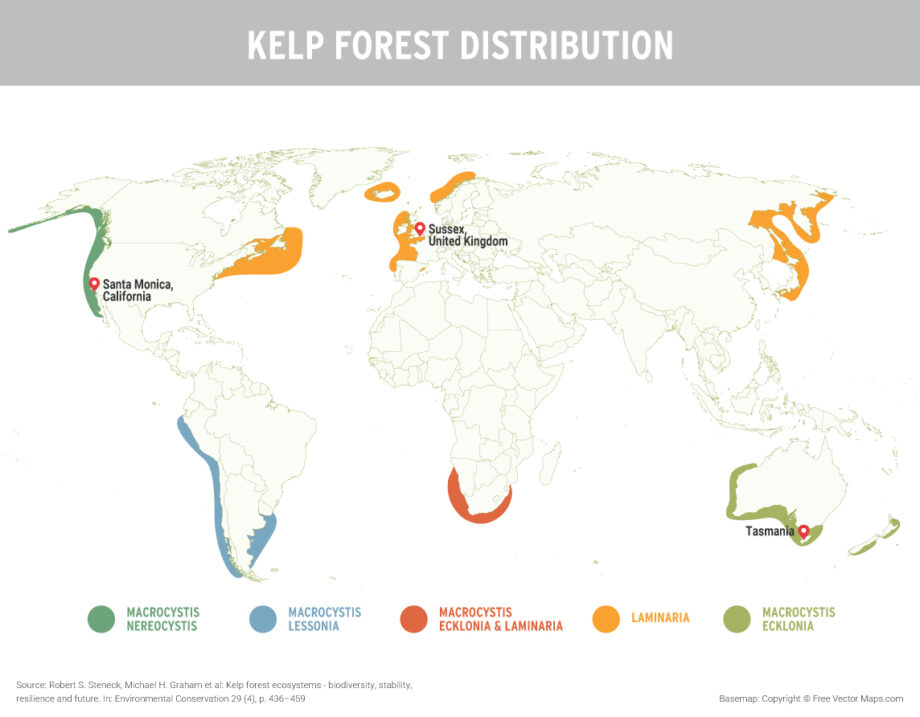
KELP FOREST DISTRIBUTION
Large Image
Kelp thrives in cold-water ecosystems where nutrient-rich water from the deep sea makes it up to the surface, a process known as upwelling. Abundant nutrients allow some types of kelp to grow up to 2 feet (0.6 meters) per day.

Having spent years studying these benefits, Layton is now trying to bring a patch of Tasmania’s struggling kelp forests back to life. Every few weeks, he dives out to inspect three 12-by-12 meter (39-by-39 feet) plots he’s created off the coast, each containing fronds of baby kelp, springing from ropes that are tethered to the ocean floor. These kelp nurseries are part of Layton’s project to determine whether climate-resilient “super-kelp” that has been raised in a laboratory will fare better in Tasmania’s changing seas. But his experiment also brings attention to the extraordinary potential of kelp to absorb carbon and help tackle climate change.

Climate-Forward Kelp

It’s the capacity to draw CO2 from the atmosphere that has added “climate mitigation” to kelp’s list of benefits. When we talk about ways oceans can sequester carbon, the conversation typically revolves around mangroves, salt marshes and seagrass meadows. But “the magnitude of carbon sequestered by algal forests is comparable to that of all those three habitats together,” says Carlos Duarte, a professor of marine science at the King Abdullah University of Science and Technology in Saudi Arabia. “Algal forests should not be left behind. They have been hidden for much too long.”

There’s a lot we still don’t understand about how kelp store CO2. But researchers are starting to build a better picture of this giant seaweed and how we might improve its capacity to help tackle climate change.

The dilemma is that kelp itself is also under siege from warming seas — which is the focus of Layton’s work. Of Tasmania’s original forest, only around 5% remains. Researchers think these plants have survived through natural variation and selection.

“There do seem to be individuals that are adapted and capable of living in the modern conditions in Tasmania that we have created through climate change,” Layton explains.

From this remaining pool of wild giant kelp, he and his colleagues have identified what Layton calls “super kelp” that may be more resilient against the effects of warming seas. From these he has harvested spores, embedding them in twine to be wound around the ropes that are rooted into the sea floor. The hope is that these super kelp spores will develop into saplings that will in turn set their own spores adrift on ocean currents, seeding new mini-forests nearby.

“For giant kelp restoration to work at the scale of the coastline, we’ll need to plant many of these seed patches,” Layton explains. “The idea is that over time, those will self-expand, and eventually coalesce — and there’s your giant kelp forest back.”

Warming waters and the removal of natural predators, like the sea otter, have caused populations of kelp-eating sea urchins to explode in Santa Monica Bay off California. Photo © iStockphoto.com | Michael Zeigler

Other kelp restoration projects around the world are tackling different threats. In Santa Monica Bay, California, conservationists are trying to save local kelp forests from voracious purple urchins, whose population has exploded since a major predator — the sea otter — dramatically declined decades ago. The urchins’ unchecked appetite has contributed to the loss of three-quarters of the bay’s former kelp forest. But fishers are carefully hand-clearing urchins — the draw being that as kelp is restored, fisheries are too. So far they’ve managed to clear 52 acres (21 hectares), which the kelp forest has reclaimed.

“All we had to do is clear the urchins out of the way,” says Tom Ford, executive director of The Bay Foundation, which is leading the effort.

The project’s success has caused others to ponder its carbon sequestration potential, Ford says. The City of Santa Monica recently established a goal of reaching carbon neutrality by 2050, and asked The Bay Foundation how kelp restoration could factor into that. A nonprofit called Sustainable Surf has also launched a program enabling people to invest in the kelp restoration project to offset their own carbon footprints.
“These kelp forests grow so fast and suck in tremendous amounts of carbon.” – Tom Ford
These kelp forests grow so fast and suck in tremendous amounts of carbon,” Ford says. In California there’s a focus on preserving wild lands with carbon credits, he explains. But the uptick in regional wildfires means that land-based forests might no longer seem like the safest bet. “Now, working off the coast is becoming perhaps a more important option.”

Similarly, in the United Kingdom, a plan known as “Help Our Kelp” aims to restore a 180-square-kilometer (70-square-mile) tract of historic kelp forest along the country’s southern Sussex Coast. It has attracted the interest of two local councils and a water company, which are intrigued by its potential to provide a new carbon sink. “All three organizations are interested in carbon, but also interested in the wider benefits [of kelp forests],” explains Sean Ashworth, deputy chief fisheries and conservation officer at the Association of Inshore Fisheries and Conservation Authorities, a partner on the project.

Captured Carbon?

Yet key questions remain about where all the stored carbon ends up. Trees stay in one place, so we can reasonably estimate how much carbon a forest stores. Kelp, on the other hand, can float off to unknown destinations. If it begins to decompose, its stored carbon may be released back into the atmosphere, explains Jordan Hollarsmith, a marine ecologist at Simon Fraser University and the Department of Fisheries and Oceans in Canada. “Truly removing that carbon from the global carbon budget would require that those kelp fronds somehow be buried, or transported to the deep sea,” she says.

In fact, emerging research is beginning to paint a picture of seaweed’s journey through the ocean. A 2016 study estimated that about 11% of global macroalgae is permanently sequestered in the ocean. The bulk of that, about 90%, is deposited in the deep sea, while the rest sinks into coastal marine sediments.

Under good conditions, the giant kelp species that grows in Tasmania can reach 40 meters (130 feet) tall and create a dense and visually impenetrable undersea forest. Photo courtesy of Cayne Layton

“If the algae reaches below the 1,000-meter horizon, it is locked away from exchange with the atmosphere over extended time scales, and can be considered permanently sequestered,” says Dorte Krause-Jensen, a professor of marine ecology at Aarhus University in Denmark and author on the 2016 study along with Duarte. Still, the challenge of tallying this up remains. Compared with mangroves, seagrasses and salt marshes, which deposit carbon directly and reliably into the sediments below, the inherent changeability of a kelp forest makes the sequestration harder to accurately quantify. But this could change, Duarte say, if kelp forests came under strict human management — something that’s already happening with smaller species of seaweed that are being farmed worldwide for food products and fertilizer.

Future Kelp

Could we similarly bring vast kelp forests under human control for the benefit of the planet? Brian Von Herzen, executive director of the nonprofit The Climate Foundation, thinks so. The Climate Foundation is a partner on Cayne Layton’s project for climate-resilient kelp, and Von Herzen is a major player in the field of “marine permaculture,” a type of open-ocean seaweed farming that mimics wild kelp forests to regenerate marine ecosystems, boost food security and sequester carbon.
Von Herzen is currently trying out prototype arrays in the Philippines to help make seaweed farming more resilient to climate change.
Central to Von Herzen’s vision is an array on which kelp would grow, hovering 25 meters (82 feet) below the ocean’s surface. Using solar, wind and wave energy to drive their motion, hoses fixed beneath the structure would siphon up colder, nutrient-rich water from the depths below. This cool water infusion would re-create an ideal micro-environment for the tethered kelp to thrive; the kelp would then oxygenate the water and create new fish habitat — all while capturing carbon, Von Herzen explains.

While these deepwater kelp forests are only hypothetical, Von Herzen is currently trying out prototype arrays in the Philippines to help make seaweed farming more resilient to climate change. Seaweed farmers there have suffered major losses as a result of warm ocean currents that sweep in and decimate their crops. But with the upwelling of cooler water generated by the new arrays, seaweed is starting to flourish again.

This project, and others being developed off the coasts of Europe and the U.S., are laying the groundwork for Von Herzen’s ultimate ambition: To dramatically scale up kelp arrays, eventually spanning great tracts of deep ocean where they could collectively absorb billions of tons of CO2 while also providing food security in the form of shellfish aquaculture and fish habitat and providing what he calls “ecosystem life support.”

Kelp could be buried in the deep sea to sequester carbon or be harvested to produce low-emissions biofuel and fertilizers, he says. “We use the thriving wild kelp forest as the ecosystem model for what we can scale in the oceans,” Von Herzen says.

Current Benefits

On the back of her research, Krause-Jensen is optimistic about the carbon sequestration potential of kelp and the possibility that it could be dramatically enlarged by sustainable farming. But practically speaking, in nations like Australia and the United States, Duarte says, “it’s harder to get a concession for a seaweed farm, than for oil and gas exploration.” And global systems for providing compensation for sequestering carbon are not yet set up to accommodate kelp.

Christophe Jospe, the chief development officer at Nori, a company that is working to make it easier to fund carbon removal initiatives, argues that with such a powerful sequestration tool at our disposal, we should accelerate its acceptance — even if seaweed farmers are only able to guarantee sequestration for, say, 10 years.

“We are throwing ourselves into a heated environmental debate where people say, well, that’s not permanent. But nothing is permanent — and it’s the reservoir of carbon that we need to increase because of the climate crisis that we’re in,” he says. “So actually, it’s a huge environmental value for a program to ensure 10 years of permanence.”

There are signs that things are gradually moving in that direction. Working with Oceans 2050, a global alliance to restore the world’s oceans led by Alexandra Cousteau, Duarte is now helping to develop a carbon credit program that could be applied to seaweed farming. This makes it possible to imagine a world where we might one day invest carbon credits in kelp farms or where wild forest restoration might count as mitigation.

Meanwhile, back in Tasmania, Layton continues to watch over his nurseries of infant kelp, and he urges us to be cognizant of what kelp forests are already doing for us, right now.

“They’re exactly like forests on land. There aren’t many people questioning their value,” he says. “Some people might not be interested in seaweed. But they may be interested in fishing, or their beachfront property not getting washed away, or making sure that their coastal waters are clean. All of those things are intimately tied to kelp forests.”

Links

(US) Minnesota Sues Exxon And Koch Industries For ’30-Year Campaign Of Deception’ On Climate

Rolling Stone - 

The state is the latest on a growing list of local governments hoping to hold the fossil-fuel industry accountable for the climate crisis

Protesters outside of a New York City courthouse for a rally coinciding with the start of a legal case against ExxonMobil, October 2019. Justin Lane/EPA-EFE/Shutterstock

The oil and gas industry was hit with yet another lawsuit when Minnesota Attorney General Keith Ellison announced this week that his office is suing two of the nation’s largest oil companies, and the oil industry’s trade group, for a “30 year campaign of deception” about the impacts of climate change.

At a press conference in Saint Paul, Ellison stated that Koch Industries, ExxonMobil, and the American Petroleum Institute “knowingly directed, conducted and funded a campaign to deceive and defraud Minnesotans and Americans” about the effects of fossil fuels on the environment. The state’s charges include fraud, failure to warn, and false statements in advertising.

Minnesota follows at least 15 progressive cities and states — from San Francisco to Rhode Island — that have filed suits against oil companies in the wake of a 2015 series by Inside Climate News, which uncovered internal Exxon documents that showed the company understood the science of climate change and the severity of its consequences more than 30 years ago, yet spent millions of dollars on a campaign to sow doubt in the science.

Using those documents, local governments have sued industry giants for fraud, and sought compensation for the damages of climate change in their communities. But the cases have yet to show results. The oil and gas industry has responded with a litany of countersuits and subpoenas that have tied up many of the cases for years. And when a case does make it in front of a judge, several have decided that it’s not an issue for the courts to decide.

 In Oakland, San Francisco, and New York City, judges insisted that while the impacts of climate change are real, it was a problem for legislators, not our judicial system, to address. “The problem deserves a solution on a more vast scale than can be supplied by a district judge or jury in a public nuisance case,” wrote U.S. District Court Judge William Alsup in 2018.

The Minnesota lawsuit argues that over the past three decades, climate change and oil and gas development has had a quantifiable impact on the state — itemizing costs like the nearly $614 million spent on asthma treatment in 2014 and the $165 million on flood disaster relief in 2007 — and it seeks to recoup those losses, in part by forcing the defendants to relinquish hundreds of billions in profits they made through what the state is calling unlawful conduct.

But it also demands that the companies undo the misinformation campaign that they’ve run for decades, by funding “a corrective public education campaign in Minnesota relating to the issue of climate change, administered and controlled by an independent third party.”

“Misleading the public about science isn’t a new concept,” said Doug Blanke, director of the Public Health Law Center at Mitchell Hamline School of Law, who was part of the legal team that sued the tobacco industry in the 1990s, in which he won a more than $6 billion settlement for the state of Minnesota. There has yet to be the same kind of victory against the oil and gas industry, but the tobacco settlement seemed near impossible too — until it wasn’t.

The Exxon documents are damning. The complaint filed by Minnesota includes a 1979 document from Exxon Engineering that acknowledges that the CO2 in the atmosphere was increasing, and that according to “the most widely held theory,” that increase was caused by burning fossil fuels, and “the present trend of fossil fuel consumption will cause dramatic environmental effects before the year 2050.”

But Exxon worked to “emphasize the uncertainty in scientific conclusions regarding the potential enhanced Greenhouse effect.” And by 1991, the Information Council for the Environment, a front group created by the coal and electricity industries, had launched a misinformation campaign to “reposition global warming as theory (not fact).” The group released ads with taglines like “Who Told You The Earth Was Warming…Chicken Little?” and “Doomsday is cancelled. Again.”

“Our future generations count on our actions today,” said Winona LaDuke, a Native American land rights activist in Minnesota who’s been on the front lines in the battle against a new oil and gas pipeline in the state. There isn’t any oil in Minnesota, but it’s criss-crossed with pipelines, like those owned by Koch Industries, carrying oil from Canada to ports along the Great Lakes. “I’ve spent most of my life fighting dumb ideas,” said LaDuke. “I’m proud that Minnesota is stepping up.”

The oil and gas industry is in a uniquely imbalanced moment. As shelter-in-place orders drastically changed our energy consumption, a barrel of oil was valued at less than zero earlier this year, and companies are still struggling to break even. More broadly, renewables, while also hindered by the shutdown, continue to take over more of the energy market and the steady drumbeat of the divestment movement chips away at the fossil fuel industry’s financial backing.

Now, Minnesota hopes to pile on a charge for the hundreds of billions of dollars that they say climate change has cost them. “Holding these companies accountable for the climate deception they’ve spread and continue to spread is essential to helping families to afford their lives and live with dignity and respect,” said Ellison. “When corporations and trade associations break the law and hurt Minnesotans, it’s my job and my duty to hold them accountable.”

Links

Affluence is killing the planet, warn scientists

The Conversation -  |  | 

Lifestyles of the rich and harmful. Midnight Runner / wiki, CC BY-SA 

Authors
  • Thomas Wiedmann is Professor of Sustainability Research, UNSW
  • Julia K. Steinberger is Professor in Social Ecology and Ecological Economics, University of Leeds
  • Manfred Lenzen is Professor of Sustainability Research, School of Physics, University of Sydney
Would you like to be rich? Chances are your answer is: “Yes! Who wouldn’t want to be rich?” Clearly, in societies where money can buy almost everything, being rich is generally perceived as something good. It implies more freedom, fewer worries, more happiness, higher social status.

But here is the catch: affluence trashes our planetary life support systems. What’s more, it also obstructs the necessary transformation towards sustainability by driving power relations and consumption norms. To put it bluntly: the rich do more harm than good.

This is what we found in a new study for the journal Nature Communications. Together with co-author Lorenz Keyßer from ETH Zürich, we reviewed recent scientific literature on the links between affluence and environmental impacts, on the systemic mechanisms leading to overconsumption and on possible solutions to the problem. The article is one of a series of Scientists’ Warnings to Humanity.

Technology and consumption

The facts are clear: the wealthiest 0.54%, about 40 million people, are responsible for 14% of lifestyle-related greenhouse gas emissions, while the bottom 50% of income earners, almost 4 billion people, only emit around 10%. The world’s top 10% income earners are responsible for at least 25% and up to 43% of our environmental impact.

Most people living in developed countries would fit into this category, meaning you don’t have to consider yourself rich in order to be globally affluent. Even many poorer people in wealthy countries have a disproportionately large and unsustainable resource footprint compared to the global average.

It is less clear, however, how to address the problems that come with affluence. Progressive mainstream policymakers talk about “greening consumption” or “sustainable growth” to “decouple” affluence from climate breakdown, biodiversity loss and other planetary-scale destruction.

Yet our research confirms that, in reality, there is no evidence that this decoupling is actually happening. While technological improvements have helped to reduce emissions and other environmental impacts, the worldwide growth in affluence has consistently outpaced these gains, driving all the impacts back up.

And it appears highly unlikely that this relationship will change in the future. Even the cleanest technologies have their limitations and still require specific resources to function, while efficiency savings often simply lead to more consumption.

Economic growth hasn’t yet ‘decoupled’ from environmental impact. Oleg Totskyi / shutterstock

If technology alone is not enough, it is therefore imperative to reduce the consumption of the affluent, resulting in sufficiency-oriented lifestyles: “better but less”. This is all easier said than done though, for there is a problem.

The super-affluent

The lockdown has seen a massive drop in consumption. But the resulting unprecedented dive in CO₂ and air pollutant emissions was merely incidental to the lockdown, not a deliberate part of it, and will not last.

So how can we reduce consumption as much as necessary in a socially-sustainable way, while still safeguarding human needs and social security? Here it turns out the main stumbling block is not technological limits or economics itself, but the economic imperative to grow the economy, spurred by overconsumption and the political power of the super-affluent.

Affluent, powerful people and their governments have a vested interest in deliberately promoting high consumption and hampering sufficiency-oriented lifestyles. Since consumption decisions by individuals are strongly influenced by information and by others, this can lock in high-consumption lifestyles.

“Positional consumption” is another key mechanism, where people increasingly consume status goods once their basic needs are satisfied. This creates a growth spiral, driven by the affluent, with everyone striving to be “superior” relative to their peers while the overall consumption level rises. What appears average or normal in a developed country then rapidly becomes a top contribution at the global level.

ustainable lifestyles are situated between an upper limit of permissible use (“Environmental ceiling”) and a lower limit of necessary use of environmental resources (“Social foundation”)

So, how can we get out of this dilemma?

We reviewed a variety of different approaches that may have the solution. They range from reformist to radical ideas, and include post-development, degrowth, eco-feminism, eco-socialism and eco-anarchism. All these approaches have in common that they focus on positive environmental and social outcomes and not on economic growth. Interestingly, there seems to be quite some strategic overlap between them, at least in the short term. Most agree on the necessity to “prefigure” bottom-up as much as possible of the new, less affluent, economy in the old, while still demonstrating sufficiency-oriented lifestyles to be desirable.

Grassroots initiatives such as Transition Initiatives and eco-villages can be examples of this, leading to cultural and consciousness change. Eventually, however, far-reaching policy reforms are needed, including maximum and minimum incomes, eco-taxes, collective firm ownership and more. Examples of policies that start to incorporate some of these mechanisms are the Green New Deals in the US, UK and Europe or the New Zealand Wellbeing Budget 2019.

Social movements will play a crucial role in pushing for these reforms. They can challenge the notion that riches and economic growth are inherently good and bring forward “social tipping points”. Ultimately, the goal is to establish economies and societies that protect the climate and ecosystems and enrich people with more wellbeing, health and happiness instead of more money.

Links

Lethal Heating is a citizens' initiative