03/07/2020

What Facebook And The Oil Industry Have In Common

The New Yorker - 

Facebook’s C.E.O., Mark Zuckerberg, like the heads of the oil industry, has resisted change that threatens his company’s central business. Photograph by Erin Scott / Reuters

Author
Bill McKibben is a founder of the grassroots climate campaign 350.org and a contributing writer to The New Yorker.
He writes The Climate Crisis, The New Yorker's newsletter on the environment.
Why is it so hard to get Facebook to do anything about the hate and deception that fill its pages, even when it’s clear that they are helping to destroy democracy? And why, of all things, did the company recently decide to exempt a climate-denial post from its fact-checking process? The answer is clear: Facebook’s core business is to get as many people as possible to spend as many hours as possible on its site, so that it can sell those people’s attention to advertisers. (A Facebook spokesperson said the company’s policy stipulates that “clear opinion content is not subject to fact-checking on Facebook.”) This notion of core business explains a lot—including why it’s so hard to make rapid gains in the fight against climate change.

For decades, people have asked me why the oil companies don’t just become solar companies. They don’t for the same reason that Facebook doesn’t behave decently: an oil company’s core business is digging stuff up and burning it, just as Facebook’s is to keep people glued to their screens. Digging and burning is all that oil companies know how to do—and why the industry has spent the past thirty years building a disinformation machine to stall action on climate change. It’s why—with the evidence of climate destruction growing by the day—the best that any of them can offer are vague pronouncements about getting to “net zero by 2050”—which is another way of saying, “We’re not going to change much of anything anytime soon.” (The American giants, like ExxonMobil, won’t even do that.)

Total, the French oil company, has made the 2050 pledge, but it is projected to increase fossil-fuel production by twelve percent between 2018 and 2030. These are precisely the years when we must cut emissions in half, according to the Intergovernmental Panel on Climate Change, to have any chance of meeting the vital targets set by the Paris climate agreement, which aim to hold the planet’s temperature increase as close as possible to one and a half degrees Celsius. The next six months will be crucial as nations prepare coronavirus recovery plans. Because effective climate planning at this moment will require keeping most oil, coal, and gas reserves in the ground, the industry will resist fiercely.

So we need power brought to bear from companies whose core business is not directly challenged by climate activism. Consider the example of Facebook again: after organizing by people like Judd Legum and StopHateForProfit.org, companies including Unilever and Coca-Cola agreed to temporarily stop advertising on the social platform. Coke’s core business is selling you fizzy sugar water that can help make you diabetic—when that’s threatened, the company fights back. But when it feared being attacked for helping Facebook’s core business, it simply stopped advertising with the company, which wasn’t essential for Coke’s business.

That’s why it is critical to get third parties to pressure the oil industry. This past month, the growing fossil-fuel divestment campaign got a huge boost when the Vatican, whose core business is saving souls, called for divestment, and the Queen of England, whose core business is unclear but involves hats, divested millions from the industry. Keith Ellison, the attorney general of Minnesota, announced that he was suing ExxonMobil, as well as the American Petroleum Institute and Koch Industries, for perpetrating a fraud by spreading climate denial for decades. (Ellison’s core business is justice, and his office is pursuing this climate action at the same time that it is prosecuting the killers of George Floyd.) All this, in turn, puts pressure on the financial industry to stop handing over cash to oil companies. As I pointed out in a piece last summer, JPMorgan Chase may be the biggest fossil-fuel lender on earth, but that’s still only about seven per cent of its business—big, but not core.

Effective progress on climate will require government and the finance industry to enforce the edicts of chemistry and physics: massive action undertaken inside a decade, not gradual, gentle course correction. And that will require the rest of us to press those institutions. Because our core business is survival.

Passing the Mic

Anna Jane Joyner is a climate activist who concentrates on what she calls “crafting stories and strategies that inspire new audiences to take action on climate change.” She makes special effort to engage evangelical Christians, including her father, who is a prominent pastor. She was featured in the Showtime series “Years of Living Dangerously,” and is the co-host of the podcast “No Place Like Home” with Mary Anne Hitt, an activist from the Sierra Club.

You’re focussed on spirituality and the response to climate change this season on the podcast. What are you learning?

Anna Jane Joyner: I’m learning to take the long view and just focus on the next right thing. When the Rabbi Jennie Rosenn talked with us, for next week’s episode, about the seder—a celebration of the exodus of Israelites from slavery and oppression—she emphasized that part of that story is that, first, they wandered in the wilderness for forty years, not knowing what would happen, but with faith that God would protect them. Reverend Lennox Yearwood, of the Hip Hop Caucus, reminded us that for many vulnerable people, activism isn’t a choice, it’s simply fighting for their lives, families, and homes. For me, that means that even when we’re feeling despair, anxiety, and fear, we can’t give up—a lot of people don’t even have that option. He told us, “We can be overwhelmed but not overcome.” Dr. Kritee Kanko, a Buddhist teacher, shared how meditation helped her climb out of a deep depression, and reminded us of our “interbeing”—how deeply interconnected we are, as we’re all witnessing now because of COVID-19.

As activists, both Mary Anne and I have increasingly turned to spirituality as a way to find our own resilience and courage, and we’ve heard the same from a lot of fellow climate friends. We wanted to dig deeper into that and share it with our listeners, and also take a look at the landscape of spiritual stories and traditions to find even more tools and guides that offer light during hard, dark times.

You come from an evangelical background in your youth. What’s made it seemingly uniquely hard for much of that world to grapple with this issue?

Anna Jane Joyner: I am a preacher’s daughter, and my dad is a climate-denying megachurch pastor. To me, it seems most white evangelicals are lost in a false nostalgia and brainwashed by the cult of Trump and Fox News. They’re driven by an ideological identity and a mentality of my team vs. yours, not science, or even compassion, and stuck in the culture wars of the nineteen-eighties and nineties. I like to remind people that there’s a lot more to Christianity than what white evangelicals have to say. There’s still a lot of hope among young people who were raised in that space, and even those who still identify with it, who are far more likely to embrace science and social justice. And there are millions of progressive Christians who care about the climate crisis and are inspired by Jesus’ teachings and other tenets of Christianity to act. But I fear that many, if not most, older white evangelicals may be lost—not that I won’t still keep trying.

How do you find solace when you have to deal with this crisis all the time, and what do you do when you just get overwhelmed?

Anna Jane Joyner: Buddhist teachings on non-attachment have been really helpful: the reminder that my job is not to know how to fix everything, it’s just to show up and do the next right thing. The Christian story of resurrection and life overcoming death is inspiring me right now. Often, when I’m really overwhelmed, I just stop what I’m doing and walk outside and listen and watch, to feel the universe itself giving me solace. When I was nineteen, I was on a sailing trip and we got caught in a terrible storm. It’s the closest to death I’ve come. And I was in a state of panic—finding it hard to breathe, etc.—and out of nowhere, for the first time in years, I prayed: “God if you can’t calm the storm outside, please calm the storm within me.” I’ve prayed that prayer a lot the past few years. When I really can’t get out of a funk, I pick up someone else’s story: a podcast, novel, memoir, show, or movie. I almost always find comfort, creativity, and courage in focussing on something beyond my own story for a minute. Then, I get back to work. There’s a lot of solace in action, too.

Climate School

This newsletter has covered the problem of abandoned oil wells before, but new numbers in a report from Reuters are truly striking. “More than 3.2 million abandoned oil and gas wells together emitted 281 kilotons of methane in 2018, according to the data, which was included in the U.S. Environmental Protection Agency’s most recent report on April 14 to the United Nations Framework Convention on Climate Change. That’s the climate-damage equivalent of consuming about 16 million barrels of crude oil, according to an EPA calculation, or about as much as the United States, the world’s biggest oil consumer, uses in a typical day.”

It turns out that public transit probably wasn’t a major spreader of the coronavirus pandemic, according to The Atlantic. Get out of your car, but wear your mask.

The House Select Committee on the Climate Crisis, which was formed by the Speaker of the House, Nancy Pelosi, after Representative Alexandria Ocasio-Cortez and young people from the Sunrise Movement occupied her office, in 2018, released its recommendations yesterday—it’s a highly detailed, five-hundred-and-thirty-eight-page document that could help form a blueprint for congressional action in the years ahead. The first reaction from Julian Brave NoiseCat, at Data for Progress: not half bad. In The New Republic, Kate Aronoff points out that although the plan’s designed to take on global warming, it’s not very global.

Scoreboard

California sent a strong signal to the trucking industry, announcing that it would phase out sales of diesel trucks in favor of ones with electric motors. The move will reduce greenhouse-gas emissions, and eventually clean the air in communities that are unfortunate enough to be situated near shipping hubs.

California, New York, and now Massachusetts are planning for a future without natural gas. The Bay State’s crusading attorney general, Maura Healey, has asked for an investigation into natural gas, noting that Massachusetts likely can’t meet its global-warming targets if it keeps burning propane. Space heating and water heating together are the second-biggest source of emissions in the state, and two-thirds of that comes from burning natural gas, so the switch to electric heat pumps running off renewables is a logical step.

Last week, authorities in Baton Rouge charged two local anti-pollution activists with the crime of “terrorizing” after they carried out a peaceful publicity stunt. Protesting plans for a huge new plastics plant in a community already suffering from high levels of pollution, the activists left a box of plastic pellets, known as “nurdles,” from a similar factory in Texas at the home of an oil-and-gas lobbyist. The attached note listed, among other things, the name and phone number of the activists’ attorney, which is not something that actual terrorists, or even criminals, normally do.

Last week, leaders in Colorado Springs decided to shut down two coal-fired power plants and invest in renewables instead. Along with the Air Force Academy, the city is home to so many religious organizations that it has been called the “evangelical Vatican.” It has also seen large-scale wildfires in recent years.

Alaska’s congressional delegation, upset that some banks have decided not to lend for oil drilling in the Arctic, including in the Arctic National Wildlife Refuge, have tried to make a “racial justice” issue out of it. The members of Congress argue that some indigenous groups want oil exploration to proceed. Bernadette Demientieff, the leader of an advocacy group for the Gwich’in tribe, dismissed the politicians’ claim in an op-ed: “Why have they spent their careers ignoring the true cause and cost of the climate crisis, as Indigenous villages slip one by one into the ocean and hunters trying to feed their families fall through prematurely melting ice?”

The Supreme Court ruling protecting gay rights may have an important knock-on effect in protecting efforts to fight climate change. Justice Neil Gorsuch ruled that the definition of sexual discrimination in the Civil Rights Act included gay and transgender people, even if they were not among its initial group of protected people. That finding could be used, analysts said, to similarly claim that the Clean Air Act covers carbon dioxide, even though it was not considered a pollutant when the law was originally adopted.

Warming Up

Surely you know to listen on occasion to WWOZ, the great heritage-music station out of New Orleans. But on Saturday evenings—and anytime on the time-and-distance-obliterating Internet—the show “Soul Power” offers rare and deep cuts from the seventies and eighties, thanks to D.J. Soul Sister. Given this week’s discussion, cue up Stargard’s “What You Waitin’ For?”

Links

(AU) Climate Change Threat To Tropical Plants

UNSW - Caroline Tang

Half of the world’s tropical plant species may struggle to germinate by 2070 because of global warming, a new UNSW study predicts.

A new UNSW study predicts global warming will mean half of all tropical plant species may struggle to germinate by 2070. Photo: Shutterstock

Tropical plants closer to the equator are most at risk from climate change because it is expected to become too hot for many species to germinate in the next 50 years, UNSW researchers have found.

Their study analysed almost 10,000 records for more than 1300 species from the Kew Gardens’ global seed germination database.

The research, published in the journal Global Ecology and Biogeography last month, was the first to look at the big picture impact of climate change on such a large number of plant species worldwide.

Lead author Alex Sentinella, UNSW PhD researcher, said past research had found that animal species closer to the equator would be more at risk from climate change.

“The thought was that because tropical species come from a stable climate where it’s always warm, they can only cope with a narrow range of temperatures – whereas species from higher latitudes can cope with a larger range of temperatures because they come from places where the weather varies widely,” Mr Sentinella said.

“However, this idea had never been tested for plants.

“Because climate change is a huge issue globally, we wanted to understand these patterns on a global scale and build upon the many studies on plants at an individual level in their environment.”

Half of the world’s tropical plant species may struggle to germinate by 2070 because of global warming, a new UNSW study predicts. Photo: Shutterstock

Seeds a key indicator of survival

The researchers examined seed germination data from the Millennium Seed Bank Partnership Data Warehouse, hosted by Kew Royal Botanic Gardens in London, to quantify global patterns in germination temperature.

They analysed 9737 records for 1312 plant species from every continent except Antarctica and excluded agricultural crops.

Mr Sentinella said they chose seed data because it was widely available and relevant to the ability of a species to cope with different temperatures.

“With seeds, you can experiment on them quickly, there are a lot of studies about them and importantly, germination directly relates to how a species will survive, because if the seed doesn't germinate the plant won't live,” he said.

“So, we collated the data from the Kew Gardens database, examined all experiments on the same species from the same locations, and then determined the range of temperatures each species could tolerate in order to survive.”

The researchers also examined climate data for the same locations as the plant species used in the study.

They looked at current temperature – the average temperature of the warmest three months from 1970 to 2000 – and predicted temperature for 2070.

The researchers then compared the temperatures the plants were experiencing now with the forecasted 2070 temperatures.

A new UNSW study predicts global warming will mean half of all tropical plant species may struggle to germinate by 2070. Photo: Shutterstock

Tropical plants to hit or exceed temperature limits

The study discovered tropical plants do not have narrower temperature tolerances but were more at risk from global warming, because it would bring them close to their maximum seed germination temperatures.

Mr Sentinella said, on average, the closer a plant was to the equator, the more at risk it would be of exceeding its temperature ceiling by 2070.

“These plants could be more at risk because they are near their upper limits. So, even a small increase in temperature from climate change could push them over the edge,” he said.

“The figures are quite shocking because by 2070, more than 20 per cent of tropical plant species, we predict, will face temperatures above their upper limit, which means they won't germinate, and so can’t survive.”

Mr Sentinella said the researchers also found that more than half of tropical species are expected to experience temperatures exceeding their optimum germination temperatures.

“That’s even worse because if those plants can survive it would be at a reduced rate of germination and therefore, they might not be as successful,” he said.

“If a seed’s germination rate is 100 per cent at its optimum temperature, then it might only manage 50 or 60 per cent, for example, if the temperature is higher than what’s ideal.”

Mr Sentinella said he was surprised to find that climate change would threaten so many tropical species.

“But our most unexpected discovery was that the hypothesis often used for animals – that those near the equator would struggle to survive the impact of climate change because they have narrower temperature tolerances – was not true for plants,” he said.

“We found that regardless of latitude, plant species can germinate at roughly the same breadth of temperatures, which does not align with the animal studies.”

The researchers also found 95 per cent of plant species at latitudes above 45 degrees are predicted to benefit from warming, because environmental temperatures are expected to shift closer to the species’ optimal germination temperatures.

Half of the world’s tropical plant species may struggle to germinate by 2070 because of global warming, a new UNSW study predicts. Photo: Shutterstock

Findings to help target conservation efforts

Mr Sentinella said it was possible for some plants to slowly evolve to increasing temperatures, but it was difficult to predict which ones would survive.

“The problem with the quick change in temperatures forecasted, is that some species won’t be able to adapt fast enough,” he said.

“Sometimes plants can migrate by starting to grow further away from the equator or, up a mountain slope where it's cooler. But if a species can't do that it will become extinct.

“There are almost 400,000 plant species worldwide – so, we would expect a number of them to fail to germinate between now and 2070.”

Mr Sentinella hopes the researchers' findings will help to conserve plant species under threat from climate change.

“Ideally, we would be able to conserve all ecosystems, but the funding is simply not there. So, our findings could help conservation efforts target resources towards areas which are more vulnerable,” he said.

“We also hope our findings further strengthen the global body of research about the risks of climate change.

“Humans have known about dangers of climate change for decades and we already have the answers to tackle it. So, hopefully our study will help encourage people and policy makers to take action now.”

Links

(AU) City Of Sydney Completes Switch To 100 Per Cent Renewable Supply

RenewEconomy - 

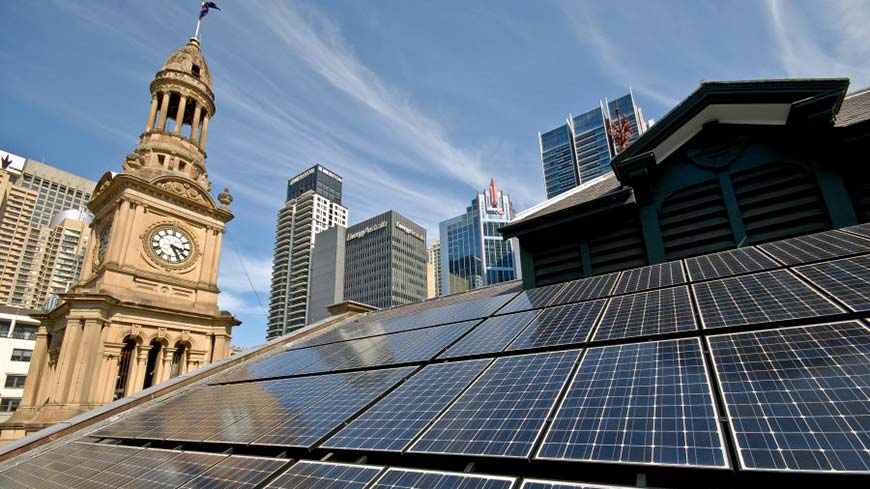
Sydney Town Hall solar. Credit: City of Sydney

The City of Sydney has officially made the switch to 100 per cent renewable electricity, with its power supplies now flowing from wind and solar projects from across regional New South Wales.

The council will now source the equivalent of all of its electricity consumption from renewable sources, including energy used throughout its operations at its buildings, depots, street lights, sporting facilities, as well as the iconic Sydney Town Hall. Its milestone came on the same day as the City of Adelaide.

“We are in the middle of a climate emergency. If we are to reduce emissions and grow the green power sector, all levels of government must urgently transition to renewable energy,” Sydney Lord Mayor Clover Moore said.

“Cities are responsible for 70 per cent of greenhouse gas emissions worldwide, so it is critical that we take effective and evidence-based climate actions.”

The City of Sydney secured a power purchase agreements with wind and solar farms in Glen Innes, Wagga Wagga and the Shoalhaven region in a deal worth around $60 million.

This includes a 3MW solar farm built in the Shoalhaven in partnership with the not-for-profit Repower Shoalhaven initiative, with the power purchase agreement struck with the City of Sydney delivering benefits to the local community located on the NSW south coast.

“Shoalhaven solar farm could not have become operational without the City’s investment. By partnering with this project, we’re creating local jobs and helping the renewables sector grow,” Repower Shoalhaven member Bob Hayward said.

“The City of Sydney decision to include a regional community-based scheme brings us a step closer to a sustainable decarbonised future while supporting regional investment and employment. We congratulate the City for this significant commitment.”

The City of Sydney will also source power from the 120MW Bomen Solar Farm located just outside Wagga Wagga, and the 270MW Sapphire Wind Farm located in NSW’s New England region.

Its the latest step in a range of pro-active measures taken by the City of Sydney council to reduce its contributions to climate change.

The council became the first government in Australia to be certified as carbon neutral in 2011 and set itself a target of reducing its emissions footprint by 70 per cent by 2030.

The council also made a formal declaration of a climate change emergency in June last year.

The deal is expected to reduce the council’s emissions footprint by around 20,000 tonnes per year, as well as saving the council around $500,000 annually over the next ten years on its energy costs. It will also likely see the council achieve its emissions reduction goal as early as 2024.

The City of Sydney was assisted in securing the arrangement by Flow Power, which hopes Sydney can serve as an example for other councils and local government authorities for how emissions reductions and cost savings can be achieved by embracing renewable energy.

“This is a landmark achievement for the City of Sydney. If organisations can follow in the City’s footsteps, a net-zero carbon future is achievable,” Flow Power CEO Matthew van der Linden said.
“The City is directly matched to these renewable projects, a move that supports the integration of renewables into the system.”

A range of local council authorities have moved to transition their electricity use to renewable supplies, including the City of Adelaide, the City of Newcastle and the government of the ACT, which switched all of the territory’s electricity consumption to renewable sources.

Links

02/07/2020

(AU) Today, The Kyoto Climate Deal Ends And Australia’s Paris Cop-Out Begins. That’s Nothing To Be Proud Of, Mr Taylor

The Conversation - 

Mick Tsikas/AAP

 is Adjunct Associate Professor James Cook University and University Fellow Charles Darwin University, James Cook University. 
Today marks the end of the Kyoto climate deal and the start of its successor, the Paris Agreement. 

Emissions Reduction Minister Angus Taylor on Wednesday was quick to hail Australia’s success in smashing the Kyoto emissions targets. 

But let’s be clear: our record is nothing to boast about.

Taylor says Australia has beaten Kyoto by up to 430 million tonnes — or 80% of one year of national emissions. On that record, he said, “Australians can be confident that we’ll meet and beat our 2030 Paris target”.

The fact that Australia exceeded its Kyoto targets means it’s accrued so-called “carryover” carbon credits. It plans to use these to cover about half the emission reduction required under the Paris commitment by 2030.

But there’s been little scrutiny of why Australia met the Kyoto targets so easily. The reason dates back more than 20 years, when Australia demanded the Kyoto rules be skewed in its favour. Using those old credits to claim climate action today is cheating the system. Let’s look at why.

The Paris climate deal officially starts today. Daniel Munoz/Reuters

Australian scorns the spirit of Paris

The Kyoto Protocol was an international treaty negotiated in 1997. Industrialised nations collectively pledged to reduce greenhouse gas emissions by 5.2% below 1990 levels. The reductions were to be made between 2008 and 2012.

Any surplus emissions reduction in the first Kyoto period could be carried over to the second period, from 2013 to 2020. In the name of climate action, five developed countries – Denmark, Germany, the Netherlands, Sweden and the UK – voluntarily cancelled their surplus credits.

However, Australia held onto its credits. Now it wants to use them to meet its Paris target – reducing emissions by 26-28% below 2005 levels by 2030.

This is clearly not in the spirit of the Paris agreement. And importantly, the history of Kyoto shows Australia did not deserve to earn the credits in the first place.

Sneaky negotiations

Under Kyoto, each nation was assigned a target – measured against the nation’s specific baseline of emissions produced in 1990. During negotiations, Australia insisted on rules that worked in its favour.

Instead of reducing its emissions by 5.2%, it successfully demanded a lenient target that meant emissions in 2012 could be 8% more than they were in 1990.

Our negotiators argued we had special economic circumstances - that our dependence on fossil fuels and energy-intensive exports meant cutting emissions would be difficult. Australia threatened to walk away from the negotiations if its demand was not met.

Australia negotiated an advantageous deal under the UN Kyoto protocol. Alexandros Michailidis/Shutterstock

Australia then waited until the final moments of negotiations – when many delegates were exhausted and translators had gone home – to make another surprising demand. It would only sign up to Kyoto if its 1990 emissions baseline (the year future reductions would be measured against) included emissions produced from clearing forests.

Here’s the catch. Australia’s emissions from forest clearing in 1990 were substantial, totalling about a quarter of total emissions, or 131.5 million tonnes of carbon.

Forest clearing in Australia plummeted after 1990, when Queensland enacted tough new land clearing laws. So including deforestation emissions in Australia’s baseline meant we would never really struggle to meet – or as it turned out, beat – our targets. In fact, the rule effectively rewarded Australia for its mass deforestation in 1990.

This concession was granted, and became known as the Australia clause. It triggered international condemnation, including from the European environment spokesman who reportedly called it “wrong and immoral”.

Then prime minister John Howard declared the deal to be “splendid”.

John Howard was thrilled with Australia’s concessions under Kyoto. LYNDON MECHIELSEN/AAP

A new round of Kyoto negotiations took place in 2010, for the second commitment period. Under the Gillard Labor government, Australia agreed to an underwhelming 5% decrease in emissions between 2013 and 2020.

Australia insisted on using the deforestation clause again, despite international pressure to drop it. It meant Australia’s carbon budget in the second period was about 26% higher than it would have been without the concession.

Had forest clearing not been included in the 1990 baseline, Australia’s emissions in 2017 were 31.8% above 1990 levels.

Forest clearing in 1990 made it easy for Australia to beat Kyoto targets. Harley Kingston/Flickr

History repeats

At the Madrid climate talks last year, Australia reiterated its plans to use its surplus Kyoto credits under Paris. Without the accounting trick, Australia is not on track to meet its Paris targets.

Laurence Tubiana, a high-ranking architect of the Paris accord, expressed her disdain at the plan:
If you want this carryover, it is just cheating. Australia was willing in a way to destroy the whole system, because that is the way to destroy the whole Paris agreement.
Whether Australia will be allowed to use the surplus credits is another question, as the Paris rulebook is still being finalised.

Analysts say there is no legal basis for using the surplus credits, because Kyoto and Paris are separate treaties.

Australia appears the only country shameless enough to try the tactic. At Senate estimates last year, officials said they knew of no other nation planning to use carryover credits.

Protesters in Spain in January 2020, calling for global climate action. JJ Guillen Credit/EPA

Nothing to be proud of

Some hoped Australia’s recent bushfire disaster might be a positive turning point for climate policy. But the signs are not good. The Morrison government is talking up the role of gas in Australia’s energy transition, and has so far failed to seize the opportunity to recharge the economy through renewables investment.

Crowing on Wednesday about Australia’s over-achievement on Kyoto, Taylor said the result was “something all Australians can be proud of”.

But Australia abandoned its moral obligations under Kyoto. And by carrying our surplus credits into the Paris deal, we risk cementing our status as a global climate pariah.

Links

Facebook Creates Fact-Checking Exemption For Climate Deniers

Heated - Emily Atkin

A group with ties to the fossil fuel industry plans to use Facebook's op-ed loophole to spread climate misinformation.

LEONELLO CALVETTI/SCIENCE PHOTO LIBRARY via Getty Images

Facebook is "aiding and abetting the spread of climate misinformation,” said Robert Brulle, an environmental sociologist at Drexel University. “They have become the vehicle for climate misinformation, and thus should be held partially responsible for a lack of action on climate change.”

Brulle was reacting to Facebook's recent decision, made at the request of climate science deniers, to create a giant loophole in its fact-checking program. Last year, Facebook partnered with an organization, Science Feedback, that would bring in teams of Ph.D. climate scientists to evaluate the accuracy of viral content. It was an important expansion of the company's third-party fact-checking program.

But now Facebook has reportedly decided to allow its staffers to overrule the climate scientists and make any climate disinformation ineligible for fact-checking by deeming it "opinion."

The organization that requested the change, the CO2 Coalition, is celebrating, E&E news reported on Monday. The group, which has close ties to the fossil fuel industry, says its views on climate change are increasingly ignored by the mainstream media. Now it plans to use Facebook to aggressively push climate misinformation on the public—without having to worry about fact checks from climate scientists.

How it all started

A column published in the Washington Examiner in August 2019 claimed that "climate models" were a "failure" that predicted exponentially more warming of the earth than has occurred. The piece, co-authored by notorious climate science denier Pat Michaels, was quickly shared more than 2,000 times on Facebook.

There was just one issue: It wasn't true.

This is exactly the kind of mess that Facebook's network of independent fact-checkers is supposed to solve. In May 2019, Facebook partnered with Science Feedback, a site dedicated to explaining "why information is or is not consistent with the science." Science Feedback's process is extremely rigorous. Each piece has multiple reviewers, and each reviewer "holds a Ph.D. and has recently published articles in top-tier peer-reviewed science journals."

Five scientists reviewed the Washington Examiner article for Science Feedback. The scientists identified a number of problems with the piece: "false factual assertions, cherry-picking datasets that support their point, failing to account for uncertainties in those datasets, and failing to assess the performance of climate models in an objective and rigorous manner." The article was rated "false" by Science Feedback and logged in Facebook's system.

That should have been the end of the story. The Washington Examiner article should have had a warning overlaid each time it was shared on Facebook, and its distribution on Facebook should have been dramatically reduced.

But that's not what happened.

Instead, an organization affiliated with Michaels, the CO2 Coalition, wrote Zuckerberg and complained about Science Feedback's rating. Among other things, the coalition claims that Science Feedback's analysis amounted to "simple differences of opinion." The coalition asked Zuckerberg to "remove Facebook’s censorship, labeling, and restrictions on this article."

Amazingly, it worked. In September, Facebook removed the false rating, overruling the judgment of Science Feedback. According to the Wall Street Journal, Facebook found that the misinformation about climate models was an "opinion" and, therefore, not eligible for fact-checking.

Now, the CO2 Coalition has announced its intention to exploit this loophole to spread climate misinformation on Facebook.

How Facebook's fact-checking program is supposed to work

The rules for Facebook's fact-checking program are clear. Facebook does not conduct the fact-checks itself. Instead, it has outsourced the process to third parties that are certified by Poynter's International Fact-Checking Network.

If a publisher has a dispute about a rating it receives on Facebook, it should "reach out directly to the third-party fact-checking organizations." The rating can only be removed by the organization that issued the fact check — either because the fact checker is convinced by the publisher's dispute or the publisher corrected the false information. There is no mechanism to appeal a fact-check directly to Facebook.

According to Facebook's rules, all "public, newsworthy Facebook and Instagram posts, including ads, with articles, photos, or videos," are eligible for fact-checking. The only type of content that is listed as exempt is original content posted by politicians or political candidates.

The Wall Street Journal reported that, after receiving the complaint from the CO2 coalition, Facebook planned to create a new rule exempting "opinion pieces" from fact-checking. But Facebook did not "respond to requests for comment" on the new rule. No such rule has been publicly acknowledged by Facebook in the months that followed.

In response to a request for comment, Facebook did little to clarify the situation, reiterating the company’s official fact-checking policies but not addressing its decision to overrule Science Feedback. “The focus of Facebook’s third-party fact-checking program is combating viral misinformation,” Facebook spokesperson Andy Stone said. “There’s an appeals process in place for publishers to appeal directly to fact-checkers to dispute ratings.”

How climate science deniers plan to exploit Facebook's loophole

Creating an unwritten exemption for "opinion" content, which is enforced by Facebook and not its fact-checking partners, creates a giant loophole for misinformation. The CO2 coalition told E&E News that they plan to exploit it.
After the quiet decision by Facebook, the coalition says it and other groups that attack consensus climate science can share content that climate scientists have labeled as misleading because Facebook will consider it "opinion" and therefore immune to fact-checking.
The CO2 Coalition is increasingly focused on using Facebook to reach more people with its message that climate change fears are overblown and that burning more fossil fuels would help humanity, Executive Director Caleb Rossiter told E&E News this week. He sees the battle over its climate-related posts as part of a larger proxy war over how to reach an audience outside of conservative media.
Rossiter said Facebook was increasingly important because "the mainstream media" is no longer willing to amplify the group's opinions. But the reason the “mainstream media” is not willing to amplify the group’s opinions is because they’re not opinions at all. They’re falsehoods.

Climate facts are not climate opinions

Andrew Dessler is one of the five climate scientists who originally fact-checked the CO2 Coalition’s op-ed by Pat Michaels. It was “complete bullshit,” he said. “We gave it a bad review, which it 100 percent deserved.”

The article claimed computer models used by climate scientists to predict warming have proved overblown, and thus shouldn’t be trusted. To prove it, Michaels compared “actual temperatures since 1979 with what the 32 families of climate models used in the latest U.N. report on climate science predicted they would be.”

The comparison was flawed. Michaels compared the earth’s present temperature with past climate models that predicted more carbon pollution than actually occurred. If we had polluted as much as the models predicted, the world would have warmed as much as the models predicted.

We know this because actual climate scientists have published research assessing the accuracy of climate models. That research, which went through the rigorous peer-review process, says computer climate models have been largely accurate for the last 40 years. Michaels’ analysis, on the other hand, didn’t go through any peer-review process, nor is Michaels climate scientist himself. What Michaels did was amateur Google sleuthing. What the scientists did was science.

Dessler thinks Michaels should be able to state his opinions about climate change without getting fact-checked. “Things like, ‘we should [implement] a carbon tax,’ or ‘subsidize nuclear energy, or even ‘we shouldn’t do anything about climate change,’” he said. “Those aren’t facts; they’re policy choices.”

But statements about the physical condition of the planet; the effect of carbon on the atmosphere; the historical accuracy of climate models—those are scientific in nature. “Those are not opinions,” Dessler said. “They’re either true or false.”

“The earth is warming. Climate models have done a good job,” he added. “That should be covered by fact-checking.”

The dire consequences of not fact-checking climate denial

The CO2 Coalition told E&E News that it is getting assistance from a "'conservative' Facebook employee." Facebook says that claim is not true, but did not specify who at Facebook reversed Science Feedback’s ruling.

American political conservatives have a long, well-documented history of perpetuating climate disinformation in order to delay climate action. Disinformation—that is, the intentional spread of misinformation—has been a key strategy of the fossil fuel industry and its political allies for decades. The less people understand about climate science, the strategy goes, the less likely they will be to support aggressive climate policies, which threaten the fossil fuel industry’s immense profitability.

The CO2 Coalition’s use of Facebook’s op-ed loophole “fits right back into that strategy of trying to promulgate misinformation to the public in order to keep alive the lack of public concern over climate change, to stop meaningful action to address it,” Brulle said. And by having the loophole, Brulle said, “Facebook is becoming part of the problem, not part of the solution, to climate change. ”

Naomi Oreskes, an acclaimed Harvard University professor who co-wrote “Merchants of Doubt,” agreed that Facebook’s op-ed loophole is “potentially very damaging.”

“We know that many people, particularly young people, are getting their information heavily, or even primarily, from social media,” she said. “For social media to propagate disinformation, without any attempt at screening, is for them to become, in effect, part of the disinformation machine.”

Links

Coronavirus And Climate Change: Collective Action Is The Only Way Forward

Deutsche Welle - Neil King | Gabriel Borrud

When faced with a crisis, coming together is the one vehicle of change humans have when it comes to fighting for their future, says social psychologist Stephen Reicher.

Rebellion protesters hold a banner saying 'United for Climate'


Human beings all over the world agreed to strict limitations to their rights when governments made the decision to enter lockdown during the COVID-19 crisis. Many have done it willingly on behalf of the collective. So why can't this same attitude be seen when tackling climate change?

Stephen Reicher is a social psychologist at the University of St. Andrews in Scotland, where he researches collective behavior and social identity. DW spoke to him for the second season of the environmental podcast On The Green Fence.

DW: We've watched the collective move very fast in response to this crisis. Were you amazed by that?

Stephen Reicher: At one level, I wasn't. If you look at the literature on what happens in emergencies, the traditional literature plays into this notion of the public as a problem — the idea that human beings are always psychologically frail and they always have difficulty in dealing with complex information. And under a crisis, they crack, they panic. You would never have a Hollywood disaster film without people running, screaming, waving their hands in the air and blocking the exits.

But actually, that isn't what happens in disasters. When people come together, when they have a sense that others will support them, especially in situations of difficulty, then it makes them better able to cope and more psychologically resilient. Collectivity is the resource that allows us to cope practically, but also psychologically, to get through these times.

Why was the response to the coronavirus seemingly so easy, particularly when compared to the far more existential threat of climate change? What is the difference between these two?

Stephen Reicher: The temporality of the issue, the fact that it is immediate, the ways in which it is tangible and the way in which it is unarguable.

If you are talking about the events that are happening now due to climate change and that are killing people, it is probabilistic that climate change was critical to them. The probabilities are very, very high. But it is not immediately self-evident in the same way that it's evident that somebody is dying from coronavirus. These things become arguable.

And that's where the second factor comes in, which is the political factor. In some places it has been consensual, and it has been pretty positive. And that's because politicians have not tried to argue or mobilize against compliance with medically-necessary measures. In other places, that's not true — in the United States, for instance, where Trump has been supporting those in various states who have been calling it a "lockdown tyranny." And in Brazil, and in India.

The other absolutely obvious point differentiating coronavirus from climate change are the political differences and the differences in terms of political leadership — in terms of a) how we understand what's going on, and b) how we should respond to what's going on.

Although climate disasters like the Australian bushfires are strongly linked to climate change, the link isn't as immediate as deaths from coronavirus, says Reicher


One example of collective action can be seen in a makeshift donation fence locals in Dresden made to provide immediate help to the homeless during the lockdown


If I understood you correctly, if there were general consensus and a general realization that we are facing an existential threat and everybody really believed the science, the collective would be moved to action. Is it really that simple or is something else holding us back?

Stephen Reicher: At the moment we are acting collectively towards members of our community who are currently alive, and we can see whether they will live or die. It is much more abstract in the sense of climate change because we are acting for many of those who are not yet born — they might be our children or grandchildren.

It's the articulation of the psychological and lived experience with the ideological way in which we make sense of it and explain it and are told how to behave. The reason why the political, in many ways, is more powerful in undermining action on climate change is because it is much more abstract. It is a much less direct experience.

Do we need role models to catalyze change? And if so, what kind of role models? If Greta Thunberg, for instance, can’t pull it off, then who could?

Stephen Reicher: We need leadership. I don't think it's entirely coincidental that some of the countries where coronavirus is raging most dangerously are those with toxic leadership, as in the United States, as in Brazil. Whereas in some of those countries which are doing well — like New Zealand — the leadership takes a very different form indeed.

Jacinda Ardern has been credited with keeping COVID-19 numbers low in New Zealand. To date, the country has seen roughly 1,500 cases and 22 deaths


The number of cases in the US has surpassed 2.5 million. Critics say President Trump's delayed response is partially to blame


Leadership can take many forms. It doesn't have to be traditional. It doesn't have to be hierarchical. It doesn't have to be a single individual. It can be distributed. But you need voices which, firstly, serve to create a sense of community and communal responsibility.  Secondly, they need to form a relationship with the public. A leader needs to be seen in many ways as one of us, as acting for us, and as achieving for us, in order to be effective.

Leadership is effective to the extent that we believe that a leader is representative of us, understands who we are and what we value. More than ever, we do need good, inclusive leadership that engages with the public rather than imposes on the public.

On a personal level, Steve, if you as a social psychologist could mold the change that we'd need to achieve for a sustainable world, how would you go about putting the collective on the right track?

Stephen Reicher: The group is always going to be part of the solution. Groups can do awful things and groups can do magnificent things. The problem doesn't lie in group psychology, per se. It depends on the specific ideologies and cultures that define the groups we belong to. How inclusive or exclusive are they? What are the norms and values that define the nature of our community? Are they values of compassion or are they values of strength and domination? Not all groups are good, but that depends upon the group culture.

The thing that is absolutely clear, however, is that if you get rid of groups, then you get rid of the one vehicle of change that we've actually got. If you get rid of groups, you freeze the status quo. The power of the powerless lies in their combination. I think we can wield that power for good rather than for ill.

The genocidal Nazi dicatorship is the prime historic example of how dangerous the collective can be


History also teaches us that the collective is the only vehicle for change we have, says Reicher


Do you think we're going to pull this off? If the science is right, we are running out of time. When it comes to the changes that have to be made, are we going to be magnificent? Are we going to be horrible?

Stephen Reicher: There is a problem with the debate that's going on at the moment. Some people are telling us that coronavirus is going to change the world for the good — we're going to realize that collectivity is terrible, we're going to realize that precarity is destructive and that inequalities kill. And other people are saying, no, no, no, it's going to be completely awful — we're all going to be divided, we're going have a recession which will pit us against each other.

The danger of making predictions in those forms is that it gives rise to fatalism. Either you believe it's going be awful so there is nothing you can do about it, or you believe it's going to happen anyway and therefore you don't need to do anything about it. Those were the critiques, for instance, of mechanical forms of Marxism.

I don't think there is any inevitable outcome. I'm not a prophet. If we want to move forward progressively, we've got to harness the power of the collective. We've got to understand how it's within the collective that we become agents who can actually make and change our own world.

To predict is to be counterproductive. It pacifies people. It says "the future will be like this," rather than to say "we need to fight for the future."

Links

Lethal Heating is a citizens' initiative