24/09/2020

(AU) By 2020 Standards, Angus Taylor's Low-Emissions Technology Statement Is Not Really A Climate Policy

The Guardian - 

Australians are just expected to trust the minister and his advisers to successfully pick winners deserving a crack at $18bn in taxpayers’ money

Angus Taylor’s low-emissions technology statement makes no attempt to set a path to net zero emissions, the underlying goal of the Paris agreement. Photograph: Lukas Coch/AAP

The first point to make about Angus Taylor’s low-emissions technology statement, launched on Tuesday as the Morrison government’s primary response to the climate crisis, is an obvious one: it would be terrific if it worked.

We should all hope the technologies that Taylor says the government will prioritise – hydrogen, energy storage, low emissions steel and aluminium, soil carbon and, yes, even the much-mocked carbon capture and storage (CCS) – come off and allow deep, rapid, sustainable cuts in greenhouse gas emissions.

Dealing with climate change is an unparalleled global challenge and any solution that can help address the problem should be embraced. Big claims have been made about the future of hydrogen, perhaps more than evidence to date can justify, but its potential applications across industry, manufacturing, transport and electricity are so great it is an obvious focus for research and development.

Similarly, taking steps to bring down the cost of energy storage is a no-brainer. The statement mentions the potential of pumped hydro, batteries and solar thermal. Cheap and varied storage options would, in theory, allow an accelerated take-up of renewable energy while reducing the reliance on the gas-fired power the government seems so keen to impose on the market.

The world needs affordable green steel production as quickly as it can get it, and the more carbon that can be sequestered in soils through improved farming practices the better.

CCS – capturing CO2 and burying it underground – is more problematic given its lengthy history of grand promises, taxpayer support for fossil fuel industries and lack of results. The statement’s suggestion it could be used in power generation seems fanciful given the international experience, but serious studies have found it is likely to be needed to play a role in industrial processes that are otherwise hard to deal with – so let’s not completely discard the idea.

The second point that should be made is less positive. While the technologies chosen may have varying degrees of merit, next-to-no evidence has been provided to explain how they were chosen, or why they are most deserving of a crack at $18bn in taxpayers’ money over the next decade. Instead, there are a series of unanswered questions.

It is not clear why they were preferred to other possibilities mentioned in the statement, including energy efficiency, electric vehicle charging infrastructure or steps to cut potent methane emissions. Based on Tuesday’s evidence, voters are just expected to trust Taylor and his handpicked advisers to successfully pick winners deserving of public support where others have failed.

The statement makes a series of big claims, including that it is anticipated the technologies will lead to Australia beating its 2030 climate target under the Paris agreement, help support more than 130,000 jobs and “avoid” 250m tonnes of emissions a year – nearly 50% of Australia’s current annual emissions – by 2040. No evidence has been released to back them up.

It sets “stretch goals” for each technology – the price point, Taylor says, at which technologies are cheaper than the more polluting alternatives used today. It is not clear how they will be met – there are no pricing mechanisms to drive technologies forward, no requirements for industry to adopt them – and the goals themselves do not come with a timeframe. A cynic might be tempted to think it was designed so the Coalition could never be accused of having failed.

The final, and perhaps most important, point to make is that the statement is not, by 2020 standards, really a climate change policy.

It makes no attempt to set a path to net zero emissions, let alone net zero by 2050, the underlying goal of the Paris agreement backed by scientific consensus, business leaders, farmers, unions and investors, and more than 100 countries.

The statement uses vague terms such as “clean” and “low emissions” technologies. Asked to define these terms, Taylor said they meant reducing emissions to below current levels. Without a concrete test – a low-emissions intensity standard or emissions reduction benchmark – it could be interpreted as suggesting a small improvement on today’s high-emitting levels would be enough. But it’s hard to know.

The statement does make clear that projects with the potential for significant greenhouse gas emissions, including hydrogen and steel made with gas, could win backing from public agencies created to lift renewable energy, assuming the government can convince the Senate to change the legislation for the Clean Energy Finance Corporation and the Australian Renewable Energy Agency.

It is possible there is a case for this – that using gas in the short term could help bring on the shift that would lead to fewer emissions overall. But it could be justified from a climate perspective only if it was part of a clear plan to get to renewably-based green hydrogen, steel and aluminium as quickly as possible.

Major investors believe that’s what global markets will want. The government has not said that’s where it wants to go and it continues to reject the sort of overarching policy – some form of carbon price – that experts maintain would help drive emissions cuts at lower cost.

Instead, the prime minister says he sees net zero emissions as an issue for the second half of the century, a more distant goal than nearly everyone (other than those on the anti-science far right) believes is necessary. And he just wants us to trust him.

Links

(AU) There Are More Horses In The Energy Race, But Are They Fast Enough?

Sydney Morning Herald - Nick O'Malley

The new details of the government’s emissions reduction road map announced on Tuesday are sensible, modest and pragmatic, says Frank Jotzo, the head of the Australian National University's centre for climate and energy policy.

In the long run, he says, they would drive down Australia’s greenhouse gas emissions.

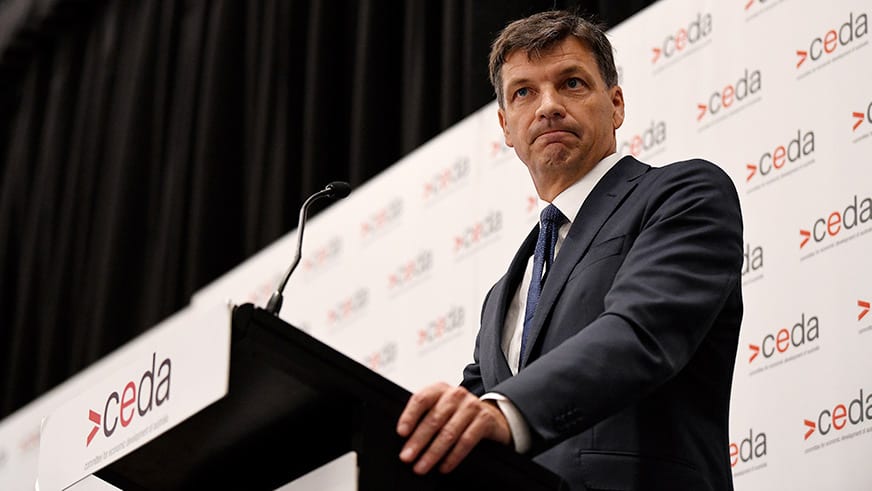
Minister for Energy and Emissions Reduction Angus Taylor during his address to the National Press Club. Credit: Alex Ellinghausen

"But we are not facing a modest long-term problem, [in climate change] we have an immediate large-scale problem.”

The new elements outlined by Energy and Emissions Reduction Minister Angus Taylor on Tuesday, “do not match the urgency of that problem,” says Jotzo.

Central to Taylor’s speech was the announcement of a hierarchy of funding priorities. Technologies seen as not yet mature but with the potential to have “transformational impacts” in reducing Australian carbon emissions and benefiting the broader economy will be placed at the top.

Technologies judged to be no longer in need of government support – such as coal, gas, wind and solar – are ranked last and would only attract funding in the event of market failure.

In energy and reductions policy, Taylor said the nation needs "more horses in the race" and identified clean hydrogen, electricity from storage [such as batteries], the development of processes to make low carbon steel and aluminium, carbon capture and storage, and increasing the carbon content of soil in agriculture as tier one priorities.

The problem is that the Intergovernmental Panel on Climate Change says that the world must start significantly reducing carbon emissions now if it is to reach net zero emissions by 2050 and set a pathway to keeping global warming as close to 1.5 degrees as possible.

Many experts propose that to meet these targets nations should be aiming to cut their emissions in half by 2030 and in half again by 2040.

By then the key technologies identified may not yet have reached scale. Clean hydrogen may need years of work in the development of electrolyzers to produce the gas.

Green steel, says Jotzo, has huge potential for reducing Australian emissions and boosting our industrial output but could still be 20 years away.

Tony Wood, director of the energy program at The Grattan Institute says he is inclined to “give the government the benefit of the doubt” for the plan. He says the technologies identified by Taylor are those he would pick.

“Of course any one of those horses could turn out to be a dog, and the government is going to have to be disciplined about killing it off and taking it to the knackery if that happens,” he says.

He acknowledged the monumental political problem Prime Minister Scott Morrison and Taylor face in corralling their party room to support any carbon abatement plan.

Perhaps most crucially he says there is potential for carbon abatement to accelerate once breakthroughs are made, especially given the huge amount of resources going into it around the world.

But both men are frustrated by what is not in the plan.

A carbon pricing mechanism – either in the form of a carbon tax or incentives paid to clean industry actors – would significantly speed up the transition to clean, they say.

“You could just stick all the policies we’ve tried over the years on a dartboard and pick one,” says Wood. “They work.”

Similarly, there is no incentive mechanism to drive coal out of Australia’s energy system. At present major coal-fired power stations are still expected to be churning away as late as 2048.

A plan with a spirit of urgency would include these measures, Jotzo says.

Links

(AU) A Policy Of The Fossil Fuel Companies, By The Fossil Fuel Companies, For The Fossil Fuel Companies

Crikey - 

The government's energy policy has been written by fossil fuel companies, to promote the scams of the fossil fuel companies, with taxpayers handing money to fossil fuel companies.

Energy Minister Angus Taylor (Image: AAP/Mick Tsikas)

We’ve reported it before, but there’s no reason to stop reporting it if they continue to offer up evidence for it: the Morrison government is a clutch of climate denialists eager to reward its major donors in the resources sector as much as it possibly can without incurring political damage.

Its “Low Emissions Technology Statement” and its commitment of $1.9 billion to support it has been crafted with that goal in mind. All the chin-stroking commentary from the Press Gallery about how the government has abandoned coal won’t change that.

The statement was literally written by fossil fuel company executives: the panellists who advised on the statement include former Origin CEO and former head of the climate denialist Business Council, Grant King; and the CEO of the Gas Infrastructure Group, Ben Wilson, along with another BCA director, Coca-Cola’s Alison Watkins, who is also a director of the Centre for Independent Studies, which has hosted climate sceptics.

The statement itself is aimless: it offers no hard targets of any kind. The real purpose is the promotion of carbon capture and storage, a repeatedly debunked myth peddled by fossil fuel companies, to the status of a foundational goal of Australian energy policy.

There it is on page five: the four “Big Technology Challenges” guiding the statement are “more affordable, clean and reliable energy to households and industry”, “expanding production and increasing productivity”, “preserving and expanding onshore manufacturing of energy-intensive products” and “scaling geological and biological sequestration”.

They may as well have included giant orbital sunshields as the fifth challenge, for all that sequestration will ever be a workable climate strategy.

Even the statement admits, quietly, that carbon capture and storage doesn’t work unless you have a pure stream of carbon dioxide to easily bottle and store. There’s a “stretch goal” of $20 per-tonne of CO2 for this, but that “does not cover capture processes, noting the cost of capture technologies varies between applications and depends on factors such as the relative concentration of CO2 produced by an industrial process”.

Even so, the government intends multiple mechanisms for handing taxpayer funding to fossil fuel companies in the name of CCS. There will be a “King Review Co-Investment Fund” — reflecting that a review of the government’s discredited Emissions Reduction Fund run by King and another fossil fuel industry executive, which recommended the fund embrace CCS, a “CCS Deployment Fund”, as well as “Emissions Reduction Fund methods to support CCS and soil carbon within 12 months”.

Soil carbon — or, more correctly, “soil magic”, The Guardian’s Lenore Taylor’s term — is another scam that has seen huge amounts of taxpayer money directed to companies undertaking projects they would have undertaken anyway, and farmers claiming that they can permanently store carbon despite no evidence they can do so. Unsurprisingly, Australia’s emissions surged the Abbott government abolished the carbon pricing scheme and established the Emissions Reduction Fund.

To do this, the government will not merely need to remove the legislative limitation on the independent Clean Energy Finance Corporation and the Australian Renewable Energy Agency that limits them to renewable and other forms of clean energy. It also promises it will force them to invest in non-renewables and scams like CCS and soil carbon. Angus Taylor’s plan promises the government will be “requiring key agencies (ARENA, CEFC and the CER) to focus on accelerating the priority technologies”.

That’s more or less all you need to know: an “energy” plan written by fossil fuel executives elevates fossil fuel industry scams to the foundation of Australian energy policy, with a government commitment to force independent renewable energy investment and program administration bodies to waste money of them, to the benefit of fossil fuel companies.

There’s probably a simpler word for it: fraud. And it comes at the expense not merely of taxpayers but of the generations to come who will suffer from our climate denialism.

Links

23/09/2020

(AU) Taylor Favours Fossil Fuels And Farmers As Roadmap Picks Five Technology Winners

RenewEconomy - 

AAP Image/Bianca De Marchi

The Morrison government has picked five technologies that will receive prioritised support under its Technology Roadmap launched on Tuesday, a plan which includes no new emissions reduction targets but which it supposed to form the basis of its climate and energy policy.

Federal energy and emissions reduction minister Angus Taylor launched the Technology Roadmap during a speech to the National Press Club in Canberra on Tuesday, with the focus firmly on technologies that favour fossil fuels, farmers and big energy users such as steel and aluminium users.

The Technology Roadmap is the latest energy policy from the Coalition, which has gone through more than 20 iterations during seven years of government, and continues its trend of preferring to direct taxpayer funding into preferred technologies, rather than policies that place a price on emissions.

“Let’s be clear – there are only two ways to reduce emissions,” Taylor said in a speech to the National Press Club on Tuesday.

“You either suppress emissions intensive economic activities – usually through some version of taxation – or you improve them. There is no third way. Australia can’t and shouldn’t damage its economy to reduce emissions.”

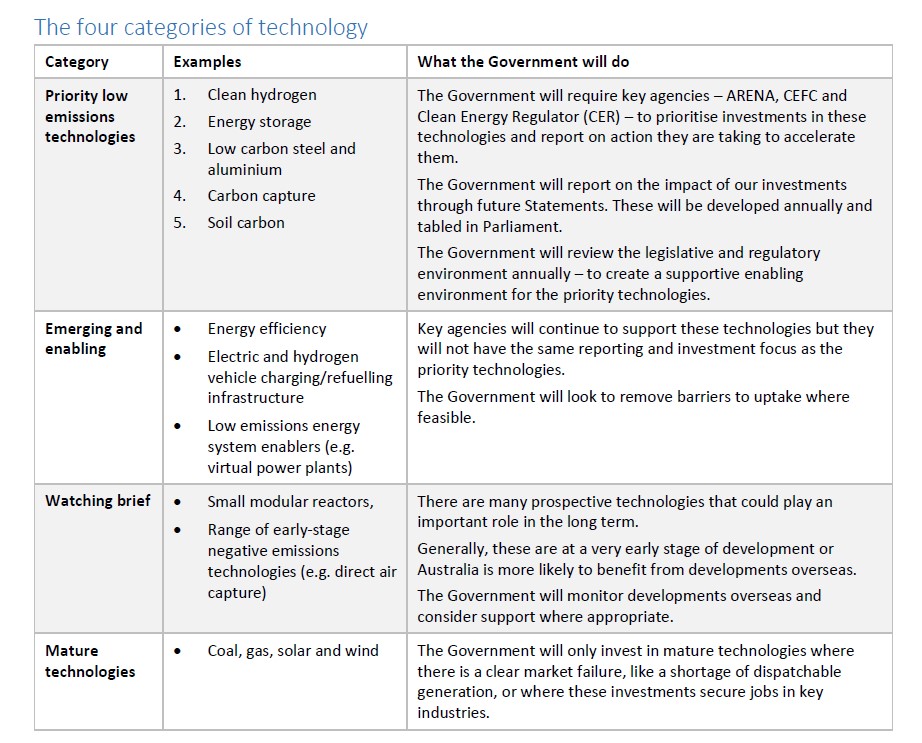
Taylor said that the government will focus on five priority technologies that will receive targeted government investment, being “clean” hydrogen, energy storage, low carbon steel and aluminium, carbon capture and storage, and soil carbon.

The government’s list of technologies under the Technology Roadmap, obtained by RenewEconomy. LARGE IMAGE

The focus on “clean hydrogen”, rather than specifically renewable hydrogen, and the renewed embrace of CCS are of particular concern as they will likely favour legacy fossil technologies. Other technologies such as electric vehicles and batteries are now second order priorities, will wind and solar are lumped with coal and gas as “mature technologies” that will receive no further support.

“Priority technologies are those expected to have transformational impacts here and globally and are not yet mature,” Taylor told the National Press Club.

“They are priorities where Government investments can make a difference in reducing costs and improving technology readiness.”

“Technologies where we, as a Government, will not only prioritise our investments but where we will streamline regulation and legislation to encourage investment,” Taylor said.

Under the Technology Roadmap, the Morrison government will monitor a number of emerging technologies, including small modular nuclear reactors, which may also receive government support pending future developments overseas.

Taylor said that the Technology Roadmap would be used to guide up to $18 billion in investment, but it is unclear how much of this – if any – is new funding, and how much will actually be able to be deployed by the main agency, the Clean Energy Finance Corp.

“The roadmap will guide the deployment of the $18 billion that will be invested, including through the CEFC, ARENA, the Climate Solutions Fund and the CER,” Taylor said.

“This will turn that into at least $50 billion through the private sector, state governments, research institutions and other publicly funded bodies. That will drive around 130 000 jobs to 2030.”

CEFC already manages $10 billion in funds, along with an additional $1 billion set to be allocated under the Grid Reliability Fund, ARENA already manages a $2 billion in grant funding, with an additional $1.9 billion set to be given to the agency and the Clean Energy Regulator already manages the $2 billion Climate Solutions Fund.

Taylor said that the government expects the plan to “support” 130,000 jobs by 2030 and to “avoid” 250 million tonnes of emissions per year by 2040, but it is also unclear how these figures have been calculated.

The government has set itself a series of four ‘stretch goals’, which do not include an emissions reduction target, but set goals for reducing the cost of the government’s ‘priority technologies’.

These stretch goals include achieving long-term (at least eight to ten hours) energy storage at an equivalent cost of less than $100 per MWh, carbon dioxide storage at less than $20 per tonne, low emissions steel below $900 per tonne and aluminium below $2,700 per tonne and the ability to measure soil carbon content at below $3 per hectare per year.

With no additional emissions reduction targets specified under the roadmap, the government appears set to present the roadmap, and a series of future ‘Low Emissions Technology Statements’, as its future action pledge in international climate talks.

Taylor suggested that the government would wind back support for investments in wind and solar projects, lumping them together with coal and gas, but would consider intervening in the market when there are market failures.

“There is no doubt that existing, proven technologies like coal, gas, solar and wind will play important roles in Australia’s energy future,” Taylor told the Press Club.

“The Government will continue to invest in mature technologies where there is a clear market failure, like a shortage of dispatchable generation.”

Prime minister Scott Morrison has already indicated that he may use government-owned Snowy Hydro to build a new gas generator in the Hunter Region, a market intervention that ha not been received well by the rest of the energy market.

Labor’s shadow minister for climate change and energy, Mark Butler, said that the technology roadmap lacked the policies needed to actually drive investment and the guide Australia’s energy transition.

“This is typical Scott Morrison – another plan to have a plan but no actual policy,” Butler said. “No policy to help reduce power prices. No policy to give investors the confidence to build new generation and ensure reliable energy.”

“This technology roadmap is useful as far as it goes but there is no shortage of reports lining government bookcases about energy technology, all of which confirm that the cheapest and the cleanest way to renew our ageing, increasingly unreliable electricity system is renewable energy and storage.”

“What Australia has desperately needed is a genuine energy policy to drive investment in affordable, reliable, clean power.”

Taylor said that the government will establish an ongoing advisory council, the Technology Investment Advisory Council, to advise in the development of the ‘Low Emissions Technology Statements’, which will be chaired by chief scientist Dr Alan Finkel.

Membership of the council will include the heads of the CEFC, ARENA and the Clean Energy Regulator, along with those that advised on the creation of the technology roadmap.

This group includes former Origin Energy CEO Grant King, CEO of Australian Gas Infrastructure Group Ben Wilson, the group managing director of Coca-Cola Amatil Alison Watkins and CEO of Macquarie Group Shemara Wikramanayake.

The advisory group will not include any representatives of the clean energy sector, outside those appointed by the government to head the three government agencies.

Links

The Tipping Points At The Heart Of The Climate Crisis

The Guardian - 

Many parts of the Earth’s climate system have been destabilised by warming, from ice sheets and ocean currents to the Amazon rainforest – and scientists believe that if one collapses others could follow

The Thwaites glacier in Antarctica, where ice is now melting on a massive scale. Photograph: Nasa/OIB/Jeremy Harbeck/EPA

The warning signs are flashing red. The California wildfires were surely made worse by the impacts of global heating. A study published in July warned that the Arctic is undergoing “an abrupt climate change event” that will probably lead to dramatic changes. 

As if to underline the point, on 14 September it was reported that a huge ice shelf in northeast Greenland had torn itself apart, worn away by warm waters lapping in from beneath.

That same day, a study of satellite data revealed growing cracks and crevasses in the ice shelves protecting two of Antarctica’s largest glaciers – indicating that those shelves could also break apart, leaving the glaciers exposed and liable to melt, contributing to sea-level rise. The ice losses are already following our worst-case scenarios.

These developments show that the harmful impacts of global heating are mounting, and should be a prompt to urgent action to cut greenhouse gas emissions. But the case for emissions cuts is actually even stronger.

That is because scientists are increasingly concerned that the global climate might lurch from its current state into something wholly new – which humans have no experience dealing with. Many parts of the Earth system are unstable. Once one falls, it could trigger a cascade like falling dominoes.

Tipping points

We have known for years that many parts of the climate have so-called tipping points. That means a gentle push, like a slow and steady warming, can cause them to change in a big way that is wholly disproportionate to the trigger. If we hit one of these tipping points, we may not have any practical way to stop the unfolding consequences.

The Greenland ice sheet is one example of a tipping point. It contains enough ice to raise global sea levels by seven metres, if it were all to melt. And it is prone to runaway melting.

This is because the top surface of the ice sheet is gradually getting lower as more of the ice melts, says Ricarda Winkelmann of the Potsdam Institute for Climate Impact Research in Germany. The result is familiar to anyone who has walked in mountains.

“If we climb down the mountain, the temperature around us warms up,” she says. As the ice sheet gets lower, the temperatures at the surface get higher, leading to even more melting. “That’s one of these self-reinforcing or accelerating feedbacks.”

We don’t know exactly how much warming would cause Greenland to pass its tipping point and begin melting unstoppably. One study estimated that it would take just 1.6C of warming – and we have already warmed the planet 1.1C since the late 19th century.

The collapse would take centuries, which is some comfort, but such collapses are difficult to turn off. Perhaps we could swiftly cool the planet to below the 1.6C threshold, but that would not suffice, as Greenland would be melting uncontrollably. Instead, says Winkelmann, we would have to cool things down much more – it’s not clear by how much.

Tipping points that behave like this are sometimes described as “irreversible”, which is confusing; in reality they can be reversed, but it takes a much bigger push than the one that set them off in the first place.

Satellite images of the disintegration of the Spalte glacier in northeast Greenland between 2013 and 2020. Photograph: EU Copernicus and Geus/Reuters LARGE IMAGE

In 2008, researchers led by Timothy Lenton, now at the University of Exeter, catalogued the climate’s main “tipping elements”. As well as the Greenland ice sheet, the Antarctic ice sheet is also prone to unstoppable collapse – as is the Amazon rainforest, which could die back and be replaced with grasslands.

A particularly important tipping element is the vast ocean current known as the Atlantic meridional overturning circulation (AMOC), which carries warm equatorial water north to the Arctic, and cool Arctic water south to the equator. The AMOC has collapsed in the past and many scientists fear it is close to collapsing again – an event that was depicted (in ridiculously exaggerated and accelerated form) in the 2004 film The Day After Tomorrow.

If the AMOC collapses, it will transform weather patterns around the globe – leading to cooler climates in Europe, or at least less warming, and changing where and when monsoon rains fall in the tropics. For the UK, this could mean the end of most arable farming, according to a paper Lenton and others published in January.

Tumbling dominoes

In 2009, a second study took the idea further. What if the tipping elements are interconnected? That would mean that setting off one might set off another – or even unleash a cascade of dramatic changes, spreading around the globe and reshaping the world we live in.

For instance, the melting of the Greenland ice sheet is releasing huge volumes of cold, fresh water into the north Atlantic. This weakens the AMOC – so it is distinctly possible that if Greenland passes its tipping point, the resulting melt will push the AMOC past its own threshold.

“It’s the same exact principles that we know happen at smaller scales,” says Katharine Suding of the University of Colorado, Boulder, who has studied similar shifts in ecosystems. The key point is that processes exist that can amplify a small initial change. This can be true on the scale of a single meadow or the whole planet.

However, the tipping point cascade is very difficult to simulate. In many cases the feedbacks go both ways – and sometimes one tipping point can make it less likely that another will be triggered, not more. For example, the AMOC brings warm water from equator up into the north Atlantic, contributing to the melting of Greenland.

So if the AMOC were to collapse, that northward flow of warm water would cease – and Greenland’s ice would be less likely to start collapsing. Depending whether Greenland or the AMOC hit its tipping point first, the resulting cascade would be very different.

What’s more, dozens of such linkages are now known, and some of them span huge distances. “Melting the ice sheet on one pole raises sea level,” says Lenton, and the rise is greatest at the opposite pole. “Say you’re melting Greenland and you raise the sea level under the ice shelves of Antarctica,” he says. That would send ever more warm water lapping around Antarctica. “You’re going to weaken those ice shelves.”

“Even if the distance is quite far, a larger domino might still be able to cause the next one to tip over,” says Winkelmann.

In 2018, Juan Rocha of the Stockholm Resilience Centre in Sweden and his colleagues mapped out all the known links between tipping points. However, Rocha says the strengths of the interconnections are still largely unknown.

This, combined with the sheer number of them, and the interactions between the climate and the biosphere, means predicting the Earth’s overall response to our greenhouse gas emissions is very tricky.

Into the hothouse

The most worrying possibility is that setting off one tipping point could unleash several of the others, pushing Earth’s climate into a new state that it has not experienced for millions of years.

Since before humans existed, Earth has had an “icehouse” climate, meaning there is permanent ice at both poles. But millions of years ago, the climate was in a “hothouse” state: there was no permanent polar ice, and the planet was many degrees warmer.

‘Hothouse’ conditions will make fires such as this one in the San Gabriel mountains above Azusa, California, in August more frequent. Photograph: Apu Gomes/AFP/Getty Images

If it has happened before, could it happen again? In 2018, researchers including Lenton and Winkelmann explored the question in a much-discussed study.

“The Earth System may be approaching a planetary threshold that could lock in a continuing rapid pathway toward much hotter conditions – Hothouse Earth,” they wrote. The danger threshold might be only decades away at current rates of warming.

Lenton says the jury is still out on whether this global threshold exists, let alone how close it is, but that it is not something that should be dismissed out of hand.

“For me, the strongest evidence base at the moment is for the idea that we could be committing to a ‘wethouse’, rather than a hothouse,” says Lenton. “We could see a cascade of ice sheet collapses.”

This would lead to “a world that has no substantive ice in the northern hemisphere and a lot less over Antarctica, and the sea level is 10 to 20 metres higher”.

Such a rise would be enough to swamp many coastal megacities, unless they were protected. The destruction of both the polar ice sheets would be mediated by the weakening or collapse of the AMOC, which would also weaken the Indian monsoon and disrupt the west African one.

Winkelmann’s team studied a similar scenario in a study published online in April, which has not yet been peer-reviewed.

They simulated the interactions between the Greenland and west Antarctic ice sheets, the AMOC, the Amazon rainforest and another major weather system called the El Niño southern oscillation. They found that the two ice sheets were the most likely to trigger cascades, and the AMOC then transmitted their effects around the globe.

What to do?

Everyone who studies tipping point cascades agrees on two key points. The first is that it is crucial not to become disheartened by the magnitude of the risks; it is still possible to avoid knocking over the dominoes. Second, we should not wait for precise knowledge of exactly where the tipping points lie – which has proved difficult to determine, and might not come until it’s too late.

Rocha compares it to smoking. “Smoking causes cancer,” he says, “but it’s very difficult for a doctor to nail down how many cigarettes you need to smoke to get cancer.”

Some people are more susceptible than others, based on a range of factors from genetics to the level of air pollution where they live. But this does not mean it is a good idea to play chicken with your lungs by continuing to smoke.

“Don’t smoke long-term, because you might be committing to something you don’t want to,” says Rocha. The same logic applies to the climate dominoes. “If it happens, it’s going to be really costly and hard to recover, therefore we should not disturb those thresholds.”

“I think a precautionary principle probably is the best step forward for us, especially when we’re dealing with a system that we know has a lot of feedbacks and interconnections,” agrees Suding.

“These are huge risks we’re playing with, in their potential impacts,” says Lenton. “This is yet another compulsion to get ourselves weaned off fossil fuels as fast as possible and on to clean energy, and sort out some other sources of greenhouse gases like diets and land use,” says Lenton. He emphasises that the tipping points for the two great ice sheets may well lie between 1C and 2C of warming.

“We actually do need the Paris climate accord,” says Winkelmann. The 2016 agreement committed most countries to limit warming to 1.5 to 2C, although the US president, Donald Trump, has since chosen to pull the US out of it.

Winkelmann argues that 1.5C is the right target, because it takes into account the existence of the tipping points and gives the best chance of avoiding them. “For some of these tipping elements,” she says, “we’re already in that danger zone.”

Cutting greenhouse gas emissions is not a surprising or original solution. But it is our best chance to stop the warning signs flashing red.

Links

(AU) Australia’s New National Preventive Health Strategy Must Include Climate Change, 30 Health Groups Say

NEWS.com.au - Charis Chang

A huge group of experts are going public with dire concerns the Federal Government is ignoring the biggest threat to Australians’ health.

Climate change must be acknowledged as a significant health risk in Australia, experts say. Source: News Regional Media 

A new strategy aimed at improving the health of Australians must include the impacts of climate change, according to 30 prominent health groups.

Experts say the impact of climate change is being ignored despite predictions that it will lead to 85 deaths per 100,000 people globally per year by the end of the century – more than are currently killed by all infectious diseases across the world.

Climate and Health Alliance Executive Director Fiona Armstrong said climate change would see thousands more Australians suffer from infectious and cardiovascular diseases, respiratory illness, heat stress, mental illness, violence, food insecurity, poor water quality and poorer nutrition.

“If the government chooses to ignore the health impacts of climate change, they are refusing to prevent that,” she said.

The Federal Government is currently developing the National Preventive Health Strategy to identify areas of focus for the next 10 years that will improve the health of Australians and to address the complex causes of things like obesity, reducing tobacco use, or improving mental health.

It aims to looks at factors such as access to green space, nutritious food supply, sanitation, supportive community networks and how cultural influences can contribute to better outcomes.

But health groups, including three groups that are part of the expert steering committee advising the government on the strategy, have released a joint statement today criticising the failure of the consultation paper to mention climate change, or include it as part of its six focus areas.

The Public Health Association of Australia, Consumers Health Forum of Australia and the Australian College of Nursing are all now going public with their concerns.

“As with unhealthy food, pharmaceuticals, tobacco, and alcohol, it is critical that the role of vested interests in relation to climate change is identified as undermining efforts to prevent illness and promote health and wellbeing,” the statement says.

It notes that climate change can impact impact people’s health in many ways.

This includes the impacts of extreme weather events such as heatwaves, floods and bushfires, which pose a direct threat to people’s lives.

Images of the Sydney Opera House shrouded by smoke haze from bushfires over last summer went around the world. Picture: Steven Saphore/AAP

But there are also other indirect impacts. Worsening air quality from smoke can create health risks, and there can also be impacts due to changes in temperature, risks to food safety and drinking water quality, and effects on mental health.

The World Health Organisation (WHO) has estimated 250,000 extra deaths a year are expected to be caused by climate change between 2030 and 2050.

This includes 38,000 extra deaths from heat stress as well as deaths from diarrhoea, malaria and malnutrition.

Elderly people in particular are susceptible to high temperatures, which can cause deaths from cardiovascular and respiratory disease.

Floods can contaminate freshwater supplies, heighten the risk of waterborne diseases, and create breeding grounds for disease-carrying insects such as mosquitoes. They can also disrupt the delivery of medical and health services.

Ms Armstrong said climate change was the biggest threat to health this century.

“The National Preventive Health Strategy must tackle climate change to protect and promote health. If we don’t, everything else risks being done for nought,” she said.

Other groups that have signed the statement include Royal Australian College of General Practitioners (RACGP), Australian Nursing and Midwifery Federation (ANMF), Australian Healthcare and Hospitals Association (AHHA) and the Australian Association of Social Workers (AASW).

The elderly are particularly susceptible to high temperatures. Source: Supplied

“A National Preventive Health Strategy that is fit for purpose in the 21st century must address climate change – or it will fail in its objectives,” the statement says.

“Preventing deaths, illnesses and injuries associated with climate change requires leadership from governments to tackle the root causes of climate change, support the health sector and the health professions to build climate resilience, and ensure the community is well informed and capable of taking health protective actions.”

A University of Melbourne study released this month found the annual economic damage of climate change in Australia, could be similar to the annual cost of the coronavirus pandemic by 2038.

Climate change is estimated to cost the Australian economy at least $1.89 trillion over the next 30 years if current emissions policies are maintained.

Health Minister Greg Hunt announced in June 2019 the government would develop the 10-year strategy and it is due to be completed by March 2021.

The consultation paper will set out what the strategy will aim to achieve and how it could be done. Rather than focusing on specific diseases, the strategy will focus on system wide, evidence-based approaches to reducing poor health.

The strategy’s consultation paper is open for feedback until September 28.

Links

22/09/2020

(AU) Scott Morrison Refuses To Commit To Net Zero Carbon Emissions By 2050

ABC News - Stephanie Dalzell

Scott Morrison says he is focused on technology that lowers emissions rather than "the politics of these commitments".


Prime Minister Scott Morrison has refused to commit to a target of net zero carbon emissions by 2050, despite describing it as "achievable".

Ahead of the release of the Federal Government's long-awaited technology roadmap for the energy sector this week, Mr Morrison said zero net emissions would be achieved in the second half of this century.

But when pressed by ABC Insiders host David Speers about a commitment to a 2050 target, Mr Morrison said he was more committed to investing in technology.

"I'm more interested in the doing," he said.

"I know people get very focused on the politics of these commitments, but what I'm focused on is on the technology that delivers lower emissions, lower cost and more jobs.

"That's what actually matters to people, that's what changes their lives, and so that's what we're delivering. And when we make a commitment, we meet it. And we don't just meet it we beat it."

Net zero emissions means every tonne of man-made greenhouse gas that is emitted must be matched by a tonne removed from the atmosphere.

Anthony Albanese has restated Labor's pledge to reach net zero carbon emissions by 2050. (AAP: Bianca De Marchi)

More than 70 countries have adopted the 2050 target. Individually, every Australian state has also signed up to net zero emissions by 2050 — either as a target or goal.

Labor leader Anthony Albanese has also pledged to meet a target of net zero emissions by 2050 but has yet to detail how Australia would get there.

But federally, the Coalition has long been divided over climate change and energy policy, with some Government backbenchers deeply opposed to any 2050 target.

It has also previously said it will not sign up to net zero emissions without knowing what the costs are.

The Coalition last week announced it would broaden the scope of government agencies set up to invest in renewables, by allowing it to fund new low-emissions technology.

Mr Morrison said the policy would help the Government achieve the target of net zero emissions, without specifically mandating it.

"Our policy is to achieve that in the second half of this century, and we'll certainly achieve that, and that's why this week's announcements were so important because it was about the technology we need to invest in now, which will make it a reality, particularly on the other side of 2030 and I think even the sort of target you've talked about, then becomes absolutely achievable," he said.

"I'm interested in doing the things that make that happen. And I think that is very achievable."

Mr Albanese said the Coalition was still struggling to settle on energy policy, sending the wrong signal to investors.

"The problem with the Prime Minister's position is that he's creating massive uncertainty as well, which is a disincentive to invest," he said.

"The Government says they're going to have a roadmap — but to a destination they don't have.

"A roadmap without a destination is a road to nowhere."

Energy shortfall revised down

Last week, Energy Minister Angus Taylor and Mr Morrison said 1,000 megawatts of new dispatchable energy was needed to replace the Liddell power station before it closed in 2023.


Gas-fired path to COVID recovery?
The Federal Government's National COVID Coordination Commission has a lot of gas industry players involved, and it appears to be showing in its policy recommendations. Read more

But the Government then released the advice it received in April from a task force set up to assess the impact of Liddell's closure, which did not find that 1,000 megawatts of additional dispatchable electricity would be needed, and instead, listed projects that would be sufficient to maintain power grid reliability when Liddell shut.

On Insiders, Mr Morrison appeared to revise the figure down.

"Well, there's about 250 megawatts, or thereabouts, that we believe are going to be necessary to fill that plan out. And we can do that, and deliver it on the ground, and that's important," he said.

"A lot of people can talk projects but they've got to get approved, they've got to be built in time, and you can get a gas-fired power station built in that time and delivered when it'll be there. It won't be on the wish list, it'll be on the done list."

Mr Albanese accused the Government of constantly changing its position on energy policy.

"Now Scott Morrison is saying it might be 250 [megawatts] that's needed, and we're neutral about what the technology will be to fill that void," he said.

"The Prime Minister has to explain how it is that people, companies, can bid for that process."

Links

Lethal Heating is a citizens' initiative