26/10/2020

(AU) Early Warning: Human Detectors, Drones And The Race To Control Australia’s Extreme Bushfires

The Guardian - 

For a century, humans high up in fire towers have sounded the alarm. But breakthroughs in technology may offer something more

Nick Dutton, fire tower operator, Rural Fire Service in the Kowen Forest fire tower near Canberra. Photograph: Mike Bowers/The Guardian

Perched in his fire tower high above the pine trees, Nick Dutton leans back and nods to the cascading hills and mountains behind him.

“I love being out here, just away from stuff,” he says. “I mean, you can’t really complain.”

Dutton, a fire tower operator, is sitting in his office, a tiny cabin propped high above the treetops by metal supports that sway with the wind.

His walls are littered with compass points and references, each a guide to the bush stretching in every direction along the eastern ACT-NSW border.

Every day, Dutton climbs into one of the ACT’s four towers, armed with binoculars, a radio, and his notebook, keeping a watchful eye for the faintest wisp of smoke rising in the distance.

The mind can easily deceive.

Stare at a spot too intently, you’ll see smoke, Dutton says.

“With a little bit of experience up here, you get used to what is and what isn’t smoke,” he says.

“Some people when they first start find it hard to discern dust from smoke.

But smoke does have its own characteristics and you do learn to pick that out.”

It’s a lonely assignment.

The days are long and quiet, narrated by birdsong from the surrounding pine forest and punctuated by hourly weather reports back to headquarters. Human encounters are typically limited to the odd buzzing of radio chatter and errant bushwalkers.

“You really have to love being alone to do this,” he says. “I think that’s the main trait, if you hate being by yourself and not talking to anyone, you won’t survive.”

Dutton’s is an increasingly rare occupation.

Towers like the one in Kowen Forest are the oldest continuing method of bushfire detection and monitoring, used in Australia since the early 1900s.

Nick Dutton surveys the landscape at the Kowen Forest fire tower near Canberra. Photograph: Mike Bowers/The Guardian


Victoria still has more than 70 towers, Western Australia’s parks department operates 13 and NSW forestry authorities operate a network of almost 50.

But their use is in decline.

In the US, where lonesome observers are known unofficially as “freaks on the peaks”, there were almost 10,000 staffed fire towers in the 1950s.

Now, there’s just a few hundred.

The decline has been driven by rapid advances in technology, and the emergence of automated cameras, sensory technology, and more accurate satellite imagery.

At the same time, worsening bushfire conditions, driven by climate change, have demanded faster, more efficient detection and monitoring technology.

The shifts beg the question: is there still a place in modern firefighting for the observer in the fire tower?

Satellites, cameras and drones: striving for real-time detection

In the 1980s, a remarkable breakthrough in fire detection was made.

US researchers noticed tiny white specks on a satellite image of the Persian Gulf captured by the National Oceanic and Atmospheric Administration’s polar orbiting environmental satellites.

Those white specks were the thermal signatures of gas flares from oilfields.

They were the first active fires ever recorded from space.

The discovery promised new space-based potential to find and watch bushfires.

At first, the results were mixed. The systems were unable to differentiate a bushfire from oilfields.

But the technology was refined, the processing algorithms improved, and more specialised sensors and satellites were brought into the mix.

View over the pine plantation from the Kowen Forest fire tower near Canberra. Photograph: Mike Bowers/The Guardian


A sensor known as the moderate resolution imaging spectroradiometer, placed aboard Nasa’s Terra and Aqua satellites, is now able to capture red “hotspots”.

The hotspots, seen in satellite imagery during last season’s horror bushfires, mark where marking the satellite sensor’s thermal bands detect high temperatures.

The accuracy, while not perfect, is now vastly improved and the technology continues to move at pace.

Earlier this year, a start-up named Fireball International, co-founded by University of Southern Queensland researcher Christopher Tylor said it had developed technology that fused satellite and tower sensors to detect a wildfire in California about 66 seconds after power lines fell and caused ignition.

Andrew Forrest’s Minderoo foundation is also proposing to use satellites, infrared sensors, and drones to identify and extinguish fires within an hour by 2025, through its $70m grant to the “Fire Shield” program.

The project is currently collaborating with fire towers like the one at Kowen Forest.

Companies like Ninox Robotics have proposed using a fleet of long-range drones equipped with advanced cameras accompanied by machine-learning algorithms to detect and monitor active fires.

Ninox believes the entire state of New South Wales can be monitored from 20 sites, using one active drone each.

Climate change, the worsening bushfire threat and ‘fast-attack’ strategies

The deployment of new technology would be most welcome in Australia.

The nation is now experiencing extreme bushfires at three times the rate it did a century ago and the climate crisis has brought new urgency to efforts to improve firefighting methods, including early detection.

Earlier this year, former commissioner of Fire and Rescue NSW, Greg Mullins, and 32 other former emergency services leaders told the bushfire royal commission that Australia should adopt “fast-attack strategies”, based on detection by remote cameras, satellite images and spotter flights.

Early detection should be complemented by mid-sized and purpose-built water bombers with the aim of extinguishing fires within 24 hours, they argued.

Nick Dutton believes detection technology will one day render fire towers unnecessary. Photograph: Mike Bowers/The Guardian


“Every big fire was once a small fire,” Mullins told the Guardian at the time. “It’s very much like a military operation with eyes in the sky, with your ground troops that are backed up with some artillery.”

Even before the release of its final report, the royal commission has urged federal, state, and territory governments work together to fast-track advances to spatial technology to help “detect ignitions and monitor accurately all fire edge intensity and progression automatically across the nation in near real time”, the royal commission said.

The benefits of real-time detection are obvious. Shorten the time between ignition and a fire crews’ first attack, and the prospects of containing a fire are greatly improved.

Not only does early detection save lives, but it has the potential to save the Australian economy billions of dollars.

Earlier this year, researchers at the Australian National University estimated an effective early detection system could save the economy an estimated $2.2bn a year over 30 years.

“In our view, the large sums that result from our conservative estimates make investments and improvements in early detection financially very viable,” the authors concluded.

Mark Crosweller, the former head of Emergency Management Australia and the National Resilience Taskforce, said that detection, while important, should not be the main focus for Australia.
Because at the end of the day, the human eye is going to be much better.
Nick Dutton
Crosweller said the common failure, seen in disaster after disaster, was one of situational awareness. Knowing where the fire is and where it’s going to go.

That failing was exposed with fatal consequences during the 2003 bushfires in Canberra, when a blaze burning in the mountains for more than a week ripped through the city without any proper warning to residents.

“They still have the same problem,” he said. “The industry is still fundamentally relying on human-centred intelligence, so human processing of data.”

The key advantage of more advanced sensory technology is its ability to feed into artificial intelligence and machine learning systems, which can then provide fast, accurate models to predict a fire’s behaviour.

“Sensory technology has the capacity to collect enormous amounts of data, but it needs to be machine analysed,” he said. “You still need a human to make a decision, but the machine can do the analysis work infinitely faster than a human can.”

“So I think it is the way of the future. And I think the future is now. I don’t think we have to wait any longer.”

The value of the human eye

Human observers, though, are far from obsolete.

In 2010, the CSIRO delivered a remarkable report on detection, comparing newer, automated camera systems with the skills of humans.

The study examined three systems: EYEfi, FireWatch, and Forest Watch, all of which used image analysis from sensors mounted on fixed towers.

The systems were tested for their ability to detect and locate fires, provide information to help with situational awareness, and integrate with emergency services agencies.

The humans won, hands down.
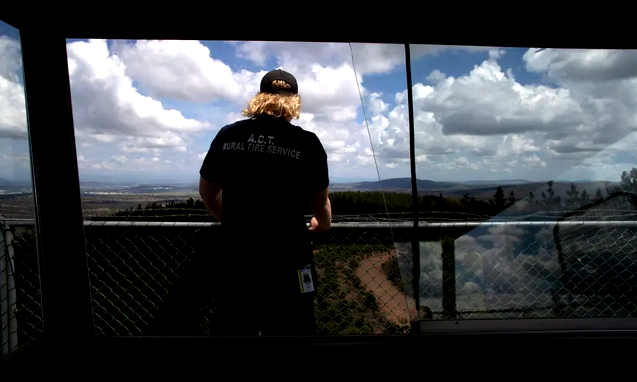
Experts say humans provide a critical second source of intelligence when a heat source is detected. Photograph: Mike Bowers/The Guardian


Six fires were lit intentionally for the study in forests near Tumut.

Tower observers saw all six. Firewatch reported one and Forest Watch reported zero. During the study, a further 250 private burns were conducted by neighbouring landholders.

“The camera systems reported many fires but comparison with tower observations in NSW and cross-referencing between camera reports in Victoria showed that a high proportion of private burns were not reported,” the study found.

The technology has come a long way since 2010.

But even still, Ailish Milner, a strategic planner with the ACT’s Rural Fire Service, believes human observers will have a key role to play in the near future.

Milner says humans provide a critical second source of intelligence when a heat source is detected using satellite or other technology.

“The towers are vital in being able to provide a second source of information,” she told the Guardian. “Being able to talk to the fire towers and say ‘we’ve got this heat source showing, can you see any smoke’ is that second source.”

“It’s all about intelligence. So the more intelligence you get, the more confirmation you have.”

Operators like Dutton don’t just spot fires, either.

Human observers bring their experience and extensive knowledge to contextualise and analyse what they’re observing.

Dutton recalls a recent example when a grassfire burnt through the Canberra suburb of Pialligo.

A colleague was in the tower and observed a strong wind change.

The observer knew the wind change would hit the fireground in Pialligo in a matter of minutes. Headquarters was alerted and crews on scene were informed.

Dutton believes detection technology will one day render fire towers unnecessary.

“But for now, I think you can start implementing the tech but still have the operators to refine the technology.”

“Because at the end of the day, the human eye is going to be much better.”

Crosweller agrees that human observers are still valuable, particularly while the industry still grapples with how to use machine learning and artificial intelligence.

“The better we get at machine learning and artificial intelligence, the better we’ll get at working out where humans fit in those systems,” he says.

“That’s why I wouldn’t exclude the use of people in that context. But it will change.”

Links

The World’s Largest Tropical Wetland Has Become An Inferno

New York Times - Catrin Einhorn | Maria Magdalena Arréllaga | Blacki Migliozzi | 

This year, roughly a quarter of the vast Pantanal wetland in Brazil, one of the most biodiverse places on Earth, has burned in wildfires worsened by climate change. What happens to a rich and unique biome when so much is destroyed?

Pantanal Wetland Fires in 2020
By Scott Reinhard and Blacki Migliozzi.·Protected areas and indigenous territories from the Amazon Geo-Referenced Socio-Environmental Information Network. Source: NASA Fire Information for Resource Management System data as of Oct. 12.  LARGE IMAGE

The unprecedented fires in the wetland have attracted less attention than blazes in Australia, the Western United States and the Amazon, its celebrity sibling to the north. But while the Pantanal is not a global household name, tourists in the know flock there because it is home to exceptionally high concentrations of breathtaking wildlife: Jaguars, tapirs, endangered giant otters and bright blue hyacinth macaws. Like a vast tub, the wetland swells with water during the rainy season and empties out during the dry months. Fittingly, this rhythm has a name that evokes a beating heart: the flood pulse.

The wetland, which is larger than Greece and stretches over parts of Brazil, Paraguay and Bolivia, also offers unseen gifts to a vast swath of South America by regulating the water cycle upon which life depends. Its countless swamps, lagoons and tributaries purify water and help prevent floods and droughts. They also store untold amounts of carbon, helping to stabilize the climate.

For centuries, ranchers have used fire to clear fields and new land. But this year, drought worsened by climate change turned the wetlands into a tinderbox and the fires raged out of control.

Fires raged through the northern Pantanal, in Mato Grosso State, in August. Maria Magdalena Arréllaga for The New York Times LARGE IMAGE


“The extent of fires is staggering,” said Douglas C. Morton, who leads the Biospheric Sciences Laboratory at the NASA Goddard Space Flight Center and studies fire and food production in South America. “When you wipe out a quarter of a biome, you create all kinds of unprecedented circumstances.”

His analysis showed that at least 22 percent of the Pantanal in Brazil has burned since January, with the worst fires, in August and September, blazing for two months straight.

Naturally occurring fire plays a role in the Pantanal, in addition to the burning by ranchers. The flames are usually contained by the landscape’s mosaic of water. But this year’s drought sucked these natural barriers dry. The fires are far worse than any since satellite records began.

2020 is the most active fire year on record for the Pantanal
Note: Cumulative sum of fire detections across the Pantanal Biome. Data as of Oct. 12. Instruments on Terra and Aqua satellites have experienced periodic failures. Source: NASA Terra and Aqua satellite data, based on detections with greater than 95 percent confidence levels.


The fires are also worse than any in the memory of the Guató people, an Indigenous group whose ancestors have lived in the Pantanal for thousands of years.

Guató leaders in an Indigenous territory called Baía dos Guató said the fires spread from the ranches that surround their land, and satellite images confirm that the flames swept in from the outside. When fire started closing in on the home of Sandra Guató Silva, a community leader and healer, she fought to save it with the help of her son, grandson and a boat captain with a hose.

Fires in the Pantanal Protected Areas
By Scott Reinhard and Blacki Migliozzi.·Source: NASA Fire Information for Resource Management System data as of Oct. 12. Protected areas and indigenous territories from Amazon Geo-Referenced Socio-Environmental Information Network. LARGE IMAGE


For many desperate hours, she said, they threw buckets of river water and sprayed the area around the house and its roof of thatched palm leaves. They succeeded in defending it, but at least 85 percent of her people’s territory burned, according to Instituto Centro de Vida, a nonprofit group that monitors land use in the area. Throughout the Pantanal, almost half of the Indigenous lands burned, an investigative journalism organization called Agência Pública found.

Now Ms. Guató Silva mourns the loss of nature itself. “It makes me sick,” she said. “The birds don’t sing anymore. I no longer hear the song of the Chaco chachalaca bird. Even the jaguar that once scared me is suffering. That hurts me. I suffer from depression because of this. Now there is a hollow silence. I feel as though our freedom has left us, has been taken from us with the nature that we have always protected.”

Sandra Guató Silva collected feathers and water hyacinths for a headdress near her home in the Baía dos Guató Indigenous area. Maria Magdalena Arréllaga for The New York Times  LARGE IMAGE

Now these people of the wetlands, some still coughing after weeks of smoke, are depending on donations of water and food. They fear that once the rains come in October, ash will run into the rivers and kill the fish they rely on for their food and livelihood.

“I couldn’t help but think, our Pantanal is dead,” said Eunice Morais de Amorim, another member of the community. “It is so terrible.”

Scientists are scrambling to determine an estimate of animals killed in the fires. While large mammals and birds have suffered casualties, many were able to run or fly away. It appears that reptiles, amphibians and small mammals have fared the worst. In places like California, small animals often take refuge underground during wildfires. But in the Pantanal, scientists say, fires burn underground too, fueled by dried-out wetland vegetation. One of the hard-hit places was a national park designated as a United Nations World Heritage site.

“I don’t want to be an alarmist,” said José Sabino, a biologist at the Anhanguera-Uniderp University in Brazil who studies the Pantanal, “but in a region where 25 percent has burned, there is a huge loss.”

A dead heron in the Baía dos Guató Indigenous area. Maria Magdalena Arréllaga for The New York Times LARGE IMAGE


As the worst flames raged in August and September, biologists, ecotourism guides and other volunteers turned into firefighters, sometimes working 24 hours at a time. Fernando Tortato, a conservation scientist with Panthera, a group that advocates for big cats, visited the Pantanal in early August to install cameras for his research monitoring jaguars and ocelots. But he found the camera sites burned.

“I said to my boss, I need to change my job,” Mr. Tortato said. “I need to be a firefighter.” Instead of returning home to his family, he spent much of the next two months digging fire breaks with a bulldozer in an urgent attempt to protect forested areas.

One day in September, working under an orange sky, he and his team finished a huge semicircular fire break, using a wide river along one side to protect more than 3,000 hectares, he said, a vital refuge for wildlife. But as the men stood there, pleased with their accomplishment, they watched as flaming debris suddenly jumped the river, igniting the area they thought was safe. They raced into boats and tried to douse the spread, but the flames quickly climbed too high.

“That’s the moment that we lost hope, almost,” Mr. Tortato said. “But the next day we woke up and started again.”

A jaguar in the Encontro das Águas State Park, more than 85 percent of which has burned. Maria Magdalena Arréllaga for The New York Times LARGE IMAGE


Mr. Tortato knows of three injured jaguars, one with third-degree burns on her paws. All were treated by veterinarians. Now, biologists are braced for the next wave of deaths from starvation; first the herbivores, left without vegetation, and then the carnivores, left without the herbivores.

“It’s a cascade effect,” Mr. Tortato said.

Animal rescue volunteers have flocked to the Pantanal, delivering injured animals to pop-up veterinary triage stations and leaving food and water for other animals to find. Larissa Pratta Campos, a veterinary student, has helped treat wild boar, marsh deer, birds, primates and a raccoon-like creature called a coati.

“We are working in the middle of a crisis,” Ms. Pratta Campos said. “I have woken up many times in the middle of the night to tend to animals here.”

Last week, the O Globo newspaper reported that firefighting specialists from Brazil's main environmental protection agency were stymied by bureaucratic procedures, delaying their deployment by four months.

Veterinarians and volunteers in Poconé, Mato Grosso, changed the bandages of a coati that was burned. Maria Magdalena Arréllaga for The New York Times LARGE IMAGE


Given the historic scope of the fires, their long-term consequences on the Pantanal are unclear. The ecosystem’s grasslands may recover quickly, followed by its shrublands and swamps over the next few years, said Wolfgang J. Junk, a scientist who specializes in the region. But the forests will require decades or centuries.

Even more critical than the impact of this year’s fires, scientists say, is what they tell us about the underlying health of the wetlands. Like a patient whose high fever signals a dangerous infection, the extent of the wildfires is a symptom of grave threats to the Pantanal, both from inside and out.

More than 90 percent of the Pantanal is privately owned. Ranchers have raised cattle there for hundreds of years, and ecologists emphasize that many do so sustainably. But new farmers are moving in, often with little understanding of how to use fire properly, said Cátia Nunes, a scientist from the Brazilian National Institute for Science and Technology in Wetlands. Moreover, cattle farming in the highlands has put pressure on local farmers to increase the size of their herds, using more land as they do so.

Forests Are Falling, Agriculture Is Rising
Percentage change in Brazilian land use
Source: MapBiomas Project - Collection 5.0 of the Annual Coverage and Land Use LARGE IMAGE

Eduardo Eubank Campos, a fifth-generation rancher, remembers his family using controlled burns to clear the land when he was a boy. He said they stopped after adding an ecotourism lodge to their 7,000 hectare property, which now includes reserves and fields on which they raise about 2,000 head of cattle and horses. 

This year, thanks to firebreaks, a water tank truck and workers quickly trained to fight fire, they were able to keep the flames at bay. The worst impact was on his ecotourism business, hit first by the coronavirus and then by the wildfires. It brings in three-quarters of his revenue.

Mr. Eubank Campos struggles to understand who would set fires when the land was so dry. “Pantaneiros know this is not the time to do burns,” Mr. Eubank Campos said, using a term for the locals that also conveys a culture built up over centuries ranching in the wetland. “They don’t want to destroy their own land.”

The Brazilian federal police are investigating the fires, some of which appear to have been illegally targeting forests.

Still, when asked about the biggest threat to the Pantanal, Mr. Eubank Campos’s answer highlights the region’s political and cultural fault lines. “I fear those organizations that come here wanting to exploit the issue and eventually ‘close’ the Pantanal, turn it into one big reserve and kick out the Pantaneiros,” he said.

Brazil’s president, Jair Bolsonaro, who campaigned on a promise to weaken conservation regulations, is popular in the region.

A farmer tried to put out a fire near the Trans-Pantanal Highway in late August. Maria Magdalena Arréllaga for The New York Times LARGE IMAGE


But Mr. Eubank Campos agrees with ecologists on a major threat to the Pantanal that comes from its borders and beyond.

Because ecosystems are interconnected, the well-being of the wetland is at the mercy of the booming agriculture in the surrounding highlands. The huge fields of soy, other grains and cattle — commodities traded around the world — cause soil erosion that flows into the Pantanal, clogging its rivers so severely that some have become accidental dams, robbing the area downstream of water.

The rampant deforestation and related fires in the neighboring Amazon also create a domino effect, disrupting the rainforest’s “flying rivers” of precipitation that contribute to rainfall to the Pantanal. Damming for hydroelectric power deflects water away, scientists say, and a proposal to channelize the wetland’s main river would make it drain too quickly.

But perhaps the most ominous danger comes from even further afield: climate change. The effects that models have predicted, a much hotter Pantanal alternating between severe drought and extreme rainfall, are already being felt, scientists say.

A study published this year found that climate change poses “a critical threat” to the ecosystem, damaging biodiversity and impairing its ability to help regulate water for the continent and carbon for the world. In less than 20 years, it found that the northern Pantanal may turn into a savanna or even an arid zone.

“We are digging our grave,” said Karl-Ludwig Schuchmann, an ecologist with Brazil’s National Institute of Science and Technology in Wetlands and one of the study’s authors.

To save the Pantanal, scientists offer solutions: Reduce climate change immediately. Practice sustainable agriculture in and around the wetland. Pay ranchers to preserve forests and other natural areas on their land. Increase ecotourism. Do not divert the Pantanal’s waters, because its flood pulse is its life.

“Everybody talks about, ‘we have to avoid this and that,’” Dr. Schuchmann said. “But little is done.”

A dead caiman in a burned area near the Trans-Pantanal Highway. Maria Magdalena Arréllaga for The New York Times LARGE IMAGE

Climate Change Activists Have Found Their Next Big Target: Mega-Law Firms

Business Insider - 

Climate activists participate in an Extinction Rebellion protest in New York, New York, October 10, 2019. Andrew Kelly/Reuters 

Key Points
  • Climate groups are starting to hold law firms accountable for their huge role in supporting the fossil fuel industry.
  • This is a smart move, and the latest in a line of new fronts in the climate battle targeting the industries the fossil fuel industry needs for survival.
  • In the very near future we are going to see the first law firms distance themselves from fossil fuel companies.
Lionel Hutz, the incompetent attorney from "The Simpson's" memorably asked, 'can you imagine a world without lawyers?' Hutz then involuntarily imagines a utopian scene that makes him shudder.

Despite being routinely derided in popular culture and lambasted for high-profile roles in political fights, lawyers as a group have largely escaped scrutiny for their huge, hidden role in the climate crisis — until now.

This month, a new environmental group, Law Students For Climate Accountability, a growing group with members across many of the top law schools in the United States, launched a "climate scorecard," ranking the Vault 100 list of top law firms in the United State in terms of their accountability for the climate crisis. 

The student-led group says that the legal profession as a whole is exacerbating the climate crisis in three major ways:

  1. Facilitating the legal transactions that are necessary for the fossil fuel industry to function. 
  2. Litigating in favour of fossil fuel companies in court.
  3. Lobbying the government on behalf of the big polluters. 

On the first point alone, Law Students For Climate Accountability say that the Vault 100 law firms collectively raked in $1.3 trillion dollars from fossil fuel-related transactions from 2015 to 2019. 

For instance, the group also highlighted the case Rhode Island vs Chevron Corporation, where the Rhode Island state government brought suit to hold fossil fuel companies liable for climate change damages. No Vault 100 firms supported Rhode Island, but 11 of them supported the fossil fuel companies. 

Meanwhile, Vault 100 firms lobby daily to weaken environmental legislation and head off attempts to control pollution at the behest of fossil fuel giants. The Vault 100 firms collectively made $36.5 million from this lobbying between 2015 and 2019.

This turn by climate activists towards targeting the legal profession is a smart move, because it represents a powerful new way to halt the fossil fuel industry's runaway train before it sends us all hurtling off a cliff.

Taking on more than just the fossil fuel companies

By now, it is obvious that the fossil fuel industry is a criminal enterprise. Many of the world's biggest oil companies have spent millions over decades spreading climate denial and delay. Nowadays they've switched to more subtle ways of holding back progress, continuing to pollute while pretending to care about climate change. 

What these companies are doing, all in the name of making more profit, is a crime against humanity. , While activists take on the fossil fuel industry directly, their accomplices are also being held accountable, of which the legal industry could be the latest major target. 

For instance, fossil fuel industry needs money to finance its operations, so activists started targeting the banks that finance them, with boycotts, noisy protests and shareholder resolutions. As of April 2020, 134 globally significant financial institutions have introduced restrictions on financing for coal with restrictions for oil and gas too on the rise. Now coal companies are openly complaining about how hard it is to get finance to build new coal plants. Without a steady flow of institutions willing to finance them, the industry will begin to contract.

Similar pushes are happening with insurance companies refusing to underwrite fossil fuel projects after opposition from activists.

The fossil fuel industry needs banks, insurance companies, and lawyers — but banks, insurance companies and lawyers do not need the fossil fuel industry. 

The lawyers turn

And now it's the turn of lawyers to be pressured. 

The heat on law firms will only increase as law students become more and more climate-conscious. The student climate strikers who rose up around the world in 2019 are now entering university, and they are pissed off. 

Generation Z, who top law firms will soon want to recruit, are even more concerned about climate than Millennials. They will not be impressed with the hypocrisy of leading firms like Allen & Overy, who boast on their website that they 'rise to the challenge' of environmental problems, and yet scored a bottom-of-the-class 'F' on the climate scorecard and were ranked the very worst on the Vault 100 for fossil fuel transactions.

It is not far-fetched to say that in this situation, law firms that continue to do business with climate-wrecking companies are going to begin to struggle to recruit. It is already happening to the fossil fuel industry directly. Bloomberg data shows that the oil industry has a "millennial problem" related to climate change. Even before the pandemic, graduate recruitment had slowed to the lowest level since records began in 2012.

"University petroleum courses are being asked to take petroleum out of their name, because people think petroleum is the devil," Lucy Williams from the UK's Geological Society, said last year. This reputational damage could easily spread to the legal industry's biggest companies if they are seen as complicit in climate disaster. How many new graduates want to work for a firm actively destroying their own future?

Recruitment difficulties could lead to other, even more serious problems. Progressive local and state governments — important clients for law firms — could be pressured into shifting day-to-day business away from firms deeply embedded in the fossil fuel industry. As this pressure mounts, we will see the first law firms distance themselves from fossil fuel companies. 

This impact could be profound. How will fossil fuel companies function, how will they expand and perpetuate their planet-killing industry, if banks won't lend to them, insurers won't insure them, and lawyers won't transact, litigate or lobby for them? Even a small contraction in the available universe of law firms available to them will drive up fees, reduce the skills available to them, and quicken their demise — which is what we need if we want to have a liveable planet.

Unless law firms shape up on climate, fast, more and more students are going to prefer Lionel Hutz's vision of a world without them.

Links

25/10/2020

China's Communist Party Knows How To Quell A Restive Population — But What About Its Environment?

ABC News - Alan Weedon

The Chinese mainland traverses diverse ecosystems, all vulnerable to climate change. (International Rivers / Reuters)

Key Points
  • Water scarcity is one of the country's most-pressing environmental concerns
  • Experts say environmental threats act as a "threat multiplier" on existing tensions
  • They say China's carbon neutral pledge could also be seen as a play to take a leadership role

It's often said that China's rise will present one of the world's greatest security challenges this century.While China has promised the world a peaceful rise, its "wolf warrior diplomacy", fast-growing military, and territorial claim to most of the South China Sea despite having no legal basis, suggest otherwise.

But there's another, less understood consequence of China's rise — and that's to do with the enormous scale of its emissions.

Richard Smith, an author and US-based expert in Chinese history and economics, said China's rising emissions — constituting nearly a third of the global total — poses "the single biggest threat to life on Earth".

"What's uniquely dangerous about the Chinese case is that its emissions are … growing so fast that scientists tell us they could eventually doom the climate on their own regardless of what the rest of the world does," Mr Smith wrote in Foreign Policy magazine.

"In the most optimistic Chinese Government scenario, coal and other fossil fuels will still provide at least two-thirds of China's electricity until as late as 2050, by which time it will be too late to matter."

China recently pledged to be carbon neutral by 2060, but the country's sheer scale makes this very difficult.

China is the world's largest emitter of CO2 — one of the greenhouse gases that cause global warming — and it is also the world's largest consumer and investor in renewable energy.

However, its renewables capacity is nowhere near the levels that could allow China to wean off fossil fuels and meet its economic growth targets in the short term.


China's zero carbon road
It's official: Chinese President Xi Jinping tells the UN that China is going carbon neutral by 2060. But how does the world's largest polluter even begin to start the process? Read more

Experts have said that global warming would have profound effects on global security, as fluctuating weather patterns and increasingly scarce resources could exacerbate geopolitical tensions.

For China, environmental issues could also have profound impacts on the stability of the Chinese Communist Party's authoritarian rule — and it's something Beijing is abundantly aware of.

"There's an assumption from a lot of people that China doesn't understand that its pollution is a problem, where I think actually, Chinese leaders are much more up-to-date and aware of all the issues surrounding climate change than most Western leaders," Jonna Nyman, an expert in international energy and climate politics at the UK's University of Sheffield, told the ABC.

"The issue is the scale of the problem they're actually facing, which is gargantuan.

China's environmental 'threat multipliers'
Sediment-laden floodwaters gush through the Xiaolangdi Dam on the Yellow River in Luoyang, Henan province.(Reuters)

Pichamon Yeophantong, a political scientist and China expert at UNSW Canberra, told the ABC that environmental threats act as a "threat multiplier" on existing tensions such as China's urban-rural divide, rather than being the source of conflict.

Mr Smith said environmental stress could add further tension in regions where Beijing is sometimes viewed with suspicion, including Tibet, Xinjiang, and Inner Mongolia.

"In Tibet, locals have long resisted 'modernisation' efforts by China — Chinese efforts to introduce rice farming, their suppression of yak herding and forced urbanisation of Tibetan herders, the urbanised destruction of the countryside around Lhasa, the trans-Tibet railroad to China," Mr Smith said.

"In Xinjiang, Chinese resource extraction, the mines, oil drilling, the coal-to-chemicals plants have made pollution in Xinjiang worse than in Beijing.

Polluted water from a rare earths mine spews into a tailings dam in Inner Mongolia. (Reuters: David Gray)

A recent report estimated about 16,000 mosques have been destroyed in the region, which Beijing denies.

The impact of climate change on China's diverse ecosystem could also make social and economic divides even more pronounced.

For example, the vast North China Plain — a region with one of the highest population densities on Earth — may experience such severe extreme heat by the latter half of this century, it would render the region uninhabitable if emissions continued unabated.

The North China Plain is home to one of the highest concentrations of people on Earth. (ABC News: Jarrod Fankhauser)

In the Hindu Kush Himalayas (HKH), it's predicted that about a third of its glaciers will melt, even if the world keeps average temperatures from rising above 1.5 degrees Celsius by 2100. If temperatures rise by 2 degrees, two-thirds of it will melt, which could intensify flooding and disrupt agricultural seasons for billions downstream.

The Hindu Kush Himalayas feed river basins used by almost 2 billion people. (ABC News: Jarrod Fankhauser)


Meanwhile, recent research by not-for-profit Climate Central suggested that sea-level rise will plunge China's coastal cities lower than tide levels by 2050 more than previously predicted, even if emissions are reduced moderately.

"[Data shows] China is a country with high vulnerability to climate change and is more vulnerable to climate change than the global average in many ways, including sea-level rise," Hongyu Guo, assistant director at Beijing's environmental advocacy body Greenovation Hub, told the ABC.

Water scarcity has led to dry farming beds along the Yongding River, south-west of Beijing. (ABC News: Brant Cumming)

"According to the China Maritime Disaster Bulletin, China's coastal sea level has been rising at an accelerating pace in the past 40 years.

The threat from within

In the short term, one of the most pressing issues for China is arguably water scarcity.

China is home to 20 per cent of the global population, but the country has access to only 7 per cent of the globe's fresh water, according to a 2018 report from China Dialogue, a non-profit organisation looking into China's environmental challenges.

About 80 per cent of the water it does have is concentrated in the south.

Meanwhile China's north, which has 64 per cent of China's farmland and more than 696 million people, suffers from acute water stress (where total water consumption — including agriculture, industrial and drinking water use — drops below 500 cubic metres per person, per year).

To ease this pressure, Beijing built the South-North canal, which transfers drinking water 1,500 kilometres from southern China to Beijing.

When it was completed in 2018, the South-North canal was the most expensive and biggest engineering project of its type.  (ABC News: Brant Cumming)

However, the sheer volume of China's water consumption means infrastructure like the canal isn't the silver bullet to solve the country's water woes.


'Great walls' of trees


In 2017, government statistics figures showed agriculture and industry — also concentrated in the north — consumed about 84 per cent of the country's water.

Meanwhile, the overuse of pesticides and fertilisers for agriculture has polluted 70 per cent of China's water table, according to government surveys.

Charles Parton, author of China Dialogue's 2018 report and the UK Parliament's Foreign Affairs Committee Special Adviser on China, concluded that water scarcity could present a grave threat to China's stability.

"Clearly if a sudden water crisis were to hit, some very hard choices would be forced upon the Government between agriculture, power generation, industry and everyday use by the people," Mr Parton wrote.

"The threat is worse than just to food security, economic prosperity and social wellbeing: the likelihood of those and other factors leading to large-scale unrest is something which must terrify the [Chinese Communist] Party."
Local vulnerabilities, global ramifications
China's damming of its reaches of the Mekong River has courted significant controversy. (Flickr: International Rivers)


Water scarcity has led to dry farming beds along the Yongding River, south-west of Beijing. (ABC News: Brant Cumming)

Water has also been a contentious issue between China and countries downstream, including Laos, Thailand, Cambodia and Vietnam.

To date, China has no formal water treaties with those countries.

In April this year, American environmental consultancy Eyes on Earth accused China of withholding water during a 2019 drought that devastated communities downstream.

The Mekong River Commission confirmed China withheld critical data from its Mekong water stations.

Dr Yeophantong said conflicts involving Asia's largest rivers, including the Mekong, could turn into "a catastrophe that has spill-over effects on other countries", as climate change is tipped to exacerbate floods and drier monsoon seasons, which could significantly disrupt livelihoods.

David Molden, director-general at the International Centre for Integrated Mountain Development (ICIMOD), an inter-governmental panel for the HKH, said neighbouring countries — including nuclear-armed Pakistan, India and China — needed to establish "escape valves" to avoid conflict.

The Himalayan ranges on the Indian-Chinese border seen from space. (NASA Johnson)

"You've got [conflicts between] India-China, India-Pakistan, and you've got Myanmar as well. So this is a conflict-prone region," Mr Molden said.

"If we can focus on science, if we can focus on the environment, we can create important [multilateral] discussion platforms where [countries] can work together."

Last week, the eight countries that make up the region — Afghanistan, Bangladesh, Bhutan, China, India, Nepal, Myanmar and Pakistan — signed a joint declaration at an ICIMOD-brokered summit to investigate the establishment of a HKH multilateral bloc.

 China's Himalayan portions are due to experience profound environmental change this century. (Flickr)

Dr Yeophantong said issues over the Mekong could prompt China to launch a similar initiative with its South-East Asian neighbours.

"But at the same time, both India and China are so focused on the military and security aspects they are neglecting the environmental dimension."

When announcing China's carbon neutrality pledge last month, President Xi Jinping told delegates at a virtual General Assembly meeting that "humankind can no longer afford to ignore the repeated warnings of nature".

President Xi Jinping's carbon neutral pledge at last month's UN General Assembly. (video)

While his statement could have been read as an environmental call-to-arms, the pledge can also provide China with an edge over the US in their strategic rivalry.

"I could see [the pledge] being a key trigger for worries among some Western states, because I think the US under Donald Trump has really left a massive power vacuum," Sheffield's Dr Nyman said.

"Things like this new pledge, alongside other Chinese leadership initiatives, have really stepped in to fill that gap."

But regardless of whether or not China wins in the geopolitical stakes, there's one battle Beijing ultimately needs to win.

"They just have to be confronted on this."

Links

Lethal Heating is a citizens' initiative