28/10/2020

(AU) Government Wants Military Response To Climate Change Breakdown

Michael West Media - 

A bill being rushed through federal parliament is raising concerns that the Government is preparing for a militarised response to climate breakdown. Lawyer, researcher and human rights advocate Kellie Tranter reports.

Image: Courtesy ABC

The hypocrisy is extraordinary. On the one hand the Coalition Government reluctantly concedes that climate change exists at all and does little of substance to try to counteract it .

Yet on the other hand it is dedicating substantial resources to establish a wide-ranging and powerful authority to tackle what it sees as the perceived threats of disaster from climate change.

A bill being rushed through parliament – the Defence Legislation Amendment (Enhancement of Defence Force Response to Emergencies) Bill 2020 – is raising concerns that the Government is preparing for a militarised response to climate breakdown.

Freedom of Information requests show that Defence is already planning towards extreme climate change impacts.

References are made in the document of the need to “prepare for significantly more disaster support operations and potentially operations involving support to the civil power such as policing the population under exaggerated stresses such as food and water security”.

Concerns about a militarised response were heightened when it was reported in September that a new civil defence agency will be housed under the Department of Home Affairs to lead a national response to emergencies such as bushfires, pandemics and large-scale cyber attacks.

Shortly afterwards Home Affairs secretary Michael Pezzullo said that climate change risks and pandemics warrant a security rethink.

And now it has emerged that national security risks sparked by climate change have prompted the Bureau of Meteorology to forge ties with the Five Eyes intelligence alliance and that the Bureau is now part of an international group sharing weather information with an impact on national security.

Last year General Angus Campbell gave a speech in which he warned what the world could expect to see from climate change:

“In about 10 years from now global warming above pre-industrial levels is set to rise by 50%. At 1.5 degrees of warming we can expect more significant impacts. Particularly in regards to oceans, low-lying areas and human health. The poor and most vulnerable will be hardest hit. Livelihoods lost. Food scarce. Populations displaced. Diseases spreading. And this now looks like our best-case scenario.”

It’s time the Government came clean. Is it preparing for an increase of 1.5 degrees of warming by 2030? If so, that has huge ramifications for all of us in terms of food and water security.

The global trend is that countries are preparing for a military response rather than a humanitarian response to climate change and Australia seems to be adopting that same approach.

The bill’s official mantra

The official mantra is that this bill amends ‘the: Defence Act 1903 to: streamline the process for calling out members of the Australian Defence Force (ADF) Reserves, including for the purposes of responding to natural disasters or emergencies; and provide ADF members, other Defence personnel and members of foreign forces with immunity from criminal or civil liability in certain cases while performing duties to support civil emergency and disaster preparedness, recovery and response.’

But the rushed time frame of getting this bill through parliament is hugely concerning because it is not an innocuous bill.

It was only introduced to parliament seven weeks ago (3 September), progressed to the Senate on 6 October, was referred to the Senate Foreign Affairs, Defence & Trade Legislation Committee two days later, and has allowed just seven days for public written submissions to be received by 15 October, with the final report to be handed down on 4 November.

In its current form the ramifications of the bill are alarmingly wide-reaching. Its constitutional validity is questionable, it creates the potential for the politicisation of the Australian Defence Force, and it does not enshrine in legislation the non-use of force.

Proponents of the bill have tried to assure members of parliament that this bill does not permit the use of force.

Yet it was reported on 14 August, before the draft legislation was introduced to parliament, that:

“While states and territories would still need to make a request for ADF support, government sources with knowledge of the potential legislation say the changes will make it easier to deploy the military and clearly set out its roles and responsibilities. This would likely include giving defence personnel greater legal protections in the event they have to help police search a property or detain someone”. [underline emphasis added]

The Bill also fails to properly define ‘other emergencies’. It delegates too much responsibility for the call out to a single minister. It foresees foreign armies and police forces being called in, and extends to them and to local defence forces an unreasonable level of immunity from criminal and civil penalties.

Karen Elphick, from the Laws & Bills Digest Section of the Parliamentary Library, rightly points out in the Bills Digest that: ‘The removal of criminal liability for actions taken in good faith performance of duty while providing certain assistance is likely to have the practical effect of expanding the circumstances in which the ADF can use force when deployed within Australia.’ In other words, if there are no consequences, force will inevitably be used and used more widely.

We saw after the 2019-20 bushfires all along the east coast and into South Australia the desperation and anger of highly stressed communities. What might happen if you throw into such communities ADF soldiers who have been given immunity? The potential for things to go wrong is high.

Instead of taking action to prevent the worst of climate change impacts from happening, the Government is pumping money into agencies to prepare them militarily.

And if the Government possesses information or credible predictions about what’s coming does it not have a responsibility to genuinely reduce emissions and prepare its citizens for all potential eventualities?

Links

(AU) It's Your Regular Arctic Death-Spiral Update With Brenda The Civil Disobedience Penguin

The Guardian - First Dog On The Moon

This just in blah blah blah disaster disaster who is even listening any more? Hello?!

Cartoon by First Dog on the Moon
LARGE IMAGE
Links

(AU) One Year Since The Catastrophic Gospers Mountain Bushfire Started, Victims Say Australia's Climate Change Inaction Is 'Unforgivable'

SBS - Gavin Fernando

Over a million hectares of land were destroyed when the mega-blaze ripped across NSW on 26 October last year, leaving dozens of communities traumatised.

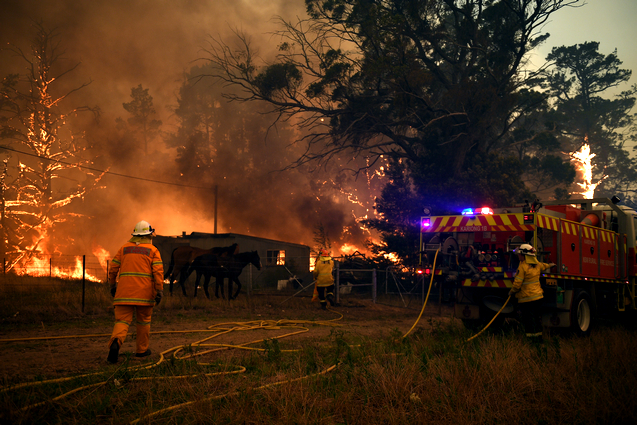
Firefighters watch on as the Gospers Mountain fire approaches a property at Colo Heights, north west of Sydney. AAP


It's been exactly one year since a single bolt of lightning at Gospers Mountain started one of the most devastating bushfires in Australian history.

In total, the Gospers Mountain fire on 26 October burnt 512,626 hectares across the Lithgow, Hawkesbury, Hunter Valley, Lower Hunter, Cudgegong, Blue Mountains and Central Coast districts – an area more than twice the size of the ACT.

It also joined the Kerry Ridge, Little L Complex, Grose Valley and Three Mile fires.

By the time torrential rain extinguished the megablaze in early February, it had burned through over a million hectares, killed millions of animals, destroyed a hundred homes, and left dozens of communities fearful and traumatised.

One year on, residents and community leaders are calling for more action to be done to reduce climate change, to ensure such a catastrophe never takes place again. 

NSW Rural Fire Service crews fight the Gospers Mountain Fire as it impacts a property at Bilpin, Saturday, 21 December, 2019. AAP


'I still get triggered when I smell smoke'

Luca Saunders, a Year 9 student at Blue Mountains Grammar School, said she gets triggering flashbacks to this day when she smells smoke or sees a fire truck.

Her house in Blackheath was in the middle of four different bushfires raging at the time, including the destructive Gospers Mountain fire.

“We were heavily affected by the Grose Valley fire and the Gospels Mountain fire, both of which came incredibly, incredibly close to my house on both sides.”

Luca Saunders says she still gets triggering flashbacks to the bushfires. Climate Media Centre


Luca evacuated to Victoria with her sister, and the pair were separated from their parents for three days, who stayed back to defend their house against apocalyptic conditions.

“I remember ash falling from the sky, everything being white and then at night-time there was always a red glow on the horizon,” Luca said. “It was an absolutely terrifying time, and we were never sure whether we’d see our house again tomorrow. We were never sure whether our livelihoods would be sustained into the coming year.”

“I personally get triggering flashbacks, if I see a fire truck or hear a siren,” she added. “Or if I smell smoke in the air.

Luca said it was “incredibly frustrating” for bushfire survivors to see how the federal government responded to the crisis.

“With the COVID-19 pandemic their response was incredibly quick, and it was very frustrating for survivors to see that that didn't happen when our lives are being affected by the climate crisis, and these bushfires,” she said.

“It's also incredibly difficult to see that a year on from this crisis that we face in this country. The government still has not advanced in its climate regulation, because it's widely publicly understood that the climate crisis was the root cause of the bush fires.”

An image taken from a plane window, captures smoke from the Gospers Mountain bushfires in December, 2019. AAP


'Lack of action on climate change is unforgivable'

Jim Casey, who has been a Sydney firefighter for more than 20 years, attended the Gospers Mountain blaze multiple times.

“The scale of the fire is what really sticks with me,” he said. “This fire had its own ecosystem in terms of the amount of heat it was generating. But it wasn’t alone - we had fires burning, really from the Queensland border to the Victorian border, and thousands and thousands of men and women trying to deal with it as best they could.”

Jim Casey has urged the federal government to do more to tackle climate change. Climate Media Centre


Mr Casey said climate change was “beyond doubt” what kicked the fires into overdrive, and the extreme weather associated with climate change.

“We had a short and warm winter which narrowed the window in which we could do hazard reduction burning, and then summer was unseasonably hot, with dry lightning strikes at the tail end of the drought,” he said. “And so you end up with the climate catastrophic firestorm that characterised the last fire season.”

He said managing fire risks to a substantial degree requires “political action” on fossil fuel burning, and on climate change itself.

“What is unforgivable in my opinion is the failure of the government to act upon the root causes of these fires,” he said. “Every inquiry, all of the bushfire scientists, the ex-fire chiefs all agree that it was climate change that pushed these fires into overdrive.

“And for that to be addressed we must start talking about the burning of fossil fuels, exports of fossil fuels and moving towards some kind of carbon-neutral future.

“Instead our government warns to start mining gas and selling that. It simply isn’t good enough. It’s fiddling while Australia burns,” Mr Casey said.

Links

27/10/2020

(USA) More Than 70 Science And Climate Journalists Challenge Supreme Court Nomination Of Amy Coney Barrett

Rolling Stone | 

“Judge Coney Barrett has displayed a profound inability to understand the ecological crisis of our times, and in so doing she enables it.”

Supreme Court nominee Amy Coney Barrett during her confirmation hearings on Capitol Hill. The full Senate vote on her nomination is expected to take place on Monday. Andrew Caballero-Reynolds/Pool/AP

NOTE
This op-ed has been signed by dozens of leading climate and science journalists, listed below.
We are science and climate journalists. 

We are researchers and weavers of information, creating a fabric that explains the work of scientists who themselves are working to describe our natural world and universe. 

We are published in the nation’s leading outlets, both large and small, including Scientific American, Nature, National Geographic, MIT Technology Review, The New York Times, The Wall Street Journal, The Guardian, The Washington Post, The New Yorker and many more. 

Over decades of reporting on the threats and now deadly and devastating harms of worsening climate change, we have succeeded in at least one respect. The vast majority of the world’s people, including those in the United States, not only acknowledge the scientific certainty of climate change, but also want action taken to address it.

We have succeeded because the science is clear, despite there being a massive well-orchestrated effort of propaganda, lies, and denial by the world’s largest fossil fuel corporations, including ExxonMobil and Koch Industries and fossil-fuel-backed institutes and think tanks. 

It is frightening that a Supreme Court nominee — a position that is in essence one of the highest fact-checkers in the land — has bought into the same propaganda we have worked so hard to dispel.

And it is facts — a word under repeated assault by the Trump administration, which nominated Judge Amy Coney Barrett — that are at issue here. “I’m certainly not a scientist…I’ve read things about climate change. I would not say I have firm views on it,” Judge Coney Barrett told Sen. John Kennedy during the Senate confirmation hearings on October 13th.

The next day, Sen. Richard Blumenthal asked Judge Coney Barrett if she believed “human beings cause global warming.” She replied: “I don’t think I am competent to opine on what causes global warming or not. I don’t think that my views on global warming or climate change are relevant to the job I would do as a judge.”

When asked that same day by Sen. Kamala Harris if she accepts that “COVID-19 is infectious,” Coney Barrett said yes. 

When asked if “smoking causes cancer,” Coney Barrett said yes. 

But when asked if “climate change is happening, and is threatening the air we breathe and the water we drink,” Judge Coney Barrett said that while the previous topics are “completely uncontroversial,” climate change is instead, “a very contentious matter of public debate.” 

She continued: “I will not express a view on a matter of public policy, especially one that is politically controversial because that’s inconsistent with the judicial role, as I have explained.”

Judge Coney Barrett repeatedly refused to acknowledge the scientific certainty of climate change. This is an untenable position, particularly when the world’s leading climate scholars warned in 2018 that we have just 12 years to act to bring down global average temperature rise and avert the most dire predictions of the climate crisis.

At the moment when the facts of the case were presented to her, this arbiter of justice freely chose to side with mistruths. Judge Coney Barrett’s responses are factually inaccurate, scientifically unsound, and dangerous.

How can Judge Coney Barrett rule on pending issues of climate change liability, regulation, finance, mitigation, equity, justice, and accountability if she fails to accept even the underlying premise of global warming? The answer is that she cannot.

Judge Coney Barrett’s ties to the fossil fuel industry have already proved problematic, forcing recusal from cases involving Shell Oil entities related to her father’s work as a long-time attorney for the company. 

She may also need to recuse herself from future cases due to her father’s former position as chairman of the Subcommittee on Exploration and Production Law of the American Petroleum Institute — the nation’s leading fossil fuel lobby.

Climate change is already an increasingly dominant aspect of American life, and an issue of growing import in American law. 

On the Supreme Court docket is BP P.L.C v. Mayor and City Council of Baltimore — a case that involves Shell, Chevron, ExxonMobil, and other major oil companies, and could impact about a dozen U.S. states and localities suing Big Oil over its contribution to climate change.

Judge Coney Barrett says, “I’m certainly not a scientist,” but she does not need to be a scientist, rather she needs to have faith in science. 

Pope Francis, the head of the Roman Catholic Church, is an ardent supporter of action on climate change, releasing in 2015 the “Encyclical on Climate Change & Inequality: On Care for Our Common Home.” The Pope embraces hard science in order to keep close to his faith.

Judge Coney Barrett has displayed a profound inability to understand the ecological crisis of our times, and in so doing she enables it.

Signed
Bill McKibben, journalist and author, the Schumann Distinguished Scholar in environmental studies at Middlebury College

Rebecca Solnit, author and journalist

Sonia Shah, science journalist and author

Jonathan Weiner, Pulitzer Prize winning author, science journalist, and professor at Columbia Journalism School

Jeff Goodell, climate journalist and author of The Water Will Come

Naomi Klein, journalist and author

Michelle Nijhuis, science journalist and author

Amy Westervelt, climate journalist

Rachel Ramirez, environmental justice reporter

Iris Crawford, climate justice journalist

Anoa Changa, movement and environmental justice journalist

Tiên Nguyễn, multimedia science journalist

Eric Holthaus, meteorologist, climate journalist at The Phoenix

Jenni Monet (Laguna Pueblo), climate affairs journalist and founder of Indigenously

Nina Lakhani, environmental justice reporter

Samir S. Patel, science journalist and editor

Clinton Parks, freelance science writer

Meehan Crist, writer in residence in biological sciences, Columbia University

Elizabeth Rush, science writer, author of Rising: Dispatches from the New American Shore

Anne McClintock, climate journalist, photographer and author, professor of environmental humanities and writing at Princeton University

Ruth Hopkins (Oceti Sakowin, Sisseton Wahpeton Oyate), tribal attorney, Indigenous journalist

Wade Roush, science and technology journalist and author

Kim Stanley Robinson, New York Times bestselling author of climate science fiction, Hugo, Nebula, and Locus Awards

Jason Mark, editor in chief, Sierra

Kate Aronoff, climate journalist

Richard Louv, journalist and author

Heather Smith, science journalist

Judith Lewis Mernit, California climate editor, Capital & Main

Madeline Ostrander, climate journalist

Julie Dermansky, multimedia environmental and social justice journalist

Kenneth Brower, environmental journalist and author

Alexander Zaitchik, science and political journalist and author

Hillary M. Rosner, science journalist and scholar in residence, University of Colorado

Wudan Yan, science journalist

Antonia Juhasz, climate and energy journalist and author

Debra Atlas, environmental journalist and author

Rucha Chitnis, climate, environmental justice and human rights documentarian

Drew Costley, environmental justice reporter

Jonathan Thompson, environmental author and journalist

Carol Clouse, environmental journalist

Brian Kahn, climate journalist

Geoff Dembicki, climate journalist and author

Peter Fairley, energy and environment journalist

Nicholas Cunningham, energy reporter

Nina Berman, documentary photographer focusing on issues of climate and the environment, professor of journalism at Columbia University

Michele C. Hollow, freelance journalist

Ben Depp, documentary photographer, focusing on issues of climate and the environment

Virginia Hanusik, climate photographer

Philip Yam, science journalist and author

Maura R. O’Connor, science journalist and author

Chad J. Reich, audio and visual journalist covering energy and environment in rural communities

Steve Ross, environmental writer/editor, former Columbia environmental reporting professor

Starre Vartan, science journalist

Michael Snyder, climate photographer

Brandon Keim, science and nature journalist

Tom Athanasiou, climate equity writer and researcher

Hope Marcus, climate writer

Jocelyn C. Zuckerman, freelance journalist

Dana Drugmand, climate journalist

Tom Molanphy, climate journalist

Roxanne Szal, associate digital editor, Ms. Magazine

Dashka Slater, author and climate reporter

Jenn Emerling, documentary photographer, focusing on issues of climate and culture in the American West

Christine Heinrichs, science writer and author

Clayton Aldern, climate and environmental journalist

Karen Savage, climate journalist

Charlotte Dennett, author, investigative journalist, attorney

Carly Berlin, environmental reporter

Ben Ehrenreich, author and journalist

Ibby Caputo, science journalist

Lawrence Weschlerformer New Yorker staff writer, environmental author, most recently with David Opdyke, of This Land: An Epic Postcard Mural on the Future of a Country in Ecological Peril.

Justin Nobel, science journalist

Signatories include recipients of:

The Pulitzer Prize, AAAS/Kavli Science Journalism Award, the Walter Sullivan Award for Excellence in Science Journalism, Rona Jaffe Foundation Writer’s Award, Award for Excellence in Health Journalism, the Hugo, Nebula, and Locus Awards for Cli-Fi, the National Association of Science Writers’ Science in Society Award, awards from the National Association of Science Writers, the Society of Environmental Journalists, and the American Association for the Advancement of Science, Los Angeles Times Book Prize in Science/Technology, the New York Public Library’s Helen Bernstein Book Award for Excellence in Journalism, numerous articles included in multiple The Best Science and Nature Writing anthologies, multiple National Book Award and National Book Critics Circle Award recipients, the Guggenheim, the Lannan Literary Award, Native American Journalists Association Awards, former Knight Science Journalism Fellows at MIT, a Rhodes Scholar, former Ted Scripps Fellows in Environmental Journalism, a National Science Foundation Research Grant Collaborator, Portrait of Humanity Award (2020) recipient, National Health Journalism Fellowship, and more.

Signatories work appears in outlets including:

The New York Times, The New Yorker, The Atlantic, National Geographic, Scientific American, Audubon, onEarth, Science, PBS NOVA, Nature, Discover, Nautilus, Outside, Rolling Stone, The Guardian, Bloomberg, Columbia Journalism Review, The Wall Street Journal, The Washington Post, CNN, Politico, USA Today, Los Angeles Times, The Advocate, The Nation, Sierra, Teen Vogue, Vogue, VICE, NPR, The Intercept, The New York Times Magazine, Archeology Today, Atlas Obscura, Oxford American, Guernica, NACLA, Mother Jones, Earther, Elemental, Longreads, MIT Technology Review, The Economist, High Country News, Wired, Men’s Journal, bioGraphic, The Atavist, Slate, Foreign Policy, UnDark, Harper’s Magazine, Ms. Magazine, Newsweek, The New Republic, San Francisco Chronicle, Louisiana Cultural Vistas, DeSmog, Al Jazeera, and more.

Links

(AU) Australia's First Offshore Wind Farm Promises Jobs Boom

The AgeMiki Perkins | Benjamin Preiss

Australia’s first offshore wind farm could provide about 8000 direct and indirect jobs in Victoria over its 30-year lifetime, including 5200 construction jobs and 740 ongoing roles a year.

The Star of the South wind farm, which would be built off the coast of South Gippsland, would invest about $8.7 billion into Victoria over its lifetime, according to new economic modelling commissioned by the project and undertaken by AlphaBeta, part of Accenture.

This modelling also shows the project would invest an estimated $4.9 billion directly into Gippsland’s economy, but the company is yet to win over some residents closest to the project, and a key union division.

The Star of the South wind farm would look similar to the Veja Mate offshore wind farm in Germany.

The wind farm would provide about 20 per cent of Victoria’s energy, and power about 1.8 million homes. The $8 billion to $10 billion project would be one of the largest offshore wind farms in the world.

Star of the South offshore windfarm

Star of the South chief executive Casper Frost Thorhauge said the project would offer regional job opportunities and be an asset to the state in the wake of the coronavirus pandemic.

“We believe we can come in and solve some of these problems and be part of a green recovery,” Mr Frost Thorhauge said.

The proposed location was chosen to capitalise on Bass Strait’s powerful winds, suitable soil and water conditions and its proximity to the Latrobe Valley, which is one of the strongest connection points to the National Electricity Market distribution grid.

“We are really excited to harvest a new resource, not only for Australia but also especially for Gippsland,” Mr Frost Thorhauge said. “The long tradition of power generation in the Latrobe Valley and Gippsland region will be maintained.”

Wind turbines produce no carbon emissions and wind is one of the least greenhouse gas-intensive energy sources, even taking into account life-cycle emissions from other energy sources used in development.

The project is backed by Copenhagen Infrastructure Partners, a fund management company in energy infrastructure, particularly renewables.

Underwater cameras being placed into the ocean for Star of the South exploratory fish surveys.


Geoff Dyke, the Construction Forestry Maritime Mining And Energy Union's mining and energy division secretary, said the union movement broadly supported the project but his division held grave concerns.

He said the wind farm would create jobs but would not replace those lost through the closure of coal mines. “It does nothing for the jobs that are in the Latrobe Valley,” Mr Dyke said.

The turbines are likely to range in height from 185 metres to 245 metres and will probably use foundations that are driven into the seabed.

Star of the South is working with the Commonwealth government on a national legal framework for offshore wind that would pave the way for the project.

Some community members are worried about the impact of wind turbines on migratory bird paths. Mr Frost Thorhauge said the company was collecting data on bird life and this would be included in any environmental assessment.

Star of the South wind- and wave-monitoring equipment, which is collecting data off the coast of Gippsland.


In March, the company started mapping the seabed, and has deployed boats and planes to establish which marine animals are present.

Daniel Ierodiaconou, an associate professor in marine science at Deakin University, has been doing fish diversity surveys through a partnership between the university and the environmental consultancy undertaking Star of the South's exploratory work.

A biodiversity survey conducted by Star of the South wind farm off the coast around Gippsland shows a huge range of fish and sea creatures.


A biodiversity survey conducted by Star of the South wind farm off the coast
around Gippsland shows a huge range of fish and sea creatures.

About 130 baited remote underwater video stations have been dropped from a boat and left underwater for an hour to document the species that come to feed, he said. From the video, scientists have been able to identify 6000 individual fish across about 70 species.

In effect, the project might actually create artificial reefs, Mr Ierodiaconou said. “They’d be putting structures out there that are likely to generate different fish communities, like some of the existing oil and gas sector infrastructure in the Bass Strait,” he said.

“When a project of this size is touted, people speculate"
Michael Hobson, Port Albert resident

The wind farm's closest point to the coast would be about 7 kilometres (the furthest about 25 kilometres), and it would be visible from the shore.

Port Albert fisherman and restaurateur Michael Hobson said he wanted to see the results of the company’s studies on marine and bird life before deciding whether he supported the project.

Opinion was divided in the town of about 300 people, he said. While the economic benefits would be welcome, there were some concerns about the impact on the environment and the fishing industry.

Some people whose livelihoods depended on the local fishing industry were worried that the project might disturb the migratory paths of fish species, he said.Mr Hobson, whose family has lived in Port Albert for six generations since 1846, noted plans for the project had resulted in higher demand for local properties.

“When a project of this size is touted, people speculate,” he said. “I think more property has changed hands here in the last six months than there has in the past six years.”

Offshore wind is a rapidly growing industry. In the past two years, Danish offshore wind developer Orsted has doubled its value on the Copenhagen stock exchange, and is now worth more than oil giant BP.

Links

(AU) Bob Brown Is Right – It’s Time Environmentalists Talked About The Population Problem

The Conversation

Shutterstock


Author
 is Honorary Professor, Australian National University     
In all the talk of tackling environmental problems such as climate change, the issue of population growth often escapes attention. Politicians don’t like talking about it. By and large, neither do environmentalists – but former Greens leader Bob Brown has bucked that trend.

Brown recently declared the world’s population must start to decline before 2100, telling The Australian newspaper:

We are already using more than what the planet can supply and we use more than the living fabric of the planet in supply. That’s why we wake up every day to fewer fisheries, less forests, more extinctions and so on. The human herd at eight billion is the greatest herd of mammals ever on this planet and it is unsustainable to have that growing.

Research suggests our species has far exceeded its fair share of the planetary bounty, and Brown is right to call for the global population to peak. It is high time others joined the chorus – not only other environmentalists, but those concerned with international development and human rights.

Bob Brown says the global population should peak before 2100. Shutterstock 

Population growth, by the numbers

COVID-19 has killed more than one million people. While undeniably tragic, the figure is minor compared to world’s annual growth in population, estimated by the United Nations at about 83 million.

In 1900, the world’s population was about 1.6 billion people. By 2023 it’s expected to hit 8 billion. According to the UN, it will reach 9.7 billion by 2050 and 11.2 billion by 2100.

(The US-based Institute for Health Metrics and Evaluation recently forecast a lower peak of about 9.7 billion by 2064, falling to about 8.8 billion by 2100.)

Why is the population growing so fast? Much of it is due to advanced fertilisers and intensive farming practices, leading to higher crop yields that can sustain more people. Health care has improved, and people are living much longer. And many parts of the world have historically had high fertility rates.

There is no expert consensus on how many people the planet can support. The answer will largely depend on how much humans produce and consume, now and in the future. Some experts believe we’ve already hit the limit.

The “planetary boundaries framework” is one way to measure Earth’s carrying capacity. Introduced about a decade ago, it involves nine planetary boundaries such as biodiversity loss, climate change and ozone depletion. If the boundaries are crossed, Earth’s capacity to support civilisation is at risk. Research suggests in some parts of the world, multiple boundaries have already been breached.

In some places, Earth’s limits have already been exceeded. Shutterstock 

It’s time to talk


In recent decades, many conservationists, politicians and scientists have been reluctant to talk about population growth.

When The Australian approached Greenpeace, the Australian Conservation Foundation and the Wilderness Society regarding Brown’s remarks, the groups said they did not comment on population growth. Brown told the newspaper environmentalists avoided the issue because they were “frightened” of being targeted by News Corp.

In an address to the National Press Club this month, Greens leader Adam Bandt reportedly wouldn’t say whether he is concerned about population growth, saying “my priority is getting energy at running on 100% renewable. That makes much more of a difference than […] population size.”

Bandt wouldn’t be the first environmental advocate to avoid the topic. But why? I believe there are three main reasons.

Most obvious is the fear of being accused of racism. Some past advocates of population “control” supported eugenics and coercion, including forced sterilisation and abortion. In fact, eugenics and forced sterilisation has been reported in both rich and poor countries.

Second, the Catholic Church has played a big role in suppressing the topic. In the 1960s a papal commission suggested the church’s decades-long ban on birth control be dropped. But in 1968, Pope Paul VI rejected the advice, and declared artificial birth control to be morally wrong.

A statue of Pope Paul VI, who believed birth control was morally evil. Shutterstock

Third is the ascendancy of free-market economics. High population growth in low-income countries is convenient for capitalism, because these populations depress wages worldwide.

In 1984, the Reagan administration became the first in a long line to deny the importance of population problems. Its views were influenced by economic theorist Julian Simon, who believed adding to the world’s population was good for human well-being.

Julian Simon argued adding to the world’s population was good for human well-being. Shutterstock

Starting the conversation

As Brown said, we should be “having a mature debate” about population growth. But where to start?

An obvious beginning is the unmet demand for contraception. For example, a UN report in 2015 reported fewer than half of African women who are married or in a union, and who need contraception, have their family planning needs satisfied.

Slowing global population growth will be helped by promoting the UN Sustainable Development Goals. One goal seeks to ensure “universal access to reproductive health and family planning” by 2030. Improving female literacy – especially when combined with internet access – is also an important way to empower women.

Apart from reproductive health care, general improvements to health, including well-funded health systems, would give couples greater confidence their children will thrive. This would reduce their perceived need for additional children in case one or more dies.

These measures all require increased investment and public attention. The environmental movement, in particular, must awaken to the link between population growth and environmental degradation. “Business as usual” will hinder human development, further oppress women and magnify many forms of environmental damage.

Links

26/10/2020

(AU) Early Warning: Human Detectors, Drones And The Race To Control Australia’s Extreme Bushfires

The Guardian

For a century, humans high up in fire towers have sounded the alarm. But breakthroughs in technology may offer something more

Nick Dutton, fire tower operator, Rural Fire Service in the Kowen Forest fire tower near Canberra. Photograph: Mike Bowers/The Guardian

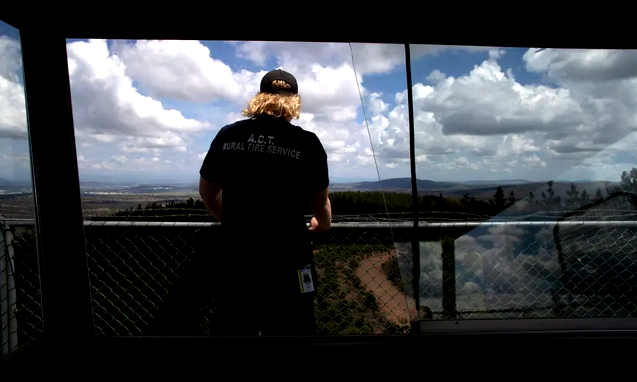
Perched in his fire tower high above the pine trees, Nick Dutton leans back and nods to the cascading hills and mountains behind him.

“I love being out here, just away from stuff,” he says. “I mean, you can’t really complain.”

Dutton, a fire tower operator, is sitting in his office, a tiny cabin propped high above the treetops by metal supports that sway with the wind.

His walls are littered with compass points and references, each a guide to the bush stretching in every direction along the eastern ACT-NSW border.

Every day, Dutton climbs into one of the ACT’s four towers, armed with binoculars, a radio, and his notebook, keeping a watchful eye for the faintest wisp of smoke rising in the distance.

The mind can easily deceive.

Stare at a spot too intently, you’ll see smoke, Dutton says.

“With a little bit of experience up here, you get used to what is and what isn’t smoke,” he says.

“Some people when they first start find it hard to discern dust from smoke.

But smoke does have its own characteristics and you do learn to pick that out.”

It’s a lonely assignment.

The days are long and quiet, narrated by birdsong from the surrounding pine forest and punctuated by hourly weather reports back to headquarters. Human encounters are typically limited to the odd buzzing of radio chatter and errant bushwalkers.

“You really have to love being alone to do this,” he says. “I think that’s the main trait, if you hate being by yourself and not talking to anyone, you won’t survive.”

Dutton’s is an increasingly rare occupation.

Towers like the one in Kowen Forest are the oldest continuing method of bushfire detection and monitoring, used in Australia since the early 1900s.

Nick Dutton surveys the landscape at the Kowen Forest fire tower near Canberra. Photograph: Mike Bowers/The Guardian


Victoria still has more than 70 towers, Western Australia’s parks department operates 13 and NSW forestry authorities operate a network of almost 50.

But their use is in decline.

In the US, where lonesome observers are known unofficially as “freaks on the peaks”, there were almost 10,000 staffed fire towers in the 1950s.

Now, there’s just a few hundred.

The decline has been driven by rapid advances in technology, and the emergence of automated cameras, sensory technology, and more accurate satellite imagery.

At the same time, worsening bushfire conditions, driven by climate change, have demanded faster, more efficient detection and monitoring technology.

The shifts beg the question: is there still a place in modern firefighting for the observer in the fire tower?

Satellites, cameras and drones: striving for real-time detection

In the 1980s, a remarkable breakthrough in fire detection was made.

US researchers noticed tiny white specks on a satellite image of the Persian Gulf captured by the National Oceanic and Atmospheric Administration’s polar orbiting environmental satellites.

Those white specks were the thermal signatures of gas flares from oilfields.

They were the first active fires ever recorded from space.

The discovery promised new space-based potential to find and watch bushfires.

At first, the results were mixed. The systems were unable to differentiate a bushfire from oilfields.

But the technology was refined, the processing algorithms improved, and more specialised sensors and satellites were brought into the mix.

View over the pine plantation from the Kowen Forest fire tower near Canberra. Photograph: Mike Bowers/The Guardian


A sensor known as the moderate resolution imaging spectroradiometer, placed aboard Nasa’s Terra and Aqua satellites, is now able to capture red “hotspots”.

The hotspots, seen in satellite imagery during last season’s horror bushfires, mark where marking the satellite sensor’s thermal bands detect high temperatures.

The accuracy, while not perfect, is now vastly improved and the technology continues to move at pace.

Earlier this year, a start-up named Fireball International, co-founded by University of Southern Queensland researcher Christopher Tylor said it had developed technology that fused satellite and tower sensors to detect a wildfire in California about 66 seconds after power lines fell and caused ignition.

Andrew Forrest’s Minderoo foundation is also proposing to use satellites, infrared sensors, and drones to identify and extinguish fires within an hour by 2025, through its $70m grant to the “Fire Shield” program.

The project is currently collaborating with fire towers like the one at Kowen Forest.

Companies like Ninox Robotics have proposed using a fleet of long-range drones equipped with advanced cameras accompanied by machine-learning algorithms to detect and monitor active fires.

Ninox believes the entire state of New South Wales can be monitored from 20 sites, using one active drone each.

Climate change, the worsening bushfire threat and ‘fast-attack’ strategies

The deployment of new technology would be most welcome in Australia.

The nation is now experiencing extreme bushfires at three times the rate it did a century ago and the climate crisis has brought new urgency to efforts to improve firefighting methods, including early detection.

Earlier this year, former commissioner of Fire and Rescue NSW, Greg Mullins, and 32 other former emergency services leaders told the bushfire royal commission that Australia should adopt “fast-attack strategies”, based on detection by remote cameras, satellite images and spotter flights.

Early detection should be complemented by mid-sized and purpose-built water bombers with the aim of extinguishing fires within 24 hours, they argued.

Nick Dutton believes detection technology will one day render fire towers unnecessary. Photograph: Mike Bowers/The Guardian


“Every big fire was once a small fire,” Mullins told the Guardian at the time. “It’s very much like a military operation with eyes in the sky, with your ground troops that are backed up with some artillery.”

Even before the release of its final report, the royal commission has urged federal, state, and territory governments work together to fast-track advances to spatial technology to help “detect ignitions and monitor accurately all fire edge intensity and progression automatically across the nation in near real time”, the royal commission said.

The benefits of real-time detection are obvious. Shorten the time between ignition and a fire crews’ first attack, and the prospects of containing a fire are greatly improved.

Not only does early detection save lives, but it has the potential to save the Australian economy billions of dollars.

Earlier this year, researchers at the Australian National University estimated an effective early detection system could save the economy an estimated $2.2bn a year over 30 years.

“In our view, the large sums that result from our conservative estimates make investments and improvements in early detection financially very viable,” the authors concluded.

Mark Crosweller, the former head of Emergency Management Australia and the National Resilience Taskforce, said that detection, while important, should not be the main focus for Australia.
Because at the end of the day, the human eye is going to be much better.
Nick Dutton
Crosweller said the common failure, seen in disaster after disaster, was one of situational awareness. Knowing where the fire is and where it’s going to go.

That failing was exposed with fatal consequences during the 2003 bushfires in Canberra, when a blaze burning in the mountains for more than a week ripped through the city without any proper warning to residents.

“They still have the same problem,” he said. “The industry is still fundamentally relying on human-centred intelligence, so human processing of data.”

The key advantage of more advanced sensory technology is its ability to feed into artificial intelligence and machine learning systems, which can then provide fast, accurate models to predict a fire’s behaviour.

“Sensory technology has the capacity to collect enormous amounts of data, but it needs to be machine analysed,” he said. “You still need a human to make a decision, but the machine can do the analysis work infinitely faster than a human can.”

“So I think it is the way of the future. And I think the future is now. I don’t think we have to wait any longer.”

The value of the human eye

Human observers, though, are far from obsolete.

In 2010, the CSIRO delivered a remarkable report on detection, comparing newer, automated camera systems with the skills of humans.

The study examined three systems: EYEfi, FireWatch, and Forest Watch, all of which used image analysis from sensors mounted on fixed towers.

The systems were tested for their ability to detect and locate fires, provide information to help with situational awareness, and integrate with emergency services agencies.

The humans won, hands down.

Experts say humans provide a critical second source of intelligence when a heat source is detected. Photograph: Mike Bowers/The Guardian


Six fires were lit intentionally for the study in forests near Tumut.

Tower observers saw all six. Firewatch reported one and Forest Watch reported zero. During the study, a further 250 private burns were conducted by neighbouring landholders.

“The camera systems reported many fires but comparison with tower observations in NSW and cross-referencing between camera reports in Victoria showed that a high proportion of private burns were not reported,” the study found.

The technology has come a long way since 2010.

But even still, Ailish Milner, a strategic planner with the ACT’s Rural Fire Service, believes human observers will have a key role to play in the near future.

Milner says humans provide a critical second source of intelligence when a heat source is detected using satellite or other technology.

“The towers are vital in being able to provide a second source of information,” she told the Guardian. “Being able to talk to the fire towers and say ‘we’ve got this heat source showing, can you see any smoke’ is that second source.”

“It’s all about intelligence. So the more intelligence you get, the more confirmation you have.”

Operators like Dutton don’t just spot fires, either.

Human observers bring their experience and extensive knowledge to contextualise and analyse what they’re observing.

Dutton recalls a recent example when a grassfire burnt through the Canberra suburb of Pialligo.

A colleague was in the tower and observed a strong wind change.

The observer knew the wind change would hit the fireground in Pialligo in a matter of minutes. Headquarters was alerted and crews on scene were informed.

Dutton believes detection technology will one day render fire towers unnecessary.

“But for now, I think you can start implementing the tech but still have the operators to refine the technology.”

“Because at the end of the day, the human eye is going to be much better.”

Crosweller agrees that human observers are still valuable, particularly while the industry still grapples with how to use machine learning and artificial intelligence.

“The better we get at machine learning and artificial intelligence, the better we’ll get at working out where humans fit in those systems,” he says.

“That’s why I wouldn’t exclude the use of people in that context. But it will change.”

Links

Lethal Heating is a citizens' initiative