07/11/2020

(AU) Victoria Plans 300mw Tesla Battery To Help Stabilise Grid As Renewables Increase

The Guardian

New battery near Geelong would be one of the biggest in the world, and is due to come on stream for next summer

The Tesla installation at Hornsdale in South Australia. Victoria’s proposeed new battery near Geelong will be twice the size, at 300 megawatts.

One of the largest lithium-ion batteries in the world is planned for Victoria after the renewable energy company Neoen won a contract to build it near the regional city of Geelong.

If constructed as promised, the battery will have a power capacity of 300 megawatts and a storage capacity of 450 megawatt-hours, making it more than twice the size of the battery at Hornsdale, South Australia, which was the biggest in the world when it began operating in 2017.

Like the Hornsdale facility, the Geelong battery will be built using Tesla equipment. The Victorian energy and climate change minister, Lily D’Ambrosio, said it would be installed near Moorabool Terminal Station and would be ready for the 2021-22 summer.

It is expected to store enough energy to run about 500,000 homes for half an hour.

It has been scaled back since it was first flagged in April when it was expected to be 600MW and cost $300m. While among the largest batteries in the world, it is smaller than batteries planned in California and New York.

D’Ambrosio said it would improve the reliability of the power grid as ageing coal-fired power stations became less reliable and the state increased its reliance on wind and solar power. The Andrews government aims to source 40% of the state’s electricity from renewable energy by 2025, and 50% by 2030.

“By securing one of the biggest batteries in the world Victoria is taking a decisive step away from coal-fired power and embracing new technologies that will unlock more renewable energy than ever before,” she said.

She said consumers would pay for the use of the battery through their power bills, but suggested it would lead to a reduction in wholesale energy prices so that Victorians were charged less for electricity.

Independent analysis found that Victorians would receive $2 in benefits for every $1 invested in the battery, she said. Energy consultancy Aurecon found the Hornsdale Power Reserve saved consumers $116m in 2019.

Neoen won the right to build the Victorian battery through a tender run by the Australian Energy Market Operator. Its contract, which runs until 2032, requires the battery to fill the breach if there is an unexpected network outage. It will also provide network services needed to support variable renewable energy, such as fast frequency control. The tender process was initiated by the Victorian government.

The Victorian Greens welcomed the announcement, saying it was part of what it had proposed under its “green new deal” plan. But the acting leader, Ellen Sandell, said the battery should have been publicly owned and the state needed to plan to move away from coal.

“Now the government needs to go one step further and actually admit we need to get off coal in Victoria,” Sandell said.

The conservation group Environment Victoria said it was a “game-changer for Victoria’s transition from old coal-burning power stations to clean energy”.

“This big battery gets us halfway to the storage target we need to prepare for the closure of Yallourn [coal] power station,” the group’s chief executive, Jonathan La Nauze, said.

The state opposition said it was “committed to supporting a considered clean energy transition” but argued the government had not made the case for the project to be at Geelong. The Coalition energy spokesman, Ryan Smith, said it had called in June for a battery to be based further west, at Mortlake near the state’s main renewable energy production zone.

“If it is located at Labor’s proposed site, too much energy from renewables projects will be lost in the transmission to the battery storage,” Smith said.

There are expected to be 80 jobs during construction of the battery, but just six full-time permanent positions once it is built.

The introduction of another large battery into the grid will further chip away at the extent to which it relies on gas-fired power for “dispatchable” generation that can be called on to support variable renewable energy.

Aemo has estimated the national grid is likely to need between six and 19 gigawatts of dispatchable power by 2040 as the system is increasingly dominated by solar and wind. It found renewable energy may at times provide nearly 90% of electricity by 2035, the amount of gas-fired power would fall as pumped hydro and batteries came online and there was no place for new coal-fired generation.

Despite this, the Morrison government says new gas-fired power is essential for the stability of the grid as ageing coal plants close.

The market operator’s chief executive, Audrey Zibelman, said Neoen’s proposal was “a significantly more cost competitive and attractive market response than other recent major battery developments in Australia”.

A portion of the battery’s capacity will be reserved to increase electricity supply over an interconnector cable between Victoria and New South Wales.

Links

(UK) (AU) Net-Zero Emissions Drive Puts Australian Industry On Notice

Sydney Morning Herald - Llewelyn Hughes

Author
Llewelyn Hughes is associate dean for research at the College of Asia and the Pacific, Australian National University, and an associate professor at the ANU's Crawford School of Public Policy.
The pressure on Australia is indisputable. In a Tuesday night call, British Prime Minister Boris Johnson reportedly called on Scott Morrison to "act boldly" on climate change and stressed the need for ambitious targets to reach net-zero carbon emissions. 

But closer to home this week there was a strong indication the government will have to move quickly to take advantage of the energy transition being embraced elsewhere.

A pile of coal for export at Newcastle this month ... for how long will those markets last? Bloomberg


Major trading partner Japan has struggled to overcome the malaise in climate policy that set in after the 2011 Fukushima nuclear disaster. Carbon emissions have slowly fallen since 2013, thanks in part to growth in renewable power generation. Almost a decade after the accident, most nuclear units remain shuttered, and restarts remain contentious. A new pipeline of coal plants has been under development.

But in his first speech to Parliament this week, Japan’s new Prime Minister, Yoshihide Suga, announced Japan would aim to achieve a net-zero carbon emissions target by 2050. It has huge implications for Australia as well as Japan.

The announcement underlines that major importers of Australia’s energy commodities are beginning to leave us behind. In 2019 Japan imported $9.6 billion (13 per cent) of Australia’s thermal coal. Suga’s declaration signals thermal coal exports to Japan have already peaked.

A critical question is what role natural gas will play in Japan’s future in the electricity sector and in heating. In 2019 Japan imported 22 per cent of Australia’s natural gas. But to get to net-zero emissions, gas will have to play a substantially lower role in its electricity sector, and a reduced role in heating.

It is crucial that Australia begins to recognise the implications of this announcement.

While mid-century seems a long way off, Japan's move will have immediate bite. A 2050 net-zero target already sends a strong policy signal that investing in new coal generation, for example, will not pay. And it shows Japan’s business community has shifted in favour of energy transition after years of prevarication. This means there is little chance that Japan will reverse course.

Japan’s cabinet is also required to review its mid-term energy policy settings every three years, and the next review must occur by the middle of next year. Work began within government last month on designing the new policy settings, and the 2030 power generation targets to be released next year are going to need to reflect this aggressive new goal.

Japanese industry already has plans to develop 10 gigawatts of offshore wind by 2030 and Japan’s former power utilities, trading companies and others are investing heavily in the area.

In his speech, Prime Minister Suga highlighted the importance of technological innovation. Japan – supported by government investment in research and development – has long been a technology provider to the world, through hybrid and electric vehicles, lithium ion batteries, energy-efficient products and advanced boilers and turbines.

In particular, Suga noted next-generation solar cells and carbon capture and use. But Japan is also investing heavily in hydrogen and associated vectors such as ammonia. Expect billions of yen of public and private research and development funding to supercharge Japan’s efforts across these areas.

Suga also specifically referred to fundamentally transforming coal policy. In some areas of Japan, coal plants are already operating less because of increased renewables integration. We can now expect cancellations of coal plants in the planning stage.

Earlier this month JERA, one of Japan’s largest owner of thermal coal plants, announced it would replace retiring older-generation coal plants with a mix of renewables and battery storage. It is also experimenting with the co-burning of green ammonia in its coal. Together this means new energy capacity will not be a new coal pipeline.

Australia is well placed to benefit from Japan’s energy transition. We are already positioning as a key exporter of low-carbon hydrogen and ammonia to Japan.

Japan’s green innovation drive means there are also opportunities for joint collaboration in research and development. We have a lot to share with Japan about integrating renewable electricity into competitive electricity systems. And, with the right policy settings, Australians will benefit from lower-cost and better-performing products – such as electric vehicles – that Japan will export.

It is no surprise Suga’s announcement was made with such fanfare so soon after China’s declaration that it would seek to achieve net-zero emissions by 2060. While Japan faces enormous challenges to reach its 2050 target, its new leader has made clear that his nation is serious about energy transition. Federal and state governments in Australia should work to identify how we can ride the wave.

(USA) (AU) Biden Says The US Will Rejoin The Paris Climate Agreement In 77 Days. Then Australia Will Really Feel The Heat

The Conversation

AP Photo/Patrick Semansky

Author
Dr Christian Downie is an Australian Research Council DECRA Fellow (2018-2021) in the School of Regulation and Global Governance at The Australian National University. He was previously a Vice Chancellor’s Postdoctoral Fellow at the University of New South Wales.
When the US formally left the Paris climate agreement, Joe Biden tweeted that “in exactly 77 days, a Biden Administration will rejoin it”.

The US announced its intention to withdraw from the agreement back in 2017. But the agreement’s complex rules meant formal notification could only be sent to the United Nations last year, followed by a 12-month notice period — hence the long wait.

While diplomacy via Twitter looks here to stay, global climate politics is about to be upended — and the impacts will be felt at home in Australia if Biden delivers on his plans.

Biden’s position on climate change

Under a Biden administration, the US will have the most progressive position on climate change in the nation’s history. Biden has already laid out a US$2 trillion clean energy and infrastructure plan, a commitment to rejoin the Paris agreement and a goal of net-zero emissions by 2050.

As Biden said back in July when he announced the plan:

If I have the honour of being elected president, we’re not just going to tinker around the edges. We’re going to make historic investments that will seize the opportunity, meet this moment in history.

And his plan is historic. It aims to achieve a power sector that’s free from carbon pollution by 2035 — in a country with the largest reserves of coal on the planet.

Biden also aims to revitalise the US auto industry and become a leader in electric vehicles, and to upgrade four million buildings and two million homes over four years to meet new energy efficiency standards.

Can he do it under a divided Congress?

While the votes are still being counted — as they should (can any Australian believe we actually need to say this?) — it seems likely the Democrats will control the presidency and the House, but not the Senate.

This means Biden will be able to re-join the Paris agreement, which does not require Senate ratification. But any attempt to legislate a carbon price will be blocked in the Senate, as it was when then-President Barack Obama introduced the Waxman-Markey bill in 2010.

In any case, there’s no reason to think a carbon price is a silver bullet, given the window to act on climate change is closing fast.

What’s needed are ambitious targets and mandates for the power sector, transport sector and manufacturing sector, backed up with billions in government investment.

Fortunately, this is precisely what Biden is promising to do. And he can do it without the Senate by using the executive powers of the US government to implement a raft of new regulatory measures.

Take the transport sector as an example. His plan aims to set “ambitious fuel economy standards” for cars, set a goal that all American-built buses be zero emissions by 2030, and use public money to build half a million electric vehicle charging stations. Most of these actions can be put in place through regulations that don’t require congressional approval.

Donald Trump announced the US would withdraw from the Paris Agreement in 2017. AP Photo/Evan Vucci

And with Trump out of the White House, California will be free to achieve its target that all new cars be zero emissions by 2035, which the Trump administration had impeded.

If that sounds far-fetched, given Australia is the only OECD country that still doesn’t have fuel efficiency standards for cars, keep in mind China promised to do the same thing as California last week.

What does this mean for Australia?

For the last four years, the Trump administration has been a boon for successive Australian governments as they have torn up climate policies and failed to implement new ones.

Rather than witnessing our principal ally rebuke us on home soil, as Obama did at the University of Queensland in 2014, Prime Minister Scott Morrison has instead benefited from a cosy relationship with a US president who regularly dismisses decades of climate science, as he does medical science. And people are dying as a result.


Obama on climate change at the University of Queensland.

For Australia, the ambitious climate policies of a Biden administration means in every international negotiation our diplomats turn up to, climate change will not only be top of the agenda, but we will likely face constant criticism.

Indeed, fireside chats in the White House will come with new expectations that Australia significantly increases its ambitions under the Paris agreement. Committing to a net zero emissions target will be just the first.

The real kicker, however, will be Biden’s trade agenda, which supports carbon tariffs on imports that produce considerable carbon pollution. The US is still Australia’s third-largest trading partner after China and Japan — who, by the way, have just announced net zero emissions targets themselves.

A Biden presidency would pressure the Morrison government to adopt more ambitious climate policies. AAP Image/Mick Tsikas

Should the US start hitting Australian goods with a carbon fee at the border, you can bet Australian business won’t be happy, and Morrison may begin to re-think his domestic climate calculus.

And what political science tells us is if international pressure doesn’t shift a country’s position on climate change, domestic pressure certainly will.

With Biden now in the White House, it’s not just global climate politics that will be turned on its head. Australia’s failure to implement a serious domestic climate and energy policy could have profound costs.

Costs, mind you, that are easily avoidable if Australia acts on climate change, and does so now.

Links

06/11/2020

(USA) Climate Change: US Formally Withdraws From Paris Agreement

BBCMatt McGrath

President Trump announcing the US pull out from Paris in June 2017. Getty Images


After a three-year delay, the US has become the first nation in the world to formally withdraw from the Paris climate agreement.

President Trump announced the move in June 2017, but UN regulations meant that his decision only takes effect today, the day after the US election.

The US could re-join it in future, should a president choose to do so.

The Paris deal was drafted in 2015 to strengthen the global response to the threat of climate change.

It aims to keep the global temperature rise this century well below 2C above pre-industrial levels and to pursue efforts to limit the temperature increase even further to 1.5C.

Why has this taken so long?

The delay is down to the complex rules that were built into the Paris agreement to cope with the possibility that a future US president might decide to withdraw the country from the deal.

Protestors objecting to President Trump's climate policies project their message onto one of his hotels. Getty Images


Previous attempts to put together a global pact on climate change had foundered because of internal US politics.

The Clinton administration was unable to secure Senate backing for the Kyoto Protocol, agreed in 1997.

So in the run up to the Paris climate talks, President Obama's negotiators wanted to ensure that it would take time for the US to get out if there was a change in leadership.

Even though the agreement was signed in December 2015, the treaty only came into force on 4 November 2016, 30 days after at least 55 countries representing 55% of global emissions had ratified it.

No country could give notice to leave the agreement until three years had passed from the date of ratification.

Even then, a member state still had to serve a 12-month notice period on the UN.

Trump: The world won't laugh any more at US

So, despite President Trump's White House announcement in June 2017, the US was only able to formally give notice to the UN in November last year. The time has elapsed and the US is now out.

What will the withdrawal mean in practice?

While the US now represents around 15% of global greenhouse gas emissions, it remains the world's biggest and most powerful economy.

So when it becomes the only country to withdraw from a global solution to a global problem it raises questions of trust.

Former Secretary of State John Kerry holds his granddaughter as he signs the Paris agreement at the UN. Getty Images

For the past three years, US negotiators have attended UN climate talks while the administration has tried to use these events to promote fossil fuels.

"Being out formally obviously hurts the US reputation," said Andrew Light, a former senior climate change official in the Obama administration.

"This will be the second time that the United States has been the primary force behind negotiating a new climate deal - with the Kyoto Protocol we never ratified it, in the case of the Paris Agreement, we left it."

"So, I think it's obviously a problem."

How is the US pull out being viewed?

Although this has been a long time coming, there is still a palpable sense of disappointment for many Americans who believe that climate change is the biggest global challenge and the US should be leading the fight against it.

"The decision to leave the Paris agreement was wrong when it was announced and it is still wrong today," said Helen Mountford from the World Resources Institute.

"Simply put the US should stay with the other 189 parties to the agreement, not go out alone."

The formal withdrawal has also re-opened old wounds for climate diplomats.

Getty Images

"It's definitely a big blow to the Paris agreement," said Carlos Fuller, from Belize, the lead negotiator for the Alliance of Small Island States in the UN talks.

"We actually worked very hard to ensure that every country in the world could accede to this new agreement. And so, by losing one, we feel that basically we have failed."

Others say that the US pull-out is partly due to the failure of the Obama administration to have the Paris agreement ratified by the US Senate.

"What Obama did at the end of his second term was fundamentally undemocratic, to sign up to a Paris agreement without going to the Senate and the Congress and instead doing it via executive order," said former UN climate chief, Yvo De Boer.

"And then, in a way, you're setting yourself up for what has happened now."

Could the US re-join the agreement?

Yes, it could.

In fact, while on the campaign trail, Joe Biden said he would seek to re-join as soon as possible - if he was elected President.

Under the rules, all that is required is a month's notice and the US should be back in the fold.

However, even if the US chose to re-enter the agreement, there would be consequences for being out - even for a few months.

"We know that the UK and the EU and the UN Secretary General are planning an event on 12 December, on the fifth anniversary of the conclusion of negotiations for the Paris agreement, where they're going to try to drive more ambition," said Andrew Light.

"Under the Paris rules, the US will not be able to participate in that."

Not everyone in the US is upset to leave the Paris agreement?

President Trump made leaving Paris a key part of his election platform in 2016, tying it into his vision of a revitalised US with booming energy production, especially coal and oil.

His perspective on the Paris agreement was that it was unfair to the US, leaving countries like India and China free to use fossil fuels while the US had to curb their carbon.


"I'm not sure what Paris actually accomplishes," said Katie Tubb, a senior policy analyst at the Heritage Foundation, a conservative US think tank.

"In terms of getting to the end of the century, if the goal is to reduce global temperatures, it just can't be done on the backs of the industrialised world."

"No matter what you think about global warming, and the nature of it, the pace of it, you have to take these growing economies seriously, and help them and I just didn't see Paris getting to that end, in any efficient or constructive manner."

How have US opponents of the pull-out reacted over the past three years?

In the wake of the President's announcement back in 2017, a number of states and businesses have pledged to continue cutting carbon and to try and make up for the Federal government's decision to walk away from the US commitment under Paris.

Among them are America's Pledge, put together by former California governor Jerry Brown and the former mayor of New York, Michael Bloomberg.

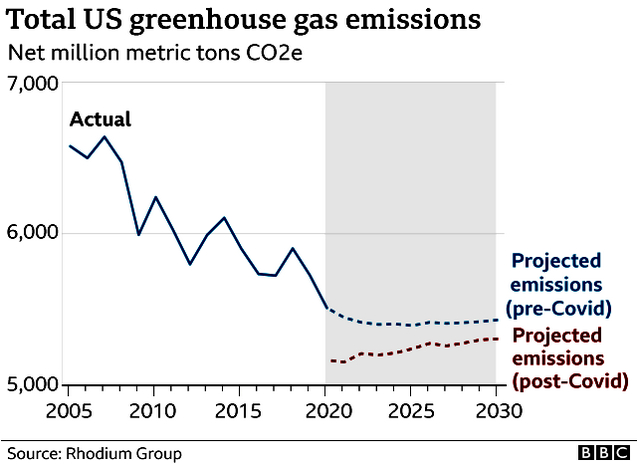
They say that states and cities will help cut US emissions by 19% compared to 2025 from what they were in 2005 - that's not enough to make up for the US promise under Paris but it keeps those targets "within reach".

At UN climate talks, groups representing states and cities that want to remain in the Paris pact have made their presence felt. Getty Images

"The public understands that fighting climate change goes hand in hand with protecting our health and growing our economy," said Michael Bloomberg in a statement.

"So despite the White House's best efforts to drag our country backward, it hasn't stopped our climate progress over the past four years."

On the business front, there has been growing pressure from shareholders of large fossil fuel-based industries to face up to the climate challenge.

A proposal filed by BNP Paribas Asset Management won a 53% majority vote at Chevron - it called on the oil giant to ensure that its climate lobbying was in line with the goals of the Paris agreement.

Will other countries now leave the agreement?

"I don't think anyone will follow Mr Trump out of Paris," said Peter Betts, a former lead negotiator for the UK and the EU in the global climate negotiations, and now an associate fellow at Chatham House.

"Nobody has in the last four years and I don't think they will in the future."

Some are worried that the US withdrawal will see other countries adopt a go-slow attitude, at a time when scientists are saying that efforts should be speeded up.

China's President Xi speaking to the UN on climate change, seen on an outdoor screen in Beijing. Getty Images

A number of countries, including Saudi Arabia, Kuwait and Russia have already shown a willingness to side with US efforts to push back on the science around global warming.

"They are biding their time, they are saying that if the US is not in then we don't need to rush to do anything at this time'," said Carlos Fuller, lead negotiator from the Alliance of Small Island States.

"I think they are hedging their bets to see what kind of a better deal they can get out of it, and not actually withdraw."

Others are hopeful that the US withdrawal will drive a sense of unity among others, and see new leadership emerge.

"The EU green deal and carbon neutrality commitments from China, Japan and South Korea point to the inevitability of our collective transition off fossil fuels," said Laurence Tubiana, one of the architects of the Paris agreement and now chief executive of the European Climate Foundation.

(USA) The Party That Ruined The Planet

New York Times

Republican climate denial is even scarier than Trumpism.

Credit...Pavel Lvov/Sputnik, via Associated Press
Author
Paul Krugman has been an Opinion columnist since 2000 and is also a Distinguished Professor at the City University of New York Graduate Center. He won the 2008 Nobel Memorial Prize in Economic Sciences for his work on international trade and economic geography.
The most terrifying aspect of the U.S. political drama isn’t the revelation that the president has abused his power for personal gain. If you didn’t see that coming from the day Donald Trump was elected, you weren’t paying attention.

No, the real revelation has been the utter depravity of the Republican Party. Essentially every elected or appointed official in that party has chosen to defend Trump by buying into crazy, debunked conspiracy theories. That is, one of America’s two major parties is beyond redemption; given that, it’s hard to see how democracy can long endure, even if Trump is defeated.

However, the scariest reporting I’ve seen recently has been about science, not politics. A new federal report finds that climate change in the Arctic is accelerating, matching what used to be considered worst-case scenarios. And there are indications that Arctic warming may be turning into a self-reinforcing spiral, as the thawing tundra itself releases vast quantities of greenhouse gases.

Catastrophic sea-level rise, heat waves that make major population centers uninhabitable, and more are now looking more likely than not, and sooner rather than later.

But the terrifying political news and the terrifying climate news are closely related.

Why, after all, has the world failed to take action on climate, and why is it still failing to act even as the danger gets ever more obvious? There are, of course, many culprits; action was never going to be easy.

But one factor stands out above all others: the fanatical opposition of America’s Republicans, who are the world’s only major climate-denialist party. Because of this opposition, the United States hasn’t just failed to provide the kind of leadership that would have been essential to global action, it has become a force against action.

And Republican climate denial is rooted in the same kind of depravity that we’re seeing with regard to Trump.

As I’ve written in the past, climate denial was in many ways the crucible for Trumpism. Long before the cries of “fake news,” Republicans were refusing to accept science that contradicted their prejudices. Long before Republicans began attributing every negative development to the machinations of the “deep state,” they were insisting that global warming was a gigantic hoax perpetrated by a vast global cabal of corrupt scientists.

And long before Trump began weaponizing the power of the presidency for political gain, Republicans were using their political power to harass climate scientists and, where possible, criminalize the practice of science itself.

Perhaps not surprisingly, some of those responsible for these abuses are now ensconced in the Trump administration. Notably, Ken Cuccinelli, who as attorney general of Virginia engaged in a long witch-hunt against the climate scientist Michael Mann, is now at the Department of Homeland Security, where he pushes anti-immigrant policies with, as The Times reports, “little concern for legal restraints.”

However, I don’t believe that it’s just about the money. My sense is that right-wingers believe, probably correctly, that there’s a sort of halo effect surrounding any form of public action. Once you accept that we need policies to protect the environment, you’re more likely to accept the idea that we should have policies to ensure access to health care, child care, and more. So the government must be prevented from doing anything good, lest it legitimize a broader progressive agenda.

Still, whatever the short-term political incentives, it takes a special kind of depravity to respond to those incentives by denying facts, embracing insane conspiracy theories and putting the very future of civilization at risk.

Unfortunately, that kind of depravity isn’t just present in the modern Republican Party, it has effectively taken over the whole institution. There used to be at least some Republicans with principles; as recently as 2008 Senator John McCain co-sponsored serious climate-change legislation. But those people have either experienced total moral collapse (hello, Senator Graham) or left the party.

The truth is that even now I don’t fully understand how things got this bad. But the reality is clear: Modern Republicans are irredeemable, devoid of principle or shame. And there is, as I said, no reason to believe that this will change even if Trump is defeated next year.

The only way that either American democracy or a livable planet can survive is if the Republican Party as it now exists is effectively dismantled and replaced with something better — maybe with a party that has the same name, but completely different values. This may sound like an impossible dream. But it’s the only hope we have.

Links

(AU) Tim Flannery: We Need To Talk To Our Kids About The Climate Crisis. But Courage Fails Me When I Look At My Son

The Guardian

Tim Flannery has been speaking about climate change for decades – but he’s finding it harder and harder to be the bearer of bad news

‘As the news darkens, I’m having difficulty talking to young people about it’: Prof Tim Flannery. Photograph: Carly Earl/The Guardian


Author
Tim Flannery is a scientist, an explorer, a conservationist and a leading writer on climate change. He has held various academic positions including visiting Professor in Evolutionary and Organismic Biology at Harvard University, Director of the South Australian Museum, Principal Research Scientist at the Australian Museum, Professorial Fellow at the Melbourne Sustainable Society Institute, University of Melbourne, and Panasonic Professor of Environmental Sustainability, Macquarie University.
Being a bearer of bad news is never easy. I’ve been writing and talking about climate change for decades now. 

Constant exposure hardens one to even the most horrific reality, and I’ve coped by acting like a jolly hangman – or at least not giving in publicly to the helplessness I sometimes feel as I relate the latest findings.

But as the news darkens, I’m having difficulty talking to young people about it. I can tell an optimistic story about developing technologies and the role they can play in helping avert the worst of the crisis. 

But we have now left action so late that some very severe climate impacts seem unavoidable. When I try to imagine how I, as a young person, would react to such news, I find it hard to continue my work.

I was recently asked to speak to a group of around 40 emerging leaders, all in their 30s and 40s. The meeting was conducted early in the morning, via Zoom. I began with an overview of the impacts of climate change as it’s emerging, as outlined in the Intergovernmental Panel on Climate Change’s sixth assessment report. 

  
Tim Flannery’s The Climate Cure. ‘We have now left action so late that some very severe climate impacts seem unavoidable,’ he says. Photograph: Text Publishing

The report, which is still being drafted, is filled with terrifying news of melting ice caps, burning forests and climate tipping points being closer than we previously thought. Because I deal with such matters every day, I’m somewhat numbed to them. But I could see that they were having a profound effect on my audience.

The group of emerging leaders I spoke to included a young executive from the fossil fuel industry. During the discussion that followed, he commented that most of the younger people in his industry, himself included, felt as I did about the emerging climate crisis. 

But while some have left to establish renewable energy companies, many more have stayed on, regardless of their personal feelings. Changing one’s career, especially if you’ve been successful, is not easy. Perhaps those who remain fear that they will plunge their families into poverty if they try to re-skill and seek work elsewhere.

The young executive then told us what it’s like to drive with his family in his branded work vehicle. Abuse is frequently hurled at him by those who despise what his company is doing, and that experience is shared by his children. I watched the faces of the Zoom participants as the distress of the executive grew. As parents we could all picture the scenario: the children locked into place for a journey they can’t escape from, as tension between adults explodes.

I know exactly how he felt. When I was climate commissioner, my older two children were teenagers. On several occasions when I was enjoying a weekend in the city with them, people shouted at me, “F– off Mr Carbon Tax”, and other abusive things. 

I could say nothing to the abusers, who were itching for a fight. And the embarrassment and hurt on the faces of my kids still haunts me. As they grew older, they came to understand that those who screamed at me were ignorant and scared. But I didn’t do a very good job, at the time, of talking with them about the reasons for the abuse.   

The reaction of very young children to the climate crisis is of even greater concern. What I didn’t realise, on the morning of that Zoom call, was that my youngest child, aged seven, had not been asleep as I thought, but had been listening to the entire presentation. 

That realisation brought me up sharp. My son is a bright boy, interested in science and space, so I’m pretty sure he understood what I said. And I’m sure that the emotionally fraught discussion he witnessed had an impact on him. But how, now, am I to talk to him about our future?

Our children carry the lessons learned in childhood far into the future. Uli Edel’s 2009 film The Baader Meinhoff Complex documents the bombings, bank robberies and killings that were carried out by radical gangs in Germany in the 1970s and 80s. 

Based on detailed evidence, it makes the case that radicalised youth was a response to the unacknowledged Nazi past of their parents’ generation. The Baader Meinhoff gang grew up in a world where prominent Nazis remained in positions of high authority. They acted as they did because they felt there had been no justice – no reckoning for the horrific acts their parents had been part of.

I strongly believe we need to speak with our children about the growing climate threat: about responsibility, impacts and forgiveness. Yet as I look at my young son playing with his Lego or reading his children’s books, my courage fails me. I keep putting the discussion off, as I suspect many workers in the fossil fuels industry do when it comes to speaking to their children.

Yet if we fail to explain the state of the world we have created, and our role in helping create it, I greatly fear that some in the next generation will grow into very angry young people indeed.

Links

05/11/2020

We Can Avert Irreversible Climate Change

Financial Times

Action is both essential and affordable — but it demands international leaders’ co-operation

© James Ferguson

Author
Martin Wolf is chief economics commentator at the Financial Times, London. He was awarded the CBE (Commander of the British Empire) in 2000 “for services to financial journalism”.
A renewed presidency for Donald Trump is likely to be nowhere more consequential than for climate change. The coming decades will determine whether the threat of damaging and irreversible change is averted, or not.

Without active US engagement, success seems inconceivable. Even with it, it would be unlikely. But, crucially, it would be conceivable. We know what to do and we know, too, that it is affordable. What is unaffordable is not to do what we need to do. But will we? That is the question.

It is indicative of the shift in the perspective of the global policy establishment that a chapter of the IMF’s October World Economic Outlook focuses on “mitigating climate change” — that is, preventing it — via “growth-and-distribution-friendly strategies”. In brief, the IMF insists that humanity can have its cake and eat it: both higher incomes and a safe climate.

As a result of rising concentrations of greenhouse gases in the atmosphere, global average temperatures are already about 1C above pre-industrial levels. On present trends, this could reach around 1.5C in a decade and 2C half a decade later. At that point, warn climate scientists, dangerous and irreversible tipping points in the climate are likely to be passed. Most governments do at least pretend to agree. Thus, in the Paris accords of December 2015, they committed themselves to keeping temperatures below these levels, even if their promises fell short of what was needed to achieve this.


As the IMF notes: “Sizeable and rapid reductions in carbon emissions are needed for this goal to be met; specifically, net carbon emissions need to decline to zero by mid-century.” If this is to happen, emissions need to fall sharply this decade and keep on falling thereafter. That would represent a huge turnround from previous trends.

What sort of programme might deliver this outcome? The answer, suggests the fund, is a combination of front-loaded green investments, aggressive funding of research and development, and a credible long-term commitment to rising carbon prices. This is in line with other studies, notably Making Mission Possible: Delivering a Net-Zero Economy, a September 2020 report from the global Energy Transitions Commission. The latter also emphasises complementary regulation, to accelerate changes in behaviour. Compensation of poorer losers against the higher fuel prices will be needed as well.


Is a move towards zero net emissions by 2050 affordable? The answer is: surprisingly so, particularly given the economically depressed post-Covid starting point. The IMF estimates that achieving this aim might lower world output by 1 per cent, relative to its “baseline” under unchanged policies, once one adds in the benefits of damages avoided. Even so, this must be put in the context of expected cumulative global growth of 120 per cent over the next 30 years. It also ignores the benefits of far lower local pollution.

Some estimates suggest that temperature increases of as much as 5C by 2100, in the absence of mitigation, might lower global output by 25 per cent. This does not take account of the massive non-economic disruptions to humanity, indeed all life, to be expected from such an unprecedentedly rapid upheaval in the climate.


Given these estimates of the modest short-term cost of mitigation against the far greater long-term costs of failure to do so, the argument for action is overwhelming. It becomes more so when one allows for the scale of the uncertainty created by unmitigated climate change, as well as its irreversibility. 

Taking action might make sense even if the costs were many times as large as now expected. So why is it not happening? One explanation is that it involves changes in lifestyles, which we dislike. Another is that it requires thinking in decades, which is unnatural. But the most important explanation is that it requires long-term co-operation, which we usually find impossible.


Co-operation among five players — China, the US, the EU, India and Japan — would deliver a huge part of what is needed. Unfortunately, this hardly looks likely right now. A shift in the US presidency towards someone sane would be a big help. Without that, sanctions against the US might be necessary. But a more aggressive shift by China than planned will also be essential.

If needed policy shifts are to happen soon enough, it will take statesmanship of a high order indeed. Domestically, programmes must compensate the most vulnerable losers, which is a good reason for using a carbon tax. Internationally, leaders must co-operate far more effectively than they did even on the Paris accord. If they are to do what is needed, leaders must overcome two other obstacles to wise action: the fossil-fuels-forever resisters; and the ecological fanatics, who argue in favour of a revolutionary overthrow of capitalism and the end of growth — by tomorrow, please.


The only realistic hope is technocratic problem-solving and co-operative policies. These must be guided by moral purpose, but not infused by fantasies of revolutionary transformations. Cries of “repent, for the end of the world is nigh” will not solve this emergency. Humanity is at its best when it uses its head. Climate is at bottom a crisis of technology and behaviour; it can be tackled only by changing incentives throughout the system.

As I have argued before, this is now extremely urgent. If we want to prevent a dangerous shift in the planet’s climate, we need to act far more decisively than hitherto. We are drinking fossil fuels in the earth’s last-chance saloon. The time has come for humanity to sober up.

Links

Lethal Heating is a citizens' initiative