10/12/2020

(AU) Heat Is The 'Silent Killer' Of Australia's Bushfire Season And Experts Say Climate Change Is The Root Cause

ABC News - Alison Branley | Sophie Scott

Alan Nichols has had severe health problems since last year's bushfire season. (ABC News: Billy Cooper)

At the height of last summer's bushfires, Alan Nichols vividly remembers racing out of his holiday unit, loaded up with essentials.

A fire was rapidly approaching Malua Bay on the New South Wales South Coast and the thick smoke from the looming firestorm was making it hard to breathe.

"It was all dark, as if it was night-time, smoke everywhere," he said.

"It hurt my eyes just to be outside.

"My lungs were going, sort of solid."

Alongside other fellow holidaymakers, Mr Nichols spent New Year's Eve trapped on the beach watching homes burst into flames.

By the time he made it home to Canberra, a heavy cough had set in — coinciding with the thick smoke haze blanketing much of the east coast of Australia.

"We weren't able to have the cooling going because it was pumping the smoke in," Mr Nichols said.

"There was just no relief."

Parliament House in heavy haze after Canberra was blanketed in bushfire smoke. (AAP: Lukas Coch)

The cough was waking him up at night and he couldn't get through a conversation without suffering a coughing fit.

A month after the initial incident, Alan's family urged him to see a doctor.

New figures show he was one of thousands of Australians who struggled with breathing difficulties in the aftermath of the fires.

In the ACT, pharmacy inhaler sales jumped by up to 204 per cent in the week of January 5.

On the South Coast of NSW, prescriptions rose 73 per cent in the second week of January, compared to the same time last year, while in the Hume area of Victoria — an area where the bushfires hit — inhaler sales spiked by 74 per cent.

Cardiologist Arnagretta Hunter said the figures were a clue as to how many Australians suffered health effects from the smoke.

Dr Hunter said the long-term effects bushfire smoke were still an unknown. (ABC News)

Dr Hunter is the chair of a working party at the Australian National University set up at the height of the smoke crisis.

Its aim was to fill a massive knowledge gap that exists in the scientific world about the short and long-term impacts of bushfire smoke.

"We know a lot about air pollution, we don't know as much about bushfire smoke," she said.

Preliminary results of a survey of more than 2,000 Canberra residents showed that between December and January, 89 per cent reported experiencing irritated eyes, scratchy throat or cough.

Almost half of the respondents felt anxious and or depressed as a result of the smoke.

While many of their health impacts will resolve, the bigger question is what will happen to these people long term.

The royal commission into bushfires heard the smoke led to an extra 3,320 hospitalisations and 429 deaths across the country.
"They died from chest infections and pneumonia," Dr Hunter said.
"[And] they've died from heart attack and stroke and cardiovascular disease; they've died because of an increase in the risk of sepsis associated with hazardous air pollution exposure."

Dr Hunter said the health impacts of smoke shouldn't be looked at in isolation, given smoke usually occurs in combination with what public health experts describe as a "silent killer" — heat.

"Thousands more people presented to hospital with cardiovascular problems, stroke problems and with pulmonary problems or exacerbations of asthma and emphysema."

Mr Nichols was prescribed many drugs to help with his condition. (ABC News: Billy Cooper)
 
Mr Nichols was one of them.

After being put on an inhaler at the end of summer he started developing pain in his legs.

He was diagnosed with blood clots and had to be rushed to the emergency department.

"I'll be on blood thinners for life now," he said.

But it didn't end there.

A week later he began experiencing heart problems.

"It was as if someone was playing the drums on the bed — it was just bang, bang, bang, bang, bang."

He was rushed to hospital a second time, this time his heart had gone out of rhythm, what's known as atrial fibrillation.

And in the weeks after the fire, his nasal washes repeatedly came out black with ash.

"For six weeks that [black] soot came out," he said.

Ash washed on many beaches following last summer's bushfires. (Supplied: Renee Tonkin) 

Experts say it's not the ash you can see that's the problem, but the microscopic particles known as PM2.5 which can get deep into the lungs and enter the body.

"What we also know is that exposure to this sort of particulate matter can have a longer-term impact on things like cardiovascular health," Dr Hunter said.

"So whether you develop a little bit of plaque in your arteries, either in the heart or the brain, or other parts of the body, whether or not there is an association with a slight increase in malignancy and cancers.

"Those are questions we won't know the answer to for another 10 or 20 years."

It is why academics are strongly urging governments to invest in long-term studies.

Climate change a 'big driver'

The royal commission into bushfires made a series of recommendations including aligning air-quality measurements around the country and standardised warnings and health advice.

It also suggested the establishment of "smoke plans" so that communities can evacuate to safe havens such as libraries and shopping centres with air filters.

But many believe dealing with the smoke is just treating the symptom of an underlying condition: climate change.

Concerned emergency services leaders have vowed to make sure the royal commission's recommendations are more than just words. 
Why the royal commission's report
is not about blame
Anyone hoping the pages of the commission's final report would deliver a reckoning or apportion blame over the handling of the fire season will be largely disappointed. Read more ...


The group, Emergency Leaders for Climate Action, consisting of retired fire chiefs and health leaders, has launched its own tracker to monitor outcomes.

The tracker is an online list of recommendations of the royal commission with updates about whether they've been implemented and what stage those reforms are at.  

"It's very critical that the states don't lose momentum," public health expert David Templeman, who is part of the group, said.

"Climate change is the big driver here; you can't get improvement in air quality unless you address the root cause of it."

Calls for the climate as cause of death

Imogen Jubb said the bushfire smoke caused her mother's health to decline. (ABC News) 

Imogen Jubb's 85-year-old mother Annemarie died of a heart attack in Canberra at the height of the fires. 

The retired psychologist had been hospitalised with breathing difficulties in early December and was able to spend Christmas with her family.

"I had no thought that she wouldn't be alive a few weeks later," Ms Jubb said.

Ms Jubb, who works for climate change think tank Beyond Zero Emissions, said as the weeks of smoke dragged into January her mother started to decline.

"She didn't feel comfortable going outside, it was really hot in the house," she said.

Annemarie Jubb died after last summer's bushfires. (Supplied) 

Ms Jubb works as a climate campaigner, but her concerns are backed by experts and her brother, a doctor, who also watched his mother's decline.

Medical experts say when patients have several health issues, it's impossible to pinpoint single contributing factor for a health emergency like a heart attack.

Imogen's brother Brendan, a practising paediatrician, believed the air quality was a factor in their mother's death.

"Certainly, she had heart problems to begin with. But the presence of the smoke did make it more difficult for her to breathe," Mr Jubb said.

"She was certainly struggling."

The family wants to see people whose deaths are linked to extreme weather events have climate change listed as an official cause of death on the death certificate, following similar calls from academics at ANU earlier in the year.

"I don't want other communities and other families to have to suffer," Ms Jubb said.

Brendan Jubb wants climate change listed as an official cause of death, following similar calls from academics at ANU. (ABC News) 

Federal Assistant Minister for Environmental Management Trevor Evans said the Government agreed with the findings of the royal commission that summers would get longer, hotter and drier because of climate change.

"Our most recent focus was to ensure that Australia's emissions continued to fall so that we met our 2020 targets," he said.

"And I'm very pleased to say that we managed to do that this year.
"We're now working very hard on meeting Australia's 2030 targets."
He said the Federal Government had worked with the states and territories throughout this year to get a consistent approach to air quality readings and warnings as recommended by the commission.

"I can confirm that New South Wales is delivering these improvements to their residents in time for this summer, our hope is that other states and territories are able to do so," Mr Evans said.

He said the Government was giving $2 million to the CSIRO and to the Bureau of Meteorology to work on a smoke forecasting tool and the Government was "open" to the suggestion of smoke plans.

"Those ideas are definitely under consideration by the Government as we speak," he said.

Links

The Paris Agreement Five Years On: Is It Strong Enough To Avert Climate Catastrophe?

The Guardian - 

With Trump no longer a threat, there is a sense of optimism around what the accord could achieve – but only if countries meet their targets

Illustration: Guardian Design

No one who was in the hall that winter evening in a gloomy conference centre on the outskirts of the French capital will ever forget it. Tension had been building throughout the afternoon, as after two weeks of fraught talks the expected resolution was delayed and then delayed yet again. Rumours swirled – had the French got it wrong? Was another climate failure approaching, the latest botched attempt at solving the world’s global heating crisis?

Finally, as the mood in the hall was growing twitchy, the UN security guards cleared the platform and the top officials of the landmark Paris climate talks took to the podium. For two weeks, 196 countries had huddled in countless meetings, wrangling over dense pages of text, scrutinising every semicolon. And they had finally reached agreement. Laurent Fabius, the French foreign minister in charge of the gruelling talks, looking exhausted but delighted, reached for his gavel and brought it down with a resounding crack. The Paris agreement was approved at last.

Nicholas Stern, the climate economist, found himself hugging Xia Zhenhua, the normally reserved Chinese minister, while whoops and shouts echoed round the hall. “I felt that the Paris agreement was the moment when the world decided it really had to manage climate change in a serious way,” he said. “We were all in it together, that’s what people realised.”

French Special Representative for the 2015 Paris Climate Conference. Photograph: Christophe Petit Tesson/EPA

At Paris, for the first time rich and poor countries joined together in a legally binding treaty pledging to hold global heating to heating well below 2C, the scientifically-advised limit of safety, with an aspiration not to breach 1.5C above pre-industrial levels. Those two weeks of tense talks in the French capital were the climax of 25 years of tortuous negotiations on the climate, since governments were warned of the dangers of climate chaos in 1990. The failure, discord and recriminations of those decades were left behind as delegates from 196 countries hugged, wept and cheered in Paris.

Todd Stern, climate envoy to President Barack Obama, recalls: “My team and I had been working toward this for seven years … and the story of climate negotiations had so often been one of disappointment. And yet here we were and we knew that we had – all together – done a really big thing. A very special moment. An unforgettable one.”

The accord itself has proved remarkably resilient. Bringing together 196 nations in 2015 was not easy – even as Fabius brought down the gavel on the agreement, there was a little chicanery as Nicaragua had planned to object to the required consensus, but was ignored. Yet that consensus has remained robust. When the US – the world’s biggest economy and second biggest emitter – began the process of withdrawal from Paris, under President Donald Trump in 2017, a disaster might have been expected. The Kyoto 1997 protocol fell apart after the US signed but failed to ratify the agreement, leaving climate negotiations in limbo for a decade.

If Trump was hoping to wreck Paris, he was disappointed: the rest of the world shrugged and carried on. There was no exodus of other countries, although some did pursue more aggressive tactics at the annual UN talks. The key axis of China and the EU remained intact, deliberately underlined by China’s President Xi Jinping when he chose to surprise the world with a net zero emissions target at the UN general assembly in September, just as the UN election race was hotting up.

Remy Rioux, one of the French government team who led the talks, now chief executive of the French Development Agency, said: “The Paris agreement has proven to be inclusive and at scale, with the participation of countries representing 97% of global emissions, as well as that of non-state actors such as businesses, local government and financial institutions – and very resilient, precisely because it is inclusive. The Paris agreement is a powerful signal of hope in the face of the climate emergency.”

On some measures, Paris could be judged a failure. Emissions in 2015 were about 50 bn tonnes. By 2019, they had risen to about 55bn tonnes, according to the UN Environment Programme (Unep). Carbon output fell dramatically, by about 17% overall and far more in some regions, in this spring’s coronavirus lockdowns, but the plunge also revealed an uncomfortable truth: even when transport, industry and commerce grind to a halt, the majority of emissions remain intact. Far greater systemic change is needed, particularly in energy generation around the world, to meet the Paris goals.

Ban Ki-moon, former UN secretary-general, told the Guardian: “We have lost a lot of time. Five years after the agreement in Paris was adopted with huge expectations and commitment by world leaders, we have not done enough.”

What’s more, we are still digging up and burning fossil fuels at a frantic rate. Unep reported last week that production of fossil fuels is planned to increase by 2% a year. Meanwhile, we continue to destroy the world’s carbon sinks, by cutting down forests – the world is still losing an area of forest the size of the UK each year, despite commitments to stop deforestation – as well as drying out peatlands and wetlands, and reducing the ocean’s capacity to absorb carbon from the air.

Global temperatures have already risen by more than 1C above pre-industrial levels, and the results in extreme weather are evident around the world. Wildfires raged across Australia and the US this year, more than 30 hurricanes struck, heatwaves blasted Siberia, and the Arctic ice is melting faster.

António Guterres, secretary-general of the UN, put it in stark terms: “Humanity is waging war on nature. This is suicidal. Nature always strikes back – and it is already doing so with growing force and fury. Biodiversity is collapsing. One million species are at risk of extinction. Ecosystems are disappearing before our eyes.”

But to judge Paris solely by these portents of disaster would be to lose sight of the remarkable progress that has been made on climate change since. This year, renewable energy will make up about 90% of the new energy generation capacity installed around the world, according to the International Energy Agency, and by 2025 will be the biggest source of power, displacing coal. That massive increase reflects rapid falls in the price of wind turbines and solar panels, which are now competitive or cheaper than fossil fuel generation in many countries, even without subsidy.

 Illustration: Guardian Design

“We never expected to see prices come down so fast,” said Adair Turner, chair of the Energy Transitions Commission and former chief of the UK’s committee on climate change. “We have done better than the most optimistic forecasts.”

Oil prices plunged this spring as coronavirus lockdowns grounded planes and swept cities free of cars, and some analysts predict that the oil business will never recover its old hegemony. Some oil companies, including BP and Shell, now plan to become carbon-neutral.

Electric vehicles have also improved much faster than expected, reflected in the stunning share price rise of Tesla. The rise of low-carbon technology has meant that when the Covid-19 crisis struck, leading figures quickly called for a green recovery, and set out plans for ensuring the world “builds back better”.

Most importantly, the world has coalesced around a new target, based on the Paris goals but not explicit in the accord: net zero emissions. In the last two years, first a trickle and now a flood of countries have come forward with long-term goals to reduce their greenhouse gas emissions to a fraction of their current amount, to the point where they are equal to or outweighed by carbon sinks, such as forests.

The UK, EU member states, Norway, Chile and a host of developing nations led the way in adopting net zero targets. In September, China’s president surprised the world by announcing his country would achieve net zero emissions in 2060. Japan and South Korea quickly followed suit. US president-elect Joe Biden has also pledged to adopt a target of net zero emissions by 2050. That puts more than two thirds of the global economy under pledges to reach net zero carbon around mid-century.

If all of these countries meet their targets, the world will be almost on track to meet the upper limit of the Paris agreement. Climate Action Tracker, which analyses carbon data, has calculated that the current pledges would lead to a temperature rise of 2.1C, bringing the world within “striking distance” of fulfilling the 2015 promise.

Niklas Hohne of NewClimate Institute, one of the partner organisations behind Climate Action Tracker, said: “Five years on, it’s clear the Paris agreement is driving climate action. Now we’re seeing a wave of countries signing up [to net zero emissions]. Can anyone really afford to miss catching this wave?”

The key issue, though, is whether countries will meet these long-term targets. Making promises for 2050 is one thing, but major policy changes are needed now to shift national economies on to a low-carbon footing. “None of these [net zero] targets will be meaningful without very aggressive action in this decade of the 2020s,” said Todd Stern. “I think there is growing, but not yet broad enough, understanding of that reality.”

Renewing the shorter term commitments in the Paris agreement will be key. As well as the overarching and legally binding limit of 1.5C or 2C, governments submitted non-binding national plans at Paris to reduce their emissions, or to curb the projected rise in their emissions, in the case of smaller developing countries. The first round of those national plans – called nationally determined contributions – in 2015 were inadequate, however, and would lead to a disastrous 3C of heating.

The accord also contained a ratchet mechanism, by which countries must submit new national plans every five years, to bring them in line with the long-term goal, and the first deadline is now looming on 31 December. UN climate talks were supposed to take place this November in Glasgow, but had to be postponed because of the pandemic. The UK will host the Cop26 summit next November instead, and that will be the crucial meeting.

The signs for that decisive moment are good, according to Laurent Fabius. The election of Biden in the US means it will be aligned with the EU and China in pushing for net zero emissions to be fully implemented. “We shall have the conjunction of the planets which made possible the Paris agreement,” Fabius told the Guardian. “Civil society, politics, business all came together for the Paris agreement. We are looking at the same conjunction of the planets now with the US, the EU, China, Japan – if the big ones are going in the right direction, there will be a very strong incentive for all countries to go in the right direction.”

US president-elect Joe Biden has appointed John Kerry as his special presidential envoy for climate. Illustration: Guardian Design


As host of the Cop26 talks, the UK is redoubling its diplomatic efforts towards next year’s conference. The French government brought all of its diplomatic might to bear on Paris, instructing its ambassadors in every country to make climate change their top priority, and sending out ministers around the globe to drum up support.

 Laurence Tubiana, France’s top diplomat at the talks, said another key innovation was what she termed “360 degree diplomacy”. That means not just working through the standard government channels, with ministerial meetings and chats among officials, but reaching out far beyond, making businesses, local government and city mayors, civil society, academics and citizens part of the talks.

“That was a very important part of [the success] of Paris,” she said. The UK has taken up a similar stance, with a civil society forum to ensure people’s voices are heard, and a specially convened council of young people advising the UN secretary-general. The UK’s high-level champion, Nigel Topping, is also coordinating a “race to zero” by which companies, and non-state actors such as cities, states and sub-national governments are also committing to reach net zero emissions.

One massive issue outstanding ahead of Cop26 is finance. Bringing developing countries, which have suffered the brunt of a problem that they did little to cause, into the Paris agreement was essential. Key to that, said Fabius, was the pledge of financial assistance. The French government had to reassure poorer nations at the talks that $100bn a year in financial assistance, for poor countries to cut their emissions and cope with the impacts of the climate crisis, would be forthcoming. “Money, money, money,” Fabius insisted, was at the heart of the talks. “If you don’t have that $100bn [the talks will fail].”

For the UK as hosts of Cop26, the question of money presents more of a problem since the chancellor, Rishi Sunak, swung his axe at the overseas aid budget in the recent spending review. Although the £11bn designated for climate aid will be ringfenced, persuading other developed countries to part with cash – and showing developing countries that the UK is on their side – has suddenly become more difficult. Amber Rudd, the former UK energy and climate minister who represented the UK at the Paris talks, said: “A country that understood the seriousness of Cop26 would not be cutting international aid right now.”

Alok Sharma, president of Cop26 and the UK’s business secretary, will draw on his experience as the UK’s former international development minister in dealing with developing countries’ expectations. He said: “I completely recognise making sure we have the finance for climate change action is very important. That’s why we have protected international climate finance. I think people understand we are in a difficult economic situation. We have said when the economy recovers we would look to restore [overseas aid as 0.7% of GDP]. I do think when it comes to climate change we are putting our best foot forward.”

Boris Johnson will be hoping to smooth over these tricky issues when he, alongside the French government and the UN, presides over a virtual meeting of world leaders this weekend, on 12 December, the fifth anniversary of the Paris accord. At least 70 world leaders are expected to attend, and they will be pushed to bring forward new NDCs and other policy commitments, as a staging post toward the Cop26 summit.

Illustration: Guardian Design

Johnson kicked off preparations for the meeting last Friday by announcing the UK’s own NDC, setting out a 68% cut in emissions compared with 1990 levels, by 2030. That would put the UK ahead of other developed economies, cutting emissions further and faster than any G20 country has yet committed to do.

Critics pointed out, however, that the UK is not on track to meet its own current climate targets, for 2023. Far more detailed policy measures are likely to be required, some of them involving major changes and economic losers as well as winners, before the path to net zero is clear.

The world is facing the task of a global economic reboot after the ravages of the coronavirus pandemic. The green recovery from that crisis is itself in need of rescue, Guardian analysis has shown, as countries are still pouring money into fossil fuel bailouts. But with so many countries now committed to net zero emissions, and an increasing number coming forward with short term targets for 2030 to set us on that path, there are still grounds for optimism.

This week’s climate ambition summit will be an important milestone, but the Cop26 summit next year will be the key test. The Paris agreement five years on still provides the best hope of avoiding the worst ravages of climate breakdown: the question is whether countries are prepared to back it up with action, rather than more hot air. 

Links

(AU) Morrison Yet To Be Granted Speaking Slot At Climate Summit He Vowed To Attend

The Guardian -  |  | 

Australian PM last week insisted he would address forum to ‘correct mistruths’ about Coalition’s action on emissions

The Australian prime minister, Scott Morrison, hopes to address an online climate summit this weekend but speaker’s slots are only open to leaders announcing new measures to tackle climate change. Photograph: Lukas Coch/AAP

Scott Morrison does not yet have a speaker’s spot at a global climate ambition summit this weekend despite telling parliament last week he intended to use an appearance at the event to “correct mistruths” about his government’s heavily criticised record on emissions reduction.

A government spokesman on Monday night said Australia had been invited to take part in the 12 December summit “both personally by [British] prime minister Boris Johnson during a phone call with prime minister Morrison, and again in writing by the leaders of hosting nations: the United Kingdom, France, Italy, Chile and also the United Nations”.

But diplomatic sources have told Guardian Australia there had been debate among the co-hosts including Britain – which is hosting the next major climate conference in Glasgow in 2021 and has taken a leading role in calling on countries to do more – as to whether Morrison should be approved to speak at the summit given the widespread view Australia is a laggard on climate commitments.

Australia does not at this point have final confirmation that it will be granted a speaking slot and a government spokesman confirmed: “The final speaker list is a matter for the event hosts.”

Australia’s high commissioner in London, George Brandis, is now back in Canberra, in part to help aid Australia’s preparations for the virtual summit. Brandis flew into the nation’s capital on Sunday.

The countries hosting the summit wrote to national leaders in October calling on them to make ambitious new commitments to combat the climate crisis in return for a speaking slot.

They said such slots would be given only to leaders who set stronger targets to cut greenhouse gas emissions over the next decade; announced a long-term strategy to reach net-zero emissions; made a new financial commitment to help developing countries; or put forward ambitious policies to adapt to locked-in climate change.

As reported by Guardian Australia, the letter stated “we hope to see you in December with a bold new commitment” but noted there would be “no space for general statements”.

A Downing Street spokesman said on Monday the program of speakers would be announced over the coming days but the summit was “an opportunity to announce new commitments”. He declined to say whether Australia’s commitments were insufficient.

There has been speculation in some media that Australia had been granted a speaking slot and would use it to confirm it would drop its bid to use controversial “carryover credits” to help meet the 2030 emissions target it set as part of the Paris agreement.

While Morrison telegraphed a potential shift on carryover credits to business leaders in a speech, the Coalition has resisted calls for it to set a net-zero emissions or carbon neutrality target for 2050 despite the goal being backed by more than 100 leaders, all Australian states and multinational companies.

After the inauguration of Joe Biden as US president in January, all members of the G7 and China will have a net-zero goal.

The Morrison government was criticised for its plan to use the credits at the Madrid climate summit a year ago. It has said it does not plan to increase its 2030 emissions target – a 26% to 28% cut below 2005 levels – and stopped making contributions to the global climate fund which was set up to help developing countries respond and adapt to the crisis.

Britain last week announced it would increase its 2030 target to a 68% cut compared with 1990 levels. The EU is meeting this week to decide on a potential 55% cut.

The host countries have asked leaders to specify what they will say in prerecorded videos to be played at the summit before being granted a slot. More than 60 countries had been given slots by Monday.

The Climate Change Authority recommended in 2015 that Australia should be cutting emissions by at least 45% and up to 65% by 2030 to play its part under a meaningful global deal.

During the previous sitting week, the Greens leader, Adam Bandt, asked Morrison in parliament whether he intended to attend the 12 December summit and whether he proposed making a meaningful announcement.

Morrison did not attend a UN climate action summit in New York last year despite being in the US to visit the Trump administration at the time. Speaking slots at that event were also reserved for countries announcing new commitments.

But the prime minister was clear about his intentions for this week’s event. He told Bandt he would be attending the summit and it would be “a great opportunity to correct the mistruths spoken by the leader of the Greens”.

The independent MP Zali Steggall said the host countries should not offer Morrison a speaking slot unless he committed to net-zero by 2050.

Steggall, who has a climate change bill before parliament, said if the prime minister did “not have sufficient authority in his party room” to set the goal he should allow a conscience vote.

“As the rest of the world moves forward in drastically reducing their emissions, the government appears unable to commit to anything other than not cheating by counting carryover credits – and this still has to be passed in the party room,” she said on Monday.

Australia’s position on net-zero by 2050 was a focus of last week’s Australasian emissions reduction summit hosted by the Carbon Market Institute.

Nigel Topping, who has been appointed by Johnson as “high-level climate action champion” for the Glasgow conference, told reporters on Thursday that Australia was “on track for the wooden spoon” on climate change but had a chance to be a leader in new energy systems based on renewables and hydrogen.

Topping said he did not know if Morrison had been confirmed to speak at the 12 December event but noted it was an “ambition summit”.

“Without a commitment to net-zero 2050 it would be very surprising to me if there is an Australian voice on the stage,” he said.

Links

09/12/2020

It Might Be The World’s Biggest Ocean, But The Mighty Pacific Is In Peril

The Conversation -  |  |  |  |  | 

Shutterstock

Authors
The Pacific Ocean is the deepest, largest ocean on Earth, covering about a third of the globe’s surface. An ocean that vast may seem invincible. Yet across its reach – from Antarctica in the south to the Arctic in the north, and from Asia to Australia to the Americas – the Pacific Ocean’s delicate ecology is under threat.


In most cases, human activity is to blame. We have systematically pillaged the Pacific of fish. We have used it as a rubbish tip – garbage has been found even in the deepest point on Earth, in the Mariana Trench 11,000 metres below sea level.

And as we pump carbon dioxide into the atmosphere, the Pacific, like other oceans, is becoming more acidic. It means fish are losing their sense of sight and smell, and sea organisms are struggling to build their shells.

Oceans produce most of the oxygen we breathe. They regulate the weather, provide food, and give an income to millions of people. They are places of fun and recreation, solace and spiritual connection. So, healthy, vibrant oceans benefit us all. And by better understanding the threats to the precious Pacific, we can start the long road to protecting it.

The ocean plastic scourge

NOTE
This article is part of The Conversation’s international network Oceans 21 series:
  • Ancient Indian Ocean trade networks
  • Pacific plastic pollution
  • Arctic light and life
  • Atlantic fisheries
  • The Southern Ocean’s impact on global climate
The problem of ocean plastic was scientifically recognised in the 1960s after two scientists saw albatross carcasses littering the beaches of the northwest Hawaiian Islands in the northern Pacific. Almost three in four albatross chicks, who died before they could fledge, had plastic in their stomachs.

Now, plastic debris is found in all major marine habitats around the world, in sizes ranging from nanometers to meters. A small portion of this accumulates into giant floating “garbage patches”, and the Pacific Ocean is famously home to the largest of them all.

Most plastic debris from land is transported into the ocean through rivers. Just 20 rivers contribute two-thirds of the global plastic input into the sea, and ten of these discharge into the northern Pacific Ocean. Each year, for example, the Yangtze River in China – which flows through Shanghai – sends about 1.5 million metric tonnes of debris into the Pacific’s Yellow Sea. 

This 2014 photo shows a black footed albatross chick with plastics in its stomach on Midway Atoll in the northwestern Hawaiian Islands. Dan Clark/ U.S. Fish and Wildlife Service via AP


A wildlife killer

Plastic debris in the oceans presents innumerable hazards for marine life. Animals can get tangled in debris such as discarded fishing nets, causing them to be injured or drown.

Some organisms, such as microscopic algae and invertebrates, can also hitch a ride on floating debris, travelling large distances across the oceans. This means they can be dispersed out of their natural range, and can colonise other regions as invasive species.

And of course, wildlife can be badly harmed by ingesting debris, such as microplastics less than five millimetres in size. This plastic can obstruct an animal’s mouth or accumulate in its stomach. Often, the animal dies a slow, painful death.

Seabirds, in particular, often mistake floating plastics for food. A 2019 study found there was a 20% chance seabirds would die after ingesting a single item, rising to 100% after consuming 93 items.

Discarded fishing nets, or ‘ghost nets’ can entangle animals like turtles. Shutterstock

A scourge on small island nations

Plastic is extremely durable, and can float vast distances across the ocean. In 2011, 5 million tonnes of debris entered the Pacific during the Japan tsunami. Some crossed the entire ocean basin, ending up on North American coastlines.

And since floating plastics in the open ocean are transported mainly by ocean surface currents and winds, plastic debris accumulates on island coastlines along their path. Kamilo Beach, on the south-eastern tip of Hawaii’s Big Island, is considered one of the world’s worst for plastic pollution. Up to 20 tonnes of debris wash onto the beach each year.

Similarly, on uninhabited Henderson Island, part of the Pitcairn Island chain in the south Pacific, 18 tonnes of plastic have accumulated on a beach just 2.5km long. Several thousand pieces of plastic wash up each day.


Kamilo Beach is referred to as the world’s dirtiest.

Subtropical garbage patches

Plastic waste can have different fates in the ocean: some sink, some wash up on beaches and some float on the ocean surface, transported by currents, wind and waves.

Around 1% of plastic waste accumulates in five subtropical “garbage patches” in the open ocean. They’re formed as a result of ocean circulation, driven by the changing wind fields and the Earth’s rotation.

There are two subtropical garbage patches in the Pacific: one in the northern and one in the southern hemisphere.

The northern accumulation region is separated into an eastern patch between California and Hawaii, and a western patch, which extends eastwards from Japan.

Locations of the five subtropical garbage patches. van der Mheen et al. (2019)

Our ocean garbage shame

First discovered by Captain Charles Moore in the early 2000s, the eastern patch is better known as the Great Pacific Garbage Patch because it’s the largest by both size (around 1.6 million square kilometers) and amount of plastic. By weight, this garbage patch can hold more than 100 kilograms per square kilometre.

The garbage patch in the southern Pacific is located off Valparaiso, Chile, extending to the west. It has lower concentrations compared to its giant counterpart in the northeast.

Discarded fishing nets make up around 45% of the total plastic weight in the Great Pacific Garbage Patch. Waste from the 2011 Japan tsunami is also a major contributor, making up an estimated 20% of the patch.

With time, larger plastic debris degrades into microplastics. Microplastics form only 8% of the total weight of plastic waste in the Great Pacific Garbage Patch, but make up 94% of the estimated 1.8 trillion pieces of plastic there. In high concentrations, they can make the water “cloudy”.

Each year, up to 15 million tonnes of plastic waste are estimated to make their way into the ocean from coastlines and rivers. This amount is expected to double by 2025 as plastic production continues to increase.

We must act urgently to stem the flow. This includes developing plans to collect and remove the plastics and, vitally, stop producing so much in the first place.


Divers releasing a whale shark from a fishing net.

Fisheries on the verge of collapse

As the largest and deepest sea on Earth, the Pacific supports some of the world’s biggest fisheries. For thousands of years, people have relied on these fisheries for their food and livelihoods.

But, around the world, including in the Pacific, fishing operations are depleting fish populations faster than they can recover. This overfishing is considered one of the most serious threats to the world’s oceans.

Humans take about 80 million tonnes of wildlife from the sea each year. In 2019, the world’s leading scientists said of all threats to marine biodiversity over the past 50 years, fishing has caused the most harm. They said 33% of fish species were overexploited, 60% were being fished to the maximum level, and just 7% were underfished.

The decline in fish populations is not just a problem for humans. Fish play an important role in marine ecosystems and are a crucial link in the ocean’s complex food webs.

Overfishing is stripping the Pacific Ocean of marine life. Shutterstock 

Not plenty of fish in the sea

Overfishing
happens when humans extract fish resources beyond the maximum level, known as the “maximum sustainable yield”. Fishing beyond this causes global fish stocks to decline, disrupts food chains, degrades habitats, and creates food scarcity for humans.

The Pacific Ocean is home to huge tuna fisheries, which provide almost 65% of the global tuna catch each year. But the long-term survival of many tuna populations is at risk.

For example, a study released in 2013 found numbers of bluefin tuna – a prized fish used to make sushi – had declined by more than 96% in the Northern Pacific Ocean.

Developing countries, including Indonesia and China, are major overfishers, but so too are developing nations.

Along Canada’s west coast, Pacific salmon populations have declined rapidly since the early 1990s, partly due to overfishing. And Japan was recently heavily criticised for a proposal to increase quotas on Pacific bluefin tuna, a species reportedly at just 4.5% of its historic population size.

Experts say overfishing is also a problem in Australia. For example, research in 2018 showed large fish species were rapidly declining around the nation due to excessive fishing pressure. In areas open to fishing, exploited populations fell by an average of 33% in the decade to 2015.

Stocks of fish used to make sushi have declined in number. Shutterstock
 
So what’s driving overfishing?
  
There are many reasons why overfishing occurs and why it is goes unchecked. The evidence points to:
Let’s take Indonesia as an example. Indonesia lies between the Pacific and Indian oceans and is the world’s third-biggest producer of wild-capture fish after China and Peru. Some 60% of the catch is made by small-scale fishers. Many hail from poor coastal communities.

Overfishing was first reported in Indonesia in the 1970s. It prompted a presidential decree in 1980, banning trawling off the islands of Java and Sumatra. But overfishing continued into the 1990s, and it persists today. Target species include reef fishes, lobster, prawn, crab, and squid.

Indonesia’s experience shows how there is no easy fix to the overfishing problem. In 2017, the Indonesian government issued a decree that was supposed to keep fishing to a sustainable level – 12.5 million tonnes per year. Yet, in may places, the practice continued – largely because the rules were not clear and local enforcement was inadequate.

Implementation was complicated by the fact that almost all Indonesia’s smaller fishing boats come under the control of provincial governments. This reveals the need for better cooperation between levels of government in cracking down on overfishing.

Globally, compliance and enforcement of fishing limits is often poor. Shutterstock 

What else can we do?

To prevent overfishing, governments should address the issue of poverty and poor education in small fishing communities. This may involve finding them a new source of income. For example in the town of Oslob in the Philippines, former fishermen and women have turned to tourism – feeding whale sharks tiny amounts of krill to draw them closer to shore so tourists can snorkel or dive with them.

Tackling overfishing in the Pacific will also require cooperation among nations to monitor fishing practices and enforce the rules.

And the world’s network of marine protected areas should be expanded and strengthened to conserve marine life. Currently, less than 3% of the world’s oceans are highly protected “no take” zones. In Australia, many marine reserves are small and located in areas of little value to commercial fishers.

The collapse of fisheries around the world shows just how vulnerable our marine life is. It’s clear that humans are exploiting the oceans beyond sustainable levels. Billions of people rely on seafood for protein and for their livelihoods. But by allowing overfishing to continue, we harm not just the oceans, but ourselves.

Providing fishers with an alternative income can help prevent overfishing. Shutterstock 

The threat of acidic oceans

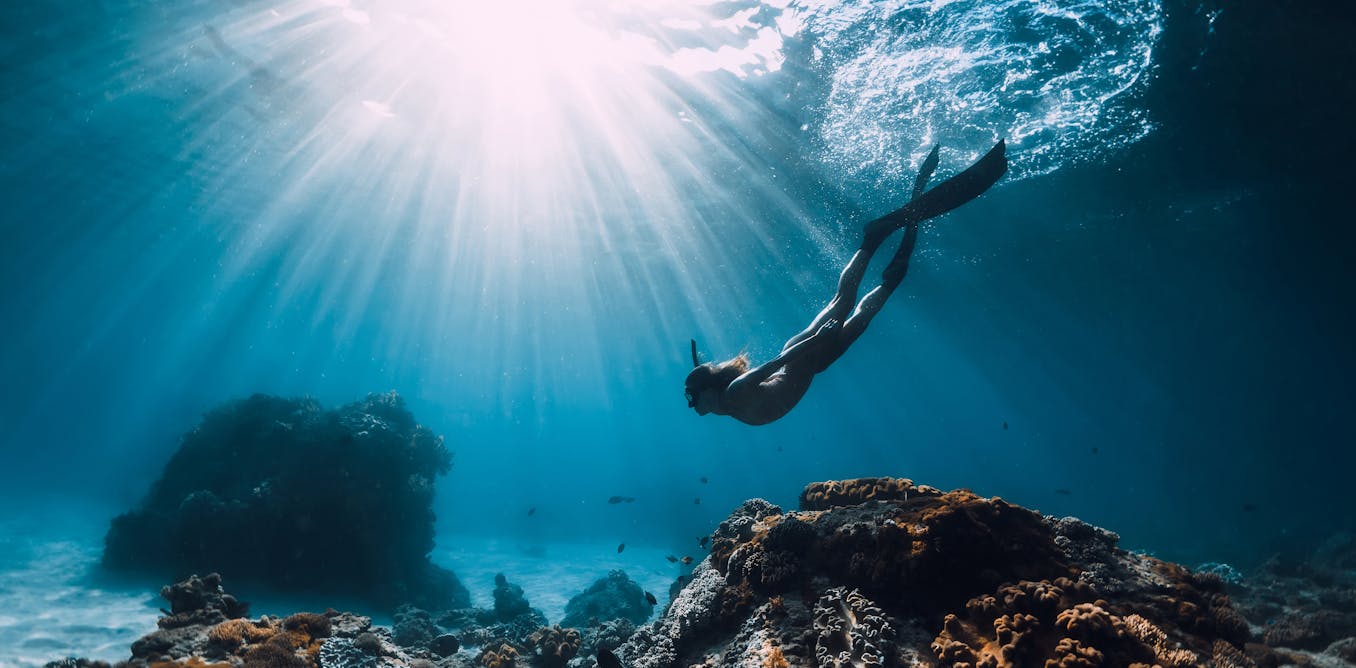
The tropical and subtropical waters of the Pacific Ocean are home to more than 75% of the world’s coral reefs. These include the Great Barrier Reef and more remote reefs in the Coral Triangle, such as those in Indonesia and Papua New Guinea.

Coral reefs are bearing the brunt of climate change. We hear a lot about how coral bleaching is damaging coral ecosystems. But another insidious process, ocean acidification, is also threatening reef survival.

Ocean acidification particularly affects shallow waters, and the subarctic Pacific region is particularly vulnerable.

Coral reefs cover less than 0.5% of Earth’s surface, but house an estimated 25% of all marine species. Due to ocean acidification and other threats, these incredibly diverse “underwater rainforests” are among the most threatened ecosystems on the planet.

The Pacific is home to more than 75% of the world’s coral reefs. Victor Huertas, Author provided (No reuse)

A chemical reaction

Ocean acidification involves a decrease in the pH of seawater as it absorbs carbon dioxide (CO₂) from the atmosphere.

Each year, humans emit 35 billion tonnes of CO₂ through activities such as burning of fossil fuels and deforestation.

Oceans absorb up to 30% of atmospheric CO₂, setting off a chemical reaction in which concentrations of carbonate ions fall, and hydrogen ion concentrations increase. That change makes the seawater more acidic.

Since the Industrial Revolution, ocean pH has decreased by 0.1 units. This may not seem like much, but it actually means the oceans are now about 28% more acidic than since the mid-1800s. And the Intergovernmental Panel on Climate Change (IPCC) says the rate of acidification is accelerating.

Each year, humans emit 35 billion tonnes of CO₂. Shutterstock 

Why is ocean acidification harmful?

Carbonate ions are the building blocks for coral structures and organisms that build shells. So a fall in the concentrations of carbonate ions can spell bad news for marine life.

In more acidic waters, molluscs have been shown to have trouble making and repairing their shells. They also exhibit impaired growth, metabolism, reproduction, immune function, and altered behaviours. For example, researchers exposed sea hares (a type of sea slug) in French Polynesia to simulated ocean acidification and found they had less foraging success and made poorer decisions.

Ocean acidification is also a problem for the fishes. Many studies have revealed elevated CO₂ can disrupt their sense of smell, vision and hearing. It can also impair survival traits, such as a fish’s ability to learn, avoid predators, and select suitable habitat.

Such impairment appears to be the result of changes in neurological, physiological, and molecular functions in fish brains.

Sea hares exposed to acidification made poorer decisions. Shutterstock

Predicting the winners and losers

Of the seven oceans, the Pacific and Indian Oceans have been acidifying at the fastest rates since 1991. This suggests their marine life may also be more vulnerable.

However, ocean acidification does not affect all marine species in the same way, and the effects can vary over the organism’s lifetime. So, more research to predict the future winners and losers is crucial.

This can be done by identifying inherited traits that can increase an organism’s survival and reproductive success under more acidic conditions. Winner populations may start to adapt, while loser populations should be targets for conservation and management.

One such winner may be the epaulette shark, a shallow water reef species endemic to the Great Barrier Reef. Research suggests simulated ocean acidification conditions do not impact early growth, development, and survival of embryos and neonates, nor do they affect foraging behaviours or metabolic performance of adults.

But ocean acidification is also likely to create losers on the Great Barrier Reef. For example, researchers studying the orange clownfish – a species made famous by Disney’s animated Nemo character – found they suffered multiple sensory impairments under simulated ocean acidification conditions. These ranged from difficulties smelling and hearing their way home, to distinguishing friend from foe.

Clownfish struggled to tell friend from foe when exposed to ocean acidification. Shutterstock

It’s not too late
  

More than half a billion people depend on coral reefs for food, income, and protection from storms and coastal erosion. Reefs provide jobs – such as in tourism and fishing – and places for recreation. Globally, coral reefs represent an industry worth US$11.9 trillion per year. And importantly, they’re a place of deep cultural and spiritual connection for Indigenous people around the world.

Ocean acidification is not the only threat to coral reefs. Under climate change, the rate of ocean warming has doubled since the 1990s. The Great Barrier Reef, for example, has warmed by 0.8℃ since the Industrial Revolution. Over the past five years this has caused devastating back-to-back coral bleaching events. The effects of warmer seas are magnified by ocean acidification.

Cutting greenhouse gas emissions must become a global mission. COVID-19 has slowed our movements across the planet, showing it’s possible to radically slash our production of CO₂. If the world meets the most ambitious goals of the Paris Agreement and keeps global temperature increases below 1.5℃, the Pacific will experience far less severe decreases in oceanic pH.

We will, however, have to curb emissions by a lot more – 45% over the next decade – to keep global warming below 1.5℃. This would give some hope that coral reefs in the Pacific, and worldwide, are not completely lost.

Clearly, the decisions we make today will affect what our oceans look like tomorrow.

Our decisions today will determine the fate of tomorrow’s oceans. Shutterstock

Links

Lethal Heating is a citizens' initiative