A growing number of climate economists say the world should take “immediate
and drastic action” to tackle climate change, according to a survey.
A partially submerged car is pictured on a flooded street
after Hurricane Florence struck Piney Green, North Carolina, U.S.,
September 16, 2018. REUTERS/Carlo Allegri
Key Points
Failing to tackle climate change could cost the world $1.7 trillion a year by 2050, according to 738 economists.
A recent survey shows that three-quarters of economists from
around the world strongly agreed that drastic action should be taken
immediately.
Two-thirds said the costs of investing toward that global goal of net-zero by 2050 would be outweighed by the economic benefits.
Failing to do so could cost the world some $1.7 trillion a year by the middle
of this decade, escalating to about $30 trillion a year by 2075, according to
estimations by the 738 economists from around the world surveyed by New York
University’s Institute for Policy Integrity.
“People joke about how economists can’t agree on most things,” said Derek
Sylvan, the institute’s strategy director and one of the authors of the
survey. “But we seem to find a pretty strong level of consensus” on the
economic importance of climate action.
Three-quarters of respondents strongly agreed that drastic action should be
taken immediately, compared with just half of economists polled by the same
institute in 2015.
For another question on reaching net-zero emissions by 2050, two-thirds said
the costs of investing toward that global goal would be outweighed by the
economic benefits, which would include preventing natural disasters,
preserving coastal infrastructure and assets and protecting food supplies.
Aerial photo shows damaged and destroyed homes after Hurricane
Michael smashed into Florida's northwest coast in Mexico Beach,
Florida, U.S., October 12, 2018. REUTERS/Dronebase
To avoid catastrophic climate change, scientists say the world needs to reach
net-zero emission by 2050 -- meaning people are adding no more emissions to
the atmosphere than they are removing.
Sylvan said he was surprised that so many saw net-zero action as “economically
desirable, even on the pretty short timeline that we’re talking about.”
Most of the international climate economists questioned for the survey in
February said they had become more concerned about climate change over the
last five years. The most common reason they gave was the escalation in recent
extreme weather events, which have included climate-linked wildfires and heat
waves.
The world saw more than 7,300 major natural disasters between 2000 and 2019,
which killed some 1.2 million and cost $3 trillion in damages, according to
the U.N. Office on Disaster Risk Reduction. That compares with about 4,200
disasters, leading to 1.19 million killed and $1.6 trillion in losses during
the 20 years previous, the data show.
A wind-driven wildfire burns near power line tower in Sylmar,
California, U.S., October 10, 2019.
REUTERS/Gene Blevins
“Some places are more exposed, and current levels of income matter a
great deal,” said Michael Greenstone, an economist at the University of
Chicago and the director of the Energy Policy Institute at Chicago.
The fallout from climate change will impact people and nations.
Economic disparities make it hard to apply simple cost-benefit analyses, he
said. For example, a poor family will feel economic losses more acutely than a
wealthy family.
“How do we think about a dollar of climate damage to (billionaires) Bill Gates
or Jeff Bezos versus a family of four living below the poverty line? I think
as a society we have to make a judgment about that.”
It was clear humans were warming the planet for some time -- now we have
official confirmation.
A simplified animation of Earth’s planetary energy balance: A planet’s energy budget is balanced between incoming (yellow) and outgoing radiation (red). Credit: NASA.
By now it should be no surprise to learn that the planet is warming very
rapidly.
The vast majority of this warming is not natural,
over 99% of scientists say, but rather the result of heat-trapping greenhouse gases released by human
activity such as burning fossil fuels.
Yet with all the thousands of studies about climate change and its connection
with human activity, it was only recently that researchers at NASA have
provided direct observations of the driving force of climate change.
Since the Industrial Revolution in the mid-19th century when humans’ appetite
for
coal
and other fossil fuels was first stirred, the concentration of CO2 in the
atmosphere has skyrocketed from 280 parts per million (ppm) to over 415 ppm
today.
We know beyond a doubt that greenhouse gases such as CO2, methane, or water
vapor trap heat in the atmosphere, thereby raising surface temperatures. We
also know that CO2 in the atmosphere is increasing at a pace 100 times faster
than it should naturally.
At the same time, human activity is also responsible for air pollution, such
as particulate matter that we all know is detrimental to our health, as well
as that of wildlife. But some of this air pollution is in the form of
aerosols, which are minute particles suspended in the atmosphere where they
reflect incoming sunlight back into space. In other words, this kind of
pollution has a global cooling effect.
Aerosols are thus a force of cooling, whereas greenhouse gases produce
heating. The difference between the energy absorbed by the atmosphere, of
which greenhouse gases are a major contributing factor, and the energy
radiated back to space by factors such as aerosols is known as “radiative
forcing”.
When radiative forcing is zero, this means that the
planet’s energy system is in balance, so the atmosphere shouldn’t warm nor
should it cool.
When radiative forcing is positive, this means
that Earth’s system is off balance and warming.
What NASA has done
in its recent study is to quantify the individual radiative forcings using
satellite observations in order to determine exactly how much each component
warms or cools the planet.
For decades, scientists have devised models of climate change predicting how
the temperature will change as a function of greenhouse gases in the
atmosphere.
Unsurprisingly, the new NASA study found that radiative
forces match these models after it combined data from NASA’s Clouds and the Earth’s Radiant Energy System (CERES), which studies the flow of radiation at the top of Earth’s atmosphere, with
other data sources such as ocean heat measurements.
“This is the first calculation of the total radiative forcing of Earth
using global observations, accounting for the effects of aerosols and
greenhouse gases,” said Ryan Kramer, first author on the paper and a
researcher at NASA’s Goddard Space Flight Center in Greenbelt,
Maryland, and the University of Maryland, Baltimore County. “It’s
direct evidence that human activities are causing changes to Earth’s
energy budget.”
Another nail in the coffin
Scientists unanimously agree that human activity is the only thing that can
explain the steep rise in the average global temperature on Earth, which has
increased by a little more than 1° Celsius (2° Fahrenheit) since 1880.
Two-thirds of the warming has occurred since 1975, at a rate of roughly
0.15-0.20°C per decade.
Although the evidence for anthropogenic global warming is overwhelming, this
was actually the first study to present direct rather than indirect evidence
in favor of this explanation for the warming we’re currently experiencing. Up
until now, direct evidence that changes in greenhouse gases affect the
atmosphere’s ability to transfer heat was only available in localized
settings.
According to the study, human activities have caused radiative forcing on
Earth to increase by about 0.5 Watts/square meter between 2003 to 2018.
“Creating a direct record of radiative forcing calculated from
observations will allow us to evaluate how well climate models can
simulate these forcings,” said Gavin Schmidt, director of
NASA’s Goddard Institute of Space Studies (GISS) in New York City. “This will allow us to make more confident
projections about how the climate will change in the future.”
Karen Joyce is Senior Lecturer - Remote sensing and spatial information, James Cook University
Stefan W Maier is Adjunct Research Fellow, James Cook University
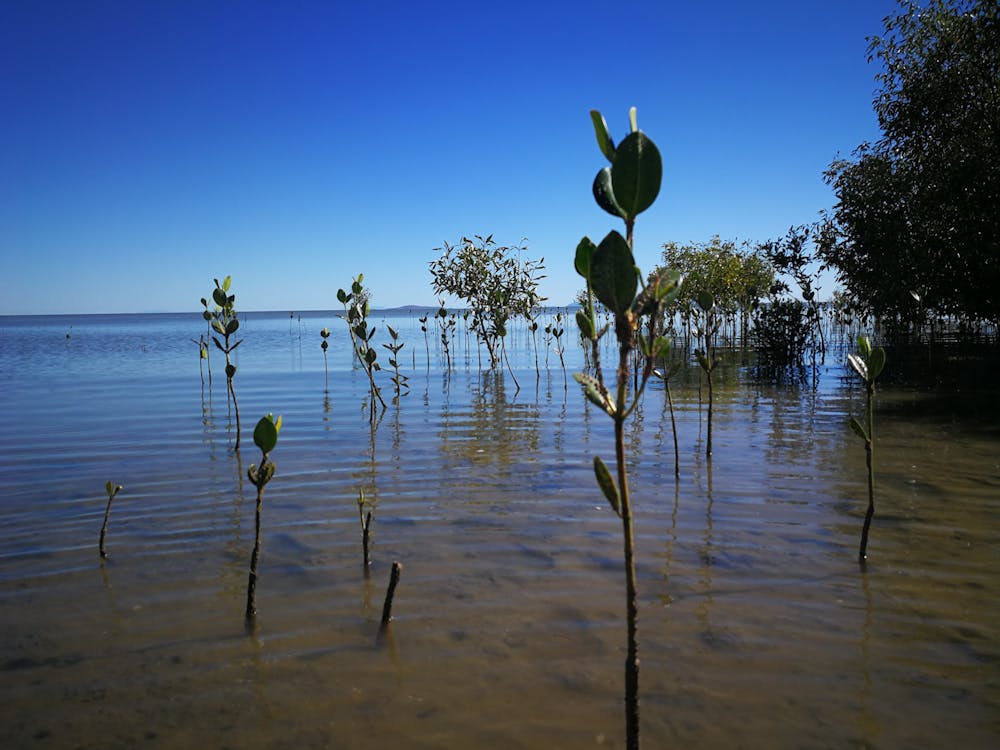
Australia is home to around 2% of the world’s mangrove forests and is the
fifth
most mangrove-forested country on Earth. Mangroves play a crucial role in the
ecosystem thanks to the dizzying array of plants, animals and birds they feed,
house and protect.
In other words, mangroves are some of our
most precious ecosystems. Despite their importance, there is much we don’t know about these complex
wetland forests. For example, when does their growing season start? And, how
long does it last?
Usually, answering these types of questions requires frequent data collection
in the field, but that can be costly and time-consuming. An alternative is to
use satellite images. In the future, this will allow us to track the impacts
of climate change on mangroves and other forests.
Mangroves play a crucial role in the ecosystem thanks to the
dizzying array of plants, animals and birds they feed, house and
protect.Nicolas Younes
What is phenology?
Our research used
satellite images to study the life cycles of mangrove forests in the Northern
Territory, Queensland, and New South Wales. We compared the satellite images
with field data collected in the 1980s, 1990s and 2000s, and found a
surprising degree of variation in mangrove life cycles.
We’re using the phrase life cycle, but the scientific term is “phenology”.
Phenology is the study of periodic events in the life cycles of plants and
animals. For example, some plants flower and fruit during the spring and
summer, and some lose their leaves in autumn and winter.
Phenology is important because when plants are growing, they absorb carbon
from the atmosphere and store it in their leaves, trunks, roots, and in the
soil. As phenology is often affected by environmental conditions, studying
phenology helps us understand how climate change is affecting Australian
ecosystems such as mangrove forests.
So how can we learn a lot in a short amount of time about mangrove phenology?
That’s where satellite imagery comes in.
How we use satellites to study mangrove phenology
Satellites are an excellent tool to study changes in forest health, area, and
phenology. Some satellites have been taking images of Earth for decades,
giving us the chance to look back at the state of mangrove forests from 30
years ago or more.
You can think of satellite images much like the photo gallery in your
smartphone: you can see many of your family members in a single image, and you
can see how everyone grows and “blooms” over time. In the case of mangroves,
we can see different regions and species in a single satellite image, and we
can use past images to study the life cycles of mangrove forests.
For example, satellite images depicted below, which use
data from the Australian government’s National Maps website, show how mangroves forests have changed in the Kimberley region of Western
Australia between 1990 and 2019. You can see how the mangrove forest has
reduced in some areas, but expanded in others. Overall, this mangrove forest
seems to be doing pretty well thanks in large part to the fact this area has a
reasonably small human population.
Images: NationalMap/Data61
Our study of satellite
images of mangrove forests in the Northern Territory, Queensland, and New
South Wales - and how they compared with data collected on the ground - found
not all mangroves have the same life cycles.
For instance, many mangrove species grow new leaves only once per year, while
other species grow new leaves twice a year. These subtle, but important
differences will allow us to track the impacts of climate change on mangroves
and other forests.
Satellite images of mangrove forests reveal not all mangroves
have the same life cycles. Here we see mangroves at different
growth stages.Nicolas Younes
Science cannot yet tell us exactly how mangrove phenology will be affected by
climate change but the results could be catastrophic. If mangroves flower or
fruit earlier than expected, pollinators such as bats, bees and birds may
starve or move to a different forests. Without pollinators, mangroves may not
reproduce and can die.
The next step in our research is to figure out how climate change is affecting
the life cycles of mangroves. To do this, we will use satellite images of
mangroves across Australia and factor in data on temperature and rainfall.
We think rising temperatures are causing longer periods of leaf growth, a
theory we plan to test by studying data from now with satellite images from
the 80s and 90s.
The next step in our research is to figure out how climate change
is affecting the life cycles of mangroves.Shutterstock
Satellite monitoring can’t do it all
Satellites can tell us a lot about how a mangrove forest is faring. For
example, satellite images captured a dieback event (depicted below, using
data from the Australian government’s National Maps website) that happened between 2015 and 2016, when around 7,400 hectares of
mangroves died
in the Gulf of Carpentaria
due to drought and unusually high air and sea temperatures.
Images: NationalMap/Data61
But satellite monitoring is not enough on its own and cannot capture the
detail you can get on the ground. For example, satellites cannot capture the
flowering or fruiting of mangroves because flowers are often too small and
fruits are often camouflaged. Also, satellites cannot capture what happens
under the canopy.
It is also important to recognise the work of researchers on the ground.
Ground data allows us to validate or confirm the information we see in
satellite images. When we noted some mangrove forests were growing leaves
twice per year, we validated this observation with field data, and confirmed
with experts in mangrove ecosystems. Field data is crucial to understand the
life cycles of ecosystems worldwide and how forests are responding to changes
in the climate.
Wetlands, including mangroves, are some of our most precious
ecosystems.Shutterstock
Greta Thunberg turned 18 a few months ago but occasionally she forgets that.
“I actually can vote now,” she grins. But the words “we children” still
sometimes slip into her sentences, out of habit. She is sanguine about the
change, but it is a bigger shift than she lets on: that phrase has been a core
part of her message.
Thunberg became the world’s most celebrated climate activist on the back of this
idea: that children have to wake the world up to the reality of climate change.
She was just 15 when she started the “school strike for climate”, for which she
skipped classes and sat outside the Swedish parliament — at first alone and
later with dozens, then hundreds of others every Friday. As the movement grew,
aided by Thunberg’s speeches, millions of students joined in. She took a year
off school, led protests all over the world and has been nominated for the Nobel
Peace Prize three times.
But today, the world is very different. When we speak in mid-March, most of
Europe is under some form of lockdown. Thunberg is at her family home in
Stockholm — her dad’s exercise bike and some houseplants form the backdrop of
our Zoom call. She’s also back at school, and isn’t cutting classes on Fridays
any more: protests during the pandemic have been mostly virtual.
Searching for an upside to the current situation, I ask whether she
sees any silver linings from the crisis, which caused global emissions to drop
by 6 per cent last year.
“The corona pandemic brought nothing
positive,” she says bluntly. “The emissions reductions we could see were
temporary and accidental . . . They didn’t occur due to us actually trying to
reduce emissions. So this has got nothing to do with climate action.” But the
pandemic does contain a lesson, she says: “It proves that the climate crisis has
never once been treated as a crisis. It just puts it in a different light.”
Thunberg became the face of the climate movement when it was
enjoying a great deal of success. In the past two years, dozens of countries
have announced targets of “net zero” emissions by 2050, which would mean
virtually stripping fossil fuels from their economies. China and the US, the
world’s two largest emitters, have both made climate change a diplomatic
priority. Many of the world’s dirtiest companies have pledged to cut emissions.
And images of thousands of children marching through streets in protests
inspired by Thunberg have galvanised a political focus on climate change that
would have been unimaginable a few years ago.
We need to stop focusing on dates and numbers and acknowledge that we
need to reduce our emissions right now
“The Greta Effect” has become a phenomenon with a life of its own. It has also
become the subject of study and debate, not all uncritical, by activists,
academics and executives. They are asking how much of Thunberg’s impact is
personal and how much is due to timing; where she goes next; and how
long-lasting, in slow-changing economies and industries, her impact will prove
to be. And these are questions that Thunberg is also asking herself.
Why
does she think she became famous? “I don’t know,” she says. “I guess it was just
the right thing at the right timing . . . People were ready for this kind of
thing, and then it just sort of [took] off. And one thing led to another and,
yeah, it just spiralled out of control . . . or at least, out of what was
reasonable.”
The last time we met was two years ago, when we had lunch together
in Stockholm. Although Thunberg is outwardly similar, over the course of our
conversation it becomes clear how much she has grown up. She is much more
confident and relaxed, and gives long and complicated answers when it comes to
her favourite topics, such as the pitfalls of net-zero targets.
She
still struggles a bit to make small talk, common among people who have Asperger
syndrome, a form of autism. What is it like being back at school? Very different
from before, she says. What does she think of the recent climate targets set by
major economies? “[My views are] completely irrelevant . . . We shouldn’t be
focusing on whether individuals think it is enough or whether I think it is
good.”
But after a slightly prickly start we settle in. Thunberg begins to work on some
embroidery as she talks — a piece she has designed for a friend who is a climate
activist in the Netherlands. “I can do these things during online classes,” she
explains, as a red thread slides across the video screen. “I concentrate better
when I do something at the same time.”
I ask how her message has
evolved in the past few years. Thunberg has long avoided detailed discussion of
what the solutions for climate change might be — she insists that is for other
people to figure out. But is it time to start thinking more about the solutions
now?
“If I would start talking about, like, taxes, or things like
that, since I have such a big reach, that would send a signal that the climate
crisis is an issue that can come down to party politics. And that really
minimises this crisis,” she says.
“We need to stop focusing on dates
and numbers and actually accept and acknowledge the fact that we need to reduce
our emissions right now. We can talk about 2030 or 2040 as much as we want. But
it is what we are doing now that really matters.”
The Paris agreement
of December 2015 prompted countries to gradually set more ambitious targets, and
the rise of social media meant that a new type of protest movement could spread
among a younger generation. But there was also something special about Thunberg
herself.
In one of her most famous moments on stage, she addressed
the UN Climate Action Summit in New York in September 2019. “How dare you?” she
asked the audience of assembled grandees, with what looked like tears of rage in
her eyes. “You have stolen my dreams and my childhood with your empty words.”
Thunberg’s speech went viral, dominating headlines about the summit.
Greta Thunberg: 'treat the climate crisis like a real crisis'
Did she really feel that angry or was she putting on a bit of a
show? “Well, I mean — both,” she says. “I knew that this was a
once-in-a-lifetime opportunity, so I better make the most out of it. So I
allowed myself to let the emotions take over.”
She seems bemused,
though, that the popular image of her as an angry teenager has persisted. “I
never get angry,” she says with a small chuckle. “If you ask anyone who is in my
close environment, they would probably laugh at that statement.”
Online,
Thunberg’s wry humour comes through in her tweets, and she has taken down her
critics, including former US president Donald Trump, who accused her of having
an “anger management problem” in 2019 and told her to go and see a film to
relax. After the US election she turned his own words against him: “Donald must
work on his Anger Management problem, then go to a good old fashioned movie with
a friend! Chill Donald, chill!” Her sense of humour seems to be thriving under
lockdown.
Other young activists inspired by Thunberg say that her voice was
one they identified with. “What she did was just monumental, it really
kickstarted the youth movement,” says Dominique Palmer, a British student and
climate justice activist who joined the Fridays for Future demonstrations. “In
the speeches that she gives, she says everything very clear-cut and exactly like
it is. That was very refreshing for a lot of people.”
The effect that
Thunberg has on her audience is one of the things that is unique about her,
according to a study published this year in the Journal of Applied Social
Psychology. “There are a lot of people who think she has done nothing,” says
Anandita Sabherwal, lead author of the paper, “The Greta Thunberg Effect”, and a
doctoral student at the London School of Economics. “Our research shows that is
not true, that she has changed [people’s] mindset.”
Sabherwal’s paper found that people who had heard of Thunberg were likely to
feel a stronger sense of “collective efficacy”, the belief that they could make
a difference by acting together. The sample size was small — about 1,300 US
adults — but Sabherwal thinks the effect may be even more pronounced in young
people, who were not included in the survey.
The surge of youth
activism has already had some real-world impacts, including court cases over
climate change brought by children. A recent legal challenge in Australia seeks
to stop fossil-fuel extraction in the country on the grounds that the government
is violating its “duty of care” to protect young people from climate change. (A
similar case in the US was dismissed last year.)
In the corporate
world, too, Thunberg’s name has been ubiquitous. “A year ago, I could not have
gone into a boardroom without someone referring to her, to Greta specifically,
or to the movement,” says Peter Bakker, president of the World Business Council
for Sustainable Development. “Greta and her movement have played an incredibly
important role in raising awareness.”
A search through transcripts of
corporate presentations shows that Thunberg’s name pops up in unlikely places.
The chief executive of Deutsche Börse, the German stock exchange group, cited
her when introducing its work on sustainable finance. The head of a large
uranium mining company pointed to Thunberg when giving his prognosis for the
future of the nuclear industry. A tractor manufacturer referred to her as it
outlined its plans for low-emissions farm vehicles. The list goes on.
“She
is a presence — sometimes explicit, always implicit — in the debates that are
taking place, about the societal concern over climate change and the need for
companies to be seen as good actors,” says Mark Lewis, chief sustainability
strategist at BNP Paribas Asset Management.
Some think Thunberg gets
a bit too much credit. Mike Hulme, a professor of human geography at Cambridge
university, likens Thunberg to the polar bear as the latest climate icon.
“Fifteen years ago, wherever you looked, the polar bear popped up . . . And for
a period, wherever you looked, Greta Thunberg seemed to be on stage.”
But
Kingsmill Bond, energy strategist at Carbon Tracker, a climate change
think-tank, says: “The big thing that is different now to any other time in the
last 50 years, in attempts to take climate more seriously, is that the economics
now work. And that is the big shift that has happened. So instead of pushing
water uphill, we are now pushing water downhill.”
In many parts of
the world, renewable energy is now cheaper than its fossil fuel equivalent. The
cost of solar panels has fallen more than 80 per cent over the past decade,
while the cost of batteries is one-seventh of what it was 10 years ago. The
affordability of renewable energy has in turn prompted many governments to
promise to cut their emissions; by one count, around two-thirds of the global
economy is covered by some form of zero emissions pledge.
“She seized
the moment,” Bond says. “It could have taken a very long time. You could say the
same about any leader — that change would have happened regardless — but you do
actually need people to do it.”
Thunberg doesn’t expect her fame to last. “I’m surprised that it
has stayed so long,” she says. “I’ve not really still grasped it, in a
way . . . You have to keep yourself distant from these kinds of things, you
can’t let this occupy your personal life. Because when all this focus [on me]
disappears, which it will very soon . . . then that could be a hard thing to
handle.”
One thing she is grateful for is that she can still go
about her daily life in Stockholm undisturbed. “I’m very lucky in Sweden, we
have this thing called Jantelagen . . . no one comes up to you,” she says. “If I
go to another country, even if it’s just Denmark or Norway . . . then I can’t
walk down the street without people stopping me. But here in Sweden no one even
looks at me. I can see in their eyes that they know it’s me, and that they
recognise me, but they don’t stop me. Which is quite nice, actually.”
She is unsure what the next steps will be for the climate youth movement. “We
have learnt during this last year that nothing can be taken for granted, that we
can’t plan things in advance.”
Even though she is not a child any
longer, she says her primary tool has not changed — using the moral high ground
to ask the adults to do the right thing. “People say that we shouldn’t be using
morals, or like, shaming people, or using guilt or whatever. But since we don’t
have any globally binding agreements, that’s all we have . . . It’s the only
resource we have available at hand.”
In many ways Thunberg’s platform
shows the great power that protest can have — but also its limitations. Making
demands can go a long way. But the child activists will grow up. And the next
steps in the climate movement are likely to fall to scientists, policymakers or
engineers.
With the UN climate summit, COP26, coming up later this
year in Glasgow, I ask if she thinks it can make a difference. Thunberg has
attended several recent climate summits, first as a little-known activist in
Katowice, Poland, in 2018, and the following year as a celebrity in Madrid and
New York. She says she will probably go to Glasgow, “if it doesn’t get cancelled
again, and if I get invited”.
But she thinks the previous summits
all failed — and Glasgow won’t be any different. “We can hold these conferences
and meetings for eternity, over and over again, as many as we want. That still
won’t lead to any change. Unless we . . . actually start acknowledging this
crisis and admit that we have failed thus far.”
Her dogs, Roxy and
Moses, are barking at the door, and her embroidery has paused. I ask if she
knows what is next and whether she thinks she’ll keep working in the field of
climate change.
“Unfortunately, yes,” she tells me. “The wish would
be that everything would just be all right. And that there wouldn’t be a need
for climate activists. But to be realistic, that’s probably not going to be the
case . . . One thing is for sure, we are still going to do everything we can,
based on the circumstances. And continue to communicate the science, and to be a
pain in the ass for people in power,” she says with a little laugh.
The British Ministry of Defense has released plans to reduce carbon
emissions and consider overall threats posed by climate change.
File Photo by Keizo Mori/UPI
Britain's defense ministry announced plans this week to reduce emissions, scale
up its transition to renewables -- and to prepare for geopolitical threats posed
by climate change.
The department put out a
press release
Tuesday detailing several steps to address climate change, on the heels of a
report
outlining its climate change and stability approach.
The Ministry of Defense intends to contribute to Britain's
goal
to reach net zero carbon emissions by 2050 and to increase use of recycled
materials for fuel and components as well as advancing maintenance methods to
reduce waste and its carbon footprint.
The release also said Britain's military plans to "adapt, fight and win in ever
more hostile and unforgiving physical environments: and to prepare to respond to
"the emerging geopolitical and conflict-related threats being exacerbated by
climate change."
"As a global military leader we must evolve and set an example on how to protect
peace and stability while embracing sustainability and reducing our carbon
emissions," Jeremy Quin, the country's defense minister, said in the release.
Quin
noted that the Royal Navy has reduced its nitrogen oxide emissions by 95% on its
offshore vessel patrols, the British Army is piloting carbon-efficient
accommodation across its training estates and the Royal Air Force has introduced
more environmentally-friendly fuel.
"Defense is already making great
strides in its efforts to become more sustainable. By changing the way we
operate, across land, sea and air domains, Defence will play its part in the
fight against climate change," said Lt. Gen. Richard Nugee, MOD Climate Change
& Sustainability lead.
Earlier this month U.S. Secretary of
Defense
David Austinissued a memo
directing military leadership to create a track protocol to measure
implementation of climate and energy goals.
The memo also directed
the Pentagon to create a Climate Working Group to coordinate Pentagon responses
to a January executive order from President
Joe Biden
which requested "an analysis of the security implications of climate change --
Climate Risk Analysis -- that can be incorporated into modeling, simulation,
war-gaming, and other analyses" within 120 days.
Earlier this month,
the Army
released an Arctic strategy
which includes plans to establish headquarters with combat brigades specially
trained and equipped to increase cold-weather dominance, as well as to improve
individual and collective training of forces to operate in the Arctic region.
The strategies note that climate change will make it more difficult to predict
weather patterns in the region -- and that existing geopolitical tensions are
likely to intensify due to increased navigability in northern climates.
Last week, the
Pentagon announced
contract modifications related to the development of a portable nuclear reactor,
noting that the Department anticipates an increased demand for electricity as it
electrifies its fleet of vehicles.
Opposition leader Anthony Albanese. Picture: Sitthixay Ditthavong
The
Commonwealth public service would aim to become a net-zero carbon
emitter if Anthony Albanese topples Scott Morrison at the next election.
Labor
members agreed at the party's "virtual" national conference to include
the new goal in the policy platform it will take to the next federal
election.
Under
the commitment, a Labor government would work with public servants,
unions and other stakeholders to examine ways to cut emissions from
transport, improve energy efficiency in buildings, purchase
environmentally friendly products and reduce and recycle waste.
No timeframe has been set for reaching the target.
Community and Public Sector Union national secretary Melissa Donnelly said the federal government should be leading by example.
"The Commonwealth must and should play a leading role in this space," she told the conference.
"It [APS] can be a leading voice and a leading actor."
The
party's wider climate and energy platform was endorsed without
controversy on Wednesday, with Labor's environmental advocacy wing and
industrial workers unions agreeing to a policy direction aimed at
protecting and creating jobs while addressing climate change.
Community and Public Sector Union national secretary Melissa Donnelly. Picture: Jamila Toderas
Labor has already committed to net zero emissions by 2050, but has so far resisted pressure to set an interim target for 2030.
Mr Albanese told ABC's RN Breakfast
on Wednesday morning it would "make no sense" to commit to medium-term
targets before two major global conferences slated for this year -
including November's United Nations climate meeting in Glasgow - had
been held.
Climate
policy was a major stumbling block for Labor at the 2019 election, with
the party struggling to reconcile its messaging to voters in progressive
city electorates and blue-collar workers in its industrial heartland.
Opposition
climate spokesman Chris Bowen has shifted Labor's focus since being
moved into the role in a January, repeatedly emphasising that workers in
coal-mining regions would be able to find jobs in renewable energy
industries as Australia transitioned to a low-carbon economy.
Addressing the conference on Wednesday, Mr Bowen reinforced that message.
"The globe's climate emergency is Australia's job opportunity," he said.
'We can put workers and jobs at the centre of climate action."
The
promise has been warmly welcomed by advocates, who have been crying out
for the Morrison government to do more to accelerate the sluggish
uptake of electric vehicles in Australia.
"Labor's
new EV policies are a much need boost to electric vehicle uptake,
lowering the sticker prices and allowing everyday Australians to get
behind the wheel," Australia Institute climate and energy program
director Richie Merzian said.
The
new policy announcement confirmed Labor had dumped the controversial
electric vehicle target which former leader Bill Shorten took to the
2019 election.
Mr
Shorten had pledged that half of all new vehicles sold in Australia in
2030 would be electric, a policy the Coalition said would "ruin the
weekend" by forcing people to give up their 4WD cars.
Mr Albanese said Labor would not set a target to avoid a repeat scare campaign.
"We've
seen that movie and we know that results in a scare campaign. What
we're doing is saying that we will make electric vehicles cheaper
because we know that this is the future," he told ABC's RN Breakfast.
Mr Taylor reiterated that Australians should be able to choose when they wanted to make the switch.
"Every Australian will make a choice at the time that is right for them," he said.
"Whether
you're a business, you're an industry, or indeed, you're a household.
People will make the choices at the times that suit them. What we've got
to do is make sure that the technology is available and supported to
make those choices."
The Climate Imaginary exhibit explores works from architects and urban
designers, pushing the boundaries of our imagination to envision better and
more creative climate futures for our cities
Monarch sanctuary. Terreform ONE
Imagine looking up from your office computer and onto a mini sanctuary for
monarch butterflies.
You walk through the building’s corridors where a fresh breeze is being drawn in
from the outdoors and stroll through the lush green park built on the rooftop of
your metro station to take the train home.
An office sanctuary for monarch butterflies and rooftop parks are
some of the ideas from urban designers for future cities.
Picture: Getty Images
These are the new scenarios urban designers are starting to envision for a
future which addresses the climate emergency.
Although there has been a long-standing emphasis on sustainability and
resilience in architecture, landscape, urban planning and design, the general
thrust has been towards problem-solving using technical and technological
solutions.
With the tangible effects of the climate emergency dominating our collective
consciousness, there is now an emerging mandate within the design field to
combine creative approaches with technological solutions to address climate
change urgently.
Part of this emerging work has involved a more speculative approach, while
including explicitly cultural, political and aesthetic emphases.
The
Climate Imaginary
exhibit, part of
Melbourne Design Week, explores
works from different architects and urban designers with an aim to push the
boundaries of our imagination to envision better and more creative climate
futures for our cities and public spaces.
For example, a non-profit architecture and urban design research group called
Terreform ONE
proposes innovative infrastructures to create
synthetic urban habitats
for threatened species such monarch butterflies.
And how about we start eating crickets? A radical idea for sure, but one of that
addresses carbon emissions of the meat industry.
The Logrono intermodal station station offers a public park where
an open rail line would have divided the city.
Picture: Abalos+Sentkiewicz
Terraform One’s designs show the possibility of creating
compact cricket shelters, offering a solution that vastly reduces the carbon footprint of protein-based
food production.
Its novelty also helps to start a conversation on the significant consequences
of our food choices and a possible transformation of our most long-standing
cultural norms.
Another project from Madrid architectsAbalos+Sentkiewicz
envisions moving away from hermetically sealed climate-controlled buildings and
creating ‘thermodynamic beauties’ .
Through their work, the architects have developed an expertise in the formal,
material and organisational aspects of a building which support a more
thoughtful approach to the thermodynamic behaviour of a building.
Their projects for the
Logrono train station and Sorigue Foundation offer elegant and novel built forms, where the aesthetics of the projects are
combined with a highly sophisticated understanding of achieving thermal comfort
instead of the more conventional emphasis on visual attributes.
The Sorigue project encompasses both a museum space and an observation platform.
Here, the designers use the heavy mass of the concrete walls, its cubic volume,
its site location within an excavated quarry as well as its saw-tooth roofline
to achieve both the desired formal appearance and choosing an effective material
for achieving thermal comfort.
For example, during the day, the saw tooth roof allows for sunlight to enter the
volume of the building while also providing a good orientation for solar panels.
The Sorigue project combines an understanding of achieving thermal
comfort as well as the more conventional emphasis on visual
attributes.
Picture: Abalos+Sentkiewicz
However, these roof openings also enable heat release at night, allowing the
building to reset for the next day. The thermal mass of the exterior walls
offers exceptional insulation while, together with the roofline, achieving a
graceful monumentality which reflects the site’s history as a quarry.
On the other hand, the interior walls and floors are designed for lightness and
to house water conduits which use these surfaces to disseminate radiant heating
and cooling while also achieving an overall sense of openness in the building’s
interior.
By burying the rail tracks, their Logrono intermodal station offers a public
park where an open rail line would have divided the city.
By using the station roof as a public park, the architects generate a gift to
the citizens of Logrono while also introducing landscape spaces rather than the
conventional industrial spaces of such infrastructures.
They also plan for a cluster of residential towers adjacent to the station which
will be formed in a way that they act as solar collectors, gathering energy for
water heating and lighting the public park so that it may be used safely at
night.
The project offers us an exemplary image of how large infrastructure projects
could also provide valuable public green spaces in our cities.
A design to better adapt Melbourne’s shorelines for a climate
changed future with possible flooding and sea level rises.
Picture: Melbourne School of Design studio: hydrosphere
The
Office for Urbanization
at Harvard’s Graduate School of Design is looking at building cities that are
dedicated to solving climate change issues.
Their proposal for 50 new agricultural towns in China is critical of large scale
industrialisation in contemporary agriculture. Instead, these constellation of
towns are planned around ecological cultivation aimed at sustaining traditional
culinary practices and supporting biodiversity.
At another scale,
Ecosistema Urbano, focuses on
public spaces as micro-climates
and designing accordingly. For example, placing cooling mists in parks and bus
shelters for hotter regions, or creating underground pathways for colder
climates where walking in the open can be problematic.
Their innovative public spaces leverage new technologies and networks to build
novel public environments, widening the ways in which urban design is practiced.
Finally, a university design studio can also be a fertile forum for cultivating
the climate imaginary. At MSD, a number of Masters-level studios have been
structured around a design-led engagement with the challenges of the climate
emergency.
One series of studios focuses on
re-defining Melbourne’s hydrosphere, that is all of the water in our environment. How can we better adapt
Melbourne’s shorelines for a climate changed future with possible flooding and
sea level rises?
Students have come up with ideas like having more green spaces around
Melbourne’s shores, flood-resistant structures and keeping buildings further
away from the waterline.
Design students have come up with ideas like having more green
spaces around Melbourne’s shores.
Picture: Melbourne School of Design studio: hydrosphere
This emerging body of work and novel design knowledge helps to expand the focus
on the climate emergency to the complex and multi-level challenge that it is.
It also helps us to reframe the engagement with this global and wicked crisis as
a creative act, one that may require us to transform conventions and imagine
other possible futures.