Monday, April 19, 2021

(AU The Guardian) Big Weather: Indigenous Artists Reflect On Climate Crisis – In Pictures

The Guardian

Aboriginal and Torres Strait Islander peoples’ cultural knowledge and sophisticated understanding of weather systems is the cornerstone for Big Weather, an exhibition currently showing at NGV Australia’s Ian Potter Centre.

Climate crisis is never far from the surface, with works from artists like Karla Dickens, Clinton Naina, Treahna Hamm and Nici Cumpston addressing the changing weather patterns and the ongoing effects of colonisation on the land and its processes.

Big Weather will be showing at the Ian Potter Centre: NGV Australia, Melbourne, until 21 October


    Nookamka – Lake Bonney (2007) by Nici Cumpston

    Nici Cumpston is a Barkandji artist from the Barka, or Darling River in far west NSW, and is compelled to make work that testifies to the ongoing plight of the people and the waterways of the Murray-Darling basin. In this series of works the artist has spent time walking and documenting the backwaters of this incredible river system with the aim to raise awareness of the fragility of this vital resource and the vulnerability of the people, animals and plants that rely upon it.


    Lightning in the rock (2015) by Noŋgirrŋa Marawilli

    ‘Noŋgirrŋa Marawili is a senior Madarrpa artist working at Buku-Larrnggay Mulka at Yirrkala in the Northern Territory. This work represents Baratjula, the Madarrpa clan estate adjacent to Cape Shield where Mundukul, the Lightning Snake lives deep beneath the sea. The artist shows the sacred rock set in deep water between the electric ‘curse’ that the snake spits into the sky in the form of lightning, and the spray of the sea trying to shift the immovable rock foundation of the Madarrpa people.’ – Hannah Presley, curator of Indigenous art, NGV (Photograph: National Gallery of Victoria)


    We are on fire (Not in a sexy way) (2020) by Karla Dickens

    ‘This is one of a number of works I created acknowledging the Black Summer fires. The work comments on the effect Australia’s mining industry has on climate change, revealed through the vintage fire hose covered in stickers from mining companies, rows of crosses and dollar signs symbolising death. The title of the work painted large on a chipped red surface and the word “empty” painted on the hose.’ – Karla Dickens


    Stolen climate (2020) by Clinton Naina

    ‘Stolen climate is made from cotton and bleach, representing the capitalist industry of cotton that was born from slavery and theft, which helped create the foundation of what is known today as climate change. White King bleach is used in this work as a metaphor of western imperialism and colonisation that has also played a major role in the creation of the circumstances that we face together globally as people.’ – Clinton Naina


    Methexical Countryscape Paakantyi #2 (2013) by Brian Martin

    ‘This drawing is a presentation of Country and in this case, Wurundjeri Country. The drawing reiterates the importance of Country hence is titled ‘Countryscape’ instead of landscape. There is a different configuration of Country as opposed to land, as Country has subjectivity. Country is important to all of us especially in terms of climate and sustainability as we need to deeply listen and relate to the non-human: Country.’– Brian Martin


    Eye of the storm (2020) by Treahna Hamm

    ‘Central to First Nations identity are totems that represent who we are as a people. Through practices of settlement, laws and regulations of the land, our cultural landscape has been made more fragile and therefore prone to bushfires ... Beneath the possum skin cloak’s symbols of what came to be in Australia 2019-2020 is an optimism that what was once wrong will become a balance, and stability through worldwide First Nations consciousness [will] prevail.’ – Treahna Hamm


    Dark Emu spiritual cultural connections to Homelands (2020) by Treahna Hamm

    ‘Painting spirituality on a subconscious level can take on many depths and levels of symbology especially on cultural ancestral objects such as possum skin cloaks. Elders’ teachings and those gained in the spiritual realm can bring forth many individual meanings to self and to others. This includes aspects of weather within culture and how connection is made by First Nations knowledge and connection to country.’ – Treahna Hamm


    Fish scoop (2010) by Yvonne Koolmatrie

    ‘Senior Ngarrindjeri weaver Yvonne Koolmatrie has woven a fish scoop out of sedge, using the Ngarrindjeri coiling technique. Women customarily used scoops to collect fish caught in nets and to entrap fish, yabbies and crayfish in the shallows. By making such cultural objects, Koolmatrie connects with the river, her Country and her ancestors.’ – Hannah Presley


    Flooded Gum, Katarapko Creek, Murray River National Park (2007) by Nici Cumpston

    This piece was created during a major drought following a decision to pump water back in to this precious river red gum forest, enabling the saplings to grow.


    Tree stumps, western shoreline – Nookamka (2007) by Nici Cumpston

    All of the works in this series show the direct impact of changing weather patterns and human control of water flow. This one shows the shoreline of this inland lake. In this case, the flow of fresh water in to the lake was stopped so the water could be kept in the River Murray. This had catastrophic effects on the fish and bird life as well as the livelihoods of those living alongside it. The stagnant water became incredibly saline and sulphuric acid rose to the surface, which reeked of rotten egg gas.


    Rockholes and country near Kata Tjuta (2007) by Bill Whiskey Tjapaltjarri

    ‘[Tjapaltjarri] tells the story of the cockatoo who was attacked by the cheeky crow while preparing to lay her eggs ... The result of the clash lies in the formations of white stones scattered across the landscape, and an overlooking hill that is the embodiment of the eagle spirit.’ – Hannah Presley


    Mount Giles from sandhills near Gilbert Springs (c. 1937) by Albert Namatjira

    ‘Albert Namatjira was a remarkable Western Arrernte artist who painted his ancestral Country. Master of a western painting style, his watercolours are infused with a deep personal connection to the rocky escarpments, native grasses and majestic ghost gums. By presenting his works alongside contemporary Western Arrernte artists in Big Weather, we can see changes in the landscape and highlight the importance of the inter-generational transfer of knowledge.’ – Hannah Presley (Photograph: NGV)

    Links

    (AU ABC) Green Hydrogen Is Billed As The New Climate Friendly Fuel In Town But Will It Work?

    ABC Landline - Eliza Borrello

    Australia's abundance of sunshine could help drive a hydrogen boom. (ABC News: Eliza Borrello)

    Key points
    • Green hydrogen could be a gamechanger if it can be used to decarbonise industries like steel making and shipping
    • The concept of green hydrogen has been around for decades, but making it isn't cheap
    • Fortescue said a green steel industry could create tens of thousands of jobs
    You may have started hearing the phrase "green hydrogen" and wondered if this clean "fuel of the future" will live up to the hype.

    Experts and the big companies funding green hydrogen trials have been wondering the same thing.

    Before we get to that, here's a quick refresher on what hydrogen is.

    Hydrogen is the most common element in the universe but it rarely exists on its own.

    On earth it's most commonly found in water, H2O.

    To use it, the hydrogen has to be split from the oxygen molecules using electrolysis, which is essentially when electricity is run through water.

    Is green hydrogen the fuel of the future? 

    Fossil fuels can power the electrolysis but when renewable sources, like the sun are used, it's called "green hydrogen" because no greenhouse gasses are emitted.

    Hydrogen fuel cells can power electric cars and trucks. But it could be a game changer if it can be used to decarbonise industries like steel making and shipping.

    The concept of green hydrogen has been around for decades but making it isn't cheap.

    Australia is home to an increasing number of green energy farms. (ABC News: Eliza Borrello)

    The Chief Executive of the Australian Hydrogen Council, Fiona Simon said hydrogen was finally being talked about seriously now because so many countries have committed to reducing their carbon emissions through net zero targets.
    "Hydrogen's time has come because we're moving to global decarbonisation," she said.
    So back to whether hydrogen will live up to the hype.

    Pilbara based iron ore miner Fortescue Metals has been trialling turning iron ore into so-called green steel using green hydrogen.

    Julie Shuttleworth, the Chief Executive of Fortescue's Future Industries arm, said very early results were promising.

    Julie Shuttleworth, the Fortescue Future Industries CEO said her company was confident in its test work on green steel. (ABC News: Eliza Borrello)

    "We're very confident in the test work that we're doing on green steel," she said.
    "There's a lot of test work going on globally using two processes."
    "One is electrolysis of iron ore, the other is using green hydrogen to reduce the iron ore all without coal."

    "We are very confident of these technologies, they've yet to be proven at commercial scale."

    Kobad Bhavnagri, the Global Head of Industrial Decarbonisation at independent research organisation Bloomberg NEF has described Fortescue's plans as "great in ambition."

    Bloomberg NEF Global Head of Industrial Decarbonisation Kobad Bhavnagri has labelled Australia a climate freeloader. (ABC News: Bryan Milliss)

    "(They're) of the scale that would be required for Australia really to get a foothold in the green steel industry," he said.

    "Making the economics work and finding the business case to invest when government policy really is not all that supportive will probably be quite a challenge."

    Fortescue has estimated a green steel industry could create tens of thousands of jobs.

    Mr Bhavnagri agreed it could drive new employment opportunities.
    "I can't speak to the exact number of jobs that could be created but the steel manufacturing business is employment intensive," he said.
    "It could be a very good candidate to replace the jobs, which will inevitably be lost in future in coal mining."

    Solar power can be used to make green hydrogen. (ABC News: Mark Bennett)

    Cheap and abundant oil supplies have helped keep hydrogen on the back burner.

    But Woodside, a company that's made its money extracting oil and gas, spent almost a fifth of its "new opportunities" budget on hydrogen in 2020.

    Woodside's Executive Vice President of Sustainability Shaun Gregory said at its "core" Woodside was an energy company and would deliver what customers wanted.

    "We're seeing increasing customer demand for hydrogen and that's great for us, that's great as an energy provider but it's great for the world as well as we move to a lower carbon future," he said.

    Woodside has proposed a pilot project called H2TAS in Northern Tasmania.
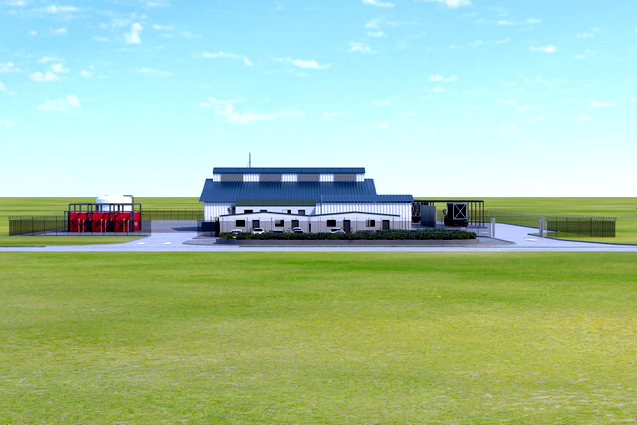
    Plans for Woodside's proposed H2TAS hydrogen project at Bell Bay in Northern Tasmania. (Supplied: Woodside)

    Mr Gregory said it would use hydro power to create four tonnes of hydrogen a day for transport.

    But he said Woodside was already looking at bigger volumes.

    "We have plans to grow those to 100 tonnes per day, in order to match that market demand," he said.

    "As the customer starts buying more and more and the market grows, we'll need to grow the size of those plants and you'll see us make announcements on the size of plants."

    A big question mark remains about the viability of transporting hydrogen.

    Plans for Woodside's proposed H2TAS hydrogen project at Bell Bay in Northern Tasmania. (Supplied: Woodside)

    It's why Fortescue Future Industries has been scouting green hydrogen production opportunities overseas, closer to international customers.

    But Mr Gregory was confident transport hurdles could be overcome.

    "Forty years ago, we didn't expect to transport natural gas in a liquid form either and we did," he said.

    "I think we'll see the same with hydrogen."

    Kobad Bhavanagri takes a different view.

    "It's not easy to put enough of it on a ship to make it worthwhile to take halfway around the world," he said.
    "Hydrogen is best used in the places where you produce it."
    Mr Bhavnagri said as a country blessed with the ability to create vast amounts of renewable energy Australia could become a hydrogen "superpower."

    But he said it would require more Federal Government support, including the signing of a net zero carbon emissions target.

    "Until you are clear that you want to reduce and eliminate emissions from your economy, you don't really have a business case to develop something like hydrogen," he said.

    Federal Energy and Emissions Reduction Minister Angus Taylor disagreed.

    "I think the real debate here is not about whether to reduce emissions," he said.

    "We all accept the need to reduce emissions."

    Energy and Emissions Reduction Minister Angus Taylor was pleased with the work Australia had done on hydrogen. (ABC News: Jess Davis)

    "It's how to do it and absolutely, Australia recognises that hydrogen is one of the important technologies where Australia has a competitive advantage."

    The German Government is spending billions of dollars on hydrogen development compared to the Australian Government's $570 million investment.

    But Mr Taylor argued as a smaller country, Australia was punching above its weight.

    "We developed a national hydrogen strategy several years ago through the excellent work of Alan Finkel and that was path breaking work, not just for Australia but for the world," he said.

    Links

    (AU SBS) United States And China Are 'Committed To Cooperating' To Tackle Climate Change

    SBS - AFP

    The world's top two economies have issued a joint statement on climate change, raising hopes they can work together on the global challenge despite sky-high tensions.

    US special envoy for climate John Kerry attends a press conference in March 2021 in Paris. Source: AP

    The United States and China are "committed to cooperating" on the pressing issue of climate change, the two sides said Saturday, issuing the pledge days ahead of a key summit hosted by President Joe Biden.

    The joint statement came after a trip to Shanghai by US climate envoy John Kerry, the first official from Mr Biden's administration to visit China, signalling hopes the two sides could work together on the global challenge despite sky-high tensions on multiple other fronts.

    But to achieve the global climate goal, Mr Kerry said words must be put into action and urged China to reduce its use of coal.

    "The United States and China are committed to cooperating with each other and with other countries to tackle the climate crisis, which must be addressed with the seriousness and urgency that it demands," said the statement from Mr Kerry and China's special envoy for climate change Xie Zhenhua.

    It listed multiple avenues of climate cooperation between the world's top two economies which together account for nearly half of the greenhouse gas emissions responsible for climate change.

    It stressed "enhancing their respective actions and cooperating in multilateral processes, including the United Nations Framework Convention on Climate Change and the Paris Agreement."

    Both countries also "look forward" to a virtual climate summit of world leaders that Mr Biden will host next week, though the statement did not say if Chinese President Xi Jinping would attend.

    "We very much hope he will take part," Mr Kerry, who is now in South Korea, told reporters on Sunday.

    "Of course, every country will make its own decisions," he said, adding: "We're not seeking to force anybody. We're seeking cooperation."

    'Biggest coal user'

    China currently has about half of the world's coal power, Mr Kerry said, adding that he "talked a lot" about it with officials in Shanghai.

    "I am not pointing fingers," said Mr Kerry.

    "We've had too much coal, other countries have too much coal, but China is the biggest, biggest coal user in the world," he added.

    "And because it's such a big and powerful economy and country, it needs to move."

    Mr Biden has made climate a top priority, turning the page from his predecessor Donald Trump, who was closely aligned with the fossil fuel industry.

    The US president has rejoined the 2015 Paris accord, which Mr Kerry negotiated when he was secretary of state, and committed nations to taking action to keep the temperature from rising no more than two degrees Celsius above pre-industrial levels.

    With the world badly off track to meeting the goal, Mr Biden hopes his summit will result in stronger pledges in advance of UN-led climate talks in Glasgow at the end of the year.

    'Unequivocal commitment'

    According to their statement, both Washington and Beijing "intend to develop" their respective long-term strategies to achieve carbon neutrality by the Glasgow meeting.

    Other moves in the near term include boosting "international investment and finance" to support the transition to green energy in developing countries, as well as phasing out production and consumption of hydrofluorocarbons, gases used in refrigeration, air conditioners and aerosols.

    Longer-term actions that need to be taken to keep the temperature goals of the Paris accord "within reach" include reducing emissions from industry and power generation while stepping up renewable energy, clean transportation and climate-resistant agriculture.

    The United States and China's pledge to cooperate on climate follows recent acrimony over accusations about China's policies in Hong Kong and its treatment of Uighurs in its northwestern Xinjiang region - criticisms Beijing rejects as interference in its domestic affairs.

    If the United States refuses to work with China on climate because of other disagreements, "you're just killing yourself," Mr Kerry told CNN before his trip to Shanghai.

    Li Shuo, a policy advisor at Greenpeace East Asia, said the joint statement showed the "unequivocal commitment" of the United States and China in tackling climate change and should "put global climate momentum back on high gear."

    "The difficult meetings in Shanghai bore fruit. Let that move the politics closer to where science requires us to be," he said.

    China - the world's biggest polluter - has announced an ambitious target to be carbon-neutral by 2060, but analysts have warned high reliance on coal and modest short-term targets could scupper the ambition.

    Links

    Sunday, April 18, 2021

    (AU Canberra Times) Australia Can No Longer Bluff Its Neighbours On Climate Change

    Canberra Times - Gordon Peake | Siobhan McDonnell

    A flood-damaged road in Dili on April 4. Picture: Gabinete Secretario Estado Protecao Civil

    Authors
    • Dr Gordon Peake is a visitor at the ANU's School of Global Governance and host of the Memorandum of Understanding podcast on international development.

    • Dr Siobhan McDonnell is a senior lecturer at the ANU's Crawford School of Public Policy and a negotiator on climate change for the Republic of Vanuatu.
    Aerial shots of Dili after this month's Easter Sunday floods made Timor-Leste's capital look like Venice, with brownish waterways where once there had been roads.

    The flood has caused at least 36 deaths, more than 14,000 people are displaced and there is significant damage to infrastructure. Some parts of the country are still cut off. With COVID-19 now circulating in the community, things are only likely to get worse.

    The Timor-Leste government has declared a state of calamity and is calling for international help. Australia has pledged to assist one of our nearest neighbours, just as it helped out in Vanuatu this time last year when Tropical Cyclone Harold struck. 

    But there's a mordant irony here: the Dili floods and the increasing intensity and regularity of tropical cyclones buffeting the Pacific are direct consequences of climate change.

    In helping out after the fact, Australia is like a firefighter holding a hose with one hand and a box of matches in another. 

    It's only going to get worse. With global temperatures already having risen more than 1 degree since pre-industrial levels, climate science predicts the Pacific will experience both increases in the frequency and intensity of extreme rainfall causing flooding, as well as an increase in the intensity of tropical cyclones.

    Increasingly, our nearest neighbours are calling Australia's bluff and are asking for more than aid after the disaster. They are asking that Australia make meaningful commitments to addressing climate change.

    Australian policy towards climate change is based on triage. Throughout the Pacific, and in Timor-Leste, Australia is ploughing big money into "resilience programs" aimed at "climate adaptation", with buzzwordy names such as "Community-based Climate Change Action Grants" and "Building Resilience to a Changing Climate and Environment" - referred to as BRACCE, an ominously accurate acronym. 

    Australia is presently spending $50 million on an Australian Humanitarian Partnership intended to make communities bearing the brunt of climate change "Disaster READY". The organisation's website is filled with glowing tributes from cheerful villagers. 

    In Vanuatu, as we talked about in the Memorandum of Understanding podcast earlier this week, much of this work involves establishing community disaster and climate change committees (CDCCCs), which perform a Herculean list of tasks in preparing for disasters, managing the relief effort and engaging in climate change adaptation work. These village committee members perform these roles unpaid, and largely unrecognised.

    But when the rains start to fall and the winds start to lash, surprise surprise: villagers find they aren't so "Disaster READY" after all. It would be hard to conceive what the villagers and city-dwellers of Timor-Leste were meant to do to be resilient in the face of the large-scale flooding that submerged whole sectors of the city. 

    In Vanuatu, and elsewhere in the Pacific, the impact of repeat category 5 cyclones over a five-year timespan meant the rebuilding after Tropical Cyclone Pam was barely completed before Tropical Cyclone Harold hit.

    The scale of these weather events is beyond any local-level resilience and risk-management training, all of which focuses the attention on communities to solve these problems, which are fundamentally related to the geopolitics of climate emissions.

    The American writer F. Scott Fitzgerald wrote: "The test of a first-rate intelligence is the ability to hold two opposing ideas in mind at the same time and still retain the ability to function."

    By that criteria, governments such as Australia have the most exceptional "intelligence": helping out with the aid and climate change programming in the region while simultaneously being the major carbon emitter.

    Increasingly, Pacific leadership is calling Australia to account. In 2018, the Pacific Island Forum - the top-level gathering for all Pacific leaders - issued the Boe Declaration, which named climate change as the greatest security threat facing the region. 

    This is not something that can be tackled with Australia's current package of support - resilience initiatives, increased defence co-operation and the opening of security colleges - or with diplomatic pussyfooting.

    Australia can no longer bluff its way on climate change. It needs to offer more than Band-Aid solutions. Like the title of the Kainaki II Declaration, signed off by all Pacific leaders and Scott Morrison at an ill-tempered Pacific Island Forum meeting in Tuvalu in 2019, the region continues to call for "Urgent Climate Action Now". 

    In the words of Vanuatu's opposition leader, Ralph Regenvanu, following the Tuvalu meeting: "In the context of the pressing climate threat that faces the Pacific, Australia must understand that relationships in the region are not just about the funding of projects ... the Pacific wants action on climate change and we want it now."

    Australia's failure to act on climate change creates growing costs both at home and abroad. Cutesy-named initiatives aren't enough.

    Links

    (Reuters) Carbon Recyclers: How Ocean Ecosystems Help Fight Climate Change

    Reuters

    Ocean ecosystems play a critical role in carbon storage and oxygen generation. Some of these ecosystems are under threat; others remain unexplored. Understanding how key players such as whales, plankton, seagrasses and other forms of sea life interact sheds light on Earth’s carbon cycle.

    Samuel Granados, Reuters


    HOW CARBON IS CAPTURED

    Key to life

    Carbon, a chemical element, is found in all organic matter on Earth, from the plants and animals alive today to fossil fuels buried underground.

     It’s a key building block in the foods we eat, and in Earth’s most abundant greenhouse gases — carbon dioxide (CO2) and methane (CH4). Sunshine reflected off the planet’s surface back into the atmosphere causes those gas molecules to vibrate, warming the atmosphere. More CO2 leads to more warming, causing climate change.

    The carbon cycle

    Animals release carbon in the form of CO2 when they breathe, while plants take in that gas along with sunshine to produce energy, a process called photosynthesis.

    Carbon dioxide also dissolves in seawater, where it is absorbed by seagrasses and algae. Seagrasses, which are plants adapted to live in the sea, are different from kelp and other algae in that they have roots, veins, leaves — and even flowers and fruits.

    Seagrass meadows

    Seagrass meadows serve as excellent breeding grounds for sea mammals and habitats for baby fish. But scientists have estimated the world’s seagrass stocks are declining by about 7% per year.

    For millennia, Earth’s natural systems kept carbon levels balanced in the environment. Industrial activities including the burning of fossil fuels, however, have increased atmospheric CO2 levels by nearly 50%, from 280 parts per million just over a century ago to about 417 ppm today. 

    That’s caused ocean CO2 levels to rise, making waters more acidic. But seagrasses can provide a buffer against that, too. By reducing the acidity of surrounding waters, seagrass ecosystems help protect animals with shells or external skeletons.

    In the sunlit surface layer of oceans

    Like land plants and seagrasses, microscopic marine algae known as phytoplankton also feed on CO2 and use photosynthesis to produce energy.

    They live in both saltwater and freshwater environments, drifting freely with currents. And like plants, they also release oxygen, contributing at least 50% of the oxygen to Earth’s atmosphere.

    CARBON IS TRANSFORMED

    The food web

    Seagrasses and phytoplankton near the ocean’s surface form the base of the aquatic food chain as they produce their own food, and then serve as food to others.

    When carbon dioxide is consumed during photosynthesis, the carbon is incorporated in the phytoplankton and seagrasses, in the same way carbon is stored in the wood and leaves of a tree.

    Carbon is then transferred to different layers of the ocean as primary producers are eaten by other organisms, which themselves reproduce, generate waste and die. 

    Body parts

    Some plankton combine calcium and dissolved carbonates to form a calcium carbonate protective coating like the shells and other body parts of coral, clams or oysters.

    Whales for example can absorb tons of carbon as their diet consists mainly of plankton and tiny shrimplike crustaceans called krill. A single whale can absorb around 33 tonnes, or 33,000 kilograms, of CO2 on average in its life while a tree can take in up to 22 kgs of CO2 a year.

    Nutrient circulation

    Phytoplankton, like land plants, require nutrients such as nitrate or calcium. They also need iron, which is scarce in large areas of the ocean. But when whales defecate, they release iron as well as other important nutrients like nitrogen in their feces.

    The liquid plume then stimulates phytoplankton growth, attracting fish and other organisms in a phenomenon known as the “whale pump”.

    CARBON SINK

    Recycle

    Crustaceans and fish transport carbon and nutrients by feeding in surface waters during the day and then migrating down the water column and excreting in deeper waters at night.

     When critters die, the carbon and nutrients in their bodies either becomes part of the food chain or sinks to the ocean floor.

    Carbon is stored

    At the bottom of the ocean, bacteria works to decompose the carbon fixed in the soft and hard tissues of organisms. When mollusks and other carbon-rich organisms die, their shells and body parts can accumulate in ocean sediments, forming carbonate-rich deposits.

    Locked away

    Seagrasses also trap carbon in underwater sediments around their roots, stems and leaves.

    The grasses store twice as much carbon per square mile as tropical forests do on land. As seagrasses die, the carbon gets locked into the sediment, where it can persist for thousands of years.

     While covering only 0.1% of the ocean bed, seagrass ecosystems account for 10%–18% of the carbon buried in the oceans, according to a January 2020 study in the journal Frontiers in Marine Science.

    When whale carcasses sink to the seafloor, the carbon in their carcasses can create a feast for deep-sea critters and also be buried in marine sediments.

    Ocean deposits are by far the biggest sinks of carbon on the planet. After long periods of time, these deposits can alter physically and chemically to become rocks and sediments themselves.

    Links

    (USA CBS News) Science Journalist Says Planet Is "On The Verge Of Another Mass Extinction"

    CBS News - Grace Segers

    Elizabeth Kolbert, staff writer for the New Yorker and author of the book "The Sixth Extinction," which won the Pulitzer Prize, warns that the planet is "on the verge of another mass extinction" in large part due to climate change.

       
    There have been five major mass extinctions in the last 500 million years, Kolbert explained to CBS News chief Washington correspondent Major Garrett in an interview for this week's episode of "The Takeout" podcast.

    The world is currently in a "moment of very elevated extinction rate," and if rates continue at this high level, the planet could face an event comparable to the extinction of the dinosaurs in the near future.

    Listen to this episode on ART19

    "We are on the verge of another major mass extinction, unless we change course dramatically," Kolbert said.

    "The question of how much we're responsible for it is pretty much 100%. We have no reason to believe we would be seeing these elevated extinction rates were it not for all the ways we are changing the planet faster than other species can evolve, to adapt to."

    Kolbert has written a new book, "Under A White Sky," which was published in February. The book looks at some of the people who are trying to reverse the effects of climate change by intervening in nature.

    One example she cites is the group of scientists in Australia trying to create "super coral" that can resist a hotter climate. There have recently been instances of mass coral bleaching due to climate change.

    "This is happening more and more as our impacts become greater and greater and the consequences become larger and larger," Kolbert said about human intervention in the natural world.

    "We're increasingly faced with situations where the options aren't great."

    Kolbert also noted that there are many benefits to the conditions that have exacerbated climate change, such as advancement in technology.

    "It can be true that we as individuals and even that human society overall has benefited from technology, and it can also be true that there are many consequences that are dangerous," she said.

    Kolbert added that the solutions to reversing some of the damage to the planet are not "going to be perfect."

    "We have to realize that there's a lot of damage that's been done that's kind of baked into this system," Kolbert said.

    "We can leave a serious problem for our kids or we can leave a disastrous problem for our kids."

    Links

    Saturday, April 17, 2021

    (AU SMH) What Keeps Climate Scientists Like Me Awake At Night - And Why The Next 10 Years Are So Critical

     Sydney Morning Herald - Lesley Hughes

    Author
    Lesley Hughes, a spokeswoman for the Climate Council, is a professor of biology and pro vice-chancellor at Macquarie University. 
    Every day, thousands of Australians find or experience a bodily symptom that could be a harbinger of something serious. Perhaps a suspicious lump, or a mole that has changed colour, or unusual gut pain.

    The sensible strategy, and one that most of us would take, would be to hightail it to our doctor at the earliest opportunity to get it checked out. Should the news be bad, most people would seek the life-saving treatment they need.

    At 1C warming, Australians already confronts drought and catastrophic fires. We don’t want to countenance warming of 3C. Credit: Nick Moir

    But what if you decide to wait – let’s say for a few years, or even a decade to two, perhaps to 2050 or beyond. By then, you might reason, imaging technology and treatments will have improved, so no point rushing things. This second strategy is clearly reckless, potentially putting your health, and perhaps life, in real danger - and unnecessarily so.

    But this is exactly what our federal government is doing by delaying real action to reduce greenhouse gas emissions – putting our livelihoods, our environmental support system, and our children’s futures at risk – and unnecessarily so.

    The latest report from the Climate Council of Australia, Aim High, Go Fast: Why Emissions Need to Plummet This Decade, lays out the science behind the necessity of urgent near-term climate action. The diagnosis is in, now the treatment must be ramped up with a greater sense of urgency than ever before, and we have to do it in the next 10 years.

    Why this decade? Imagine that the accumulated greenhouse gas emissions in the atmosphere is a mountain that we need to scale and then descend as quickly as possible. The problem is that this mountain is not a solid, stable piece of terrain but is getting higher and steeper every day. The longer we delay getting to the top and start to head down, the higher the mountain becomes, and the tougher the challenge.

    Facing the climate ‘endgame’ in a world bound for 1.5 degrees warming
    What we have to lose by not getting over the mountain has been laid out in forensic detail by climate scientists for decades – more frequent and severe weather events like floods, bushfires, heatwaves, droughts. Declining crops, loss of species, degraded ecosystems, and higher insurance bills are just some of the consequences.

    For Australia, this could manifest in the loss of coral reefs, uncontrollable bushfires every year, a ravaged coastline, and uninsurable assets.

    With just over 1C of global warming we have already lost half the hard coral cover on the Great Barrier Reef, a global icon that provides billions to the Australian economy and employs tens of thousands of people.

    After the hottest and driest year on record in 2019, the Black Summer bushfires affected 8 million Australians, with more than 30 killed directly and another 400 deaths attributable to smoke inhalation. Half our ancient Gondwanan rainforests were burnt, probably irreparably, and three billion vertebrate animals were killed or displaced.

    Unless we radically reduce emissions in the next few years, we are on track for about 3 degrees of warming by the end of this century. With the impacts of just over 1 degree already a clear and present danger, you don’t need to be a climate scientist to do the future maths.

    All this should be serious enough to warrant significant action. But if I can stretch the mountain analogy a bit further, the thing that keeps climate scientists awake at night is the real prospect that the summit could become so high and so unstable that an avalanche – a tipping point – could be triggered.

    At worst, a runaway greenhouse effect could take the Earth’s climate system beyond a point where human life and civilisation could be sustained.

    Australia to use Biden summit to repair ‘climate wars’ damage

    To do our fair global share, Australia needs to triple the level of its current ambition to cut emissions and aim for a 75 per cent reduction by 2030, and net zero by 2035. Net zero by 2050 is at least a decade too late.

    This means no new coal mines, no “gas-led recovery”, no more magical thinking about some new method of carbon capture and storage. We’ve got the sun, wind, land and water. We’ve got the brains, the science and the technology to do it now.

    US President Joe Biden’s upcoming climate summit is a golden opportunity for Australia to finally shed its status as – in his climate envoy John Kerry’s words – a “roadblock” to climate action.

     We need to commit to a 2030 target that is ambitious and fair. There is no safe level of global warming, and every fraction of a degree of avoided heating will be measured in lives, ecosystems and communities saved.

    What will happen to our cities (and beaches) at 3 degrees of warming?

    With concerted action we can still hold global average temperature to well below 2C. We need to act in our national interest by being a leader of solutions, not clinging to 18th century technology.

    The task ahead is undoubtedly challenging, but just as a healthy lifestyle has more benefits than just longevity, so too does concerted climate action – clean jobs, clean manufacturing, new export opportunities and regenerated landscapes.

    Delay is the new denial. Putting off treatment for a serious medical problem is reckless.

    The climate emergency must be approached with the same sense of urgency.

    Links

    Lethal Heating is a citizens' initiative