The Guardian
- Matthew Taylor | Emily Holden | Dan Collyns | Michael Standaert | Ashifa Kassam
Children and young adults around the world are demanding action from
governments on global heating and the ecological crisis

|
Chinese climate activist Howey Ou on hunger strike in
Lausanne, Switzerland, 19 April 2021. Photograph: Laurent Gilliéron/EPA
|
Sofia Oliveira, aged 16
Sofia Oliveira is one of six young Portuguese people who have filed a lawsuit against 33 countries with the European
court of human rights, demanding that governments do more to reduce
emissions and safeguard their future physical and mental wellbeing. Last
October the Strasbourg-based court granted the case priority status.

|
Sofia and her brother André
|
After we announced that we were six youths from Portugal
who were suing 33 countries
for not doing enough to reduce emissions and fight climate change, the response
was bigger than anything I had imagined. Media called from around the world. And
it made me so happy and hopeful.
I’ve been worried about climate change for a long time. When I was 11 years old,
my younger brother André, who is also one of the young people in this case, had
a terrible asthma crisis. The weather was hot and dry, and he was suffocating.
Here in
Portugal
the effects of climate change are increasingly visible: heatwaves that cause
water shortages and affect food production, and violent wildfires that give us
anxiety. Sometimes I think, if climate change is already so extreme, what will
it be like in the near future if we do nothing about it? So one of the most
important reasons I’m involved in this case is to help my little brother have a
good future, along with my parents, myself and the next generation.
Right now, the courts have told the governments that they need to reply by the
end of May. The 33 countries tried to have the case dismissed, but the
court said no. And we were so happy. Imagine, 33 of the biggest economies in the world
saying, “We don’t want this” and
six youths saying, “We are going to do this.”
I think we might win the case. I hope the case will make things right, that it
will make countries lower their emissions and stop using so many fossil fuels.
This case is revolutionary – it has shown that together our voice is strong and
can reach the whole world.
As told to Ashifa Kassam.
Saúl Amaru Álvarez Cantoral, 15
Saúl, who goes by his second name, Amaru, is one of seven Peruvian children
who have filed a
complaint
against the Peruvian state for its alleged failure to adequately halt
deforestation in the Amazon. They argue that their futures are severely
compromised due to the climate crisis, particularly their right to enjoy a
healthy environment, along with their rights to life, water, and health. The
case was filed in December 2019, but has not progressed due to the Covid-19
pandemic.

|
Saúl Amaru Álvarez (second from right in blue shirt) and his
co-plaintiffs outside court in Lima, Peru Photograph: Saúl Amaru Álvarez
|
We filed this
lawsuit
because the state does not really develop national policies to protect the
environment. By raising our voice as children and teens, we can make the state
listen to us and develop more concrete measures to combat climate change.
We were inspired by Greta Thunberg and the idea that children and teenagers can
make a difference. We believe that the young should raise our voices when the
adults don’t, especially when our politicians are not the best.
In our Amazon, the main problem is deforestation. There are no measures to
resolve this problem. The amount they cut down goes up every year, so if we
don’t halt this problem now, it will get worse and worse and be more difficult
to stop.
Since I was little, I was taught about the problem of pollution and climate
change, but I never thought about taking action because I assumed that
politicians would take care of it, or I should grow up and become a professional
to make changes. Then I realised I could do something as a teenager without
letting any more time pass – I could take action.
You can witness climate change. Adults always tell you what the weather was like
before; the seasons, for example, are more uncontrolled. How can it be that one
day it is hot and the next day it is cold?
We are waiting for a response to the lawsuit because it is a long process. Plus,
we have a lot of problems in the country. We are constantly in crisis, so I
think it’s not a priority at the moment.
I think we can win. I almost take it for granted that we will because our cause
is a just cause. It’s the first lawsuit of its kind in
Peru
and I hope, for that reason, that it might be the beginning of something and the
first of many more.
As told to Dan Collyns.
Anjali Raman-Middleton, 17
Raman-Middleton, who lives in south London, is one of the co-founders of
the air pollution campaign Choked Up.

|
Choked Up campaign members Anjali Raman-Middleton (centre) with
Nyeleti Brauer-Maxaeia and Destiny Boka-Batesa Photograph: Martin Godwin/The Guardian
|
I went to primary school with Ella Kissi-Debrah [who
died as a result
of air pollution] and, like her, grew up just off the South Circular road in
London, so I have lived with the reality of air pollution all my life.
I met the three other founders of Choked Up – who are all young women of colour
from south London – on the Advocacy Academy programme last year. It was great to
meet people who, like me, felt so passionately about clean air and the
environment and who also recognised how people of colour were being
disproportionately affected by the environmental crisis – whether in the UK with
air pollution, or in the global south with the impacts of climate change.
Too often our experiences are overlooked by an environment movement that is
predominantly white and middle class. As young people of colour, we found that
frustrating. But I am hopeful this can change because young people are becoming
more aware of the intersectionality of climate justice.
There is a growing understanding that it is not just as simple as “solving or
fixing” climate change – there is a whole system, a whole multitude of other
issues around racial and social justice that are intertwined with the climate
crisis. Choked Up aims to make those connections and foreground the experiences
of young people of colour. We chose air pollution as our campaign because all
four of us live in heavily polluted areas and see every day the often
devastating impact it has on our communities.
As told to Matthew Taylor.
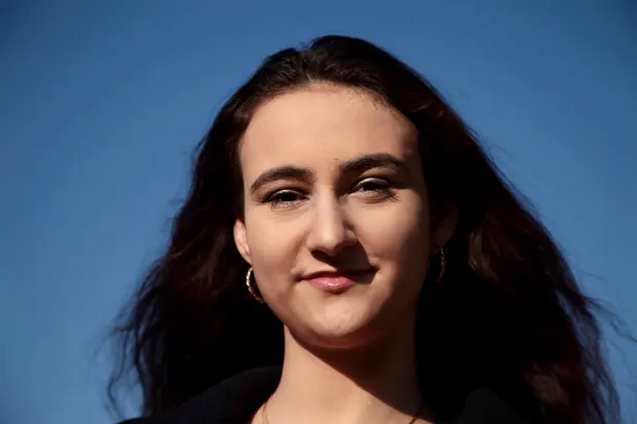
Jamie Margolin, 19
Jamie Margolin organised a youth climate march at 15 and co-founded the youth climate action
movement This Is Zero Hour at 16. She is a plaintiff in the Our Children’s
Trust lawsuit against the government in her home state of Washington,
US.
|
Jamie Margolin. Photograph: Bojana Novakovic
|
When I first started, I was kind of under the illusion that Democrat equals
climate action. I didn’t understand that just because I lived in a blue state,
it didn’t mean my leaders would automatically listen to me.
Well, I stepped out of that reality really quickly. I joined a lawsuit suing the
state of Washington for denying my generation our rights to life, liberty and
the pursuit of happiness by continuing to worsen the climate crisis. But
lawsuits take years. I couldn’t just wait around for the courts to do their
thing.
It was a perfect storm – of absolute hell. There were the wildfires that blew
over the city of Seattle, covering it in a thick layer of smog. It was really
scary because the Pacific north-west is known for amazing air quality – it’s
clean and crisp. Suddenly that was gone. I couldn’t breathe, to the extent that
it hurt. And then there was Hurricane Maria, Hurricane Harvey, all of these
climate disasters. And the last president pulled us out of the Paris climate
accords. It was all of these things that came together.
This was before Fridays for Future, before Greta Thunberg started striking.
Youth climate mobilisations were not in vogue. The Standing Rock movement, which
was big at the time, was started by indigenous young people, so it’s not like
young people weren’t mobilised. It just wasn’t something people paid attention
to.
When I was 15 years old, I found other youth activists on social media, and we
organised 25 youth climate marches, with the main one in Washington, DC. We also
had a youth climate lobby day around the country. The movement has changed the
culture. Things that were niche are now common knowledge. Greta and I are now
legal adults. We have to understand there’s wisdom in each generation.
I identify as a lesbian. When you’re part of a marginalised community, you have
to actively fight for justice for your community, while also fighting for
climate justice. I’m in film school right now, and I’m not studying to make
climate documentaries. The thing I’m super passionate about is LGBT
representation in the media, and storytelling. People are often very surprised
when I tell them my dream job is to write gay Disney princess movies.
I have dreams beyond just trying to stop the end of the world. No one
wants to think about climate change. Everyone has other dreams. When I
was a little child, I wasn’t like, “Some day I hope to narrowly escape planetary
destruction.” That wasn’t my dream. But I’m doing this because I have to, for
survival.
As told to Emily Holden.
Howey Ou, 18
One of China’s only youth climate activists to take part in Fridays for
Future and Extinction Rebellion activities in recent years, before beginning
to inspire a handful of others to take similar action.

|
Howey Ou: ‘Although we expect difficulty, we still dare to
exist’ Photograph: Howey Ou
|
Ou Hongyi, also known as Howey Ou, demonstrates for climate action, even though
demonstrations are forbidden in China without explicit approval of the
authorities. In October, Howey sat alone in front of a hotel for more than 10
hours to protest about the lack of ambition in the hotel industry in China to
reduce carbon emissions.
But while some youths in China have become energised by Ou’s activism, many
attempts to take part in protests have been scuttled, including plans for
protests on 19 March.
“Police interfered before the action happened,” Ou said. “Two activists I know
of went to Chengdu, but their families were called and they warned them, or
tried to scare them, to not take part. They were told to go to the Chengdu NGO
management office to ‘provide information’ separately in the days before the
action, then on Friday morning [19 March] they were taken to the police station
for formal interrogation, required to sign documents, had their DNA samples
taken, and were released that night. So they did not go out on the streets.
“The next week, when they returned home, the police met them at the train
station like old friends, and they were visited again by police later in the
week.”
“Other than these, I spoke with other students who organised at their schools
but they now have no more intention to organise any Fridays for Future actions.
They’ve been warned by their schools or had conflicts with their parents and
stopped.”
She is currently in Europe, and recently went on hunger strike in protest at
industrial policies there. She remains defiantly positive about the role that
protest can play.
“This is not about how much suppression we received, but the bright part is that
although we expect difficulty, we still dare to exist. We dare to tell the truth
about the climate and ecological emergency, we dare to challenge the capitalist
and consumeristic world. We refuse to be prisoners of injustice.”
As told to Michael Standaert.
Links


