07/06/2021

(AU New Daily) SA Leads On Climate Change Action As States And Territories Pick Up Federal Government’s Slack

New DailyCait Kelly

South Australia is leading the way on transitioning to renewable energy. Photo: Getty

In lieu of a national policy to help Australia transition from fossil fuels the states and territories have picked up the slack – and one state has done a lot better than others, according to a new report.

South Australia offers vital lessons for other jurisdictions on transitioning from a fossil fuel-based electricity grid to a low emissions, high renewables grid, a report released by the Institute for Energy Economics and Financial Analysis (IEEFA) this week found.

“The proportion of South Australia’s electricity demand met by large scale and small scale variable renewable energy generation grew from 0 per cent to 60 per cent in just 14 years,” the report’s author Johanna Bowyer said.

“Coal was phased out in 2016. Today the grid is dominated by wind and solar backed up by battery storage and interstate grid connectivity, with peaking gas being used as a temporary generation technology until South Australia moves to net 100 per cent renewables.”

The IEEFA report follows last month’s announcement by the world’s largest advanced economies, the powerful G7 group of nations, that they they would stop international financing of coal projects in a bid to tackle climate change and limit the rise in global temperatures to 1.5 degrees Celsius above pre-industrial levels.

The move further isolated Australia on the global stage when it comes to the Morrison government’s stance on climate change and funding and investing in coal.

SA shows the potential of renewable energy

South Australia has the largest proportion of demand provided by rooftop solar of all states in Australia’s National Electricity Market, and a staggering 40 per cent of homes have rooftop solar installed.

“But the records don’t stop there,” IEEFA report co-author Gabrielle Kuiper said.

“South Australia has shown that 100 per cent solar generation is possible during the daytime to meet users’ energy demands,” Dr Kuiper said.

There is now broad agreement across state and territory governments that Australia needs to take action to combat the threat of climate change.

All state and territory jurisdictions have adopted a target of net zero emissions by 2050 but SA has led the pack and is expected to achieve its net 100 per cent renewable energy target by 2025, five years ahead of schedule.

“SA is not just a good example for Australia, it’s a good example worldwide in terms of having a large jurisdiction move to renewables,” Australia Institute climate change and energy director Richie Merzian said.

As other countries grapple with making the transition, South Australia shows the world how it can be done, he said.

“The timing is great – the US is looking at how it can get to 100 per cent renewables in 14 years. These lessons will be drawn on, and we have them right here in our backyard,” Mr Merzian said.

But the states and territories will need more support from the federal government, he said.

“The Australian government knows its main trading partners are going to net zero,” Mr Merzian said.

“But in the meantime, they’re trying to promote and expand and sell as much fossil fuels as they can.”

Links

(AU The Australian) Price Is Right For Carbon Trading In Australia

The AustralianJohn Durie

Illustration: John Spooner

John Connor figures Australia has a carbon market architecture to match anywhere in the world but needs leadership to fill in the gaps and allow business to drive volume harder.

The chief executive of the Carbon Market Institute has spent much of the past 30 years working for not-for-profit organisations dedicated now to the goal of helping business and government achieve the net zero emissions goal.

He doesn’t think the present policy is necessarily optimal but “it’s one that can easily evolve”.

“One of the dirty little secrets in this whole debate in Australia is that it already has an effective working system to establish a carbon price but it’s largely set by government action through the Emissions Reduction Fund reverse auctions,” he said.

“What we want is to have business driving the market and for that we need proper guidelines and clear pathways to decarbonisation, clear signals for investment to reinforce what we already have, and the level of business enthusiasm for the process,” he added.

State governments have made valuable efforts, including NSW’s electricity road maps and Queensland’s land restoration projects.

The Climate Market Institute has the simple aim of helping “business manage risks and capitalise on opportunities in the transition to a net-zero emissions economy”.

The Carbon Market Institute’s John Connor. Picture: Supplied
The second leg is the important one because Connor is a firm believer that the transition represents a huge opportunity for the Australian economy. The missing link, he argues, is federal leadership to bring the private policy engine together with public policy.

Federal Energy Minister Angus Taylor will address the institute’s Emissions Reduction Summit in Sydney on June 25, so he has the opportunity to explain where his government is coming from.

The previous day his state colleague, NSW Energy Minister Matt Kean, will speak, with a chance to outline his plans for electric vehicles in the state.

The institute aims to speak for business leading the transition to net zero emissions by sharing knowledge, building capacity and looking for opportunity.

It claims to be “the stewards of Australia’s carbon markets and related effective policies”.

The Australian market, Connor argues, has integrity but is missing liquidity and hasn’t exploited the linkages.

As someone who has worked on climate policy for his entire career, Connor thinks “net zero emissions” is one of the great motivating phrases that has helped drive both private and public policy.

The institute’s base highlights the degree of business interest, with membership growing by 36 per cent last year alone to more than 100 including BHP, Aurizon, Qantas, Wesfarmers, Westpac, AGL, Coles, ANZ and Ampol.

The institute is aiming to help development by improving the market’s operation through modifications like the recent industry code of conduct.

Connor said “this increases trust, accountability, transparency and consumer protection in the sector”.

The sector is 10 years old with 971 carbon farming projects around Australia registered with the Clean Energy Regulator, while 94 million Australian Carbon Credit Units have been issued, offsetting Australia’s entire transport emissions.

Transport is Australia’s third-largest source of emissions.

“Australia’s domestic carbon industry must at least triple by 2030 to help keep global warming to the goals of the Paris Agreement,” Connor says.

The industry is seeking government changes to its rules to make it easier to measure soil carbon creation and project stacking to allow different methods on the one project, among other developments.

The Carbon Markets Institute was established a decade ago formally by Ted Baillieu, the then Victorian premier, after leadership from his predecessor John Brumby.

Connor is in his third year at the helm of institute after a stint helping Pollination’s Martijn Wilder advising the Fiji government for its term as chair of the UN climate change conference in 2017.

Working with Fiji was a pivotal moment for Connor in confronting the practical impact of climate change as its land disappears.

He said it was a “powerful reminder about just what we are confronting”.

Connor was born in the NSW country town of Yass. Later the family moved down the road to Wagga Wagga for his father Vince’s job with the NSW Electricity Commission.

After school in Wagga he completed degrees in arts and law at Macquarie University. He was attracted to public law and the law school’s critical approach.

One of his first jobs was with then prime minister Bob Hawke’s roundtables on economic sustainability. Connor’s brief at the time was with fisheries.

His parents figured it was a phase he was going through and not a real job but they now realise that there is more to it than they first thought.

A stint with the then independent member for Manly, Peter Macdonald, continued his education before some time with the Nature Conservation Council landed him a job with the Australian Conservation Foundation.

Then based in Melbourne, Connor worked with Tim Costello at World Vision on its Make Poverty History campaign.

In 2007 he moved to the Climate Institute, funded by Eve Kantor and her partner Mark Wootton and aimed at economic modelling and evidence-based climate research policy.

Connor says the institute occupied what was called the radical centre of Australian politics backing a climate price.

This was a heady time in the climate debate with the election of the Rudd government and ratification of the 1998 Kyoto protocol, and many in the carbon club were prepared for the revolution.

Ironically Rudd’s election took the heat from the debate, according to Connor, because “concern dropped after the election because people thought they had voted for someone who would deal with it (climate change)”.

Connor adds: “People have lived off the red meat of climate culture wars. It took too long to get the pricing mechanism in place and the climate issue became an effective wedge issue.”

Rudd, he said, did some good things but he didn’t do well in supporting a price on carbon, and then it became a “great wedge – is your policy a carbon price?”.

The irony is “the Morrison government has such a policy, and while its safeguard mechanism is very weak, the government is spending $2.5 billion through the Emissions Reduction Fund to establish a carbon price”.

“Business has realised it’s time to change and their investors and customers are pushing them towards a carbon price, market and net zero emission targets,” Connor says. “The private policy issue is really revved up.”

For Connor it’s been three decades of policy work to get here, but now it’s time for federal leadership. The opportunity for Australia to develop a new industry is the goal.

Links

(AU SBS) UN Warns Of 'Point Of No Return' On Climate Change As Australians Mark World Environment Day

SBS - Rashida Yosufzai

Australians have planted trees, cleaned up beaches and streets and protested for threatened species to mark World Environment Day, as the UN launches a major new ecological campaign.

Australians marked World Environment Day with tree planting, clean up events and conservation rallies across the country. Source: SBS News

The United Nations has warned the world is reaching the point of no return on climate change, stressing that the next decade is humankind's final chance to avert a climate catastrophe.

On World Environment Day, the UN has launched a campaign calling for governments to deliver on a promise to restore at least one billion degraded hectares of land in the next decade – an area about the size of China.

"We are rapidly reaching the point of no return for the planet," UN Secretary-General António Guterres said in a new video message. He said the world faced a triple environmental emergency of biodiversity loss, climate disruption and escalating pollution.

"We are ravaging the very ecosystems that underpin our societies. And, in doing so, we risk depriving ourselves of the food, water and resources we need to survive."

The UN chief said the United Nations Decade on Ecosystem Restoration campaign was a chance to avert a climate catastrophe.

"Science tells us these next 10 years are our final chance to avert a climate catastrophe, turn back the deadly tide of pollution and end species loss."

'Koalas on death row'

Australians marked World Environment Day with tree planting, clean up events and conservation rallies across the country.

In Sydney's Hyde Park, around 200 people gathered to call for the NSW government to strengthen legal protections for koalas.

Conservationists say NSW koala populations have plummeted in the past 30 years. Before the Black Summer bushfires that devastated habitats, it was estimated to be fewer than 20,000.

A recent NSW parliamentary inquiry found that koalas in NSW could be extinct by 2050, because of the loss of habitat, disease and climate change events.

Tree planting events were held across Australia to mark World Environment Day. SBS News

Nature Conservation Council NSW chief executive Chris Gambian warned koalas would join the Tasmanian Tiger as an extinct species unless there was a strict ban on the destruction of koala forests, and new nature reserves, habitat restoration and ecological research.

"Koalas in NSW are on death row," he said.

"Business as usual is simply no longer an option – this is an emergency that requires drastic action. Their numbers were plummeting before the Black Summer bushfires killed thousands of koalas and incinerated millions of hectares of forest.

"We will get to a point where our kids won't be able to show their kids koalas in the wild. You (would) only be able to see it in a museum or gallery."

There were also tree planting events across the country - including in western Sydney where a small group came together with the aim of planting more than 2,000 trees in the Penrith area.

Nicola Masters from Greening Australia said the initiative was important for the area, which suffers extreme heat events during summer.

"We're getting extreme urban heats and extreme weather conditions out here. The trees will act as a carbon sink, they will mitigate the effects of this increasing urban heat," she told SBS News.

Projects like this are what the United Nations wants more of.

But it says conservation efforts alone won't be enough to prevent widespread biodiversity loss and the collapse of ecosystems.

Hobart rally

Hundreds of people also came together in Hobart's city hall, calling for protections for the Tarkine Forest in Tasmania’s north-west.

Former Greens leader Bob Brown, whose Bob Brown Foundation organised the rally, said the issue was galvanising people all over the country.

"We will stop this mad-brained destructive invasion of the Tarkine forest for a toxic waste dump that the company has got alternative sites for."

Links

06/06/2021

(UK AZoCleantech) Sea Ice In Arctic Coastal Regions Are Thinning Faster Than Previously Thought

According to a new modeling study headed by researchers from the University College London (UCL), sea ice in the Arctic coastal regions may be thinning up to twice as fast as previously assumed.

The research vessel Polarstern drifting in Arctic sea ice. Source: MOSAiC website image library https://multimedia.awi.de/mosaic/. Image Credit: Alfred-Wegener-Institut.

The thickness of sea ice is deduced by quantifying the height of the ice above the water, but this measurement is affected by snow weighing the ice floe down. To adjust this measurement, scientists generally use a map of snow depth in the Arctic but this method is very old and does not factor in climate change.

Now, in a new research work recently published in The Cryosphere journal, scientists exchanged this map for the results of a novel computer model developed to predict the depth of the snow as it changes year to year, and they surmised that sea ice in major coastal areas was thinning at a speed that was 70% to 100% faster than previously assumed.

The thickness of sea ice is a sensitive indicator of the health of the Arctic. It is important as thicker ice acts as an insulating blanket, stopping the ocean from warming up the atmosphere in winter, and protecting the ocean from the sunshine in summer. Thinner ice is also less likely to survive during the Arctic summer melt.
Robbie Mallett, Study Lead and PhD Student, UCL Earth Sciences

Mallett continued, “Previous calculations of sea ice thickness are based on a snow map last updated 20 years ago. Because sea ice has begun forming later and later in the year, the snow on top has less time to accumulate. Our calculations account for this declining snow depth for the first time, and suggest the sea ice is thinning faster than we thought.”

There are a number of uncertainties in measuring sea ice thickness but we believe our new calculations are a major step forward in terms of more accurately interpreting the data we have from satellites.
Julienne Stroeve, Study Co-Author and Professor, UCL Earth Sciences

Stroeve continued, “We hope this work can be used to better assess the performance of climate models that forecast the effects of long-term climate change in the Arctic—a region that is warming at three times the global rate, and whose millions of square kilometres of ice are essential for keeping the planet cool.”

To estimate the thickness of sea ice, the investigators utilized radar from the European Space Agency’s CryoSat-2 satellite. By timing the duration it takes for radar waves to reflect from the ice, the researchers can estimate the height of the ice above the water, from which they can deduce the overall thickness of the ice.

In the latest study, the investigators used an innovative snow model—called SnowModel-LG—that was earlier designed by scientists from UCL and Colorado State University.

This model calculates the depth and density of snow by using inputs, like snowfall, air temperature and ice motion data to monitor the amount of snow that builds up on sea ice as it travels around the Arctic Ocean.

Then researchers combined the outcomes of the snow model with satellite radar observations and subsequently calculated the total speed of decline of the thickness of sea ice in the Arctic region and also the variability of the thickness of the sea ice from year to year.

The researchers also observed that the speed of decline in the three coastal seas of Laptev, Kara, Chukchi increased by as much as 70%, 98% and 110%, in that order, when compared to previous calculations. The team further found that the variability in the thickness of the sea ice from year to year also increased by 58% across all seven coastal seas.

In the coastal seas, sea ice usually differs from 0.5 m to 2 m thick. But increasingly, the ice in this area is not tolerating the summer melt.

The more rapid thinning of sea ice in the coastal Arctic seas holds major implications for human activity in the area, in terms of shipping along the Northern Sea Route for a greater part of the year and also in terms of the extraction of resources from the seafloor, like minerals, gas and oil.

More ships following the route around Siberia would reduce the fuel and carbon emissions necessary to move goods around the world, particularly between China and Europe. However, it also raises the risk of fuel spillages in the Arctic, the consequences of which could be dire. The thinning of coastal sea ice is also worrying for indigenous communities, as it leaves settlements on the coast increasingly exposed to strong weather and wave action from the emerging ocean.
Robbie Mallett, Study Lead and PhD Student, UCL Earth Sciences

Mallett, Professor Stroeve, and study co-author Dr Michel Tsamados from UCL Earth Sciences had spent many weeks exploring ice and snow in the Arctic onboard the German research vessel Polarstern, which investigated the central Arctic Ocean in 2019 and 2020.

Links

(USA NYT) Tasked To Fight Climate Change, A Secretive U.N. Agency Does The Opposite

New York TimesMatt Apuzzo |

Behind closed doors, shipbuilders and miners can speak on behalf of governments while regulating an industry that pollutes as much as all of America’s coal plants.

The International Maritime Organization’s headquarters in London. Shipbuilders, oil companies, miners and chemical manufacturers are among the delegates appointed by many member nations. Credit...Mary Turner for The New York Times

LONDON — During a contentious meeting over proposed climate regulations last fall, a Saudi diplomat to the obscure but powerful International Maritime Organization switched on his microphone to make an angry complaint: One of his colleagues was revealing the proceedings on Twitter as they happened.

It was a breach of the secrecy at the heart of the I.M.O., a clubby United Nations agency on the banks of the Thames that regulates international shipping and is charged with reducing emissions in an industry that burns an oil so thick it might otherwise be turned into asphalt. Shipping produces as much carbon dioxide as all of America’s coal plants combined.

Internal documents, recordings and dozens of interviews reveal what has gone on for years behind closed doors: The organization has repeatedly delayed and watered down climate regulations, even as emissions from commercial shipping continue to rise, a trend that threatens to undermine the goals of the 2016 Paris climate accord.

One reason for the lack of progress is that the I.M.O. is a regulatory body that is run in concert with the industry it regulates. Shipbuilders, oil companies, miners, chemical manufacturers and others with huge financial stakes in commercial shipping are among the delegates appointed by many member nations. They sometimes even speak on behalf of governments, knowing that public records are sparse, and that even when the organization allows journalists into its meetings, it typically prohibits them from quoting people by name.

An agency lawyer underscored that point last fall in addressing the Saudi complaint. “This is a private meeting,” warned the lawyer, Frederick J. Kenney.

Next week, the organization is scheduled to enact its first greenhouse gas rules since Paris — regulations that do not cut emissions, have no enforcement mechanism and leave key details shrouded in secrecy. No additional proposals are far along in the rule-making process, meaning additional regulations are likely five years or more away.

A container ship sailing out of Hong Kong last year. The industry burns an oil so thick it might otherwise be turned into asphalt. Credit...Jerome Favre/EPA, via Shutterstock

The reason, records show, is that some of the same countries that signed the Paris accords have repeatedly diluted efforts to rein in shipping emissions — with industry representatives in their ears at every step. Shippers aligned themselves with developing nations like Brazil and India against setting emissions caps. China, home to four of the five busiest ports in the world, argued for years that it was too soon to make changes or even set targets.

Often, what politicians say publicly does not match their closed-door posture. In 2019, for example, when the Chilean president, Sebastián Piñera, urged world leaders to make “more ambitious climate commitments,” his diplomats in London worked to defeat shipping speed limits, a measure that would have reduced carbon emissions.

The stakes are high. Shipping, unlike other industries, is not easily regulated nation-by-nation. A Japanese-built tanker, for instance, might be owned by a Greek company and sailed by an Indian crew from China to Australia — all under the flag of Panama. That’s why, when world leaders omitted international shipping from the Paris agreement, responsibility fell to the I.M.O., which has standardized the rules since 1948.

So if the I.M.O. does not curb shipping emissions, it is unclear who will. And for now, the agency is not rushing to change.


“They have gone out of their way to try to block or water down or discourage real conversation,” said Albon Ishoda, a Marshall Islands diplomat.

His tiny Pacific island nation is among those that have benefited from, and perpetuated, the industry’s hold on the agency. The country effectively sold its diplomatic seat in London to a private American company decades ago.

But global warming changed things. Seas are rising. Homes are washing away. Much of the nation could become unlivable in the coming decade.

Children playing near the ocean in the Marshall Islands in 2015. Credit...Josh Haner/The New York Times

Now, the Marshall Islands are putting forward a moonshot environmental plan, a carbon tax that would penalize polluters. It is a shot across the bow of the I.M.O.’s industrial and political forces.

And the Marshallese are moving to reclaim their diplomatic seat and speak for themselves.

“My voice is coming from my ancestors, who saw the ocean as something that brought us wealth,” Kitlang Kabua, the Marshallese minister leading the effort. “Today we’re seeing it as something that will bring our ultimate death.”

Watered Down from the Get-Go

The Marshallese are unlikely disrupters at the maritime organization.

In 1990, the nation’s first president signed a deal with a company, International Registries Inc., to create a tax-friendly, low-cost way for ships to sail under the Marshall Islands flag.

The company, based in Virginia, did all the work and, on paper, the Marshall Islands became home to one of the world’s largest fleets. The government shared in the revenue — roughly $8 million a year as of recently, one official said.

Things got thorny, however, when the foreign minister, Tony de Brum, traveled to the I.M.O. in 2015. His stories of his vanishing homeland had given urgency to the Paris talks and he expected a similar reception in London.

He and his team had no idea what they were walking into.

When Mr. Ishoda arrived in island business attire — floral shirt, trousers and a suit jacket — he said security sent him back to his hotel for a tie.

“The I.M.O. is effectively a closed-door gathering of old male sailors,” said Thom Woodroofe, an analyst who accompanied Mr. de Brum to London. “It’s surprising it doesn’t still allow smoking.”

Mr. de Brum, too, was almost denied a seat. International Registries, which represented the Marshall Islands on the I.M.O., initially refused to yield to the foreign minister, Mr. Woodroofe recalled.

Foreign Minister Tony de Brum in the Marshall Islands in 2015. Credit...Josh Haner/The New York Times

At United Nations climate meetings, countries are typically represented by senior politicians and delegations of government officials. At the maritime organization’s environmental committee, however, one in four delegates comes from industry, according to separate analyses by The New York Times and the nonprofit group Influence Map.

Representatives of the Brazilian mining company Vale, one of the industry’s heaviest carbon polluters and a major sea-based exporter, sit as government advisers. So does the French oil giant Total, along with many shipowner associations. These arrangements allow companies to influence policy and speak on behalf of governments.

Connections can be hard to spot. Luiz Gylvan Meira Filho sat on the Brazilian delegation in 2017 and 2018 as a University of Sao Paulo scientist. But he also worked at a Vale-funded research organization and, during his second year, was a paid Vale consultant. In an interview, he described his role as mutually beneficial: Brazilian officials relied on his expertise, and Vale covered his costs.

“Sometimes you cannot tell the difference. Is this actually the position of a nation or the position of the industry?” said David Paul, a Marshallese senator who attended an I.M.O. meeting in 2018.

Hundreds of other industry representatives are accredited observers and can speak at meetings. Their numbers far exceed those of the approved environmental groups. The agency rejected an accreditation request by the Environmental Defense Fund in 2018.

Industry officials and the maritime organization say such arrangements give a voice to the experts. “If you don’t involve the people who are actually going to have to deliver, then you’re going to get a poor outcome,” said Guy Platten, secretary general of the International Chamber of Shipping.

Mr. de Brum tried to persuade these industry officials and diplomats to set ambitious emissions targets over the following eight months.

“Time is short, and it is not our friend,” he told delegates in 2015, according to notes from the meeting. (The Times independently obtained meeting records and never agreed not to quote people.)

But I.M.O.’s secretary general at the time, Koji Sekimizu of Japan, openly opposed strict emissions regulation as a hindrance to economic growth. And an informal bloc of countries and industry groups helped drag out the goal-setting process for three years.

Documents show that China, Brazil and India, in particular, threw up repeated roadblocks: In 2015, it was too soon to consider a strategy. In 2016, it was premature to discuss setting targets. In 2017, they lacked the data to discuss long-term goals.

Container ships and other vessels off the coast of Singapore. Credit...Vivek Prakash/Reuters

The question of data comes up often. Adm. Luiz Henrique Caroli, Brazil’s senior I.M.O. representative, said he does not believe the studies showing rising emissions. Brazil wants to cut emissions, he said, but not before further study on the economic effect.

“We want to do that, this reduction, in a controlled way,” he said in an interview.

The Cook Islands, another Pacific archipelago, make a similar argument. Like the Marshalls, they face rising seas and an uncertain future. But the more immediate concerns are jobs and cost of living, said Joshua Mitchell, of the country’s foreign office. “Existential questions have to be balanced against the priorities of the country in the moment,” he said.

Megan Darby, a journalist for Climate Home News, said she was suspended from maritime meetings after quoting a Cook Islands diplomat.

The I.M.O. almost never puts environmental policies to a vote, favoring instead an informal consensus-building. That effectively gives vocal opponents blocking power, and even some of the agency’s defenders acknowledge that it favors minimally acceptable steps over decisive action.

So, when delegates finally set goals in 2018, Mr. de Brum’s ambition had been whittled away.

The Marshall Islands suggested a target of zero emissions “by the second half of the century” — meaning by 2050. Industry representatives offered a slightly different goal: Decarbonization should occur “within” the second half of the century, a one-word difference that amounted to a 50-year extension.

Soon, though, the delegates agreed, without a vote, to eliminate zero-emissions targets entirely.

What remained were two key goals:

First, the industry would try to improve fuel efficiency by at least 40 percent. This was largely a mirage. The target was set so low that, by some calculations, it was reached nearly the moment it was announced.

Second, the agency aimed to cut emissions at least in half by 2050. But even this watered-down goal is proving unreachable. The agency’s own data say emissions may rise by 30 percent.

Compromised Away

Rising seas threaten homes in the Marshall Islands, like those on Ejit in the Majuro Atoll. Credit...Josh Haner/The New York Times

When delegates met last October — five years after Mr. de Brum’s speech — the organization had not taken any action. Proposals like speed limits had been debated and rejected.

What remained was what several delegates called the “refrigerator rating” — a score that, like those on American appliances, identified the clean and dirty ships.

European delegates insisted that, for the system to work, low-scoring ships must eventually be prohibited from sailing.

China and its allies wanted no such consequence.

So Sveinung Oftedal of Norway, the group’s chairman, told France and China to meet separately and compromise.

Delegates worked across time zones, meeting over teleconferences because of the Covid-19 pandemic. Shipping industry officials said they weighed in through the night.

The Marshallese were locked out.

“We’re always being told ‘We hear you,’” Mr. Ishoda said. “But when it comes to the details of the conversation, we’re told ‘We don’t need you to contribute.’”

Ultimately, France ceded to nearly all of China’s requests, records show. The dirtiest ships would not be grounded. Shipowners would file plans saying they intended to improve, would not be required to actually improve.

German delegates were so upset that they threatened to oppose the deal, likely triggering a cascade of defections, according to three people involved in the talks. But European Union officials rallied countries behind the compromise, arguing that Europe could not be seen as standing in the way of even limited progress.

“At I.M.O., that is as always the choice,” said Damien Chevallier, the French negotiator. “We have the choice to have nothing, or just to have a first step.”

All of this happened in secret. The I.M.O.’s summary of the meeting called it a “major step forward.” Natasha Brown, a spokeswoman, said it would empower customers and advocacy groups. “We know from consumer goods that the rating system works,” she said.

But the regulation includes another caveat: The I.M.O. will not publish the scores, letting shipping companies decide whether to say how dirty their ships are.

A Storm on the Horizon

Skies over the northeast Pacific Ocean streaked with clouds that form around particles from ship exhausts. Credit...NASA Earth Observatory

Ms. Kabua, the Marshallese minister, is under no illusions that reclaiming the diplomatic seat will lead to a climate breakthrough.

But if it works, she said, it might inspire other countries with private registries to do the same. Countries could speak for themselves rather than through a corporate filter.

Regardless of the outcome, the political winds are shifting. The European Union is moving to include shipping in its emissions-trading system. The United States, after years of being minor players at the agency, is re-engaging under President Biden and recently suggested it may tackle shipping emissions itself.

Both would be huge blows to the I.M.O., which has long insisted that it alone regulate shipping.

Suddenly, industry officials say they are eager to consider things like fuel taxes or carbon.

“There’s much more of a sense of momentum and crisis,” said Mr. Platten, the industry representative. “You can argue about, ‘Are we late to it,’ and all the rest. But it is palpable.”

Behind closed doors, though, resistance remains. At a climate meeting last winter, recordings show that the mere suggestion that shipping should become sustainable sparked an angry response.

“Such statements show a lack of respect for the industry,” said Kostas G. Gkonis, the director of the trade group Intercargo.

And just last week, delegates met in secret to debate what should constitute a passing grade under the new rating system. Under pressure from China, Brazil and others, the delegates set the bar so low that emissions can continue to rise — at roughly the same pace as if there had been no regulation at all.

Delegates agreed to revisit the issue in five years.

Links

(UK The Guardian) G7 Nations Committing Billions More To Fossil Fuel Than Green Energy

The Guardian

In spite of green rhetoric, money has piled into aviation and car industries since start of pandemic, report finds

G7 countries bailed out companies such as Air France without applying any green caveats. Photograph: Christian Hartmann/Reuters

The nations that make up the G7 have pumped billions of dollars more into fossil fuels than they have into clean energy since the Covid-19 pandemic, despite their promises of a green recovery.

As the UK prepares to host the G7 summit, new analysis reveals that the countries attending committed $189bn to support oil, coal and gas between January 2020 and March 2021. In comparison, the same countries – the UK, US, Canada, Italy, France, Germany and Japan – spent $147bn on clean forms of energy.

The support for fossil fuels from seven of the world’s richest nations included measures to remove or downgrade environmental regulations as well as direct funding of oil, gas and coal.

The analysis from the development charity Tearfund, the International Institute for Sustainable Development and the Overseas Development Institute showed that the nations missed opportunities to make their response to the pandemic greener.

In most cases, money provided for fossil fuel industries was given with no strings attached, rather than with conditions requiring a reduction in emissions or pollution. The analysis found that eight in every 10 dollars spent on non-renewable energy came without conditions.

This included lifelines that were thrown to the aviation and car industries, which received $115bn from the G7 countries. Of that money, 80% was given with no attempt to force the sectors to cut their emissions in return for the support.

Only one in every 10 dollars committed to the Covid-19 response benefited the “cleanest” energies such as renewables and energy efficiency measures.

The UK prime minister, Boris Johnson, will open the G7 summit in Cornwall on 11 June. He has said he wants to unite the nations to “build back better” from the coronavirus pandemic to create a greener, more prosperous future. As well as the G7, the UK has invited South Africa, Australia, India and South Korea to take part.

The analysis of the actions of the seven major western economies in the last 15 months reveals they are not yet investing at sufficient scale in technologies that support fast decarbonisation of their economies, and they have not created green jobs at scale in response to Covid-19.

Paul Cook, the head of advocacy at Tearfund, which operates in some of the poorest countries in the world most affected by global heating, said: “Every day, we witness the worsening consequences of the climate crisis for communities around the world – farmers’ crops failing; floods and fires engulfing towns and villages; families facing an uncertain future.

“Choices made now by the G7 countries will either accelerate the transition towards a climate-safe future for all, or jeopardise efforts to date to tackle the climate crisis.”

The G7 countries are among the most polluting in the world. They represent a 10th of the world’s population but are responsible for almost a quarter of CO2 emissions.

“Their actions can set the scene for success or failure at the UN climate talks being hosted by the UK in November,” Cook said.

During the Covid-19 pandemic, unprecedented amounts of public money were spent by nations; it is estimated that the 50 largest world economies committed at least $14.6tn to fiscal stimulus measures in 2020. The authors said that well-designed and targeted stimuli could be used as a springboard for launching low-carbon societies.

The report analysed the support the seven nations, plus the four others invited to attend the summit in Cornwall, gave to five energy areas: the cleanest energy, such as wind and solar; clean energy that may still rely on fossil fuel power, such as electric vehicles; fossil fuel energy with conditions; fossil fuel energy without any conditions; and other energy sectors including biofuels and nuclear.

The greatest support given by G7 countries was to transport. Bailouts were given to companies including Air France, British Airways, Ryanair, easyJet, Lufthansa, Japan Airlines, Alitalia, Renault and Honda. The financial support would end up sustaining highly polluting industries for decades to come, with very little pressure to “go green”, the authors said.

Since the bailouts, some G7 countries have increased their commitments to cleaner energy, including rail and electric vehicles. But the report said: “Investments in the transport sector remain significantly skewed towards fossil fuels and are at odds with G7 commitments to build back better.”

The propping up of the oil and gas sectors was particularly evident in Canada and the US, both major oil and gas producers. As well as direct support, both countries rolled back environmental regulations on fossil fuel companies.

Some G7 nations made positive steps towards halting support for dirty industries. In February, Italy extended a ban until September this year on fossil fuel drilling. The UK and France brought in policies designed to end international support for fossil fuels. The UK has also announced a ban on new petrol and diesel cars by 2030.

“These actions should serve as a precedent for other G7 countries,” the report said.

This month, in the first comprehensive study of the journey to net zero, the International Energy Agency (IEA) said that pledges by governments, even if fully achieved, fell well short of what was required to bring global energy-related CO2 emissions down to net zero by 2050 and give the world an even chance of limiting the global temperature rise to 1.5C above pre-industrial levels, as the Paris agreement states.

Links

05/06/2021

(AU The Conversation) ‘Flash Droughts’ Can Dry Out Soil In Weeks. New Research Shows What They Look Like In Australia

The Conversation | 

Dan Peled / AAP

Authors
  •  is a Research Fellow, Monash University
  •  is Senior Lecturer, School of Earth, Atmosphere and Environment, Monash University
At the tail end of winter in 2015, the ground in the Wimmera in northwestern Victoria had been a little dry but conditions weren’t too bad for farmers. The crop season was going well.

The start of September looked promising. It was cool, and there were decent rains. One Wimmera lentil grower said, “As long as it doesn’t get too hot, we should actually be OK.”

A few weeks later, summer weather had arrived early. At the start of October, the soils were baked dry. Lentils and other pulse crops were devastated.

This kind of event, where drier-than-normal conditions transform into severe or extreme drought in the space of weeks, is called a “flash drought”.

While flash droughts are still not well understood, our research studies how they occur in Australia - which may help move us toward being able to warn of flash drought in advance.

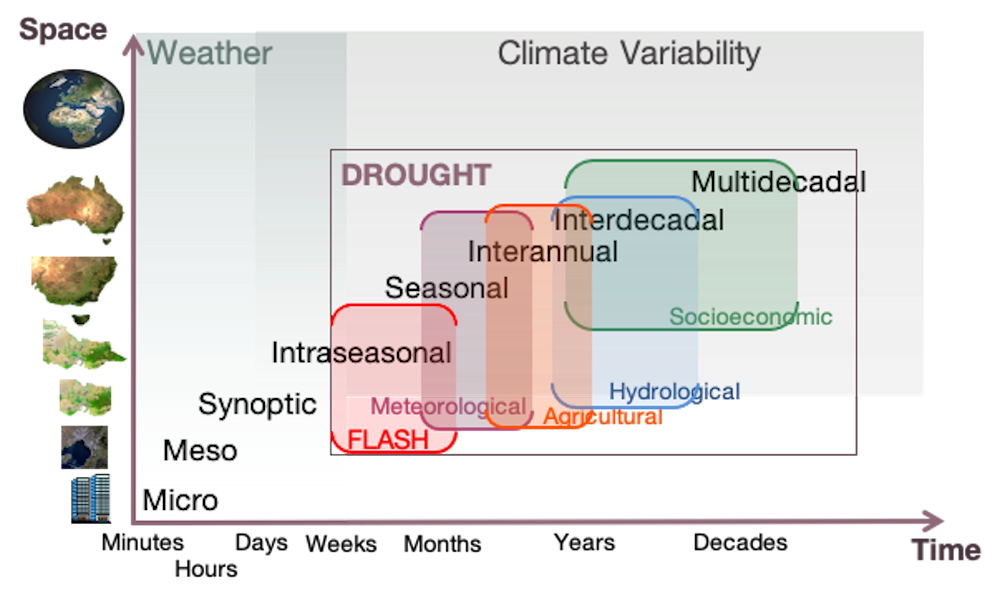
The different kinds of drought

Scientists typically talk about drought as a lack or deficit of available moisture to meet various needs, such as in agriculture or for water resources. We often classify different types of drought depending on where there is a lack of water, or what its effects are:
  • meteorological drought is a deficit of rain or other precipitation
  • agricultural drought is a deficit of moisture in the soil and evaporating or transpiring into the air
  • hydrological drought is a deficit of water in runoff and surface storage such as dams
  • socioeconomic drought is a lack of water that affects the supply and demand of economic goods and services.
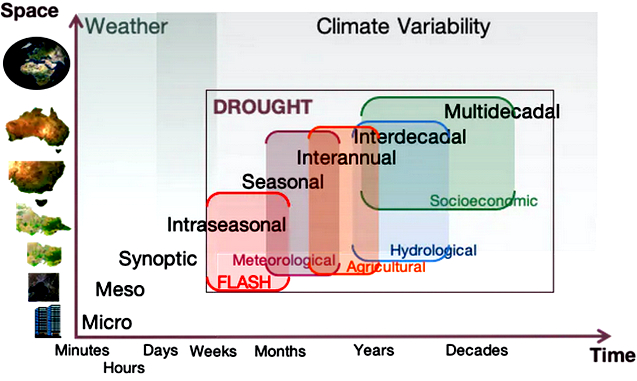
Different types of drought can occur at the same time, or a drought may evolve from one type to another. Droughts can last from months to decades, and can cover areas from a local region to most of the continent.

The different types of drought, showing how long they last and the size of the area they affect. Ailie GallantAuthor provided

Recently, a new characterisation of drought has been added to the drought spectrum: “flash” drought.

What causes flash droughts?

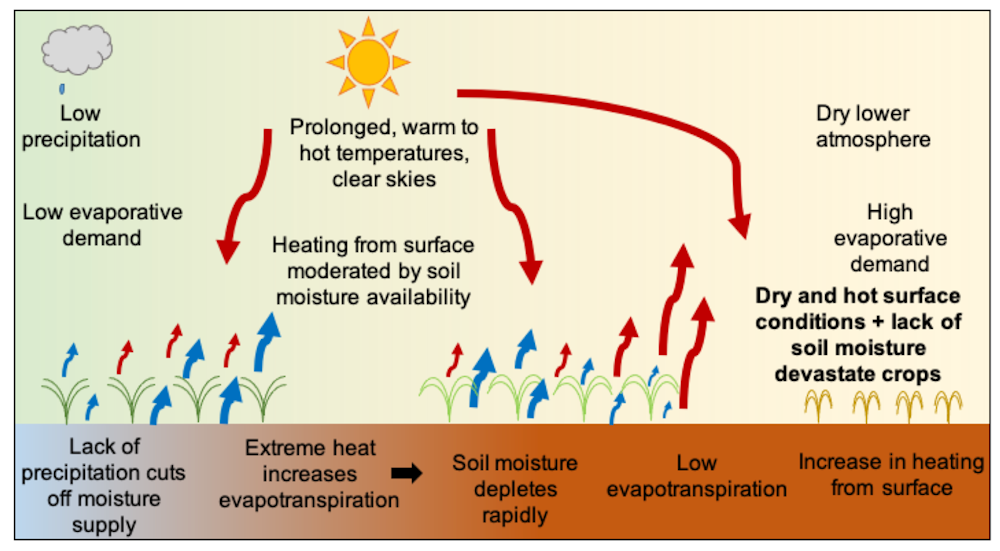
Flash droughts are droughts that begin suddenly and then rapidly become more intense. Droughts only occur when there is insufficient rainfall, but flash droughts intensify rapidly over timescales of weeks to months because of other factors such as high temperatures, low humidity, strong winds and clear skies.

These conditions make the air “thirsty”, which meteorologists call “increased evaporative demand”. This means more water evaporates from the surface and transpires from plants, and moisture in the soil is rapidly depleted.

Under these conditions, evaporation and transpiration increase for as long as moisture is available at the surface. When this moisture is depleted and there is no rain to replenish it, the lack of water limits evaporation and transpiration – and vegetation becomes stressed as drought emerges.

When there is a lack of rain accompanied by high temperature, low humidity, strong wind and clear skies, conditions are right for flash drought. Tess ParkerAuthor provided

Why haven’t we heard about flash drought before?

Flash droughts have always existed, and were first described in 2002. However, some particularly devastating flash droughts over the past decade have led to a surge of interest among researchers.

One such drought happened in the US Midwest. In May 2012, 30% of the continental United States was experiencing abnormally dry conditions. By August, that had extended to more than 60%. Although other rapidly developing droughts had been seen before, the widespread impacts of this event caught the attention of the US public and government.

Flash droughts are also increasingly a focus of attention in China and Australia. One of the few studies of flash drought in Australia examined an event when conditions in the country’s east suddenly changed from wet in December 2017, to dry in January 2018.

Anecdotal reports from farmers in the northern Murray–Darling Basin indicated removal of livestock from properties, and sheep numbers at record lows. By June 2018, there were reports of trees dying and a desert-like landscape, with little grass cover.

What happened in the Wimmera?

Our recent study of flash drought in Australia used several different measurements to capture a range of conditions related to drought.
  • precipitation describes the supply of moisture from the atmosphere to the surface
  • evaporative demand is the atmospheric demand for moisture from the surface
  • evaporative stress is the supply of moisture from the surface relative to the demand from the atmosphere
  • soil moisture is the wetness or dryness of the land surface.
The index we used to determine the atmospheric demand shows that the speed of development and the intensity of flash drought are driven by high temperatures, low humidity, strong winds and clear skies. All of these increase the demand for moisture from the surface.

After a drier than normal winter, southeast Australia experienced a cool and wet start to September 2015, with some rain in the first week of the month. Humidity and surface air pressure were roughly average, and surface sunshine below average, suggesting normal evaporative demand.

A warm spell began in mid-September, and intensified into a severe heatwave by early October, with temperatures over 35℃ persisting for several days in some areas. Throughout this period the overlying air became very dry. A persistent high-pressure system brought clear skies and increased sunshine.

By the end of October, the Wimmera was in severe or extreme drought conditions, devastating pulse and grain crops. Analysts estimated wheat production fell by 23%, with a loss of A$500 million in potential yields.

Flash drought in Australia

Flash droughts in Australia occur in all seasons. In the Wimmera, flash droughts are most frequent in summer and autumn. They can end as rapidly as they start, but in some cases may last many months.

In several instances, flash droughts in the Wimmera have started in summer or autumn, and the region has remained in drought through the following winter, and sometimes into spring. In this way, flash drought can be the catalyst for the common droughts lasting 6-12 months typical of southeast Australia.

But there is some potential good news. We have long known that seasonal-scale droughts in Australia are strongly related to the El Niño-Southern Oscillation (ENSO), which gives us some ability to predict them.

ENSO strongly affects rainfall, which means it can also be linked to flash droughts in winter and spring.

Further, sub-seasonal forecasting, which predicts the climatic conditions weeks to a month in advance, has improved considerably in recent years. Given flash droughts occur on these timescales, we can be optimistic that prediction of flash droughts may be possible

Links

Lethal Heating is a citizens' initiative