05/07/2021

Barrier Reef: Ley Stunned By 22 Years Of Warnings

The Saturday Paper - Mike Seccombe

Two decades ago an Australian scientist warned climate change would kill the reef. Since then, governments have steadfastly ignored what is happening.

An aerial bleaching survey of the Great Barrier Reef, March 2020. Credit: ARC Centre of Excellence for Coral Reef Studies

Thirty years ago, Ove Hoegh-Guldberg was a PhD student at the University of California. The Australian scientist had become interested in the phenomenon of coral bleaching, in which corals lost their vibrant colours and turned ghostly white.

The cause of this bleaching was still a mystery. Was it a disease, or related to levels of salinity or light, or something else?

Hoegh-Guldberg experimented with the various possible causes, and realised it was a function of water temperature. If the water got too hot, the corals would expel the zooxanthellae – the microscopic algae that give them their colour, with which they have a symbiotic relationship – and bleach. Eventually, they would die.

Thus the link was made between coral bleaching and climate change.

Over the decade that followed, Hoegh-Guldberg and other marine scientists researched just how sensitive corals were to temperature rises. The short answer was “very”.

At the same time, climate models were becoming more accurate. “That allowed me to take the climate models,” Hoegh-Guldberg remembers, “and say, ‘Okay, what’s the temperature going to be in 2050 or 2100?’ ”

In 1998, as Hoegh-Guldberg was conducting this research, the world experienced its hottest year on record. There was a mass-bleaching event on the Great Barrier Reef. The work to marry climate science and coral science was showing up in the real world.

A year later, Hoegh-Guldberg detailed his findings in the somewhat arcane journal Marine and Freshwater Research, published by the CSIRO in association with the Australian Academy of Science.

They were shocking, even to him. His paper predicted that events as severe as the 1998 bleaching – then the worst on record – would likely become “commonplace within 20 years”. He found that “the thermal tolerances of reef-building corals were likely to be exceeded every year within the next few decades”.

As he tells The Saturday Paper, his research saw no evidence of “miraculous evolutions” in corals that might change the outcome for reefs. They simply cannot live through multiple bleachings. “They can’t really survive more than one or two a decade.”

If reefs were to bleach every year, as Hoegh-Guldberg predicted, they would “disappear” by mid-century.

Unsurprisingly, given the degree of scepticism and outright denial expressed by some about human-caused climate change, his paper “did cause a stir”. Even other scientists suggested he was exaggerating the problem.
“The evidence for the Great Barrier Reef being in danger is very clear. And most of that evidence has been provided by the Australian government itself. So it’s not a surprise…”
“No one had come out and sort of said it quite bluntly like that before,” he says. “And of course, I took flak from scientists and non-scientists, and nutters and all sorts.”

And politicians, too, particularly those on the conservative side, who even then had a long, inglorious record of shooting the messenger when it came to climate science.

Repeatedly, One Nation senator Malcolm Roberts sent dossiers to the vice-chancellor and members of the senate and academic board at the University of Queensland – where Hoegh-Guldberg is a professor of marine studies – demanding his sacking.

Shortly after his paper came out, Hoegh-Guldberg met former Liberal Environment minister Robert Hill. The exchange is documented in Marian Wilkinson’s definitive book on the hijacking of Australian climate policy by denialists and fossil fuel interests, The Carbon Club.

Said Hill, on meeting Hoegh-Guldberg: “Oh, you’re the author of that alarmist paper.”

Hoegh-Guldberg replied: “No, I am the author of an alarming paper, which is somewhat different.”

Within a few years, the scientific debate was resolved, and smart, evidence-based opinion came to appreciate that Hoegh-Guldberg’s was the appropriate description. Hill himself changed his mind. Not that Hoegh-Guldberg finds much satisfaction in having been proved right: “I would much prefer to have been wrong.”

In 2002, there was another mass-bleaching event. Since then, they have come with increasing frequency. There have been three bleaching events on the Great Barrier Reef in just the past five years, collectively affecting 80 per cent of the reef.

By 2007 the Great Barrier Reef Marine Park Authority, under the then new Environment minister, Malcolm Turnbull, had come up with a Climate Change Action Plan. This was not as promising as it might have seemed.

The plan was light on detail and very light on funding – a paltry $9 million over five years. Importantly, though, it acknowledged climate change as “the greatest long-term threat to the Great Barrier Reef”. It just did too little about it.

That same year the Queensland Conservation Council mounted a challenge to Xstrata’s plans for expansion of the Newlands coalmine in central Queensland, arguing it would contribute to global warming and harm the reef. The president of the Land and Resources Tribunal, Greg Koppenol, disputed the link between fossil fuel and climate change.

Others, for financial reasons rather than blind ideology, would prefer the bleaching and its links to climate change were kept quiet. They point to an estimated $6.4 billion a year and 64,000 jobs that depend on tourists wanting to see the reef.

In 2018, Col McKenzie, the head of the Association of Marine Park Tourism Operators, representing more than 100 businesses in the Great Barrier Reef, made news by writing to the federal government and demanding it stop funding the work of another of the world’s leading reef researchers, Professor Terry Hughes, director of the Australian Research Council Centre of Excellence for Coral Reef Studies at James Cook University.

“I think Terry Hughes is a dick,” McKenzie told Guardian Australia. “I believe he has done tens of millions of dollars of damage to our reef in our key markets, being America and Europe. People won’t do long-haul trips when they think the reef is dead.”

Hughes’s sin was to draw attention to the results of his organisation’s research, documenting the decline in coral as a result of bleaching. The irony is that the scientists are every bit as concerned for the reef’s health as any tourist operator, even more so, and their work is focused on preventing its further decline.

After scientists documented the damage from the 2002 bleaching, for example, the Howard government responded with a rezoning of large parts of the reef to exclude commercial fishing.

In response to the evidence of the reef’s decline and criticism both domestic and at international forums, government now is spending much more on reef management. The federal Department of Agriculture, Water and the Environment claims some $200 million a year is spent by the Commonwealth and Queensland, seeking to improve water quality, control pests such as the crown of thorns starfish, and increase the resilience of corals. But the money is not nearly enough and the focus of its spending is too narrow.

“Every year or so, the state of Queensland and the Commonwealth produce what’s called a water-quality report card, and they give catchment-by-catchment grades,” Hughes says. “They’re too often D plus or C minus. It’s a bit like the vaccine rollout: there’s been some modest progress, but the plan is not fully funded. The state of Queensland estimated it would cost something like $800 million or $900 million a year for a decade to fix water quality.”

Hughes says the current state Labor government has acted more effectively than their federal counterpart, through measures including legislating to limit land-clearing in Barrier Reef catchments, the imposition of cane farm nitrogen and phosphorus “budgets” to reduce fertiliser runoff, and buybacks of some land in sensitive areas.

But this does not address the reef’s greatest problem, the one Hoegh-Guldberg’s research pointed to 22 years ago: climate change.

Indeed, governments both Labor and Liberal, state and federal, continue to make it worse. No matter how much is spent on reef management, it is no more than smoothing the dying pillow so long as climate change continues unabated.

Fossil fuels, the cause of that climate change, continue to be exported to the world, ironically on ships passing through the very reef their cargoes will help to destroy.

When scientists make that obvious point, they are criticised for it. They are accused of having political agendas. Since Hoegh-Guldberg’s first predictions, there has been no broad or comprehensive attempt by government to address the impact of climate change on the reef and the very real prospect that rising sea temperatures will kill it.

“In science,” says Hoegh-Guldberg, “problem-solving is meant to be impersonal. You play the ball, not the person. But people have used those sort of tactics to try to deny the science. But of course, I’ve always said that it makes me more determined.”

So we come to the latest example.

When the United Nations scientific organisation, UNESCO, announced its recommendation last week that the Great Barrier Reef be placed on the World Heritage “in danger” list, the Morrison government’s response was furious and misleading in multiple ways.

In a media release, Environment Minister Sussan Ley accused UNESCO of having “singled out” Australia in its “State of Conservation of Properties” report. In fact, the report canvassed the status of dozens of World Heritage sites, across many countries, and called for several others to be added to the existing list of 53 properties whose “outstanding universal value” was in danger of being lost for one reason or another.

Undeterred by this reality, Ley further claimed officials in her department had been assured in the week prior that the reef was not going to be recommended for listing as endangered, and were “stunned” by UNESCO’s “backflip”.

The co-ordinator of UNESCO’s World Heritage Marine Programme, Dr Fanny Douvere, promptly and categorically denied that any such assurance had been given, either formally or informally.

Ley’s combative media release suggested that UNESCO’s recommendation was the result of flawed science. She complained the draft decision had been made “on the basis of a desk top review … without examining the Reef first hand” or appreciation of “the outstanding science-based strategies being jointly funded by the Commonwealth and Queensland Governments”.

“In a call to the Director-General of UNESCO, Audrey Azoulay, with Foreign Minister Marise Payne overnight, I expressed Australia’s dissatisfaction with the process that is being followed,” she said in the release. “I made it clear that we will contest this flawed approach, one that has been taken without adequate consultation.”

Speaking to reporters later, she went further, suggesting a dark conspiracy intended to embarrass Australia. She pointed particularly to China’s involvement on the World Heritage Committee. “Clearly there was politics behind it, and that has subverted the proper process. For the World Heritage Committee not to foreshadow this listing is appalling.”

Terry Hughes describes this as “misinfomation”. He begins a long recitation of the reasons Ley’s claims are wrong and why the government should not have been surprised by the draft listing.

For a start, he says, the recommendation to designate the reef as “in danger” was not made by the World Heritage Committee but by UNESCO scientists.

“The World Heritage Committee, which is the 21 countries, half of which rotate every three years, is chaired by China; but China would not have seen the draft recommendation until it was released by UNESCO.”

As to the claim this assessment was made on the basis of inadequate information, he cites abundant scientific evidence, provided by people such as himself and Hoegh-Guldberg, and more importantly, the Australian government.

“Australia itself has documented the decline of the Great Barrier Reef, primarily due to global warming and runoff, in the three Barrier Reef Outlook Reports that have been produced in the last 15 years, every five years up to 2019,” says Hughes. “The 2019 report – produced by the Commonwealth – downgraded the Barrier Reef from poor to very poor.”

He points out that the International Union for Conservation of Nature, the scientific body that advises UNESCO, also produced a report last year. It listed the reef’s status as “critical”.

“So, the evidence for the Great Barrier Reef being in danger is very clear,” he says. “And most of that evidence has been provided by the Australian government itself. So it’s not a surprise; it’s nothing to do with China.”

Nor is this the first time the reef has been considered for an “in danger” listing. In 2015, the government managed to avoid listing, through a combination of lobbying and promises to better protect the reef.

“The Reef 2050 plan arose because of a directive from UNESCO for Australia to demonstrate that it was doing more,” Hughes says. “And that plan is now five years old. That the plan has nothing much to say about climate change, apart from acknowledging it as the No. 1 threat.”

Hughes says Australia is not being singled out. “UNESCO commissioned a report in 2018 on the vulnerability of the 29 World Heritage areas around the world that have coral reefs in them. Four – the Great Barrier Reef, Lord Howe Island, Shark Bay and Ningaloo – [are] in Australia. And I was part of that report; I’m one of the authors. All of those properties have shown multiple bleaching events in the last 30 years.”

What distinguishes Australia from the countries responsible for the stewardship of most of those sites, however, is its lack of action to address the underlying cause: climate change caused by the burning of fossil fuels.

“Australia is an outlier in that it has the second-highest per capita emissions in the world. Australia is a signatory to the 1.5 degree target of the Paris Agreement, but it hasn’t done anything much to achieve that target,” Hughes says.

“So UNESCO over the last couple of years has been moving towards linking a state party’s policy for climate change and for emission reductions to their responsibilities for management of climate-sensitive World Heritage properties.”

Ley and the government should not have been surprised, then, by what has happened. UNESCO, Hughes says, “has been broadcasting this over a number of years now”.

But the Morrison government has not been tuned in. Instead of climate action, Hughes says, “we have the gas-led recovery, Adani and other new coalmines and gas fields being subsidised and encouraged by the Morrison government”.

Just this week, the government’s Northern Australia Infrastructure Facility announced it would provide $175 million towards a new coalmine in Queensland.

The final decision on the status of the reef will be made a couple of weeks from now, at a virtual meeting of the member states of the World Heritage Committee.

Usually, their determinations are unanimous, but that is unlikely this time. Apart from Australia and China, there are 19 other countries on the committee, and the government has been furiously lobbying them. Ley’s statement suggests the government is very worried.

But the larger point remains. For decades, governments have been warned about the impact climate change will have on the Great Barrier Reef. Those warnings have proved accurate. And yet the government has done nothing substantial to engage with the reality of this. Instead it feigns shock at a listing confirming what it has already long known: that heating seas are killing the reef, which may only have a few decades left before it is gone entirely.

This is the difference between alarmist and alarming, the one Hoegh-Guldberg pointed out, and governments still have not learnt it.

Links

(Washington Post) Climate Change Could Cost Condo Boards Billions. They Aren’t Ready For It.

Washington Post - Evan McKenzie

The Surfside, Fla., building collapse is just one example of a bigger looming problem

Investigators are trying to figure out why Champlain Towers South in Surfside, Fla., collapsed. Climate change could leave other condo buildings around the country facing expensive repairs and upgrades to avoid disasters. (Octavio Jones/For The Washington Post)

Author
Evan McKenzie teaches in the political science department and the law school at the University of Illinois at Chicago. He is the author of two books about condominium and homeowner associations. 
The collapse of the Champlain Towers South condominium building in Surfside, Fla., is a terrible tragedy. Besides the stories of the victims and their grieving loved ones, early attention has focused on the causes of the collapse, such as how the building was constructed, the effects of saltwater on reinforced concrete and whether the condominium association was properly maintaining the high-rise.

Those are important matters, but the disaster exemplifies a bigger problem, one that will still loom once we have answers about what went wrong in Surfside: The untrained, unpaid and unsupervised volunteer directors of the nation’s more than 350,000 condo and homeowners’ associations, armed with limited financial resources, are expected to deal with the unprecedented infrastructure challenges that climate change poses to their communities. And there is no reason to believe that they are up to that task.

More than 20 percent of the U.S. population lives in property administered by condominium and homeowners’ associations, nonprofits run by volunteers elected by the owners. These directors and officers are responsible for an estimated $7 trillion worth of private property and infrastructure, including high-rise buildings, private streets, parks, pools, sewer and water systems, lakes, garages, and many other building systems and amenities.

As condos and HOAs blossomed across the country in the last 50 years, little or no thought was given to the eventual effects of climate change, in terms of location or construction quality. The common-interest housing sector emerged in the 1960s as a way to put more people on less land, increasing developer profits and local property tax revenue.

The model spread rapidly, and condos and HOAs are now the default options for new construction in many states, not just across the Sun Belt where they originated but in older metro areas as well. Many locations are problematic from the outset. Developers often build in places that appeal to buyers but pose environmental challenges — such as on reclaimed wetlands or beaches next to rising seas, as in Surfside.

Other developers place subdivisions at the top of artificial slopes that turn into mudslides in hundred-year storms, which now occur more often than they used to. Terrible disasters have struck neighborhoods built in areas that are prone to drought-induced wildfires. Local governments may approve these location decisions because they are great for sales and the property tax base, but they drop environmental issues right in the laps of condo and HOA boards.

Condo and homeowners’ associations were never designed or empowered to handle such conditions. These associations are essentially on their own, with virtually no support from any level of government. Although most of them operate well most of the time, paying for routine maintenance and repair has always been a challenge, long before climate change made things worse.

For years, industry insiders have pointed out that although directors and officers are responsible for maintaining the property, most unit owners are notoriously unwilling to see their housing costs go up now to sock away funds for repairs in the future. Why, they ask, should they pay today so someone else can have a new roof long after they’ve moved out? Yet that is precisely what they are expected to do. Somehow, dozens, hundreds or even thousands of owners are supposed to overcome their self-interest and collective-action problems and commit to maintaining their private infrastructure in perpetuity.

Now the maintenance and repair responsibilities that condo boards struggle with every day, with varying degrees of success, are being amplified by the effects of global climate change. It is increasingly clear that owner resources and volunteer expertise are inadequate to meet the challenge of maintaining buildings, preventing and mitigating climate-related damage, and restoring property that is severely harmed or even destroyed.

The Surfside disaster is an instructive example of an association faced with environmental challenges beyond its means. The 12-story condo tower with 136 units was built 40 years ago on reclaimed beachfront wetlands, where the proximity of a rising ocean, saltwater and gradual land subsidence have been constant threats to structural integrity. A few years ago, engineers told the condo board that they had an expensive problem on their hands with deteriorating reinforced concrete.

After much internal back-and-forth, the board recently assessed a total repair cost on the owners of $15 million. That averages out to more than $110,000 per unit for this midsize association, an eye-popping figure for any homeowner and one that would undoubtedly put many into foreclosure for failure to pay. Repairs were set to begin soon; residents were initially supposed to decide whether to pay their share of the assessment at once or in monthly installments by this past Thursday.

Some are claiming that the collapse could have been avoided if better maintenance had been done earlier. Maybe. But there are thousands of beachfront condos on the Atlantic, Pacific and Gulf coasts. We cannot expect all of them to be maintained consistently to industry standards with sea level rise, storm surge, land subsidence and a host of other coastal climate issues in mind. We know there will always be some that risk skipping maintenance, thinking the worst won’t happen there.

Sea level rise is not the only climate-related problem that places owners in harm’s way and that local governments and developers never anticipated. It is clear by now that climate change produces heavy rainfall, including hurricanes and so-called 100-year storms, that can cause major flooding, landslides and other stormwater-related disasters.

Condo and homeowners’ associations have been severely affected by such events, and developers have been sued from coast to coast over their failure to anticipate them and build accordingly. Expensive litigation after the fact is no substitute for prevention, but it is unrealistic to expect condominium and homeowner associations to undertake costly anticipatory measures. They have neither the expertise nor the resources to do so. In most cases, they don’t even know where to begin.

Many other communities have been built near places prone to wildfires, which have taken on new ferocity in drought conditions fueled by global warming. The costs of safeguarding neighborhoods against these fires are daunting for owners and associations, and prevention is almost entirely out of their hands.

In 2003, wildfires destroyed 331 homes in Scripps Ranch, an upscale San Diego-area neighborhood where developer-created HOA requirements for wooden “shake” shingle roofs accelerated the destruction. The San Diego City Council banned these roofs in new construction, including for people who wanted to rebuild their homes. Yet they faced intense resistance from Scripps Ranch owners over proposed building code changes intended to protect their homes against future wildfires, because implementing those changes would have been expensive.

Owners in a fire-prone area might be understandably angry if their association required them to pay for new roofs, elaborate sprinkler systems, doors and windows with heat-resistant double-glazed material, and special fire-retardant house paint. If local governments encounter pushback when they require such measures, it seems unlikely that condo and homeowners’ associations would adopt them voluntarily.

In effect, condo and HOA developments are a huge experiment in privatization of local government functions, and sometimes the offloading of government responsibilities goes too far. We can expect a condo or HOA board to handle garbage collection, get the leaves and snow removed from private streets, and broadly live up to its responsibilities to residents. But when private communities took off in the 1960s, we didn’t even know what climate change was.

We cannot realistically expect condo boards to prevent damage from sea level rise, more-frequent severe storms, extreme heat and drought, and other major changes in the environment — especially not in buildings that weren’t built to withstand such conditions. If the proliferation of condos and HOAs is to continue in the time of climate change, federal, state and local governments must play a more supportive, directive and protective role. Otherwise, millions of owners and their volunteer community leaders will be swamped by forces beyond their control.

Links

(AU The Age) ‘UNESCO Was Right’: Global Experts Back Barrier Reef Danger Warning

The Age - Mike Foley

World-leading environmental scientists, including Australia’s pre-eminent coral reef experts, have publicly praised UNESCO’s decision to recommend the Great Barrier Reef be rated “in danger”, a move that was slammed by the federal government.

The United Nations Educational, Scientific and Cultural Organisation - whose member countries control World Heritage listings - issued a draft “in danger” rating over the health of the Great Barrier Reef, due to poor water quality and the impact of climate change.

Global experts are backing UNESCO’s draft in danger rating for the Great Barrier Reef. Credit: iStock

Environment Minister Sussan Ley and Foreign Minister Marise Payne wrote to UNESCO director-general Audrey Azoulay and said the draft listing was “extremely disappointing” because it lacked scientific rigour and “premature” because UNESCO had not finalised a policy for assessing global warming impacts.

Ms Ley penned an article in The Australian this week to argue Australia had been unfairly “singled out” by UNESCO as a “poster child of a wider agenda” of climate action, which also failed to recognise recent gains in managing run-off to improve water quality.

But in an open letter to UNESCO and Ms Azoulay, five world-renowned scientists endorsed the in-danger warning.

They said while governments were investing in the reef, climate change and water quality targets had not been met.


Great Barrier Reef
Scientists reject Minister’s blast over UNESCO Barrier Reef downgrade
“UNESCO has made the right decision to recommend that the world’s most iconic Reef system be inscribed on the List of World Heritage In Danger,” the letter said.

Forecasts for the reef’s survival are dire.

There have been three mass coral bleaching events since 2016.

A recent Australian Academy of Sciences report said if the world warmed by 2 degrees only 1 per cent of corals would survive.

Professor of Marine Studies at the University of Queensland Ove Hoegh-Guldberg said Australia’s current emissions reduction commitments are consistent with a climate change trend of a “lethal” 3 degrees of global warming.

“We therefore greatly appreciate UNESCO’s draft recommendation for Australia to urgently address the threat of climate change,” he said.


Great Barrier Reef
Outrage at UN’s Barrier Reef warning a sideshow to climate catastrophe
Professor Hoegh-Guldberg was one of the signatories of the letter, along with Terry Hughes, the founding director of the Centre of Excellence for Coral Reef Studies at James Cook University, National Geographic Society Explorer in Residence Dr Sylvia Earle, Potsdam Institute for Climate Impact Research director Professor Johan Rockström and International Coral Reef Society president Professor Andréa G. Grottoli.

Professor Terry Hughes said the draft in-danger listing “presents a challenge to all nations to immediately reduce greenhouse gas emissions”.

“It should be no surprise UNESCO has linked Australia’s lack of progress on reducing emissions to an in danger listing on the Great Barrier Reef. Australia should be at the forefront of international climate efforts and that’s hardly the case,” Professor Hughes said.

The James Cook University associate professor said on Thursday that governments had made welcomed investments in water quality but “those efforts have not met their targets”.

The earth has already warmed by 1.1 degrees and medium-range estimates forecast 1.5 degrees of warming by 2045 to 2050.

Unlike most nations that are aiming for carbon neutrality by 2050 or earlier, Australia has not set a deadline to reach net zero emissions.

Australia has committed to reducing its emissions by at least 26 per cent by 2030, based on 2005 levels.

The UK aims to cut emissions 78 per cent by 2035, Japan 46 per cent cut by 2030, Canada 45 per cent and the US 50 per cent by 2030.

The World Heritage Committee will meet from July 16 to 31 to decide whether to accept or modify the draft decision on the Great Barrier Reef.

Links

04/07/2021

(CA The Guardian) Canadian Inferno: Northern Heat Exceeds Worst-Case Climate Models

The Guardian - 

Scientists fear heat domes in North America and Siberia indicate a new dimension to the global crisis indicate a new dimension to the global crisis

A wildfire burning on a mountainside in Lytton, British Columbia, on Thursday.

If you were drawing up a list of possible locations for hell on Earth before this week, the small mountain village of Lytton in Canada would probably not have entered your mind.

Few people outside British Columbia had heard of this community of 250 people. Those who had were more likely to think of it as bucolic.

Nestled by a confluence of rivers in the forested foothills of the Lillooet and Botanie mountain ranges, the municipal website boasts: “Lytton is the ideal location for nature lovers to connect with incredible natural beauty and fresh air freedom.”

Over the past seven days, however, the village has made headlines around the world for a freakishly prolonged and intense temperature spike that turned the idyll into an inferno.

The US president, Joe Biden, and Canadian prime minister, Justin Trudeau, have warned worried populations to brace for more. Shocked climate scientists are wondering how even worst-case scenarios failed to predict such furnace-like conditions so far north.

Johan Rockström, the director of the Potsdam Institute for Climate Impact Research, said the recent extreme weather anomalies were not represented in global computer models that are used to project how the world might change with more emissions.

The fear is that weather systems might be more frequently blocked as a result of human emissions.

“It is a risk – of a serious regional weather impact triggered by global warming – that we have underestimated so far,” he said.

In Lytton, it felt as if the weather itself had stagnated. Trapped in a vast heat dome that enveloped western Canada and the north-western US, temperatures had nowhere to go but up.

In Lytton, the Canadian national heat record was broken on Monday, smashed on Tuesday and then obliterated on Wednesday when the local monitoring station registered 49.6C (121F).

After the insufferable heat came choking fire. First the forest burned, then parts of the town. On Wednesday evening, the mayor, Jan Polderman, issued the evacuation order.

“It’s dire. The whole town is on fire,” he said on TV. “It took, like, a whole 15 minutes from the first sign of smoke to, all of a sudden, there being fire everywhere.”

By Thursday, satellite images showed an eruption of blazes around the village and a widening smoke cloud across the region.

Canada heatwave: resident films escape from wildfire as flames engulf Lytton village – video 

Police stations and hospitals reported a surge in heat-related deaths – 486 in British Columbia, and dozens more south of the border. Roads buckled as asphalt expanded. At least one city suffered power cuts.

The psychological, political and economic impacts are harder to quantify, but for many, along with the horror came a sense of bewilderment that these northern territories were hotter than the Middle East.

David Phillips, the Canadian government’s senior climatologist, summed it up in an interview with CTV. “I mean, it’s just not something that seems Canadian.”

A woman and her cat rest inside a tent at the Oregon Convention Center cooling station in Portland. US. Photograph: Kathryn Elsesser/AFP/Getty Images

More people in more countries are feeling that their weather belongs to another part of the world.

Across the border, in Washington state, the maximum heat measured at Olympia and Quillayute was 6C higher than the previous all-time record, according to the Weather Prediction Centre. 

In Oregon, the town of Salem hit 47C, smashing the previous record by 9C. Several areas of California and Idaho also saw new highs.

The previous week, northern Europe and Russia also sweltered in an unprecedented heat bubble. June records were broken in Moscow (34.8C), Helsinki (31.7C), Belarus (35.7C) and Estonia (34.6C).

Further east, Siberia experienced an early heatwave that helped to reduce the amount of sea ice in the Laptev Sea to a record low for the time of year.

The town of Oymyakon, Russia, widely considered to be the coldest inhabited place on Earth, was hotter (31.6C) than it has ever been in June.

This followed a staggeringly protracted hot spell in Siberia last year that lasted several months.

Carlo Buontempo, director of the Copernicus Climate Change Service, said there was a clear human fingerprint on this “very freakish” event.

Without emissions from cars, farms and industry, he said, the record temperatures in the western north Americas would be expected only once in tens of thousands of years, but the probability rises along with the levels of the greenhouse gas. 

“In the present-day climate, getting an extremely hot June is common and is likely to occur twice in three decades. However, an analysis from many computer models suggests that by the end of the century these extreme temperatures are more likely than not. Human influence is estimated to have increased the likelihood of a new record several thousand times.”

How a heat dome forms and its effect on the jet stream

                  
Rising temperatures can be seen across the world. Even in the Middle East, temperatures of 50C plus were once outliers, but parts of Pakistan, India, Australia, the US and Canada are now regularly approaching or passing that mark.

But the intensity of the heat in the north-west Americas this year and Siberia last year has taken many scientists by surprise and suggested extra factors may be involved in northern latitudes.

One theory is that the recent temperature spike might have been caused not just by global heating, but by slowing weather systems that get stuck in one place for an extended period, which gives them time to intensify and cause more damage.

This was an important factor in the devastation in Texas caused by Hurricane Harvey in 2018, which sat above Houston for several days rather than blowing inland and weakening.

Blocked high-pressure fronts were also blamed for the blistering heatwave in Europe in 2019.

Experts at the Potsdam Institute and elsewhere believe the rapid heating in the Arctic and decline of sea ice is making the jet stream wiggle in large, meandering patterns, so-called Rossby resonance waves, trapping high- and low-pressure weather systems in one location for a longer time.

This theory remains contested, but Michael Mann, director of the Earth System Science Center at Pennsylvania State University, said this week’s unexpectedly fierce heat at Lytton and elsewhere should prompt climatologists to consider additional impacts of human activity.

“We should take this event very seriously,” he wrote in an email. “You warm up the planet, you’re going to see an increased incidence of heat extremes. Climate models capture this effect very well and predict large increases in heat extremes.

"But there is something else going on with this heatwave, and indeed, with many of the very persistent weather extremes we’ve seen in recent years in the US, Europe, Asia and elsewhere, where the models aren’t quite capturing the impact of climate change.”

Regardless of which interactions are to blame, scientists are agreed that the simplest way to reduce the risk of further temperature jolts is to cut fossil fuel emissions and halt deforestation.

“It appears that this heatwave is still a rare phenomenon in the current climate, but whether it stays that way depends on our decisions,” Friederike Otto, associate director of the Environmental Change Institute at the University of Oxford, said.

“If the world does not rapidly eliminate fossil fuel use and other sources of greenhouse gas emissions like deforestation, global temperatures will continue to rise and deadly heatwaves such as these will become even more common.”

Links

(VICE) One Day After Setting Canada’s Heat Record, Town Burns To Ground

VICE - Mack Lamoureux

Officials said that most structures in Lytton, B.C., have been destroyed and multiple residents are still unaccounted for. 

A motorist watches from a pullout on the Trans-Canada Highway as a  wildfire burns on the side of a mountain in Lytton, B.C., Thursday, July 1, 2021. THE CANADIAN PRESS/Darryl Dyck

A small village in British Columbia burned to the ground one day after suffering through the hottest temperature ever recorded in Canada and several of its residents are still missing.

On Wednesday night, as a fire suddenly began boring down on the village of Lytton, which has a population of around 250 people, police went door to door and ordered the residents to evacuate their homes as soon as possible.

Michael Farnworth, B.C.’s public safety minister, said the blaze burned almost the entire town to the ground. 

"Most homes and structures in the village, as well as the ambulance station and the RCMP detachment, have been lost," Michael Farnworth said at a news conference on Thursday. "I also understand that some residents have not been accounted for and their location is currently being investigated by the RCMP."

“We got a phone call from emergency alert and I didn’t believe them,” evacuee Sharon Brown told Global News. “I looked out the door and there was fire everywhere. And my house burned down right after my daughter picked me up.”

The B.C. Coroners Service has yet to confirm if there have been any deaths, according to the Canadian Press. 

The number of residents unaccounted for is unknown.

The fire destroyed several cellular towers which has hampered the evacuees’ ability to contact loved ones.

The province has set up emergency reception centres and is urging residents to sign up. Because of the lack of cell service, officials do not even know if residents remain in the village. 

“Being without any cell service — that’s everybody’s lifeline. Nobody can contact each other,” an evacuee told Global News. “We’re going into Spence’s Bridge (a small B.C. community) to get some cell service and finally just get some relief, let everybody know we’re OK.”

Structures destroyed by wildfire are seen in Lytton, B.C., on Thursday, July 1, 2021. THE CANADIAN PRESS/Darryl Dyck

Several wildfires are ripping through the province at the moment, including one near Lytton, but B.C. Premier John Horgan said that the blaze was not caused by a nearby wildfire.


“We do not yet know what started the fire in Lytton,” said Horgan on Thursday. “There was little or no time to warn the community. In fact, it was the mayor himself that got the first whiff. Within minutes the city was engulfed.” 

Horgan said that he heard anecdotal information that the fire was sparked by a train going through the city but that a full investigation is underway. The Globe and Mail reported Friday that CN is actively investigating if the fire was started by one of their trains.

Shortly before the blaze, the little-known town became famous in Canada for breaking numerous heat records.

On Sunday, the town set a heat record with 46.6°C, then on Monday, it broke its own record after hitting 47.9°C. On June 29 it got even hotter, reaching 49.6°C (121.3°F), which beat out Las Vegas’ heat record of 47.2°C. It now stands as the hottest temperature ever recorded in Canada. 

The residents are now left to process the fact that not only have their homes been burned to the ground but that possible neighbours are missing.

Multiple GoFundMe campaigns have been started for the victims, several of which have raised over $100,000.

Canada Breaks Heat Record For Second Straight Day and Mountains Are Melting
In a press release about the shattered heat records, the World Meteorological Organization (WMO) said the heat experienced in Lytton is “more typical of summer temperatures in the Middle East than a province which is home to the Rocky Mountains and Glacier National Park.” 

British Columbia is not alone in experiencing severe spikes in temperature. 

“The Northwest Territories have recorded their all-time highest temperatures not just in June, but any point in the year,” Armel Castella, a meteorologist with Environment and Climate Change Canada, said in the press release. “ We are setting records that have no business in being set so early in the season.”

The WMO believes that heat records will continue to be broken as the summer carries on.

Links

(The Conversation) The North American Heatwave Shows We Need To Know How Climate Change Will Change Our Weather

The Conversation -  | 

NASA

Authors
  •  is Professor in Atmospheric Science, Monash University
  •  is Professor, School of Earth, Atmosphere and Environment, Monash University
Eight days ago, it rained over the western Pacific Ocean near Japan.

There was nothing especially remarkable about this rain event, yet it made big waves twice.

First, it disturbed the atmosphere in just the right way to set off an undulation in the jet stream - a river of very strong winds in the upper atmosphere - that atmospheric scientists call a Rossby wave (or a planetary wave).

Then the wave was guided eastwards by the jet stream towards North America.

Along the way the wave amplified, until it broke just like an ocean wave does when it approaches the shore. When the wave broke it created a region of high pressure that has remained stationary over the North American northwest for the past week.

This is where our innocuous rain event made waves again: the locked region of high pressure air set off one of the most extraordinary heatwaves we have ever seen, smashing temperature records in the Pacific Northwest of the United States and in Western Canada as far north as the Arctic.

Lytton in British Columbia hit 49.6℃ this week before suffering a devastating wildfire“.

What makes a heatwave?

While this heatwave has been extraordinary in many ways, its birth and evolution followed a well-known sequence of events that generate heatwaves.

Heatwaves occur when there is high air pressure at ground level. The high pressure is a result of air sinking through the atmosphere. As the air descends, the pressure increases, compressing the air and heating it up, just like in a bike pump.

Sinking air has a big warming effect: the temperature increases by 1 degree for every 100 metres the air is pushed downwards.

The North American heatwave has seen fires spread across the landscape. NASA

High-pressure systems are an intrinsic part of an atmospheric Rossby wave, and they travel along with the wave.

Heatwaves occur when the high-pressure systems stop moving and affect a particular region for a considerable time. When this happens, the warming of the air by sinking alone can be further intensified by the ground heating the air – which is especially powerful if the ground was already dry.

In the northwestern US and western Canada, heatwaves are compounded by the warming produced by air sinking after it crosses the Rocky Mountains.

How Rossby waves drive weather

This leaves two questions: what makes a high-pressure system, and why does it stop moving?

As we mentioned above, a high-pressure system is usually part of a specific type of wave in the atmosphere – a Rossby wave. These waves are very common, and they form when air is displaced north or south by mountains, other weather systems or large areas of rain.

Rossby waves are the main drivers of weather outside the tropics, including the changeable weather in the southern half of Australia. Occasionally, the waves grow so large that they overturn on themselves and break. The breaking of the waves is intimately involved in making them stationary.

Importantly, just as for the recent event, the seeds for the Rossby waves that trigger heatwaves are located several thousands of kilometres to the west of their location. So for northwestern America, that’s the western Pacific. Australian heatwaves are typically triggered by events in the Atlantic to the west of Africa.

Another important feature of heatwaves is that they are often accompanied by high rainfall closer to the Equator. When southeast Australia experiences heatwaves, northern Australia often experiences rain. These rain events are not just side effects, but they actively enhance and prolong heatwaves.

What will climate change mean for heatwaves?

Understanding the mechanics of what causes heatwaves is very important if we want to know how they might change as the planet gets hotter.

We know increased carbon dioxide in the atmosphere is increasing Earth’s average surface temperature. However, while this average warming is the background for heatwaves, the extremely high temperatures are produced by the movements of the atmosphere we talked about earlier.

So to know how heatwaves will change as our planet warms, we need to know how the changing climate affects the weather events that produce them. This is a much more difficult question than knowing the change in global average temperature.

How will events that seed Rossby waves change? How will the jet streams change? Will more waves get big enough to break? Will high-pressure systems stay in one place for longer? Will the associated rainfall become more intense, and how might that affect the heatwaves themselves?

Our answers to these questions are so far somewhat rudimentary. This is largely because some of the key processes involved are too detailed to be explicitly included in current large-scale climate models.

Climate models agree that global warming will change the position and strength of the jet streams. However, the models disagree about what will happen to Rossby waves.

From climate change to weather change

There is one thing we do know for sure: we need to up our game in understanding how the weather is changing as our planet warms, because weather is what has the biggest impact on humans and natural systems.

To do this, we will need to build computer models of the world’s climate that explicitly include some of the fine detail of weather. (By fine detail, we mean anything about a kilometre in size.)

This in turn will require investment in huge amounts of computing power for tools such as our national climate model, the Australian Community Climate and Earth System Simulator (ACCESS), and the computing and modelling infrastructure projects of the National Collaborative Research Infrastructure Strategy (NCRIS) that support it.

We will also need to break down the artificial boundaries between weather and climate which exist in our research, our education and our public conversation.

Links

03/07/2021

(AU SMH) From Drying Rainforests To Heavier Downpours, Australia’s Climate Is Changing

Sydney Morning Herald - Peter Hannam

Australia’s tropical rainforests will dry out, marine and land heatwaves will become more frequent and intense, and thunderstorms will dump more rain and worsen floods as the globe heats up.

These are among the many impacts from climate change that will blight the nation further unless atmospheric levels of greenhouse gases stabilise, according to the final report of the federal government’s Earth Systems and Climate Change Hub.

’Hub research has shown a clear link between climate change and worsening bushfire weather conditions over the past 70 years,” the centre’s final report finds. Credit: Nick Moir

The work of more than 100 researchers, to be expanded in a new Climate Systems Hub that began operations on Thursday, made advances across fields ranging from bushfire prediction to the rapid identification of the role climate change rather than natural variability plays in an extreme weather.

“It’s clear that climate change is already happening and having impacts,” said David Karoly, the leader of the Earth Systems Hub that ended its work on June 30.

Hub achievements include the “massively successful” improvements to the main ACCESS climate model used by Australian governments and agencies to hone future predictions to a smaller scale than before, he said.

Ancient Gondwanan rainforests in Queensland and NSW, which get as much as 40 per cent of their moisture from being shrouded in clouds, face a drier and hotter future with climate change. Credit: Brian Cassey

The final report said there was “a clear link between climate change and worsening bushfire weather conditions over the past 70 years”, and singled out the World Heritage-listed Gondwana Rainforests as one area of concern.


Extreme weather
‘Hazards are many’: Millions found to be at risk from sea level rise
The forests, which stretch from north of Newcastle in NSW up to southern Queensland, were hard hit by the 2019-20 Black Summer bushfires and are likely to become drier as clouds and fog that provide as much as 40 per cent of moisture rise in a warmer climate.

“Higher cloud height, especially during the dry season, could lead to a dry climate that is beyond the tolerance of some species, resulting in rainforest community changes,” the report found, adding “even moderate increases in cloud height were found to have significant implications for cloud-water dependent species”.

Professor Karoly said that, while the lineage of the forests dates back many millions of years, changes were underway in a matter of a hundred years, far faster than species could adapt.

Similarly rapid changes were underway in the oceans around Australia although their remoteness from most people’s experiences meant they were not well known.

The Tasman Sea is warming at four times the global average, placing at risk giant kelp forests off the Tasmanian coast. Credit: Craig Sanderson

The Tasman Sea, for instance, is warming four times faster than the global average in part because the East Australian Current is strengthening and dragging tropical water much further south.

Key ecosystems, such as the giant kelp forests off Tasmania, are at risk from more frequent heatwaves.

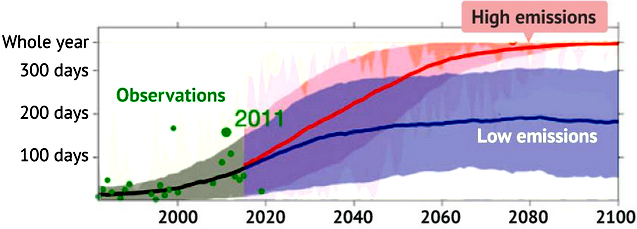
“A marine heatwave [in the Tasman Sea] similar in intensity to those in 2015–16 and 2017–18 is currently expected to occur approximately once every 20 years,” the report said.

“Under [a global] low-emissions scenario, it is expected to occur once every 15 years by the end of the century, and under the high-emissions scenario, a marine heatwave is projected to occur almost every year.”

Marine heatwave days per year
Source: The Earth Systems and Climate Change Hub

Thunderstorms were another area of interest, including how the number of danger so-called “pyrocumulonimbus” clouds formed out of bushfire plumes.

At least 35 of them were detected during Black Summer, increasing the risk of erratic winds on unpredictable fire behaviour and ignite new blazes ahead of the fire front, the report noted.

Cumulative observed number of fire-generated thunderstorms
Source: The Earth Systems and Climate Change Hub

East coast lows, another big weather event affecting coastal areas from Queensland to Victoria, were among phenomenon undergoing change.

The Hub developed new ways to analyse the complex storms and found the most extreme rainfall near eastern Australia was frequently caused by such low-pressure systems combining with a front and a thunderstorm.

The researchers found short-duration events produced by thunderstorms could potentially increase in intensity by about 15 per cent per degree of global warming.

A line of storms associated with an east coast low sweeping over the Hawkesbury River north of Sydney in July 2020. Credit: Nick Moir

Andy Pitman, head of the ARC Centre of Excellence for Climate Extremes and a Hub advisor, said east coast lows were “one of the least effectively studied phenomena in Australia” even though their impacts can be huge in terms of floods, storm surges and wind damage.

“I worry about how ill-prepared we are for any climate signal for east coast lows,” he said.

Drone vision of Lake Burrendong in the central-west region of NSW in January 2020 when water levels fell to a couple of per cent of capacity. Credit: Nick Moir


Extreme weather
Hundreds of deaths as Canadian heatwave shatters records
At the other end of the weather spectrum was so-called flash droughts, another of the Hub’s research areas.

These are triggered by lower-than-average rainfall, accompanied by abnormally high temperatures, a dry atmosphere, clear skies and more sunshine, and can be perilous for crops.

The researchers showed the sudden dry spells could be forecast, and they can happen even in winter.

The outgoing Hub cost $23.4 million, with matching contributions from CSIRO, the Bureau of Meteorology and five universities including the University of Melbourne and the University of NSW.


Bushfires
Storms, tornadoes and explosions: How bushfires are getting stranger
Its successor has been allocated federal funding of $38 million over six years.       

While welcomed, “we are not investing remotely enough given the scale of the risk”, Professor Pitman said, adding the new funding was “not even one year’s salary of a top soccer player”.

Simon Marsland, a CSIRO senior scientist who will lead the new Climate Systems Hub, said how communities could adapt to the warming impacts still to come will be one priority as will efforts to work closely with Indigenous populations that are often particularly exposed to extreme weather.

Dr Marsland noted the current record-shattering heatwave in Canada, with near 50-degree temperatures recorded even at a latitude as far as 50 degrees north, were “a good reminder that climate change is here now and not something in the far future”.

Links

Lethal Heating is a citizens' initiative