18/08/2021

(Vox) It’s Time To Freak Out About Methane Emissions

Vox

This lesser-known greenhouse gas will make or break a “decisive decade” for climate change.

Landfills around the world are one source of rising methane. Others include oil and gas and cows. Omar Havana/Getty Images

From his home office in Arizona, Riley Duren was multitasking, telling me about frighteningly powerful greenhouse gases even as he monitored his team’s aircraft. The plane was flying at 20,000 feet to measure methane spewing from wells in the Permian Basin of Texas. An aerial map on his computer screen brought the measurements to life: Dozens of red zones represented otherwise invisible plumes of methane above oil and gas fields.

“It’s just like watching a firework show. They’re just popping up all over the place,” said Duren, a University of Arizona scientist who leads the nonprofit Carbon Mapper, which has public and private partners including NASA, the state of California, and the company Planet.

In the public conversation about climate change, methane has gotten too little attention for too long. Many people may be unaware that humans have been spewing a greenhouse gas that’s even more potent than carbon dioxide into the atmosphere at a rate not seen in at least 800,000 years. It harms air quality and comes from sources as varied as oil and gas pipelines to landfills and cows. But methane and other greenhouse gases, including hydroflurocarbons, ozone, nitrogen dioxides, and sulfur oxides, are finally getting the attention they deserve — thanks largely to advances in the science.

Until the past few years, methane’s relative obscurity made sense. Carbon dioxide (CO2) is by far the largest contributor to climate change, and it comes from recognizable fossil fuel sources such as car tailpipes, coal smokestacks, and burning gas and oil. The most troubling part is that it sticks around in the atmosphere for hundreds of years, making climate change not just a problem for us now, but generations well into the future. Carbon is now embedded in our language, from “carbon footprint” to “zero-carbon lifestyle.”

A landmark new report from the Intergovernmental Panel on Climate Change, a UN panel of top climate scientists, marks the first time the global body devotes substantial attention to the major role of gases other than CO2. Its sixth assessment of the science of climate change, which finds that the evidence of man-made warming is “unequivocal” and many climate impacts will be irreversible, dedicates a full chapter of the report to “short-lived pollutants” such as methane. One of their most common sources is fossil fuels.

NOAA data shows rising methane concentrations in the atmosphere, and the drastic cuts needed starting in the 2020s if there’s any hope of limiting warming to 1.5 degrees Celsius. UN Global Methane Assessment, 2021

Since these gases are such a tiny part of the atmosphere, compared to how much carbon we’re pumping in the air, methane is “always number two” in discussions of climate change, said Drew Shindell, who chaired the world’s first United Nations Global Methane Assessment released this year. It’s fallen “between the cracks” in global research thus far, Shindell says.

Methane has literally fallen between the cracks: Some of it leaks out of the ground in places like oil fields and permafrost, and scientists are still trying to understand where it all comes from. The IPCC report reflects these uncertainties. The chapter authors, for example, do not name the dominant source of human-caused methane emissions, whether fossil fuels or agriculture. But what we now know represents one of the greatest evolutions in climate research since the last IPCC assessment came out in 2013. The work of scientists like Duren helps the world understand the biggest culprits of the methane crisis, in hopes that governments and corporations take urgent action.

Even though methane is not nearly as well understood as carbon, it’s playing an enormous role in the climate crisis. It’s at least 80 times as effective at trapping heat than carbon in a 20-year period, but starts to dissipate in the atmosphere in a matter of years. If this is the “decisive decade” to take action, as the Biden administration has said, then a methane strategy has to be at the center of any policy for tackling global warming.

Methane could mean the difference between a rapidly warming planet changing too quickly and drastically for humanity to handle, and buying the planet some much-needed time to get a handle on the longer-term problem of fossil fuels and carbon pollution.

Methane pollution erases gains from switching off of coal

 Shindell, one of the scientists who raised an early alarm about methane, was studying air pollution in the late 2000s when he found a strange trend. Ground-level ozone, the pollutant that forms hazy smog, was rising in the US — which surprised him after decades of progress under the Clean Air Act. He realized the “relentless growth in methane,” which accelerates the formation of ozone near the ground, was to blame. Ever since, he’s been trying to warn the world not to overlook this dangerous pollutant and its costs to both the climate and human health.

Identifying the millions of sources of methane around the globe isn’t so simple. Cattle release methane, and so does decomposing organic material. All the food waste that goes into landfills release methane. And natural gas is almost entirely methane.

If you’ve heard politicians call natural gas a “bridge fuel,” what they mean is that natural gas emits less carbon dioxide than coal. It’s wrong to call it clean, because burning methane still releases carbon — and methane that escapes without burning is a powerful warmer.

A climate report released Monday by the United Nation’s (UN) Intergovernmental Panel on Climate Change (IPCC), predicts that unless humans make immediate changes to limit methane emissions, carbon dioxides and other heat trapping gases, the earth will continue to warm with devastating effects on human and animal life. Spencer Platt/Getty Images

The oil and gas industry has argued that it isn’t to blame for methane pollution, but advocates and scientists have shown otherwise. Environmental Defense Fund, which has commissioned flights to monitor methane over Texas oil and gas fields, has found that oil fields in the US are leaking 60 percent more methane than the Environmental Protection Agency estimates. University of Michigan scientist Eric Kort found methane spewing from offshore wells at far higher rates than previously understood. The environmental group Earthworks, using expensive, on-the-ground camera equipment, helped track down some sites that were repeat offenders of venting methane into the atmosphere.

The scientific papers have mounted: Since 2013, at least 45 scientific papers have highlighted the disproportionate role of oil and gas operations, according to a review by the advocacy group Climate Nexus. Scientists like Duren have also produced vivid images of methane that a layperson can understand, just like the imagery below from April this year.


This false color scene shows a series of methane plumes detected by the Global Airborne Observatory (over laid on Google Earth imagery) from an altitude of 17,500 ft (~5.3 km). The red plumes indicate methane emissions from oil & gas infrastructure.

According to Duren, Carbon Mapper has detected over 3,000 methane plumes in the Permian Basin with its airborne surveys, all coming from a range of oil and gas infrastructure, including wells, tank batteries, compressor stations, pipelines, and more.

Together, these findings suggest a grim outlook for the minimal progress made so far in tackling carbon pollution: Rising methane pollution effectively erases some of the progress the US has made by cleaning up the coal-fired power sector.

The IPCC report noted that methane has been rapidly climbing since 2007, driven by a mix of agriculture (from East and West Asia, Brazil, and northern Africa) and fossil fuels, specifically from North America. In other words, scientists are confident that humans are the main cause of increasing methane pollution.

Still, the data needs to get better. The Trump administration scrapped early rules that would’ve required oil companies to monitor and fix their own leaks. Few major economies even measure methane. China has launched a carbon-trading market to tackle carbon emissions, but has done less to control methane, which comes not just from gas but coal as well.

Scientists know a lot about CO2 — and much less about other gases

There are other greenhouse gases out there besides CO2 and methane. Nitrogen dioxides, black carbon, and halogenated gases (a category that includes chemicals used for refrigerants, hydrofluorocarbons) are other contributors to climate change.

A graphic from the IPCC’s summary for policymakers makes sense of how all these gases interact to add up to at least 1.1 degrees Celsius of average global warming since the 1850s. As the below graphic shows, CO2 and methane make up most of the warming, but other pollutants leave their mark too. Some aerosols from fossil fuels, like sulfur dioxide, actually have a cooling effect (but are dangerous to our lungs).

Other pollutants besides carbon have a heating effect on the atmosphere. IPCC AR6 Summary for Policymakers

There’s good news and bad news when it comes to the second-worst cause of global warming.

First the bad: Methane is rising, and there’s plenty we don’t know about it. Even if we pinpointed the worst offenders in oil and gas, its other sources would still require sweeping societal change, like a reduction in the number of cows raised for food. (There’s been some experimentation with feed for cattle to reduce methane, or more wackily, fart-collecting backpacks for cows).

Food waste, which releases methane as it decomposes, is a problem too. Across the world, the richest economies are throwing out half their food. Landfills may be able to capture some of the methane, but that too is an energy-intensive process.

Even though methane is not nearly as well-understood as carbon, it’s playing an enormous role in the climate crisis. Patricia Monteiro/Bloomberg via Getty Images

That leaves oil, coal, and gas. Coal is the worst offender; it leaches both carbon as well as methane, making it the number one priority to phase out. Oil production is a big problem too, in part because producers don’t face much regulatory or economic pressure to recapture the extra gas. Even when industry is trying to capture and sell natural gas, producers lose methane throughout its extraction and transportation. It leaks out as producers pipe the gas to compressor stations, process it for shipment, ship it hundreds of miles by pipeline to a refinery, and transport it to the consumer in the form of liquefied natural gas, plastic, petrochemicals, or the gas that lights up ovens in homes and apartments.

The whole system is extremely leaky, but the leakiest parts are not totally clear. “It’s just been really hard to put our finger on exactly the source, and be able to attribute it to the granularity that would enable us to solve it,” said Fran Reuland, a researcher on methane in the oil and gas industry at the think tank RMI. “Because it’s happening over such a large area, wrapping your mind around just how much is coming out is one of the main problems.”

Another frustrating challenge is that methane emissions fluctuate. Carbon Mapper pieced together a time series of a section of the Permian Basin in the southwestern US, in which the dots corresponding with methane emissions. About half the time, Duren estimates, some of the worst offenders may be venting methane directly into the atmosphere to relieve pressure, while the other half probably represent persistent leaks and malfunctions.

This time series illustrates the importance of frequent monitoring of highly intermittent (but high magnitude) methane point source emissions. This represents several weeks of daily surveys of a ~ 6000 km2 area in the Permian basin.

Environmentalists argue we must transition off coal, gas, and oil as quickly as possible — but stopping the pollution can’t wait for the transition to play out. A coalition of 134 environmental and health groups have rallied around a certain target — cutting 65 percent of the oil and gas industry’s methane pollution by 2025 — and have pressured the Biden administration to adopt the same goal by using existing technology.

The gains from containing methane will be critical as the world continues to gamble with its climate. A study from EDF scientists published in the peer-reviewed journal Environmental Research Letters found that tackling methane emissions across multiple sectors, including oil and gas, agriculture, and landfills, can slow the current rate of runaway warming by a staggering 30 percent. One-quarter of one degree Celsius by 2050 might not sound like a lot, but small changes to global averages contain a range of extreme impacts that will worsen across the globe.

There’s the good news: The world doesn’t need to wait around for better science. Action is feasible now.

Estimates of methane’s biggest sources from human activity around the world. In North America, the biggest source is fossil fuels. UN Global Methane Assessment, 2021

Here’s what can be done about methane emissions now

When the IPCC report came out on August 9, Lisa DeVille, a member of the Dakota Resource Council who lives on the Fort Berthold Indian Reservation, was encouraged to hear scientists “echoing what most of us can see with our own eyes,” based on what she sees on the front lines of oil production in North Dakota.

“The land near my home is crisscrossed with oil and gas pipelines, literally littered with drilling rigs,” DeVille said in a call with reporters. She said her home has been ravaged by unusually high rainfall and flooding, and she and her husband have had to breathe in smoke from wildfires. “I live less than a mile away from well pads that vent and flare methane and choke our atmosphere, making local people like my husband and I sick. This means the land that is part of my identity as an Indigenous women has been turned into a pollution-filled industrial zone.”

Under pressure from climate advocates, the Environmental Protection Agency is expected to pass a new set of rules in September. Environmentalists have pushed for high targets, and hope these rules will require oil and gas companies to both monitor and address methane leaks from existing and future wells, using sensors and regular equipment checks. The Biden administration has suggested that methane regulation offers “near-term solutions” to climate change.

There’s widespread agreement, even from some in the fossil fuel industry, that the place to start is tackling leaks. This will get easier as scientists gather better data about where methane is leaking. From the industry’s perspective, companies are losing product and dollars. For activists, plugging leaks is one step on the road to permanently phasing out gas.

The problem that underlies all of climate action is that humanity has to trade short-term profit for the long-term costs. Carbon pollution affects the world for the long haul, and methane is making the crisis significantly worse in the near term.

On the plus side, tackling methane and other dangerous pollutants would have an “immediate payoff,” said Global Methane Assessment’s Shindell. It could change our dangerous climate trajectory over the next 30 years.

“Every action counts,” said Jane Lubchenco, a senior science adviser to the Biden administration, in an interview with Vox. “Every avoided tenth of a degree matters.”

Fractions of degrees could translate into wild swings in extreme weather, or tipping points we don’t even fully understand. In the effort to prevent climate catastrophe, methane will count tremendously.

Links

(The Guardian) Biden-Backed ‘Blue’ Hydrogen May Pollute More Than Coal, Study Finds

The Guardian

Infrastructure bill includes $8bn to develop ‘clean hydrogen’ but study finds large emissions from production of ‘blue’ hydrogen

A Shell hydrogen station for hydrogen fuel cell cars in Torrance, California. Photograph: Lucy Nicholson/Reuters

The large infrastructure bill passed by the US Senate and hailed by Joe Biden as a key tool to tackle the climate crisis includes billions of dollars to support a supposedly clean fuel that is potentially even more polluting than coal, new research has found.

The $1tn infrastructure package, which passed with bipartisan support on Tuesday, includes $8bn to develop “clean hydrogen” via the creation of four new regional hubs. The White House has said the bill advances Biden’s climate agenda and proponents of hydrogen have touted it as a low-emissions alternative to fuel shipping, trucking, aviation and even home heating.

But a new study has found surprisingly large emissions from the production of so-called “blue” hydrogen, a variant being enthusiastically pushed by the fossil fuel industry and probably falling under the definition of clean hydrogen in the Senate bill.

Blue hydrogen involves splitting gas into hydrogen and carbon dioxide and then capturing and storing the CO2 to ensure it doesn’t heat the planet. But this process involves the incidental release of methane, a potent greenhouse gas, and uses a huge amount of energy to separate and then store the carbon dioxide, some of which escapes anyway.

This means that the production of this hydrogen actually creates 20% more greenhouse gases than coal, commonly regarded the most polluting fossil fuel, when being burned for heat, and 60% more than burning diesel, according to the new paper, published in the Energy Science & Engineering journal.

“It’s pretty striking, I was surprised at the results,” said Robert Howarth, a scientist at Cornell University who authored the paper alongside Mark Jacobson, a Stanford University researcher. “Blue hydrogen is a nice marketing term that the oil and gas industry is keen to push but it’s far from carbon free. I don’t think we should be spending our funds this way, on these sort of false solutions.”

The Hydrogen Council, a group that includes the oil companies BP, Total and Shell among its members, has said that hydrogen has a “key role to play in the global energy transition” by replacing more polluting fuels, predicting it will account for 18% of total energy demand by 2050.

Dozens of gas companies in the US have started producing hydrogen or testing its viability in existing gas pipelines, which some climate campaigners have said is a step towards entrenching fossil fuel infrastructure at a time when the world, as outlined by Monday’s Intergovernmental Panel on Climate Change (IPCC) report, needs to rapidly move to net-zero emissions.

But others are more upbeat about the use of hydrogen to help lower emissions in some stubbornly polluting sectors. “Hydrogen is not a panacea or a silver bullet, but it appears to be critical for decarbonization of ‘hard-to-electrify’ sectors such as long-haul heavy trucking, international marine shipping and some parts of heavy industry,” said Mike Fowler, director of advanced energy technology research at the Clean Air Task Force.

There is a form of “green” hydrogen that involves producing hydrogen from water using only renewable energy, but this option isn’t explicitly chosen for funding by the infrastructure bill, which still needs to pass the Democrat-held House of Representatives.

“We look at that bill and see massive giveaways to fossil fuel infrastructure that is incompatible with serious climate action,” said Carroll Muffett, chief executive of the Center for International Environmental Law. “Congress went out of its way to not specify green hydrogen and so this funding just helps prop up the fossil fuel industry. The potential of these technologies is being routinely overstated even as the impacts are being understated.”

The latest IPCC report, which warned of “irreversible” impacts if emissions aren’t drastically cut, identified methane, produced from oil and gas drilling and animal agriculture, as providing a huge contribution to current global heating. If methane, a short-lived but very powerful greenhouse gas, was cut by around half this decade, it would shave 0.3C off the increase in global temperature by 2040.

Progressive Democrats hope that methane, as well as other greenhouse gases, will be more comprehensively tackled in an upcoming $3.5tn reconciliation bill that will include far stronger climate measures than the infrastructure legislation.

“This budget resolution will be a generational investment in the future of our people and our planet,” said Ed Markey, a Democratic senator who helped craft the Green New Deal alongside Alexandria Ocasio-Cortez.

Links

(AU SBS) 'War-Time Mobilisation’: New Report Calls For A Drastic Shift In Australia's Fight Against Climate Change

SBS News - Biwa Kwan

The business and banking sectors are being urged to urgently plan emissions reduction strategies, following the release of the IPCC climate report last week.

Australia's business and banking sectors are being urged to play a bigger role in rapidly reducing emissions following the release of the IPCC climate report. Source: AAP

Australia's business and banking sectors are being urged to play a bigger role in rapidly reducing emissions following the release of a landmark report on the impacts of climate change.

A new report, released on Monday by the Melbourne-based Breakthrough - National Centre for Climate Restoration think tank, urges Australia's financial sector to change its approach to climate risks to avoid making the same mistakes that led to the 2008 Global Financial Crisis.

The analysis found there is an urgent need to overhaul the climate risk modelling being used to underpin investment decisions.

The frameworks are based on assumptions of a net zero by 2050 target and an average global warming scenario of between 3 and 4 degrees Celsius above pre-industrial levels.

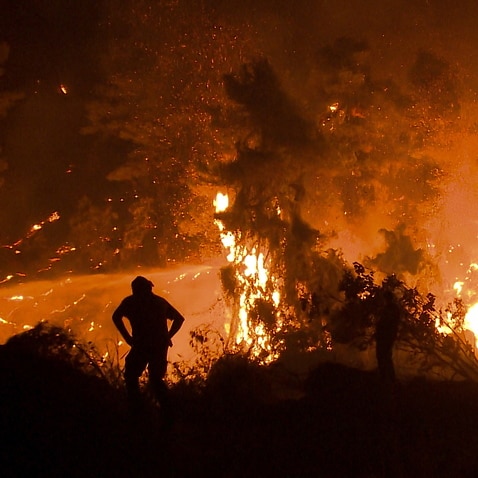
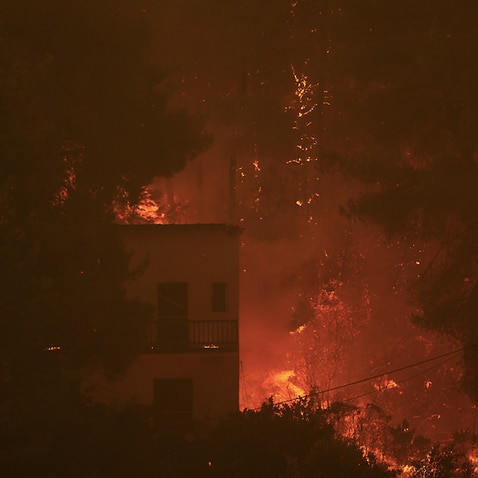
Residents and volunteers watch the development of a wildfire near Kamatriades in Evia, Greece, on the night of 10 August 2021
Overwhelmed by the latest IPCC report? Here's what you can do to help act on climate change


Report co-author Ian Dunlop said that proposition cannot be accepted. 

"The best analysis around the world - among security analysts - is that 3 degrees Celsius temperature increase will lead to complete social chaos.

"And 4 degrees Celsius is beyond the ability of human civilisation to survive. It will be a complete breakdown."

It follows the latest report from the Intergovernmental Panel on Climate Change, which found global warming could hit 1.5 degrees Celsius above pre-industrial levels around 2030 - a decade earlier than previously projected.

Push for net zero by 2030

Mr Dunlop, a former CEO of the Australian Institute of Company Directors, said much more drastic action must be taken by the business and banking sectors in Australia.

"We have to take precautionary action, where you say: 'Look, you have got to now ensure that this [3-4 degree Celsius global warming] does not happen at all costs'.

"We have to get real. There is no point fiddling around the edges. Everybody now has to reduce emissions around the world.

Mr Dunlop said the Australian government's technology road map was part of the solution, but momentum needs to gather around a net zero target by 2030.

"Now to get there it means you have to move to something like war-time mobilisation.

"We need a completely apolitical approach to say we have to now focus all of our efforts - whether it be technically, financially, or whatever - to achieve this outcome."

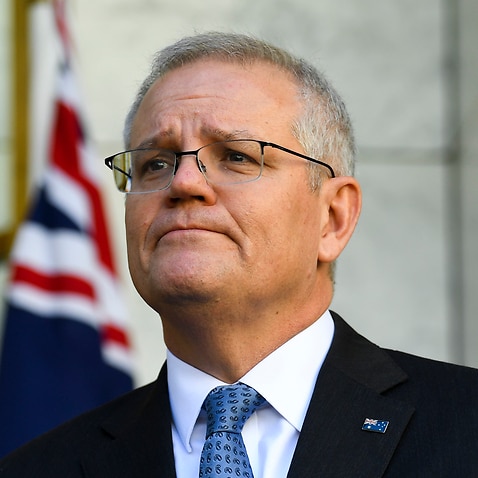
Prime Minister Scott Morrison speaks to the media during a press conference at Parliament House in Canberra.
Scott Morrison says Australia won't sign 'blank cheque' to reduce emissions after dire climate change warning

He said the rapid response of governments to threat of COVID-19 showed large-scale action can be achieved.

"If you look at what is happening in NSW right now with COVID. We have moved in the space of 24 hours to a complete shutdown of the state.

"Why did they do it? On a precautionary basis because they suddenly realise unless they do that, this Delta variant is going to spread like wildfire.

"Climate is in the same situation. But the threat is far far greater. We need to stop playing games with this, and start getting serious with the way we approach it."

He said the work by Australian universities, NGOs and think tanks showed a number of measures could be implemented, including a carbon tax and a shift away from fossil fuels.

"We have to assemble the best possible expertise. Stop denying that climate is a threat. Net zero emissions by 2050 is far too late. We have to achieve as close to 2030 as possible. And if you have only 10 years to do it - then what you have to do is quite different than if you had 30 years."

'Businesses part of the solution'

Mr Dunlop said while financial regulators have in some ways been leading the thinking on climate change risks for the economy, businesses have a key role to play. 

"The business world is absolutely fundamental to solving this problem," said Mr Dunlop.

"What company directors have started to see in the last three or four years is that they now have to face up to the fact that climate change is a material risk to their future survival. And they have a fiduciary responsibility to understand it - and to manage those risks accordingly.

"They haven't been doing that. They have tended to rely and respond to what the regulators are doing."

In guidance to Australian companies issued in April, the Australian Prudential Regulation Authority recommended they stress test their finances against global warming scenarios of up to 4 degrees Celsius.

It also proposed stress testing Australia's financial system with the 3 degrees Celsius global warming scenario.

The Financial Stability Board in 2015 established the Task Force on Climate-related Financial Disclosures.

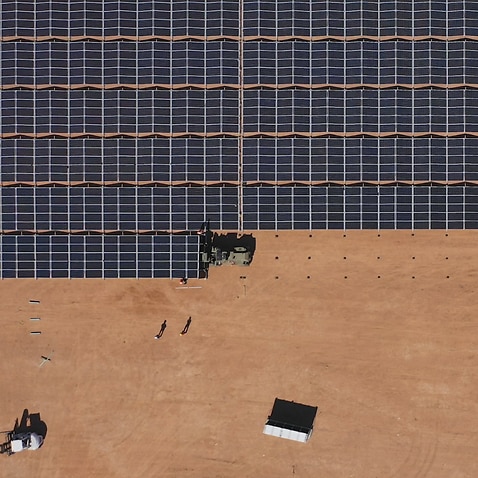
An aerial view of the Port Bonython power station, which used panels prefabricated by 5B
Billionaires invest 'tens of millions' in Aussie solar farm that could power Singapore

The European Central Bank recently conducted risk modelling on the impacts of climate change on the financial system, including in their model approximately four million companies and 2,000 banks over a 30-year timeline.

It found climate change impacts are a "major source of systemic risk, particularly for banks with portfolios concentrated in certain economic sectors and, even more importantly, in specific geographical areas".

Small businesses also have a role in coming up with solutions, Mr Dunlop said. 

"There is going to be massive social change, in addition to the big issue of getting emissions down.

"It means a complete change in the way society operates - and that is going to result in enormous opportunities for small business - in reframing the way they operate and picking up new ideas."

'Code red'

The IPCC report released last week found global warming of 1.5 degrees Celsius above pre-industrial levels could be reached by the early 2030s - a decade earlier than previously anticipated three years ago.

The Earth's global surface temperature rose around 1.1 degrees Celsius in the last century - since the pre-industrial period of 1850–1900. That level of temperature rise has not been seen since before the last ice age - 125,000 years ago.

The report's authors found that although the window to limit global warming to 1.5 degrees is narrowing, it can be achieved if immediate, rapid and large-scale reductions of emissions are adopted.

It found under the current trajectory, one in 50-year severe weather events would occur with greater frequency and intensity.
Prime Minister Scott Morrison during the G7 Summit in Carbis Bay, Britain, 12 June 2021.
Australia left isolated on climate after G7 leaders pledge to end support for coal-fired power stations

Extreme heatwaves that occurred every 50 years without any global warming are now happening every decade.

The time between events reduces to every five years with 1.5 degrees of warming, every 3.5 years under 2 degrees, and every 15 months at 4 degrees.

Mr Dunlop said there was a risk of repeating the mistakes of 2008 Global Financial Crisis when risk modelling did not anticipate the true extent of the impacts.

"The thing we risk here is the same sort of problem occurring is: people's failure to imagine the impact of climate change - and the way in which we must deal with it."

United Nations secretary-general Antonio Guterres said the "code red" report "must sound a death knell for coal and fossil fuels before they destroy our planet".

PM defends climate performance

Responding to the IPCC report, Prime Minister Scott Morrison said Australia had performed well in reducing emissions by 20 per cent based on 2005 levels, adding that Australia is "on track" to meet its emissions reduction target of 26 to 28 per cent below 2005 levels by 2030.

Climate change scientists said the conclusion of 20 per cent emissions reduction uses accounting methods that rely on the decline in land use sector emissions arising from state government policies.

Taking the land use sector emissions out of the equation, Australia's emissions increased by seven per cent - even as the UK reduced theirs by 33 per cent, the EU by 20 per cent and the US by 11 per cent.

Labor frontbencher Tony Burke said the federal government needs to commit to a net zero target for 2050.

A wildfire burns trees at Pefki village on Evia Island,  north of Athens, Greece, Sunday, Aug. 8, 2021
Global warming of 1.5 degrees could be reached a decade earlier around 2030, major climate report finds

"We were always critical of it (the goverment's 2030 target)," he told ABC's Insider's program on Sunday.

"You can't view the 2050 target as something that you start working towards in 2048."

The federal opposition is still working on its target for 2030, but has said it is committed to a net zero target by 2050.

Meanwhile, other countries have forged ahead with plans to shift away from fossil fuels or adopt a carbon price. 

Costa Rica last week began debating a proposed law that would permanently ban fossil fuel exploration as the nation aims to achieve net zero carbon emissions by 2050.

China last month launched the world’s largest carbon-trading market, the Shanghai Environment and Energy Exchange, in a step towards net-zero emissions by 2060.

Links

17/08/2021

(Carbon Brief) Analysis: What The New IPCC Report Says About When World May Pass 1.5C And 2C

Carbon Brief Zeke Hausfather

View of planet Earth from space. Credit: Buradaki / Alamy Stock Photo.

The Intergovernmental Panel on Climate Change’s (IPCC) sixth assessment report (AR6) is the first major IPCC review to specifically focus on when the world might pass the 1.5C and 2C warming levels. 

AR6 uses a combination of historical observations, climate models and an updated estimate of climate sensitivity to provide a best-estimate that the world will pass – or temporarily “reach” – 1.5C somewhere between 2030 and 2035, depending on the future emissions scenario. 

Even in the most stringent mitigation scenario examined in the report – SSP1-1.9 – the world exceeds 1.5C in most models during the middle of the 21st century, before falling back down below 1.5C by 2100 due to the large-scale deployment of negative emissions technologies (for more details on the Shared Socioeconomic Pathways (SSPs) used in the AR6, read Carbon Brief’s explainer). 

The date that the world is expected to pass 1.5C is in “the early part of the range” suggested in Chapter 1 of the IPCC’s 2018 special report on 1.5C (SR15), due to a combination of revisions to historical temperature records and higher near-term warming projections. However, a separate, more directly comparable estimate found in Chapter 2 of the SR15 report is nearly identical to the new AR6 estimates.

The world is expected to pass 2C in emissions scenarios that do not feature strong near-term mitigation with a best-estimate of between the early 2040s and the early 2050s. These – and the 1.5C exceedance dates – are quite similar to those given in an earlier Carbon Brief analysis published in late 2020.

AR6 has also updated the remaining “carbon budget” that can be emitted before the world is committed to 1.5C or 2C of warming. 

The carbon budget for a 50% chance to limit warming to 1.5C is quite similar to that given in the SR15 report. It shows that the world can emit around 460bn tonnes of CO2 (GtCO2) – or just 11.5 years of current (2020) emissions – after 1 January 2021 before being committed to 1.5C. 

The carbon budgets for limiting warming to 1.5C with a 66% chance has been slightly increased due to the narrower range of climate sensitivity in the AR6. The remaining carbon budget to limit warming to 2C is similarly affected.

In addition, the report introduces new carbon budgets for limiting warming to 1.7C, as well as for limiting to each temperature with higher (83%) or lower (17%) probability.

The narrower range of future projected warming in the AR6 compared to past IPCC reports – coupled with more historical observations over the past few years – provides a better sense of when these important warming levels may be exceeded.

When will the world pass 1.5C?

AR6 focuses in some depth on when the world might pass 1.5C and 2C warming levels relative to the pre-industrial period. The authors suggest that the world is likely to pass 1.5C in the early 2030s, in the absence of rapid emissions mitigation. This is in the earliest part of the 2030-52 range reported in the SR15 summary for policymakers (SPM).

The 1.5C and 2C warming levels are noteworthy in part because they reflect the targets set in the Paris Agreement. However, Paris targets specifically refer to end-of-century warming outcomes, so scenarios such as SSP1-1.9 – which overshoot 1.5C mid-century before reducing temperatures back down through a large-scale deployment of negative emissions – are nominally consistent with Paris goals, even if they may exceed 1.5C during the 21st century.

(See Carbon Brief’s Q&A on the IPCC report for an introduction to the scenarios used by the IPCC, or Carbon Brief’s explainer for more details.)

Calculating when the world exceeds a particular temperature threshold is not a straightforward exercise. Global average surface temperatures in any given year are driven by a combination of long-term warming and short-term natural variability.

The latter – driven by El Niño and La Niña events or volcanic eruptions – can result in a year being up to 0.2C warmer or cooler than the trajectory of long-term human-caused warming. This means it is quite possible for humans to have only warmed the world by 1.3C – only slightly above today’s level – and see a single year that exceeds 1.5C.

In fact, the World Meteorological Organization estimated last year that there is a one-in-four chance that the world will exceed 1.5C for at least one year by 2025.

The international community of researchers and policymakers is more concerned with the effects of long-term human-caused warming than short-term natural variability. Because of this, passing the 1.5C and 2C limits has generally been defined based on a multi-year average rather than a single year, though there is no clear agreed-upon approach. 

To avoid the problem of over-interpreting short-term variability, the AR6 authors calculate the 20-year periods where the average temperature reaches 1.5C (or 2C) warming above pre-industrial levels

For example, in the SSP2-4.5 scenario, they find that 2021-40 is the first 20-year period when the average is most likely to exceed 1.5C.

This formulation is a bit confusing – in order to simplify it (and compare it to other approaches) Carbon Brief uses the mid-point of the 20-year period (for example, 2030 in the case of a 2021-40) as the likely point at which the longer-term average temperature exceeds 1.5C, following the approach used in Chapter 4 of the AR6.

This generally provides a good estimate of the likely exceedance year, though may be slightly off in cases where the rate of warming changes significantly over the course of the 20-year period (for example, in very high emissions scenarios). 

Both the SR15 report and a 2020 analysis by Carbon Brief used a somewhat different approach; rather than looking at 20-year averages, these methods smoothed the data to remove short-term temperature variability before calculating the likely exceedance year.

Carbon Brief used the new CMIP6 models, while the SR15 Chapter 1 assessment simply extrapolated historical warming trends and uncertainties into the future. AR6, on the other hand, uses its own assessed warming range based on CMIP6 models constrained by both observations and climate sensitivity estimates. 

The SR15 report actually included two separate assessments of when the world might pass 1.5C. Chapter 1 of the report suggested that the world would pass 1.5C somewhere between 2030 and 2052, adding that there was stronger evidence to support the early part of this range.

The Chapter 1 text did not give a central estimate, but did include a figure, showing the world passing 1.5C around 2040. This was based on an assumed continuation of the (at the time) historical warming trend of 0.2C per decade. 

However, this value underestimates both recent observed warming trends (in part due to corrections to observational temperature records in the years since the publication of the SR15) and is lower than the near-term warming projections in most of scenarios evaluated in the SR15 report (and those in the new AR6). 

In addition, deep in the supplementary materials of Chapter 2 of the SR15 report was an estimate (in Table 2. SM.12) that a 1.5C low overshoot scenario (similar to the SSP1-1.9 scenarios) would pass 1.5C around 2035.

It suggested that well-below 2C scenarios (similar to SSP2-2.6) would pass 1.5C around 2033.

These values are nearly identical to the best estimates in the new IPCC report, though because they were not highlighted in the main text, this was not widely understood at the time.

The figure below shows the main SR15 projection of 1.5C exceedance times (grey bar), along with the new AR6 likely exceedance year (and uncertainty ranges) for each of the new SSP scenarios.

In addition, Carbon Brief’s estimates of when the world might pass 1.5C are shown alongside the new IPCC projections for comparison purposes.
Range of possible 1.5C exceedance years from Chapter 1 and Chapter 2 of the IPCC SR15 report (grey bar and dots, respectively), as well as AR6 and Carbon Brief exceedance year estimates for each of the SSPs. Dots represent central estimates (when available), while bars represent the very likely (5–95%) range. 20-year average periods in the AR6 are converted to expected exceedance years by taking the midpoint of the range. Note that bars extending to the top of the graph represent cases where the uncertainty range encompasses outcomes that never exceed 1.5C. Chart by Carbon Brief using Highcharts.

The new AR6 values are notably in the earliest part of the range given by SR15 Chapter 1. The AR6 estimates that the world will pass 1.5C around 2030 under a moderate emissions scenario (SSP2-4.5), whereas SR15 gave a range of 2030-52

However, as mentioned above, the AR6 numbers are in line with those in the SR15 Chapter 2 supplementary materials.

More broadly, the AR6 finds a best-estimate exceedance year of 2027-35 across all of the models examined, albeit with a wide uncertainty range for each. In scenarios without rapid mitigation, the world is very likely to exceed 1.5C in the late 2030s (SSP5-8.5) or mid-2040s (SSP2-4.5) at the latest.

The new AR6 central estimates of when the world will likely pass 1.5C are generally quite similar to Carbon Brief’s 2020 analysis, though are, on balance, a few years earlier. More importantly, the uncertainty range in the AR6 is considerably larger, suggesting that the long-term average temperature may pass 1.5C as early as 2020 or 2021.

However, passing 1.5C this early is a very unlikely outcome given observed temperatures today.

These early potential exceedance dates are likely something of an artifact of model-observation mismatches after the 1995-2014 normalisation periods – where models and observations are matched in the AR6.

Carbon Brief’s earlier analysis, by contrast, used model projections from 2020 onwards based on a best-estimate of the human contribution to warming.


Crossing 2C

In addition to 1.5C exceedance years, the AR6 report provides estimates of when the world may pass 2C warming relative to pre-industrial levels.

These are shown for each SSP scenario expected to pass 2C in the figure below, alongside Carbon Brief’s own estimates. Note that SSP1-1.9 and SSP2-2.6 are excluded as temperatures are unlikely to exceed 2C in most models under these scenarios.
Range of possible 2C exceedance years in the AR6 and Carbon Brief’s 2020 analysis. Dots represent central estimates (when available), while bars represent the very likely (5–95%) range. 20-year average periods in the AR6 are converted to expected exceedance years by taking the midpoint of the range. Chart by Carbon Brief using Highcharts.

AR6 finds that in the modest-mitigation SSP2-4.5 scenario the world is likely to exceed 2C around 2052, with a range of 2037 to 2084.

For the high emissions SSP3-7.0 scenario, the world is likely to pass 2C around 2046 (with a range of 2035-2062), while in the very high emissions SSP5-8.5 scenario it is 2041 (with a range of 2032 to 2053).

These values are effectively identical to Carbon Brief’s earlier estimates, except for a wider range of possible later exceedance dates in SSP2-4.5 and SSP3-7.0. This may reflect differences between the unweighted CMIP6 models used by Carbon Brief and the assessed warming range in the AR6.

The results of the new AR6 report are clear: the best estimate is that the world will pass 1.5C in the 2030s, even under the rapid mitigation scenarios of SSP1-1.9 and SSP1-2.6.

However, there is still a chance in these scenarios that the world will not pass 1.5C, particularly under the SSP1-1.9 scenario and if sensitivity of the climate to CO2 and other greenhouse gas emissions is on the low end of the range assessed in the AR6 report.

In the SSP1-1.9 scenario, the best estimate is that the world will overshoot 1.5C in the middle of the 21st century – warming by 1.6C relative to pre-industrial levels – before temperatures fall back down to below 1.5C by 2100 through the widespread use of negative emissions technologies.

The world is unlikely to warm more than 2C in either of the deep mitigation scenarios. In the other three scenarios examined, however, the best estimate is that the world will pass 2C somewhere between the early 2040s and early 2050s.

Updates to the remaining carbon budget

The year in which the world will exceed 1.5C and 2C warming levels is a related, but somewhat separate, question from the remaining carbon budget. 

Carbon budgets are a simplified way to measure the maximum emissions that can still enter the atmosphere if the world wishes to limit global warming to levels such as 1.5C. They are based on the fact that the amount of warming that will occur can be approximated by total – that is, cumulative – CO2 emissions.

In practice, though, carbon budgets mask a lot of complexity. Because the world is already most of the way to 1.5C of warming, the remaining budget is relatively small and, therefore, quite sensitive to the approach used.

The 2018 SR15 report significantly expanded the carbon budget, relative to what was reported in the IPCC fifth assessment report (AR5) in 2013-14. This was primarily due to the use of observations rather than climate model projections to estimate historical warming; for more technical details see this Carbon Brief analysis.

AR6 used a broadly similar approach to that of the SR15 (Chapter 2) to calculate the remaining budget and generally obtained similar results. The figure below shows the remaining carbon budgets for both a 50% chance and a 66% chance of avoiding more than 1.5C warming above pre-industrial levels from the SR15 and the AR6, as of 1 January 2021. 

These are calculated by subtracting observed global emissions (as reported by the Global Carbon Project) over the 2018-20 period from the SR15 budget (which gives the remaining allowable budget starting in 2018) and by subtracting observed 2020 emissions from the AR6 budget (which provides a budget starting in 2020).
Remaining carbon budgets for a 50% and 66% chance of avoiding more than 1.5C warming as of January 1st 2021. Published budgets have been adjusted using observed CO2 emissions from the Global Carbon Project. Chart by Carbon Brief using Highcharts.

Both the SR15 and AR6 suggest that the world has around 460GtCO2 remaining in the 1.5C budget for a 50% avoidance chance.

This means that the remaining carbon budget would be fully exhausted in just 11.5 years of current (2020) emissions – and less than that if global emissions rebound (as expected) in 2021 and do not decrease over the next decade.

For example, the carbon budget would be used up in 10.7 years if emissions continued at 2019 levels. This would result in a world committed to a 1.5C temperature increase around 2031 – quite similar to the best estimate exceedance dates found in the AR6 discussed above.

For a 66% chance of limiting warming to 1.5C, AR6 reports that the world has a remaining carbon budget of 360GtCO2 – or nine years of current emissions. 

This is a notable increase from the SR15 carbon budget of 295GtCO2.

This increased carbon budget for a 66% avoidance chance reflects a narrower transient climate response to cumulative carbon emissions (TCRE) value calculated in the AR6 report (1C to 2.3C per 1000 gigatons of carbon – GtC) than in the SR15 (0.8C to 2.5C per 1,000GtC), resulting from the narrower estimate of climate sensitivity in the AR6.

This TCRE revision does not affect the 50% avoidance chance as the best-estimate of TCRE is unchanged at 1.65C per 1,000GtC.


Methodological changes

A number of other important elements were updated in the AR6 carbon budget calculations. 

First, updated temperature records were used that moved the world a bit closer to 1.5C than was assumed in the SR15 report, which, all things being equal, would result in a lower carbon budget.

However, in the SR15 report the global surface air temperature (GSAT) was assumed to be warming faster than the global mean surface temperature (GMST), resulting in a smaller carbon budget.

(GMST is the standard metric used when discussing historical, observation-based recordings. It is based on a combination of land-surface air temperatures from weather stations and the sea surface temperature, measured using buoys and ships. It is subtly different from GSAT, which is generally used by climate models. It is also based on land surface air temperatures, but this is combined with temperatures of the air above seawater, rather than of the seawater itself.)

AR6 – based on more recent studies – found more limited evidence for this assumption, and did not assume any difference between GSAT and GMST. This change largely counterbalanced the reduction in the carbon budget associated with updated temperature records, resulting in a 50% avoidance budget nearly identical to that of the SR15.

The SR15 report suggested that unrepresented Earth system feedbacks – such as thawing permafrost – could result in a reduction of remaining carbon budgets of up to 100GtCO2 over the course of this century – and these were not included in the remaining carbon budgets numbers.

The AR6 lowers this estimate of Earth system feedbacks to 26GtCO2 (albeit with an uncertainty of ±97GtCO2) and includes these feedbacks in its carbon budget numbers – while acknowledging that there is still low confidence in the exact magnitude of these estimates.


Carbon budget for 2C

In addition to remaining carbon budgets for 1.5C, both the SR15 and AR6 provide carbon budgets for 2C. These are shown – calculated as starting in 2021 – in the figure below.
Remaining carbon budgets for a 50% and 66% chance of avoiding more than 2C warming as of January 1st 2021. Published budgets have been adjusted using observed CO2 emissions from the Global Carbon Project. Chart by Carbon Brief using Highcharts.

AR6 slightly reduces the remaining carbon budget for a 50% chance of avoiding 2C, relative to that in the SR15 – from 1,375GtCO2 (or 34 years of current emissions) to 1,310 

GtCO2 (or 33 years of current emissions). This suggests that the world will exhaust its remaining 2C carbon budget around 2053 if current emissions continue – quite similar to the 2052 exceedance year in the modest mitigation SSP2-4.5 scenario discussed earlier. 

For a 66% chance of avoiding 2C warming – which is how the Paris Agreement goal of limiting warming to well-below 2C is commonly interpreted – AR6 has slightly increased the remaining carbon budget from 1,045GtCO2 (26 years of current emissions) to 1,110GtCO2 (28 years of current emissions). This reflects the updated TCRE values in the AR6 compared to the SR15 report.

Overall, both the exceedance years and carbon budgets reported in the AR6 are similar to values reported in the SR15 report – despite notable updates to the models used for calculating exceedance years and the approach used for calculating carbon budgets.

The AR6 exceedance estimate of around 2030 is in the earliest part of the range reported by Chapter 1 of SR15 but is very similar to the values reported in the supplementary materials of the SR15.

Links

(AU SMH) UN’s ‘Code Red’ Climate Warning A Burning Issue For Australia’s Fire Risk

Sydney Morning HeraldMike Foley

A landmark United Nations climate report mapped out with unprecedented certainty the nature of the dangerous bushfire future which will confront this country, according to the two Australian lead authors who were among the 234 contributing scientists.

Global warming will intensify the decline of southern Australia’s crucial winter rainfall and increase the number of extremes heat events. This combination will drive greater risks of extreme fire with more hot, dry, windy weather said Australian National University Climate Change Institute Professor Mark Howden.

Fires sweeps through the Snowy Mountains region in January 2020. Credit: Alex Ellinghausen

“The conditions that generate fire weather are likely to increase in both frequency and intensity,” Professor Howden said.

The Intergovernmental Panel on Climate Change, released last week, showed with greater confidence than ever before that the world is “very unlikely to avoid 1.5 or 2 degrees of warming under the current trajectory of greenhouse emissions”, Professor Howden said.

Extreme weather
Humans’ fingerprints on climate change are becoming clearer
UN Secretary-General Antonio Guterres said the report was “a code red for humanity”. While the world has on average warmed by 1.1 degrees due to human-induced climate change, Australia’s landmass has heated by 1.4 degrees due to regional weather conditions affecting the continent.

It was “increasingly clear climate change has played a significant role in extreme heat events in many regions” such as Australia’s 2019/20 Black Summer bushfires, a heat dome in the United States and the fires burning in southern Europe, Professor Howden said.

A joint study by the Bureau of Meteorology and CSIRO found southern Australia had already lost significant seasonal rainfall. Winter rainfall has reduced by 11 per cent in the south-east, and winter rainfall is down 20 per cent in south-west Western Australia since 1970, compared to the previous 70 years.

Bushfires
‘Where the rubber hits the road’: Australia’s bushfire recovery effort heats up
While summers with above-average rainfall will become more likely because for each degree increase in air temperature the atmosphere can hold seven per cent more moisture, extra rain won’t wet the landscape and reduce fire risk, Professor Howden said.

Winter rain in southern Australia evaporates less than in summer, which soaks into the soil and stays in the landscape for longer to reduce aridity when hotter weather hits, he said.

“We’re losing our useful rainfall (in winter) and gaining not very helpful rainfall in summer. That summer rainfall is inherently very variable and it’s not particularly useful in terms of changing the moisture profile in the landscape because most of what rain does fall evaporates fairly quickly in summer,” Professor Howden said.

“Those wetter years generate large amounts of fuel and then in the dry years, that will form as (forest) litter, and it will become extremely dry and very flammable, so that variability can actually drive the in predisposing factors for really big fires.”

With the world tracking for 2 degrees of warming or more, the other Australian IPCC lead author, Professor of Climate Change, Roshanka Ranasinghe, said in that scenario there are dozens of what’s known as climate impact drivers that will play out.

Professor Ranasinghe, from the IHE Delft Institute for Water Education, said “we have high confidence that 11″ of those scenarios will hit Australia such as rising temperatures and extreme heat.

Meanwhile, a study by CSIRO and Bushfire Co-operative Research Centre has found a uniquely dangerous weather system that spews hot, dry air from the interior across eastern Australia like a fire hose could occur up to four times more often by 2100 if greenhouse emissions continue unchecked.

The system occurs when a low-pressure system races northwards from the Southern Ocean and collides with a high-pressure system on the NSW coast. The two systems rotate around each other and suck hot, dry air from inland Australia out towards the coast, resulting in high and dry westerly winds that can run for days.

Links

Lethal Heating is a citizens' initiative