02/09/2021

(Independent Australia) Climate Crisis Putting A Billion Children At ‘Extremely High Risk’

Independent Australia - Reynard Loki

A new U.N. report has revealed almost half of the world’s children are seriously threatened by the rapidly deteriorating global climate, writes Reynard Loki.

Climate activist Greta Thunberg has collaborated with UNICEF to report on the risk of global warming to children (Screenshot via YouTube)

Swedish climate activist Greta Thunberg said in 2019:
“Adults keep saying we owe it to the young people to give them hope. But I don’t want your hope. I don’t want you to be hopeful. I want you to panic. I want you to feel the fear I feel every day.” 
Now the famed young eco-warrior and Nobel Peace Prize nominee might get her wish as she, along with other youth activists, has collaborated with UNICEF – a United Nations agency working in more than 190 countries and territories to provide humanitarian and developmental aid to the world’s most disadvantaged children and adolescents – to launch an alarming new report that has found that a billion children across the world are at ‘extremely high risk’ from the impacts of climate change.

Released ahead of the United Nations Climate Change Conference to be held in November in Glasgow and on the third anniversary of Fridays for Future (FFF) – the youth-led global climate strike movement founded by Thunberg – ‘The Climate Crisis Is a Child Rights Crisis’ is the first climate report to combine high-resolution geographic maps detailing global environmental and climate impacts with maps that show regions where children are vulnerable due to an array of stressors, including poverty and lack of access to education, health care or clean water.

The report introduces the new Children’s Climate Risk Index (CCRI), a composite index that ranks nations based on children’s exposure to climate shocks, providing the first comprehensive look at how exactly children are affected by the climate crisis. It also offers a road map for policymakers seeking to prioritise action based on those who are most at risk. Nick Rees, a policy specialist at UNICEF focusing on climate change and economic analysis and one of the report’s authors, told The Guardian:
“It essentially [shows] the likelihood of a child’s ability to survive climate change.”
Henrietta Fore, UNICEF’s executive director, said:

For the first time, we have a complete picture of where and how children are vulnerable to climate change and that picture is almost unimaginably dire.

Climate and environmental shocks are undermining the complete spectrum of children’s rights, from access to clean air, food and safe water; to education, housing, freedom from exploitation and even their right to survive.

Virtually no child’s life will be unaffected. For three years, children have raised their voices around the world to demand action.

UNICEF supports their calls for change with an unarguable message — the climate crisis is a child’s rights crisis.

In addition to finding that approximately 1 billion children – nearly half the world’s child population – live in countries that are at an ‘extremely high risk’ from climate impacts, the report found that almost every single child on the planet has been exposed to at least one climate or environmental stressor, such as air pollution, flooding, heatwaves, tropical storms or drought. Moreover, the report found that 850 million children – approximately one-third of the world’s child population – are exposed to four or more stressors.

Specifically, the CCRI found that:
  • 1 billion children are highly exposed to exceedingly high levels of air pollution;
  • 920 million to water scarcity;
  • 820 million to heatwaves;
  • 815 million to lead pollution;
  • 600 million to vector-borne diseases;
  • 400 million to tropical storms;
  • 330 million to riverine flooding; and
  • 240 million to coastal flooding.
 In the report’s foreword, Thunberg and three other youth climate activists with FFF – Adriana Calderón from Mexico, Farzana Faruk Jhumu from Bangladesh and Eric Njuguna from Kenya – wrote:

Children bear the greatest burden of climate change. Not only are they more vulnerable than adults to the extreme weather, toxic hazards and diseases it causes, but the planet is becoming a more dangerous place to live.

In 1989, virtually every country in the world agreed children have rights to a clean environment to live in, clean air to breathe, water to drink and food to eat.

Children also have rights to learn, relax and play. But with their lack of action on climate change, world leaders are failing this promise.

The four youth activists, all part of the international youth-led Fridays for Future global climate strike movement, added:

‘Our futures are being destroyed, our rights violated and our pleas ignored. Instead of going to school or living in a safe home, children are enduring famine, conflict and deadly diseases due to climate and environmental shocks.

'These shocks are propelling the world’s youngest, poorest and most vulnerable children further into poverty, making it harder for them to recover the next time a cyclone hits or a wildfire sparks.’

Mitzi Jonelle Tan, a youth campaigner from the Philippines who also helped launch the UNICEF report, told The Guardian:

“One of the reasons I’m a climate activist is because I was born into climate change like so many of us have been.

"I have such vivid memories of doing my homework by the candlelight as typhoons raged outside, wiping out the electricity, and growing up being afraid of drowning in my own bedroom because I would wake up to a flooded room.”

In addition to detailing the climate risks facing the world’s children, the CCRI reveals a worrisome inequity regarding who must ultimately deal with the consequences of climate change. The 33 extremely high-risk countries for children – including the Central African Republic, Chad, Nigeria, Guinea and Guinea-Bissau – collectively are responsible for a mere 9% of global carbon dioxide emissions.

This finding supports related research published in a 2020 report produced by Oxfam that found that the richest 1% of people are responsible for 15% of cumulative emissions — twice as much as the poorest half of the global population.

Fore said:
“Climate change is deeply inequitable. While no child is responsible for rising global temperatures, they will pay the highest costs. The children from countries least responsible will suffer most of all.”
The UNICEF report’s authors connect this climate inequality to COVID-19, saying that the pandemic:

‘...has revealed the depth of what can go wrong if we do not listen to science and act rapidly in the face of a global crisis.

'It has laid bare the inequality that cuts across and within countries — the most vulnerable are often propelled further into poverty due to multiple risk factors, including poor access to vaccines, creating vicious cycles that are difficult to escape.’

In order to avoid the worst impacts of climate change, global net emissions of carbon dioxide must be nearly halved by 2030 and reach net zero by 2050, according to the Intergovernmental Panel on Climate Change (IPCC), the U.N. body for assessing the current state of the world’s climate science.

The main problem is that the world’s nations are not meeting their targets to achieve these goals. In fact, a report released by the IPCC on 9 August found not only that climate change was unequivocally caused by human activity, but also that within two decades, rising temperatures will cause the planet to reach a significant turning point in global warming.

Average global temperatures are predicted to be warmer than 1.5 degrees Celsius above pre-industrial levels, causing more frequent and intense heatwaves, droughts and extreme weather events. U.N. Secretary-General António Guterres called the IPCC’s discouraging findings a ‘code red for humanity’.

Thunberg declared in an address to some 10,000 people gathered for a climate demonstration in Helsinki, Finland, in 2018:

“Today we use 100 million barrels of oil every day. There are no politics to change that. There are no rules to keep that oil in the ground, so we can’t save the world by playing by the rules because the rules have to change.

"Everything needs to change and it has to start today.”

In their report, UNICEF calls on governments and businesses to protect children from the climate crisis not only by reducing greenhouse gas emissions but also by increasing investments in health and hygiene services, education and clean water, providing children with climate education and green skills and including young people in climate negotiations and decision making.

The report asked to:
‘Ensure the recovery from the COVID-19 pandemic is green, low-carbon and inclusive, so that the capacity of future generations to address and respond to the climate crisis is not compromised.’
In December of 2011, during the COP 17 climate talks held in Durban, South Africa, activists marched through the streets calling for action in the negotiations. Christiana Figueres, who was at the time the executive secretary of the United Nations Framework Convention on Climate Change (UNFCCC) where she later oversaw the establishment of the Paris Climate Agreement in 2015, told the marchers that the children have a single message for climate negotiators: “Do more, do more, do more.”

A decade later, with the Earth’s atmosphere heating up at a rate unprecedented in the last two millennia and economists suggesting that the Paris Agreement may be doomed to fail, it’s becoming painfully clear that the U.N. and the world’s political and business leaders didn’t do nearly enough.

Thunberg, Calderón, Jhumu and Njuguna, who committed to the climate fight even if it means missing more days at school, wrote:

There is still time for countries to commit to preventing the worst, including setting the appropriate carbon budgets to meet Paris targets and ultimately taking the drastic action required to shift the economy away from fossil fuels.

We will strike again and again until decision-makers change the course of humanity. 

We must acknowledge where we stand, treat climate change like the crisis it is and act with the urgency required to ensure today’s children inherit a liveable planet.


Links

(AU The Guardian) Every One Of Us Should Care About The Climate Crisis. Together We Can Make A Big Difference

The Guardian - Bronte Campbell | Pat Cummins | Daisy Pearce

Three of Australia’s biggest sports stars have joined more than 350 other athletes in a new climate campaign. Here’s why they are calling for urgent action

Bronte Campbell, dual Olympic champion swimmer
Olympic swimmer Bronte Campbell is one of more than 300 athletes who penned
an open letter to Australia’s leaders calling for urgent action on the climate crisis.
Photograph: Dan Himbrechts/AAP


Bronte Campbell: Sport was the first thing that helped me feel Australian. As a shy girl from Malawi who didn’t like wearing shoes and had second-hand clothes, sport brought me forward and told me I belonged. Twenty years later, sport has given me everything I dreamed of and more. And it’s given me a platform. A chance to join my voice with others and advocate for change.


I grew up in Africa, surrounded by nature, swimming in Lake Malawi. Water was my safe place and I absolutely loved it. But we haven’t been very good at looking after it. Our oceans, waterways, our climate, our planet. The future looks bleak and the progress is too slow.

Signing up to The Cool Down was a way to say I care, we care, and you should too. We should all care about how we’re treating the planet and how we’re going to fix it. We should all care about emissions, and not just because of the planet. We’re not just fighting for nature, we’re fighting for our way of life.

Climate change will impact every aspect of how we live, including how we play sport – the thing that has told so many of us that we are Australian.

Pat Cummins, Australian men’s cricket team vice-captain
Cummins and his partner Becky in the Southern Highlands of NSW.
Photograph: Ryan Pierse/Getty Images

Pat Cummins: In a few months my partner, Becky, and I are expecting our first child. When we think about his future, not only do we think of a good education, of friendships and hopefully a life filled with joy, we want to do our best to make sure he has a planet that’s liveable.

We’re incredibly lucky to live in a country that’s home to beautiful rainforests, coastlines and countryside. From our snowfields to the Great Barrier Reef, Australia’s landscapes and range of ecosystems are truly special. We’re also home to the oldest living cultures in the world.

I think all of that is worth protecting and want to one day share that with my kids.

Australians pride ourselves on punching above our weight and competing on the world stage. But when it comes to climate action, unfortunately, that isn’t the case. We are a country surrounded all around by coasts. The sunniest, windiest continent in the world.

We have the opportunity to lead the way on renewable energy. To build a future that’s great for all of us. One we can be proud to pass on to our kids and grandkids.

Daisy Pearce, AFLW star and media personality
Daisy Pearce plays for AFLW team the Melbourne Demons.
Photograph: Scott Barbour/Getty Images

Daisy Pearce: I am at my happiest and healthiest when I am immersed in nature. Whether it’s taking in and sharing the beauty of an animal with my two kids, observing the power of the ocean, standing on a sheer rock face on Mt Buffalo, Victoria, or on the hot sand in Exmouth, WA. At those moments it’s easy to feel the exhilaration of how small I really am in the scheme of things.

It has become undeniable that so much of this is in jeopardy. At this rate, it is a very real possibility that my own grandchildren won’t get to enjoy all of these things that are at the core of what I love. That’s what motivates me. I want to do something about it. I believe we all have a role to play.

I believe the responsibility for climate action doesn’t just sit with the government or big organisations, nor does it rest on the shoulders of the stereotypical “tree-huggers”.

Every one of us should care and every one of us can make a big difference. Even if you start small. I think sometimes people get overwhelmed, thinking that to make change you need to be the perfect environmentalist or make a complete overhaul of your lifestyle but small choices at a household level will make a significant difference.

When we take action in our own lives and stand up for the future we want, we stand our best chance of ensuring our grandchildren will be able to enjoy the incredible things we’ve been lucky enough to experience in this incredible country.

Links

(UK The Guardian) Shell Aims To Install 50,000 On-Street EV Charge Points By 2025

The Guardian - 

Oil firm sets out plans to provide a third of Britain’s network needed to hit climate targets

The sale of new petrol and diesel cars will be banned from 2030 in the UK. Photograph: Koen van Weel/EPA

Shell has announced its aim to install 50,000 on-street electric vehicle (EV) charging points in the UK over the next four years, in an attempt to provide a third of the network needed to hit national climate change targets.

Earlier this year, the energy company acquired ubitricity, a leading supplier of local authorities’ on-street EV power points, with a network of 3,600 chargers in lamp posts or bollards.

The paucity of on-street charging in urban areas has been seen as a significant obstacle in the government’s drive to phase out fossil fuel vehicles in favour of electric cars. The sale of new petrol and diesel cars will be banned from 2030 in the UK.

The lost history of the electric car – and what it tells us about the future of transport.  Read more
Shell will entice local authorities by offering to meet the upfront costs of installation that are not covered by government grants, subject to commercial terms. The government’s Office for Zero Emission Vehicles currently pays 75% of the installation cost.

According to a National Audit Office report into reducing carbon emissions from cars, more than 60% of urban households in England do not have off-street parking, with the number rising to 68% for social housing.

Shell’s UK chair, David Bunch, said: “It’s vital to speed up the pace of EV charger installation across the UK and this aim and financing offer is designed to help achieve that. We want to give drivers across the UK accessible EV charging options, so that more drivers can switch to electric.”

The transport minister, Rachel Maclean, said the announcement was “a great example of how private investment is being used alongside government support to ensure that our EV infrastructure is fit for the future”.

The UK Committee for Climate Change’s progress report to parliament in June recommended as a priority there should be 150,000 public charge points in operation in the UK by 2025 to ensure they would be widely available across the country.

Shell has targeted global growth from 60,000 charge points today – including on fuel station forecourts and commercial premises - to about 500,000 by 2025. BP had previously stolen a march in the UK electric charging business, after snapping up Chargemaster in 2018.

The oil company, which has been regularly targeted by climate crisis campaigners in recent years, has pledged to invest heavily in greener businesses and become net zero by 2050.

This week Extinction Rebellion activists glued themselves to the Science Museum in London in protest against Shell’s sponsorship of an exhibition about greenhouse gases.

Links

01/09/2021

(AU The Conversation) 1,600 Years Ago, Climate Change Hit The Australian Alps. We Studied Ancient Lake Mud To Learn What Happened

The Conversation -  |  | 

Shutterstock

Authors
If you’ve ever visited Australia’s highest peak — Mount Kosciuszko — you might remember the long uphill trek to the summit past some of Australia’s most picturesque and rugged landscapes.

Vibrant snow gums, boardwalks with meadows of exquisite alpine plants, and blinding patches of snow.

As you approach the summit, a quartet of stunning blue lakes appear, created by glaciers during the last ice age that carved new valleys out of the mountain.

Lakes like these are windows to the past, offering an opportunity to understand how our climate and environment has changed over hundreds to thousands of years. One such lake, Club Lake — so-named for its resemblance to a suit in a deck of cards — was the focus of our new study.

After studying the lake’s sediment, we learned the Australian Alps experienced a sudden climate change about 1,600 years ago that brought a long spell of warmer conditions. What makes this sudden warming event particularly interesting is that it bears striking similarity to today.

Climate change in the Australian Alps

The Australian alpine region is the traditional home of a number of Aboriginal groups, including the Ngarigo, Walgalu and Djilamatang people. It is also home to highly diverse flora and fauna that occur nowhere else, from billy buttons (Craspedia costiniana) known for their vibrant yellow rosette of tiny flowers, to the broad-toothed rat and its chubby cheeks.

Mountain pygmy possums like in Australia’s alpine region, and are under dire threat from climate change. AAP Image/Department of Sustainability and Environment/Tim Arch

But this unique wildlife is under immense threat from climate change.

By 2100, Australia may warm by at least 4℃, with bushfires becoming more frequent and devastating. The fragile alpine ecosystem will be hit particularly hard by these changes.

Many of Australia’s alpine species are already near their climatic limits, and are constrained by altitude. They’re at risk of becoming regionally extinct if their climatic thresholds are exceeded.

As the temperature warms, treelines move upslope to cooler temperatures, pushing alpine flora and fauna to higher elevations. At some point they can go no higher — they’re squeezed out of their niche.

The critically endangered mountain pygmy-possum, for example, relies on the seasonal snowpack for winter hibernation, but increased temperatures are limiting this habitat.

A dip into the past

Our study showed Club Lake holds vital clues to the link between rising temperatures, loss of native plant species and more frequent fires in the Snowy Mountains.

Lake sediments are used all over the world as indicators of climate and environmental change because of the unique way they trap material. A body of water can act as a seal that ensures sediments are largely undisturbed over time.

We extracted sediments from the bottom of Club Lake to a depth of 35 centimetres. This equates to about 3,500 years of history, approximately 100 years for each centimetre.

Club Lake in Mt Kosciuszko. Shutterstock

To work out how temperatures have changed over this time, we looked for the presence of molecular fossils, called “lipid biomarkers”. Analysing these biomarkers in the laboratory can tell us what the temperature in the environment was like, hundreds or thousands of years ago.

In the 3,500 years we examined, we detected a gradual warming trend. Superimposed on this, we found a sudden warming event that started 1,600 years ago, and lasted about six centuries. We suspect it was due to an atmospheric phenomenon linking higher tropical sea surface temperatures to southeastern Australia.

We’re not yet sure how much of Australia was affected by this warming, but other research from 2018 measured similar temperature changes in stalagmites from the Yarrangobilly caves 50 kilometres away.

Alpine snow gums (Eucalyptus pauciflora). Zoë Thomas

What happened during this climate change?

During this unusual warmth, alpine herbs and shrubs declined, while the abundance of trees, particularly eucalyptus, increased. We know this by looking at grains of pollen preserved at different depths within the lake sediment samples, which indicates what types of plants were growing nearby.

We also found small particles of charcoal, produced by bushfires, embedded within the sediment layers. This showed the changes in vegetation also coincided with greater fire activity.

What surprised us most, however, was discovering a large increase in mercury at this time.

Mercury, which occurs naturally in the environment, is the only metal that’s liquid at room temperature, and is particularly sensitive to temperature changes. Higher temperatures enhance mercury deposition from the atmosphere, and our study shows a five-fold increase in mercury flux 1,600 years ago.

Alpine herbfields. Nicola Pain

Industrial activities over the last 150 years, such as burning coal, have increased the abundance of mercury significantly. Our findings suggest future climate change is likely to increase the risk of mercury exposure not just in cities, but also in the seemingly remote Australian alpine environment.

Mercury contamination is a significant public health and environmental problem. At certain levels it’s poisonous to the nervous system, and it does not easily degrade.

What can we do?

Insights from the past can help governments, environmental agencies, and scientists come up with effective strategies to protect the vulnerable flora and fauna of the Australian Alps. But it’s not just changes in climate they’ll have to contend with in future.

There are other perils, such as soil erosion and habitat fragmentation from the legacy of sheep and cattle grazing, and tourism. Invasive pests and pathogens are likely to further reduce the resilience of these alpine ecosystems.

Feral horses are a significant threat to native wildlife in Australia’s alpine region. Shutterstock

Restoration programs over the last 50 years have aimed to revitalise the natural vegetation in the Kosciuszko National Park following 135 years of grazing — finally banned in 1969 — and the environmental damage caused by the Snowy River Hydro-Electric scheme.

More recently, the federal government has committed A$3.5 million towards recovery from the devastating 2019-2020 bushfires. Incorporating Aboriginal knowledge into mainstream fire management is essential for tackling future crises.

This is the critical time for climate action to protect this unique and iconic Australian landscape.

Links

(Book Review: Nature) Witness In US Climate-Change Law Suit Tells All

Nature - Catherine Higham

Was the government a primary cause of the US addiction to fossil fuel? An expert who testified gives evidence.

Young people rally outside the US Supreme Court in 2018 to support the climate case Juliana et al. v. US government. Credit: Win McNamee/Getty

MIT Press (2021)
The week of 24 May 2021 was, in the words of one leading litigator, “a great week to be a climate lawyer”. Two landmark judgments sent shock waves through the legal world.

On 26 May, the Hague District Court ordered Royal Dutch Shell to reduce its greenhouse-gas emissions by 45% from 2019 levels by 2030.

It was the first time that a court had ordered a company to take such action on the basis of harm to others.

The next day, an Australian judge found that the minister of the environment had a duty of care to Australian children to protect them from foreseeable future harms caused by increased greenhouse-gas emissions in the atmosphere.

Both judgments represent years of graft by committed plaintiffs and legal teams.

They are also part of a wider story.

Around the world, some 1,850 ‘climate-change cases’ have now been filed, many by climate lawyers and clients who have turned to the courts to address the climate crisis by filling the gaps left by slow or inadequate government action.

Successes such as those in Australia and the Netherlands, unimaginable a decade ago, represent hard-fought victories in a continuing battle over the evolving understanding of rights and responsibilities in the context of a changing climate.

Neither would have been possible without previous cases — won or lost — that introduced climate science into the courtroom.


It is against this backdrop that Gus Speth’s timely book must be understood.

It began as an expert report in a famous climate-change case: Juliana et al. v. US Government, submitted to the Oregon District Court by 21 youth plaintiffs and others in 2015.

The claimants’ arguments rested on the federal government’s constitutional obligations to protect US citizens’ rights to life, liberty and property, and to protect the atmosphere as part of a “public trust”.

They alleged that the government had violated these duties by “perpetuating” a fossil-fuel-based energy system, despite “long-standing knowledge” of its harms.

In their introduction to the book, Julia Olson and Philip Gregory, counsel for the plaintiffs, explain that they had to demonstrate that the government had both allowed and knowingly created the alleged harms.

This required them to prove that the conduct of the federal government was a primary cause of the US addiction to fossil fuels, the point Speth’s report was commissioned to demonstrate.

Speth was an inspired choice of witness.

Drawing on first-hand knowledge from his time as chair of the US Council on Environmental Quality during the administration of president Jimmy Carter (1977–81), and his founding role in several major environmental non-governmental organizations, Speth gives a clear and concise account of the scientific evidence available to successive US presidents and Congresses over five decades.

He provides a chilling description of the gulf between the safer course of action recommended by scientists and advisers, and the reality of federal policy.

Given the book’s original purpose — an exhaustive presentation of evidence — at times it can seem like a laundry list of warnings ignored.

Fortunately, Speth peppers it with gripping insider details.


One compelling example: the speed with which the administration of George H. W. Bush (1989–93) turned away from early recognition of the benefits of using policy to reduce climate risk, and became dominated by staffers who used material from the fossil-fuel industry to cast doubt on the science.

The administration of Bill Clinton (1993–2001) ran a miscalculated public-awareness campaign that actually increased the partisan divide in perceptions of climate science.

These episodes offer fascinating insight into subsequent events.

Much of the story is not new. Elements of the interactions between the US fossil-fuel industry and the federal government have been charted elsewhere, such as in the work of science historian Naomi Oreskes, or in climate scientist Michael Mann’s book The New Climate War (2021).

Yet even for the familiar reader, Speth’s focus on the federal government provides a fresh perspective.

A key feature of the Australian and Dutch cases is that, unlike many before them, they establish a legal responsibility for the defendants to act now and in the future.

The important issue was not what the minister or Shell knew in the past, but what they should do now, in the light of the global consensus on the climate threat.

Although establishing the parameters for future decisions is a crucial goal of climate litigation, Speth’s book reminds us that major questions about historic responsibility cannot be ignored.

In the US context, the Juliana plaintiffs have begun settlement talks with the administration of President Joe Biden and vice-president Kamala Harris, which might lead to answers.

Around the world, similar reckonings with the past are just beginning.

Links

(AU SMH) Even 1.5C Warming Will Still Leave World’s Coasts Exposed To Extremes

Sydney Morning Herald - Peter Hannam

One-in-100-year extreme sea-level events along the world’s coastal regions will become annual occurrences by the end of the century even if the most ambitious climate change action is taken.

The findings, which include work by Australian researchers, are published on Tuesday in Nature Climate Change journal.

The paper builds on the Intergovernmental Panel on Climate Change’s latest report and sought to estimate what was the lowest amount of global warming that would trigger at least a 100-fold change in the frequency of the present-day once a century extreme event by 2100.

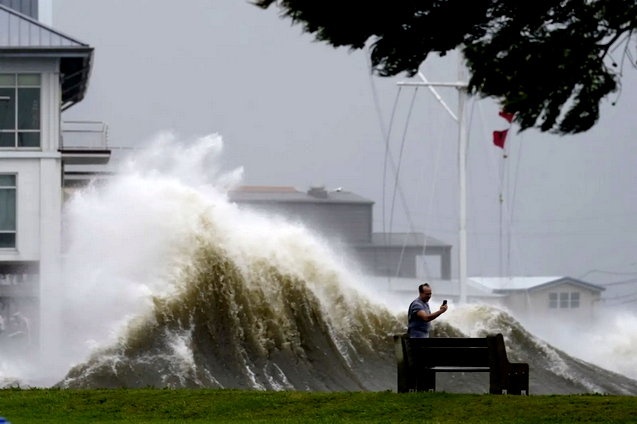
A man takes pictures of high waves along the shore of Lake Pontchartrain in Louisiana as Hurricane Ida nears. Climate change will lift sea levels everywhere, adding more heat to the oceans. Credit: AP

The research combined observations at 179 spots with climate modelling to assess more than 7200 locations around the world.

About half the world’s coastal areas will endure such extreme sea-level events “even under 1.5 degrees of warming, and often well before the end of the century”, the paper said.

“We combined different data sets across international research groups,” said Ebru Kirezci, an engineering post-doctoral student at the University of Melbourne and one of the paper’s authors.

“Governments and policymakers should do more work on protection and mitigation scenarios.”

For Australia, the areas likely to see the fastest rise of extreme sea-level events will be in the east and the south, but also areas of south-west Western Australia, Dr Kirezci said.

Such events lead to beach erosion, inundation of inland areas and other damage.

Even at 1.5°C warming, many regions will see extreme sea levels

Source: Nature Climate Change

According to the recent IPCC report, global sea levels have risen an average of about 20 centimetres between 1901 and 2018 as the warming oceans swell and more land-based ice melts into the sea.

Extreme weather
IPCC report may have underplayed risk of freak El Nino and La Nina events

The average annual rate has accelerated from 1.3 millimetres in the first seven decades of the 20th century, to 1.9 millimetres in the following 25 years to 3.7 millimetres between 2006 and 2018, the IPCC stated.

The paper found areas with relatively narrow sea-level changes now, such as in parts of the tropics that are not subject to big cyclones and the Mediterranean, will register the shift to more extremes sooner.

By contrast, some northern hemisphere coastlines will see little change even at 5 degrees of warming.

Extreme weather
‘How lucky do you feel?’: The awful risks buried in the IPCC report
John Church, a former senior CSIRO sea-level researcher now working at the University of NSW, said the paper contained “new and useful information”.

Even at 1.5 degrees, the lower end of the Paris Agreement, “we’re going to have to adapt”, Dr Church said. “It’s an important message to get out.”

Dr Church’s past work showed that in the 20th century, the risk of extreme events along the west and east coasts of Australia had roughly tripled.

“I’d guess since 2000 they have increased by another factor of three,” he said.

Global warming
What will happen to our cities (and beaches) at 3 degrees of warming?
Dr Kirezci said governments needed to prepare for the inevitable sea-level rises by considering sea walls and other barriers.

Governments should also assess which coastal communities are most at risk and consider relocating them inland, and also investigate early warning systems to improve safety.

Her next line of work has been to examine the socio-economic damage likely for populations in every country.

Sea-level increases vary around the world because of two main processes, Dr Church said.

One is a change in mass distribution, such as in Greenland where the land actually rises as its heavy ice sheets melt.

Changes in currents, such as the strengthening of the East Australian Current, also contribute to difference rates of sea-level rises, he said.

Links

31/08/2021

(AU The Guardian) David Pocock Leads 250 High-Profile Australian Athletes In Climate Campaign

The Guardian -  | 
  • The Cool Down includes Pat Cummins, Lance Franklin
  • Group writes urgent open letter to nation’s leaders
Climate advocate and former Wallabies captain David Pocock on Monday launched The Cool Down campaign. Photograph: Mick Tsikas/AAP

A who’s who of Australian sport, spearheaded by the former Wallabies captain, David Pocock, have been brought together in a new initiative that aims to use the platforms of high-profile sportsmen and women to tackle the climate crisis.

The campaign, named The Cool Down, was launched on Monday by Pocock who, after retiring from rugby union in 2020, has focused his energies on conservation and climate activism.

Josh Frydenberg admits climate change a major preoccupation in global markets. Read more
Pocock is joined by more than 250 current and former athletes who have penned an open letter to the nation’s leaders encouraging bold action be taken as extreme weather events become more frequent and “our Australian way of life, including sport at every level” is jeopardised.

The group, which includes Pat Cummins, Cate and Bronte Campbell, Lance Franklin, Rohan Browning, Darcy Vescio, Mick Fanning, Craig Foster, Ian Chappell, Liz Ellis and Mark Webber, hopes to encourage Australians to make their voices heard.

It has backed scientific calls for the country to cut greenhouse gas emissions at least in half by 2030 and reach net zero emissions before 2050.

The campaign highlights the connection between extreme weather events and sport – including how heat has impacted the Australian Open tennis tournament in recent times and how bushfire smoke has affected professional sport – and Pocock called for bold action to be taken.

“The people and places we love, as well as the sports we love so much are threatened by climate change,” Pocock said.

“We have the resources in our own backyard to be a world leader in this field and, as a sporting nation, we’re used to performing on the world stage. It’s time we harness that to focus on strong climate action.”

The latest assessment by the Intergovernmental Panel on Climate Change published earlier this month found human activities were unequivocally heating the planet and causing changes not seen for centuries and in some cases thousands of years.

The world’s leading authority on climate science found greenhouse gas emissions were already affecting weather and climate extremes in every region across the globe, helping cause increased heatwaves, heavier rainfall events and more intense droughts and tropical cyclones, the report found.

In Australia, it found average temperatures above land had already increased by about 1.4C since 1910.

The open letter, which people are invited to sign, says “sport’s future is more uncertain than ever, but its power has never been more important”.

“Australians have always punched above our weight on the world stage and it’s time to do it on climate.”

Professor Mark Howden, the director of the ANU Institute for Climate, Energy & Disaster Solutions, said any delay in addressing Australia’s poor record on emission-reduction would

“If we don’t take rapid and strong global action to reduce our greenhouse gas emissions, the world could well have passed 1.5C by the time of the Brisbane Olympics in 2032, failing to meet the lower of the two Paris Agreement temperature goals,” said Howden, who is also a vice-chair of the IPCC.

“This could come at a time when everyone’s eyes will be on Australia, focusing attention on our contributions to reduce emissions.”

No major sporting organisation in Australia includes climate change in their annual reporting and former Diamonds netball coach Ellis said the campaign was “our stake in the ground to spread this important message”.

David Pocock: 'I've got a lot more comfortable just being a bit weird and different'. Read more
“As sportspeople, we recognise the role we play in our sports-loving country and supporting the generations of athletes to come after us. We have the opportunity to take action within our field and use our platform to accelerate the change we need to see,” Ellis said.

Other sportspeople to lend their names to the campaign include current Wallabies captain Michael Hooper, AFL footballer Nat Fyfe and AFLW star Daisy Pearce, the NRL’s Nathan Cleary, golfer Karrie Webb, cricketer Rachael Haynes and Matildas duo Tameka Yallop and Alanna Kennedy.

The Australian government is facing increasing pressure to increase the 2030 emissions target it set six years ago – a 26-28% cut below 2005 – and join the more than 100 countries that have set a mid-century net zero emissions goal.

Earlier this month, Dr Jonathan Pershing, the deputy to US presidential climate envoy John Kerry, told the Guardian that Australia’s targets were “not sufficient” and the country should be considering a 50% cut in greenhouse gas emissions by 2030.

The former UN chief Ban Ki-moon said Australia was “out of step” with the rest of the world, and and the former European Union trade commissioner, Cecilia Malmström, warned it was becoming “more and more isolated” at a time when the world was increasingly being hit by floods, fires and droughts.

Links

Lethal Heating is a citizens' initiative