08/09/2021

(Anthropocene) People Don’t Know What Climate Experts Are Talking About

Anthropocene MagazineSarah DeWeerdt

Simpler language and more context could aid public understanding of climate change


Members of the public have trouble understanding words and phrases that climate scientists often use, according to a new study. The confusion affects both people who accept the reality of climate change and climate change doubters.

If climate change is to be stopped, scientists can’t just communicate amongst themselves. They also need to make their findings understood by policymakers and the general public so that we can collectively take action. This need has led the Intergovernmental Panel on Climate Change (IPCC) and other climate-science organizations to step up their efforts at science communication.

To find out if these efforts are hitting the mark, researchers conducted in-depth interviews with 20 members of the U.S. general public about key terms used in climate change communications. The group of study participants was about evenly split between the climate-concerned (those who accept the scientific consensus that climate change is mostly human-caused) and the climate-ambivalent (who hold varying views on the reality of climate change).

Each 30-40 minute interview covered 8 terms drawn from an IPCC report: tipping point, unprecedented transition, carbon neutral, carbon dioxide removal, adaptation, mitigation, sustainable development, and abrupt change.

 Participants were asked to share their interpretation of each term and rate how easy it was to understand, and to do the same with a sentence using the term. They were also invited to make suggestions for improving the language to make it clearer and more comprehensible.

Participants rated the terms mitigation, carbon neutral, and unprecedented transition as hardest to understand, the researchers report in the journal Climatic Change. The terms adaptation and abrupt change were rated easiest.

Still, both climate-concerned and climate-ambivalent participants found many of the terms unfamiliar and too technical.  And the sentences that were meant to clarify the terms were sometimes no help because they were wordy and full of jargon.

LARGE IMAGE
“Words that might be familiar to climate scientists may not be familiar to people who are not in climate science,” says lead author Wändi Bruine de Bruin, Provost Professor of Public Policy, Psychology, and Behavioral Science at the University of Southern California Sol Price School of Public Policy and Dornsife Department of Psychology.

What’s more, a closer look at the interview transcripts revealed subtle misunderstandings of many of the terms. For example, participants knew what adaptation means but not necessarily what it means in the context of climate change.

Even though mitigation was perceived as the hardest term to understand and adaptation one of the easiest, some participants conflated the two (a finding that has popped up in other studies, too).

Some people thought that “unprecedented transition” referred to extreme weather events or climate shifts, when in fact the IPCC uses the phrase to indicate sweeping changes to the economy and society that will be necessary to respond to climate change.

Participants also felt that many of the terms left out crucial details. For example, some didn’t understand how carbon neutrality is achieved, what adaptation was to, or what form of carbon various terms referred to. For carbon dioxide removal, people needed to know what carbon was being removed from and how.

The clear takeaway: “To communicate more clearly, avoid jargon,” says Bruine de Bruin. “As a rule of thumb, words of three syllables or more tend to be less widely understood and more likely to involve jargon. If you must use jargon, try to explain what it means in everyday language.”

Participants suggested that climate scientists should use simpler words when communicating with the general public, clarify the climate change context of various terms, and make the underlying processes explicit. They also made specific suggestions about how to improve or explain various terms (See table.)

Both climate-concerned and climate-ambivalent participants expressed confusion about the terms in the study, as well as being willing to suggest improvements to the language. But while the sample size is large enough to find terms that are misunderstood and how, it wasn’t designed to identify differences between the two groups, Bruine de Bruin says.

“A survey with a large sample would be needed to find out how common these misunderstandings are, and how they are related to climate change concern,” Bruine de Bruin says. Future studies could also examine whether the simpler explanations really do improve public understanding or engagement with climate change.

Links

News Corp Hasn’t Seen The Light On Climate – They’re Just Updating Their Tactics

RenewEconomy -


Have you heard the good news? One of the key institutions holding back climate action in Australia – Rupert Murdoch’s News Corporation – is suddenly on Team Climate Action!

Today, the Sydney Morning Herald revealed that the company’s Australian outlets are set to launch a campaign urging “the world’s leading economies” to embrace a target of net zero emissions by 2050; to be fronted by columnist Joe Hildebrand. The details aren’t out yet, but I contend that we can comfortably predict what it will look like.

It will be a centrist, pro-business approach to climate action. It will make a show of dismissing the “hysterics” of climate activists, while urging governments, including Australia’s, to set distant, meaningless and non-binding climate targets.

It won’t allow any room for emissions reductions in line with the 1.5C goals or the Paris agreement; no short-term meaningful targets or actions such as those highlighted in the IEA’s recent ‘net zero’ report. It won’t argue for a coal phase-out by 2030, or the end of all new coal, gas and oil mines in Australia, or a ban on combustion engine sales by 2030-2035; all vital actions if Australia is to align with any net zero target.

It’ll champion controversial technologies like CCS and fossil hydrogen. It’ll highlight personal responsibility: tree planting, recycling and electric vehicle purchases. It will not propose or argue in favour of any new policies; at least none that might reduce the burning of fossil fuels.

How can we know all this before we’ve seen the actual campaign? It’s easy – let me explain.

Done with denial

Here’s a remarkable statistic for you. In the month of August this year, global media coverage of climate saw its highest volume since the December 2009 Copenhagen climate meetings. That’s partly down to the release of the IPCC’s AR6 Working Group one report into climate change, six years in the making.

That report reiterated something extremely important: every single tonne of carbon dioxide does damage. Actions must be immediate and aggressive to align with the most ambitious pathways. Delay is deadly.

No media coverage records for Australia: coverage of climate change has dropped almost entirely off the radar relative to the high volumes of late 2019 and early 2020 (partly driven by the Black Summer bushfires).

These figures track newspaper coverage of climate change or global warming in 5 Australian newspapers (Sydney Morning Herald, Courier Mail & Sunday Mail, The Australian, Daily Telegraph & Sunday Telegraph, and The Age). Updated through August 2021.

During the Black summer bushfires of 2019-20, I did a few interviews about Australia with baffled and perplexed international reporters. “What is going on over there? Why did the people elect such a climate laggard?”.

A key part of my response was to pin blame on Australia’s media industry. Mostly on News Corp, which dominates the country’s uniquely concentrated media landscape, and which is notorious for its heavily politicised climate views. In fact, a recent study quantified this in historical terms, analysing media coverage within Canada, New Zealand, the United Kingdom, the United States and Australia for its climate science accuracy.

By a comfortable margin, News Corp’s Daily Telegraph and the Courier Mail scored the second and fourth worst among every media outlet analysed between 2005 and 2019 (The Australian wasn’t included in the analysis).

Australia has, in general, seen the least accurate climate science coverage from 2013 onwards, despite a general rising trend in scientific accuracy over the past decade. For a decade and a half, News Corp lied about climate science with the blatant aim of protecting the revenue streams of the fossil fuel industry, and protecting its political allies.


This is important as a historical study, but today, it’s increasingly irrelevant. As the study points out, the accuracy of climate science has essentially plateaued in media coverage, with outright denial consigned to the dustbin.

The authors highlights that “the terrain of climate debates has shifted in recent years away from strict denial of the scientific consensus on human causes of climate change toward ‘discourses of delay’ that focus on undermining support for specific policies meant to address climate change”. The fundamental goal is the same – staving off action – but the way it manifests is very different.

Delay is the main game

There are many substantial recent examples of this. A good one was the severe blackouts that spread across Texas in February this year, which were immediately blamed on wind power failures, alongside easily debunked claims that snows and ice were blocking solar panels and freezing up wind turbines in Texas and around the world.

This isn’t climate change denial: it’s “mitigation denial“. That is, a move away from denying the problem exists and towards decrying its solutions as utterly unacceptable. An important part of this performance is pretending to have a moment of having seen the light, but then continuing to commit the same acts of delay as before.

Murdoch’s The Sun, in the UK, did precisely this. In October 2020, The Sun launched a ‘Green Team‘ campaign that focused on ‘individual responsibility’ in the lead-up to COP26, to be held in Glasgow at the end of this year. It wasn’t long until they were celebrating their own victory in freezing fossil fuel taxes. The UK’s Daily Express, another hyper-conservative outlet that ‘saw the light’, continues to publish articles attacking climate activism and, more significantly, framing climate action in an explicitly “eco nationalist” way, as UK writer Sam Knights highlights in this article in Novara media. He says,
“Make no mistake: these newspapers are not your friends. They are not your allies. Their politics are not in any way ecological. They are deeply racist, reactionary, right-wing publications. Their sudden interest in climate change is not to be celebrated – it is a terrifying indication of things to come.”
It’s notable that these examples seem to manifest in the UK, and less so in similar anglophone countries like Canada or the US or New Zealand. Those are led by centre-left parties and politicians, but the UK’s conservative embrace of climate action is surely a model that Australia’s PM Scott Morrison pines to replicate.

Sure, the UK certainly is miles ahead of Australia in terms of climate action – but there remains a very significant gap between Boris Johnson’s climate policies and where the country actually needs to be to align with the carbon budget that its independent climate advisor body has laid out.

A technocratic, rich white country with a government more concerned with optics than doing what needs to be done to protect people from being hurt by fossil fuels. Morrison’s obviously inspired by the UK, but Australia’s conservative media outlets are increasingly inspired, too.

Net zero by sometime after I retire, please

This is all coming to a head at COP26. George Brandis, Australia’s attorney general, who once declared that “coal is very good for humanity indeed”, is now High Commissioner for Australia to the UK, and has significantly ramped up the broader greenwashing exercise that the government has been enacting over the latter half of last year and most of this one.

As I wrote in RenewEconomy, that means creative accounting, dodgy charts and deceptive framing, all designed to paper over Australia’s significant failure to reign in emissions.

Morrison will almost certainly set a net zero by 2050 target before COP26, but it’ll be packaged with a collection of loop holes that allow for rising emissions in the short term. It is dawning on the government just as it is dawning on News Corp: the best way to protect the fossil fuel industry today is not to deny the science, but to pretend to accept it. This is not the end of climate denial. It’s evolution from a common ancestor.

That this effort will be lead by Joe Hildebrand is telling enough. His previous work on climate change does exactly what a centre-right campaign like this would be best at – decrying both sides as ‘hysterical’ while failing to propose anything meaningful or substantial. We can also see hints of what a conservative climate message looks like in a previous editorial from the more progressive News Corp outlet, NT News, which – of course – continues to host syndicated climate denial from the Sky News Australia channel. Ditto for News dot com. What might reasonably seem like a surprising change of heart in News Corp’s stance on climate is actually a long-term tactical shift that has been occurring for at least a few years. Whatever policies they failed to destroy through their earlier campaigns, they will try and reframe through racist, nationalistic, technocratic and pro-business frames.

Whatever policies they can delay or destroy, they’ll simply keep running scare campaigns about, insisting that ‘the balance isn’t right’, and that the threat of climate action is greater than the threat of climate change, as they always have (in Australia, News Corp’s partnerships with Google and Facebook mean these campaigns to destabilise climate action are growing more powerful and more harmful every day).

When the next federal election comes around, the “COSTS OF NET ZERO” scare campaigns will ramp up in Australia as they are in the UK, and News Corp will be at the forefront, pleading that acting too fast will cause catastrophe. Absolutely mark my damn words: this is what will happen.

Net zero by 2050 isn’t enough. We’ll know that the denialism has truly ended when organisations like News Corp treat the IPCC’s latest report like it’s real. That is, when they acknowledge that every additional unit of greenhouse gases causes harm to life on Earth, and that actions to stop their release must be as fast as possible.

That climate change is an emergency that requires rapid action to wind down the fossil fuel industry in a just and equitable way, and that its replacement must be grown to full size with just as much passion and urgency.

This campaign won’t look anything like that. We know what it will look like – and it won’t be anything surprising at all.

Links

(AU Crikey) News Corp’s Net Zero By 2050 Push Is What Climate Change Denial Looks Like In 2021

Crikey -

It sounds so very environmentally caring and sharing. But the truth is the Murdoch media's campaign is a cynical, and useless, move.

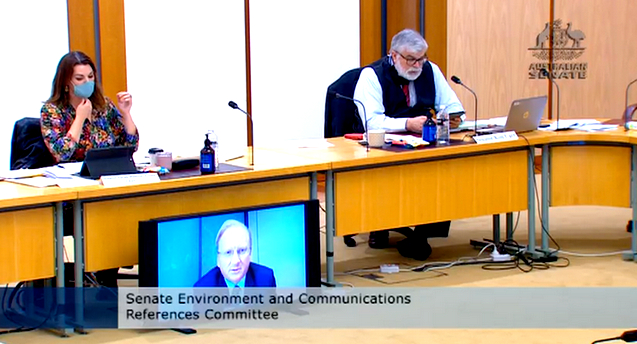
News Corp's Sky News Australia CEO Paul Whittaker appearing at a Senate hearing into media diversity

Less than a month ago, the world’s leading climate scientists issued a stark warning: the world is hurtling towards a future where increasingly common and severe fires, droughts and floods threaten our existence.

Our only option to reverse the trajectory, the IPCC sixth assessment report’s authors wrote, was to take drastic climate action.

Viewed through that lens, News Corp’s promise to briefly campaign for an unambitious target of net zero emissions by 2050 is a commitment to lock the world into 1.5 degrees of warming and all the horrors that would entail.

Far from being a shift from the company’s traditional opposition to climate action, this campaign is further proof that Rupert Murdoch’s empire doesn’t believe the science about the world’s transformation — or doesn’t care.

On Monday morning, Nine papers reported that News Corp’s metro papers and news channel Sky News Australia would launch a “company-wide campaign promoting the benefits of a carbon-neutral economy as world leaders prepare for a critical climate summit in Glasgow later this year”.

The target, even if taken up, would leave the federal government lagging behind the US and UK and drag it in line with many banks, insurers and other companies.

News Corp stays silent on James Murdoch’s climate denialism claims. Read More

This report comes as a Senate inquiry into media diversity holds a hearing on Sky News Australia’s suspension from YouTube.

The details of the campaign show it is even smaller than it first appears.

News Corp papers and Sky will campaign for two weeks in October. The Australian will be excluded from the campaign, and “dissenting voices” — a euphemism for the staunchest climate change denialists who inhabit many of its top perches — will be expected to “reframe” their arguments.

(It remains to be seen how figures such as Rowan Dean will reframe their complete denial of man-made climate change.)

Sky’s participation will be limited to a documentary exploring the idea of net zero carbon emissions.

The choice of Joe Hildebrand as the face of the campaign provides some insight into the direction of the campaign, says writer and consultant Ketan Joshi.

“His previous work on climate change does exactly what a centre-right campaign like this would be best at: decrying both sides as ‘hysterical’ while failing to propose anything meaningful or substantial,” he wrote in RenewEconomy.

During the bushfires of December 2019, the News Corp columnist warned against discussing climate change in the midst of a climate emergency.

While Australians were fleeing for their lives, Hildebrand argued that they shouldn’t have to concede much to battle climate change: “We need to find an economic path for Australia that can give working people the same quality of life — or just the capacity to survive day to day — that our abundance of fossil fuels currently offers.”

The announcement also makes clear that when it comes to climate change News Corp continues to act as more of a player than an impartial observer.

Nine’s Zoe Samios and Rob Harris report that its management briefed the government about the campaign, much like how a government would usually brief a publication about its campaign. In the inquiry hearing on Monday morning, Sky News’ CEO Paul Whittaker defiantly claimed that News Corp accepts the science: “We don’t deny climate change. The question is what is the solution, and what is the cost?”

The world’s top experts say the solution is immediate action — and the cost is less than the cost of inaction. Anything less — like News Corp’s campaign — is denying the science of how our climate is changing for the worse.

Links

More Than 200 Medical Journals Call For Urgent Action On Climate Change

France 24 - AFP

The authors say better air quality alone would benefit health so much that the global costs of emissions reductions would easily be offset. © Arun Sankar, AFP/File 

Global warming is already affecting people's health so much that emergency action on climate change cannot be put on hold while the world deals with the Covid-19 pandemic, medical journals across the globe warned on Monday.

"Health is already being harmed by global temperature increases and the destruction of the natural world," read an editorial published in more than 220 leading journals ahead of the Cop26 climate summit in November.

Since the pre-industrial era, temperatures have risen around 1.1 degrees Celsius (34 degrees Fahrenheit).

The editorial, written by the editors-in-chief of over a dozen journals including the Lancet, the East African Medical Journal, Brazil's Revista de Saude Publica and the International Nursing Review, said this had caused a plethora of health problems.

"In the past 20 years, heat-related mortality among people older than 65 years has increased by more than 50 percent," it read.

"Higher temperatures have brought increased dehydration and renal function loss, dermatological malignancies, tropical infections, adverse mental health outcomes, pregnancy complications, allergies, and cardiovascular and pulmonary morbidity and mortality."

It also pointed to the decline in agricultural production, "hampering efforts to reduce undernutrition."

These effects, which hit those most vulnerable like minorities, children and poorer communities hardest, are just the beginning, it warned.

As things stand, global warming could reach +1.5C on pre-industrial levels around 2030, according to the UN's Intergovernmental Panel on Climate Change.

And that, along with the continued loss of biodiversity, "risk catastrophic harm to health that will be impossible to reverse," the editorial warned.

"Despite the world's necessary preoccupation with Covid-19, we cannot wait for the pandemic to pass to rapidly reduce emissions."

In a statement ahead of the publication of the editorial, World Health Organization chief Tedros Adhanom Ghebreyesus said: "The risks posed by climate change could dwarf those of any single disease."

"The Covid-19 pandemic will end, but there is no vaccine for the climate crisis.

"Every action taken to limit emissions and warming brings us closer to a healthier and safer future."

The editorial pointed out that many governments met the threat of Covid-19 with "unprecedented funding" and called for "a similar emergency response" to the environmental crisis, highlighting the benefits.

"Better air quality alone would realise health benefits that easily offset the global costs of emissions reductions," it read.

The authors also said "governments must make fundamental changes to how our societies and economies are organised and how we live."

Links

07/09/2021

(AU The Conversation) Climate Change Means Australia May Have To Abandon Much Of Its Farming

The Conversation | 

A dust storm engulfs a farm in Forbes, NSW. This image won the National Photographic Portrait Prize for 2021. Joel B. Pratley/National Portrait Gallery,

Authors
  • Andrew Wait is a Professor in the School of Economics at the University of Sydney. He has a PhD from the Australian National University and a Bachelor of Economics (Honours) from the University of Adelaide.
  • Kieron Meagher is a Professor, Research School of Economics, Australian National University. He has an MA (Hons.) in pure mathematics from Waikato University and a PhD in Economics from the Australian National University.
The findings of the Intergovernmental Panel on Climate Change suggest Australia may have to jettison tracts of the bush unless there is a massive investment in climate-change adaptation and planning.

The potential impacts of climate change on employment and the livability of the regions have not been adequately considered.

Even if emissions are curtailed, Australia likely faces billions of dollars of adaptation costs for rural communities.

As the IPCC’s Sixth Assessment Report (published last month) makes clear, the climate will change regardless of any mitigation actions taken now.

Even under its modest conservative projections, worldwide temperatures will rise by 1.5℃.

That may not sound like much, but it will double the frequency of droughts — from once every 10 years to once every five.

Worse still, a 2℃ temperature rise — also a likely outcome without substantial emission reductions — will make droughts 2.5 times more frequent.

Farm profits are falling

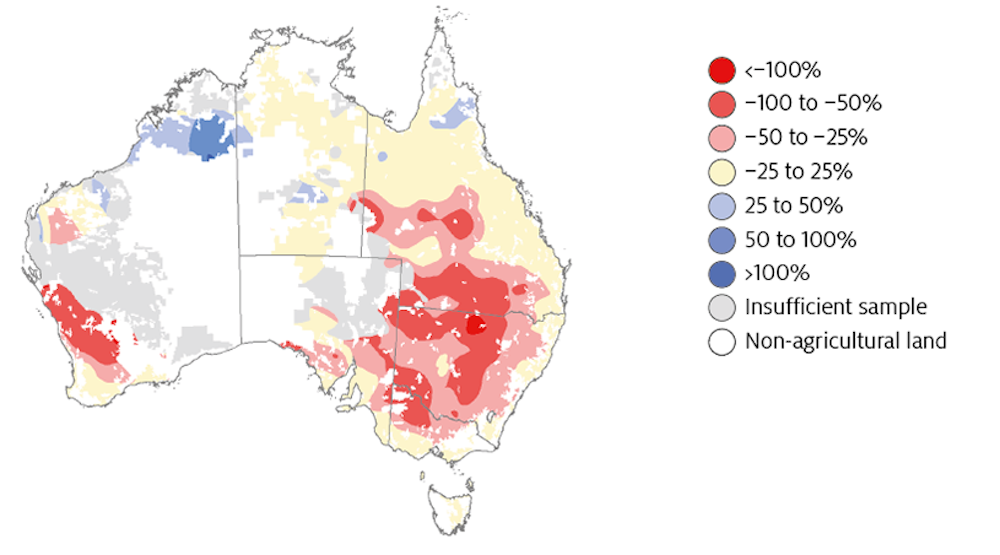
Climate change is already hurting Australian farmers. Compared with historical averages, agricultural profits have fallen 23% over the 20 years to 2020. This trend will continue.

The Australian Bureau of Agricultural and Resource Economics and Sciences (ABARES) predicts a likely scenario is that overall farm profit will fall by 13% by 2050. There will be significant differences between regions. Cropping profits in Western Australia, for example, are predicted to drop 32%.

Effect of 2001-2020 seasonal conditions on farm profit
ABARES

With higher emissions, the reductions will be worse. Estimates of the fall in farm profits range from 11% to 50%.

These changes go beyond the cycles of weather with which Australian farmers have always had to cope. Inconsistent water supplies, increased natural disasters and greater production risks will render agricultural production in many areas uneconomic.

Due to these climatic changes agricultural assets, both land and infrastructure, could become virtually worthless – so-called stranded assets.

No future without water

Vibrant regional communities aren’t just about farms. They are interdependent networks of businesses, towns, public infrastructure and people.

The effect of falls in farm income will ripple throughout these communities. Lower output will mean fewer jobs. If farms close, so will other regional businesses, leading to more stranded assets. Those affected could face displacement along with an inability to sell their homes and businesses.

And of course these communities can’t survive without water.

A water canal between Pooncarie and Menindee in western New South Wales in February 2019. At the time more than 98% of New South Wales was in drought. Dean Lewins/AAP

So far development planning in Australia has not adequately considered the potential impacts of the climate on livability, especially in rural communities. This failure to account for climate change exacerbates the potential for stranded assets.

For example, the NSW Auditor General reported in September 2020 that the state government had “not effectively supported or overseen town water infrastructure planning in regional NSW since at least 2014”. This contributed during the intense drought of 2019 to at least ten regional NSW cities or towns coming close to “zero” water.

Population pressures

In some areas these water problems are being compounded by population growth.

Consider, for instance, the NSW townships surrounding Canberra. In January 2020 the town of Braidwood (about halfway between Canberra and Batemans Bay) had to start trucking in water when its own water source, the Shoalhaven river, stopped flowing. Yet nearby Bungedore (about 50 km away) is building a new high school due to population growth.

Farmer Ian Cargill stands in a middle of a dam on his property near Braidwood, NSW, in August 2018. At the time 100% of the state was drought-affected. Lukas Coch/AAP

This “tree-change” trend, with people leaving cities in search of a better lifestyle and more affordable housing, is widespread. It appears to have been amplified by the COVID-19 pandemic, with figures showing net internal migration of people out of Sydney and Melbourne.

More investment in adaptation needed

There is an urgent need for a comprehensive assessment by all levels of government of risks to livelihoods in agriculture and regional communities, and of the default risk on stranded assets.

Budget projections need to account for climate-change adaptation and economic structural change.

In last year’s budget the federal government committed to investing A$20 billion “to ensure Australia is leading the way in the adoption of new low-emissions technologies while supporting jobs and strengthening our economy”.

As important as this is, we must start planning and spending on adaptation.

The A$1.2 billion over five years the federal budget allocated for natural disasters is just the beginning. In some regions changed farming practices, subsidised insurance and investment in water infrastructure may be enough. But proper infrastructure takes many years to plan, and to build.

Some areas are going to become unviable. We will need deal with the loss of entire communities, and internal climate refugees.

It is time to start budgeting for the costs of living with climate change, not just the costs of cutting emissions.

Links

(AU SMH) Top UN Official Calls For Australia To Urgently Dump Coal

Sydney Morning HeraldNick O'Malley

The United Nations’ top climate official has urged Australia to have a “more honest and rational conversation” about urgently abandoning coal power, which he said was in the nation’s and the world’s best interests.

Selwin Hart, UN Assistant Secretary-General and Special Adviser to the Secretary-General on Climate Action, said wealthy nations must stop using coal power by 2030 and the rest of the world must dump it by 2040 if the world is to keep global warming to within the agreed target of 1.5 degrees Celsius.

Poland’s Belchatow plant is the world’s largest lignite coal-fired power station. Credit: Getty

“Market forces alone show coal’s days are numbered, as many investors increasingly abandon it in favour of renewables, which are now cheaper in most places,” said Mr Hart during a speech recorded for an Australian National University leadership forum.

“We fully understand the role that coal and other fossil fuels have played in Australia’s economy, even if mining accounts for a small fraction - around 2 per cent - of overall jobs.

“But it’s essential to have a broader, more honest and rational conversation about what is in Australia’s interests because the bottom line is clear.

“If the world does not rapidly phase out coal, climate change will wreak havoc right across the Australian economy: from agriculture to tourism, and right across the services sector,” he said.

Climate policy
Political forces back independent candidates in climate change power bid
Mr Hart also called on Australia to increase its 2030 greenhouse gas emissions reduction target from the current commitment of 26 to 28 per cent, saying collectively the world must reduce emissions by 45 per cent by the end of the decade if we are to hold warming to 1.5 degrees.

And he called on Australia to adopt a net zero target by 2050, noting that all Australian states and territories had already done so, as well as Australia’s island nation neighbours, along with nations representing 73 per cent of the world’s economy.

The federal government has said its preference is to reach net zero before 2050, but it has not made a formal commitment to reaching the target.

Coal
How Germany closed its coal industry without sacking a single miner
Mr Hart’s speech comes as high-level calls to end the world’s thermal coal industry intensify in the lead up to the COP26 climate talks in Glasgow in November, and are likely to be raised during the United Nations General Assembly later this month.

Alok Sharma, the Conservative United Kingdom cabinet minister who is to be the formal host of COP26 has spent much of his time in recent months travelling the world in a diplomatic push to have countries agree to a timeline to end coal use.

“If we are serious about 1.5°C, Glasgow must be the COP that consigns coal to history … we are working directly with governments, and through international organisations to end international coal financing,” he said in a speech in May.

“The days of coal providing the cheapest form of power are in the past. And in the past they must remain … The coal business is going up in smoke. It’s old technology. So let’s make COP26 the moment we leave it in the past where it belongs.”

In his speech for the ANU Mr Hart said the nation faced increased droughts, heatwaves, fires and floods, while Pacific island nations could be “wiped from the map” by climate change.

“Mass relocations of entire national populations would be among the catastrophic results.”

A spokeswoman for Energy and Emissions Reduction Minister Angus Taylor said that Mr Hart was, “right to point out that action and achievement this decade matter more than future aspirations and ambition.”

“Australia has a strong 2030 target and a clear plan to meet and beat it.

“By contrast, Labor have no 2030 target and no plan to achieve their 2050 aspiration.”

A spokesman for the Energy Council of Australia said the group was on record as supporting net zero by 2050.

Future Power
What's a 'just transition' and can you switch to green energy without sacking coal workers?
The chief executive of the Minerals Council of Australia, Tania Constable, said its members supported the Paris Agreement and the transition to a net zero economy, and were accelerating exploration for metals and minerals needed for new zero emission technologies.

“Mining directly employs 256,000 – triple the number 20 years ago – and the mining and METS [mining, equipment, technology and related services] sector directly employs 480,000 people, indirectly employs 650,000 through purchases from other sectors, and in total supports 1.1 million jobs, or 10.8 per cent of national employment,” she said.

Links

Ghostly Satellite Image Captures The Arctic ‘Losing Its Soul’

Atlas ObscuraGemma Tarlach

In the aftermath of an extreme melt event, what do scientists see in the Greenland Ice Sheet’s swirls of white, blue, and ominous gray? 

In a satellite image of the Greenland Ice Sheet's southwestern corner, captured on August 21, 2021, pale blue meltwater streams across ice or collects in slushy depressions. The deeper blue areas are meltwater lakes with depths up to about 30 feet. European Union, Copernicus Sentinel-2 imagery

“We started hearing a noise, like breaking, or coins falling,” says Marco Tedesco, a climate scientist at Columbia University’s Lamont-Doherty Earth Observatory.

He makes a loud, sustained crunching sound, recreating what he and his team heard, years earlier, while doing fieldwork on the Greenland Ice Sheet.

Below the surface of the ice near where they were standing, a flood had begun. “The water below starts to move but you still have snow on top,” Tedesco says of the phenomenon. As the flowing water gains momentum, overlying snow and ice give way and reveal a meltwater stream or river.

What Tedesco describes is a small-scale seasonal melt event, one of many that occur every summer at the lower-elevation edges of the Greenland Ice Sheet, an expanse of more than 650,000 square miles that’s second only to the Antarctic Ice Sheet in size. This year, however, things were different.

Following a mid-August heatwave that led to the first-ever recorded rainfall at Summit Camp, at the ice sheet’s highest point, torrents of meltwater streamed across its surface. Climatologists recorded daily melt rates seven times higher than normal.

In the satellite image above of the southwestern corner of the ice sheet, captured on August 21, pale blue water carves extensive channels around islands of bright white ice, or collects in slushy depressions. The left side of the image is darker and, like storm clouds on the horizon, it’s a warning of what’s to come.

The Greenland Ice Sheet, like the rest of the Arctic, is trapped in a feedback loop caused by climate change: As more ice melts, it creates conditions for even faster, more extreme melt events.
“Summer melt is getting bigger and bigger and bigger.”
“The Arctic is losing its soul,” says Mark Serreze, director of the National Snow and Ice Data Center. “The Arctic in so many ways is defined by its snow and ice, in all its forms.”

He adds that, while meltwater runoff at lower elevations is a natural process that has been happening each summer for millennia, “what the image really conveys is how that process of summer melt is getting bigger and bigger and bigger.”

University of Lincoln climate scientist Edward Hanna says the “quite dramatic” surface meltwater shown in the image is a scene that’s likely to be repeated because “Greenland is breaching a crucial tipping point driven by human-induced climate change.”

For Serreze, who has been studying the Arctic since 1982, the dramatic events in Greenland aren’t a surprise. “We have long known the Arctic would be the place raising the red flags first, and that’s exactly what has happened,” he says.

But it’s still a shock. “To see a rain event at the top of the Greenland Ice Sheet?” He shakes his head in disbelief.

Each summer, meltwater around the edges of the ice sheet carves channels as it travels to the sea, as shown in this 2017 image. The process has been accelerating for decades. Martin Zwick/REDA&CO/Universal Images Group via Getty Images

Tedesco, author of The Hidden Life of Ice: Dispatches from a Disappearing World, sees something else in both the Summit Camp rain event and the stunning satellite image taken the following week: opportunity.

“To me, it’s really important that we had an unprecedented rain event, to show that these things can happen,” says Tedesco. The Summit Camp rain may help bring wider recognition of something he and his colleagues have known for years.

“These events are strongly connected to the changes we’re imposing on the planet,” says Tedesco, calling Earth “a thermodynamic system so delicate, but powerful.”

Thanks to the satellite image’s “fantastic” quality, Tedesco says, “you can really see the story that’s going on here,” including extensive meltwater ponding on the right side that’s “very likely slush.”

Researchers working on the Greenland Ice Sheet have observed meltwater streams and even rivers forming along its lower-elevation edges in summer months, though the intensity of the activity is increasing. Joe Raedle/Getty Images

The left side of the satellite image, Tedesco says, sits close to Greenland’s western coast, and is colored by rock, dust, and other particles deposited by wind, as well as bacteria and other microorganisms. Its darker color accelerates melting because of a phenomenon known as ice-albedo feedback.

“Albedo is a fancy word for how reflective the surface is,” says Serreze. As highly reflective snow and ice melt, the darker surface exposed—rock, open water, or older ice, depending on the location—absorbs more of the sun’s energy and spurs even more intense melting.

“We’re seeing this across the Arctic as we’re losing the sea ice cover and we’re losing the snow cover,” he says.

The vast Greenland Ice Sheet is second only to Antarctica’s in size, and is experiencing unprecedented stress. Photo by Mario Tama/Getty Images

There’s an unexpected wrinkle revealed in the darker portion of the satellite image, however. Tedesco has studied this particular part of the ice sheet; because of the underlying topography and other factors, he and many colleagues believe that at least some of the material staining the ice was originally deposited elsewhere on the sheet, long ago.

“People think this stuff could have been buried in the ice in other places and, with the flow of the ice and increased melting, it’s now exposed,” he says, noting the idea remains largely unstudied. For him, the possibility of ancient material returning to the surface is poignant.

“This image is basically a time machine,” he says, studying the swirls and ripples of white, blue, and gray on his computer monitor with a pensive expression.

“You have, on the right, the future: a patchy, wet, slushy ice sheet. You have in the middle the present, which is basically your ice now, frozen. And you have a very deep past on the left, which is also driving the future because, of course, the darker it is, the more it absorbs sunlight and the faster it melts.”

Links

Lethal Heating is a citizens' initiative