Vox
- Umair Irfan
These five climate scenarios show us what the future of the planet could
look like.

|
Extreme heat and dry weather created the conditions for massive
wildfires around the world, like the blazes that torched Greece in
August. STR/NurPhoto via Getty Images
|
How bad could climate change get?
Humans have already warmed the planet by at least 1 degree Celsius by burning
fossil fuels that spew heat-trapping gases into the sky.
The oceans are rising, and deadly disasters like wildfires, heat waves, and
flooding are becoming more destructive. Almost every part of the world is
experiencing
the effects of climate change.
That much is “unequivocal,” according to the
latest report
from the Intergovernmental Panel on Climate Change (IPCC), an international team
of scientists convened by the United Nations.
What’s far less certain is just how bleak the future of our planet will be.
This critical question reaches beyond physical sciences into economics,
sociology, and even psychology. Humans still have the power to slow the climate
crisis — though with each day that goes by without sweeping societal changes to
slash emissions, the outlook grows more grim.
The first installment of the
IPCC’s sixth assessment report, which focuses on the physical science behind climate change, considers five
scenarios that game out how humanity will respond, or not, to the specter of
warming.
They reveal that some of the more extreme projections of the past are less
likely to come to fruition. But every scenario in the report also overshoots one
of the targets of the 2015 Paris climate agreement.
A best-case scenario now requires drastically more climate action than the world
has achieved to date, and the window for action is closing.
However, “Scenarios are not predictions,” the report says. “Instead, they
provide a ‘what-if’ investigation of the implications of various developments
and actions.”
In short, these scenarios show how scientists are grappling with the
capriciousness of human behavior. What happens if more countries are taken over
by nationalists? Or if clean technology makes a radical leap forward? Or if
countries and corporations actually start to buckle down and throttle emissions?
Our planet has many possible futures that depend on human decisions. These
visions of tomorrow emphasize that we have profoundly and irreversibly changed
the world, but also that much of the potential warming is still in our hands.
Five stories about the future of our climate, explained Read
between the many lines of the nearly 4,000-page IPCC report and you will see
that it actually tells five different stories about the future, complete with
their own little narratives.
Here’s the backdrop for these stories: The planet is undergoing a massive,
uncontrolled experiment, rapidly revealing what happens when 2.6 million pounds
of carbon dioxide per second (and still rising) are added to the atmosphere. All
of humanity is participating in this experiment, whether directly contributing
to it or feeling its impacts.
But it’s an immensely frustrating experiment because the subjects (all of us)
are constantly messing with the controls. How much more Earth will warm up in
the coming century hinges on what people will do. And what people are doing is
changing.
It’s increasingly clear that many of the factors that helped bring the world to
the current point will not persist into the future — unchecked population
growth, a massive surge in coal mining, too few clean energy options.
With the 2015 Paris climate agreement, countries agreed in principle to limit
warming this century to less than 2°C, with an additional target of staying
below 1.5°C. These goalposts didn’t exist when the IPCC put out its last
comprehensive report in 2013.
And with improvements in measurement, simulations, and studies of the historical
climate, researchers have a much better grasp of
climate sensitivity
— the range of expected warming if carbon dioxide levels in the atmosphere were
to double, compared to their levels in the 19th century.
For decades, the best estimate for climate sensitivity ranged between 1.5°C and
4.5°C. Now scientists set the range between 2.5°C and 4°C, with 3°C as the most
likely value.
After honing down how the planet will respond to carbon dioxide, the next step
is to figure out how much carbon dioxide will be emitted. To do this, scientists
have imagined how humanity will progress from here on out.
They’ve considered population growth, advances in clean energy, and an
observer effect, in
which alarming climate science spurs action to limit greenhouse gas emissions.
Their five stories are known as shared socioeconomic pathways
(SSPs), each of which makes different assumptions about shifts in policy,
economics, and technology.
Here are the scenarios in the latest report:
1) SSP1-1.9 — This scenario has been described as “
taking the green road.” It’s the most ambitious and hardest-to-achieve storyline.
It envisions a gradual but concerted shift toward clean energy, with few
political barriers in adapting to and mitigating climate change.
This entails a rapid drawdown of fossil fuels, widespread deployment of clean
energy, increasing energy efficiency, and lower resource demands. By the middle
of the century, humanity will zero out its contributions to climate change.
This scenario also assumes inclusive global development that lifts all
countries. It imagines improvements in education and health that would help
stabilize population growth, with the total declining slightly to 7 billion
people.
To create this future, humans would likely need to achieve a
global philosophical shift away from the pursuit of economic growth and toward
improvements in human well-being.
While every scenario in the new IPCC report will likely overshoot the 1.5°C
target, under SSP1-1.9, global average temperatures would eventually decline
below this level by 2100.
It’s also worth noting that 1.5°C of
warming is no picnic; that’s still warmer than the world is today, leading to
effects like increasing the frequency and intensity of heat waves and extreme
rainfall.

|
Global surface temperatures vary widely under different
emissions pathways. IPCC
|
2) SSP1-2.6 — This pathway envisions that the world will
eventually get its act together on climate change, but more slowly than in the
optimistic path of SSP1-1.9.
It envisions an economy with net-zero emissions after 2050. SSP1-2.6 also
expects the global population to reach 7 billion people. The result is a world
that will warm up to 1.8°C, with a likely range between 1.3°C and 2.4°C by 2100.
It may not seem like much, but this increase in warming compared to SSP1-1.9 has
major ripple effects.
Sea levels will have risen between 30 and 54 centimeters by the end of the
century, up from the
24 cm of rise
that has already occurred. That would inundate major coastal metropolises on a
regular basis and put another 10 million people around the world at risk from
coastal flooding.
A world with 2°C of warming would double the number of people exposed to extreme
heat compared to a 1.5°C scenario. And every additional bit of warming would
bring more environmental declines and exposure to climate hazards.
3) SSP2-4.5 — Sometimes described as “middle of the road,” this
scenario lines up with what countries have pledged to do so far about climate
change.
If every country actually fulfilled its existing obligations, their emissions
would lead to about 2.7°C of warming by 2100, with a likely range between 2.1°C
and 3.5°C.
Under this scenario, the Arctic Ocean would likely be ice-free in the summer,
which could have ripple effects on weather all over the world.
On top of the devastating effects in the first two scenarios, scientists expect
that
3°C of warming
would cause a significant drop in global food production, far more extreme heat,
and more devastating flooding from extreme rainfall.
This storyline
presumes that future global development patterns
will not radically shift from historical trends. Inequalities will still persist
between countries and development will be slow, but there will be international
cooperation on environmental goals. The global population in this scenario would
peak at 9.6 billion people.
4) SSP3-7.0 — In this narrative, nationalism is resurgent and
countries retreat from international cooperation, focusing instead on their own
economic goals.
“I sort of jokingly refer to this as Trumpworld,” said
Zeke Hausfather, director of climate and energy at the Breakthrough Institute and a
contributing author to the latest IPCC report.
“It’s a reasonable storyline for what a worst-case world could look like.”
This would lead to countries exploiting their own fossil fuels resources more.
Investments in education and technological development would
decline.
Population growth would slow in industrialized countries
but remain high in developing countries, with the total reaching 12.6 billion
people.
Solving climate change would become a low international
priority.
SSP3-7.0 also accounts for high levels of heat-trapping gases, other than carbon
dioxide, including aerosols and methane.
By the end of the century,
sea levels will have risen catastrophically — between 46 cm and 74 cm in this
scenario — and the world will have warmed by roughly 3.6°C, with a range between
2.8°C and 4.6°C.
Fortunately, this scenario is on the fringes of what’s plausible, scientists
say. “That’s not the world we’re heading toward right now, but it’s certainly a
world you could see happening,” Hausfather said.
5) SSP5-8.5 — Imagine a world where humanity doesn’t just do
nothing about climate change but continues to make it worse.
This scenario envisions global economic growth across the board fueled by
burning coal, oil, and natural gas, with the planet’s population leveling off at
7 billion people.
While resources are devoted to adapting to climate change, there is little
effort to mitigate emissions.
The net result would be 4.4°C of warming, with a range between 3.3°C and 5.7°C.
As if large-scale coastal inundation and extremely destructive weather weren’t
enough, parts of the planet would become unlivable during the hottest times of
the year.
This odd combination of assumptions and results makes this the most dire but one
of the least plausible scenarios. However, it helps scientists probe the upper
limits of their models.
Why the IPCC decided on these particular storylines
The five
SSPs in the new IPCC report are sorted based on the level of “radiative forcing”
— how much energy the atmosphere would trap by the end of the century, in watts
per square meter.
So the SSP1-1.9 pathway is expected to cause 1.9 watts per square meter of
radiative forcing by 2100. Radiative forcing is directly related to how much the
planet will heat up on average.
These scenarios were developed in the wake of the 2015 Paris climate agreement.
That’s when nearly every country in the world agreed to limit warming this
century to less than 2°C above pre-industrial levels, with a high-bar target of
keeping warming below 1.5°C.
SSPs consider what humans need to do to
meet those goals — and they also account for changes in technology, like rapidly
falling prices of renewable energy, which hadn’t yet occurred when the IPCC
published its last assessment report in 2013.
The low-end scenarios are meant to illustrate what would happen if the world
actually did meet its climate objectives.
Climate models then digest the assumptions in each of these scenarios to yield
estimates of how the climate will change under each one.
It’s important to remember that these scenarios are not exact forecasts of the
future.
The scientists who created them are not making judgments about which ones are
most likely to come to pass.
“We do not consider the degree of realism of any one scenario,” said
Amanda Maycock, an associate professor of climate dynamics at the University of Leeds and an
author of the future climate scenarios chapter, in an email.
SSPs are meant to illustrate the mechanisms of climate change, factoring in
human decisions that will determine the scale of the problem.
How should people plan for the future under climate change? In all of these potential futures, climate change will continue for
years to come. Decades of past pollution, and our ongoing reliance on fossil
fuels, are already baked in.
“If we would bring down our CO2 emissions to zero today, there would be no
further warming from CO2 — but of course that is impossible,” said
Joeri Rogelj, director
of research at the Grantham Institute at Imperial College London and an IPCC
author.
Even the most aggressive climate action would lead to a phase-out over time, not
a sudden end to emissions. “There is only that steep a pathway we can follow
until we get to zero emissions,” he added.
But humans still have the power to determine the longer-term path. Right now,
the world is somewhere between scenario 3 (SSP2-4.5) and scenario 4 (SSP3-7.0).
“The five illustrative scenarios behave quite similarly over the next 20 years
(2021-2040) with average global temperature anomalies differing by less than
one-tenth of a degree,” said Maycock. “By mid-century (2041-2060) the scenarios
start to diverge more strongly.”
|
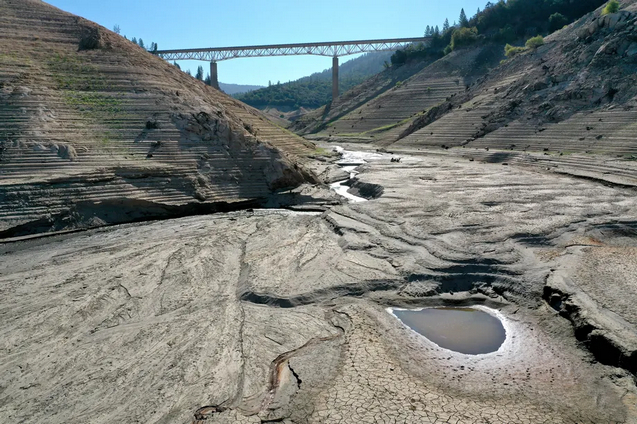
Water levels in California’s Lake Oroville reached record lows this
year amid extreme heat and a massive drought, threatening
hydroelectric power production.
Justin Sullivan/Getty Images
|
These scenarios reveal just how much of a challenge it will be for the world to
change course.
It will require seismic shifts across the global economy and will take years to
yield results. Yet many decisions about the future (where to build homes, how
much food to grow, what places are no longer livable) have to be made today.
That’s where it can be useful to have a range of possibilities.
A more dire future could result from a reversal of many climate change policies
currently in place. On the other hand, moving to a lower emissions trajectory
would require drastic reductions in greenhouse gas emissions.
In 2018, the IPCC looked specifically at what it would take to limit warming to
less than 1.5°C, the high-ambition target under the Paris climate agreement.
They found that global emissions would have to plummet by more than 50 percent
from where they are now by 2030.
But this possibility is getting less and less likely: Since that report,
greenhouse gas emissions have only grown, and atmospheric concentrations of
carbon dioxide reached record highs.
The biggest obstacles to rapidly reducing warming are not laws of nature, but
the modern fossil fuel-dependent economy humanity has constructed for itself.
“This warming is not really because of inertia in the physical system, but
rather inertia in how quickly we can bring down emissions to zero,” said Rogelj.
So how can people prepare for the future?
The most prudent
course of action is to work toward the best-case scenario while preparing for
some of the worst consequences of climate change.
The low-end scenarios, like scenario 1 (SSP1-1.9), illustrate the minimum amount
of warming the world will have to endure.
The middle pathways align roughly with the current trajectory of greenhouse gas
emissions.
The high-emissions storylines are much less likely, but they are not impossible.
There could be feedback loops or tipping points in the global climate system
that scientists have yet to uncover, which could accelerate warming beyond
what’s expected with humanity’s emissions.
So future warming past 4°C, which would lead to truly catastrophic consequences,
cannot be completely ruled out.
The storylines themselves should also serve as motivation to aggressively limit
climate change. The differences between them highlight that there are immense
dividends for lowering greenhouse gas emissions, and severe consequences for
failing to do so.
Even small increases in warming are consequential, and the impacts of
climate change are already visible today
in phenomena like melting ice caps, rising sea levels, and more destructive
extreme weather.
But the flip side is that all efforts to mitigate climate change are meaningful,
even if the world overshoots its targets.
All the warming that’s avoided will save lives and property and will enhance
human welfare.
There may be a point of no return, but there is no point at which our actions
don’t matter.
Links


