24/12/2021

(CNN) From Floods And Wildfires To Inaction And Urgency: These Are The Top Climate And Weather Stories Of 2021

CNN - Rachel Ramirez | Brandon Miller | Bill Weir

The view from the theater of an American Legion building on December 11 after tornadoes ripped through Mayfield, Kentucky.

The climate crisis took a catastrophic toll across the globe in 2021. From the Arctic to Louisiana and to China's Henan province, signs that climate change is already altering our weather were everywhere.

In the United States, historic flooding trapped and killed residents in submerged basements. In Canada, an entire town was erased by a wildfire fueled by extreme heat. Rain fell at the summit of Greenland for the first time.

As climate disasters mounted, the world aligned around combating the crisis: Scientists published a landmark report that concluded humans are unequivocally to blame; US President Joe Biden reentered the Paris Agreement in the early days of his administration; world leaders met at the UN climate summit in Glasgow, Scotland, to negotiate solutions.

But promises were not met with action in 2021, and humans are pumping more planet-warming emissions into the atmosphere than ever. Experts now warn that the Earth is currently on track for 2.4 degrees Celsius of warming above pre-industrial levels -- far beyond the critical 1.5-degree threshold that scientists say we should stay under.

This year's disasters are proof the climate crisis is intensifying and that the window is rapidly closing to slash our reliance on fossil fuels and to prevent changes that would transform life as we know it.

"What we think of as climate change is now becoming very personal," Jennifer Marlon, a climate scientist at the Yale School of the Environment, previously told CNN. "It's not far away anymore. It's now in our front yard, it's in our backyards, it's in our basements, it's even in our lungs as (we are) breathing smoke from these wildfires."

These are the top 10 climate crisis stories of 2021.

10. Historic rain at Greenland's summit

Rain droplets can be seen on a window looking out from a scientific post at the summit of Greenland in August.

In August, precipitation at the typically snowy summit of Greenland fell as rain for the first time.

Temperatures at the Greenland summit -- roughly two miles above sea level -- rose above freezing for the third time in less than a decade around August 15. Precipitation fell as rain and dumped 7 billion tons of water on the ice sheet, enough to fill the Reflecting Pool at the National Mall in Washington, DC, nearly 250,000 times.

It was the heaviest rainfall on the ice sheet since record keeping began in 1950, according to the National Snow and Ice Data Center. And scientists say it will occur more often: A recent study found the Arctic region is expected to experience more rain than snow sometime between 2060 and 2070, marking a major transition in its precipitation patterns as the planet warms.

"Things that happen in the Arctic don't specifically stay in the Arctic," Michelle McCrystall, climate researcher at the University of Manitoba in Winnipeg, previously told CNN. "The fact that there could be an increase in emissions from permafrost thaw or an increase in global sea level rise, it is a global problem, and it needs a global answer."

9. Texas deep freeze
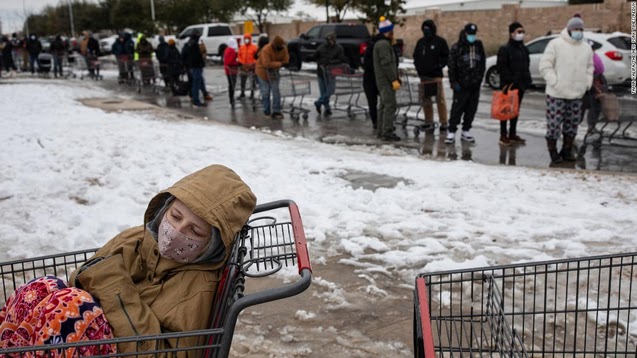
Camilla Swindle, 19, sits in a shopping cart as she and her boyfriend wait in a long line to stock up at a grocery store in Austin, Texas, on February 16, 2021.

February brought a historic deep freeze to Texas, which was also felt across much of the Central Plains and into the Southeast, and showed how the climate crisis can produce both hot and cold extremes.

A crippling winter storm swept across the Central United States the week of February 15, and plunged deep into Texas -- a state ill-equipped to handle a multi-day freeze. Electricity generation ground to a halt, and around 4 million people lost power.

Why snow and blackouts in Texas are a preview for all of us 1min 54sec

At the time, Gov. Greg Abbott blamed the power outages on frozen wind turbines and solar panels, though the state's fossil fuel energy sector was ultimately to blame for the energy crisis.

The Texas Department of State Health Services reported the extreme winter weather killed more than 200 people. However, an independent analysis by Buzzfeed put the number of deaths between 500 and 1,000.

The economic toll also proved catastrophic. The Texas comptroller's office reported the storm may have cost the state as much as $130 billion, and urged the weatherization of its power infrastructure.

8. Fatal floods across three continents

Cars sit in floodwaters following heavy rain in Zhengzhou in China's central Henan province on July 22, 2021.

In the span of a few weeks, destructive and fatal flash flooding ravaged parts of Western Europe, China's Henan province and the state of Tennessee.

In mid-July, severe flooding killed more than 200 people in Germany and Belgium. Vast swaths of the region saw 24-hour rainfall totals of roughly between 4 to 6 inches, which is more than an average month's worth of rainfall in the area.

World Weather Attribution, a group of scientists that establishes the link between climate change and weather, found the record rainfall was up to nine times more likely due to human-caused climate change.

In China, the floods that struck Henan province killed more than 300 people. Zhengzhou, the provincial capital of 12 million people, was one of the hardest-hit areas. Entire neighborhoods were submerged, while passengers were trapped in inundated subway cars, clinging to ceiling handles to stay above water.

Back in the United States, a staggering amount of rain led to flash flooding in Tennessee that destroyed more than 270 homes and killed more than two dozen people, including 7-month-old twins. State emergency management officials were not prepared for the magnitude of the event. The fallen phone lines, coupled with washed out roads, made it harder for them to get into the flood zone.

7. US rejoins the Paris Agreement

President Joe Biden signs his first executive orders in the Oval Office of the White House on January 20, 2021, in Washington.

Within hours of being sworn in, Biden signed an executive order in January to rejoin the global climate pact known as the Paris Agreement, which former President Donald Trump pulled the United States out of while in office.

In April, Biden pledged to cut US greenhouse gas emissions in half by 2030, in part to make good on the country's renewed membership in the agreement.

Under the Paris Agreement, countries are expected to track and enhance their commitments to drastically cut greenhouse gas emissions every five years. The primary goal of the climate accords is to put a lid on global warming to well below 2 degrees Celsius above pre-industrial levels, with a preferred 1.5-degree limit.

However, the United Nations says there is still a huge gap between what's been promised and what scientists say is needed to curb emissions.

6. UN report: A 'code red'

Steam rises from the Miller coal Power Plant in Adamsville, Alabama.

Every six to seven years, the United Nations' Intergovernmental Panel on Climate Change publishes a report that summarizes the state of climate research. The panel's latest report came in August, and its authors concluded it is "unequivocal" that humans have caused the climate crisis and that "widespread and rapid changes" have already occurred, some of them irreversibly.

UN Secretary-General António Guterres called the report "a code red for humanity."

Scientists said the planet has rapidly warmed by more than 1 degree Celsius higher than pre-industrial levels, and is now barrelling toward 1.5 degrees -- a critical threshold that world leaders agreed warming should remain below to avoid worsening impacts.

To halt the precipitous trend, scientists say countries must make deep cuts to greenhouse gas emissions while simultaneously removing carbon dioxide from the atmosphere.

5. A critical summit in Glasgow

'No more blah, blah, blah!' Thunberg joins protesters outside climate summit 57sec

World leaders gathered in Glasgow in November for the UN-brokered climate change summit known as COP26.

And after nearly two weeks of negotiations on how to limit global warming, nearly 200 countries signed the Glasgow Climate Pact, which included the first-ever acknowledgment of the role burning fossil fuels have played in perpetuating the climate crisis.

While the final pact showed some progress, the text didn't reflect the urgency scientists have called for. Countries agreed to "phase down" the use of unabated coal for power generation, instead of completely phasing it out. Developing nations also left disappointed after negotiations around climate financing -- funding from wealthy nations to help low-income countries deal with the crisis -- broke down.

4. Hurricane Ida

Video shows power of Ida when it made landfall 1min 7sec

In late August, Category 4 Hurricane Ida destroyed homes, uprooted trees and cut off power to more than 1 million customers in Mississippi and the already storm-ravaged state of Louisiana.

Ida checked all the boxes of how climate change is making hurricanes more dangerous, according to scientists: They are producing more rainfall, moving more slowly once they make landfall and generating larger storm surges.

Michael Wilson stands in the doorway to his flood-damaged home after Hurricane Ida made landfall as a Category 4.

But the impact didn't end on the Gulf Coast. As the storm made its way inland, Ida's remnants triggered flash flood emergencies in the Northeast. The storm broke the single-hour rainfall record in Central Park and gave Newark, New Jersey, its wettest day ever.

The flooding killed dozens of people in the Northeast, and many of them drowned in basement apartments in New York City. Some Ida survivors in the city are still displaced, and the storm exposed the dire need to strengthen the city's infrastructure against the worsening climate crisis.

Hurricane Ida's damage cost at least $60 billion, the National Oceanic and Atmospheric Administration estimated, and exceeded the combined cost of the seven most damaging tropical cyclones of 2020.

3. December tornado outbreak

Tornado devastation captured by incredible drone video 1min 39sec

At the tail end of a year already packed with extreme weather, a series of tornadoes tore through the Midwestern and Southeastern United States on December 12 and 13. The last month of the year is typically the quietest for tornadoes, but warm temperatures brought a historic twist.

In Kentucky, tornadoes uprooted trees, leveled homes and killed dozens of people. Gov. Andy Beshear said at a news conference that the tornado event reached a "level of devastation unlike anything I have ever seen."

Though it's not completely clear what role climate change played in December's outbreak, scientists say the fingerprints of global warming can be found on every extreme weather event. Victor Gensini, a professor at Northern Illinois University and a top tornado expert, said the outbreak is one of the most remarkable tornado events in US history.

"When you start putting a lot of these events together, and you start looking at them in the aggregate sense, the statistics are pretty clear that not only has there sort of been a change -- a shift, if you will -- of where the greatest tornado frequency is happening," Gensini told CNN, "but these events are becoming perhaps stronger, more frequent and also more variable."

2. Pacific Northwest heat wave

Canada wildfire: Village devastated after heat wave 1min 7sec

An unprecedented heat wave in late June killed hundreds of people in the Pacific Northwest and British Columbia. All-time record temperatures were set across the region, and scientists say the heat wave would have been "virtually impossible" without human-caused climate change.

Experts told CNN the normally temperate region is unprepared for extreme heat events, with many residents not owning air conditioning units. As a result, hundreds of people died from heat-related illness. Officials later called the heat wave a mass casualty event.

In British Columbia, the same heat wave fueled a fast-moving wildfire that obliterated the town of Lytton just one day after the temperature soared to 121 degrees and broke Canada's all-time temperature record.

1. Drought, wildfires and water shortages

A home is engulfed in flames as the Beckwourth Complex Fire tears through Doyle, California, on July 10, 2021.

Amid the acute disasters, the Western United States has been in the grips of a historic, multi-year drought, which scientists say is a clear sign of how the climate crisis is affecting not only the weather but water supply, food production and electricity generation.

In California, this summer's drought was the most extreme in the state's 126-year record, with July 2021 as the driest month since data gathering began in 1895. By August, more than 95% of the West was in drought conditions.

Lake Mead and Lake Powell -- two of the country's largest reservoirs -- drained at alarming rates after a dry winter and extreme drought this summer. The federal government in August declared a water shortage on the Colorado River for the first time, triggering mandatory water consumption cuts for states in the Southwest beginning in 2022.

These Americans are fleeing the West because of extreme heat 3min 20sec

The megadrought also primed the landscape for perilous wildfires. The three largest fires of 2021 -- the Bootleg, Dixie and Caldor Fires -- have burned roughly 1.6 million acres, an area half the size of Connecticut. High-level winds wafted smoke from some of these fires across the country, stretching from the West Coast to New York City.

Scientists say this summer is only a preview of what's to come: The United Nations' August report concluded droughts that may have occurred only once every decade or so now happen 70% more frequently.

Links

(Pursuit: University of Melbourne) What We Now Know About Climate Change After 2021

Pursuit: University of Melbourne -  |  | 

Along with COVID-19, much of the focus in 2021 was on climate change and how the world, including Australia, is going to reach those crucial targets

Getty Images

Authors
  • Professor Jacqueline Peel is Director, Melbourne Climate Futures, Melbourne Law School, University of Melbourne
  • Professor John Wiseman is Professorial Research Fellow, Melbourne Sustainable Society Institute; Senior Research Fellow, Melbourne Climate Futures, University of Melbourne
  • Dr Andrew King is Climate Extremes Research Fellow, School of Earth Sciences, Faculty of Science, University of Melbourne
2021 saw an increase in extreme weather events that broke records around the world.

The impacts of climate change continued apace globally, with devastating flooding, fires, droughts and heatwaves experienced by millions of people across the globe.

Meanwhile, world leaders, delegates and activists from nearly 200 nations arrived in Glasgow on October for COP26 – the biggest climate event of the year.

But after two weeks of negotiations over emissions, carbon trading and reparations for climate damage – world still isn’t on track to avert a climate crisis or to limit global warming to 1.5°C above pre-industrial levels.

And Australia was singled out as a climate change “pariah” for its failure to strengthen its 2030 target to reduce emissions further and move away from fossil fuel production.

As 2021 comes to a close we asked three experts to look back at the year. Professor Jacqueline Peel is the Director of Melbourne Climate Futures, Professor John Wiseman is a Professorial Research Fellow at the Melbourne Sustainable Society Institute, and Dr Andrew King is a Climate Extremes Research Fellow at the School of Earth Sciences and the ARC Centre of Excellence for Climate System Science.

2021 saw an increase in extreme weather events that broke records around the world. Picture: Getty Images

PROFESSOR JACQUELINE PEEL

2021 has been an enormously consequential year for climate action in Australia and internationally. After more than a decade of unproductive climate policy ‘wars’ in Australia, we end the year with an official truce.

Both sides of the political divide in Canberra have embraced the need for Australia to reach net zero emissions by 2050. This was inconceivable just 12 months ago.

Both sides of the political divide have embraced the need for Australia to reach net zero emissions by 2050. Picture: Getty Images

Reaching this milestone was made easier by the support of the business community (who embraced net zero much earlier than the Federal government), by the action of State and Territory governments (who are leading the way on ambitious climate policy and renewable energy investment), and by the relentless activism of civil society and the general public calling for change.

Attention now turns to short-term actions to reduce emissions, including 2030 targets and policies.

International events played a major role in driving Australian policy progress this year, bookended by the COP26 Summit – the world’s “last, best chance” to keep alive the goal of no more than 1.5°C of global warming.

Melbourne's real-world impact on climate change.  Read more
In the lead-up to COP26, the USA, UK and other wealthy industrialised countries made ambitious pledges to halve their emissions by 2030, ramping up the pressure on the Australian government to improve its climate game.

Coal also crossed a threshold in 2021, with new pledges on coal phaseout and phase-down emerging at COP26, and support for stopping coal financing by major international players like China and the USA.

The Australian government will remain under pressure to update its “nationally determined contribution” and 2030 target heading into COP-27 in Egypt next November.

Keeping ‘1.5°C alive’ and averting the worst impacts of climate change – vital for vulnerable communities in Australia and our Indo-Pacific region – is still possible but the road ahead is steep and the clock is ticking. There’s never been a more important time for concerted action, on all fronts, to ensure a safe, sustainable climate future.

Keeping ‘1.5°C alive’ is vital for vulnerable communities in Australia and our Indo-Pacific region. Picture: Getty Images

PROFESSOR JOHN WISEMAN

There were many moments I felt proud to be Australian in 2021. Grace Tame’s award as Australian of the Year for her advocacy for survivors of sexual assault. Patty Mills heroic leadership of the Boomers at the Tokyo Olympics.

But watching Australia win the Colossal Fossil award for the country with the worst climate action record at COP26 in Glasgow was less inspiring.

Hope and courage in the climate crisis.  Read more
Many countries used the Glasgow COP as a trigger to significantly strengthen their emission reduction goals. The UK announced a target of cutting emissions by 78 per cent by 2035. The US set a target of 50 to 52 per cent reduction by 2030. The Australian government’s 2030 emission reduction goal stayed firmly stuck at 26 to 28 per cent.

But 2021’s Australian climate action news wasn’t all bad.

State governments and cities further strengthened renewable energy plans. Legal challenges requiring governments and business to address the full extent of climate risk began to have real impact. Support for climate action independents began to build. The School Strike 4 Climate movement continued to demonstrate the vital role that young people will play in driving climate action.

Scientific evidence about the speed of climate action needed to avoid catastrophic global warming remains crystal clear. For Australia, that means a 2030 emissions reduction target of at least 75 per cent.

The Australian government’s 2030 emission reduction goal stayed firmly stuck at 26-28 per cent. Picture: Getty Images

The first key task in achieving that goal is the just and rapid phase out of Australian production and use of coal, oil and gas.

The 2022 Australian election provides our next crucial opportunity to open this door.

DR ANDREW KING

At COP26 in Glasgow, leaders re-affirmed their aim to keep global warming to well below 2°C and preferably below 1.5°C above pre-industrial levels.

With so much focus on the Paris Agreement targets it’s important that we understand the implications of meeting these goals.

Until now, most climate projections have been based on model simulations where the world continues to warm well beyond the Paris Agreement’s 1.5°C and 2°C limits, but this is different from the intention of the Paris Agreement under which global warming should stop rather than continue.

In our recent paper, we proposed a new framework which allows us to make climate projections for a world where human-caused carbon dioxide emissions fall to zero and we stabilise global temperatures in line with the Paris Agreement.

We anticipate this will have a large impact on climate projections as the ocean warms up very slowly over centuries and this alters our weather patterns.

As the ocean warms up, this will alter our weather patterns and impact climate projections. Picture: Getty Images

Our framework will allow us to better understand how the climate will evolve should we succeed in meeting the Paris Agreement and halting global warming.

Even after COP26, the ambition required to meet the Paris Agreement is a long way off from being met, so policies to support strengthened pledges are needed from nations across the world – including Australia. 

Links

(Discover) Did 2021 Deal A Fatal Blow To Climate-Change Denial?

Discover - Tom Yulsman

Data and extreme weather events are making it harder than ever to ignore our warming world. But climate change denial has also taken on a new form.

(Credit: Daniel BROWN/Sipa USA via AP)

From brutal heat in North America and Siberia to devastating flooding in China and Europe, 2021 delivered worsening climate extremes of the kind long predicted by scientists.

Streetcar cables melted in Portland. A raging river swept away entire homes in Germany’s lush Ahr Valley wine region. And wildfires have set records across the globe in the past two years.

For many people, recent disasters have transformed human-caused climate change from a theoretical, far-off risk to an undeniable reality. And this summer, the United Nations dropped a landmark climate report, emphasizing that avoiding even worse impacts will require deep, rapid cuts in greenhouse gas pollution. But does that mean 2021 will be remembered as the year denial of climate change all but died?

At least one renowned environmental scientist believes so. “I think you have seen a seismic shift,” says Jonathon Foley, executive director of Project Drawdown, a non-profit that advances climate solutions. “Most of the conversation now is really more about what we should do, not denying whether or not climate change is happening.”

Other experts don’t go as far, saying denialism may be waning but is not yet dead. They also warn that promoters of climate denial now emphasize delaying action.

That said, even Harvard University science historian Naomi Oreskes, co-author of Merchants of Doubt, thinks something has shifted. Her 2010 book documented how politically motivated scientists teamed with corporate and other interests to cast doubt on the science of many issues, starting with tobacco and leading to global warming.

Now, years later, she says, “This is a glass half-full, half-empty problem. There are certainly a lot of things to feel good about.”

Elevated Concern

Surveys show rising alarm about climate change. In a 2021 poll by George Mason and Yale universities, 70 percent of Americans surveyed said they were worried about global warming.

A similar poll also showed growing bipartisan support for climate action, with 6 in 10 voters voicing support for ambitious climate and clean energy infrastructure legislation.

(Credit: Alexandros Michailidis/Shutterstock)

“I do think our country and world have changed in important ways,” says Edward Maibach, director of the Center for Climate Change Communication at George Mason University.

“We’re now in an inevitable transition to an economy in which we are no longer emitting carbon dioxide into the atmosphere.”

The shift may not be surprising, given the clear rise in weather and climate extremes documented by the U.N.’s Intergovernmental Panel on Climate Change (IPCC) report.

In 2021, we saw heat waves, like the shattering of high temperature records in June on the Pacific coast of the U.S. and Canada. July brought torrential rains in Western Europe.

Deluges followed in China’s Henan province, where half its average annual precipitation fell in just six hours, triggering flooding that killed more than 300 people. And the western U.S. has seen a profound increase in wildfire activity, a point driven home by multiple 2021 megafires of 100,000 acres and greater.

As Foley puts it: “Denial of the basic reality of climate change is no longer credible.”

But what was denialism about in the first place? The answer offers insights into an era of delayed action that may be the new zeitgeist.

Present danger

Katharine Hayhoe, an atmospheric researcher and chief scientist for The Nature Conservancy, argues that most people who dismiss climate change aren’t really denying its basic physics.

Rather, they fear solutions pose more risks to them — to their finances and lifestyles, for example — than climate change itself. But instead of admitting that, “people grasp at the straws of denial offered by the merchants of doubt.”

Hayhoe believes that’s changing. “There are some very large see-through holes in that smokescreen of denial today,” she says. “With record-breaking heat in June, rather than July or August, with rising sea levels, people can see with their own eyes that now something is happening where they live.”

Surveys support her view. Maibach notes that when his center began polling in 2008, a majority of Americans surveyed did believe the climate was changing but saw it as a distant threat. “Half now see climate change as a clear and present danger in their own communities,” he says.

Deflection Tactics

But many industries still oppose meaningful climate action and are trying to delay it while shifting blame from corporations to individuals, argues Penn State climate scientist Michael Mann in his 2021 book The New Climate War.

To delay action, corporate interests and their supporters in government have executed what he calls “a deflection campaign.” They place the responsibility for battling climate change on consumers, insisting that they must change their behavior.

Does this mean we’ve transitioned from denialism to delayism?

Oreskes sees no distinction. “Delay is denial, because the scientific evidence is overwhelming that we have to act now,” she says. “It’s all a package, and it all has the same purpose, which is to keep us using fossil fuels.”

Foley expresses similar concerns. “I think we’re entering a new age of subterfuge,” he says. Fossil fuel companies are trying to look like they support action on climate change, he adds, while they are just doing “business as usual.”

At the same time, greenhouse gas emissions have peaked in roughly 50 countries and are now going down, according to Foley. In the U.S., emissions have dropped by roughly 20 percent since 2007.

“That’s pretty good news,” he says. “Not good enough. But at least we’re bending the curve in the right direction.”

Without even faster and deeper cuts, though, future impacts could make 2021’s heat waves, wildfires and deluges look tame.

UN Report: Climate Change is Irrevocable

Even amidst summer’s climatic misery, a report from the Intergovernmental Panel on Climate Change (IPCC) seemed shocking when it arrived in August.

Every inhabited region on Earth is now experiencing climate changes not seen in thousands, and even hundreds of thousands, of years, the report revealed. And with atmospheric CO2 exceeding any level known in at least 2 million years, long-term changes are inevitable, including continued increase of the planet’s temperature, melting of glaciers and ice caps, and rising seas.

We’ll most likely also see more heat waves, droughts and deluges. Even if we were to swiftly slash greenhouse gas emissions enough to cap global warming at 1.5 degrees Celsius (2.7 degrees Fahrenheit) by mid-century, we should expect an incidence of extreme events “unprecedented” in climate records, according to the report. (We’ve got only about 0.4 C to go.)

Still, we can limit climate change with “strong and sustained reductions in emissions of carbon dioxide and other greenhouse gases,” the IPCC said in a statement. In fact, failure to do so could lead to misery far worse than what we’ve seen.

Links

23/12/2021

(Washington Post) Climate Change Is The Greatest Threat To Humanity. Here’s How Filmmakers Have Tried To Make Sense Of It All.

Washington Post - Sonia Rao

Over the past 20 years, directors have increasingly put out movies that help viewers process a crisis of existential proportions

(Matt Chase for The Washington Post)

A few years after “Independence Day” premiered in theaters, Roland Emmerich faced immense pressure to write and direct a sequel.

His sci-fi disaster movie was the highest-grossing film of 1996, raking in more than $300 million at the domestic box office and $800 million worldwide. It set a new standard for Hollywood blockbusters. Naturally, executives wanted another.

But Emmerich’s concerns lay elsewhere. He had recently swung by a bookstore after wrapping production on another project and picked up “The Coming Global Superstorm,” a book that blended fact and fiction while exploring the possibility of unprecedented environmental catastrophe in the near future. The details could seem a bit far-fetched. And yet, deep into pondering potential dangers that were more rooted in reality, Emmerich realized he had no time for alien invasions.

His next disaster movie would be about the one to which humans were contributing.

“My friends thought I was crazy,” he recalls. “Whenever they asked, ‘What is this movie about?’ I would say, ‘Global warming.’ Don’t forget that at that time, in ’99, global warming was some sort of fringe thing. People read about it, but nobody really knew what was going on.”

He wound up co-writing and directing 2004′s “The Day After Tomorrow,” a film marketed with the indelible image of the Statue of Liberty buried under snow. Its scientific accuracy was debated at great length, the central narrative derided as cliched. But its lasting impact on audiences is undeniable. Even now, as the climate crisis figures into more and more conversations throughout the entertainment industry, Emmerich’s film is often among the first to be mentioned.

The subject had been tackled before. But as climate change cements itself as the greatest modern threat to humanity, filmmakers have increasingly varied how they depict its widespread effects. Some still place disasters front and center. Others, such as George Miller, who set “Mad Max: Fury Road” in a decaying environment, explore how societal structures respond to a collapsing world.

Seven in 10 Americans said they were at least “somewhat worried” about global warming in a recent survey conducted by Yale and George Mason University. That includes 35 percent who said they were “very worried,” a record high for the poll; only 9 percent said the same in 2011. These distraught feelings are becoming such a fixture of life on this planet that experts have already started to refer to them as “climate grief.” These emotions demand that we find a way to adapt and move forward.

While some films can exacerbate climate grief, others call for action. The Washington Post spoke with several filmmakers about their decisions to address climate change, how they went about doing so and what role fictional storytelling can play in helping us process a crisis of existential proportions.

“That’s the function of story as it always has been, no doubt — since early man,” Miller says. “We try to make meaning out of what is apparently a chaotic world.”

Depicting a disaster
‘The Day After Tomorrow’
“The Day After Tomorrow,” from 2004, focuses on a storm system that threatens to quickly destroy the Northern Hemisphere. (Twentieth Century Fox/Everett Collection)

Things fall apart rapidly in “The Day After Tomorrow.” Soon after climate scientist Jack Hall (Dennis Quaid) says at a United Nations conference that climate change could lead to an ice age, a storm system develops and threatens to destroy the Northern Hemisphere. Jack’s son Sam (Jake Gyllenhaal) and his friends seek shelter at the New York Public Library, where they burn books for warmth as snow mounts against the building’s outer walls.

Like its peers in the disaster genre, “The Day After Tomorrow” is consumed by the special effects involved in depicting calamity. Emmerich says his critics often forget that “when you make a movie, it has to be dramatic in a certain way.” People bought tickets to be stunned. This was the guy who made “Independence Day,” after all.

The movie ends with sheets of ice stretching over the hemisphere, its events all having taken place within days. Dramatic, yes, but Emmerich insists the science is “solid” even if experts said around the time of the theatrical release that such a phenomenon couldn’t occur over that short a period of time. In a way, it didn’t really matter. Echoing some scientists, former vice president Al Gore told USA Today in 2004 that, while “it’s important we separate fact from fiction,” the movie at least got people talking.

The film directed attention to real problems, down to the culpability of powerful people who doubted the reality of climate change. It isn’t a coincidence the vice president who dismisses Jack’s research bears a resemblance to Richard B. Cheney, nor that he serves under a compliant president.

“We did a press tour all around the world where we educated people about climate change and what it all means,” Emmerich says. “It was interesting, because it was a Hollywood movie.”

Given the public’s familiarity with the climate crisis these days, some argue filmmaking should go further. Earlier this year, science journalist Maddie Stone wrote in Polygon that she wondered whether “Hollywood executives worry that carbon taxes, battery storage technology and Green New Deals aren’t sexy enough topics to drive a compelling story with mainstream appeal.”

Speaking to The Post, Stone, an avid consumer of science fiction, notes that novelists have increasingly explored what filmmakers seem hesitant to try. There’s a push within the climate fiction space to depict possible solutions to our troubles, even if the narrative doesn’t center on them.

“It’s interesting that policymakers and climate activists are starting to world-build that future,” she says, “but we haven’t really seen that yet in mainstream film.”

Animating an allegory
‘WALL-E’
"WALL-E," from 2008, is a robot love story that also explores the perils of overvaluing short-term economic interests. It takes place in the 29th century, hundreds of years after humans abandoned Earth. (Walt Disney Co./Everett Collection)

In 2008, Disney released “WALL-E,” a movie with a political bent director Andrew Stanton insisted was unintentional. While promoting the Pixar film in an interview with New York magazine, the director said he had no “ecological message to push.” It was just about a love story between two robots.

The characters in question are WALL-E — a trash-compacting robot in the 29th century who remains on Earth, a garbage-strewn land humans abandoned centuries earlier for inhabitable spacecraft — and EVE, a robot sent to the planet to scan for signs of life. WALL-E accompanies EVE back to a starliner, where humans have become sluggish and dependent on machinery doing everything for them.

Stanton began writing “WALL-E” when he and his wife, whom he now describes in an interview with The Post as an “early adopter” of Amazon, ordered so many packages that the cardboard boxes began to pile up. He says he thought of the practice as “consumerism run amok, where the desire to buy stuff was greater than the ability to deal with all the trash being made for it.” There’s a simple connection to be made between this line of thought and harsher environmental critiques of capitalism, but Stanton wasn’t making it himself.

“I don’t like being preached to when I watch my entertainment,” he says, recalling that he “didn’t want to come across, even accidentally, like I had something greater to tell than the story of WALL-E.”

Still, the premise of the film is inherently political — and seems to grow more relevant with each year that passes. Stanton says he might have been a bit defensive in outright denying messaging beyond the love story. He wasn’t trying to target “big-bucks companies directly,” he adds, “but I was saying … complacency is the enemy. Complacency and trust without verifying who you’re giving all your money to, who you’re giving all your power to.”

“WALL-E” implores its viewers to think twice about how the systems in place operate. It underscores the perils of overvaluing short-term economic interests, represented by the animated humans’ unwillingness to change harmful behaviors that have become convenient to them.

“I actually trust kids to be serious,” Stanton says of his primary audience, adding that he has “no problem with a young kid — or my kids — knowing that the Earth can really go south fast if you don’t do the right things.”

Forecasting the future
‘Beasts of the Southern Wild’
In the 2012 film “Beasts of the Southern Wild,” Quvenzhané Wallis stars as a 6-year-old living on an island in a Louisiana bayou. The island's residents are instructed to evacuate after it floods. (Fox Searchlight/Everett Collection)

Recent science suggests that today’s children will live through three times as many climate disasters as their grandparents. This fact, compounded by their innocence in the matter, can be especially distressing to process — an emotion palpable throughout Benh Zeitlin’s Oscar-nominated “Beasts of the Southern Wild,” which made Quvenzhané Wallis the youngest-ever best actress nominee.

The 2012 film takes place at a Louisiana bayou on an island nicknamed the Bathtub, where 6-year-old Hushpuppy (Wallis) lives with her ailing father, Wink (Dwight Henry). Often left to fend for herself, Hushpuppy is forced to grow up quickly. At school, she learns about prehistoric, bison-like creatures called aurochs, said to have devoured the children of cave men. She is also taught survival tactics as preparation for when her world falls apart; eventually, the Bathtub will be underwater.

“Beasts of the Southern Wild” was adapted from a play by Lucy Alibar, with whom Zeitlin co-wrote the screenplay. The director says that when he first screened it, “a lot of people thought it was about [Hurricane] Katrina and the past. My answer to that was, this is not a film about the past. This is a film about the future.”

Speaking in September from southern Louisiana, where he traveled to help communities recover from Hurricane Ida, Zeitlin says outsiders tend to view the region as a “doomed place in the world” and wonder why its inhabitants stay put. He “really wanted to make a film that answered that question in a way that was … defiant about what a ridiculous question that is.”

“I remember talking to someone down here about the issue, and I remember them saying something to me about feeling like the people from this area are like a plant that can only grow in one place,” he continues. “If you tried to plant it somewhere else, it would die.”

Nearly a decade after the film’s release, Zeitlin encountered people who were uprooted by Ida. Residents of the island where he shot the film once lived “a life of abundance,” he says. “In order for the oil industry to strip the lands here, they have to create narratives that dehumanize the people whose lives they’re destroying.” Fighting back involves accessing the public’s emotions.

In the film, after the Bathtub floods and its residents are instructed to evacuate, Hushpuppy returns and sees aurochs arriving. The climate crisis grounds “Beasts of the Southern Wild” in real life but, according to Zeitlin, its narrative ultimately mirrors that of a Greek myth or story from the Bible.

“What’s happening in nature renders us a speck,” he says. “The only way Hushpuppy could understand the radical way in which her life was changing was through stories that were large, [and by seeing] herself as a character in a story about a species on the verge of extinction.”

Predicting the post-apocalypse
‘Mad Max: Fury Road’
“Mad Max: Fury Road,” from 2015, is set in a decaying desert environment after warfare over resources. (Warner Bros./Everett Collection)

There are some stories we encounter time and time again, according to George Miller.

“Floods and fire and plunder and pestilence are pretty timeless,” he says. “I think they’re intrinsic to the human narrative … it’s just that they’re amplified now. Now the main difference is, we know we can measure it. We can model and predict the trouble ahead.”

The action of 2015′s “Mad Max: Fury Road,” the Tom Hardy-starring fourth installment in the Mad Max franchise, takes place in a desert wasteland following intense warfare over resources. The tyrannical Immortan Joe (Hugh Keays-Byrne) maintains power by seizing control of the water supply. He sends one of his captains, Imperator Furiosa (Charlize Theron), to obtain gasoline but realizes a handful of his concubines have fled with her.

Furiosa plans to escape to the Green Place, a fertile land she remembers from her childhood spent with a tribe of women. Then she discovers it has become an uninhabitable swampland.

The future seen in “Fury Road” is bleak. A haunting question arises more than once: “Who killed the world?” Miller describes the cautionary tale as an allegory, noting that it deals “with a more elemental world than the complex modern moment we’re dealing with. It’s a regression to a medieval time.”

The filmmaker’s youth in rural Australia led him to become “acutely aware of the droughts and the floods and the dust storms.” He says most stories set in vast, empty landscapes are bound to engage with their environments to some extent. Such was even true of 2006′s “Happy Feet,” his Oscar-winning animated film about a tap-dancing penguin that also commented on the dangers of overfishing.

“To be a storyteller, you respond to the world that’s around you in all its dimensions,” Miller says. “You can’t help but tell these big, sweeping stories without it becoming part of the story.”

“Fury Road” joins films like Bong Joon-ho’s 2013 thriller “Snowpiercer” in depicting societal ruin as a result of climate change. Experts who advocate for more hopeful views of the future — such as Stone, the science journalist — point to the celebrated science fiction writer Kim Stanley Robinson as an example of someone from whom Hollywood could seek inspiration.

Many consider Robinson’s work to be optimistic because he writes utopian fiction; in an interview with The Post, the author laughs and says the “bar is very low.” He acknowledges, however, that stories like his resonate because they give people something to believe in.

“With climate, what I wanted to do was fight the dystopia, to be anti-dystopian,” Robinson says. “At this point, given the climate emergency … dystopia is pouring oil on a burning house.”

Stirring the psyche
‘First Reformed’
In 2018's “First Reformed,” Ethan Hawke is a pastor who suffers a crisis of faith, partly brought on by his interactions with a radical environmentalist who doesn’t want to bring a child into an unlivable world. (A24/Everett Collection)

There is a certain appeal to post-apocalyptic storytelling because the worst has already happened, says actor Ethan Hawke. It can be daunting, on the other hand, to dive head first into a contemporary issue as “depressing and scary and real” as climate change. Who knows what the future holds?

But Hawke did so with “First Reformed,” the 2018 film in which he stars as Ernst Toller, the pastor at a tourist-frequented church who suffers a crisis of faith. It is brought on in part by his interactions with a radical environmentalist named Michael (Philip Ettinger), whose pregnant wife Mary (Amanda Seyfried) seeks guidance from Toller because Michael doesn’t want to bring a child into an unlivable world.

Michael wonders, “Will God forgive us for destroying his creation?” Toller is consumed by the thought, and soon after discovers that the church overseeing his own receives financial support from one of the region’s biggest sources of pollution. The pastor’s crisis deepens.

“Reverend Toller is struggling with his own place in the system,” Hawke says. “In this country, everything is acceptable as long as it’s accumulating more wealth. … He’s finding himself in the middle of a society that’s making [his quest for goodness] near impossible.”

This profound sense of loneliness is a staple of work by writer-director Paul Schrader, who was unavailable for an interview. “First Reformed” ends ambiguously, mirroring Toller’s own search for answers. It could seem disheartening, but Hawke considers the act of provoking such deep thought to be productive in itself. He refers to a scene in which Toller describes wisdom as “holding two contradictory truths in our mind simultaneously: hope and despair.”

“Most of us are pretty comfortable being asleep, and sometimes we need a work of art to wake our mind up to the way we think about these things,” Hawke says. “Why should we not despair? What is hope? What am I doing to follow the hope in my heart? Those kinds of conversations are really valuable in regards to ringing a bell to make people remember they’re alive and participating.”

Reassigning responsibility
‘The Dead Don’t Die’
Bill Murray, Chloë Sevigny and Adam Driver star as small-town police officers in “The Dead Don't Die,” a comedy about a zombie apocalypse that is the result of fracking that throws Earth off its rotational axis. (Abbot Genser/Focus Features)

Jim Jarmusch tries not to be didactic. “I’m not a proselytizer,” he says. “But everything is political.”

That includes “The Dead Don’t Die,” his 2019 comedy in which fracking at the North and South poles sets Earth off its rotational axis, leading to a zombie apocalypse. The undead are a classic metaphor in film, used to highlight any sociopolitical hazard to which we must wake up the sheeple. Jarmusch’s entry to the genre casts a wide net, from an overreliance on technology to monetary greed.

“It’s the fact that we have a broken operating system,” he summarizes. “Capitalism is obviously a suicide machine for life on this planet. Profit and greed are held as rewards.”

“The Dead Don’t Die” is a star-studded satire, featuring Bill Murray, Adam Driver and Chloë Sevigny as small-town police officers who struggle to maintain order amid the chaos. Viewers root for them to succeed. But Jarmusch notes that, since the film’s release, his impression of their enemies has evolved. He sees the zombies even more as victims, as a “consequence of the monsters” rather than monsters themselves.

That shift hints at a central obstacle in writing about climate change. Storytelling often favors clear heroes and villains, the latter responsible for the conflict at hand. But what if the villain is a system, or our established way of life? What level of complicity turns presumed heroes into villains?

“I really resent this being put on [individual] people,” Jarmusch says, “like, ‘You better recycle your plastic,’ and then they just dump it in the ocean.”

Daniel Hinerfeld leads an initiative at the Natural Resources Defense Council, an environmental advocacy organization, for which he consults with major companies such as Netflix, Sony and NBCUniversal to encourage artists to harness the “tremendous untapped power in entertainment storytelling to change the way people think and feel and behave around environmental issues.”

Hinerfeld says he has recently witnessed many a lightbulb moment for artists who come to recognize that, as with any crisis, there is meaningful drama to mine in what could initially be perceived as “abstract” or “boring” subject matter. There are struggles to depict, anxieties to work out and, of course, futures to imagine.

“The clock is running down on civilization here, but we just go about our lives as we normally have for decades because we don’t know what to do and we’re terrified,” Hinerfeld says. “The moment you start to unpack that terror a little bit, creative storytellers suddenly realize there’s a whole world of storytelling here.”

Links - Further films with a climate change theme

Lethal Heating is a citizens' initiative