Saturday, January 15, 2022

(The Conversation) Ocean Heat Is At Record Levels, With Major Consequences

The Conversation -

Author
Dr. Kevin Trenberth is a Distinguished Scholar at the National Center for Atmospheric Research (NCAR) in Boulder, Colorado, USA.
Dr. Trenberth is an affiliate faculty at the University of Auckland, New Zealand.
He studies climate variability and change.
The world witnessed record-breaking climate and weather disasters in 2021, from destructive flash floods that swept through mountain towns in Europe and inundated subway systems in China and the U.S., to heat waves and wildfires.

Typhoon Rai killed over 400 people in the Philippines; Hurricane Ida caused an estimated US$74 billion in damage in the U.S.


Globally, it was the sixth hottest year on record for surface temperatures, according to data released by NASA and the National Oceanic and Atmospheric Administration in their annual global climate report on Jan. 13, 2022.

But under the surface, ocean temperatures set new heat records in 2021.


As climate scientist Kevin Trenberth explains, while the temperature at Earth’s surface is what people experience day to day, the temperature in the upper part of the ocean is a better indicator of how excess heat is accumulating on the planet.

The Conversation spoke with Trenberth, coauthor of a study published on Jan. 11, 2022, by 23 researchers at 14 institutes that tracked warming in the world’s oceans.
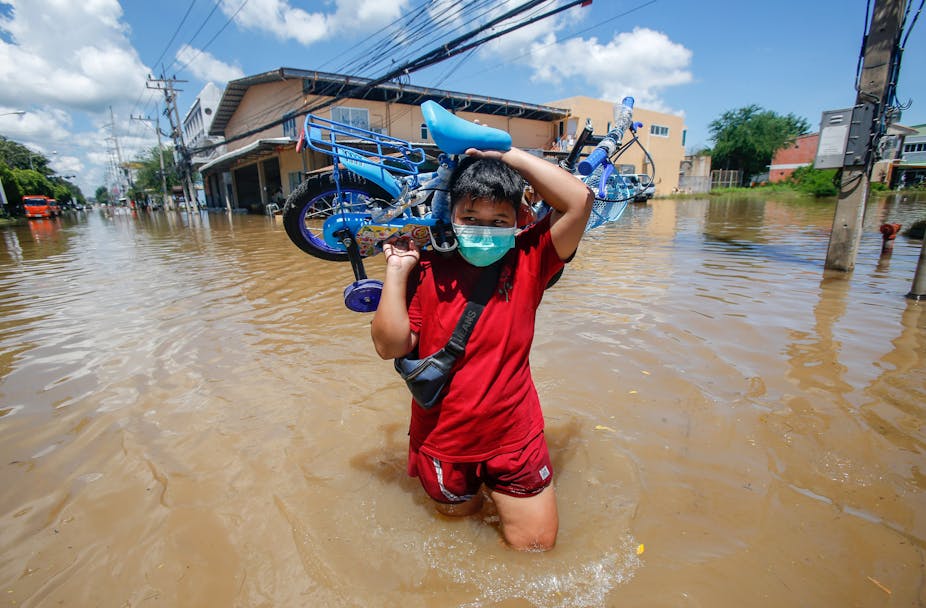

A person carries a child's bike through flood water
A tropical storm’s rain overwhelmed a dam in Thailand and caused widespread flooding in late September. It was just one of 2021’s disasters. Chaiwat Subprasom/SOPA Images/LightRocket via Getty Images

Your latest research shows ocean heat is at record highs. What does that tell us about global warming?

The world’s oceans are hotter than ever recorded, and their heat has increased each decade since the 1960s. This relentless increase is a primary indicator of human-induced climate change.

As oceans warm, their heat supercharges weather systems, creating more powerful storms and hurricanes, and more intense rainfall. That threatens human lives and livelihoods as well as marine life.

The oceans take up about 93% of the extra energy trapped by the increasing greenhouse gases from human activities, particularly burning fossil fuels. Because water holds more heat than land does and the volumes involved are immense, the upper oceans are a primary memory of global warming.

I explain this in more detail in my new book “The Changing Flow of Energy Through the Climate System.”
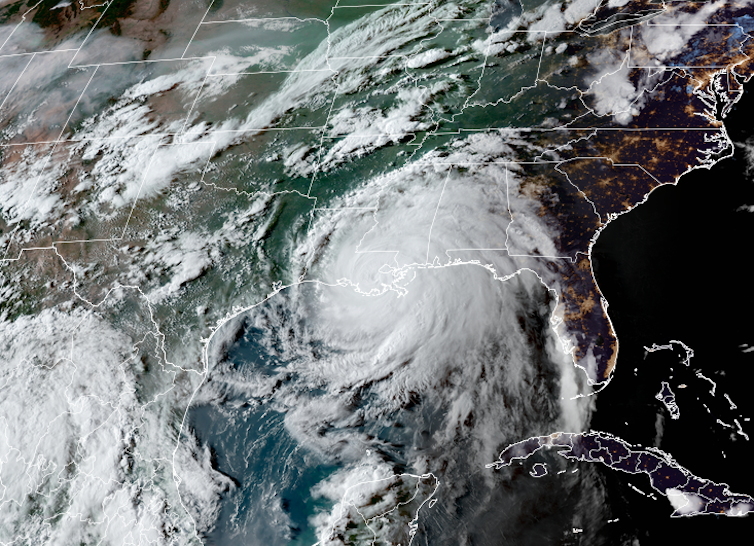
Hurricane Ida making landfall on the Louisana coast
Hurricane Ida did $74 billion in damage from Louisiana to the Northeast in 2021. RAMMB/CIRA/Colorado State University

Our study provided the first analysis of 2021’s ocean warming, and we were able to attribute the warming to human activities. Global warming is alive and well, unfortunately.

The global mean surface temperature was the fifth or sixth warmest on record in 2021 (the record depends on the dataset used), in part, because of the year-long La Niña conditions, in which cool conditions in the tropical Pacific influence weather patterns around the world.
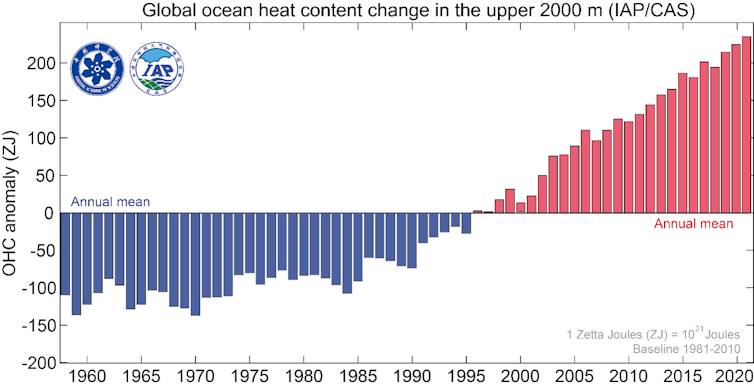
Ocean heat content in the upper 2,000 meters of the world’s oceans since 1958, relative to the 1981-2010 average. Ocean temperature records go back to the 1950s. The units are zettajoules. Lijing Cheng

There is a lot more natural variability in surface air temperatures than in ocean temperatures because of El Niño/La Niña and weather events.

That natural variability on top of a warming ocean creates hot spots, sometimes called “marine heat waves,” that vary from year to year.

Those hot spots have profound influences on marine life, from tiny plankton to fish, marine mammals and birds. Other hot spots are responsible for more activity in the atmosphere, such as hurricanes.

While surface temperatures are both a consequence and a cause, the main source of the phenomena causing extremes relates to ocean heat that energizes weather systems.
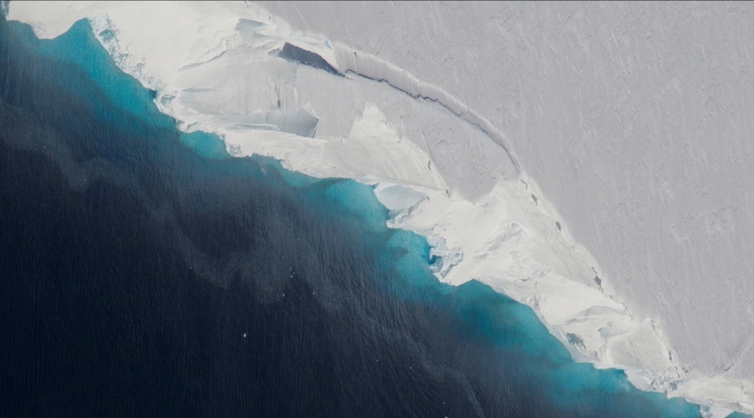
Scientists are concerned about the stability of Antarctica’s Thwaites Glacier, which holds back large amounts of land ice. NASA

We found that all oceans are warming, with the largest amounts of warming in the Atlantic Ocean and in the Southern Ocean surrounding Antarctica.

That’s a concern for Antarctica’s ice – heat in the Southern Ocean can creep under Antarctica’s ice shelves, thinning them and resulting in calving off of huge icebergs. Warming oceans are also a concern for sea level rise.

In what ways does extra ocean heat affect air temperature and moisture on land?

The global heating increases evaporation and drying on land, as well as raising temperatures, increasing risk of heat waves and wildfires. We’ve seen the impact in 2021, especially in western North America, but also amid heat waves in Russia, Greece, Italy and Turkey.

The warmer oceans also supply atmospheric rivers of moisture to land areas, increasing the risk of flooding, like the U.S. West Coast has been experiencing.

2021 saw several destructive cyclones, including Hurricane Ida in the U.S. and Typhoon Rai in the Philippines. How does ocean temperature affect storms like those?

Warmer oceans provide extra moisture to the atmosphere. That extra moisture fuels storms, especially hurricanes. The result can be prodigious rainfall, as the U.S. saw from Ida, and widespread flooding as occurred in many places over the past year.

The storms may also become more intense, bigger and last longer. Several major flooding events have occurred in Australia this past year, and also in New Zealand. Bigger snowfalls can also occur in winter provided temperatures remain below about freezing because warmer air holds more moisture.
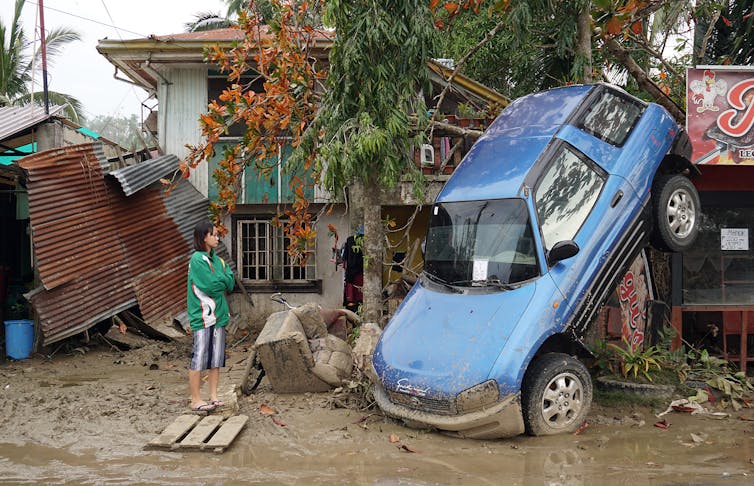
A woman stands, arms crossed, staring at a car propped on its nose against a business after the typhoon.
A resident in the Philippines looks at a vehicle swept away by flood water during Typhoon Rai. Cheryl Baldicantos/AFP via Getty Images

If greenhouse gas emissions slowed, would the ocean cool down?

In the oceans, warm water sits on top of cooler denser waters. However, the oceans warm from the top down, and consequently the ocean is becoming more stratified. This inhibits mixing between layers that otherwise allows the ocean to warm to deeper levels and to take up carbon dioxide and oxygen. Hence it impacts all marine life.

We found that the top 500 meters of the ocean has clearly been warming since 1980; the 500-1,000 meter depths have been warming since about 1990; the 1,000-1,500 meter depths since 1998; and below 1,500 meters since about 2005.

The slow penetration of heat downward means that oceans will continue to warm, and sea level will continue to rise even after greenhouse gases are stabilized.

The final area to pay attention to is the need to expand scientists’ ability to monitor changes in the oceans.

One way we do this is through the Argo array – currently about 3,900 profiling floats that send back data on temperature and salinity from the surface to about 2,000 meters in depth, measured as they rise up and then sink back down, in ocean basins around the world.

These robotic, diving and drifting instruments require constant replenishment and their observations are invaluable.
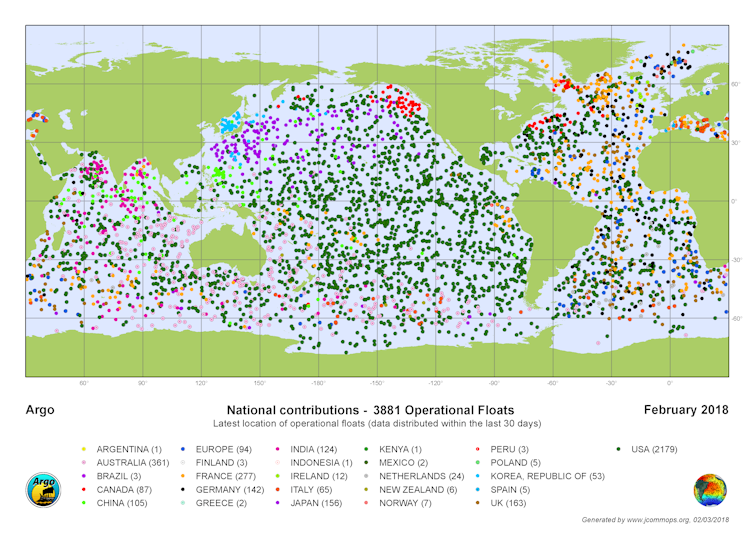
Argo floats keep tabs on ocean changes around the world. Howard Freeland, 2018, CC BY-ND


Links

(AU ABC) Channel Country Gas Development Could Increase National Emissions By 60 Per Cent, Report Says

ABC News - Nathan Morris

A pattern of channels among green herbage and wildflowers near Windorah in July 2019.
The channels in Queensland's south west after flooding in 2019 — not far from where gas development is proposed. (ABC Southern Queensland: Nathan Morris)

Key Points
  • Professor Ian Lowe says emissions from a proposed Queensland gas development is incompatible with government pledges to cut carbon
  • The Queensland government says emissions reduction targets "are achievable"
  • "Fugitive emissions" in Queensland are the highest in the nation and "the long-term trend is increasing" 
A new report by a leading climate change expert has found that proposed gas development in the Lake Eyre Basin could increase Australia's total annual emissions by 60 per cent. 

Last month the ABC revealed that, without consulting traditional owner groups, the Queensland government had progressed plans for gas development in the environmentally fragile Channel Country, a vast system of flood plains in the state's south west.

A report, commissioned by environmental group Lock the Gate by leading climate change scientist Emeritus Professor Ian Lowe from Griffith University, modelled the potential carbon emissions if the gas projects in Queensland went ahead.

The Queensland component of the gas is in the Cooper-Eromanga Basin, and Professor Lowe found that if just 25 per cent of the resource was recovered, the emissions it would produce would be "incompatible" with Queensland's emission reduction targets.
"It would increase greenhouse gas emissions by about 60 per cent of Australia's current total national emissions from all sources: electricity, transport, manufacturing agriculture," he said.
"The high level of production would be about 300 million tonnes of carbon dioxide a year, and Australia's current total emissions from all causes is about 500 million tonnes a year."

An aerial shot of cattle grazing in a green paddock
The Channel Country's flood plains are home to a large sustainable grazing industry. (Supplied: OBE Organic)

The Queensland government has pledged to reduce emissions by 30 per cent of 2005 levels by 2030, but Professor Lowe's report found that even "the low export scenario would result in Scope 1 emissions alone that are more than 50 per cent of Queensland's proposed reduction of 31 million tonnes a year from all sources by 2030."

"Even a modest level of production would be incompatible with Queensland stated emission reduction targets," he said.

A map of locations in the Channel Country have production licences from Origin Energy
More than 250,000 hectares of land in the Channel Country is subject to Origin Energy's applications. (Supplied: Queensland Government)

Targets 'achievable'

But the Queensland government said its emissions targets were "achievable".
"In fact, Queensland achieved 20 per cent of its renewable energy target by 2020 and is almost halfway to reaching its 2030 emissions reduction target, having reduced emissions by 14 per cent since 2005," a spokesperson said.
Traditional owners call for a pause
on Channel Country fracking plans
Birds eye view of the veins of the Kati Thanda-Lake Eyre basin river systems
The Lake Eyre Basin contains an estimated 334 trillion cubic feet of "unconventional gas", meaning to release the gas from the predominantly shale rock formation, gas wells would need to be depressurised by extracting groundwater or hydraulic fracturing, also known as fracking. 

There is concern among traditional owners and graziers in the area, but the Queensland government spokesperson said that additional approvals were still required before gas development could occur in the region, and they would be "subject to stringent assessment criteria".

Fugitive emissions

Professor Lowe said the Lake Eyre Basin contained high levels of additional CO2, which would be released directly into the atmosphere during gas extraction.

"The gas there contains significant amounts of carbon dioxide, so just producing the gas to be burned somewhere else would result in the release of significant amounts of carbon dioxide into the Australian atmosphere," he said.

A map of the Lake Eyre Basin
The Lake Eyre Basin covers large parts of four Australian states and territories. (ABC News: Alex Palmer)

The other factor was the "fugitive emissions" from gas production, the methane gas that either escapes or has to be vented from production pipelines for safety.

Queensland has the highest fugitive emissions from coal and gas mining in the nation, and they continue to rise.

A 2018 Queensland government report found fugitive emissions represented "11 per cent of Queensland's total emissions and the long-term trend is increasing emissions".

"Methane is a much more powerful greenhouse gas than carbon dioxide, and so the leakage, if gas were produced in the Channel Country, would add significantly to our greenhouse gas production locally," Professor Lowe said.
"In typical natural gas fields, about 5 per cent of the gas leaks into the atmosphere, in some bad cases at 7 or 8 per cent."
A coal seam gas well and all of the piping and water extraction infrastructure.
Coal seam gas mining is widespread further east of the Channel Country, and criss-crosses farm land. (ABC Southern Queensland: Nathan Morris)


A spokesperson for the Queensland government said it had a plan to reduce fugitive emissions.

"The Palaszczuk government has committed in its draft 30-year-plan for the resources industry to work with industry to investigate ways to reduce fugitive emissions from resource activities, particularly in the Bowen Basin," they said.
"It also expects industry to reduce emissions, including fugitive emissions."
'Making enormous money'

After gas prices fell during 2020, international demand for the resource has rebounded, and the International Energy Agency forecasts more growth in the coming years.

"All these gas companies at the moment are trying to produce as much gas and ship as much gas as they possibly can," Bruce Robertson said, an Energy Finance Analyst with the Institute for Energy Economics and Financial Analysis (IEEFA).

"Even if it's not contracted gas, they're making enormous money on it."

Coal seam gas wells near Chinchilla
Coal seam gas wells in an area south of Chinchilla in southern Qld, near the Tara residential estate. (AAP: Supplied)


However, last year another report from the International Energy Agency said:
"Beyond projects already committed as of 2021, there are no new oil and gas fields approved for development in our pathway [to net-zero], and no new coal mines or mine extensions are required."
Mr Robertson said this was at odds with the continued enthusiasm for fossil fuel projects in Australia.

"In every state and territory, we're seeing new areas opened up for exploration by the current governments," he said.

"We're seeing this massive expansion of the gas industry, which is entirely inconsistent with any climate commitments."

While demand for gas remained strong now, Mr Robertson thought that would change.
"The change is very rapid when it occurs, and all the factors are in place for that change to occur in gas and when it comes it will come very quickly," he said.
"In New South Wales, for example, the state where I live, there are 17 battery projects, grid-scale battery projects in the planning system right now." 

Resources a major economic driver

Farmer welcomes CSG Farmer Ian Hayllor stands near gas drilling rig on his farm near Dalby in June 2021.

A report in December 2021 by the Federal Department of Resources found oil and gas projects "accounted for the largest share of committed projects by value".

The Queensland government also reports that the resources industry directly employs around 80,000 people in the state.

And according to Australian Petroleum Production and Exploration Association (APPEA), liquefied natural gas (LNG) and oil projects generated $13.20 billion in royalties and contributed $55 billion to national GDP. 

Links

(Radio New Zealand) Climate Change: 'One In 50-Year Event Is Now One In 10-Year Event', Says Scientist


New Zealand had the hottest national average temperature last year, but the single highest temperature recorded in the country remains unbeaten.

No caption
Photo: RNZ / Cosmo Kentish-Barnes

National Institute of Water and Atmospheric Research's (NIWA) annual climate report was released yesterday, with Canterbury's Rangiora holding onto a near 50-year record of 42.4C.

Last year's highest recorded temperature was 39.4C in Ashburton.

Weather events exacerbated by climate change are thought to be bringing a hotter, drier climate to Aotearoa's shores.

NIWA meteorologist Nava Fedaeff said a hot north-westerly wind from Australia was key to scorching days.

"Canterbury is often the place where we see the hottest temperatures and that's because of our friends, the Southern Alps," Fedaeff said.

"The recipe for our hottest temperatures recorded is usually a north westerly wind flow coming from Australia."

As the wind blows over the Southern Alps, it heats the other side in a process called the Foehn Effect, creating warm, dry conditions on the east coast.

Fedaeff said the phenomenon was common knowledge to locals.

"Anyone living on the east coast of the South Island is very familiar with a nor'wester wind."

This wind is expected to become more frequent, thanks to climate change, and could bring more droughts to the Canterbury Plains.

At the beginning of the year many parts of Canterbury were drought stricken.
Many parts of Canterbury were drought-stricken at the beginning of 2017. Photo: RNZ / Patrick Phelps

Manaaki Whenua - Landcare Research senior scientist Nick Cradock-Henry said more work was needed to adapt the country to new climate conditions.

Dr Cradock-Henry believes "there's no going back."

"There's a certain amount of change that is essentially 'baked' into the climate change system ... we need to put a greater emphasis on adaptation," he said.

Extreme rainfall events, floods, droughts and coastal erosion would effect Canterbury, he said, but he believed local councils were so far responding well.

"In Canterbury, regional councils have a significant responsibility and certainly Environment Canterbury and Christchurch City Council have both been stepping up.

"Thirty-year investment decisions need to take a much longer view ... We need to be recognising the one in 50-year event is now the one in ten-year event."

Links

Friday, January 14, 2022

(AU RenewEconomy) South Australia Sets Smashing New Renewables Record In Final Days Of 2021

RenewEconomy - 

Pacific Hydro's Clements Gap wind farm in South Australia

South Australia set an impressive new renewable energy record in the final days of 2021, with the state’s solar and wind farms and rooftop solar systems supplying an average of just over 100% of local demand every day for a period of almost one week.

The unprecedented uninterrupted stretch of 100%-plus renewable energy output in South Australia was documented by data analyst Geoff Eldridge at NEMlog. Eldridge confirms that the state’s renewables share averaged slightly over 100% of demand (101%) for a period of 156 hours, or 6.5 days, ending on Wednesday December 29.


According to the charts supplied by NEMlog (see above), the share of wind over those six-and-a-half days averaged at 64.4%, while rooftop PV averaged 29.5%, and the share of utility-scale solar averaged 6.2%.

The average renewables share would have been higher, but for curtailment of semi-scheduled generation, which Eldridge notes averaged at 8.2% over the period (4.8% wind + 3.4% utility solar) see below curtailment chart.


The contribution from gas over the period was minimal, averaging 114MW, ranging from 43MW to 405MW, for the period. (See graph below.)


It is not uncommon for renewables to supply a more than 100% share of South Australia’s demand, these days – although this is the first time it has happened for so many days in a row.

In the same month last year, wind and solar set a record share of local demand – reaching a peak of 142.3 per cent on the morning of Sunday, December 19.

That record – documented again by Eldridge – beat the previous record of 137.3 per cent and came amid reduced gas generation and increased exports to Victoria, as well as the introduction of new grid protocols in the state.

The Australian Energy Market Operator has significantly reduced the need for gas generators to operate in the background at times of high wind and/or solar output in South Australia, thanks to the commissioning of four synchronous condensers that can provide much of the system strength originally sourced from gas.

That means that the “directions” and “interventions” issued by AEMO can be vastly reduced, and the amount of wind and solar allowed to export to the grid to be significantly increased at certain times.

Links

(AU ABC) Seeds Of Beauty Leaf Tree Examined As Source Of Low-Emissions Biodiesel

ABC Capricornia | Jasmine Hines

A man in a high vis shirt is holding two canisters of liquid
Researcher Ashwath Nanjappa with beauty leaf tree bio oil (left) and bio liquor (right). (Supplied: CQ University)

Key Points
  • The native beauty leaf tree could be grown in large-scale plantations on marginal land for biofuel
  • Researcher Nanjappa Ashwath says the trees could produce 4,000 litres of biofuel per hectare each year
  • The bioenergy sector could contribute an extra $10 billion to the economy annually by the 2030s
As Australia pushes forward in its net zero emissions commitments, some believe the key to a greener fuel could be hidden in the oil-rich seeds of the native beauty leaf tree.

But CQ University researcher Nanjappa Ashwath says he has found the beauty leaf tree can be grown on marginal land, ending the food-versus-fuel land-use debate that has plagued the biofuel sector.
"The tree produces about 10,000 fruits per tree per year, which equals to it producing up to 4,000 litres of biodiesel per hectare per year – and that's growing up in a really marginal soil," he said.
A man taking a selfie and smiling, there are trees with large leaves in the background.
CQ University's Nanjappa Ashwath says the trees can be grown on land not fit for agricultural purposes. (Supplied: CQUniversity)

A hardy alternative

Associate Professor Ashwath describes the tree as being similar to a medium-sized mango tree, or a macadamia tree with seeds and a kernel inside but with a softer shell.

He said the biofuel produced within that shell had been tested in engines with just a "slight reduction in power" compared to traditional petroleum diesel. It performed similarly to other biodiesels.

Dr Ashwath said in good news for time-poor producers, the seeds did not require harvesting as they naturally fell to the ground and could be collected up to six months later.

He said the oils of the tree could also be made into the less-profitable medicinal Tamanu oil, with 15 millimetres costing about $25.

A pile of large, round seeds.
The plant's seeds contain up to 60 per cent oil. (Supplied: CQUniversity)

"That supplied whole oil as the medicine is a limited market, whereas if you use the same oil for biodiesel production, the scope it's not limited because 80 per cent of fuel [in Australia] is imported," he said.
Dr Ashwath said his research showed the plant grew well in soil which was not rich in nutrients.

And while it did not grow in drought, he said it tolerated hot and dry conditions as well as waterlogging, making it a suitable plantation for areas in northern Australia from Rockhampton up to Cairns, including around Darwin.

A man wearing a blue shirt and a hat inspects the leaves of a tree, there are several potted trees around him.
Dr Ashwath says the seeds' oil is a good option for future biodiesel production. (Supplied: CQUniversity)

Biofuel growth

The federal government outlined its commitment to bioenergy in its release of the first Bioenergy Roadmap in November.

The roadmap says that by the start of the next decade, the sector could contribute about $10 billion in extra GDP per year with 26,200 new jobs, reducing emissions by 9 per cent and enhancing fuel security.

It also predicts bioenergy could grow from 3 per cent of Australia's total energy consumption to up to 20 per cent by the 2050s.

Ships use the world's heaviest fuel.
This one burns vegetable oil

Edwine Oldendorff
The country's first grain ship powered by biofuel is set to leave port, only the second time the renewable fuel alternative has been used in an Australian export ship. Read more
Dr Ashwath said overall demand for biodiesel remained low because it was still cheaper to buy traditional petroleum diesel, but other countries were showing interest in the beauty leaf tree.
"There are many inquiries, especially in Indonesia [where] they're establishing quite large plantations, especially in the islands where they don't have the supply of the petroleum diesel," he said.
"Papua New Guinea is also interested in growing these because these plantations occur naturally, and Sri Lanka is also doing quite a lot of research on it."

But Dr Ashwath said for producers looking for extra income, plantations of thousands of hectares would be required to turn a profit.

Links

(Deutsche Welle) What To Expect From The World's Sixth Mass Extinction

Deutsche Welle - Alistair Walsh

Humans alive today are witnessing the beginning of the first mass extinction in 65 million years. What does biodiversity loss mean for us and the environment?

Aerial shot of dead sheep scattered across a dry landscape
The impacts of biodiversity loss could have wide-ranging impacts

About 65 million years after the last mass extinction, which marked the end of dinosaurs' roaming the planet, scientists are warning that we are in the early throes of another such annihilation event. Unlike any other, this sixth mass die-off — or Anthropocene extinction — is the only one caused by humans, and climate change, habitat destruction, pollution and industrial agriculture all play a hand.

In mass extinctions, at least three-quarters of all species cease to exist within about 3 million years. Some scientists believe that at our current rate, we could be on track to lose that number within a few centuries.

Over the next few decades alone, at least 1 million species are at risk of being wiped out. That's according to an estimate in a landmark report published in 2019 — but many scientists say it could well be an undercount.

Trying to predict the results of a complete collapse in biodiversity is almost a black art — ecosystems are incredibly complex.

Scientists agree, however, that there are several clear predictions should extinctions continue at this rate. And all the effects are inextricably linked, like a game of Jenga.

Loss of food security

"I think the first thing we'll see is that our food supply starts to dwindle quite markedly, because so much of our food depends on pollination," said Corey Bradshaw, a professor of global ecology at Flinders University in South Australia, who uses mathematical models to show the interplay between humans and ecosystems.

A bee on a flower head, pollen on its legs
Bees play a vital role in ensuring our food security

About one-third of the world's food supply relies on pollinators such as bees, and, if they die out, agricultural yields could plummet, Bradshaw said.

Some crop pests may thrive as predators drop off, further impacting monoculture harvests.

And millions of people rely on wild species for nutrition and their livelihoods, particularly on coastal and inland fisheries, which are especially vulnerable to disappearing.

According to Bradshaw, this lack of food security, which will also be connected to increased drought and flooding, will hit poorer regions hardest — particularly sub-Saharan Africa and parts of Southeast Asia.

Soil fertility

The quality of soil is also expected to deteriorate if critical microorganisms die off. Though underrepresented in the data, some researchers believe they are potentially vanishing at a faster rate than other species. Their disappearance could lead to worsening erosion, which in turn results in more floods, as well as poorer fertility, which again impacts crop growth.

A single flower pushed through cracked, dry ground
Healthy soils rely on microorganisms that some scientists say are dying out at rapid rates

Colman O'Criodain, the policy manager for conservation organization WWF International, said this was particularly dangerous.

"The organic matter in a way is kind of like the glue that holds everything together. If you think of it like a Christmas pudding, it has some dry ingredients like breadcrumbs and flour and dried fruits, but it's the eggs and the stout and so on that hold it together and make it soft and mushy and give it its shape," O'Criodain said.

Water shortages and natural disasters

A lot of the world's fresh water comes from wetlands that purify and redistribute this life source. The Himalayan water tower for example, which is fed by rivers and wetlands, supplies about two billion people. If systems like these collapse, as a result of impacts including algae blooms and receding vegetation, humanity could lose a lot of water for drinking and agricultural use.

As forests recede, rainfall patterns are likely to shift as evapotranspiration — the process in which moisture is returned to the atmosphere through evaporation and plant transpiration — is affected, further drying out the landscape, as has been seen in the Amazon.

The UN Food and Agriculture Organization estimates that about 10 million hectares (24 million acres) of forest were cut down annually from 2015.

Green forest borders deforested areas where the ground has been laid bare
The Amazon rainforest is under threat from deforestation

And with the loss of trees and vegetation — fundamental regulators of atmospheric carbon dioxide — climate change is expected to worsen, triggering more extreme weather events. Drier conditions and unhealthy forests also increase the risk of wildfire.

Meanwhile, crop failures and other ecological threats will likely trigger mass migrations as people escape famine and conflict over dwindling resources.

Loss of resilience and more pandemics

"What we have done as humans is simplify the whole planet, especially the production ecosystems, to such an extent that they have become vulnerable," Carl Folke, a transdisciplinary environmental scientist and the founder of the Stockholm Resilience Centre for research into sustainability science, told DW.

"Resilience is often called the science of surprise. If you are living with very stable conditions and everything is predictable, you don't need that buffer of biodiversity. But if you're living in more turbulent times with more unpredictable situations, that type of portfolio of options becomes extremely important," Folke said.

A swab is taken from a bat
Teams of researchers around the world are studying species from which another pandemic could possibly emerge

Researchers have also warned that loss of biodiversity could lead to an increased risk of pandemics as wild animals and humans come into closer contact through habitat fragmentation and disruption of natural systems.

The oft-cited example of this already happening is the 2014 Ebola outbreak in West Africa, believed to have been caused by children playing in a hollowed-out tree full of bats. Though the origin of COVID is still unclear, the results of some scientific studies link it to wild bats.

A fundamental loss of heritage, culture and the intangible

These effects are only those that can be quantified. For many conservationists and scientists, recklessly allowing species to go extinct is akin to vandalism. Even if we survive and avoid the catastrophic consequences, the world would be greatly and irreversibly diminished by mass extinctions.

The most tragic losses could be those we cannot even see.

"Think about the consequences of extinction as burning an art gallery. So you're not even thinking about a potential direct value at all, but you're thinking about the intangible loss of the World Heritage," said Thomas Brooks, the chief scientist at the International Union for Conservation of Nature (IUCN).

"Remember, any single species is a product of millions of years of evolution. You're looking at the loss of what makes humanity part of the planet. You're looking at what makes us whole," he continued.

Photo taken on June 3, 2016, shows the landscape of Mavinga conservation area in Cuando-Cubango, Angola. Mavinga conservation area lies on the east part of Angola's Cuando-Cubango Province, being part of the Kavango-Zambezi Transfrontier Conservation Area spanning five southern African countries, Angola, Botswana, Namibia, Zambia and Zimbabwe.
Conservationists are calling for large swaths of the earth to be turned into actively managed conservation areas

Can species loss be reversed?

Despite these catastrophic predictions, there is some cause for optimism. If humans do something.

"There are what sometimes appear to be insurmountable odds facing conservation of life on Earth. But, on the other hand, there are also very many inspiring stories of success, and examples of cases where people have been able to turn the tide, to put in place actions that allow the curve to be bent or the trends to go in the right direction," Brooks said.

And Brooks is intimately familiar with the challenges faced. The IUCN painstakingly produces the Red List, which forms the fundamental basis of scientific insights into species loss.

Research shows that conservation efforts work. A recent study found that had it not been for conservation interventions, losses would have been three to four times worse since 1993.

Watch video 3min 21sec

UN biodiversity chief: 'Without biodiversity, there would be no life'


Scaling up conservation success stories — such as the reintroduction of beavers in Europe — appears to be a key weapon in the battle against biodiversity loss.

Elizabeth L. Bennett, the Wildlife Conservation Society's vice president for species conservation, is adamant that setting aside large conservation areas can make a significant difference to biodiversity.

"If it's in the right places and very well planned and very well managed, then it will certainly help a lot," she said.

As a first step to that goal, the Wildlife Conservation Society is pushing for the adoption of the "30 by 30" agreement at the Kunming Convention on Biological Diversity (COP15) in spring, in which 30% of lands and seas would be placed under protection by 2030 — roughly double what the world has now.

Achieving that would be a good start, but any agreements struck at COP15 will only be the beginning of a long journey.

As the WWF's O'Criodain put it: "We all look back to when we passed our final exams and we thought for certain that the world was our oyster. Really, it's one step, but there's still plenty of time to mess up our lives."

Links

Lethal Heating is a citizens' initiative