Thursday, January 27, 2022

(Yahoo News Australia) What Australia Looks Like In 2050: 'A Very Different World'

Yahoo News Australia - Michael Dahlstrom

We've asked the world's top experts to predict how Australia will look in the years 2030, 2050 and 2100.
  • 2030: More extreme weather
  • 2050: A different world to today
  • 2100: Either uninhabitable or beginning to repair

By 2100 Australia's weather will be very different than it is today. Source: Getty - File

As global warming continues to disrupt seasonal norms, many Aussies could have already experienced the most stable temperatures of their lifetimes.

Over the coming two decades, extreme weather is set to disrupt society with increasingly severe bushfires, drought and storms.

The good news is by the end of the century, living on Earth could actually be more pleasant than it is today.

Working to predict how the future may look, we spoke with climate scientist Professor Tim Flannery who examined what life will be like if we reduce greenhouse gas emissions compared with failure to act.

Professor Flannery has been warning about the impact of global warming for decades and is the author of over 20 books, a founding member of advocacy group Climate Council, and the 2007 Australian of the Year.

Over the last 10 years, he has witnessed global warming shift from being “mostly theoretical” in the public consciousness to something that affects us all.


“I think we’re living now in the era of early climate change impacts,” he told Yahoo News Australia.

“There is no doubt that we’re going to see more and more of these extreme weather events, but I guess in the future they may not seem so extreme.”

How climate change will harm Australia by 2030


Looking towards 2030 can be a little frightening as the carbon and methane emissions already in the atmosphere continue to impact the climate.

A comparison of the periods July 1950 - June 1985 and July 1985 - June 2020 shows dangerous fire weather days have already increased. Source: BoM

“The trajectory is pretty baked in for the next decade or two because carbon takes a long time to reach its full warming potential… we should prepare for that,” Prof Flannery said.

“Australia already has average temperatures over the continent above 1.5 degrees above the pre-industrial average, while the rest of the world is at 1.1 degrees.

“In a decade from now the rest of the world will probably be at 1.5 degrees and Australia will probably be around 2 degrees, maybe a bit more.”

Once Australia hits this climate milestone, Prof Flannery warns the country will begin to experience the “really serious impacts” scientists have been warning about.


The warming will likely cause a number of key trends:

  • Accelerated sea level rise and worsening coastal erosion
  • Increased weather intensity including Category 6 cyclones
  • More frequent and extreme bushfires
  • A greater chance of extreme flood events


How climate change could impact Australia by 2050

Australia now faces a sliding doors moment when it comes to how the country will look in 2050.

Without meaningful steps to tackle the crisis, Prof Flannery warns we’re looking at “such a different world” – though it’s difficult to predict a complete picture.

Although each approach reaches net zero by 2050, the emissions accumulated during the intervening years differs, leading scientists to call for hard and fast cuts now. Source: Climate Council

“If we don’t take action, and we continue to emit at current levels, by 2050 we are going to be probably close to 3 degrees of warming,” he said.

“At that stage we will have triggered some of the positive feedback loops that drive warming ever faster.

“No matter what we do at that point there's very little impact that we'll have, particularly in terms of shifting to clean energy and closing off our polluting plan, because the damage will already have been done.”

An alternative vision of 2050 explained


Despite his bleak forecasts, Prof Flannery remains confident that the worst impacts of the climate crisis can be avoided.


During the COP26 climate talks he witnessed commitments from government and industry which he believes will see global warming kept below 2 degrees.

“I prefer to not look at that grimmer possible future; It feels to me to be disempowering,” he said.

“I put all of my energy into avoiding that worse future.”

If emissions are sharply decreased by 2030, there will be less severe climate change impact by 2050.

The world may then be focused on removing carbon from the atmosphere and improving biodiversity.

“So restoring forests, restoring ocean health, looking at those half dozen possibilities that exist for getting carbon dioxide out of the air at scale,” he said.

“We’ll be really nudging those tipping points at that time, and anything we can do to reduce that impact is going to be absolutely essential.”

What other leaders say about the climate crisis


Civilisations could collapse by 2100

Despite only dealing with probabilities, scientists predict without a determined effort to reduce emissions, the globe will likely experience 4 degrees of warming by 2100.

“That makes large parts of Australia and other continents uninhabitable,” Prof Flannery warns.

Australia may actually be a healthier place to live in 2100. Source: Getty - File

While the food, medical and transport sectors have all been disrupted by the coronavirus pandemic, that will pale in comparison to the impact of systemic change.

Sustainable patterns of supply that keep our world functioning will begin to collapse and so too will our civilisations. 

Why life on Earth could be wonderful by 2100

The further into the future we look, the more time humans will have had to repair the damage they have cause to the planet.

“By 2050, regardless of what we do, we're still going to be in a titanic struggle against the changes that we've already set in place,” Prof Flannery said.

“By 2100, with emphatic action to deal with these problems, I think we could be living in a healing world, a world that's much better than the world we live in today, with restored forests, biodiversity, ocean health and more stability in many ways.

“That possibility is out there. But it will take a lot of work for us to get to that point.”


Links

(Architectural Digest) Australia Just Opened The Climate Change-Focused Museum Of The Future—And It’s Beautiful

Architectural Digest -  Jessica Cherner

Built on the 2,471-acre estate formerly belonging to famed painter Arthur Boyd, Bundanon is now a sprawling destination for both art and ecology

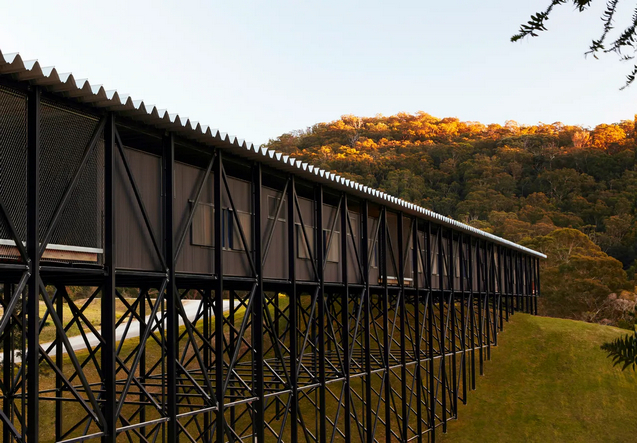
One of the two Kerstin Thompson Architects-designed structures at Bundanon is The Bridge, a 530-foot-long architectural marvel with built-in guest rooms. Photo: Zan Wimberley

In places where the effects of climate change are as frequent as they are devastating, sustainable architecture is perhaps as—if not more—important as aesthetics. Bundanon, the 1,000-hectare arts destination in regional New South Wales, Australia, is taking sustainability to a rather unheard of level.

Designed by the Australian firm Kerstin Thompson Architects (KTA), the new Art Museum and Bridge for Creative Learning is intended to respond and adapt to both current and future climate disasters. The nearly 530-foot-long bridge is positioned so high that floodwaters can flow beneath it rather than on it. What’s more, the art museum is hidden within a hill to protect itself against wildfires.

And if this wasn’t impressive enough for a building, this beautifully constructed fire-resistant infrastructure happens to house a $46.5-million, 4,000-piece contemporary art collection.

The Bridge is built on stilts to avoid inevitable floods. In fact, it was designed in such a way that it would be able to adapt to and even benefit from climate change-induced events. Because flood waters flow beneath The Bridge, the water is harvested and stored for later use. Plus, the whole structure is powered by solar energy. Photo: Zan Wimberley

The two new structures, which opened to the public on January 29 (with an official ceremony and festival of events coming later in the year), were constructed to be environmentally responsible. “Art museums have historically run with high energy consumption,” Bundanon CEO Rachel Kent explains.

“Both cooling and heating systems are needed, for example, to maintain a stable temperature critical to the conservation of artworks. With the current climate crisis, this is clearly unsustainable. It is vital that museums and galleries, like other industry sectors, actively seek solutions that aim to have a net-zero energy target.”

Chief among the energy-saving elements at Bundanon’s new art museum is the solar panels that power the entire museum. One of the many structures on the massive property that will house these solar panels includes the home where famed Australian artist Arthur Boyd and his wife Yvonne lived before donating their estate to Australia in 1993.

Though the estate covers a large swath of ground—2,471 acres, to be exact—it’s split up into two clusters. The first groups the Homestead, Arthur Boyd Studio, and Artists in Residence Complex, while the second one houses the Boyd Education Centre, the new KTA–designed Art Museum, and The Bridge.

Australian artist Arthur Boyd and his wife Yvonne lived on the enormous estate until they donated it in the early 1990s. His studio was only steps away from the couple’s home. Photo: John Janson-Moore

The 541-foot-long by 30-foot-wide bridge borders the museum and comprises 34 guest rooms, dining spaces, and a public cafe—amenities nearly ever other traditional bridges lack.

Plus, The Bridge is where Bundanon and KTA’s sustainably-minded ambitions come into play: It’s powered by the aforementioned solar panels, but also enlists passive temperature management and black water treatment, while harvesting and storing rainwater.

Kent adds, “It would be ideal if these solutions and more could be integrated into the museum sector as a standard.”

Perhaps as important as the sustainability of Bundanon’s new additions is the landscaping, which celebrates the surrounding area’s natural heritage—indigenous and pastoral. Of course, there’s also a subtle homage to the Boyds, with their domesticated garden that has been integrated with the bucolic clearings.

For the highly specific landscaping, the Bundanon visionaries turned to landscape architects Wraight Associates and Craig Burton, who rather than place the primary focus on the aesthetic, made ecology the centerpiece of the grounds. Like nearly every aspect of Bundanon, there’s more to the landscaping than trees and gardens.

But that was the architects’ point. They wanted to design groundbreaking structures that are as beautiful as they are full of purpose. The Bridge and museum aren’t there for decoration; they’re responding to climate change in a way no other art-centric architecture has before.

And, of course, the Australian architects wanted to honor the estate’s original owners. Though Bundanon’s latest additions further solidify the Boyds’ legacy, the enormous artistic estate is more than a place to look at beautiful things in a natural oasis—it’s a step-by-step manual that details how to prevent the disastrous effects of climate change.

Links

(USA EcoWatch) John Kerry Warns ‘We’re in Trouble’ On Climate Change

EcoWatch - 

“Coal is the dirtiest fuel on the planet."

U.S. special climate envoy, John Kerry speaks during the COP26 climate change conference on November 10, 2021 in Glasgow, Scotland. Jeff J Mitchell / Getty Images

John Kerry, the first United States special presidential envoy for climate, said that the world is “not on a good track” in its goal of avoiding the worst effects of climate change, Reuters reported.

Kerry said actions to move away from fossil fuels must be strengthened this decade. On Monday, Kerry addressed “Building Momentum to UN COP27,” an event hosted by officials from Egypt — who will host the next UN climate summit — and the U.S. Chamber of Commerce.

“We’re in trouble, I hope everybody understands that. Not trouble we can’t get out of, but we’re not on a good track,” Kerry said, as The Hill reported.

 Kerry expressed concern regarding the recent increase in global coal use and about plans for the building of new coal plants that don’t use carbon capture technology, reported Reuters.

According to The Hill, Kerry blamed coal use for “the worst” of climate change.

“Coal is the dirtiest fuel on the planet, no one has figured out how to make it clean, even though they talk about clean coal,” Kerry said.

 Kerry expressed that he is in support of gas if it incorporates carbon capture technology, Reuters reported.

“Many countries — most countries — have the ability to deploy very significant additional amounts of renewables, and they’re not doing it,” Kerry said, as The Hill reported.

Kerry said that, instead, gas usage in those countries has increased, adding that gas could be used as a “bridge fuel,” but that building gas infrastructure indefinitely would undermine the good it might do.

“If you can capture 100 percent [of emissions] and it makes it affordable — that’s wonderful. But we’re not doing that,” Kerry added, as reported by The Hill.

Kerry expressed that while the COP26 summit in Glasgow resulted in a lot of good, the planet is reaching dangerous tipping points. He cited recent research that found that the Arctic is warming four times faster than the rest of the Earth.

“No government in the world has the amount of money we need to affect this transition,” Kerry said at a virtual event last week, CNBC reported. “It will be private sector investment and private sector discovery more than anything else … that’s what’s going to get us out of this hole.”

Kerry said that the number of private sector entities that had set forth net-zero goals at the Glasgow summit encouraged him, reported The Hill.

“We need to be compelled as human beings, as leaders particularly, to respond to this,” added Kerry, as The Hill reported.

Links

Wednesday, January 26, 2022

(BBC) Climate Change: 'Fragile Win' At COP26 Summit Under Threat

BBC News - Matt McGrath

COP President Alok Sharma acknowledges the applause at the end of marathon talks in Glasgow in November. Jeff J Mitchell

COP26 President Alok Sharma has warned that progress made during the summit is at risk of "withering on the vine".

Mr Sharma said that the agreements reached at the Glasgow climate meeting had been a "fragile win" for the world.

But unless the commitments made are turned into action this year, the chances of keeping global temperatures in check will be lost.

Quoting from the popular film, Don't Look Up, he said this was no time to "sit tight and assess".

The UN's COP26 climate summit in November ended with a deal being struck in a bid to stave off severe climate change. This pact was the first ever UN climate deal to explicitly plan to reduce coal - the worst fossil fuel for greenhouse gases.

But the pledges didn't go far enough to limit temperature rise to 1.5C, seen by scientists as the threshold for dangerous impacts from global warming.

Twelve weeks to the day after the start of COP26 (so named because it was the 26th meeting of the Conference of the Parties), Alok Sharma delivered his first major speech since the gathering, at a Chatham House event in Central London.

Mr Sharma is essentially in charge of the negotiations process until the next major conference, COP27, in Egypt in November.

He highlighted the fact that, despite the pandemic, and frayed international relations, countries had worked together at COP26 to deliver the Glasgow Climate Pact.

That agreement, he said, was a significant achievement.

Around 120 world leaders came to COP26 on the banks of the Clyde in November 2021. OLI SCARFF

In Glasgow, countries had agreed to return with new and improved carbon-cutting plans for 2030 by the time of the next major summit in Egypt in November.

The hope is that every nation will increase their national efforts in line with limiting global warming below 1.5C.

Mr Sharma also underlined the progress made in Glasgow on getting rid of the most polluting fossil fuel.

"When my team and I were deliberating on whether we should aim to consign coal power to history, I was warned we would never get the word 'coal' in a COP text," Mr Sharma said.

"Yet every country at COP has agreed to phase-down coal power."

But the achievements in Glasgow will not survive if global leaders don't take concrete action this year, he explained.

"Unless we honour the promises made, to turn the commitments in the Glasgow Climate Pact into action, they will wither on the vine,"Mr Sharma told the audience.

"We will have mitigated no risks. We will have seized no opportunities. Instead, we will have fractured the trust built between nations. And 1.5C will slip from our grasp. So my absolute focus for the UK presidency year is delivery."

Mr Sharma outlined four key priorities for this year, the first of which involves getting countries to increase their actions on cutting carbon. He would be concentrating on getting the richer G20 group of nations to do more.

Alok Sharma meets with the incoming Eqyptian President of COP, Sameh Shoukry. AFP

There must also be a renewed focus on helping countries to adapt to climate change, and to make advances on the issue of loss and damage.

Money was critical to progress, he reiterated.

Come November, leaders of the richer countries must be able to show that the $100bn (£74bn) promised every year from 2020 would finally be delivered.

At a number of points in his speech, Mr Sharma referred to the South African deal put together at COP26.

Countries, including the UK, are stumping up the cash for South Africa to transition away from coal. Mr Sharma indicated that this approach may well be used again.

"Where we can support them, as we're doing with South Africa, in going from coal to a clean energy transition, that's something that developed countries are going to have to do, increasingly."

Links

(INVERSE) Arctic Ice Study Reveals Consequences Of Climate Change Can Last Thousands Of Years

INVERSE - Tara Yarlagadda

It's a matter of millennia, not centuries.


IN 2004, HOLLYWOOD made paleoclimatology — the study of Earth’s ancient climate — pop-culture famous with scientist Jack Hall, who analyzes the Antarctic past only to discover an imminent Ice Age in The Day After Tomorrow. But this kind of work isn’t a Hollywood invention.

Paleoclimatology can help us understand the consequences of present and future climate change. New research on Greenland’s ice sheet shows just how far into the future we can peer — and it isn’t a rosy picture.

A recent study published in the journal PLOS ONE simulated changes to the Greenland ice sheet — an immense body of ice spanning 1.63 million kilometers — between the last interglacial period 125,000 years ago and the year 2100.

The research reveals for the first time the extent of the delayed response that could come if the Greenland ice sheet melts due to shifting temperatures, posing striking implications for the effect of present climate change on melting Arctic ice.

“The evolution of the ice sheet in the past tells us that the response of ice volume to climate change is delayed by several millennia,” Hu Yang, a co-author on the study and a researcher at the Alfred Wegener Institute Helmholtz Center for Polar and Marine Research, tells Inverse.

WHAT’S NEW — The scientists identified three key findings from their simulations, which modeled the Greenland ice sheet over time.
  1. The ice sheet reached its maximum and minimum volumes around 17 to 18,000 years and 5 to 6,000 years ago, respectively — even though extreme climate change had begun occurring several thousand years prior to these dates.
  2. The scientists conclude changes to the Greenland ice sheet lagged behind the actual climate change events by “several millennia.”
  3. In more recent history, between 8,000 years ago and the pre-industrial era, the researchers find that Greenland’s climate grew colder, and the Greenland ice sheet also grew in volume until the second half of the twentieth century, even though temperatures began rising in the 1850s after the Industrial Revolution.
In other words, there was a lag in the effect of global warming on the ice sheet’s volume.

All of this means we won’t necessarily see Greenland’s ice sheet melt in real-time as global temperatures dangerously rise. Rather, we might have to wait millennia to see the full effects of climate change on the ice sheet.

“The results show that [Greenland ice sheet] delayed the climate change in the past, and will delay human-induced climate change as well,” Yang says.

The study also reveals how past climate change — paleoclimate — has lingering effects on the present-day melting of the Greenland ice sheet.

“Its evolution is not only controlled by present climate changes but also influenced by past climate,” he adds.


Analyzing how the Greenland ice sheet responded to past climate events could help scientists understand the effects of present-day global warming on the ice sheet. Getty

HOW THEY MADE THE DISCOVERY — Using various earth system and ice sheet models, including one created by the research team’s Alfred Wegener Institute, the researchers simulate changes to the volume of the Greenland ice sheet between 125,000 years ago and the year 2100.

“The current study qualitatively gives a picture of how ice sheets evolve in the past and will possibly evolve in the future,” Yang says.

WHY IT MATTERS — Earth’s past informs the present, and there is no better evidence of that truism than the researchers’ chilling new findings on this massive Arctic ice sheet.

Scientists have already established the link between melting ice in both Greenland and the Arctic circle and global warming. We’re already seeing the effects of such ice melt as rising sea levels pose an imminent threat to coastal cities.

“Within this century, melting of the Greenland ice sheet could, in the worst case of warming, possibly increase the sea level by tens of centimeters,” Yang says.

But according to this new study, we might not see the worst effects of ice melt in our lifetime, leading us to potentially underestimate the devastating effects of climate change on both this monumental ice sheet and sea-level rise.

“More significant sea-level rise from melting could be irreversible and last for several millennia, even if we can stop or reverse the warming,” Yang grimly concludes.

The worst effects of climate change on melting Greeland ice may not be seen for millennia, the researchers conclude. Shutterstock

WHAT’S NEXT — As with any significant initial finding, there are some caveats that future work will have to address.

The researchers acknowledge their model underestimates warming temperatures by 1 degrees Celsius, would could, in turn, underestimate the impacts of the climate crisis on the changing Greenland ice sheet.

“The estimated amplitude of ice mass changes has large uncertainty,” Yang explains. “In the future, we would use better models and combine [on-ground] observations to reduce the uncertainty.”

Nonetheless, ice sheet simulations like this one will continue to be a crucial method for accurately predicting the long-term effects of global warming on the sea-level rise from the Greenland ice sheet.

If we want to truly understand the impact of the climate crisis on ice melt, we need to shift our timeline of analysis from centuries to millennia, the researchers argue.

“The most worrying melting of [the ice sheet] will not occur within decades, or centuries — it could last for [a] thousand years,” Yang says.
ABSTRACT: Using transient climate forcing based on simulations from the Alfred Wegener Institute Earth System Model (AWI-ESM), we simulate the evolution of the Greenland Ice Sheet (GrIS) from the last interglacial (125 ka, kiloyear before present) to 2100 AD with the Parallel Ice Sheet Model (PISM). The impact of paleoclimate, especially the Holocene climate, on the present and future evolution of the GrIS is explored. Our simulations of the past show close agreement with reconstructions with respect to the recent timing of the peaks in the ice volume and the climate of Greenland. The maximum and minimum ice volume at around 18–17 ka and 6–5 ka lag the respective extremes in climate by several thousand years, implying that the ice volume response of the GrIS strongly lags climate change. Given that Greenland’s climate was getting colder from the Holocene Thermal Maximum (i.e., 8 ka) to the Pre-Industrial era, our simulation implies that the GrIS experienced a background growth from the mid-Holocene to the industrial era. Due to this background trend, the GrIS still gains mass until the second half of the 20th century, even though anthropogenic warming begins around 1850 AD. This is also in agreement with observational evidence showing mass loss of the GrIS does not begin earlier than the late 20th century. Our results highlight that the present evolution of the GrIS is not only controlled by the current climate change, but also affected by paleoclimate, especially the relatively warm Holocene climate. We propose that the GrIS was not in equilibrium throughout the entire Holocene and that the slow response to Holocene climate needs to be represented in ice sheet simulations in order to predict ice mass loss, and therefore sea level rise, accurately.
Links - INVERSE Climate Change Articles

(USA CBS News) "Mega" Iceberg Releases 152 Billion Tons Of Fresh Water Into Ocean

CBS News - Li Cohen

When the massive A68A iceberg snapped off its ice shelf in July 2017, it was the sixth-largest iceberg on record. Now more than half of it is gone. 

A study published on January 10 in the journal Remote Sensing of Environment shows that the massive block of ice had broken off from Antarctica's Larsen Ice Shelf in 2017 and traveled northeast to South Georgia by 2021.

The iceberg once measured roughly 5,719 square kilometers — nearly half the size of Connecticut — but it started to disintegrate once it arrived to the South Georgia island in the Atlantic Ocean. 

The European Space Agency described it as a "mega" iceberg, saying it stayed relatively the same size for the first two years of its life as it stayed in the cold waters of the Weddell Sea near the Antarctic Peninsula. Then it started its "epic" journey across the Drake Passage, ESA said, and everything changed.

As of January 2021, it had lost roughly 3,200 square kilometers, or more than half of its area. Now, it's a little bigger than Rhode Island.

Researchers from the University of Leeds, Centre for Polar Observation and Modelling and British Antarctic Survey studied the iceberg through satellite imagery and found that throughout those years of travel the iceberg became smaller as it broke apart and gradually melted.

Over its three-and-a-half-year journey, it's estimated that the iceberg lost roughly 544 cubic kilometers of its ice, about a third of which was due to basal melting. 

In the time it's been around South Georgia, researchers found, the iceberg released roughly 152 billion tons of fresh water and nutrients into the ocean over the course of about three months. That amount of water could fill roughly 61 million Olympic-sized swimming pools. 

This significant loss could result in "potentially impacting the island's rich ecosystem," the study says. 

One of the concerns observers had was that the iceberg would collide with the seafloor near the island. Researchers found, however, that the closest the iceberg got to the island was about 38.5 miles offshore in December 2020.

While A68A did not ground itself on the seafloor, researchers aid, it's likely that it did hit the floor in some of the shallower areas as it turned, and is believed to have affected "only a small area." 

It is possible, however, that other icebergs could end up grounded in the area in the future, which could potentially destroy organisms that reside on the seafloor . A grounded iceberg can also disrupt ocean currents and making it difficult for the island's penguins to feed in the sea, researchers said.

Trajectory of A68A and historic icebergs overlain on a bathymetric map. Observing the disintegration of the A68A iceberg from space.

The study's lead author Anne Braakmann-Folgmann said in a statement that the berg released a "huge amount of melt water."

She told CBS News that it's too early to say what the specific impact of A68A will be, but that generally, cold freshwater from icebergs changes the physical properties of ocean water around it, and releases nutrients that can "foster biological production." 

South Georgia and the South Sandwich Islands are a "haven for wildlife," according to their government, serving as home to roughly 5 million seals and 30 different bird species, a third of which are considered threatened or near-threatened. 

The waters surrounding the islands are also a critical area for migrating whales, fish and Antarctic krill populations, which according to the government, are a "key link" in the Southern Ocean food web. 

"In this case, the penguins, seals and whales feeding in the waters around South Georgia could benefit from more food availability," Braakmann-Folgmann said. "And especially the penguins and seals, who are raising their offspring on the island are dependent on food sources nearby." 

Researchers added, however, that the melting could potentially alter the ocean properties in a way that also impacts currents, which could, in the "worst case," divert krill, a crucial source of food for whales, away from the island. Studies on the matter are still ongoing.

Links

Tuesday, January 25, 2022

(The Conversation) 5 Ways Climate Change Boosts Tsunami Threat, From Collapsing Ice Shelves To Sea Level Rise

The Conversation -

Shutterstock

Author
is Adjunct Research Fellow, Curtin University.
The enormous eruption of the underwater volcano in Tonga, Hunga Tonga-Hunga Ha'apai, triggered a tsunami that reached countries all around the Pacific rim, even causing a disastrous oil spill along 21 beaches in Peru.

In Tonga, waves about 2 metres high were recorded before the sea level gauge failed, and waves of up to 15m hit the west coasts of Tongatapu Islands, ‘Eua, and Ha’apai Islands. Volcanic activity could continue for weeks or months, but it’s hard to predict if or when there’ll be another such powerful eruption.

Most tsunamis are caused by earthquakes, but a significant percentage (about 15%) are caused by landslides or volcanoes. Some of these may be interlinked – for example, landslide tsunamis are often triggered by earthquakes or volcanic eruptions.
But does climate change also play a role? As the planet warms, we’re seeing more frequent and intense storms and cyclones, the melting of glaciers and ice caps, and sea levels rising. Climate change, however, doesn’t just affect the atmosphere and oceans, it affects the Earth’s crust as well.

Climate-linked geological changes can increase the incidence of earthquakes and volcanic eruptions which, in turn, can exacerbate the threat of tsunamis. Here are five ways this can happen.

1. Sea level rise

If greenhouse gas emissions remain at high rates, the average global sea level is projected to rise between 60 centimetres and 1.1m. Almost two thirds of the world’s cities with populations over five million are at risk.

Rising sea levels not only make coastal communities more vulnerable to flooding from storms, but also tsunamis. Even modest rises in sea level will dramatically increase the frequency and intensity of flooding when a tsunami occurs, as the tsunami can travel further inland.

For example, a 2018 study showed only a 50 centimetre rise would double the frequency of tsunami-induced flooding in Macau, China. This means in future, smaller tsunamis could have the same impact as larger tsunamis would today.


2. Landslides

A warming climate can increase the risk of both submarine (underwater) and aerial (above ground) landslides, thereby increasing the risk of local tsunamis.

The melting of permafrost (frozen soil) at high latitudes decreases soil stability, making it more susceptible to erosion and landslides. More intense rainfall can trigger landslides, too, as storms become more frequent under climate change.

Tsunamis can be generated on impact as a landslide enters the water, or as water is moved by a rapid underwater landslide.

In general, tsunami waves generated from landslides or rock falls dissipate quickly and don’t travel as far as tsunamis generated from earthquakes, but they can still lead to huge waves locally.

In Alaska, US, glacial retreat and melting permafrost has exposed unstable slopes. In 2015, this melting caused a landslide that sent 180 million tonnes of rock into a narrow fjord, generating a tsunami reaching 193m high – one of the highest ever recorded worldwide.

Scientists survey damage from a megatsunami in Taan Fiord that had occurred in October, 2015 after a massive landslide. Peter Haeussler, United States Geological Survey Alaska Science Center/Wikimedia

Other areas at risk include northwest British Columbia in Canada, and the Barry Arm in Alaska, where an unstable mountain slope at the toe of the Barry Glacier has the potential to fail and generate a severe tsunami in the next 20 years.

3. Iceberg calving and collapsing ice shelves

Global warming is accelerating the rate of iceberg calving – when chunks of ice fall into the ocean.

Studies predict large ice shelves, such as the Thwaites Glacier in Antarctica, will likely collapse in the next five to ten years. Likewise, the Greenland ice sheet is thinning and retreating at an alarming rate.

Icebergs colliding with the seafloor can trigger underwater landslides. Shutterstock

While much of the current research focus is on the sea level risk associated with melting and collapse of glaciers and ice sheets, there’s also a tsunami risk from the calving and breakup process.

Wandering icebergs can trigger submarine landslides and tsunamis thousands of kilometres from the iceberg’s original source, as they hit unstable sediments on the seafloor.

4. Volcanic activity from ice melting

About 12,000 years ago, the last glacial period (“ice age”) ended and the melting ice triggered a dramatic increase in volcanic activity.

The correlation between climate warming and more volcanic eruptions isn’t yet well constrained or understood. But it may be related to changes in stress to the Earth’s crust as the weight of ice is removed, and a phenomenon called “isostatic rebound” – the long-term uplift of land in response to the removal of ice sheets.

The end of the last ice age saw a huge increase in volcanic activity as ice melted. Whether the same could happen from climate change today remains to be seen. AP Photo/Marco Di Marco

If this correlation holds for the current period of climate warming and melting of ice in high latitudes, there’ll be an increased risk of volcanic eruptions and associated hazards, including tsunamis.

5. Increased earthquakes

There are a number ways climate change can increase the frequency of earthquakes, and so increase tsunami risk.

First, the weight of ice sheets may be suppressing fault movement and earthquakes. When the ice melts, the isostatic rebound (land uplift) is accompanied by an increase in earthquakes and fault movement as the crust adjusts to the loss of weight.

We may have seen this already in Alaska, where melting glaciers reduced the stability of faults, inducing many small earthquakes and possibly the magnitude 7.2 St Elias earthquake in 1979.

In 2018, back-to-back earthquakes shattered highways and rocked buildings in Alaska, briefly triggering a tsunami warning for islands and coastal areas south of the city. Marc Lester/Anchorage Daily News via AP

Another factor is low air pressure associated with storms and typhoons, which studies have also shown can trigger earthquakes in areas where the Earth’s crust is already under stress. Even relatively small changes in air pressure can trigger fault movements, as an analysis of earthquakes between 2002 and 2007 in eastern Taiwan identified.

So how can we prepare?

Many mitigation strategies for climate change should also include elements to improve tsunami preparedness.

This could include incorporating projected sea level rise into tsunami prediction models, and in building codes for infrastructure along vulnerable coastlines.

Researchers can also ensure scientific models of climate impacts include the projected increase in earthquakes, landslides and volcanic activity, and the increased tsunami risk this will bring.

Links

Lethal Heating is a citizens' initiative