Saturday, January 29, 2022

(AU AIIA) The Language Of Diplomats In Times Of Climate Change And Populism

Australian Institute of International Affairs - Mirjam Gruber

The power of language has long been recognised — while populists often employ radical and emotionally driven language, diplomats must be thoughtful and cautious in their communication. Is this compatible in times of climate change?

Author
Mirjam Gruber is a political scientist at the Center for Advanced Studies of Eurac Research, a private research center based in Bolzano, Italy.
While the United Nations Climate Change conference in Glasgow and its results were criticised by environmental activists and also by scientists as damaging for climate protection, some participants of the conference seemed satisfied that a common agreement was found at all.

For example, the global coal “phase-out” was modified to a “phase-down” due to pressure from China and India, which many described as too vague and too unspecific.

However, looking at other international papers, many agreements between different international actors seem to fit this description of vague and unspecific.

In fact, a well-known feature of diplomatic semantics is that many issues are not addressed at all, and others are not clearly stated. Reasons for this vary, but one primary goal is to maintain international relations peacefully and prevent escalations of conflict.

Sometimes, therefore, adjectives or articles are deliberately omitted from conversations or documents, general paraphrases are used instead of concrete ones, or specifics are left unspecified. In principle — when in doubt — diplomats formulate sensitive issues too cautiously rather than too aggressively. This is also called the jargon of diplomats, because it helps to communicate in difficult situations and can help to find solutions to pressing issues.

Indeed, leading negotiations and engaging in persuasion are essential abilities that diplomats must master. In this respect, language is a major tool for diplomats. But of course, it is not just diplomats that know and use the power of language.

Understanding language as a social, cultural, or psychological phenomenon is one of the main research fields of linguistics scholars. The study of linguistic aspects of social phenomena or issues has now become a part of many disciplines, such as political science, sociology, or psychology.

The role of language and how it is framed has an influence on the perception of social phenomena, and thus it can shape the representation of these phenomena. Especially nowadays, when people receive an incredible amount of information through digitalisation and more concretely social media and so are exposed to fake news, misinformation, and disinformation, the linguistic dimension can be a central aspect in the studies of social and individual behaviour.

Many examples can be found in the scientific literature that examine the influence of language on the behaviour of individuals, on the polarisation of society, or on the perception of social issues. However, just as diplomats use language selectively to achieve their goals, so do other actors.

For example, in migration studies, the role of far-right and right-wing populist actors came into focus as they have strongly influenced the migration discourse in many countries. For instance, scholars claimed that the, “strong anti-immigration and anti-refugee rhetoric orchestrated by the Law and Justice Party (PiS) across the Polish public sphere has also played a pivotal role in increasing levels of xenophobic, as well as outright racist sentiments, in wider Polish public discourse and society.”

Similar developments have been observed in many other countries, such as the USA, UK, and Australia.

Furthermore, right-wing populist actors are also increasingly shaping public discourse on other issues, such as climate change. This is exacerbated by the spread of fake news, such as the denial of anthropogenic climate change, which has even been fuelled by former US President Donald Trump.

In the current discourse on the COVID-19 pandemic, fake news as well as conspiracy theories are a major problem — which can also contribute to the polarisation of society. Even though rising populist movements in industrialised Western nations often do not have a great deal of formal power, they have the potential to substantially impact policies through influencing political and public discourse.

Due to the rising populist influence in many regions of the world, as well as the fast dissemination of fake news and the global challenge of the climate crisis, language and its power must become the centre of attention not only in research, but also in public discourse.

While political parties, social movements, think tanks, and the media are already the subject of environmental and climate research, the role of diplomats and diplomatic jargon should become more central.

This is where so-called climate diplomacy comes in. The current climate crisis requires the international community to tackle this problem via the implementation of climate change policies — and not only on a global level, but also a national and local level.

To do so, a common and conscious language is an important ingredient. Indeed, thoughtfulness and sensitivity in communication is essential to define common goals.

On the other hand, regarding climate change, the international community has already agreed to implement the goals of the Paris Agreement. In this phase, it is particularly important to rely on science and to generate strong implementation measures that are based on scientific evidence and research.

At this point, it should also be mentioned that climate change itself is already a term that has been politically framed.

In fact, some media outlets have decided to speak of the “climate crisis” or “climate emergency” to better reflect the scale of the issue.

Such framing in the sense of promoting unified and strong communication based on scientific evidence is especially important in times when fake news or, more specifically, the denial of climate change, is actively and strongly fuelled by some actors, such as far right political parties such as the Alternative for Germany, fossil fuel and coal industries, or media outlets.

In diplomacy, however, things often go in a different direction. When diplomats or ambassadors shift from using terms such as “climate change” or “climate crisis” to “promoting biodiversity” when communicating with policy makers, the urgency of the climate crisis suddenly sounds less critical and does not directly imply a serious threat.

So, what is the goal behind changing such terms?

Maintaining a dialogue with all possible actors is, of course, very important. However, in the case of an issue where science is very strong and individual nations — as well as the international community — have promised to act and to comply with agreements, concise and assertive use of language might help to implement policies which are urgently needed in the fight against climate change.

Diplomacy is certainly a difficult area in international relations, and it requires extreme sensitivity and empathy — and often uses language as one of its key tools.

These linguistic evasions from the concrete to the non-concrete offer advantages, but can also have disadvantages.

In today’s world, we can and should discuss the impact of diplomatic jargon in relatively new areas of international cooperation — the fight against climate change — and the direction in which the further development of diplomatic language should go, taking into particular consideration the potential rising populist influence in public discourses.

Links - Australian Institute of International Affairs Climate Change Articles

(AU SMH) ‘Living In Swelter Boxes’: January 27 The Deadliest Day For Heatwave Deaths

Sydney Morning Herald - Miki Perkins

January 27 is the deadliest day in Australia for heat-related deaths, with heatwaves posing a greater threat to life than any other natural hazard including bushfires and floods.

Heatwaves cause more deaths than any other weather event. Credit: Glenn Campbell

There have been more than 4500 deaths caused by periods of extreme heat since 1900, more than the total of other natural disasters combined, according to new statistical findings from risk industry analysts Risk Frontiers. These numbers will grow as climate change fuels more frequent and intense heatwaves.

The people most at risk of dying due to extreme heat are the elderly and those from a lower socioeconomic background.

For reasons that are not yet fully understood, most deaths have occurred on January 27, the day after Australia’s national public holiday, Risk Frontiers general manager Andrew Gissing said.

“One hypothesis could be that people are active and out and about on the 26th and suffered heat-related illness on the 27th,” Mr Gissing said.

“Another interesting finding is that people weren’t really doing much shortly before they died. They might be sitting on their couch or sleeping: business as usual,” he said.


Heatwave incident locations in Australia between 2001 and 2018.


New analysis of Australian coronial records relating to heatwave deaths between 2000 and 2018 found there were 473 deaths reported that were explicitly heat-related, of which 354 occurred during heatwave conditions. This research was published in the International Journal of Disaster Risk Reduction this month.

Almost all the 354 deaths occurred during two occasions: the 2009 heatwave that preceded the Black Saturday bushfires and an extreme heatwave in Victoria and South Australia in 2014.

The Bureau of Meteorology defines a heatwave as three or more days in a row when both daytime and night-time temperatures are unusually high.
Extreme weather

Mr Gissing said the real figure was likely to be much higher than coronial records show, with people dying of heart attack or stroke, for example, that had been related to stress caused by high temperatures.

Men have a higher mortality rate during heatwaves than women. And those most at risk include the elderly – particularly those over 70 – and people who are socioeconomically disadvantaged, unable to easily access health services, have a physical or mental disability, are socially isolated or don’t have access to air conditioning.

Most of the fatalities that occurred indoors happened in older houses, highlighting the need for governments to find inexpensive ways to support people living in public housing or renting to adapt their homes to extreme heat.

Perth and parts of Western Australia have sweltered through a recent heatwave, with six consecutive days over 40 degrees, while this week Victoria has experienced a low-intensity heatwave, with a sustained period of above-average temperatures and warm nights.

If you live in low income in public housing, or have a disability, it’s more difficult to escape the heat, said head of the Victorian Council of Social Services Emma King.

Low cost heat adaption tips

  • Water your garden: trees and plants cool the air when watered well
  • Seal any gaps: Stop hot air getting into your home
  • Turn off appliances: electrical appliances can generate heat
  • Create a cool room. Focus on keeping one room cool to save money
  • Cover your windows. Protect from sun inside and out.

“Extreme heat is particularly dangerous for people living in antiquated public housing units that act like ‘swelter boxes’,” Ms King said.

Installing rooftop solar on all suitable public housing properties would be a good first step, allowing tenants to use their air conditioning for longer periods, she said.

Recent recording-breaking hot days were a clear health hazard, said board of member of Doctors for the Environment Australia Dr John Iser. “Some of these hot days are unlivable days, we have temperatures in central and north-western Australia that are over 50 degrees.”

Earlier this month, data found the past seven years had been the seven warmest on record despite the La Nina weather pattern. The report showed the world has already warmed between 1.1 and 1.3 degrees above pre-industrial levels.

The world’s oceans also recorded their hottest year in more than 60 years with greenhouse gases driving increasing temperatures.

Mr Gissing urged people to check on older or isolated people in their community during a heatwave, and invite them to spend time in a cooler house.

“Heatwaves are as much of a social hazard as anything else,” he said. “These deaths are highly preventable if we all look out for each other”.

Links

(The Conversation) How To Teach Children About Climate Change, Inspire Hope And Take Action To Change The Future

The Conversation - |

Children need information that both acknowledges the troubling realities we’re facing and that also equips them to take action. (Roy/Flickr), CC BY-NC

Children need information that both acknowledges the troubling realities we’re facing and that also equips them to take action. (Roy/Flickr), CC BY-NC


Listen To The Article
8min 35sec

Author
  •  is Assistant Professor, Faculty of Health Sciences, Simon Fraser University, Burnaby, B.C.
  •  is a PhD Student, Faculty of Health Sciences, Simon Fraser University, Burnaby, B.C.
Children and youth know that climate change is altering lives, environmental patterns and futures.

Human-caused climate change is altering the intensity of the likelihood of extreme weather, and has contributed to an abrupt rise in disasters over the past 20 years, creating significant personal and economic costs.

In 2021, many people across Canada experienced the impacts of weather-related events linked to climate change, including devastating flooding, landslides, heat domes, wildfires, thawing permafrost and hurricanes.

We have examined existing research about understanding climate change related to youth and children and their mental health. Our focus is learning how to best equip young people to navigate climate change and to envision their futures amid multiple social challenges.

While the effects of climate change are undeniable across global communities, these effects also disproportionately impact people who experience social, structural and systemic inequities and marginalization.

Our early research findings have identified the importance of moving beyond traditional curricular approaches in schools.

We hope to help develop innovative ways to teach children and youth about climate change in a way that is trauma-informed and seeks to build resilience in children and youth. This includes linking scientific approaches with arts-based methods.

We have also begun a process of interviewing British Columbia educators and reviewing the province’s curriculum to assess how B.C. is doing with regards to best practices in climate change education, and what might be improved.

Intergenerational justice issue

Climate change is a social and intergenerational justice issue that disproportionately impacts children and youth, who have have inherited the problem.

Youth and children also have unique needs in climate adaptation, mitigation and recovery processes, given the effects climate disasters can have on their lives. Children also want to be actively and meaningfully engaged in responses to climate change, but are often not given the opportunity — and when they do act, their efforts can go unnoticed.

When young people perceive that adults are not taking substantial action on climate change and when their voices go unheard, these experiences can contribute to youth losing hope for their futures. This is particularly the case in a media-saturated world where reminders of climate disasters, as well as misinformation, are permeating the news, social media and the social environment around them.

The impacts of climate change, as well as youth and children’s reaction to them, serve as continuous reminders for educators, parents or guardians, regional planners and health providers that climate change is an urgent issue requiring immediate attention. How we communicate about climate change and imagine possible social responses to this shared crisis has a lasting effect on children and youth today.

People taking part in an Extinction Rebellion protest against old-growth logging lie on the street, in Vancouver, B.C., in March 2021. THE CANADIAN PRESS/Darryl Dyck

Need for ‘grounded hope’

 For their development and well-being, children need information that both acknowledges the very troubling realities we are facing but also equips them to take action to change that future.

Building on the thinking of psychologist Lee Daniel Kravetz, we think this could be called offering “grounded hope” — a way of seeing based in a realistic understanding of circumstances, while cultivating hope by building confidence in our ability to have a role in shaping outcomes. With respect to climate change, this approach would encourage young people to learn how to identify and connect with the strengths and assets of their communities and to develop tools for envisioning and building sustainable solutions.

This agency can counter the despair that comes from the climate crisis. An important way to foster this agency is through linking scientific approaches with arts-based methods. For children and youth, art is not only a powerful and accessible way to communicate about how climate change is affecting their lives and sense of future, but also a creative way to develop new metaphors, narratives and design principles for building a more hopeful future.

Responses to climate change

Youth have varied reactions to the effects of the climate crisis on their future. These reactions include having stress or anxiety-related responses that negatively affect sleep, ability to focus and relationships; feeling like the future is out of their hands, leading to reduced priority of planning for the future (such as considering further education) or expressing commitments to taking action to address climate change.

Educators play an important role in helping youth and children manage their stress about the future and stay connected to each other in a kind and compassionate way. Paying attention to both is critical when the going gets tough.

Learning to stay connected through relationships in a compassionate way is critical in navigating climate change. (AP Photo/David Cliff)

Trauma-informed approaches

 Beyond stress, some children and youth find the effects of climate change are traumatic. The Manitoba Trauma Information Centre defines trauma as “a single experience, or enduring repeated or multiple experiences, that completely overwhelm the individual’s ability to cope or integrate the ideas and emotions involved in that experience.” Research shows that when talking to young people about climate change, a trauma-informed practice that builds resilience is helpful.

A B.C. Ministry of Education document offering key principles and strategies promoting mental health in schools notes that taking a trauma-informed lens means “integrating an understanding of past and current experiences of trauma into all aspects of school life.”

From curriculum guidelines to teaching approaches, schools must seek to operate out of an awareness of the historically and culturally specific ways that students are vulnerable to both climate trauma and other forms of trauma resulting from intersecting forms of injustice and marginalization.

Life chances

 The COVID-19 pandemic has highlighted the ways in which severe and sustained changes to children’s social world via, prolonged periods of social distancing and school closures, for example, may alter children’s development, prospects for educational attainment and life chances — chances people have for “sharing in the socially created economic or cultural ‘goods’ … in any given society,” as explained by sociologist Anthony Giddens.

Extreme-weather events create the possibility for similar personal and social upheaval, along with significant impacts to the natural environment, communities and built infrastructure. However, involving children meaningfully (in age- and stage-appropriate ways) in making change can promote feelings of agency and resilience in the age of the climate crisis.

We look forward to continuing to understand specific ways educators, parents and role models are teaching about climate change in resilience-building ways, and what insights this may yield for future directions for climate change education.

Links

Friday, January 28, 2022

(Vice) How To Sue A Government Over Climate Change

Vice - Helen Meriel Thomas

Gluing yourself to the road is one way to protest environmental collapse. Suing fossil fuel companies is another.

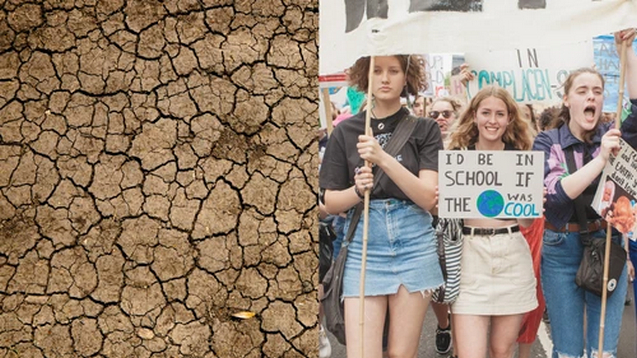
Drought-ridden land next to a group of young activists

So you want to do something about climate change, but you’re not sure where to start. Sharing an Instagram infographic about the impact of shopping from Shein, despite what the slacktivist critics might say, can still have an impact. But what are your options if you want to take things to the next level? Do you have to glue yourself to the road?

The short answer is: no. 

If you’re someone who prefers pen and paper, using the law is a great way to get your point across. An increasing number of successes involve using litigation to hold companies and governments to account over their climate pledges.

In 2021, a court case against Shell brought by 17,000 Dutch citizens and seven organisations, including Friends of the Earth International, successfully ruled that the company must reduce its emissions.

ClientEarth is an environmental law charity that uses treaties like the Paris Agreement to bring climate criminals to justice. VICE spoke to one of their lawyers, April Williamson, to find out how you, a lowly individual, can hack the law to fight climate change. 

VICE: So what actually is the Paris Agreement, and is it legally binding? 

April Williamson:
The Paris Agreement is an international agreement, which has been signed by almost every country in the world, concerning climate change. All signatories have agreed to limit global warming to well below two degrees Celsius, and are pursuing efforts to limit warming to below 1.5 degrees Celsius. The Paris Agreement is binding on all of its signatories. However, that doesn't mean that an individual or an organisation can directly sue a government for failing to uphold its obligations.


These Kids Are Suing European Governments Because of the Climate Crisis. Tristan Kennedy
So what happens if countries don’t stick to it?

April Williamson: Typically, the Paris Agreement will be implemented at the national level through national laws. And so for example, in the UK, you have the Climate Change Act, which has legally binding targets to reduce carbon dioxide emissions in the UK by 100% (net zero) by 2050*. It's national laws like that which people can use to hold the government accountable. 

Corporations are some of the biggest offenders when it comes to emissions. Are they part of the Paris Agreement?

April Williamson: Companies are not a party to the Paris Agreement, so they can't be held directly responsible. However, the agreement has been used to inform cases against companies – for example, there was a recent case in the Netherlands against Shell, where the courts found that it wasn't managing climate change risk appropriately and ordered it to reduce its emissions by 45 percent by 2030. That's a really important figure, because the scientific consensus is that that's what's required in order to meet the temperature targets.

Police clearing Extinction Rebellion tents in London. Photo: ZENO MORINO / ALAMY STOCK PHOTO

Could the British government theoretically be sued for, for example, reducing tax on domestic flights, which directly goes against their commitment to reduce carbon emissions?

April Williamson: That's quite a complicated question. As you can imagine, cases like that require quite a lot of factual analysis. I think that the problem is that the way that many national laws have been set up dictates that emissions need to be reduced within a certain timeframe. But the way that the government decides to meet those emissions reduction targets and meet their ultimate goal is within their discretion. They can choose exactly how they plan to do that, as long as they meet those targets… Policies like reduced tax for domestic flights could mean that they're not meeting their targets, but that would require quite a lot of analysis to be able to see whether or not there's a strong case.
.

The Activist Who Keeps Exposing Environmental Racism in the U.S. Geoff Dembicki
Is the UK currently meeting its emissions targets?

April Williamson:
Through the passing of the Climate Change Act, we established the Climate Change Committee, which is an independent committee that reviews the government's performance against its targets. The government did meet its first two emissions reductions targets, which are set out over a five year timeframe, but it's estimated that it's going to be missing its future targets. So the government is in danger of not complying with UK legislation.

What will happen if it doesn't comply?

April Williamson: The government could be in danger of facing a judicial review, which is where somebody, an individual or an organisation, or a group of people, could bring the government to court to try and push it to comply with its obligations. A good example would be another case in the Netherlands, for example, which was brought by a charity called Urgenda. They essentially said that the government hadn't set adequate policy and wasn't doing enough to meet their target, and the court ordered them to have a certain amount of emissions reduced by a certain time. We're expecting to see more cases like that around the world.


Meet the Young Activist Suing the UK Government Over Climate Change. Molly Lipson
What’s the connection between human rights law and climate change?

April Williamson: You will have seen in the news that there are more and more natural disasters and extreme weather events affecting people. So sea level rise, flooding, wildfires, landslides; many of those things could affect people's right to life. People have died in some of these disasters, it affects their health, it could affect their property if their homes or anything else that they own is lost. Almost every government in the world, in addition to having signed the Paris Agreement, is also a party to various human rights treaties. Amongst those, you have the right to life and the right to property, which could be impacted by climate change. Last year, the UN Human Rights Council also adopted a resolution which recognises the right to a clean and healthy environment, and we're expecting that to be used in different litigation cases and human rights cases that might be related to climate change.

Extinction Rebellion protesters in London. Photo: Chris Bethell

What other legal structures are there in place to protect the environment?

April Williamson: In addition to climate specific laws, there are also quite a number of different laws that can be used to protect the environment more generally, like planning. For example when major infrastructure is built, there might be requirements on the emissions it can make. And this goes all the way down to quite small things like home insulation.

At an individual level, there are also quite a few existing laws, which are not necessarily designed to protect the environment, but which can be used to do so. There are corporate laws, where, for example, directors could potentially be held to account if they fail to identify and manage risks appropriately. You could also use consumer laws to make sure that people are aware of the impacts of the products they’re using, or that they’re being advertised to accurately in “green” marketing.

If you suspect a company is misleading the public with greenwashing – i.e., portraying themselves or their product as sustainable and climate-conscious when they are not – can you complain to the Advertising Standards Agency?

April Williamson: Yes, you certainly can. It's actually quite easy to complain. You don't need a lawyer, you don't need anyone to advise you. It's a simple form. And that could potentially trigger an investigation to see whether or not the advert is misleading, or shouldn't be run the same way again. You can also email ClientEarth for our ongoing investigations into greenwashing.

Is it actually worth emailing your MP to urge them on climate action?

April Williamson: Yes, it is definitely worth emailing your MP. An MP is there to represent their constituents, and will often have a good idea of what's important to people who are living in a constituency. By writing to your MP with a clear and concise summary of why you think climate change is important and what the issues are, it can be escalated as an issue for them so they can go on to take action.

What are the most powerful tools individuals have at their disposal to hold governments and companies to account for climate change?

April Williamson: It's definitely not outside of an individual's power to be able to bring a legal case. But litigation isn't the be all and end all. It's also really important to do things like activism, advocate for policy changes, and engage with the science to make sure that people like your MP are aware of the problem, understand all of the findings and can escalate it to try and get stronger laws and enforcement.

Links

(The Guardian) Climate Change One Day At At Time - In Pictures

The Guardian

Munni-Morteratsch Glacier Morteratsch Glacier, Bernina Range, Switzerland, 5 September. Photograph: Munni/Blipfoto

Blipfoto members, or ‘blippers’, choose to record a single photo from their day.

This unique community of photographers enjoy recording life as they see it.

Perspectives on climate are often presented as ad hoc events so it’s not often we get to see a global perspective of public opinion and perception.

We look back at a selection of photos and snippets of day-to-day reflections on climate change from some of their 2021 journals.

Questioning, observing, acting and responding - it’s a compelling insight into everyday views on climate change.

The gallery was put together at Blipfoto by Rebecca Cole and Richard Hunt-Smith.


Justa Walkin’ the Dog
Blackheath, New South Wales, Australia
2 January

Justa Walkin’ the Dog - Blackheath, New South Wales, Australia
Almost a year after describing ‘a horror day for bushfires, especially in Victoria and southern NSW’, you’ll understand why this photo represents much more than an image of a rainy day to blipper member Trisharooni. She wrote: ‘It’s wet, wet, wet, and forecast to continue all week. Not complaining really, not after last year, but it’s going to mean a lot of work in the garden when it eventually stops.’ Unfortunately, we’ll hear more about this later ... …

It’s here!
Mississippi, US
15 February

It’s here It’s here! Mississippi, US
Blipper Loveeveryminute records: ‘Arctic temps. But it’s so pretty. And yes, we are in our jammies! Out here nobody cares. We usually get the same storms that come through Texas. I talked to my cousin on the TX/Mexican border and they have had crazy cold temps. More ice and freezing rain coming Wed and Thursday. This is unusually cold for us. But I do love the cold. Be safe!’ Photograph: loveeveryminute/Blipfoto

Liming
Bärstadt, Hesse, Germany
15 March

Liming, Bärstadt, Hesse, Germany
Blipper Munni noticed a helicopter over the next hill, dumping white stuff all over the landscape. She explained in her journal that the helicopter pilot was liming the forest: ‘I had already read about it in our local newspaper. The reason being the high level of air pollution which makes the forest soil more acidic and kills the trees which are already damaged by the drought. Whether it helps to save the remaining trees, we’ll probably know in a year or two.’ Photograph: Munni/Blipfoto


Poppies in Les Corts
Barcelona, Spain
28 April

Poppies in Les Corts, Barcelona, Spain
Digitaldaze tells the Blipfoto community about what is hopefully to become a permanent features of the Catalan city: ‘Wild flowers in a park/garden just 2 mins from our front door. I love that the city council has allowed and nurtured spaces like this in the last year.’ Photograph: digitaldaze/Blipfoto


Scenes from hell
Fabrezan, south of France
24 July

Scenes from hell, Fabrezan, south of France
Blipper Veronica was left feeling quite stressed by this scene: “A huge pall of smoke and the constant drone of Canadairs and Dashes since 1pm. A fire started near the autoroute around 10km away … 30C and windy ... it soon spread. When I went out for a walk at 4pm it didn’t look that menacing, but since then it’s got totally out of control … Walking out of the village at 6:30, I could see the flames on the ridge just beyond my favourite pylon as the fire raced towards Fabrezan.’ Photograph: Veronica/Blipfoto


The deluge
Edinburgh, Scotland
4 July

The deluge, Edinburgh, Scotland
‘This was an unusual amount of rain. I know storms like that from Germany. Infrastructure here is just not designed to cope with this amount of water. In Karlsruhe in Germany fillers on the tram tracks started to melt in the heat. The trams were out of action for a week or so. This is what climate change looks like. We get more extreme weather that our infrastructure struggles to cope with. We also need to stop burning fossil fuels. The sooner the better. Photograph: magi/Blipfoto


Kahurangi Falls
South Island, New Zealand
19 July

Kahurangi Falls South Island, New Zealand
It makes for a pretty photo but blipper TeeJay puts it in perspective: ‘This waterfall is usually a tiny trickle that is about a 20th of this size. The phenomenal rains that have hit the top half of the South Island over the past 72 hours has turned it into a raging torrent. The road to Murchison finally opened last night so I was able to come through today. (Most highways in the top half of the South Island [have been] closed. Slips, flooding and accidents.)’ Photograph: TeeJay/Blipfoto


Hot, hot, hot
East Kilbride, Scotland
20 July

Hot, hot, hot, East Kilbride, Scotland
You may be thinking white-washed Mediterranean village but we are in Scotland here, says Blipper Croftcrafts. ‘I haven’t experienced heat like this since I was in Nigeria. As the forecast said 26 degrees for East Kilbride, I went out this morning to buy a fan … When I got home I had to build it. All fine ’til I came to the last little screw when I dropped it and couldn’t find it so had to improvise with a piece of wire. A crofter will never be stuck! I sat out with my umbrella and fan but it was still too hot.’ Photograph: Croftcrafts/Blipfoto


Cheap thrills for the elderly
Portland, Oregon, US
1 August

Cheap thrills for the elderly, Portland, Oregon, US
Sometimes a picture (or a blip!) really does paint a thousand words: ‘Cheap thrills for the elderly.’ That’s what Sue said as she stood over the mister on a Sunday afternoon, the 1st of August, 91F/ 33C. A great relief to have a good belly laugh.’ Photograph: kendallishere/Blipfoto


Morteratsch Glacier
Bernina Range, Switzerland
5 September

Morteratsch Glacier Morteratsch Glacier, Bernina Range, Switzerland
Blipper Munni describes shock at this view: “The last years have taken their toll on the glacier like nothing before. The path now ends in the middle of nowhere. There is nothing to see but a rocky cliff, and water flowing down from somewhere on top of it - where the glacier now ends. That’s more than a kilometre from where I saw it once.” Photograph: Munni/Blipfoto


The great white hope
Worcestershire, England
27 September

The great white hope The great white hope, Worcestershire, England
Blipper Mooncoin is perhaps not sure, leaving us with this single sentence accompanying this eyecatching photo: “Prepare to be disappointed.” There are often two sides to a story. Photograph: mooncoin/Blipfoto


Flooding
Dumfries, Scotland
28 October

Flooding Flooding, Dumfries, Scotland
Unknowingly, yet pertinently, this happened 12 days later: “The rain has finally stopped but not before causing chaos in Dumfries and surrounding areas, it caused traffic chaos and some businesses will be affected by flooding. You see and hear the power of the water thundering down river and it is quite scary, but I decided to show this side street where this car has been left behind.” Photograph: SkyAboveMe1/Blipfoto

Bug hunting
Somerset, England
21 October

Bug hunting Bug hunting, Somerset, England
Blipper JDO was surprised to discover that the common green shieldbug (palomena prasina), although native to the UK was once confined to southern England adding: “It’s yet another beneficiary of climate change, and is now marching steadily northwards. In its wake, another species, the southern green shieldbug, is moving into the south of the country from the Continent, but as far as I know that one hasn’t yet reached the Shire.” Photograph: JDO/Blipfoto


Ferpecle Valley and Mont Mine
Switzerland
24 October

Ferpecle Valley Ferpecle Valley and Mont Mine, Switzerland
“You can see the U shaped valley that cradled the much reduced Mont Mine Glacier. My friend remembers when it came to the valley floor just 40 some years ago! Today was definitely about the colours: golden larch trees, white glaciers and blue skies, the perfect day to visit this area.” Photograph: HilarysView/Blipfoto


100,000 demand action now!
Glasgow, Scotland
6 November

100,000 demand action now! Glasgow, Scotland
Blipper richard describes his feelings about the demonstrations: “Powerful, sobering, good natured. This is what peaceful protest looks like.” Photograph: richard/Blipfoto


Which is the greater threat?
Collaroy Beach, NSW, Australia
4 November

Collaroy Beach, NSW, Australia 4 November
Blipper Samagainplease has been recording the building of their local wall in his journal with mixed emotions. On this day, he wrote: “This area of the beach is unsafe due to recent erosion. Exposed rocks in the water and on the beach. They missed a few other adjectives before ‘erosion’. Things like ‘persistent, predictable, regular, ongoing, relentless’. “Intellectually, I get the need for safety in the workplace etc etc, from an immediate threat, but the juxtapositioning of these two signs give me an unjustifiable feeling akin to sheltering under desks during the cold war.” Photograph: samagainplease/Blipfoto


Shipwrecks in the bog
Ilkley Moor, Yorkshire, England
18 December

Shipwrecks in the bog Shipwrecks in the bog, Ilkley Moor, Yorkshire, England
With mixed feelings on the UK government’s drive for protecting nature, on Ilkley Moor in West Yorkshire, positive change is happening in this eerie scene: Blipper WharfedaleBex wrote: “I’ve been wanting to check out the bog restoration going on up here. Lots of sphagnum moss has already been planted to encourage peat formation on the moors and now you can see small dams have been installed which already look like they’re working to re-wet the peatland. It’s a real lift to see something positive like this happening on your doorstep.” Photograph: WharfedaleBex/Blipfoto


Dystopian December
Edinburgh, Scotland
23 December

Dystopian December - Edinburgh, Scotland
Blipper Rowanhagdorn saved a series of images during the last month of the year titled dystopian December, making thought-provoking and sometimes ironic observations such as this: “The link between coronavirus and ski-ing has made it so uncool that skis are being binned. Maybe it’s better to chuck them now before climate change stops it.” Photograph: rowanhagdorn/Blipfoto


One perfect rose
Somerset, England
27 December

One perfect rose, Somerset, England
“I know it’s only two days since I was celebrating the fact that the solitary bees could be emerging just a couple of months from now, but I do find it worrying that my Iceberg rose is still flowering in the last week of December. The name has started to look uncomfortably ironic.” Photograph: JDO/Blipfoto


New Year’s Eve?
Sheringham, Norfolk, England
31 December

Throughout the year, photographers on Blipfoto have noticed and commented on climate change. The last day of the year was no exception. 2021 finished with a record-breaking high temperature and blipper Bom wrote on New Year’s Eve: “Another weirdly warm temperature with a max per my weather station of 14.6°C, no wonder the ice cream shop decided to open in Sheringham and had several takers. There was heavy rain again this morning, making 2.74 inches of rain for Dec – that might not be a lot for most areas, but it’s 50% higher than our Dec average and with only two sunny days.” Photograph: Bom/Blipfoto

Links

Lethal Heating is a citizens' initiative