02/03/2022

(AU ABC) WA Weather Delivers Perth Its Hottest Summer On Record As Scientists Predict Trend To Continue

ABC NewsTyne Logan

Perth recorded a string of six consecutive days above 40 degrees Celsius as temperature records kept tumbling. (ABC News: Jon Sambell)

Key Points

  • There were 13 days of 40C temperatures in Perth over summer
  • There was also a record number of days over 35C
  • Several regional towns are also set to break their summer heat records
It's been a summer for the history books in Western Australia with Perth sweltering through its hottest on record, and several regional towns all but guaranteed to follow suit.

While numbers will not be technically official until Tuesday, Bureau of Meteorology figures show Perth's average maximum temperature is currently 33.2 degrees Celsius — well above the previous record of 32.3 set in 2012/13.

It means the city is guaranteed to break the record even without the final day's temperature, forecast to be 36C.

Several regional towns through the Central West, Wheatbelt, Great Southern and South West are also likely to break summer records.

The numbers speak for themselves

When you look at individual days, it is easy to see why.

Perth set a summer record of 13 days above 40C, six of which were consecutive.

Perth also experienced a record number of days above 35C, and in January Onslow equalled Australia's hottest ever temperature, reaching 50.7C.
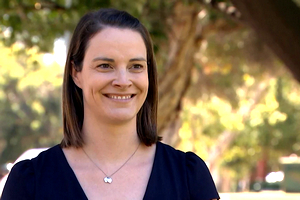
BOM forecaster Jessica Lingard says there's been an unusual number of heat records broken this summer. (ABC: Greg Pollock)
Bureau of Meteorology forecaster Jessica Lingard said it had been hard to keep up with the number of records.       

"So many places have had their hottest Christmas, their hottest December, their hottest January," Ms Lingard said. 
"There has just been an awful lot of records broken this season and it's quite unusual."
What's been driving the heat?

In terms of weather systems, Ms Lingard said it was the usual heat-bearing systems that fuelled the hot weather.

Perth has endured its hottest summer on record. (ABC News: Hugh Sando)

That includes high pressure systems and west coast troughs, which drive in strong and warm easterly winds from the desert and often delay or stop the sea breeze.

But she said this year the systems were sticking around for much longer than normal, allowing the heat to build.

"They usually transition eastwards fairly rapidly, forming a west coast trough and then a couple of days later it moves inland," she said.

"But we've been seeing these west coast troughs really hanging around for a long time.

"We're talking four to seven days, so that really allows all that warm air from inland parts to penetrate right into coastal areas."

Challenging fire season

The conditions have had devastating consequences, even for regions that only experienced short bursts of heat.

In early February, four out-of-control bushfires were burning at the same time — ultimately destroying homes in Denmark, Bridgetown and Corrigin.

In February 2021 an out-out-control bushfire doubled in size overnight in Denmark, destroying three houses. (Supplied: Emily Harper)
A week later it happened again, but this time with lightning added to the mix.

One home in Jerramungup was lost along with two in Hopetoun.

Department of Fire and Emergency Services Commissioner Daren Klemm said conditions had been particularly severe this year.

"We've had some really challenging, complex fires in particularly difficult fire weather," he said.

Fingerprint of climate change

Unfortunately, climate science indicates this is just the start.

Rainfall has declined significantly in the last 50 years over WA's south-west.

While it can be difficult for scientists to directly attribute extreme weather events to climate change, climate scientist Andrew King said Perth's summer clearly bore the fingerprint of global warming.

"Given the background trends and previous work looking at heatwaves and their links to climate change in different parts of Australia, and our understanding of how the climate system works, we can be quite confident that climate change has exacerbated the heat and Perth the summer," Dr King said.

He said there would still be cooler summers in future, but climate change had loaded the dice to make hot years more common.
"Because we've got such a clear trend in temperatures across the whole of Australia, including in Western Australia, it's just quite easy to break records these days," he said.
"I guess an analogy to that is you can think of like COVID cases.

"If you've got an outbreak occurring, you can have record numbers of cases each day, day after day, when you've got a strong trend in case numbers. 

"In a way, temperature trends are a bit like that, when you've got a very clear trend, it's very easy to break records so you break them more frequently."

Dr Andrew King says there's very little doubt that WA's hot summer was influenced by climate change. (ABC Weather: Kate Doyle)

Dr King said heatwaves would only become more frequent and intense if greenhouse has emissions were not reduced.

"However, if we try and reduce our greenhouse gas emissions and try and stick to the Paris Agreement, that would help a lot.

"We would see slightly worse heat waves than we do now, but not as bad as if we just keep emitting greenhouse gases."

Links

(USA PBS NewsHour) UN Releases Dire Climate Report Highlighting Rapid Environmental Degradation

PBS NewsHour - William Brangham

A new United Nations science report warned that the effects of climate change are growing faster and more severe than expected.

It cited hunger, disease, poverty and other ills made worse by a warming planet and indicated the repercussions may soon outstrip humanity's ability to adapt.

William Brangham reports.


REPORT VIDEO


REPORT 
AUDIO

REPORT TRANSCRIPT
  • Judy Woodruff:

    Now let's take a deeper look at the new climate change report the U.N. released today.

    As William Brangham tells us, it provided the starkest warnings yet, not only about what could happen, but what's already been set into motion.

  • William Brangham:

    The evidence is everywhere, burning forests in Argentina, massive floods in Bangladesh, drought in Spain. The impacts of climate change are here, and they're getting worse.

    And according to a landmark United Nations report, not only are some of these impacts worse than previously known; some may already be irreversible.

  • Antonio Guterres, United Nations Secretary-General:

    Today's IPCC report is an atlas of human suffering and a damning indictment of failed climate leadership. With fact upon fact, this report reveals how people and the planet are getting clobbered by climate change.

  • William Brangham:

    The report conducted by a U.N. panel of more than 200 scientists from over 60 countries emphasized that our warming of the planet is unleashing damages at a pace and intensity that many nations won't be able to handle, and that reducing the pollution that's driving climate change isn't happening nearly fast enough.

  • Hans Otto Portner, Co-Chair, Intergovernmental Panel on Climate Change:

    The scientific evidence is unequivocal: climate change is a threat to human wellbeing and the health of the planet. Any further delay in concerted global action will miss a brief and rapidly closing window to secure a liveable future.

  • William Brangham:

    The report noted that each additional fraction of warming had serious implications for life on Earth. The report laid out 127 of these threats, including the growing loss of usable farmland and increasing drought, which will threaten the global food supply, rising sea levels and floods, which are already driving tens of thousand of people from their homes, growing numbers of punishing deadly heat waves, and increasing extinction of plant and animal species.

  • Camille Parmesan, Make Our Planet Great Again, France:

    Some impacts are already irreversible. Even at the 1.09 in warming that we have had, we're already seeing species go extinct, and that is new for the — since the last IPCC report.

  • William Brangham:

    World leaders, including President Biden, have pledged to try and limit global warming to no more than 1.5 degrees Celsius, or 2.7 degrees Fahrenheit.

    But with the world's top economies spitting out near record carbon emissions, achieving that goal is getting further out of reach every day. At the current pace, the planet is on track to warm between two and three degrees Celsius this century.

  • Antonio Guterres:

    Global emissions are set to increase almost 14 percent over the current decade. That spells catastrophe. It will destroy any chance of keeping 1.5 alive.

  • William Brangham:

    And if the planet overshoots that 1.5-degree target, as it's expected to, this report warns that some of these damages likely can't be undone.

  • Camille Parmesan:

    Species have already gone extinct because of climate change. Islands have already become uninhabitable because of sea level rise.

  • William Brangham:

    The U.N. report notes that poorer, less developed nations are and will continue to be the hardest hit by the ravages of climate change.

    In 2019, it's estimated that over 13 million people in parts of Asia and Africa were driven from their homes by extreme weather events. The report found that, between 2010 and 2020, droughts, floods and storms killed 15 times as many people in these highly vulnerable countries.

  • Camille Parmesan:

    What you find is that the most vulnerable are the most affected, whether it's the most vulnerable within a country, the poorest, the ones in the most marginalized settlements, or the most vulnerable countries. It works at all scales.

  • William Brangham:

    One hundred and ninety-five governments approved this report. But the head of the U.N. argues that, if past action is any guide, these warnings continue to fall on deaf ears.

  • Antonio Guterres:

    The facts are undeniable. This abdication of leadership is criminal.

  • William Brangham:

    For the "PBS NewsHour," I'm William Brangham.
Links

(AU SMH) Climate Change Will Cost Australia Hundreds Of Billions Of Dollars: UN Report

Sydney Morning HeraldMike Foley

Climate change will cost Australia’s economy hundreds of billions of dollars in coming decades, driven by loss of life and physical damage caused by heatwaves, droughts, floods, fires and other natural disasters, according to the United Nation’s report compiled by the world’s climate scientists.

 The Intergovernmental Panel on Climate Change (IPCC) report on the impacts of climate change makes “conservative estimates” for the economic cost of global warming.

It said 1 degree warming would cause a loss of 0.3 per cent of GDP a year, 2 degrees would cost 0.6 per cent of growth a year and 3 degrees would decrease growth by 1.1 per cent a year.

Lismore in northern NSW is being hit with the worst flood ever recorded. Credit: Elise Derwin

That means that, under 2 degrees of warming, Australia’s economy would miss out on $115 billion in lost earnings over the next decade and $350 billion over the next 20 years.

Under 3 degrees warming, the economy would lose $200 million in potential earnings by 2032 and $600 billion by 2042.

The world has already heated by 1.1 degrees and Australia’s land mass has warmed by an average of 1.4 degrees since 1910, according to the CSIRO. 

Climate policy
The IPCC said there is a “very high level of confidence” that current international emissions reduction commitments would not limit warming to less than 2 degrees. 

If the rest of the world followed Australia’s current commitments and policies, global warming would exceed 3 degrees, according to Climate Action Tracker.

Greenhouse gases retain heat in the atmosphere, adding to the energy that drives weather events – making droughts, cyclones, fires and floods more frequent, intense and unpredictable.

Unprecedented floods are sweeping down the North Coast of NSW, after Brisbane was inundated last week, just two years after the most intense drought on record in many parts of the eastern seaboard.

General manager of natural disaster consultancy Risk Frontiers, Andrew Gissing, said Lismore was exceeding record flood heights set in 1974 and 1954 by a significant margin, with forecast peaks that have an annual average chance of about 0.2 per cent of occurring.
Emissions


Even if the earth’s heating is kept at under 2 degrees, the number of heatwave-related deaths in Sydney, Melbourne and Brisbane will more than double to an average of 300 year by 2080, under current population growth.

This scenario would also see the mercury top 50 degrees in extreme events in these cities, and the frequency of days topping 35 degrees will rise between 25 per cent and 85 per cent depending on the location around the country.

Agriculture across the country is expected to suffer major financial stress as the atmosphere heats, although financial impacts are hard to forecast due to shifting growing zones, adaptive livestock and plant breeding, and advances in drought adaptation.

The Murray Darling Basin is home to 2.4 million people and agricultural production is worth an annual average of $2.6 billion.

The river system is already struggling with over-extraction for irrigation and the report highlighted findings from the CSIRO that 2 degrees of warming would reduce streamflows by 20 per cent.

Reduction in long-term average inflows to the River Murray
Source: Australian government

“The scientific evidence is unequivocal: climate change is a threat to human wellbeing and the health of the planet said Hans-Otto Pörtner, a scientist on the IPCC working group of scientists, as the Climate Change 2022: Impacts, Adaptation and Vulnerability report was released on Tuesday.

“Any further delay in concerted global action will miss a brief and rapidly closing window to secure a liveable future.”

United Nations Secretary General Antonio Guterres reiterated his plea for the world to reverse the current trend and cut greenhouse emissions in a last-ditch hope of limiting global temperature rise to 1.5 degrees.

“Science tells us that will require the world to cut emissions by 45 per cent by 2030 and achieve net zero emissions by 2050,” he said. “But according to current commitments, global emissions are set to increase almost 14 per cent over the current decade.

Key risks identified for Australia
  1. Loss and degradation of coral reefs and associated biodiversity and ecosystem service values in Australia due to ocean warming and marine heatwaves (very high confidence). 
  2. Loss of alpine biodiversity in Australia due to less snow (high confidence). 
  3. Transition or collapse of alpine ash, snowgum woodland, pencil pine and northern jarrah forests in southern Australia due to hotter and drier conditions with more fires (high confidence).
  4. Loss of kelp forests in southern Australia and south-east New Zealand due to ocean warming, marine heatwaves and overgrazing by climate-driven range extensions of herbivore fish and urchins (high confidence). 
  5. Loss of natural and human systems in low-lying coastal areas due to sea-level rise (high confidence).
  6. Disruption and decline in agricultural production and increased stress in rural communities in south-western, southern and eastern mainland Australia due to hotter and drier conditions (high confidence). 
  7. Increase in heat-related mortality and morbidity for people and wildlife in Australia due to heatwaves (high confidence). 
  8. Cascading, compounding and aggregate impacts on cities, settlements, infrastructure, supply-chains and services due to wildfires, floods, droughts, heatwaves, storms and sea-level rise (high confidence). 
  9. Inability of institutions and governance systems to manage climate risks (high confidence).

Links

01/03/2022

(UN The Guardian) IPCC Issues ‘Bleakest Warning Yet’ On Impacts Of Climate Breakdown

The Guardian

Report says human actions are causing dangerous disruption, and window to secure a liveable future is closing

Wildfires tearing through a forest in the Chefchaouen region of northern Morocco. Photograph: Fadel Senna/AFP/Getty Images

Summary
  • Everywhere is affected, with no inhabited region escaping dire impacts from rising temperatures and increasingly extreme weather.
  • About half the global population – between 3.3 billion and 3.6 billion people – live in areas “highly vulnerable” to climate change.
  • Millions of people face food and water shortages owing to climate change, even at current levels of heating.
  • Mass die-offs of species, from trees to corals, are already under way.
  • 1.5C above pre-industrial levels constitutes a “critical level” beyond which the impacts of the climate crisis accelerate strongly and some become irreversible.
  • Coastal areas around the globe, and small, low-lying islands, face inundation at temperature rises of more than 1.5C.
  • Key ecosystems are losing their ability to absorb carbon dioxide, turning them from carbon sinks to carbon sources.
  • Some countries have agreed to conserve 30% of the Earth’s land, but conserving half may be necessary to restore the ability of natural ecosystems to cope with the damage wreaked on them.
Climate breakdown is accelerating rapidly, many of the impacts will be more severe than predicted and there is only a narrow chance left of avoiding its worst ravages, the Intergovernmental Panel on Climate Change (IPCC) has said.

Even at current levels, human actions in heating the climate are causing dangerous and widespread disruption, threatening devastation to swathes of the natural world and rendering many areas unliveable, according to the landmark report published on Monday.

“The scientific evidence is unequivocal: climate change is a threat to human wellbeing and the health of the planet,” said Hans-Otto Pörtner, a co-chair of working group 2 of the IPCC.

“Any further delay in concerted global action will miss a brief and rapidly closing window to secure a liveable future.”

Droughts, floods, heatwaves

In what some scientists termed “the bleakest warning yet”, the summary report from the global authority on climate science says droughts, floods, heatwaves and other extreme weather are accelerating and wreaking increasing damage.

Allowing global temperatures to increase by more than 1.5C above pre-industrial levels, as looks likely on current trends in greenhouse gas emissions, would result in some “irreversible” impacts.

These include the melting of ice caps and glaciers, and a cascading effect whereby wildfires, the die-off of trees, the drying of peatlands and the thawing of permafrost release additional carbon emissions, amplifying the warming further.

‘Atlas of human suffering’

António Guterres, the UN secretary general, said: “I have seen many scientific reports in my time, but nothing like this. Today’s IPCC report is an atlas of human suffering and a damning indictment of failed climate leadership.”

John Kerry, the US special presidential envoy for climate, said the report “paints a dire picture of the impacts already occurring because of a warmer world and the terrible risks to our planet if we continue to ignore science.

"We have seen the increase in climate-fuelled extreme events, and the damage that is left behind – lives lost and livelihoods ruined. The question at this point is not whether we can altogether avoid the crisis – it is whether we can avoid the worst consequences.”

Chance to avoid the worst

This is the second part of the IPCC’s latest assessment report, an updated, comprehensive review of global knowledge of the climate, which has been seven years in the making and draws on the peer-reviewed work of thousands of scientists.

The assessment report is the sixth since the IPCC was first convened by the UN in 1988, and may be the last to be published while there is still some chance of avoiding the worst.

 A first instalment, by the IPCC’s working group 1, published last August, on the physical science of climate change, said the climate crisis was “unequivocally” caused by human actions, resulting in changes that were “unprecedented”, with some becoming “irreversible”.

This second part, by working group 2, deals with the impacts of climate breakdown, sets out areas where the world is most vulnerable, and details how we can try to adapt and protect against some of the impacts.

A third section, due in April, will cover ways to cut greenhouse gas emissions, and the final part, in October, will summarise these lessons for governments meeting in Egypt for the UN Cop27 climate summit.

‘Cataclysmic’ for small islands

Small islands will be among those worst affected. Walton Webson, an ambassador of Antigua and Barbuda and the chair of the Alliance of Small Island States, called the findings “cataclysmic”.

He urged the UN to convene a special session to consider action. “We are continuing to head for a precipice – we say our eyes are open to the risks, but when you look at global emissions, if anything we are accelerating towards the cliff edge.

"We are not seeing the action from the big emitters that is required to get emissions down in this critical decade – this means halving emissions by 2030 at the latest. It is clear that time is slipping away from us.”

Governments in other parts of the world could help their people to adapt to some of the impacts of the climate crisis, the report says, by building flood defences, helping farmers to grow different crops, or building more resilient infrastructure.

But the authors say the capacity of the world to adapt to the impacts will diminish rapidly the further temperatures rise, quickly reaching “hard” limits beyond which adaptation would be impossible.

‘Global dominoes’

The climate crisis also has the power to worsen problems such as hunger, ill-health and poverty, the report makes clear.

Dave Reay, the director of Edinburgh Climate Change Institute at the University of Edinburgh, said: “Like taking a wrecking ball to a set of global dominoes, climate change in the 21st century threatens to destroy the foundations of food and water security, smash onwards through the fragile structures of human and ecosystem health, and ultimately shake the very pillars of human civilisation.”

The report plays down fears of conflicts arising from the climate crisis, finding that “displacement” and “involuntary migration” of people would ensue but that “non-climatic factors are the dominant drivers of existing intrastate violent conflicts”.

But Jeffrey Kargel, a senior scientist at the Planetary Science Institute in the US, said: “The current warfare activity in eastern Europe, though not attributable to climate change, is a further caution about how human tensions and international relations and geopolitics could become inflamed as climate change impacts hit nations in ways that they are ill-prepared to handle.” 

● ● ● ● ● ● ● ● ● ● ● ● ● ● ●

This climate crisis report asks:
what is at stake? In short, everything

Environment editor

Major IPCC report, approved by 195 countries,
lays bare devastating harm caused by unchecked global heating

Africa faces severe drought and famine unless global heating is kept to no more than 1.5C. Photograph: World Food Programme/Reuters

“A liveable and sustainable future for all”.

It is the very last words of the new report from the Intergovernmental Panel on Climate Change (IPCC) that spell out what is at stake. In short, it is everything.

The damage from global heating is already hitting hard. The comprehensive IPCC assessment, which is based on 34,000 studies, documents “widespread and pervasive” impacts on people and the natural world from increasingly frequent and intense heatwaves, droughts, wildfires, storms and floods. Some impacts are now irreversible.

Heat is killing more people, drought is killing more trees and warming oceans are killing more coral reefs, the nurseries of the oceans. But without action, worse is coming, the report said, and faster than scientists had thought.

The new report analyses the impacts of the climate crisis and how humanity can adapt, in addition to slashing emissions. The good news is that a liveable future remains within grasp – just.

But the window of opportunity for action is “brief and rapidly closing”. The response from UN secretary-general António Guterres was stark: “Delay is death.”

But tackling climate impacts alone will not work. The IPCC sets out in the strongest terms to date that the climate crisis is inseparable from the biodiversity crisis and the poverty and inequality suffered by billions of people.

Given this scope, and with a liveable future on the line, the assessment could be seen as one of the most important in human history. It was produced by more than 1,000 physical and social scientists and unanimously approved by the governments of 195 nations.

“I have seen many scientific reports in my time, but nothing like this,” said Guterres. Laurence Tubiana, at the European Climate Foundation and one of the architects of the 2015 Paris climate agreement, said the report was “brutal” and “there can be no more excuses” for inaction.

Already, 3.5 billion people are highly vulnerable to climate impacts and half the world’s population suffers severe water shortages at some point each year, the report said. One in three people are exposed to deadly heat stress, and this is projected to increase to 50% to 75% by the end of the century.

Half a million more people are at risk of serious flooding every year, and a billion living on coasts will be exposed by 2050, the report said. Rising temperatures and rainfall are increasing the spread of diseases in people, such as dengue fever, and in crops, livestock and wildlife.

Even if the world keeps heating below 1.6C by 2100 – and we are already at 1.1C – then 8% of today’s farmland will become climatically unsuitable, just after the global population has peaked above 9 billion.

Severe stunting could affect 1 million children in Africa alone. If global heating continues and little adaptation is put in place, 183 million more people are projected to go hungry by 2050.

The ability to produce food relies on the water, soils and pollination provided by a healthy natural world, and the report said protection of wild places and wildlife is fundamental to coping with the climate crisis.

But animals and plants are being exposed to climatic conditions not experienced for tens of thousands of years. Half of the studied species have already been forced to move and many face extinction.

Maintaining the resilience of nature at a global scale depends on the conservation of 30% to 50% of Earth’s land, freshwater and oceans, the IPCC report said. Today, less than 15% of land, 21% of freshwater and 8% of oceans are protected areas, and some regions, like the Amazon, have switched from storing carbon to emitting it.

The IPCC report is also crystal clear that adapting to the climate crisis is as much a social problem as a scientific one. The best way to give effective and lasting protection from climate chaos is through action that addresses “inequities such as those based on gender, ethnicity, disability, age, location and income”.

“Targeting a climate resilient, sustainable world involves fundamental changes to how society functions, including changes to underlying values, world-views, ideologies, social structures, political and economic systems, and power relationships,” the report’s authors said in an accompanying document. 

“This may feel overwhelming at first, but the world is changing anyway – climate-resilient development offers us ways to drive change to improve wellbeing for all.”

The report warned that climate “losses and damages” are “strongly concentrated among the poorest vulnerable populations”, who have done least to cause the problem.

That is a significant phrase, echoing the “loss and damage” for which low-income nations are demanding compensation from rich nations, and which will be a key issue at the next UN climate summit in Egypt in November.

Madeleine Diouf Sarr, the chair of the Least Developed Countries at the UN climate talks, said: “I read this report with a great deal of fear and sadness, but not surprise. It’s very clear to us that no amount of adaptation can compensate for failing to limit warming to 1.5C.”

However, the regional analysis in the IPCC report demonstrates that the climate crisis affects everyone. In North America, it warns of increasing deaths and physical and mental illness due to greater extreme weather, from storms to wildfires. In Europe, “substantive agricultural production losses are projected for most areas over the 21st century”.

Australia faces “increases in heat-related mortality and morbidity for people and wildlife”, while “destruction” lies in wait for small island settlements.

In central and south America, “severe health effects due to increasing epidemics” are anticipated, particularly from diseases spread by insects and other animals.

Among the most populous continents, one of Asia’s greatest risks is flooding, and Africa is haunted by hunger as climate impacts hit farmers.

The IPCC message that hope remains is measured: “Near-term actions that limit global warming to close to 1.5°C would substantially reduce projected losses and damages related to climate change in human systems and ecosystems, but cannot eliminate them all.” Some low-lying areas appear doomed already.

The report also noted that “losses and damages escalate with every increment of global warming”, meaning every action to cut emissions or adapt matters. Adaptation is heavily underfunded, the IPCC said, but investment now is far cheaper than acting later.

Among the adaptation measures the IPCC cites are restoring wetlands to protect against flooding, greening the world’s fast-growing cities to cool them, and using trees to shade crops and livestock.

The IPCC scientists said the end of the century is less than a lifetime away, with a child born today being 78 years old in 2100: “Actions taken now will have a profound effect on the quality of our children’s lives.”

The future is in the decisions we make today, said Christiana Figueres, former UN climate chief and now at the Global Optimism group: “We can prevent and protect ourselves from extreme weather, famines, health problems and more by cutting emissions and investing in adaptation strategies.

"The science and the solutions are clear. It’s up to us how we shape the future.”

Links

(AU The Conversation) New IPCC Report Shows Australia Is At Real Risk From Climate Change, With Impacts Worsening, Future Risks High, And Wide-Ranging Adaptation Needed

The Conversation |  |  |  |  |  |  |  | 

Getty Images

Authors
  •  is Director of the Griffith Climate Change Response Program, Griffith University
  •  is Senior Principal Research Scientist, CSIRO
  •  is Professor, ARC Future Fellow & Editor in Chief (Reviews in Fish Biology & Fisheries), University of Tasmania
  •  is Principal Research Scientist, CSIRO Oceans and Atmosphere, CSIRO
  •  is Professor, RMIT University
  •  is Director, ANU Institute for Climate, Energy and Disaster Solutions, Australian National University
  •  is Professor, Monash University
  •  is Senior Lecturer, School of Public Health, The University of Queensland
  •  is Principal Research Scientist, CSIRO
Climatic trends, extreme conditions and sea level rise are already hitting many of Australia’s ecosystems, industries and cities hard.

As climate change intensifies, we are now seeing cascading and compounding impacts and risks, including where extreme events coincide.

These are placing even greater pressure on our ability to respond.

While the work of adaptation has begun, we have found the progress is uneven and insufficient, given the risks we face.

These findings are from our work as co-authors of the new Australia and New Zealand chapter in the Intergovernmental Panel on Climate Change 6th Assessment Report on Impacts, Vulnerability and Adaptation, released today.

What does the report mean for Australia?

This new report represents the efforts of over 270 climate change experts to review and synthesise the latest information.
These authors collectively examined over 34,000 peer reviewed publications about how climate change is affecting ecosystems and societies, future risks, adaptation enablers and limits, and links to climate resilient development.

Climate change is bringing hotter temperatures, more dangerous fire weather, more droughts and floods, higher sea levels, and drier winter and spring months to southern and eastern Australia, amongst other changes.

These changes are increasing the pressure on our natural environment, settlements, infrastructure and economic sectors including agriculture, finance and tourism.

Boats rescue Lismore residents from their homes during the town’s worst recorded floods on February 28th, 2022. Jason O'Brien/AAP

In low-lying areas along our coasts, where so many Australians live, homes, infrastructure and ecosystems will be lost to the rising sea if mitigation and adaptation are inadequate.

For our farmers and the agrifood sector, climate change brings unwelcome stresses and disruptions, making it more challenging to produce food profitably and sustainably. Intensified heat and drought will place yet more stress on our rural communities, particularly in Australia’s south-west, south and east.

Australians will experience more deaths and ill health from heatwaves, as will our wildlife.

Lyle Stewart looks through burned debris at his burned out house at Nerrigundah, Australia on Jan. 13, 2020, after a bushfire raced through the town. Rick Rycroft

The threat of cascading impacts

Unfortunately, that’s not all we have to contend with. We have identified two new types of climate-related risk.

The first are the cascading, compounding and aggregate impacts on our cities and towns, roads, supply-chains and services, emerging from the interaction of disasters like wildfires, floods, droughts, heatwaves, storms and sea-level rise.

Think of the rolling impacts from the Black Summer bushfires, which killed people and wildlife, destroyed homes and resulted in major economic losses for tourism, farming and forestry. Or think of the ongoing floods in New South Wales and Queensland.

The second is the slow speed at which governments and institutions are moving to deal with these changing risks, undermining the system-wide adaptation needed. What does this mean in practice? That the scale and scope of what we can expect to see happen may overwhelm our capacity to respond to these impacts – unless we address these risks quickly and strategically.

Climate impacts are powerfully and unevenly amplified by existing stresses affecting our environment and people. For instance, Australia’s coral reefs already face threats from pollution and invasive species. Climate change acts as a threat multiplier.

Climate change will pose more of a threat to vulnerable Australians, such as those with inadequate health care, poor quality housing and unstable employment.

We examined how much the projected damage could be reduced through better adaptation such as changes in policy, more effective planning and technical solutions.

Our ecosystems most at risk are our world-famous coral reefs and the huge biodiversity and ecosystem services they provide. Steadily warming oceans and sudden marine heatwaves have already pushed many areas to the edge.

The Great Barrier Reef is already at a very high risk of crossing a critical threshold where further warming may cause irreversible damage. Between 2016 and 2020, three marine heatwaves struck the Great Barrier Reef, causing major coral bleaching and death. Once the coral is gone, many of the fish and invertebrates do not survive.

In typical conditions, it takes a minimum of a decade for the fastest growing corals to recover from a single bleaching event. We are no longer in typical conditions. Warming beyond 1.5℃ would see marine heatwaves strike more often. Bleaching will go well beyond the reef’s natural ability to regenerate.

Coral reefs have limits to their resilience. Getty Images

What does adaptation look like?

If we fail to address underlying vulnerabilities in our society and fail to reduce climate-related risks, we will make climate change impacts even worse and undermine our capacity to adapt, well into the future.

But if we step up adaptation now, we will see benefits both in the near- and long-term. This includes practicalities like making sure all strategic planning, land use planning and infrastructure developments take complex climate change risks into account – in a systematic, rather than siloed, narrowly focused, way.

On the positive side, Australia’s adaptation efforts have increased in ambition, scope and implementation across governments, non-government organisations, businesses and communities since the last IPCC assessment in 2014.

In recent years, Australia has created a government agency for recovery and resilience, a disaster risk reduction framework, and national adaptation guidance.

States and territories have introduced climate adaptation strategies, with some evidence of implementation. Local governments, regions, communities and associated alliances are becoming more active in adaptation. In the private sector, there is some rapid work underway to address climate risk and disclosure.

Tree planting as part of an effort to reforest 1500 hectares of Mongo Valley in northern New South Wales, July 2018. Aussie Ark

A Laudable though this progress is, we found that progress on adaptation is distinctly uneven. That’s due to implementation barriers as well as limits to adaptive capacity. Barriers we found include competing objectives, divergent risk perceptions and values, knowledge constraints, inconsistent information, fear of litigation, up-front costs, and lack of engagement, trust and resources.

If we are to get better at adaptation, we have to shift from reactive to anticipatory planning, to better plan for and reduce climate-related risks. Systemic risks demand systemic adaptation.

We found there was a great deal to be gained from better integration and coordination between levels of government and sectors through more effective policy alignment and more inclusive and collaborative institutional arrangements.

Australia would benefit from a national risk assessment and a national climate adaptation implementation plan. Other ways to enable more effective adaptation include serious and stable funding and finance mechanisms, and nationally consistent and accessible information and decision-support tools.

The way we go about adaptation is also important. Climate planning that promotes inclusive governance, collective action and mutual support can make the process of change easier, fairer and more effective.

Supporting Aboriginal and Torres Strait Islander peoples and their institutions, knowledge, values and self-determination is especially important. The knowledge, skills and experience held by Aboriginal and Torres Strait Islander peoples is relevant to climate change adaptation across society.

The best time to act is now

If we delay introducing effective adaptation methods and significant global emission reduction, the damage caused will be more expensive and require far greater change. We need robust, timely adaptation, and deep cuts to emissions.

That’s to have our best chance of keeping global warming to 1.5-2℃ and reduce the challenges of adaptation.

Although the climate impacts and risks we face are increasingly severe, it is by no means too late to avert the worst outcomes.

It is still possible to move to a pathway of “climate resilient development” in which we work together to rapidly contain global warming, adapt effectively and help secure a better future for all.

Links

Lethal Heating is a citizens' initiative