05/03/2022

(AU SMH) Australian Government Pushes Oil And Gas Regulator To Do Less About Emissions

Sydney Morning HeraldPeter Milne

A federal government directive that the offshore environment regulator ignore the oil and gas sector’s massive indirect emissions but consider its economic benefits could open decisions to legal challenge.

Resources minister Keith Pitt told the National Offshore Petroleum Safety and Environmental Management Authority he expected it to only consider the direct emissions from projects it assessed as later indirect, or scope 3, emissions were managed by countries that bought Australian oil and gas.

Gas is good: Resources Minister Keith Pitt. Credit: Alex Ellinghausen

In February, Mr Pitt wrote to NOPSEMA chief executive Stuart Smith listing his expectations of the independent regulator, which also included exercising its powers “consistent with government policy” and considering the “economic and commercial environment”.

Environmental Defenders Office managing climate lawyer Brendan Dobbie said Mr Pitt’s expectation on emissions conflicted with NOPSEMA’s legal obligations.

“The regulations specify that NOPSEMA must consider both direct and indirect impacts of offshore gas projects,” Mr Dobbie said, including scope 3 emissions.

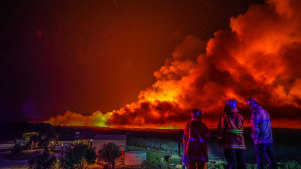
Firefighters at the scene of the blaze near Margaret River in Western Australia in December.

“The importance of local decision-makers recognising the global impacts of fossil fuel projects has been acknowledged by the courts.

“At a time when the scientific consensus tells us that the development of any new fossil fuel project will cause us to miss our Paris targets, it is imperative that NOPSEMA consider the full scope of greenhouse gas impacts caused by Australian offshore gas projects.”

Like Mr Pitt, the Australian gas industry has argued scope 3 emissions are not its responsibility, but its customers’.

However, most direct emissions from many Australian gas projects are classified as scope 3 emissions by NOPSEMA as the heavily polluting plants that cool the gas to a liquid for export are located onshore, outside its jurisdiction.

Woodside’s Scarborough, the LNG project most recently assessed by NOPSEMA, will emit about 0.5 million tonnes of carbon pollution a year offshore, processing onshore at Woodside’s Pluto plant will produce 2.8 million tonnes and use by its mostly overseas customers another 25 million tonnes.

If NOPSEMA ignored what it considered to be scope 3 emissions then 85 per cent of the emissions within Australia under the control of the gas producer would escape its attention.

The exclusion of scope 3 emissions would ease the regulatory path for offshore gas producers.

Woodside’s $16.6 billion Scarborough project and Santos’ $5 billion Barossa project have both had high-level project proposals accepted by NOPSEMA but must still get numerous environment plans approved by the regulator for each stage of construction and operation.

Existing projects, such as Chevron’s Gorgon and Wheatstone, would also benefit as NOPSEMA reviews their environment plans every five years.
Firefighters at the scene of the blaze near Margaret River in Western Australia in December.

Mr Pitt’s letter to NOPSEMA, posted on the regulator’s website, also said the regulator played an important part in encouraging investment in the “globally competitive” oil and gas industry that is expected to produce exports of $76 billion this financial year.

“I expect NOPSEMA to consider the broader social, economic and commercial environment,” Mr Pitt said in the letter.

Mr Dobbie said regulations required NOPSEMA to only consider environmental issues when assessing environmental approvals.

“If NOPSEMA were to take into account economic and commercial matters when determining environmental approvals, it may fall into legal error and those approvals may be subject to challenge in the courts,” he said.

Mr Pitt’s expectation that NOPSEMA has a role in encouraging investment contrasts with the previous ministerial statement of expectations in 2019 by then-resources minister Senator Matt Canavan who said the regulator was kept separate from agencies that promoted the petroleum industry “to ensure its regulatory independence”.

Mr Pitt said the purpose of a ministerial statement of expectations was to provide greater clarity about government policies and objectives that were relevant to the regulator.

“It is regulatory best practice for an independent regulator to fully consider the broader social, economic and commercial environment,” Mr Pitt said.

Mr Pitt was asked if he sought legal advice on whether NOPSEMA could meet his expectations to ignore scope 3 emissions and consider non-environmental issues and still meet its legal obligations but did not respond.

NOPSEMA chief executive Stuart Smith has two months to respond to Mr Pitt outlining how the regulator will meet the minister’s expectations.

Links

(The Conversation) Five Key Points In The IPCC Report On Climate Change Impacts And Adaptation

The Conversation - | |

Climate change has increased the risk of huge bushfires in Australia. josh.tagi / shutterstock

Authors
  • is Environmental Social Science Reserch Fellow, University of Oxford
  • is Professor of Climate Urbanism, University of Sheffield
  • is Associate Professor of Science, Technology and Society, Singapore Management University
The latest report from the UN’s Intergovernmental Panel on Climate Change (IPCC) looks at the impacts, adaptation and vulnerabilities associated with the climate crisis, and we are three of the 270 scientists and researchers who wrote it.

The document reports stark new findings on the way current global warming of 1.1℃ is impacting natural and human systems, and on how our ability to respond will be increasingly limited with every additional increment of warming. Here are five key points in the new report:

1. Risks will be magnified if warming is unchecked

Since the previous IPCC report on impacts and adaptation back in 2014, heatwaves, droughts, wildfires and other extremes have increased in frequency and intensity far beyond natural variability.

These hazards have substantially damaged ecosystems across the globe, and in some cases led to irreversible losses such as species extinction.

Humans are also hit too, through heightened food and water insecurities, greater incidences of food-, water- and vector-borne diseases, and worse physical and mental health.

If global warming is left unchecked, these climate hazards will unavoidably increase. Every increment of global temperature rise magnifies the resulting loss and damage.

2. Adaptation is hitting limits

The report says that much of the world’s current climate adaptation measures are not necessarily effective. In fact, there are both “hard” and “soft” limits.

In natural systems, the hard limits mean that no amount of human intervention (beside reducing greenhouse gas emissions) can make a difference.

For example, warm water coral reefs may completely disappear if ocean temperatures continue increasing – you can’t simply “adapt” to that.

Corals in Indonesia begin to bleach as the sea gets too warm. Ethan Daniels / shutterstock

In human systems, soft limits include obstacles like insufficient finance and poor planning, which could be addressed through more inclusive governance.

However there are also hard limits such as limited water in small islands, as rising seas and extreme weather can mean sea water contaminates fresh water. And once we lose an island to sea-level rise, no amount of adaptation will bring that island back.


The IPCC also finds that adaptation cannot prevent all losses and damages, which are unequally distributed around the world.

3. ‘Maladaptation’ can make things worse

The IPCC cites evidence of adaptation actions that further deepen existing social inequities and lead to adverse outcomes – what’s known as “maladaptation”.

One example would be when a sea wall is built to protect a settlement from sea-level rise and instead prevents rainwater from draining, leading to the emergence of flooding as a new hazard.

Unfortunately, there is ample evidence of maladaptation and it especially affects marginalised and vulnerable people.

‘Free from oil, gas and deforestation’: an indigenous Amazonian protester. Sebastian Moreira / EPA
For this latest report, the IPCC also made a conscious effort to bring in philosophers, anthropologists and other authors from many different disciplines which may not be seen as traditional areas of climate change research.

This meant drawing on more qualitative social sciences and providing a richer picture of topics like vulnerability and climate justice.

Unlike any other IPCC report before it, this one attempted to involve indigenous knowledge.

However there are strict rules in the IPCC about what sort of knowledge can be included, with anything not peer-reviewed seen as secondary or questionable by member countries.

While this new report is an inclusive step, there is still significant work needed to ensure that knowledge such as indigenous oral history has a place in IPCC assessments.

4. Cities are a challenge – and an opportunity

Among the figures reported, more than one billion people in low-lying settlements face hazards such as sea-level rise, subsiding coasts, or flooding at high tides, while 350 million urban residents live with the threat of water scarcity.

Climate change impacts such as extreme temperatures also worsen ongoing problems in cities, such as air pollution.

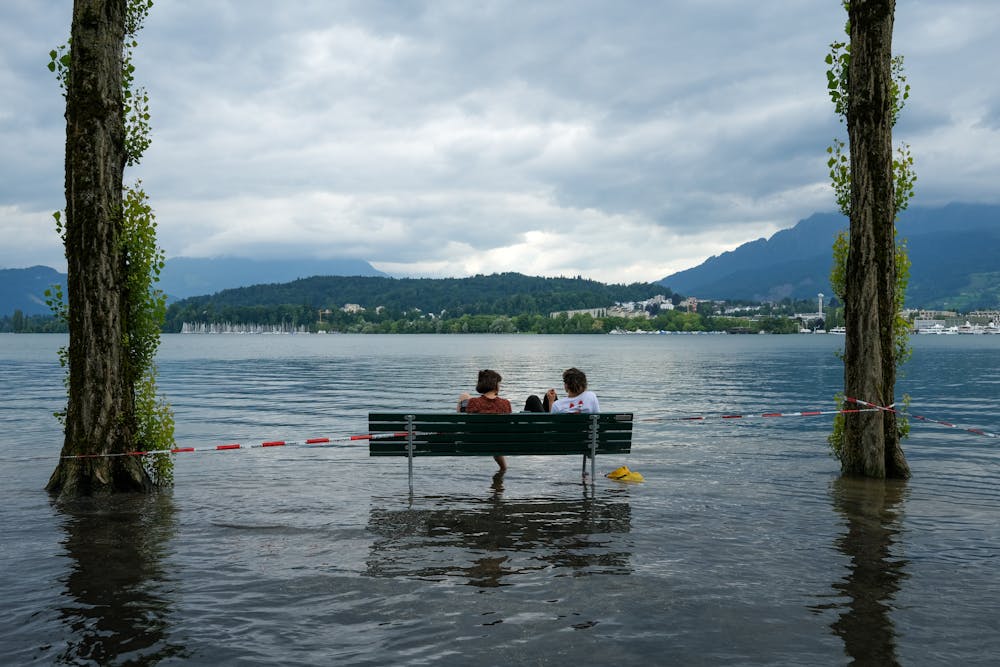
Flooding in Lucerne, Switzerland. cinan / shutterstock

Yet cities are also sites of opportunity, and the IPCC report maps a wide range of options for urban adaptation.

These include physical barriers to stop floods and rising seas, or more nature-based solutions such as planting trees upstream to slow excess river flows and shade homes in heatwaves, or restoring mangroves that protect communities from coastal flooding.

The report also cites social policy measures such as cash transfers to provide safety nets, insurance and other types of livelihood support.

5. The window of opportunity is closing, rapidly

The new report emphasises the need to couple adaptation measures with greenhouse gas emission reductions to enable “climate resilient development”.

This will require adequate financing, inclusive governance, transparency in decision making, and the participation of a wide range of people and groups.

Yet, the world is on a path to exceed 1.5℃ warming within the next decade. Current development policies which accelerate greenhouse gas emissions actually increase climate maladaptation risks and widen social inequalities.

To urgently shift our collective course from 1.5℃ of warming and beyond, the report charts paths for climate-resilient development that policymakers can apply, all of which reduce climate risks while improving lives, especially among those most vulnerable to global warming.

Time, however, is running short.

Links

(AU The Guardian) Tasmania Records Driest Summer In 40 Years As La Niña ‘Swings The Wind Around’

The Guardian -

Weather pattern slashes rainfall in Australia’s southernmost state while temperatures soar

The view over Hobart from Mount Wellington on a sunny day. As La Niña has sent more rain to the Australian mainland, Tasmania has endured a hot, dry summer. Photograph: Genevieve Vallee/Alamy

While Queensland and New South Wales have been hit with historic rainfall and floods, Tasmania has endured its driest summer in 40 years.

The island state’s west and south-west – both sparsely populated and typically wet – recorded their lowest levels of rainfall on record, the Bureau of Meteorology said.

This meant that across the state it was driest summer since 1980-81, and the fourth driest since records began more than a century ago.

Total rainfall was 43% below the long-term average. Parts of the south-west had between 200mm and 400mm less rain than they normally would in summer.

This was consistent with projections of changed rainfall across the state due to rising temperatures caused by greenhouse gas emissions.

A major report by the Intergovernmental Panel on Climate Change published this week found that global heating was expected to lead to more winter rain in Tasmania but a reduction in summer rain in the state’s west.

Anna Forrest, a meteorologist with the bureau, said the impact of the La Niña weather pattern that has helped drive the extraordinary rain further north was likely to have played a role in reducing the amount of rain in Tasmania.

During a La Niña event, strong trade winds blow west across the Pacific Ocean, pushing warm surface water towards Asia and the seas north of Australia.

The warmer waters lead to increased rainfall across northern and eastern Australia but play a different role further south.

“The predominant wind direction for Tasmania is westerly but this summer we’ve had a lot of easterly winds,” Forrest said. “It is highly unusual but that is the impact a La Niña has on Tasmania’s climate. It basically swings the wind around.”

The Tasmanian dry spell coincided with one of the state’s hottest summers on record. The mean temperature across days and nights was 1.3C higher than average, making it the fifth warmest summer since records began. The average maximum day time temperature was 1.7C above the long-term average.

Across the country, it was the 17th warmest summer on record. It was 0.73C above the long-term average measured across the years 1961 to 1990, but cooler than some recent summers, reflecting La Niña’s impact. Summer rainfall was close to average for Australia as a whole.

The IPCC last year reported that human activities were unequivocally heating the planet, affecting weather and climate extremes in every region across the globe and helping to cause increased heatwaves, heavier rainfall events and more intense droughts and tropical cyclones.

In Australia it found that average temperatures above land had already increased by about 1.4C since 1910. Annual changes in temperature were now above what could be expected from natural variation in all regions across the continent.

A scientific review has concluded that the frequency of El Niño, which is associated with higher temperatures in eastern Australia, and La Niña events were expected to increase under business-as-usual scenarios of greenhouse gas emissions.

Links

04/03/2022

(AU Financial Times) Catastrophic Floods Pile Pressure On Australian Government

Financial Times - |

PM’s administration criticised over climate change stance as soldiers called in to help disaster relief operations

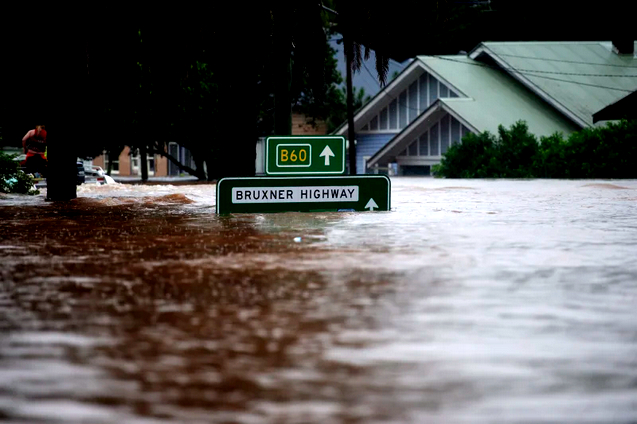
Residents evacuate after flooding in Lismore, northeastern New South Wales. The extreme weather has claimed seven lives and flooded 18,000 homes so far. © JASON O'BRIEN/EPA-EFE/Shutterstock

Devastating floods that have submerged cities and towns insland and New South Wales and triggered thousands of insurance claims are stoking criticism of the Australian government’s stance on climate change.

The wild weather, described by meteorologists as a “rain bomb”, moved south from Queensland over the weekend and has claimed seven lives and flooded 18,000 homes.

The flooding is the latest in a series of natural disasters to hit Australia in recent years that included bushfires in 2019 and the bleaching of the Great Barrier Reef, and has piled pressure on Prime Minister Scott Morrison’s conservative government to tackle climate change more robustly.

Josh Frydenberg, Australian treasurer, declined to mention climate change when asked on Monday about the floods, saying “forever it’s been thus”.

Australia was criticised last year when it reluctantly signed up to a “net zero” greenhouse gas emission target by 2050 but refused to phase out fossil fuel production. It also declined to set more stringent 2030 decarbonisation targets, saying it would not be lectured to by other countries.

Simon Bradshaw, head of research at the Climate Council, countered that for every 1C of warming, the atmosphere could hold 7 per cent more moisture, which would lead to more severe rainfall.

Bradshaw said governments at local and state levels were trying to address the risks but there was a lack of leadership at the federal level.

“We don’t see any signs that the national level decision makers are willing to take the steps required to ensure Australia plays its part in tackling climate change, protecting communities and unleashing the huge opportunities in renewable energy and climate solutions,” he said.

Dozens of people remain stranded on the roofs of their houses with some buildings, including a historic town hall near Byron Bay, washed away entirely, according to reports. The government has deployed 200 soldiers to help with disaster relief in the region.

Carbon capture and storage
Water levels on the Brisbane river reached almost 4m, the highest level since severe flooding hit Queensland’s biggest city in 2011, while the regional town of Gympie suffered its worst flooding since the 1880s.

“No one has seen this much rain in such a short amount of time,” said Anastacia Palaszczuk, premier of Queensland.

She said emergency services had made 113 water rescues and 1,544 people had been evacuated in the state, which has also been hit by power outages.

Insurers have classified the floods as catastrophic, which means claims will be given priority status.

Andrew Hall, chief executive of the Insurance Council of Australia, said: “It’s too early to understand the extent of the damage to property in affected areas and to estimate the insurance damage bill. However, insurers have received more than 3,500 claims in south-east Queensland over the last three days.”

David Wilkes, a general manager at insurer IAG, said it had received 3,200 claims by Sunday night.

The former head of the government’s National Resilience Taskforce, Mark Crosweller, said: “What we are seeing unfold is what we had long predicted.”

Links

(AU SMH) Make No Mistake: These Floods Are Climate Change Playing Out In Real Time

Sydney Morning HeraldBlanche Verlie | Lauren Rickards

Time to adapt: the flooding in Lismore this week. Credit:Elise Derwin


Authors
Yet again, regions across NSW and Queensland are coming face to face with “unprecedented” floods. 

We are seeing the far-reaching impacts of climate change, as documented and projected by this week’s report from the Intergovernmental Panel on Climate Change, playing out in real time in our communities.

Floods, like other extreme weather events fuelled by climate change, have long-term, wide-ranging impacts.

As we are seeing in Lismore, Brisbane and beyond, these events take out critical infrastructure, such as roads, buildings and power lines. This can take decades to rebuild, if we ever get there.

Horrifically, as we are seeing in these unspeakable events, people die. People lose their loved ones. Others lose their homes or their pets. The environment gets slammed. All kinds of inequality magnify these effects, and these effects in turn magnify inequalities. This is why climate change is known as a “threat multiplier”.

We know this. What we often fail to recognise is that all of these impacts intersect with each other, making them all worse. In the months after such spectacular disasters, people who are left homeless and/or without a livelihood often suffer acute and long-term physical and mental ill-health.

Communities and the networks of supportive relationships they provide can be torn apart as people move away, leaving those who remain more isolated and vulnerable to experiencing the post-traumatic stress that often lives in the wake of such disasters. But all “recovery” efforts – whether rebuilding physical infrastructure, or rebuilding community – require healthy people.

Extreme weather
‘They put people in the face of these disasters’: Insurance boss blasts planning laws
These floods can no longer be accurately described as a “one in 1000-year” event, as suggested by NSW Premier Dominic Perrottet.

It is just five years since Lismore’s last catastrophic flooding event, and just a decade since Brisbane’s notorious 2011 floods.

But neither are they “the new normal”, given the escalating changes. In our intensifying climate, heroic ideals of “rebuilding” and “recovery” will not always be possible.

Not only do the varied impacts of individual extreme weather events interact with each other, they compound upon legacies of loss, trauma, disruption and incapacitation that have come (not that long) before.

Many people affected by the current floods have also suffered through recent climate-related extreme events, including previous floods, storms, heatwaves and the Black Summer fires. Because they are still dealing with the lingering effects of these other manifestations of a changing climate, including serious financial costs, this means the current floods are even more consequential for them.

Climate policy
By making people worse off, climate-change related disasters are exacerbating the damage inflicted by further climate events, making people even more vulnerable to what lies ahead.

The social, economic and environmental impacts of the floods are thus a manifestation of climate change in more ways than one.

Not only is climate change making floods in eastern Australia more extreme in meteorological terms, but it is making people and society more vulnerable to their negative effects.

But the impacts of climate change are not inevitable or “natural”.

The social aspect of climate change impacts gives us more options for reducing them. Because impacts emerge out of specific, local, dynamic social situations, we can intervene in those situations to avoid or lessen them.

This is what adaptation is about. It involves not only reducing flood hazards (for example, through land use planning and stormwater management), but also ensuring people are as prepared and well placed to cope as possible.

Floods 
The mega risk climate change poses is that impacts outpace our adaptation, undermining our mitigation in the process.

The IPCC assessment (which one of us helped write) concludes that two of the most serious threats to Australia are cascading, compounding and aggregate impacts of such disasters, and that our institutions fail to adapt fast enough.

More broadly, it flags the risk of worsening vulnerability and, in turn, social inequalities.

The current floods underline what is at stake. Adaptation has to get ahead of the curve.

This challenge – dealing with proliferating impacts today while adapting to prevent and reduce impacts tomorrow – is partly why the report concludes that the window of opportunity to act is closing.

Mitigating greenhouse gases and systematically reducing the risk of climate change impacts requires people to be well, housed, resourced and functioning.

This window will open and close for us according to what we are dealing with.

So while those caught up in the current floods manage their cascading effects, the rest of us need to get to work in our various professions, organisations and communities to progress mitigation and adaptation, from the national scale down.

Links

(AU ABC) IPCC Report: Australian Coral, Kelp, Alpine And Some Forest Ecosystems At Risk Of Irreversible Damage Due To Climate Change

ABC Science - Nick Kilvert | Belinda Smith

Mountain ash (Eucalyptus regnans) forests, like this one in Yarra Ranges National Park, could look completely different under sustained global warming. (Getty Images: Jason Edwards)


Key Points
  • Australia stands to lose biodiversity in natural ecosystems due to global warming and poor management
  • If high carbon emissions continue unabated, ecosystems from oceans to mountaintops are at greatest risk
  • In the case of coral reefs, bleaching events at least once every five years are all but locked in
Some of Australia's iconic and unique natural ecosystems may disappear for good if we keep emitting carbon at current rates, climate experts warn.

According to the latest Intergovernmental Panel on Climate Change (IPCC) report on the effects of and adaptation to climate change, Australia can expect more hotter days, fewer cold ones, more extreme fire weather, and heatwaves on land and in oceans under 1.5 to 2C of global warming above pre-industrial levels.

The world is currently at an average of about 1C of warming, and, exacerbated by other human actions, this is already modifying Australian ecosystems, says Griffith University climate and environmental scientist Brendan Mackey.

"We know how the climate has changed in the last 100 years in Australia, and we have some evidence now for how ecosystems have been impacted by those changes."

Professor Mackey was a coordinating lead author for the Australasian chapter of the IPCC report, which outlined nine key climate risks for the region.

     Beautiful one day, uninsurable the next? Our changing climate could soon make it harder to get a mortgage on the Queensland coast. We had three properties assessed, with mixed results. Read more
Four of those risks focused on ecosystems at risk of severe damage — or even collapse — under climate pressures.

So let's take a tour of the continent and have a look at what's at stake — and they're not necessarily the ecosystems you might expect to see.

Up high in alpine regions

When we think of alpine regions, often the images that spring to mind might be the snow-covered peaks of Europe or the Himalayas.

Though much lower, Australia's alpine regions host some of the most unique biodiversity on the planet — mountain pygmy possums, corroboree frogs, spiny crayfish, snow gums, and myriad plant species.

But the short stature of our mountains is their Achilles heel.

Many species have adapted to living in the cooler climes found on our mountainsides above 1,000 metres or so.

Mountain pygmy possums need snow cover to insulate them from the freezing air while they hibernate over winter. (Supplied: Victorian Department of Environment, Land, Water and Planning)

As the climate warms, those animal and plant species are forced to migrate further and further up the mountains to find a suitable, cooler habitat.

But there's not very much further for them to go, according to Professor Mackey.

"If you're in New Zealand, as you go up in elevation, they have real mountains with pointy tops.

"In New Zealand, the alpine vegetation can potentially grow uphill a bit, and any plants or animals that are dependent upon that habitat can go with it.
"But in Australia, the top of our alpine zone, there are no peaks above it."
The IPCC singled out Australian alpine regions for special mention in the latest report.

There's predicted to be a sharp increase in extinctions in these regions as warming goes beyond 1.5C toward 2C.

On the latest predictions, we're forecast to hit 1.5C around 2030.

In Australia's tropical north, species have already been observed pushing further up mountains, according to Steven Williams from James Cook University.

"The lowland species are moving into the midlands, the midlands species are declining," Professor Williams said.

"A lot of the endemic [bird] species … most of them have already declined by up to 30 per cent, some to 60 per cent."

For mammal species like possums, he said it seemed to be the increase in extremely hot days that had been doing the most damage.

Green ringtail possums are already declining in the Queensland wet tropics. (Getty Images: Auscape)

"The ring-tailed possums endemic to the area have already declined by 50 per cent," he said.

"Two other species are declining badly.

"The paper that we’re about to bring out on the possum shows that most of the possum species will be in really serious trouble by 2050.
"Some of the birds, based on their observed decline so far in the last 10 years, would be in similar deep s*** by 2040-2050."
But so far Australia's southern alpine regions are yet to feel the real brunt of climate change, according to Ary Hoffman from the University of Melbourne.

Mt Buller's mountain pygmy possum population appears to be healthy, for instance.

Its key threat today, according to Professor Mackey, is logging.

In the southern alpine regions more generally, Professor Hoffman said the biggest threat right now is from weeds and ferals like the wild brumbies.

But the changes will come, he said.

"There is no doubt about it. There are plants you only find in snow patches, and they will disappear," Professor Hoffman said.

"Animals associated with the wetlands and the bogs will start disappearing; frog species like the corroboree frog and Baw Baw frog, they’ll be in trouble."

The southern corroboree frog is critically endangered, with fewer than 200 wild individuals left. (Taronga Zoo: Michael McFadden)

But he said it's the unexpected interactions between species that create the most uncertainty.

Scientists suspect warmer temperatures and longer drought in the Australian alps are responsible for a boom in longicorn beetles, for instance.

The beetles in turn are causing an extensive and sudden dieback in our snow gums — trees a few hundred years old have been dying en masse as they're essentially ringbarked by the beetles.

"That's the problem with climate change — you get these unexpected things happening," Professor Hoffman said.


The race to save five Australian species from extinction 29min 35sec

Some forests on land …

Speaking of snow gums, forests of southern and south-west Australia were also singled out as Australian ecosystems at risk of the one-two punch of climate change and human mismanagement.

Sudden death of the snow gums

But not the eucalypt forests of Victoria and NSW that were decimated in the 2019-20 bushfires … at least not immediately.

That's mainly because those trees are known as "sprouters", and store tiny buds under trunk and branch bark which are ready to grow out as green shoots should a fire go through the area, Professor Mackey said.
"So most of our native eucalypt forest is well adapted to wildfires."
The forests at risk are of towering jarrah and mountain ash, found in the continent's south-west and south-east corners respectively, as well as gnarled snow gum woodland and Tasmania's pencil pines.

And each is affected slightly differently by a warming world.

In southern Western Australia, winter rainfall would normally replenish underground reserves of water, which the deep roots of jarrah trees tap into to keep going over summer.

But regional winter rainfall has steadily dropped over the past 30 years, and their subterranean reservoirs haven't been topped up as much.

On the other side of the country, mountain ash trees are "seeders". Older trees can cope with intense bushfires, but seedlings must grow for around 20 years before they can reproduce.

"So if you start getting catastrophic wildfires more than two to three times every 10 years, that's faster than it takes the ash forest to grow," Professor Mackey said.

"And if you have a commercial logging regime that's keeping ash forest at a young age — so rather than letting the trees grow to be 400 years old, you're harvesting them between 48 years old and 46 years old — they're younger trees, they're more vulnerable, and they're more likely to be killed by fire.
"The more of these catastrophic fires we have, the more we risk going into a downward spiral."
More fires, more often, affect snow gums in a similar way. These trees resprout from the base, where they keep a stock of starches and sugars for this purpose.

"But if you increase the frequency of catastrophic fire events ... and snow gums get hit too often, they don't have time to replenish the energy stock they use to regenerate," Professor Mackey said.

Pencil pines (Athrotaxis cupressoides) can live for 1,300 years. (Getty Images: Ted Mead)

And Tasmania's ancient pencil pines haven't had to deal with catastrophic fires — until recently.

Bushfires in 2016 razed swathes of pencil pine forest, and even six years on, large areas are not recovering well, Professor Mackey said.
"If it got hit by another extreme wildfire event like that, it's going to be in very serious trouble."
So what would happen if these forests disappeared?

They wouldn't leave a barren plain. Rather, a different type of forest would grow in its place.

For instance, if snow gums disappeared, they might be replaced by woody shrubs that can regenerate after fire quickly — something that's already happening in parts of the country.

And this, Professor Mackey says, results in an overall loss of biodiversity.

"You lose something that was particular to a local environmental condition, and it's replaced by something which is more common elsewhere."

… and forests beneath the waves

When Gretta Pecl started diving in the kelp forests off the east coast of Tasmania in the mid-1990s, towering stands of giant kelp stretched from seabed to surface.

"By around 2005, I started noticing changes," said Professor Pecl, now a marine ecologist at the University of Tasmania and a lead author on the Australasian chapter of the IPCC report.

Different and diminutive kelp species started moving in while the long ropey strands of giant kelp dwindled.

"And when you consider the kinds of [kelp] habitats and systems that we had in the late 90s and early 2000s to what we've got now, they actually look like two different ecosystems."

Tasmania's giant kelp (Macrocystis pyrifera) forests have declined by more than 90 per cent since the 1960s. (Getty Images: Nigel Marsh)

Indeed, the IPCC report states "less than 10 per cent of giant kelp in Tasmania was remaining by 2011 due to ocean warming".

The loss of kelp forests in southern Australia and south-east New Zealand — highlighted as a key risk — is already severe, Professor Pecl said.

"But it could be reduced substantially by rapid, large-scale and effective mitigation and adaptation strategies", such as transplanting more heat-tolerant types.

So what happened to the once-dominant kelp forests?

The tragedy of Tasmania's
underwater kelp forests


Giant kelp is sensitive to temperature and thrives in the cold, nutrient-rich water that laps at the Tasmanian coastline.

But on the east coast, this has been replaced by water that's warmer and comparatively devoid of nutrients.

This warm water is shuttled down by the East Australian Current, which has moved 350 kilometres south since the middle of last century, Professor Pecl said.

"That extension of the East Australian Current, as shown in the working group 1 IPCC report, is largely driven by warming over the Pacific."

This underlying ocean warming is separate to marine heatwaves — days-long bursts of particularly warm seawater.

Kelp must also contend with overgrazing by nibbling fish and sea urchins that are moving southward with the East Australian Current.
"They literally eat kelp out of house and home," Professor Pecl said.
"We know that at the global level, around half of plants and animals, including marine species, are moving poleward … and changing where they live now as a function of climate.

"Effectively everything is moving at the same time, but at different rates.

"Connections are being broken apart and new connections are being formed … and the kelp forests around Australia are a victim of that."

But worst affected will be coral reefs

By now we've all heard how climate change is going to kill a lot of coral. We've already seen several mass bleaching events on the Great Barrier Reef since 2016.

According to the latest report, we're expecting to see bleaching conditions on the reef at least once every five years by 2035, even if we aggressively cut emissions from today.

That's likely to increase to every year by around 2050.

Without long periods in between bleaching events for the coral to recover, mass mortality is a near certainty.

In March 2020, the Great Barrier Reef endured its third mass bleaching event in only five years. (Supplied: Victor Huertas)

At 1.5C of warming, the IPCC predicts we'll lose between 70 to 90 per cent of coral diversity. At 2C, that rises to more than 99 per cent.

But the problem is far bigger than losing pretty corals. The corals are merely one part of a massive food web that provides nutrients for marine species well beyond the reef itself, according to Scott Heron from James Cook University.

"Coral reefs cover less than one-tenth of 1 per cent of the ocean floor," Dr Heron said.

"But they support more than 25 per cent of oceanic fish species.
"When we talk about punching above weight, corals are really punching above weight."
Losing 90 per cent or more of coral species is going to have a profound effect on fish abundance, including on many of the commercial fish species that we rely on.

Then there is the physical buffering that reefs provide our coastlines.

Reef scientists anxiously eyeing the weather
Reefs help dissipate wave action, sheltering our coastal communities from the worst impacts of storms and cyclones.

"That's all the more important in an era where we're seeing storm intensity increase," Dr Heron said.

"We're not necessarily seeing more tropical cyclones, but we're seeing more severe tropical cyclones."

Despite the dire predictions for our reefs, Dr Heron says he thinks they're still worth fighting for, and that we need to make an equitable and rapid transition from greenhouse-gas-emitting technologies.

"The number of options and ideas that we have available to us are rapidly diminishing," he said.
"The question is: what are we doing this decade so that we minimise the impacts?"
Links

Lethal Heating is a citizens' initiative