08/03/2022

(AU ABC) NSW And Queensland Flooded The Same Week A Major Climate Report Was Released. We Need To Talk About It

ABC Science - Nick Kilvert

IPCC warns window to save ourselves from climate change is 'rapidly closing' (Photo: AAP)

As the rain bucketed down 10 days ago, residents of a nearby house in our neighbourhood in the outskirts of Brisbane were woken by a loud cracking.

Their newly built home had begun slipping down the hill.

Get prepared for extreme weather and see how one town survives and adapts to intense bushfires and severe storms in AR. Read more
The phenomenal amount of rain that had already fallen had caused a landslip that had destabilised the foundations, forcing them to evacuate in the darkness to a shed on flatter ground.

It took two days to be able to make out the carnage — the white and yellow home usually in clear view across the valley from our back verandah was obscured by the blinding rain.

When it finally eased, we could see the front stairs were gone, the front house-poles splayed down the hill, and the right-hand side of the house was slumped awkwardly, peering over the steep incline.

No doubt they'll need to pull the house down and start again.

Records will continue to tumble

Mt Glorious just to the north of Brisbane received more than 700 millimetres in 24 hours.

Further north, Maryborough endured its second major flood in as many months.

Gympie, used to semi-regular flooding, was under more water than it had been in more than 100 years.

The Mary River, which intersects both towns, was at its highest peak in Gympie since 1893.

In Brisbane, bridges and causeways were flooded. Then entire streets. Nervous residents watched as the river pushed into more houses with each high tide.

Residents of Brookfield in Brisbane's west reported emptying more than 1,000 mm of water from rain gauges between Thursday and Sunday.

As the system tracked south, some Lismore locals thought they'd be safe taking shelter on, or in, their roof spaces.

But the floodwaters didn't stop rising – 1974's record flood markers throughout the town were eclipsed by the swelling brown water.

Volunteers in tinnies and on jet-skis were going rooftop to rooftop, ferrying residents to higher ground. In some cases they had to cut people out from inside roof spaces.

Lismore residents were using tinnies to pluck neighbours from rooftops. (AAP: Jason O'Brien)

At the time of writing, 16 people had died in Queensland and New South Wales, with that figure likely to rise.

This is the second "one-in-100-year" flood in 11 years in south-east Queensland and northern New South Wales.

Two years ago, these regions were in the grips of bushfire.

Descriptors like "rain bomb" are being bandied about as politicians and reporters search for new adjectives to describe the system that dumped more rain on parts of the south-east than the fabled 1974 floods.

Just like in 2011, the word unprecedented has been thrown around a lot.

What's caused our record floods?
The highly unusual combination of two consecutive weather events that "act like a boiling pot of water" is to blame for the devastating floods and storms that have hit the east coast, an expert says. Read more
It may well be unprecedented. But it's not unexpected.

This is the new precedent; the new present.

And yes, weather systems are variable, rainfall especially.

Of course a one-in-100 year event doesn't guarantee it'll only happen once every 100 years. And yes, it's a La NiƱa year when rainfall totals are expected to be higher. And yes, we've always had extreme weather.

It will take time for scientists to determine how much climate change contributed to the devastation, this time.

But this is what climate change looks like. Big weather, tumbling records, one extreme following another.

And it's going to get worse.

Big polluters 'guilty of arson of our only home'

Climate forecasts say that warming will cause more intense storm events. A hotter atmosphere is capable of carrying more moisture before it's released. A warmer ocean carries more energy to fuel storm systems.

We're only at around 1.1 degree Celsius of warming above pre-industrial levels.

Leaders at the Glasgow summit failed to commit to targets that will keep warming below 2C this century. ( PHIL NOBLE/POOL/AFP via Getty Images)

They had a chance at the Glasgow Climate Summit last year, but politicians both here and internationally won't commit to measures that might keep warming to 2C this century, let alone 1.5C. Right now we're tipped to cross the 1.5C threshold soon after 2030.

As the IPCC outlined in its 2018 report, the threat of temperature and rainfall extremes — both negative and positive — will continue to rise sharply between 1.5C and 2C in parts of Australia.

Last week the IPCC released its latest report on the impacts of climate change and projected impacts to ecosystems.

Increased bushfire area, higher drought-induced tree mortality, longer duration of hot days, lost agricultural productivity are already being measured in Australia, they reported.

The ecosystems Australia's set to lose
Some of Australia's iconic and unique natural ecosystems are headed for irreversible damage if we keep emitting carbon at current rates, climate experts warn. But they're not necessarily the ones you might expect. Read more
United Nations secretary-general Antonio Guterres described the report as an "atlas of human suffering" and "a damning indictment of failed climate leadership".
"This abdication of leadership is criminal. The world's biggest polluters are guilty of arson of our only home," he said.
Flooding from intense rainfall is already Australia's most expensive disaster. The latest IPCC reportwarned it's going to get worse.

Yet in the midst of it all, the IPCC report has barely rated a mention in Canberra.

Silence supports the status quo

The IPCC has been releasing these reports now for 32 years, publishing more than 60 major reports to 2022.

Since 1990, scientists have warned that there needs to be a radical shift from our dependence on fossil fuels. At that stage we had some, but not much, time up our sleeves.

Our politicians back then had a good idea of what was at stake. They were warned about climate change at a CSIRO briefing in 1986.

In 1990, then environment minister Ros Kelly under the Hawke government proposed an emissions target to cabinet.

But as the years went by, under pressure from the fossil fuel industry and others, commitments wavered and emissions climbed.

All the while the IPCC and climate scientists' predictions only got firmer, more refined and more urgent. And now we're starting to live them.

Angus Taylor has been spruiking
carbon capture technology.
Here's what he's not saying
Federal Minister for Energy and Emissions Reduction Angus Taylor has been speaking about carbon capture and storage technology this week as part of the Federal Government's push to overhaul clean energy investment in Australia. Read more

But governments around the world, including our own, continue to subsidise fossil fuels and bet heavily on unproven technologies like carbon capture and storage, and continue to finger-point and what-about on their share of global emissions, instead of just doing their very best to get emissions down.

It feeds the inertia if we follow the sentiment that "now's not the time" to talk about climate change — at times when we've all got our hands full cleaning up its mess.

Kicking the can down the road has allowed the status quo to get us where we are today: on borrowed time, with the prospect of overshooting an adaptable 1.5C of warming practically a given.

But when we're not in the midst of a bushfire, a flood or a drought, we tend to forget the urgency. Other more immediate problems require our attention.

If we're lucky right now, we might get a reprieve: a few years without a major natural disaster, likely exacerbated by a warming world.

But as climate scientists and the IPCC continue to warn us, the breaks between extreme events are going to get shorter. And when the disasters come, they'll bite harder.

Why should we wait for the next one to talk about it? Or the one after that?

While images of flooding still fill our news bulletins, it's important to remember that these events aren't happening in a vacuum.

Climate change is happening around us, and now is not the time for avoiding the subject.

No ducking, no delaying.

It's time to take it on.

Links

(New Daily) Alan Kohler: Some Difficult, Expensive Decisions Will Have To Be Made By Whoever Wins This Election

New Daily - Alan Kohler

Some difficult decisions face the winner of the next federal elction in dealing with climate change, writes Alan Kohler.

Lismore is not the only town devastated by the Queensland and New South Wales floods, although it was probably the worst, and it embodies the problem now facing Australia from climate change.

On February 28, the water level in Lismore reached 14.4 metres. The previous high was 12.46 metres in 1890.

That also happened to be the day the Intergovernmental Panel on Climate Change published its sixth assessment report on the impact of climate change, in which it warned of “cascading, compounding and aggregate impacts on cities, settlements, infrastructure, supply chains and services due to wildfires, floods, droughts, heatwaves, storms and sea-level rise”.

Flooding in Lismore is estimated to be the worst on record.

There have been 29 major floods in Lismore’s history and this year’s was the worst by a long way: 90 per cent of the town’s businesses were submerged; none of the residents was unaffected.

The levee built in 2005, 10.7 metres high and designed for a one-in-10-year flood, was well overtopped by this one-in-130-year event, and the city was inundated up to its eaves.

Now what? After all, climate change is a one-way street, for both extreme weather events and insurance – there’s no going back.

It’s not just a question of how long the poor residents and business owners of Lismore have till the next 100-year flood, it’s also a matter of what insurance is going to cost them in the meantime – if they can get it.

What’s it going to cost to keep them in Lismore or Gympie or Grafton, and who’s going to pay?

The 10.7-metre high, 2005 levee cost $21 million and was funded equally by the local council, the state government and the federal government. How high should it be now? Fifteen metres? Who’s going to pay for it this time? Is that even feasible? And will it make insurance affordable or available for residents and businesses?

Those questions apply up and down the east coast, from outer Sydney to the Sunshine Coast, and the answers will be decided in the boardrooms of the world’s reinsurance corporations and the federal cabinet in Canberra.

It is not an oversimplification to say that the more money the federal government spends on climate change adaptation and defence against floods cyclones and bushfires, the more insurance will be available for people living in the bush and the less it will cost.

Alternatively, the less the government spends, the more towns will have to be abandoned due to the lack of insurance.

Or at least they should be abandoned: many people will choose to live in them uninsured, because they love it, and it’s where they have always been and have nowhere else to go. This means it becomes a matter of who helps them rebuild after the next flood, if not an insurance company.

Ninety per cent of Lismore’s businesses were submerged in the flood.

So far the government has been largely missing in action.

Twelve years ago it set up the National Climate Change Adaptation Research Facility with $40 million in funding to identify knowledge gaps and fund research. It produced a lot of research that is now informing the IPCC, but that’s all.

There have been a few other small amounts of funding, like last year’s piddling $50 million National Flood Mitigation Infrastructure Program, and, of course, there’s the famously unspent $3.9 billion Emergency Response Fund, now $4.7 billion with interest earned.

It’s a demonstration of the politics of climate adaptation that the Insurance Council of Australia issued a call last month for the government to spend a laughably inadequate $2 billion over 10 years on “resilience measures”, otherwise large parts of Australia would be uninsurable.

What’s more, it felt the need to offer an estimate of the return on that investment – $19.3 billion.

For a start, the money should be spent simply to protect peoples’ lives, not for a return, and in any case $2 billion is a fraction of what’s going to be required.

In Chapter 11, the IPCC’s sixth assessment report spells out in merciless detail what Australia and New Zealand are in for, whatever is done about getting emissions down from here.

“More droughts and extreme fire weather are projected in southern and eastern Australia (high confidence).
“Increased rainfall intensity is projected, with fewer tropical cyclones and a greater proportion of severe cyclones (medium confidence).”

The lead author of this chapter, Professor Brendan Mackey, summed it up for me over the weekend: Floods and bushfires will happen more often and cyclones will be more intense and occur further south, where houses aren’t built to withstand them.

Some difficult, expensive decisions will have to be made by whoever wins this election.

Links

(AU The Guardian) Climate Council Says Too Many Leaders Are Silent On Global Heating’s Role In ‘Megafloods'

The Guardian -

Organisation urges all political parties to outline concrete steps on how to prepare for inevitable climate-fuelled disasters

A car submerged by flood waters in Lismore during the major floods of the past week. The Climate Council says ‘too many leaders’ have been silent or absent on the climate crisis driving natural disasters. Photograph: Jason O'Brien/AAP

The Climate Council has issued a pre-election call for all Australian political parties to acknowledge the climate crisis is driving worsening disasters, including the “megafloods” in Queensland and New South Wales.

The Australian Industry Group also declared on Monday that Australia’s former competitive advantage in carbon-intensive energy was “gone” and the country needed “coherent and efficient action” to build a new advantage in clean energy.

With an election due by May, the Climate Council said “too many leaders” were silent or absent on the climate crisis, and Australians were “paying a high price” for the lack of meaningful action.

‘Next level destruction’: NSW residents detail the moments floods devastated their homes.  Read more

“Climate change isn’t a footnote to the story of these floods. It is the story,” the Climate Council said in a statement on Monday.

The organisation – which brings together climate scientists, health, renewable energy and policy experts – issued a four-point call for all federal political parties and candidates.

That includes actively acknowledging “the destructive role that climate change is playing in driving worsening disasters including these megafloods”.

“Now is the time to talk about the Morrison government’s inadequate response to climate change, because burning coal, oil, and gas is supercharging extreme weather,” the Climate Council said.

“Those who argue otherwise want debate gagged because they are failing to step up on this issue.”

The calls come after the latest major assessment by the Intergovernmental Panel on Climate Change (IPCC) found global warming caused by humans was causing dangerous and widespread disruption, with many effects expected to be more severe than predicted.

Prof Brendan Mackey, the coordinating lead author of an Australia-New Zealand chapter in the report and director of the Griffith University Climate Action Beacon, said last week: “One of the clear projections is an increase in the intensity of heavy rainfall events.”

The Climate Council said some politicians claimed the latest flooding disaster was something no one could have predicted. But “scientists have been warning us for decades that climate change will worsen all extreme weather in Australia”.

The Climate Council called on all federal political parties and candidates to outline concrete steps to prepare and equip emergency services and communities for inevitable climate-fuelled disasters.

It said parties and candidates should also “explain to the public how in the next term of federal parliament you plan to get national emissions plummeting by rapidly scaling up readily available renewable energy and building an economy that is free from fossil fuels”.

The organisation’s fourth call for Australian politicians is to ensure that towns, cities and communities are rebuilt in a way that takes into account climate change and makes them more resilient.

Home affairs minister Karen Andrews and prime minister Scott Morrison are briefed on the flooding disaster in Canberra. Photograph: Mick Tsikas/AAP


“Too many leaders are silent or absent,” the Climate Council said.

“It’s time to show leadership and step up to the most critical issue not just of our time, but all time. We have everything to lose, the time for action is now.”

The Australian Medical Association said last week the devastating floods in Queensland and NSW “added urgency for more to be done to mitigate and adapt to the impacts of climate change”.

The Queensland premier, Annastacia Palaszczuk, said bluntly on Friday: “Let’s face it, it is climate change.”

The prime minister, Scott Morrison, has acknowledged that advice from the Bureau of Meteorology indicated climate change was contributing to more regular and severe natural disasters. He said climate resilience must become “part of our everyday planning and preparations”.

“There’s obviously a lot of change that’s occurring, and that’s why we’ve got the policies that we have,” Morrison told 6PR on Friday. “But we’ve also got to deal with the practical issues of the here and now, and these impacts will continue.”

The Morrison government last year bowed to growing international and domestic pressure to commit to net zero emissions by 2050, but it refused to lift its 2030 target from the Abbott-era level of a 26% to 28% cut on 2005 levels.

Labor has committed to a 43% cut in emissions by 2030, while the Greens’ policy is a 75% reduction by 2030.

Australia should chase clean energy opportunities, group says

The chief executive of the Ai Group, Innes Willox, said roughly halving emissions by 2030 “would put Australia in the mainstream of advanced economies”. On Monday the business organisation published its own pre-election energy and climate policy statement.

Australia, it said, “needs to prepare the economy and communities for lower demand for emissions intensive exports, pursue all opportunities for clean economy exports, and get ready for carbon border adjustments in major economies”.

“The next three years could set Australia up to achieve a new clean energy advantage and a thriving and clean economy,” Willox said.

Willox said the closure of coal generators would accelerate, and the transition must be managed effectively to reduce “negative impacts on price, security and reliability”. He said fair treatment of affected workers, communities and supply chains was “essential so that they can thrive”.

The leader of the Greens, Adam Bandt, is scheduled to visit Townsville on Monday to pledge to help coalminers to find new work in “another mining job, or a job in metals processing or manufacturing”.

Bandt will unveil a policy to create Green Metals Australia, a new body to support new and existing businesses that wish to accelerate the green manufacturing transition.

Of the $5.9bn to be invested, $700m would be made available as grants and the rest would be used for concessional finance and purchasing equity.

The policy continues the Greens’ push to win support from coal workers in a bid to win a second Senate seat in the Queensland.

“Coal is fuelling the climate crisis and making the floods in Queensland and New South Wales worse, but that’s not the workers’ fault,” Bandt said.

“Coal workers need to be supported, not demonised.”

Links

07/03/2022

(The Conversation) Climate Change: Effect On Forests Could Last Millennia, Ancient Ruins Suggest

The Conversation -  | 

Forest plants can’t keep up with the speed at which the climate is changing.


Authors
  •  is Senior Researcher in Ecology & Biostatistics (CNRS), UniversitĆ© de Picardie Jules Verne (UPJV)
  •  is Research Fellow and Lecturer, School of Biological Sciences, University of Bristol     
Forests are home to 80% of land-based biodiversity, but these arks of life are under threat.

The rising average global temperature is forcing tiny plants like sidebells wintergreen on the forest floor (known as the understory) to shift upslope in search of cooler climes.

Forest plants can’t keep up with the speed at which the climate is changing – they lag behind.

The pace at which forests adapt to changing conditions is so slow that species living in forest understories today are probably responding to more ancient changes in their environment.

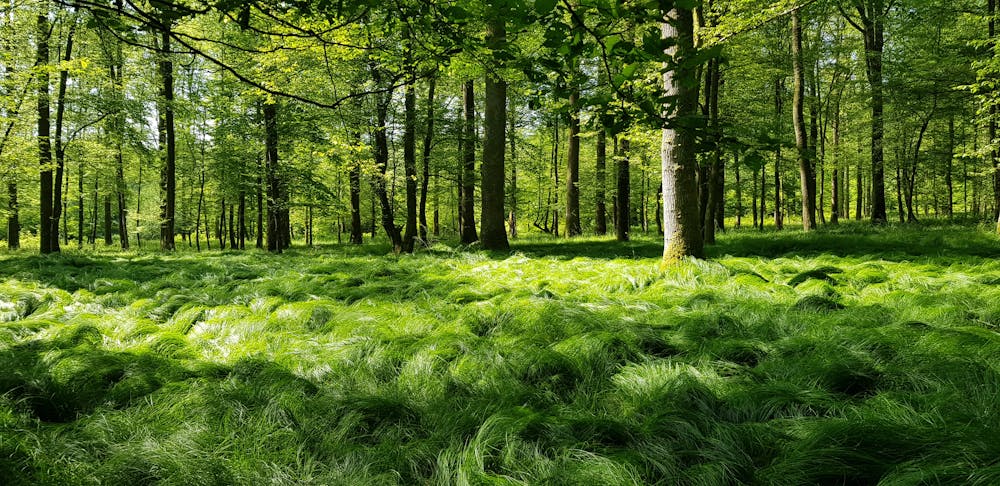
For instance, the Mormal Forest floor in northern France is, in several places, covered by a carpet of quaking sedge. This long grass-like plant betrays the former settlements of German soldiers who used it to make straw mattresses during the first world war.

Changes in how people managed the land, sometimes dating back to the Middle Ages or even earlier, leave a lasting fingerprint on the biodiversity of forest understories.

Knowing how long the presence of a given species can carry on the memory of past human activities can tell scientists how long climate change is likely to have an influence.

The wind whispering through Mormal’s sedge evokes the region’s wartime past. Jonathan Lenoir, Author provided

Ecologists are turning to technologies such as lidar to rewind the wheel of time.

Lidar works on the same principles as radar and sonar, using millions of laser pulses to analyse echoes and generate detailed 3D reconstructions of the surrounding environment. This is what driverless cars use to sense and navigate the world.

Since the late 1990s, lidar has enabled amazing discoveries, such as the imprints of Mayan civilisation preserved beneath the canopy of tropical forest.

In a new paper, I, along with experts in ecology, history, archaeology and remote sensing, used lidar to trace human activity in the CompiĆØgne Forest in northern France back to Roman times – much later than historical maps could ever do.

Illuminating ghosts from the past

Compared to farm fields, which are ceaselessly disturbed, forest floors tend to be well-preserved environments. As a result, the ground below the forest canopy may still bear the imprints of ancient human occupation.

Archaeologists know this pretty well and they increasingly rely on lidar technology as a prospecting tool. It allows them to virtually remove all the trees from aerial images and hunt artefacts hidden below treetops and fossilised under forest floors.

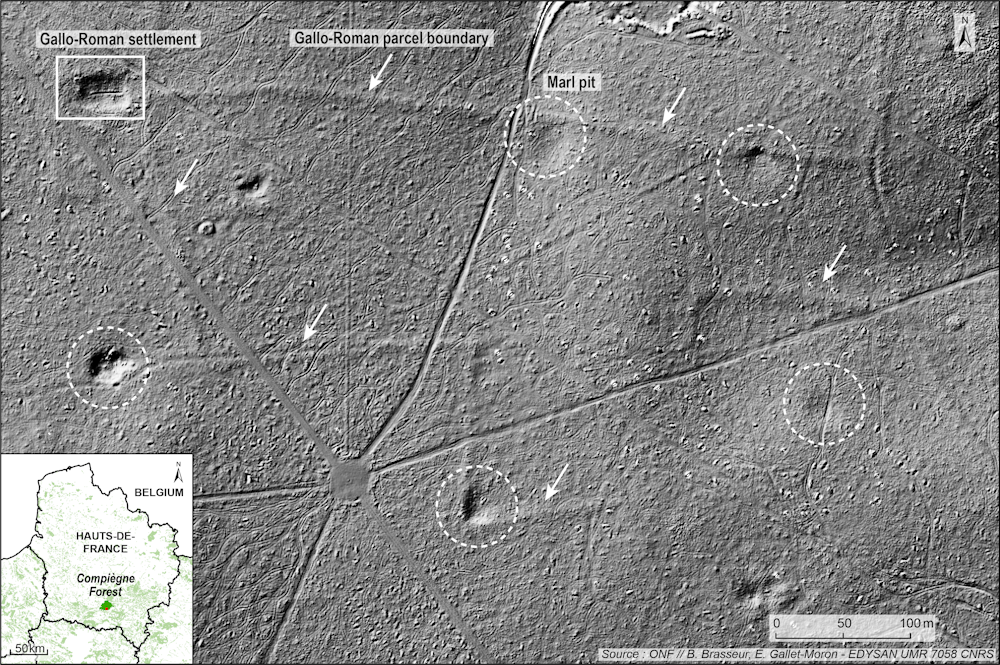
Using airborne lidar data acquired in 2014 over the CompiĆØgne Forest in northern France, a team of archaeologists and historians found well-preserved Roman settlements, farm fields and roads.

Long considered a remnant of prehistoric forest, the CompiĆØgne was, in fact, a busy agricultural landscape 1,800 years ago.

Lidar can reveal the terrain hidden beneath forests. Jonathan Lenoir, Author provided

A closer look at these ghostly images of the CompiĆØgne Forest reveals several depressions within a fossilised network of Roman farm fields.

Archaeologists excavated numerous depressions like this across many forests in north-eastern France and found that people from the late iron age and Roman era carved them.

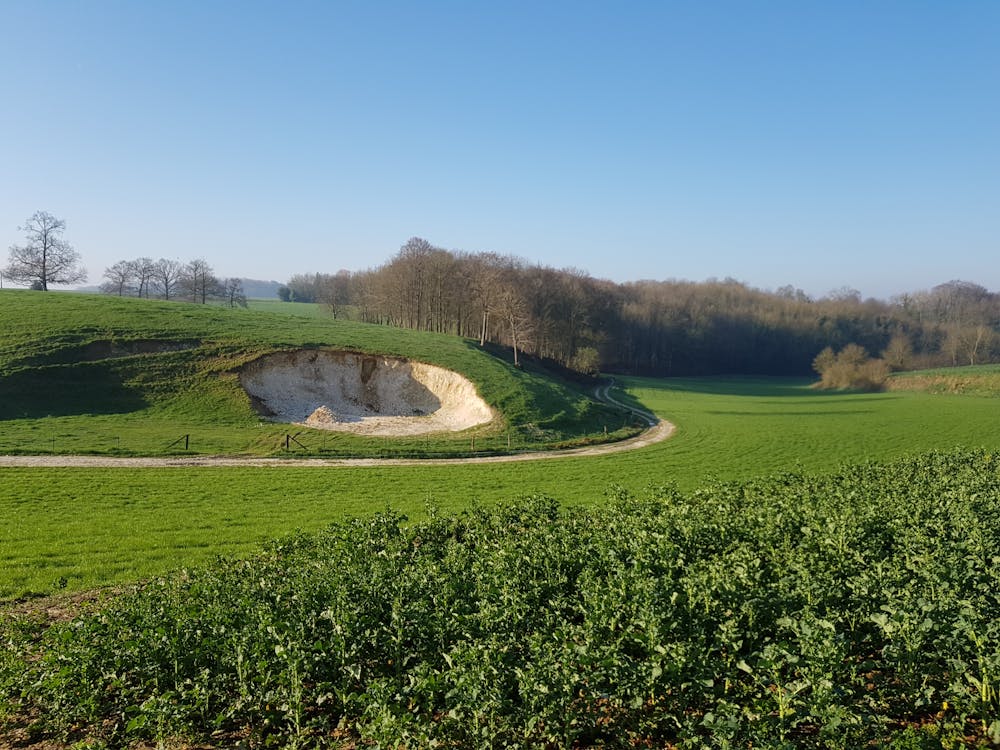
These depressions were made to extract marls (lime-rich mud) to enrich farm fields in carbonate minerals for growing crops and to create local depressions where rainwater collects naturally for livestock to drink.

Marling is still a widespread practice in crop production in northern France.

A pit for extracting marl in Northern France. Jonathan Lenoir, Author provided

The long-lasting effects of human activity

These signs of Roman occupation in modern forests provide clues to why some plant species are present where we wouldn’t expect them to be.

On a summer day in 2007 in a corner of the TronƧais Forest in central France, a team of botanists found a little patch of nitrogen-loving species – blue bugle, woodland figwort and stinging nettle – nestled among more acid-loving plants.

Nothing special at first sight. Until archaeologists found that Roman farm buildings had once stood in that spot, with cattle manure probably enriching the soil in phosphorous and nitrogen.

Blue bugle heralds an ancient Roman farm. Kateryna Pavliuk/Shutterstock

If a clutch of tiny plants can betray ancient farming practices dating back centuries or millennia, ongoing environmental changes, such as climate change, will have similarly long-lasting effects.

Even if the Earth stopped heating, the biodiversity of its forests would continue changing in response to the warming signal, in a delayed manner, through the establishment of more and more warm-loving species for several centuries into the future.

Just as the Intergovernmental Panel on Climate Change has a mission to provide plausible scenarios on future climate change, the Intergovernmental Science-Policy Platform on Biodiversity and Ecosystem Services aims to provide plausible scenarios on the fate of biodiversity.

Yet none of the biodiversity models so far incorporate this lag effect. This means that model predictions are more prone to errors in forecasting the fate of biodiversity under future climate change.

Knowing about the past of modern forests can help decode their present state and model their future biodiversity. Now lidar technology is there to help ecologists travel back in time and explore the forest past.

Improving the accuracy of predictions from biodiversity models by incorporating lagging dynamics is a big challenge, but it is a necessary endeavour for more effective conservation strategies.

Links

(AU ABC) Worse Weather And More Floods: The IPCC Report Contains Warnings Australia Should Heed

ABC NewsMichael Slezak

This 7.30 report looks at the IPCC's warnings that health risks are intensified by climate change. (Jess Davis)

This week we saw large parts of the country engulfed by flood waters.

People fleeing torrents raging through their living rooms, others wading neck-deep across rivers that were once roads. Some clung to their roofs, dotted like islands in a sea of murky brown, others rescued by neighbours in dinghies.

Some were trapped by landslides. Some even lost their lives.

This week, we also saw the world's most comprehensive analysis of what climate change was doing to us. How it's going to get worse, and what we can do to prepare.

Climate change warnings
The IPCC says climate change is now a threat to human wellbeing, warning the window we have to act is "rapidly closing". Read more
Set against the backdrop of some of the worst floods and heaviest rainfalls in Australian history, the findings of the Intergovernmental Panel on Climate Change (IPCC) were both bleak, and shocking.

UN Secretary-General Antonio Guterres described it as "an atlas of human suffering" and laid the blame squarely at world leaders, calling it "a damning indictment of failed climate leadership".

The response from world leaders was mixed — ranging from urgent concern to deflection and complete silence.

What did the report say about how climate change will affect humans? The 2,600-page report's findings are about as bad as you could imagine.

Climate change is already upending the lives of billions of people around the world and will definitely get worse over the coming years and decades.

Continuing warming — and worsening impacts — are inevitable, with some of those impacts beyond our ability to adapt.

For example, the increasing heat will kill hundreds more people in Melbourne, Sydney and Brisbane, no matter what. But it will kill hundreds more again, if we don't act quickly to cut emissions.

The projections about future flooding are incredibly worrying. The report says with sea level rise of just 0.5m — which we will likely see this century, and maybe as soon as 2050 — what is currently considered a "one-in-100-year flood event" could happen "several times a year".

The report also notes flash flooding is going to become more common as downpours become more intense. (Supplied: Sue Higginson)

Some coastal areas will be lost to sea level rise, which will be made worse by more intense storm surges. In some cases the report says there is no serious option but retreat.

Mapping tools can easily reveal how rising seas will inundate coastal areas. Coastal Risk Australia is one such tool.

It shows that sea level rise by 2100 — if we don't move to quickly cut emissions — huge parts of Cairns will be inundated.

By 2100, sea levels may rise by 0.84m. This map shows what that'd look like in Cairns.(Supplied: Coastal Risk Australia)

Byron Bay will also see large parts flooded at high tide, as would Noosa.

If we cut emissions now, we delay that amount of sea level rise for some time, giving us perhaps decades to prepare. 

But in the longer term, we will see sea level rise for centuries, according to report author Mark Howden, head of the ANU Institute for Climate, Energy and Disaster Solutions.

And there are serious worries, he says, that we might already have triggered some tipping points that will make sea level rise much faster.

When it reaches 5 metres, huge parts of all our capital cities will be under water.

Longer term, if sea levels rose by 5m, huge parts of most capital cities like Sydney (pictured) would be underwater. (Supplied: Coastal Risk Australia)

No matter what we do with emissions, the Great Barrier Reef is going to see bleaching conditions every year this century — although we can delay that by about a decade by cutting emissions.

The ecosystems Australia's set to lose
Some of Australia's iconic and unique natural ecosystems are headed for irreversible damage if we keep emitting carbon at current rates, climate experts warn. Read more
The heat stress will be made worse by heavy rainfall, which will push pollution onto the reef.

And while we can spend billions to protect small patches of the reef, none of that is going to stop widespread bleaching.

Even if we limit warming to 1.5C, scientists have estimated 90 per cent of the reef could be killed. Beyond that, there would be virtually nothing left.

Some alpine forests and the animals that depend on them are already near the point of no return, and with inevitable ongoing warming may not survive. The report says with immediate cuts to greenhouse gases, we can save more of the alpine ecosystems.

What needs to be done? The report found the window of opportunity to take the required action was rapidly closing but there was still time to avoid the worst ravages of climate change.

Keeping warming at 1.5C wouldn't stop increased disruption, but would, for example, save hundreds of Australians' lives each year from heat-related deaths and allow the economy to grow to 2070 rather than shrink.

Antonio Guterres was clear about what we needed to do to achieve that.

"Science tells us that will require the world to cut emissions by 45 per cent by 2030 and achieve net zero emissions by 2050," he said.

"But according to current commitments, global emissions are set to increase almost 14 per cent over the current decade."

Youtube Antonio Guterres described the IPCC's latest report as "an atlas of human suffering".

But because even 1.5C of warming will involve huge impacts on society, we also need to start to prepare.

Adaptation is complex and needs to be progressed by all levels of government and society. What it will involve will be different for different locations, different sectors and different communities.

In some places it will involve levees to hold back water, or a "managed retreat" from the coast. In other places it will involve new planning rules about what sorts of buildings can be built.

The report emphasised that those that were the most vulnerable to climate change were also those who were the least able to adapt: the world's poor. So a big part of adapting to climate change is addressing the gap between rich and poor.

What did the Australian government say about the report? The Australian government had very little to say about the report. There were no widely distributed press releases by the Environment Minister, the Emissions Reduction Minister or the Prime Minister.

Minister Bridget McKenzie holds the portfolio for Recovery and Resilience — one that is highly relevant to the IPCC report.

In an interview, she accepted climate change was making events like the floods this week more frequent and intense, and accepted that this was a result of the failure of leaders.

"The IPCC is dead right. There has been a lack of leadership," she said.

Bridget McKenzie said there had been a lack of leadership on climate change, globally.

But she denied that the Morrison government itself had demonstrated any lack of leadership.

When the ABC approached environment minister Sussan Ley's office for a response to the findings of the report, we were given a statement from a "Morrison Government spokesperson" that celebrated Australia's action on climate.

It argued Australia was reducing emissions faster than many comparable countries, spending a record amount on adaptation and had agreed to a net-zero by 2050 target – with a "detailed" plan.

All these points were disputed by experts contacted by the ABC.

The report says some ecosystems will degrade, and there’s not much we can do about it.(Supplied: Great Barrier Reef Legacy, File photo)

"Australia is consistently ranked dead last based on our weak climate performance," said Will Steffen, a climate scientist at the Climate Council.
"This government's failings on this critical issue will go down as the defining policy and leadership failure of the past decade.
"Australia has the highest emissions per capita and per unit of GDP among wealthy developed nations.

"The Morrison government announced a net zero by 2050 target but this isn't backed up by any credible policies. The Morrison government's own modelling shows it won't even come close to reaching this far away, vague goal."

What about the Opposition and other leaders? Labor was more vocal about the report. Its spokesperson on climate and energy, Chris Bowen, described the report as a "stark warning which is particularly relevant to Australians," and said a strong response to climate change could boost our economy.

He said the events showed the stronger 2030 emissions reduction targets promised by Labor — 43 per cent compared to the government's 26 per cent — and Labor's Powering Australia plan, which includes ambitious plans for renewable energy, improved energy transmission and electric vehicles, were desperately needed.

The Greens put out a very detailed press release on the report and sought media coverage.

"This report leaves no room for argument. If we want to stop dangerous climate change, we need to keep coal and gas in the ground," Greens leader Adam Bandt said.

"Delay is the new denial. We can't wait until 2050, and anything less than a rapid phase-out of coal and gas means giving up on the 1.5 degrees goal in the Paris Agreement."

Some global leaders were on the front-foot talking about the report.

John Kerry, the US special presidential envoy for climate, said the report "paints a dire picture of the impacts already occurring because of a warmer world and the terrible risks to our planet if we continue to ignore science".

And former leaders of small island nations were exasperated. Anote Tong, former president of Kiribati, said: "The IPCC report confirms what people in Kiribati already knew: sea levels are rising fast and growing climate change impacts such as flooding and higher king tides are endangering our very ability to continue living on our ancestral homelands."

Large parts of island nation Kiribati will become inhabitable with rising sea levels.(Supplied: Your Brother, Your Sister/Darren James)

Professor Steffen urged Australia to lead on climate change.

"We have so much to lose as a nation if we don't start taking climate change seriously, and so much to gain if we do, as one of the sunniest and windiest countries on Earth," he said.

"Amongst wealthy, developed nations, we need to be a global leader on climate change, not its biggest laggard."

The IPCC report itself makes a similar point in no less urgent language.

"Any further delay in concerted anticipatory global action on adaptation and mitigation will miss a brief and rapidly closing window of opportunity to secure a liveable and sustainable future for all," it said.

Links

Lethal Heating is a citizens' initiative