18/09/2015

Is Prime Minister Malcolm Turnbull Already A Climate Change Turncoat?

The Guardian - Graham Readfearn

Malcolm Turnbull once endorsed common sense positions on climate change. Then he became prime minister.
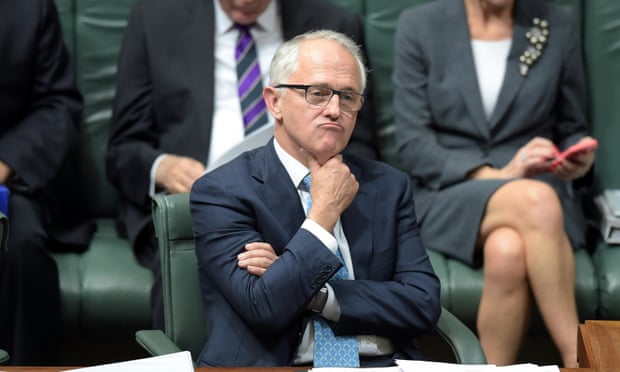
Australian Prime Minister Malcolm Turnbull reacts during House of Representatives Question Time at Parliament House in Canberra, Wednesday, Sept. 16, 2015. Photograph: Lukas Coch/AAP

During the first few days of being prime minister, Malcolm Turnbull seems to be doing his best to argue about climate change with a former version of himself.
I know I might have already given the game away here, but who do you think said this only five years ago?
We are as humans conducting a massive science experiment with this planet. It’s the only planet we’ve got…. We know that the consequences of unchecked global warming would be catastrophic. We know that extreme weather events are occurring with greater and greater frequency and while it is never possible to point to one drought or one storm or one flood and say that particular incident is caused by global warming, we know that these trends are entirely consistent with the climate change forecasts with the climate models that the scientists are relying on…. We as a human species have a deep and abiding obligation to this planet and to the generations that will come after us.
Stirring stuff eh?
That was Turnbull in August 2010, speaking at the launch of a report demonstrating the technical feasibility of moving Australia to a 100% renewable energy nation.

Malcolm Turnbull speaks in 2010 at the launch of a report explaining how Australia could be powered entirely by renewable energy, an idea he now seems to ridicule.

During his first question time as PM earlier this week, Turnbull was asked if he would join Labor in its aspiration (and that’s about the extent of Labor’s policy on this right now) that Australia should be generating 50% of its electricity from renewables by 2030.
Turnbull’s response?
[Opposition leader Bill Shorten] is highlighting one of the most reckless proposals the Labor party has made. Fancy proposing, without any idea of the cost of the abatement, the cost of proposing that 50% of energy had to come from renewables! What if that reduction in emissions you needed could come more cost-effectively from carbon storage, by planting trees, by soil carbon, by using gas, by using clean coal, by energy efficiency?
What did the Turnbull of 2010 make of a plan to move away from fossil fuels that was twice as ambitious as Labor’s, that actually explained how it could be done and that proposed doing it faster?
Turnbull said that to “effectively combat climate change” the nation “must move… to a situation where all or almost all of our energy comes from zero or very near zero emissions sources”.
But now it seems, Turnbull wants to ridicule an idea that he enthusiastically supported five years earlier.
Turnbull once described the government’s Direct Action climate change policy as “fiscal recklessness on a grand scale” but now thinks the policy is a “resounding success”.
During his Question Time response, Turnbull also listed “clean coal” and “carbon capture” as viable responses to the problem.
Turnbull considered “clean coal” in his 2010 speech, but the Turnbull of old struck a sceptical tone, saying that “despite all of the money and all of the hope that has been put into carbon capture and storage there is still, as of today, not one industrial scale coal fired power station using carbon capture and storage”.
Since 2010, the coal industry has managed to get only one commercial CCS electricity plant up and running – SaskPower’s Boundary Dam project in Canada (the CO2 emissions from the plant are captured and sold to oil drillers to be pumped underground to push more crude to the surface, which seems to defeat the object of the exercise).
One clean coal plant in five years is apparently though, enough to assuage Turnbull’s scepticism that the coal industry’s perennial great hope had failed to materialise despite all the promises.
When it comes to reducing emissions, Turnbull has been consistent over the years in stating that it doesn’t matter how you cut emissions, just so long as you cut them.
But hearing his response to questions earlier this week, it appears that he is no longer willing to advocate a transition to renewables that he previously felt was essential.
Turnbull is obviously backing his government’s policy that buys emissions reductions, no matter where and how they are created.
But after you’ve spent $2.55bn of taxpayer money on projects to reduce emissions, you’re still left with the problem that you started out with. Too many energy providers relying on fossil fuels instead of renewables that load the atmosphere with carbon dioxide.
An approach like this is like putting the climate change cart before the fossil fuel horse.
In 2011, Turnbull said it was important that even within the debates between the merits of a carbon price or Direct Action, people should “not fall into the trap of abandoning the science.”
But now, Turnbull is defending his government’s weak targets on climate change that, if they were replicated by other countries around the world, analysts say would likely see the planet warm by 3C or more.
Not only is Turnbull abandoning the science, he is abandoning his previous common sense position on climate for what a former Turnbull described as a policy that was no more than fig leaf.
To quote Turnbull himself, building a future without a reliance on fossil fuels for energy is “absolutely essential if we are to leave a safe planet to our children and the generations that come after them”.

17/09/2015

Canada: Climate Change Law Suit Pending

The Globe and Mail - Jeff Gray Law Reporter

Canada could one day face a lawsuit such as the one that saw a court in The Hague order the Netherlands government to slash greenhouse gases, the lawyer who spearheaded the groundbreaking legal action says.
Roger Cox, partner with Dutch law firm Paulussen Advocaten in Maastricht, Netherlands, is in Toronto on Tuesday for a speaking engagement and plans to meet with Canadian lawyers exploring whether court action here could be modelled on his surprise win in June.
Mr. Cox said in an interview that the Canadian government is a good target for this new kind of climate-change litigation, given Canada’s reputation in recent years as an environmental bad apple for its oil sands and its withdrawal from the Kyoto Protocol: “I think it’s a very beautiful country, but on the climate-change issue, there is a lot to be done.”
Video: Not fighting climate change would be 'irresponsible': Ontario Premier Kathleen Wynne
His historic case, launched on behalf of an environmental group called the Urgenda Foundation, argued that the Dutch government had a legal obligation to protect its citizens by doing its part to keep global temperatures from rising more than two degrees Celsius, a consensus target scientists say would see the world avoid the catastrophic potential of more dramatic climate change.
Mr. Cox’s victory has already inspired copycats in other countries, including Belgium. Some Canadian legal experts say the idea that a Canadian court could make a similar ruling is not as far-fetched as it might sound. But it would still be an uphill battle.
However, legal observers say private companies, too, should brace themselves for more climate-change-related litigation of all kinds in the wake of the Dutch ruling.
In that decision, the court ordered the Netherlands to reduce the county’s greenhouse gas emissions by 25 per cent from 1990 levels by the year 2020, citing the government’s international obligations and its “duty of care” to protect its citizens from the harm that would come with failing to stop climate change. The Dutch government is appealing.
Mr. Cox, making his first appearance in North America since the Dutch court victory, will be speaking on Tuesday at Osgoode Hall in Toronto at an event (to be webcast at www.cigionline.org/live) organized by the Centre for International Governance Innovation. Also discussing the issue will be Stephen Goudge, a former Ontario Court of Appeal justice; Lorne Sossin, the dean of the Osgoode Hall Law School; and Lewis Klar, former dean of the University of Alberta’s law school.
In an interview, Prof. Sossin said any climate-change case launched against the Canadian government would be an uphill battle, but there are many legal grounds on which it could be based, such as various acts of legislation or the Charter of Rights and Freedoms.
He said any case would avoid the pitfalls of previous similar cases, such as a court challenge asserting that housing was a Charter right that failed last year and a lawsuit that tried to force Ottawa to follow its 2007 Kyoto Protocol legislation.
But a climate-change case that stayed away from purely playing politics and went after something specific, such as emissions targets, could possibly get off the ground, Prof. Sossin said.
And climate-change litigation, against not just governments but companies as well, could be the next tobacco litigation, he predicts, noting that those cases were also once seen as long shots a generation ago.
“I think we are going to look back on climate change in exactly that way,” he said.
Environmental lawyers say they believe that a case could be launched in Canada based on the Dutch example. Allan Early, a B.C. lawyer who has acted for aboriginal people seeking redress for abuse at residential schools, said he and others were in the very early days of exploring the idea: “I am pretty convinced that such a case will be launched. I think it’s inevitable and I think it’s necessary.”
Keith Stewart, head of Greenpeace Canada’s energy campaign, said his group is starting legal research into possible lawsuits or shareholder class actions against oil and coal companies: “We’re mostly looking at the model of the tobacco companies, where not only the product they were selling is causing harm but they were aware of this and they tried to hide that fact.”
A variety of climate-change-related lawsuits have been filed in the United States, including a recent case launched against Washington on behalf of a group of children.
Mr. Cox said his idea to launch a legal climate-change case came after the failure of the 2009 Copenhagen climate-change talks to come up with a strong binding global deal. (Canada was blamed by some for blocking progress at the talks.) He wrote a book, Revolution Justified, to lay out his case.
Coming to Canada in the midst of an election campaign focused on an ailing economy sapped by low oil prices, Mr. Cox argued that no government can get away with saying that cutting carbon emissions harms the economy in court: “There is always a lot said in the media about how it will hurt your economy. But in court you have to have proof for what you[r’e] saying. … There’s no proof whatsoever that this would be the case – the opposite maybe, if you look at countries like Denmark and Sweden and Germany, for instance.”

Links

16/09/2015

Eight Things Malcolm Turnbull Should Do On Climate, Renewables

Renew Economy -

Malcolm Turnbull’s dramatic replacement of Tony Abbott as prime minister of Australia has raised hopes of a change in direction for the Coalition government, particularly on climate change and renewable energy, and thereby the shape of its economic future.
Screen Shot 2015-09-15 at 12.58.01 pmTurnbull promised an end to “policy by slogans”, and a new move to bring the Australian population along with the idea of an exciting future, first of all by explaining what that future might be, and respecting their intelligence.
But is this all just style and no substance? The next few weeks will tell.
Some are hopeful.
Paul Gilding, author and corporate advisor, describes a collective sigh of relief for those arguing for progressive climate and renewable energy policies.
“For climate advocates PM Turnbull is a “Nixon to China” moment,” Gilding said today. “We will never get on track as a country on this issue without genuine bipartisan support – and because of the way Rudd and Abbott made this a Left/Right issue, only the Liberal Party shifting can deliver the change we need.
“That’s why Turnbull’s arrival as PM is a game changer for Australia’s approach, but the impact will be medium to long term rather than sudden policy shifts. While Abbott had to say he supported action on climate policy, everyone knew he was faking it because the politics demanded he do so.
“Turnbull actually supports climate action and has long understood the economic implications of the transition required. And rather than being fearful of those implications he embraces them – seeing the inherent opportunity in a transition away from coal and towards a technology driven transformation of the energy system.
“The influence of this over time, on the business community and on public attitudes will be long lasting and leave a legacy for a generation.”
Others are not so sure. John Hewson, the former Liberal leader and now champion of fossil fuel divestment campaigns, said Turnbull may well have sold out. “I think it’s all for Malcolm to do right now,” Hewson said on ABC TV’s Q&A program. “The rumour is he’s sold out on climate change, which I personally think is the largest policy challenge – moral challenge, economic, political and social challenge – of this century.”
So what will Turnbull do? Over the next few days, weeks, months, we will find out. But here are eight things he could do right now:

Stop the slogans
This should be the easy part. No more “axe the tax”, no more “climate change is crap”, no more “wind farms are offensive”, no more “coal is good for humanity.” Oh, and don’t replace the slogans with 120-word ones.

Get excited about new technology:
This shouldn’t be too hard, either. Just before the first leadership crisis in February, Turnbull was in California having a test drive of a Tesla Model S, the up-market electric super-car. He raved about the experience: “Tesla has gone from employing 500 people to 11,000 in five years. A reminder of how innovation drives jobs,” he noted on his blog.
“Batteries have the potential to revolutionise the energy market, reducing peaking power requirements, optimising grid utilisation of renewables and in some cases enabling consumers to go off the grid altogether. The excitement of technology in the Bay Area is exhilarating…..but not quite as palpable as the jolt you feel when you hit the accelerator!”
Perhaps he should require all party members to test drive a Tesla. He could just as equally share that enthusiasm, and dump the party’s poisonous rhetoric, about other technologies such as battery storage and renewables. And he should not funnel government funds to daft projects like the rail link for the Galilee Basin coal mines. Even Barnaby Joyce understands that.

Get moving on climate change:
There was a telling moment in Turnbull’s first press conference when the newly designated PM was about to answer a question on emissions reduction targets. Deputy Julie Bishop quickly noted that Australia’s targets were set and would not change. It was a reminder to Turnbull that whatever his own views on climate change, he had to take the party with him.
It is clear that Turnbull has cut a deal with the Far Right rump of the party not to reintroduce an ETS – the very policy mechanism that caused his downfall in 2009. But Turnbull’s own views are very clear. As he said in 2010:
“Climate change is real, it is affecting us now, and yet, right now we have every resources available to us to deal with climate change, except for one, and that is leadership.
“We cannot cost-effectively achieve a substantial cut in emissions without putting a price on carbon.”
Turnbull has the opportunity to provide that leadership. It will take time to introduce a carbon price, but it will most likely come through a baseline and credit scheme, a sort of emissions reduction fund and safeguards mechanism with bite, and amendments to the current proposal. Reputex goes into more details here. 

Sweep out the dead wood:
Turnbull may be constrained by promises made to the Right Wing, but he can change the rhetoric and the mood, and the vision, by sweeping away the inner cabal that fashioned Abbott’s policy making.
This includes the likes of climate deniers such as Maurice Newman, Dick Warburton, David Murray and Tony Shepherd, and shake the Cabinet from the grim grasp of the Institute of Public Affairs and its policy wish-list. The right wing commentariat – including Alan Jones, Ray Hadley, Tim Blair and Andrew Bolt voiced their anger. They will be sniping at every turn.
That generational change is also needed elsewhere, particularly in the energy industry where many of the incumbent utilities, and policy and pricing regulators – from the industry minister Ian Macfarlane down – are from the “old school” of energy management, and don’t seem to get the concept of decentralised generation, and the exciting technologies that Turnbull has alluded to, including EVs (such as his affection for Tesla), solar, and battery storage, and the smart software that will pull these technologies together.

Remove the threat to dismantle CEFC, ARENA and the CCA:
If only Bernie Fraser had hung around for another week. The chairman of the CCA resigned last week, apparently frustrated by his inability to get his voice heard, even by environment minister Greg Hunt. Yet the CCA should play a critical role in advising on climate change policies.
Ditto the Clean Energy Finance Corporation and the Australian Renewable Energy Agency. Both have committed to playing a large role in the imminent roll-out of utility-scale solar, yet have been hamstrung in their broader goals by funding cuts in the case of ARENA, and restricted mandates in the case of the CEFC (Abbott’s instruction not to invest in wind farms or rooftop solar).
Both agencies have been operating with the threat of closure looming behind them. With a positive mandate, both can play a critical role in the bringing in and lowering the cost of the technologies that Turnbull is so excited about.

Express support for renewable energy, and boost the target:
Tony Abbott, Joe Hockey and others in the Coalition made it very clear, they don’t like renewable energy, and they hated wind energy. That has caused the investment drought to continue, despite the reduced 33,000GWh target that was supposed to provide certainty, and turned large investors like Meridian Energy to greener shores. Turnbull should be able to turn that antipathy on a dime, simply by expressing support for new technologies.
Turnbull has been an enthusiastic supporter of renewable energy. Way back in 2010, he even attended the launch of BZE’s Zero Carbon plan for 2020, along with Bob Carr and the Greens’ Scott Ludlam. Turnbull was particularly supportive of solar thermal with storage.
“As you know the great challenge with renewable sources of energy; solar and wind in particular, is that they are intermittent,” he told the event. “So what do we do when the sun isn’t shining and the wind isn’t blowing. How do we store that power.
“There is the ability with concentrated solar thermal power stations to use the sun’s energy to superheat a substance, in this case molten salt, that will hold its heat for long enough to be able to continue to generate steam and hence energy after the sun has stopped shining or during or day after day of rain. So there is a real opportunity there, with that technology, to generate baseload power from solar energy – something of a holy grail.”
Given that experience, maybe Turnbull should pitch for 100 per cent renewables? It is probably too much to expect Turnbull to lift the current renewable energy target in the short term, but that is exactly what he needs to do. The industry needs a long term policy, and Turnbull will be under pressure to match Labor’s 50 per cent renewable energy target by 2030, which even big investment banks say is readily achievable. Rooftop solar needs ongoing regulatory support as well, and it fits Turnbull’s rhetoric about a new economic future.

Impose emission standards on coal generators, and efficiency standards on cars
Whatever his support for the current policy, Turnbull cannot duck the fact that Australia’s industrial emissions are growing, and particularly in the energy sector. Short of a carbon price, Turnbull could follow the lead of the US and China and impose strict emissions limits for coal-fired generators, impose energy efficiency targets for vehicles, and reintroduce the efficiency standards for new homes. Designing an exit strategy for coal generators is one of the most urgent issues.

Find a new environment minister, or tell Greg Hunt to stop saying silly things:
Greg Hunt likes to tell people how hard it was to push a progressive line in an Abbott government. Many people wondered how hard he tried. Hunt came up with some of the Abbott government’s worst whoppers on climate change, coal, and renewable energy.
Turnbull cannot afford to have such rhetoric repeated under his leadership, so if Hunt stays in that office (and we will find out at the end of the parliamentary sitting week) the former Australian universities debating captain will have to be given another topic to argue: Decisive climate change is good for the economy and will not bankrupt Australia.

Conservatives Worldwide Tackling Climate Change: Will Turnbull?

ABC Opinion - Ben Oquist

Tony Abbott failed to move with global shifts in conservative thinking about climate change. The new Prime Minister has a chance to rectify this, writes Ben Oquist.
Malcolm Turnbull declared that Tony Abbott had failed on economic leadership. Australia's future, Turnbull said last night, is to be a nation that is "agile, that is innovative, that is creative".
Indeed, instead of addressing future economic challenges, Abbott focused on a Queensland coal mine as an economic solution and declared war on the environment movement.
As Australia's unemployment rate crept up this year, so too did the former prime minister's rhetoric. He quickly moved from making unpopular statements about the aesthetics of windmills to overheated statements about the dangerous "inefficiency" of courts enforcing the law.
Instead of pursuing sensible reforms to fill the budget's revenue hole, Abbott ruled out reforming superannuation tax concessions, which will soon cost the budget more than the aged pension. He ruled out reforming the CGT discount and negative gearing, which even the RBA has said needs to be reviewed. And he ruthlessly set about undermining the renewable energy industry, an innovative industry that puts downwards pressure on household energy bills.
Abbott's strategy of blaming environmentalists for his poor economic performance was fighting a losing battle.
This year, the Abbott government cut the popular renewable energy target, intimated that there would be subsidies for the Adani coal mine, attacked the federal court for enforcing environmental laws, held an inquiry into the charitable status of environmental organisations, and proposed to water down the Environmental Protection and Biodiversity Conservation (EPBC) Act.
As I have written previously, the reason that none of these activities has boosted the economy is simple: more people work at McDonald's than work in coal mining.
Abbott's recent intimation that he wanted to subsidise Adani's Carmichael coal mine simultaneously showed Liberal voters that he couldn't see the mining boom was over and that he didn't mind splashing taxpayers' money around to help his pet projects - the latter of which should be anathema to the supposed party of small government and the free market.
Most polls show that economic management is very important to Liberal party voters. But as the economy slowed, unemployment rose and the budget deficit grew, Abbott was more interested in picking ideological fights with environmentalists than he was with addressing the structural problems impacting on the post-boom economy.
In the 21st century, the idea that what is good for the environment is bad for the economy makes neither economic nor political sense. Conservative leaders around the world figured out long ago that the new economy needed a new politics.
Germany's Angela Merkel drove the G7's commitment to completely decarbonise its economies. The United Kingdom's David Cameron says that climate change is one of the most serious threats Britain faces.
In contrast, Abbott laughed when his minister joked about rising sea levels sinking our smallest neighbours. Abbott's tin ear ensured he marched to his own beat, rather than moving with global shifts in conservative thinking about climate change.
Abbott's approach has also been political poison for his Coalition partners in Nationals seats. At the last NSW state election the Nationals lost the seat of Ballina to the Greens in a campaign described as "a referendum on coal seam gas". Abbott's support for the Shenhua coalmine on the prime agricultural land of the Liverpool Plains has opened the door for the return of Tony Windsor and may mean the end of Barnaby Joyce's parliamentary career.
If Turnbull is to turn both the economy and the polls around, he will have to start supporting the industries that are creating jobs, rather than subsidising the ones that are shedding them. If Turnbull matched the ALP's recent commitment to a 50 per cent renewable energy target by 2030 he could simultaneously give certainty to a new industry, boost investment and jobs, all while appealing to the public. It's good economics and good politics.
Turnbull could scrap the $5 billion northern development fund, designed to shovel taxpayers' money into commercially unviable projects,and replace it with a public transport fund. Of course, to achieve such a shift Turnbull would need to convince his base that efficiently moving people around cities was a productivity issue and not a green issue; a claim that few New Yorkers or Londoners would dispute.
By definition a country and a planet that is tackling climate change is a planet that needs fewer coal mines and fewer coal-fired power stations. While Abbott would never admit it, the owners of our oldest and dirtiest coal fired power stations would happily walk away if someone would take their liabilities; for example, the need to clean up the messes they have made on their mine sites.
Turnbull could do that next week and call it direct action.
Turnbull has a unique opportunity to not just reposition the Liberal party but to redirect economic policy in Australia. The coming months will reveal if the Liberals have decided to dump a bad strategy, or simply dump the bad salesman for the bad strategy.
By letting go of coal, reaching across the aisle for some bipartisanship on renewable energy and superannuation tax concession reform, Turnbull could not only help fix the budget and the economy, he could fix politics too.

Ben Oquist is the executive director of The Australia Institute. Follow him on Twitter @BenOquist.

Turnbull Climate Policy: Changes 'Slow And Subtle'

Fairfax - , Environment editor, The Age
 
The difference Malcolm Turnbull may bring to Australia's position at UN climate talks in Paris is allowing Foreign Minister Julie Bishop more scope to negotiate on the ground. Photo: Alex Ellinghausen
Those hoping that Malcolm Turnbull's sudden rise to the prime ministership will usher in an immediate and radical overhaul of Australia's climate change position should take a deep breath.
Any instant effect is likely to be much more subtle.
It's true Turnbull is better attuned to the problem than his predecessor (yes, that's an understatement).
But he will also be careful not to spark a war to his political right by moving quickly to a stricter carbon regime.
After all Turnbull has already once lost his party's leadership over climate change once (that time as opposition leader over a deal with the Rudd government to implement an emissions trading scheme).
In this light he described the Coalition government's current policy as "very well designed" at his first press conference after Monday's leadership ballot. This is the same man who in 2009 intimated the main pillar of the Coalition climate plan - the Direct Action scheme, then in its infancy - was "bullshit".
The real influence Turnbull may have on climate change policy is more likely to emerge post-election - if he wins of course.
The government has created a reset point for climate policy in 2017-18 because it knows it has a policy gap between the programs that are in place and what needs to be done to meet Australia's 2030 target to reduce emissions by 26 to 28 per cent from 2005 levels.
At that point a Turnbull-led government could seek to put some much needed teeth into the Direct Action policy, pushing it towards something that looks more like a trading scheme or at least a stronger cap on industry emissions. It could also implement strong new measures alongside it such as emissions standards for coal-fired power plants.
In the short-term Turnbull will hopefully turf the ideological excess that Tony Abbott and his office too often indulged in on climate change.
That includes the subtle, but real, pressure that had been felt within government scientific institutions, such as the Bureau of Meteorology and CSIRO, to downplay climate change work.
It may see an end to the government hostility to bodies like the Climate Change Authority and the Clean Energy Finance Corporation, which has brought it nothing but political pain.
The shift in Australia's position at the United Nations climate talks in Paris at the end of the year, where it is hoped a new global deal to tackle climate change will be signed, will also be likely be more nuanced than revolutionary.
That is because in recent times Foreign Minister Julie Bishop, and others in the Australian negotiating team, have already re-engaged Australia in the talks as a reasonably constructive player, even if its target is on the weak side among developed country pledges.
Turnbull may attend the Paris talks, but the French government only wants world leaders to be there for the opening days. Much of the nitty-gritty of the talks is to be left to foreign ministers and negotiating teams.
The difference Turnbull may bring to Australia's position in Paris is allowing Bishop, who has emerged as a strong diplomat, more scope to negotiate on the ground.
By comparison Abbott famously sent a ministerial chaperon with his Foreign Minister to the last major round of the UN climate talks in Lima. Bishop also had a hard fight with her colleagues back home to get Australia to make a contribution to the Green Climate Fund.
These potential short-term tweaks under a Turnbull leadership will not address some of the fundamental gaps in Australia climate policy, such as the gaping distance between our post-2020 target and current policies.
But it could be a welcome first step to depoliticising what is essentially a debate about the future survival of our planet.
One might even describe it as adult government.

Turnbull Needs To Be The Turning Point For Climate Policy

THE HUFFINGTON POST -

Paul Kennedy via Getty Images
The election of Malcolm Turnbull as our 29th Prime Minister may prove to be a turning point in the way we as Australians perceive our national identity. From the coal economy to the new economy, we can finally lay to rest the Tony Abbott led mantra that coal is the backbone of our nation.
While in structural decline for some years, the coal economy has clearly been the beneficiary of a culture war waged by an unrelenting Abbott Government whose leader drank the kool-aid (or should we say coal aid) some time ago.
The coal economy has been giving way to the new economy both in substance and perception. But now it has lost its most forceful advocate. While it is unlikely that climate change policy under the Turnbull/Bishop team will change substantially in the near term, we should expect our dialogue at least to change. And this matters.
The restoration of tri-party acceptance of the science of climate change will give the renewable energy industry just the boost it needs having suffered one of its worst financial years on record in 2014/15. The mining industry's war of attrition took its toll as a result of its capacity to garner the strong support of Prime Minister Abbott and his allies. But to a financially struggling fossil fuel sector, the loss of their cheerleader-in-chief could be a mortal blow.
None of this should lead us to getting carried away.
It is, of course, easy to hope that the election of a Prime Minister who accepts the science of climate change may be a watershed moment for climate policy. While it may be, in the long term, the reality during the remainder of this term of Government is that we are unlikely to see much substantive policy change. In his last role as party leader, Malcolm Turnbull supported an emissions trading scheme that was too weak and too poorly put together to make any real difference. And this time around he is loathe to respond quickly to what insiders perceive as his Achilles heel.
Ultimately, having a Prime Minister who accepts the need to act will help shift the political landscape over the medium term. The moment support among the Australian population for strong action on climate change fell away was the moment it lost tri-partisan support. New voices from within the Liberals (and indeed the Nationals) will emerge over the next few years thanks to the space created by the removal of a climate skeptic Prime Minister. These new voices will drive new policy and ultimately show that those who support Government-led action on climate change are on the right side of history.
While our political parties catch up, the good news is that the Australian public are ready to move from the coal economy to the new economy.
A recent public opinion poll by Future Super found that the coal industry's net approval rating was minus 18, only rivalled by the unpopularity of Tony Abbott himself (who was at minus 24 in last week's Essential poll). The renewable energy industry's net approval rating in comparison is currently sitting at positive 77 percent.
Tackling climate change and building our new economy will take ingenuity and innovation. It will take a Government who is prepared to dismantle subsidies to the fossil fuel industry and instead use the might and power of Government to help build the industries and the businesses of the future. No longer can we be happy sending our greatest renewable energy scientists and engineers to China and Europe. Instead, we must incentivise them to be part of the clean energy revolution at home.
In his opening press conference Malcolm Turnbull labelled the disruption caused be technology as an opportunity. This kind of rhetoric matters. It sends a signal to those of us who are building the new economy that we have a Prime Minister who has at least taken the time to come to grips with the direction of our nation.
His words must be followed up by substantive policy change. Instead of campaigning to scrap the Clean Energy Finance Corporation and the Australian Renewable Energy Agency, let's unleash their capacity by giving them certainty. Instead of subsidising the fossil fuel industry to the tune of over $6 billion a year, let's invest in an education sector that can train the engineers and scientists who will power our knowledge economy.
Malcolm Turnbull cannot afford to let the right flank of his party hold him back as the coal economy gives way to the new economy. The public have spoken and financial markets have spoken. Now all we need is our political class to get on board. Here's hoping that today marks a new dawn for how our political representatives respond to the urgent need to address the greatest moral challenge of our time.

To sign a petition calling for Malcolm Turnbull to act on climate change visit here.

13/09/2015

This Artificial "Leaf" Can Produce Fuels From Carbon Dioxide And Sunlight

IFLScience

photo credit: Stock image via Mopic/Shutterstock.
Researchers say they have developed an artificial "leaf” that can produce fuels such as methane and gasoline from carbon dioxide. The team claimed it is a major step towards using fuels made renewably from sunlight for everything from heating our homes to running cars, without emitting any greenhouse gases.
The breakthrough, published in the Proceedings of the National Academy of Sciences, was led by Peidong Yang and his team at the Kavli Energy NanoSciences Institute at the University of California, Berkeley. It builds on the natural process of photosynthesis, where water and carbon dioxide are turned into sugar – organic fuel – by plants. By tweaking the process, via synthetic photosynthesis, it could be possible to create a whole host of different products.
To demonstrate this is possible, the team were able to make their system produce methane, rather than sugar, from carbon dioxide. Their equipment used a combination of semiconducting nanowires and bacteria to work. Using inorganic catalysts, water was split into hydrogen, which was then used by living cells to convert carbon dioxide into chemical products – in this case, methane.
"We're good at generating electrons from light efficiently, but chemical synthesis always limited our systems in the past,” said Yang in a discussion on the breakthrough. “One purpose of this experiment was to show we could integrate bacterial catalysts with semiconductor technology. This lets us understand and optimize a truly synthetic photosynthesis system.”
A similar system devised by Yang and his team earlier this year produced butanol, a component of gasoline, and various biochemical building blocks. Next, they will attempt to make an entirely synthetic system, without the need for bacteria, that builds on designs in nature to replicate the process of photosynthesis, and ultimately produce liquid fuels that can last months or years.
"This is not about mimicking nature directly or literally," said Ted Sargent, the vice-dean of research for the Faculty of Applied Science and Engineering at the University of Toronto, in the discussion. "Instead, it is about learning nature's guidelines, its rules on how to make a compellingly efficient and selective catalyst, and then using these insights to create better-engineered solutions."
So, you won’t be using artificial leaves to power your home or car just yet. But this could be a significant step in that direction.

Lethal Heating is a citizens' initiative