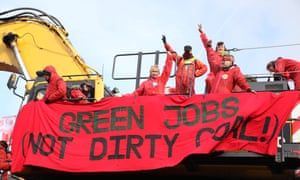
The Guardian - Press Association Coal-generation hit historic low several times last week in what experts say are the only occasions since the first coal-fired generator opened in London in 1882
Record low in UK coal production can as warm weather helped lower demand. Photograph: Christopher Furlong/Getty Images
The amount of electricity generated from coal in the UK has fallen to zero several times in the past week, grid data shows.
In what green energy supporters have described as a “historic turning
point” for the UK’s power system, coal-fired electricity first fell to
zero late on Monday night and for the early hours of Tuesday morning,
according to data from BM Reports.
On Thursday, there was no electricity from coal for more than 12 and a
half hours, more than half the day, with it making no contribution to
the UK’s power supplies late at night when demand was low and for a
period in the day, the data shows.
It is thought to be the first time the UK has been without
electricity from coal since the world’s first centralised public
coal-fired generator opened at Holborn Viaduct in London, in 1882,
according to the Carbon Brief website which reports on climate science and energy policy.
The record lows in coal power generation come as the UK enters the
summer months, which sees lower demand for electricity, and with more
than half of the country’s coal capacity out of action, for example for
planned maintenance.
But there have also been a series of recent closures of coal-fired
power plants as they become less economic, while plants such as Drax in
North Yorkshire have partially switched to burning “biomass”.
The government has said it wants to see coal phased out by 2025, as it is the most polluting way of generating electricity.
There has also been an increase in the amount of renewables on the
system, with a record 27% of the UK’s power coming from sources such as
wind power in the last quarter of 2015.Estimates of the power now being generated from solar panels, from
household arrays to large scale farms, also show it is regularly
outstripping coal during the day, reaching 6.8 gigawatts (GW) at a
midday peak this week compared to a high of 3GW output from coal.
Solar is limited to generating power during the day, but analysis
from Carbon Brief found that over the course of a week, the clean
technology produced more power last week than coal.
Juliet Davenport, chief executive of renewable electricity supplier Good Energy said: “This week marks an historic turning point for energy in the UK.
“Coal formed the backbone of the industrial revolution and was the
fuel that powered Britain into the 21st century. But it’s time to begin
to say farewell.
“Our energy is becoming cleaner and greener, with wind, solar and
other renewables generating more of our electricity than ever before. We
are celebrating this news as it shows that our future can be fossil
fuel-free.”
For John Church, a
leading authority on sea-level rise caused by global warming, there was
much that was fitting – and yet callous – about being sacked at sea.
The
veteran scientist was well into one of dozens of research voyages he
had taken since joining CSIRO as a post doctoral student in 1979.
His
vessel, the RV Investigator, was midway between Antarctica and New
Zealand and steaming north on the 170 degree longitude when he
received Thursday's call to tell him he was "potentially redundant".
(See map below.)
John Church speaks to the media about proposed cuts to the CSIRO. Photo: Penny Stephens
Sitting with a supporter in the ship's conference room, Dr Church was told his services were no longer needed.
"I
was OK during the call but it is certainly not a nice feeling to have
what you have worked for - for so many years - thrown on the scrapheap,"
the 64 year-old told Fairfax Media after finishing a 12-hour stint on
watch.
CSIRO's RV Investigator on one of its research voyages. Photo: Pete Harmsen
Accelerating sea-level rises
Dr Church's achievements
include developing sophisticated models linking sparse tidal gauge
information around the world with satellite data to reveal how much sea
levels are rising.
The current mission is retracing previous
journeys along the 170 W longitude line to measure precisely how key
parameters such as temperature, salinity and acidity are changing.
No thought bubble: Deploying weather balloons from RV Investigator. Photo: Stewart Wilde
As Dr Church notes, including in a Nature paper published last month, sea-level increases are accelerating as a warming planet melts glaciers and swells oceans.
From
increases of a few tenths of a millimetre annually in the 1000 years
before about 1850, the rate jumped 1.7 mm on average in the 20th
century. Since 1993, the rise has quickened to about 3 mm a year, he
says.
Despite this trend, CSIRO will slash about half the climate staff –
about 70 scientists - in its Oceans & Atmosphere division. New
hires will be made in climate adaptation and mitigation, the agency
promises but numbers cited so far are much smaller.
As with other
CSIRO staff, Dr Church will get a chance to save his job. The sole
scientist on board to be told of a pending redundancy, he was granted
until June 16 – or three weeks after the voyage ends in Wellington, New
Zealand – to argue his case.
Letter of support
Scientists
from leading research agencies, such as NASA of the US and
France's CNES, have called for Dr Church's group to be retained.
In a letter sent to Prime Minister Malcolm Turnbull and
Science Minister Christopher Pyne obtained by Fairfax Media, the
scientists said the team was key for global efforts to collect and
analyse climate change processes.
"Breaking up the long-term
research program of this world-famous CSIRO Oceans and Atmosphere unit
is a catastrophic short-sighted management decision," the letter said.
"In
addition to the detrimental effect on research and accuracy of
predictions for the Australian region, this decision will also impact on
the international collaboration programmes, built up progressively over
the last 20 years."
Fairfax Media sought comment from Minister Pyne, and the PM's office.
Kim,
Carr, Labor's shadow science minister, said "the actions of the CSIRO
will only see Australia's best and brightest leave our shores for other
countries who are in demand for their talent and expertise".
"Malcolm
Turnbull says he wants to create an ideas boom but all he is creating
is the largest brain drain in Australia's history."
Greens Senator
Peter Whish-Wilson said CSIRO executives had shown "monumental
disrespect" to Dr Church by effectively issuing him his redundancy
notice while at sea.
"John Church won the CSIRO Medal for Research
Achievement in 2006 and is the world leader in sea-level rise
research," Senator Whish-Wilson said.
"If CSIRO aren't holding
onto John, then they aren't serious about continuing to engage in
sea-level rise and I urge the board of CSIRO to stop this process
immediately."
A CSIRO spokesman said it would not comment on
discussions with staff: "All of the talks and negotiations at present
have the same goal of ensuring the excellent science and the
long-term future of CSIRO is maintained".
'Inconceivable to the world'
Rosemary
Morrow, one of the letter's authors, said CSIRO's undermining of its
oceans expertise "is just inconceivable to the rest of the world.
Especially for a country at the crossroads of so many evolving climate
modes - of droughts and driving rains."
Dr Morrow added a personal touch, saying Dr Church had been the ideal mentor when she studied in Hobart.
"John
was a great PhD supervisor - interested, curious, with a wide
oceanographic knowledge and a patient teacher," she said. "I was very
lucky to have him…it was a very motivating start to my professional
life."
Andy Pitman, head of the ARC Centre of Excellence for
Climate System Science based at the University of NSW, said Dr Church
was "the world's premier scientist" in sea-level research.
"Sacking John risks 30 years of accumulated science knowledge and the
capability of transferring that knowledge to the next generation of
scientists," Professor Pitman said.
"If you have a batsman
averaging over 100 in cricket it's a cause for national celebration. In
science, the accumulation of runs over time provides insight and
understanding that is irreplaceable," said Professor Pitman. "CSIRO has
just sacked its Bradman of sea-level science."
Outspoken
Dr
Church, who has been among the most outspoken scientists criticising
the current round of CSIRO job cuts, was told one reason for his firing
was the need to consolidate sea-level change into regional impacts.
"This
is essentially a repetition of [chief executive] Larry Marshall's
incomplete, naive and misleading statements, except for a focus on my
area of science," he said.
"Any reading of the literature or of
the most recent [Intergovernmental Panel on Climate Change]
reports would clearly indicate that the overriding uncertainty in sea
level remains the amount and distribution of sea level rise," he said.
Also mentioned
was the cutback of external funds, including the Abbott government's
ending of the Australian Climate Change Science Program that had been
funded from 1990 until June this year.
Various clashes in recent
years with management "probably did not earn me any favours but I do not
know if I was targeted because I was prepared to think for myself and
to speak out," Dr Church said. "Personally, that is what I think the
taxpayer expects from their scientists."
Dr Church says he will take a short break after a stressful few months finishing research and confronting "the CSIRO disaster".
But he's unlikely to be marooned for long, with fellowships and other roles in the offing.
"Sea-level
rise is a long term issue," he says, noting that without emissions
reductions, the world is committed to seas rising several metres over
coming centuries.
"These will become critical issues without major
and urgent greenhouse gas mitigation for the many millions of people
living near the coast," he says.
Video
Major CO2 milestone reached Carbon dioxide continues to increase in the atmosphere with a major milestone of 400 parts per million of CO2 recorded in the Southern Hemisphere according CSIRO's Dr David Etheridge Links
Ever since the "hockey-stick graph," climate science
and graphic design have been intimately associated with one another.
It's a tough science to communicate, since it plays out over the course of generations, taking potentially hundreds or even thousands of years to complete
a global climactic shift. How do you effectively communicate a subtle
but potentially catastrophic shift for our planet? Do you use a log
scale, or a linear one? Do you use annual averages, or high temperature
records, or what?
A new visualization from University of Reading climate scientist Ed Hawkins has a novel approach: putting monthly average temperatures on a circular
graph and animating the outward spiral toward certain amounts of
deviation from that month's global average in the 1850-1900 range.
The graph chose 1850 as the earliest year in the animation because that's when we begin to see the temperature data
we need to make the comparison. The red lines represent 1.5 and 2.0
degrees Celsius deviation from the 1850-1900 global temperature average
for that month. Those thresholds were chosen by the international
community, not Hawkins — at the end of the day they're just nice, round
numbers we can use for comparison, but they are useful because they tend
to be associated with major shifts in global climactic behavior. The goal,
seemingly impossible at this point, is to stop the outward spiral
before it hits the 1.5 degree mark, but the 2.0 mark is clearly the more
achievable goal at this point.
A
few things are immediately obvious, upon glancing at this infographic.
The first is that an astonishing amount of the progress we've made
toward the internationally-discussed thresholds of deviation from past
averages has come in the past few decades. The rate of outward movement toward the first threshold temperature is somehow more effective than an upward-sloping graph.
If
you look more closely, you'll see some interesting points in climactic
history. There's the various El Nino events that increase temperatures
for a short time, the most memorable of which came in 1877. In the 1880s
to the 1910s we observe a bit of cooling, which the graphic's creator claims was partially due to volcanic eruptions changing the permeability of the atmosphere to sunlight. There's a marked recovery
in the 1910-1940 range, as the effects of those eruptions cleared, and
the sun happened to naturally increase its energy output. At this point,
the greenhouse effect caused by the industrial revolution had yet to
build up to a harmful extent.
The controversial "hockey stick" visualization of uptick in global temperature, created by Mann, Bradley & Hughes in 1999.
El
Nino is also somewhat responsible for the big jumps since 2000,
naturally pushing up temperatures in 1998 and 2016. Still, it can't
account for anywhere near the entirety of the discrepancy.
One
thing pointed out by Hawkins himself is that while this trend might seem
to be taking on a momentum all its own, the reality is it is still
moving outward in response to human behavior, so in principle it should
still be possible to reverse that trend by changing those behaviors.
Many climate scientists have spoken of a "tipping point" past which
climate change could become temporarily self-sustaining — but despite
the visuals on this graph, there are still optimists among the best
educated on this topic.
We'll see how long that lasts.
Parts of the Arctic were 16℃ warmer than normal in February. Bernhard Staehli / shutterstock
And another one bites the dust. The year 2014 was the warmest ever recorded by humans. Then 2015 was warmer still. January 2016 broke the record for the largest monthly temperature anomaly.
Then came last month.
February didn't break climate change records – it obliterated them.
Regions of the Arctic were were more than 16℃ warmer than normal –
whatever constitutes normal now. But what is really making people stand
up and notice is that the surface of the Earth north of the equator was
2℃ warmer than pre-industrial temperatures. This was meant to be a line
that must not be crossed.
Two degrees was broadly interpreted
as the temperature that could produce further, potentially runaway
warming. You can think of it as a speed limit on our climate impact. But
it's not a target speed. If you are driving a car carrying a heavy load
down a steep hill you're often advised to change down from top gear and
keep your speed low, as if you go too fast your brakes will fail and
you will be unable to stop. Less braking means more speed which means
less braking – a dangerous runaway feedback loop. Hopefully the hill
flattens out and you have enough straight road ahead to recover. If you
don't then you will be stopping much more abruptly.
February smashes earth's all-time global heat record by a jaw-dropping margin.
We are currently swamping the Earth's ability to absorb greenhouse gases. 2015 saw the largest annual increase in carbon dioxide since records began – far higher than the Earth has experienced for hundreds of thousands of years.
More carbon dioxide in the atmosphere means higher temperatures.
There is already one positive feedback loop in operation; the extra
warming from our emissions is increasing the amount of water vapour in the atmosphere, which further increases temperatures. Fortunately, this is not a very strong feedback loop.
Unfortunately, there seem to be other, much more powerful ones lurking in the event of further warming. Tipping points
such as the thaw of permafrost and release of the very powerful
greenhouse gas methane in large quantities would drive world
temperatures well beyond the 2℃ threshold.
Even if we came to our collective senses and rapidly reduced carbon
emissions at that point, we would still have to revert to drastic geoengineering
to rein in further warming. There is no guarantee that such climate
brakes will work. If they fail, our civilisation would be on a collision
course with a much hotter planet.
Permafrost may contain a huge global warming time bomb. Galyna Andrushko / shutterstock
The safe–unsafe threshold of 2℃ recognises the significant amount of uncertainty there is over where dangerous warming really begins. It could be at more than 2℃. Hopefully it is. But it's not impossible that it is less. We need to bear in mind that it was only the northern hemisphere that crossed the 2℃ line. Also, we need to factor in the monster El Niño that is having an effect on temperatures across the globe. In 2014, I predicted that 2015 would break record temperatures. This is not due to any psychic powers on my part, but the then very clear El Niño signal that was emerging.
So while temperature records may continue to be set for the rest of 2016, by the end of this year the situation should have cooled somewhat. Right? At times, it feels as if such statements are offered up as prayers in the hope that we are not in fact witnessing the beginning of abrupt and sustained climate change. But what's even scarier is the political, economic and social reaction to these landmarks in climate change.
Have you heard any political speeches referring to these recent climate change records? Not one of the major Republican presidential candidates even "believes" in human-produced climate change, let alone that it is something to worry about.
How was the stock market this morning? It appears febrile enough to lurch from euphoric boom to catastrophic bust on the basis of bland statements from central bankers but proves remarkably deaf to evidence that the entire industrial and financial system is headed for disaster.
Know what's trending on Twitter as I write? A photoshopped giant dog, the latest Game of Thrones trailer and Kim Kardashian's naked body. Actually, it's mainly Kim Kardashian's naked body and people's responses to it. Followed by people's responses to the responses.
It would be churlish of me to deny people the pleasure of looking at pictures of a photograph of a cuddly dog adjusted in order to make it appear both cute and monstrous. But we appear disinterested, either through denial or desensitisation, to the environmental changes happening right in front of our eyes.
There are sure to be more climate records broken this year. But we treat them as we treat new fashions, phones or films. More novelty, newer features, more drama. We seem unable to understand that we are driving such changes. Record breaking changes that will ultimately break our civilisation, and so scatter all that we obsess and care about.
Across the world, thousands of protesters are taking on the planet's biggest fossil fuel companies. We should support them – and if we can, we should join them
Protesters close Ffos-y-Fran opencast coal mine in Merthyr Tydfill, south Wales, earlier this month. Photograph: Natasha Quarmby/REX/Shutterstock
Right now, thousands of people are taking direct action as part of a global wave of protests against the biggest fossil fuel infrastructure projects across the world. We kicked off earlier this month by shutting down the UK's largest opencast coal mine in south Wales. Last Sunday, around 1,000 people closed the world's largest coal-exporting port in Newcastle, Australia
and other bold actions are happening at power stations, oil refineries,
pipelines and mines everywhere from the Philippines, Brazil and the US,
to Nigeria, Germany and India.This is just the start of the promised escalation after the Paris
agreement, and the largest ever act of civil disobedience in the history
of the environmental movement. World governments may have agreed to
keep warming to 1.5C, but it's up to us to keep fossil fuels in the ground.
With so many governments still dependent on a fossil fuel economy,
they can't be relied upon to make the radical change required in the
time we need to make it. In the 21 years it took them to agree a
(non-binding, inadequate) climate agreement,
emissions soared. It's now up to us to now hold them to account, turn
words into action and challenge the power and legitimacy of the fossil
fuel industry with mass disobedience.
It is unjust that corporations and governments can commit crimes
against the planet and society without retribution, while those fighting
to prevent such crimes are punished, murdered
and incarcerated. But the number of people willing to challenge this is
growing. And if we really want climate justice, ;protest in the pursuit
of this must be normalised; we must support rather than denounce those
willing to put themselves on the line, since we all benefit from their
actions. Not everyone is in a position to take civil disobedience, but
we can all get behind it.
Renewables can offer secure, long-term jobs that are safer and less dependent on specific sites of extraction
Many of the changes that need to be made to tackle climate change
would also improve the quality of life for the majority of people on the
planet – from allowing people in Beijing to go outside without wearing pollution masks, to creating good jobs for millions.
Mining companies argue that their operations provide vital jobs for
local people. But the fossil fuel industry cannot offer secure jobs when
it is crumbling (despite the trillions it receives in public subsidies
while support for renewables is being pulled). With massive divestment,
falling prices, a global climate deal, growing global resistance and
increasing scientific evidence about their effects, the demise of the
industry is inevitable.
These jobs are not only insecure, but often dangerous. My only
memories of my coal miner grandad are of him lying in bed coughing and
in pain with a back injury caused at work. The effects of his job
continued long after the mine closed and he was made redundant: the
respiratory illness that killed him and his brothers was caused by
inhaling toxic air from the mine – the same toxic air that communities
unfortunate enough to live near a site of fossil fuel extraction or
burning have to breathe.
Corporate fossil fuel extraction also leads to local communities
dependent on a finite resource, and at the mercy of a corporation whose
primary interests are profit. When the oil runs dry or the coal runs
out, the company makes its exit, leaving behind all of the pollution and
none of the wealth. The area my family lived in, once a thriving
community when coal was plentiful, is now a place of high unemployment, social decay and few opportunities.
Renewables can offer not only secure, long-term jobs that are safer
and less dependent on specific sites of extraction, but also the
opportunity for democratic ownership of energy and sustainable
communities. The choice between clean, safe, democratic and sustainable
energy/jobs or dirty, dangerous and undemocratic energy/jobs is a
no-brainer. We have the technology right now to make the transition to a
zero-carbon Britain – the barriers are not technological but political.
To overcome those political barriers, we need to reclaim our power –
both in terms of who has power over our lives, and how we power our
lives. And as 2017 is said to be the year when the door to reach two
degrees closes forever, now is the time to do it. This year must be the year of mass climate disobedience.
Chancellor Angela Merkel’s government is offering home and factory
owners at least 13 billion euros ($14.8 billion) in loans and subsidies
over the next four years to reduce the carbon emitted from their
properties.
The money, earmarked in the mid-term federal budget
plan, will be disbursed to property owners who sign up to programs to
cut power and heat consumption, said the Economy and Energy Ministry
Thursday in Berlin. About 8 billion euros of the allocation are being
offered in programs run by the Frankfurt-based KfW development bank
Frankfurt, it said.
Germany, Europe’s biggest
emitter of carbon dioxide, is struggling to reach its target of cutting
greenhouse gas emissions 40 percent by 2020 compared with 1990 levels.
It notched a reduction of 27 percent by last year with sectors including
heat efficiency, transport and farming lagging behind. About 30 percent
of Germany’s carbon dioxide output comes from heating buildings,
according to the ministry.
“The
cleanest and cheapest energy is the one you don’t use at all,” Economy
and Energy Minister Sigmar Gabriel said to reporters today in Berlin.
“Expanding renewable energy alone won’t realize the climate protection
goals of energy policy.”
Merkel’s government is aiming to fine
tune the surging growth in wind and solar energy, which has caused
difficulties for transmission networks as power-grid upgrades drag on.
Auctions for clean power will be introduced from 2017, tapering
commitments made during two decades of guaranteed payment programs.
Subsidies have been credited with making German power the second most
costly in Europe after Denmark.
Climate change could impact the Middle East by the mid-century, say
leading experts and scientists. Its wide-reaching effects could result
in massive regions in the Middle East and in Africa being rendered
uninhabitable.
According to
researchers at Germany's Max Planck Institute for Chemistry and The
Cyprus Institute in Nicosia, extreme heat days in these areas have
increased twofold since the 70s, and could become so hot in the years to
come that human beings would be unable to inhabit them.
During the
hotter days, these regions can routinely see temperatures that exceed
110 degrees Fahrenheit. But if climate change continues unabated, this
could increase to 114 degrees by the year 2050, and peak at 122 degrees
by the year 2100.
According to the study's lead author, Jos Lelieveld, who is the
director of the Max Planck Institute for Chemistry, "Prolonged heat
waves and desert dust storms can render some regions uninhabitable,
which will surely contribute to the pressure to migrate."
The heat waves could result in the displacement of more than 500 million people when all is said and done.
To create this
dire prediction, the researchers studied data that goes all the way back
the mid-80s. Using this technique, they were able to accurately predict
modern day heat waves and temperature patterns.
The study
compared what would happen if fossil fuels were reduced over the next
100 years, and what would happen if they were not, to create a
predictive model.
From the years 1986 to 2005, heat waves in these areas were confined to 16 days on average.
But by the
middle of the century, they could last as many as 80 days, and by the
end of the century they could last over 100 days.
The study noted
that these regions could experience 200 warm or hot days by the middle
to end of the century if something is not done to curb climate change.
A hot topic for
debate, there are arguments on both sides of the climate change topic.
But the reality is that one way or another the world is heating up.
Modern science, and the community at large believes that humans have
helped speed up this process, at the very least, or are vast
contributors to it.
If changes are not made soon, we could see hotspot regions that emulate Mars on our home planet.


 Sitting with a supporter in the ship's conference room, Dr Church was told his services were no longer needed.
"I
was OK during the call but it is certainly not a nice feeling to have
what you have worked for - for so many years - thrown on the scrapheap,"
the 64 year-old told Fairfax Media after finishing a 12-hour stint on
watch.