20/05/2016

Humans Damaging The Environment Faster Than It Can Recover, UN Finds

The Guardian - 

Radical action is needed to combat increasing rate of environmental damage to water sources, land, biodiversity and marine life, report shows
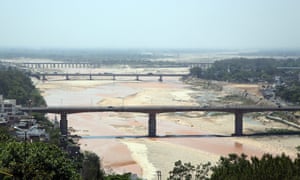
A general view of almost dry river Tawi, in Jammu, the winter capital of Kashmir, India
The dried-up river Tawi in Kashmir, India. Water scarcity is an increasing problem in poorer parts of the world. Photograph: Jaipal Singh/EPA
Degradation of the world's natural resources by humans is rapidly outpacing the planet's ability to absorb the damage, meaning the rate of deterioration is increasing globally, the most comprehensive environmental study ever undertaken by the UN has found.
The study, which involved 1,203 scientists, hundreds of scientific institutions and more than 160 governments brought together by the UN Environment Programme (UNEP), concludes that without radical action the level of prosperity that millions of people in the developed world count on will be impossible to maintain or extend to poorer countries.
Water scarcity is the scourge of some of the poorest regions on Earth, the study found, leaving developing countries increasingly unable to feed themselves, and causing hardship for millions of people. There appears little prospect of this dire situation being remedied, according to the UN, without radical action being taken.
Water sources are under increasing threat from population growth, climate change, rapid urbanisation, rising levels of consumption, and the degradation of lands that previously provided a natural replenishment of water resources.
The study is intended as an aid to the world's efforts to combat climate change and other environmental threats, as it highlights the difficulties of improving the lives of people in developing countries and tackling global warming, while food resources come under continuing pressure.
UNEP found the rate of damage to the natural environment was increasing globally, despite concerted efforts to persuade governments to take measures to improve the condition of vital natural resources, such as water, land and the seas.
"If current trends continue, and the world fails to enact solutions that improve patterns of production and consumption, if we fail to use natural resources sustainably, then the state of the world's environment will continue to decline," warned Achim Steiner, executive director of UNEP.
He said the tools for improving the environment for millions of people existed in developed countries but were in danger of not being used.
The study, using decades of scientific data, found that basic measures to tackle some of the key causes of environmental damage were still not being taken. These included measures to reduce air pollution, such as changes to vehicles; the damage to marine eco-systems, which can have a huge effect on fish stocks on which hundreds of millions of people depend; and the degradation of land when modern agricultural methods were pursued without regard to the longer-term consequences.
Despite the recent global agreement on cutting greenhouse gas emissions, signed in Paris last December, global carbon output continues to rise. The report argues this will put a long-term strain on the ability of developing economies to feed their own people as the result of changes such as increased droughts and floods.
Climate change is exacerbated by the emissions of greenhouse gases from agriculture, including the leaching of nitrous oxide – a powerful greenhouse gas – from run-off emissions and incorrectly stored animal manure.
These sources increased by more than a quarter between 2000 and 2010, the report found.
Other problem areas identified in the report included glaciers in the Andes, which provide vital water resources for tens of millions of people, but which are shrinking as the climate warms.
In rich countries, these problems have built up over decades and centuries while economic growth was pursued at the expense of the environment. Subsequent efforts to remedy the environment have met with partial success.
But in developing countries, the path of future development has more potential to change, which has encouraged international institutions to devise more sustainable growth pathways that are supposed both to alleviate poverty and preserve the environment.
If they follow the same pattern of growth, then the danger of irreparable environmental damage will intensify, the study's authors conclude.
They recommend an increased awareness of the environmental impact of development. For instance, exploiting water resources can be made more sustainable by recycling water where possible, and changing agriculture so that wasteful methods of irrigation are replaced by more efficient ones.
Developing countries should also change their methods of dealing with waste, the report found, so as to protect clean water sources and prevent the burning of solid waste in landfill dumps.

Links

Want To Know If The Paris Climate Deal Is Working? University Divestment Is The Litmus Test

The Conversation -   

Green progress? The ANU needs to dig deeper on divestment. Nick-D/Wikimedia Commons, CC BY-SA
The Paris climate agreement has been praised for sending a strong signal to the world that we are now serious about cutting greenhouse emissions.Yet despite the diplomatic acclaim, the Paris deal doesn't offer much in concrete terms. It is a simple global show-and-tell regime with no enforcement – if countries miss their targets they will receive little more than a talking-to.
For many, the deal's saving grace is the message it sends to investors, businesses and the wider world outside diplomatic and political circles. The Economist has summed up this "investment signal" idea well:
Perhaps the most significant effect of the Paris agreement in the next few years will be the signal it sends to investors… [After Paris] the idea of investing in a coal mine will seem more risky.
The problem is that there is little to no empirical evidence to support this idea. Will hard-nosed financiers change their ways purely on the basis of long-term pledges that are not supported by short-term actions? Will they redirect vast sums of money because of faith in a loose international treaty? In all honesty, we don't know.
There are clues, however, if we know where to look. If we want to see whether the investment signal from Paris is working, then universities will probably be – for want of a better phrase – the canary in the financial coalmine.
If Paris has truly signalled to the world that the age of fossil fuels is coming to a close, then it should put the movement to divest from fossil fuels on steroids.
And universities are better placed to divest than many other types of institution. It therefore follows that the success of Paris can be measured by whether it spurs universities to quit investing in fossil fuels.

Going fossil-free
Fossil fuel divestment is spreading across the world. According to the campaign group Fossil Free, at least 518 institutions, collectively worth US$3.4 trillion, are either fully or partially divesting.
The list includes groups such as the Rockefeller Brothers Fund, local governments such as the Australian Capital Territory and the cities of Oslo and Copenhagen, among many others.
Meanwhile universities, which currently make up 12% of this list, have become a particular target for the divestment movement. This is because they are forward-looking institutions with progressive, well-educated stakeholders. After all, it was university faculty members across the world who helped to set out the problem of climate change, and young students who will be among the generations most affected by its future impacts.
Just as universities were among the first movers against apartheid, they can set an example to others in the case of climate. Universities, many of which manage multi-billion-dollar endowments, have both the ability and responsibility to exercise financial power and act early on long-term moral problems.
If the Paris investment signal exists, then, we can expect universities to act well in advance of those with much greater inertia and vested interests in the status quo, such as profit-making corporations (which make up just 3% of Fossil Free's divestment list).

Mixed results
So far the response from universities has been patchy, particularly in Australia. The Australian National University (ANU) provides an informative case study. It shows both the potential of divestment and the limits of the Paris market signal.
In 2014, ANU blacklisted seven resource companies (including two fossil fuel firms, Santos and Oil Search) on the basis of its "socially responsible investment" policy. This triggered a backlash from the likes of the then treasurer, Joe Hockey, and prime minister, Tony Abbott, as well as sustained criticism from the Australian Financial Review.
The outcry showed the power that universities can wield in the climate debate when they put their money where their mouth is. In this case it was a positive impact as it triggered a wider debate on climate policy and investments.
Last month, the ANU updated its policy, announcing a 39% reduction in the carbon intensity of its stock portfolio and pledging to divest from companies that draw more than 20% of their revenue from coal.
However, the policy allows for continued investment in diversified mining companies such as Woodside Petroleum, Rio Tinto and BHP Billiton. This potentially includes firms with significant fossil fuel holdings (BHP Billiton Mitsubishi Alliance is the largest Australian coal producer, accounting for a quarter of Australian coal exports).
This is partial, not full, divestment – it's a positive step, but far from the seismic investment shift needed to meet the Paris climate goals.
Importantly, the trigger for change has come from within, rather than from Paris. There has been overwhelming pressure from staff and students to divest fully. Yet the university has resisted these calls. Indeed, ANU Vice-Chancellor Brian Schmidt last month tweeted that "fossil fuels are good business for universities", for the time being at least.There are several counterarguments to this , from the falling costs of renewable energy, to the improving performance of fossil-free investment funds, which often outstrip more conventional ones. But on a basic level it comes down to leadership.
ANU staff and students are campaigning hard for full divestment. Source: Author provided
The ANU has branded itself as a place of "thought leadership". Its current actions show neither long-term thought nor leadership. True leadership would mean showing real belief in the implications of the Paris Agreement.
Widespread, full university divestment from fossil fuels would further pressure national governments to strengthen their commitments – which will be crucial if the Paris Agreement is to meet its goals.
In contrast, continued investment in fossil fuels weakens such pressure and bolsters a belief in the continued relevance of the fossil fuel industry in a post-Paris world.
Universities such as the ANU have not responded swiftly enough to Paris and the signalling of the end of the fossil fuel era. If thought leaders won't do it, how can we ask the same of governments and banks?

Links

Climate Change Effects Shown In NASA Images Highlight Drastic Impact

NEWS.com.au
THINK the science of climate change is not settled?
These confronting before and after photos of shrinking glaciers and disappearing lakes may well change your mind.
The images released by NASA's climate change arm reveal just how much our world has changed — some in months, others over years.
From the whiting event in Lake Kivu in Central Africa, to a flooding Mississippi River in the US, the before and after photos reveal startling changes in some places across the world, some in the space of just a few short years.
Other dramatic pictures reveal the effects of fire and flooding.
Shrinking Mýrdalsjökull ice cap, Iceland shown from 1986 to 2014 (right). Source: NASA

Glaciers also come up for mention with Alaska's Columbia Glacier a particular cause for concern.
The glacier which descends through the Chugach Mountains into Prince William Sound used to extend to the northern edge of Heather Island, near the mouth of Columbia Bay in the 1700s.
But in 1980 it began a rapid retreat and according to NASA has now "thinned so much that the up and down motion of the tides affects its flow as much as 12km upstream, until the glacier bed rises above sea level and the ice loses contact with the ocean."
Growing Wax Lake Outlet, Louisiana pictured in November 1984 to October 25, 2014 Most of the Mississippi River delta plain is losing ground.
Growing Wax Lake Outlet, Louisiana pictured in November 1984 to October 25, 2014 Most of the Mississippi River delta plain is losing ground. Source: Supplied
NASA said the gallery, which is constantly updated, aimed to "present stunning images, mostly from space, of our ever-changing planet, chronicling changes taking place over time periods ranging from days to centuries."
The agency said the before and after images not only aimed to show the impacts of climate change but also highlighted the destruction caused by wildfires and floods.
The pictures also show the retreat of glaciers as well as the human impact on urban areas due to population growth.
The gallery, which features dozens of images across the globe, also allows people to zoom in on their own area to see what changes are taking place around them.
Some of the images are just days old, showing recent impacts.
While scientists have been warning about the danger of the Earth warming up for years, climate change sceptics claim it's a myth.
These images may put that into perspective.
It wouldn't be the first time NASA has revealed a frightening future for the planet.
Just last year NASA also warned sea levels will rise by a metre over the next century.
Experts predicted an ice sheet the size of Queensland is melting faster than expected which could cause massive storm surges capable of decimating Australia's coastal cities within the next century.
Mustang Complex Fire, Idaho pictured in July 2012 to September 2012 The Mustang Complex Fire, sparked by a lightning strike on July 30, 2012, has consumed more than 330,000 acres of the Salmon-Challis National Forest in northeastern Idaho.
Mustang Complex Fire, Idaho pictured in July 2012 to September 2012 The Mustang Complex Fire, sparked by a lightning strike on July 30, 2012, has consumed more than 330,000 acres of the Salmon-Challis National Forest in northeastern Idaho. Source: Supplied

Scientists said satellite images revealed large sections of Greenland and Antarctica are vanishing at a much faster rate than previously anticipated, and predict sea levels will rise even further than originally thought.
The stark warnings from NASA are echoed by the World Bank which on Wednesday issued a warning that the world is underprepared for major risks posed by extreme weather and other hazards.
It warned by 2050, 1.3 billion people and $217 trillion in assets will be affected by worsening river and coastal floods.
The World Bank also predicted this will only get worse with rising population growth and migration.
Licungo River flooding, Mozambique February 1, 2014 — January 17, 2015. Weeks of heavy rainfall capped by a particularly strong tropical disturbance caused the Licungo and other rivers in Mozambique's Zambezia province to flood. Source: NASA's Earth Observatory


Videos

Biodiversity Saves Fish From Climate Change: Study May 17


Five Ways To Save The World. The world is being transformed by global warming faster than anyone anticipated. But some of the world's most eminent scientists are on the case, in the face of imminent catastrophe.

India Just Set A New All-Time Record High Temperature — 123.8 Degrees

Washington Post - Angela Fritz

(earth.nullschool.net)
A small city in northwest India climbed to a searing 51 degrees Celsius — or 123.8 degrees Fahrenheit — on Thursday afternoon, and broke the country’s record for all-time hottest temperature. The previous record, 50.6 degrees Celsius, was set in 1886.

The record was broken in Phalodi, which is just 125 miles away from the city that, up until this afternoon, claimed fame as the hottest location in India — Pachpadra.
(meteomanz.com)
(meteomanz.com)
April and May tend to be the hottest months in northwest India, and this year has been exceptionally so.
Christopher C. Burt, a weather historian at Weather Underground, posited that April’s heat wave was the most intense ever observed in Southeast Asia.
In India it lasted for weeks — but the heat never truly dissipated, dragging on into May. Hundreds of people have died from heat-related illness. Northern India and Nepal have been battling their worst wildfires in years. Officials have on occasion banned daytime cooking in an attempt to prevent accidental fires that killed nearly 100 people in late April.
The India Meteorological Department issued a “severe heat wave warning” for a huge swath of the country on Thursday, which will continue through Saturday. The department expects temperatures will remain above average through at least May 27.
A similar period of extreme heat killed over 2,500 people in 2015.

Links

19/05/2016

Prime Minister's Climate Statement: Response And Fact Check

Climate Institute


The Prime Minister's recognition that countries will need to increase their emissions reductions targets is important, but his interpretation of the Paris Agreement and the way countries are to move forward is respectfully incorrect.
One of the key reasons Paris was a success is because national targets are not negotiated in the agreement. Countries are required to set them and consider the objective of limiting warming to 1.5-2°C and the goal of net zero emissions economies. Australia's inadequate targets were established by Tony Abbott well in advance of Paris and if other countries did similar would lead to warming of 3-4°C.
Australia is locked out of any leverage with its low ambition targets and policies. This was highlighted last month when Australia wasn't invited to a "High Ambition Coalition" meeting, which includes the US, EU and small island states. If Australia is to have any leverage it will need to lift its ambition and then engage globally, not the other way around.
Our budget release highlighted that Australia's emissions are rising and that Direct Action funding is running out. We look forward to a coherent climate and energy plan from the government.

Climate Policy - Fact Check
Prime Minister Malcolm Turnbull on the Paris Agreement during his press conference with Luke Howarth on 9 May 2016.

Point 1: "All of the nations in the world agreed to emissions targets for 2030." No, they did not.
In Paris, countries agreed to limit warming to 1.5-2°C and to achieve net zero emissions. A framework was also established to ratchet up national targets through time towards these goals.
Before Paris, countries put forward a range of initial targets for 2025 or 2030. Counties only formalise their targets when they ratify the agreement. The Abbott government submitted its initial, and inadequate 2030 target, well after most other advanced economies.
A process to update these targets starts in 2018. Updated 2030 targets are to be submitted in 2019-20. These targets will be judged against their compatibility with the objectives of the Paris Agreement – limiting warming to 1.5-2°C.

Point 2: Setting credible targets limits a countries leverage Countries do not negotiate their targets. They are nationally determined. This is a key reason why the Paris meeting succeeded.
History shows that when countries advance credible targets it drags up the targets of other nations, not the opposite.
Australia is actually limiting its leverage by advancing an inadequate 2030 target. This is demonstrated by not being invited to a "High Ambition Coalition" meeting with the US, EU, small island states and other vulnerable nations on how we should accelerate towards the 1.5-2°C goal.

Point 3: Countries will only strengthen targets if they do so together It is good that the Prime Minister has reiterated that Australia will need to strengthen its targets.
The Prime Minister, however, implies that countries have not already agreed to do this. In Paris countries strengthened their targets, and agreed to continue strengthening targets every five years.
As the Prime Minister notes key test against which countries will be judged is whether the target is consistent with the 1.5-2°C goal. This will be a collective process.
Australia's current target is consistent with a world heading towards 3-4°C, and the longer it takes to get on a credible path towards the Paris objectives the more costly the transition will be.

Links

With Women At The Top, UN Climate Body Has Chance For Real Change

The Guardian - Climate Home

Women now hold six of the most influential positions at global climate talks, but can they make a difference on the ground?
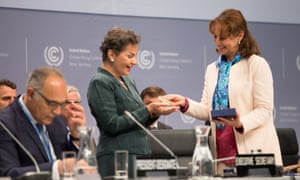
Outgoing UN climate chief Christiana Figueres
Outgoing UN climate chief Christiana Figueres has held her role for six years. Photograph: UNFCCC
Whisper it quietly, but a gender revolution is taking place at the global climate change negotiations.
As of 17 May, the six most influential positions within the UN process are all held by women, a significant increase on last year's total of two.
Outgoing UN climate chief Christiana Figueres has held her role for six years, but it's the steady arrival of other women in top jobs that is a sign of change.
France environment minister Ségolène Royal is now president of the talks, aided by two UN "climate champions": Moroccan minister Hakima El Haite and Paris Agreement architect Laurence Tubiana.
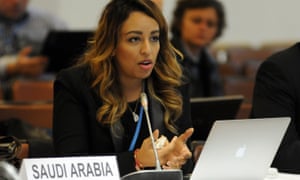
Saudi Arabian diplomat Sarah Baashan
Saudi Arabian diplomat Sarah Baashan is now a co-chairs of the UN talks. Photograph: Courtesy of IISD

This week, Saudi Arabian diplomat Sarah Baashan and New Zealand's former climate ambassador Jo Tyndall completed the team, taking charge as co-chairs of the UN talks.
"It is quite unsurprisingly two women who will take action forward. It is quite wonderful to see two new voices and two new inspirations to support work," said a smiling Figueres on Monday.
It's just possible that on any given day, not a dark suit and tie will be spotted on the main podium of the negotiations, a forum long dominated by greying men.
That represents a "notable development" says Mariana Panuncio, who leads WWF's advocacy in Latin American and the Caribbean. "Each has arrived because of their own merits," she adds.
The presence of a Saudi Arabian at the top table points to a desire of the oil-rich Kingdom to take a "constructive approach," she argues.
Veteran climate justice campaigner and former Ireland president Mary Robinson described the appointment of Bashaan and Tyndall as a "significant step" towards gender balance at the talks.

Gender features in the preamble to the Paris Agreement

A UN official said the appointment of the pair as co-chairs was "spontaneous", but others eye a desire by the 196 countries at the negotiations to start implementing the 2015 Paris Agreement.
The landmark deal contained five references to gender – an issue that was discussed "behind the curtains to the last moments," says veteran Finnish and EU diplomat Aira Kalela.
While she ascribes the number of women at the top as "more a coincidence than planned action" she does believe it offers a valuable chance for the gender equality movement.
Figueres' replacement Patricia Espinosa, Mexico's ambassador to Berlin, handed those wanting more equality at the top of UN climate talks another victory.
But a few high profile names masks a longstanding gulf between the number of men and women involved in tackling global warming.
Since 2008, women on average have made up just over 30% of delegates at the annual summit, according to data supplied by the Women's Environment and Development Organisation (WEDO).

At the 2015 Paris summit, just over 38% of national delegations were women, with Peru, Hungary, Lesotho, Italy and Kiribati among the most balanced delegations and Mauritius, Yemen, Afghanistan and Oman the least.
European countries generally have the highest levels of balance between the sexes; African and Asian countries the lowest. Just over a quarter of delegation heads in 2014 were women.
"What I'm finding is women are prevalent in places of less power," says WEDO advocacy director Bridget Burns. At smaller UN meetings women take the lead. At the bigger ones a man takes over.
It's a point picked up by Achala Abeysinghe, legal advisor to the 48 least developed countries at UN negotiations.
"We have to further rally around and accelerate progress towards more equal participation of men and women in this process," she tells Climate Home by email.
"We still have far to go towards equal representation in positions of power and leadership and gender equality in general."
Panuncio agrees, pointing out this level of leadership is not yet a clear trend and not something that people can "assume" will continue without pressure.
"We need to ensure women are reflected across the board and across all echelons and that I think is something we need to strive for and ensure," she says.
"Women in developing countries are often impacted by climate change, but they continue to be under-represented and we need to mainstream this across our overall approach."
Outside the UN bubble, gender equality is far from a given, as a recent report published by the Overseas Development Institute (ODI) and Climate Development Knowledge Network revealed.
Moroccan minister Hakima El Haite and Paris Agreement architect Laurence Tubiana
Moroccan minister Hakima El Haite and Paris Agreement architect Laurence Tubiana. Photograph: UNFCCC
Focused on communities in India, Africa and Latin America, the study determined that women are frequently left out of initiatives to improve resilience to extreme weather.
Despite clear benefits, including women in climate adaptation planning was often seen as "slowing and complicating" by some communities, said Virginie Le Masson, an ODI geographer.
That, recommended the study, has to change if vulnerable communities are to stand a chance of coping when hit by climate-induced floods, droughts or crop failures.
It's a challenge the UN climate body's women should be equal to, suggests Kalela, especially given the number of women in positions of power this year.
"It gives now an excellent opportunity to also include women perspectives in developing and implementing climate policy," she says.
"But I don't yell out of joy… I would rather look at the Paris Agreement on a long run and think we have other reasons to be happy with what we got."
Burns agrees. "Being able to visually see representation changing is an important part of transformation but the challenge can be if that overshadows large structural inequalities. If that is pointed to solely as progress that becomes problematic."

Links

Election 2016: What Are Our Leaders Really Thinking About Climate Change?

ABC News - Nick Harmsen

Richard Di Natale, Bill Shorten and Malcolm Turnbull
It's impossible to know what our political leaders are actually thinking when it comes to climate change.
Climate change, and the policies to slow its impact, have dominated the last few election cycles in Australia. But it has barely rated a mention at the start of this campaign.
So what do our leaders really think about climate change? That question was on the mind of one curious Australian, who asked ABC News to investigate.
For the purposes of this exercise, let's focus on the leaders of the two competing major parties and the Greens.
Of course, it's impossible to know what Prime Minister Malcolm Turnbull, Opposition Leader Bill Shorten and Greens Leader Richard Di Natale are really thinking.
But we can look at what each of them have said on the issue, what their policy positions are, and how they have changed over time.
Our questioner may be pleased to learn that both Mr Turnbull and Mr Shorten consider climate change a real phenomenon, caused by human activity.
In a 2010 speech from Mr Turnbull, then a humble opposition backbencher, he said that science shows "we have already exceeded the safe upper limit for atmospheric carbon dioxide".
"We are as humans conducting a massive science experiment with this planet," he said.
"It's the only planet we've got. We are dealing in scientific terms with enormous uncertainty.
"There is a tendency for people to point to the forecasts for the future, sea levels, temperatures, other impacts of climate change and say, 'oh well, they've over egged the pudding a little bit, it's probably going to be less dramatic than that'.
"But we are dealing with uncertainty and it may well be and indeed there is considerable evidence, that it may well be that many of these forecasts that we've become so used to, in fact err on the conservative side."
Mr Shorten, in an address to the Lowy Institute last November, echoed similar sentiments, calling climate change "a crisis unprecedented in human history".
"It is an existential threat — a matter of survival. A violation of basic human safety and basic human rights," he said.
"The islands of the Pacific will be first affected, but no country is immune.
"Australia can benefit if we take action on climate change. Australia has a lot to lose if we do not.
"The global temperature is rising and human activity is the cause. The proof is irrefutable."
The regional impacts of climate change are also a key focus for Mr Di Natale.
This topic featured heavily in a foreign policy speech he delivered to the Lowy Institute this week.
"This isn't just about preserving our environment, or transforming our economy, but as the American defence force has said, it is about protecting our national security as well," he said.
"The impact of global warming is going to fundamentally change the character of our foreign relationships.
"The science is crystal clear - we have to keep global warming to below 2 degrees, preferably 1.5 degrees to avoid catastrophic climate change. And to get this done is going to require an unprecedented commitment.
"To fail on this front means unprecedented global and regional instability."
So on the science of climate change, one could argue there's little separating the leaders. So how does that translate into action?

What should Australia do?
Here's where the differences start to emerge.
While the major parties support global action committed to at the Paris talks, each has a strikingly different idea of what Australia's contribution should be, and how those emissions reductions should be achieved.
Mr Turnbull has agreed to continue Tony Abbott's target of reducing carbon emissions by up to 28 per cent by 2020, based on 2005 figures.
Mr Shorten's Labor Party has adopted far more ambitious figures — a 45 per cent reduction target by 2030, with an ambition to reach a "net zero" of emissions by 2050.
Senator Di Natale has chosen the most rapid path to lower emissions — up to an 80 per cent reduction by 2030, and "net zero" by 2040.
It's a similar story when it comes to renewable energy targets.
The Coalition has a target for 23.5 per cent of Australia's electricity to come from renewable sources by 2020, when the target will be reviewed.
Labor has already committed to a longer term target — of 50 per cent renewable energy by 2030.
The Opposition Leader has been arguing the case that Australia will not meet its global responsibility if it persists with the Coalition's climate targets.
"We are the 13th largest polluter in the world, with the highest emissions per person in the OECD. And despite Liberal government accounting chicanery, our domestic emissions are going up, not down," he told the Lowy Institute.
For his part, the Prime Minister argues increasing the emissions target would burden the economy, without necessarily reducing global emissions.
"For Australia to go out on its own and nearly double its target … would impose a huge cost on Australians and would abandon the leverage we have to get a stronger global response," he said.
You can read more about the competing policies of the Liberals, Labor and the Greens on their websites.

How will they achieve the targets?
The Windy Hill wind farm near Ravenshoe in far north Queensland.
The Coalition has a target of 23.5 per cent renewable energy by 2020, while Labor has pledged 50 per cent by 2030. (ABC Local: Rae Allen)
This is where the fractious debate surrounding climate change gets really heated.
With Mr Turnbull as Opposition Leader, Australia came close to reaching a bipartisan consensus on an emissions trading scheme (ETS) as the most effective mechanism to reduce pollution.
But it wasn't to be. Mr Turnbull was rolled by Mr Abbott in a leadership contest, with Mr Turnbull's support for an ETS a key driver of discontent in the Coalition.
From the Opposition backbenches, Mr Turnbull didn't hold back when describing his successor's climate policy.
"The Liberal Party is currently led by people whose conviction on climate change is that it is "crap" and you don't need to do anything about it," he said.
"Any policy that is announced will simply be a con, an environmental fig leaf to cover a determination to do nothing."
The policy that was adopted, and later implemented by then prime minister Abbott — so called "Direct Action" — will see $2.55 billion in incentives paid to polluters to reduce their emissions.
Critics argue it will cost many billions more to be effective, because it doesn't cap the total amount of emissions.
Now, as Prime Minister, Mr Turnbull has a different take on its effectiveness.
He told reporters, "We have moved from ideology in the climate change debate, to one of practical negotiation and outcomes".
But the Liberal leader isn't the only one to negotiate a policy shift.
After supporting a temporarily fixed carbon tax in government, Labor is now promising not one, but two emissions trading schemes.
One would cover the electricity industry. Labor argues its design would allow the scheme to operate "without a significant impact on absolute price levels faced by consumers".
The other scheme would measure polluters' emissions against individually predetermined baselines.
The government would not set a price on carbon, but companies who exceed their pollution caps would be required to purchase domestic or international permits to offset any emissions beyond the baseline.
The Coalition counters that Labor's scheme would increase electricity prices and put an increased burden on everyday Australians.
The Greens are proposing a more dramatic approach — to stop any new or expanded coal or gas mines. Miners would also lose access to diesel fuel rebate.
The Greens are seeking to reintroduce a carbon price. But unlike the scheme adopted by the Gillard government, there would be no free permits.
Senator Di Natale says that means coal and gas exporters would have to pay the full cost of the greenhouse gases that leak from their mining operations.
The Greens also want to impose a $3 per tonne levy on coal exports, using the proceeds to help fund the transition to clean energy, prepare for natural disasters and to provide climate finance to developing nations.

Who to believe?
With such shifting positions between, within and around the major parties, it's no wonder our curious Australian wants to know what our leaders really believe on climate change.
Ultimately, that's for them to know, and for our questioner to judge.

Links

Lethal Heating is a citizens' initiative