Saturday, June 09, 2018

We Are Almost Certainly Underestimating The Economic Risks Of Climate Change

Vox - David Roberts

The models that inform climate policymaking are fatally flawed.
With some stories, you just can’t avoid stock art. Getty Images/EyeEm
One of the more vexing aspects of climate change politics and policy is the longstanding gap between the models that project the physical effects of global warming and those that project the economic impacts. In a nutshell, even as the former deliver worse and worse news, especially about a temperature rise of 3 degrees Celsius or more, the latter remain placid.
The famous DICE model created by Yale’s William Nordhaus shows that a 6-degree rise in global average temperature — which the physical sciences characterize as an unlivable hellscape — would only dent global GDP by 10 percent.
Projections of modest economic impacts from even the most severe climate change affect climate politics in a number of ways. For one thing, they inform policy goals like those President Obama offered in Paris, restraining their ambition. For another, they fuel the arguments of “lukewarmers,” those who say that the climate is warming but it’s not that big a problem. (Lukewarmism is the public stance of most Trump Cabinet members.)
Climate hawks have long had the strong instinct that it’s the economic models, not the physical-science models, that are missing something — that the current expert consensus about climate economic damages is far too sanguine — but they often lack the vocabulary to do any more than insist.
As it happens, that vocabulary exists. At this point, there is a fairly rich literature on the shortcomings of the climate-economic models upon which so much political weight rests. (Here’s an old post of mine from 2015 bashing them.)


Two recent papers help simplify and summarize that literature. They are addressed to different audiences (one the US, one the international community), but both stress the importance of improving these lagging models before the next round of policymaking. I’ll touch on the US-focused one first, the international one second.

US climate policy is moribund; it’s a good time to update models
The first paper is “Time to refine key climate policy models,” a commentary in Nature Climate Change by Alexander Barron, a former Environmental Protection Agency and congressional staffer (on the Waxman-Markey bill) who is now at Smith College.
He notes that a relatively small set of models — “a handful of computational general equilibrium (CGE) models, sector-specific models, or hybrids like the US Energy Information Administration (EIA)’s National Energy Modeling System (NEMS)” — tends to set expectations and policymaking in the US. And there are reasons to believe those models are systematically underestimating climate change’s economic impacts and overstating the costs of mitigating it.
Barron summarizes the areas where current modeling falls short.

Technology costs: When it comes to clean energy technology, economics and policy are moving quickly, and because of the vicissitudes of academic review, the cost data used in official models is often years old and well out of date. Plus, models assume learning curves that renewables have exceeded again and again. “Work to incorporate empirically supported learning rates and induced innovation is challenging but possible,” Barron writes, “and research suggests that including innovation can significantly lower required carbon prices for a given target.”

Opportunities outside the electricity sector: As I’ve written recently, climate policy urgently needs to broaden its gaze from the power sector and start taking on other sectors. But models inhibit that. In models, the transportation sector and especially the industrial sector are resistant to carbon prices.
Research is needed to disaggregate those sectors into subsectors and find the places where policy can gain traction, and to explore the effects of electrification, widespread behavioral changes, cutting-edge technologies (like autonomous vehicles), and other things to which models remain largely blind.
Electrification is coming. Shutterstock
Demand and energy efficiency: Though virtually all decarbonization scenarios involve massive amounts of energy efficiency, we remain unable to model it very well. It is often “forced” into models as an exogenous variable, but at a flat per-kWh cost that allows little differentiation between the different potentials of different subsectors. Data on efficiency is not sophisticated enough to allow models to intelligently allocate resources to it and within it.
“All models would benefit from sustained investment in improved efficiency cost estimates, more publicly available data, updated information on adoption behaviors, and careful examination of model responses,” Barron writes.

Social benefits: Models often omit or undercount social benefits like health improvements and reductions in premature mortality from lower air pollution, reductions in disaster management costs, and the, uh, “use value” of a clean environment (hiking and stuff). “In fact,” Barron writes, “none of the modeling platforms historically used to analyze US climate policy produce direct estimates of the economy-wide reductions in air pollutants, let alone their economic impacts.”
(In late 2017, EPA’s Science Advisory Board released detailed recommendations for how to improve cost-benefit analyses along these lines. EPA Administrator Scott Pruitt is currently working to neuter the board and make cost-benefit analysis even worse.)

Uncertainty: To “reduce fixation on a single scenario,” Barron says, policymakers should be presented with a range of projections emphasizing how outcomes vary with assumptions and sensitivities. Modelers should strain to ensure that journalists and policymakers understand that models are not predictions and that outcomes depend entirely on our choices.
These are fairly technical problems, but solutions are within the grasp of the research community. US climate policy is likely on hold for (at least) four years, as Trump madness is worked out, but this is an area where improvement is both possible and achievable.
“Shortcomings in existing policy models represent barriers to climate policy that could be reduced with modest resources and limited political capital,” Barron writes. It would be nice for better models to be available when the US returns to sane climate policymaking.
The only GIF that matters.
The IPCC is working on its next big report and still using models that underestimate economic damages
The second paper, in Review of Environmental Economics and Policy, makes the same point — commonly used models are underestimating the economic impacts of climate change — in a slightly different way, to a different audience.
The audience in this case is the Intergovernmental Panel on Climate Change (IPCC), which is preparing to pull together its Sixth Assessment Report, to be released over 2021 and 2022. IPCC assessment reports are hugely influential in global policymaking.
The models typically used to estimate effects are integrated assessment models (IAMs), using an “expected utility function” — that is, they add up effects based on their probability of occurring. Such models are “integrated” in that they include economic and climate models in interaction. The economy produces emissions, which feed into the climate models, which produce effects, which are applied as a “damage function” to the economic models.
The problems with IAMs are well-explored at this point (see this collection of papers from the National Academy of Sciences; or, see above), but the paper’s authors — Thomas Stoerk of the Environmental Defense Fund, Gernot Wagner of the Harvard University Center for the Environment, and Bob Ward of the ESRC Centre for Climate Change Economics and Policy and Grantham Research Institute at the London School of Economics and Political Science — focus on one in particular.
The expected utility function does not allow modelers to indicate their subjective confidence in various sources of input data. And many difficult-to-quantify effects are omitted entirely; “physical impacts are often not translated into monetary terms and they have largely been ignored by climate economists,” the authors write.
In other words, IAMs have the effect of undercounting risks and masking uncertainty, which is unfortunate since risks and uncertainties are the signal features of climate policymaking.
The heart of the critique is that IAMs do not properly account for “tipping points,” levels of atmospheric change “beyond which impacts accelerate, become unstoppable, or become irreversible.” We do not have a great understanding of tipping points or exactly when they might occur. But we know that they become more likely as temperature climbs and become almost certain as temperatures rise more than 4, 5, or 6 degrees.
Such high temperatures are not the most likely outcome, but they are, shall we say, less unlikely than one might like. The distribution of climate outcomes has a “fat tail,” which means even on the far end of extreme possibilities, a 6-degree apocalypse, the chances are still between 5 and 10 percent.
Wagner & Weitzman
IAMs do not account well for fat-tail risks. Nor do they account for “ambiguity aversion,” the authors write, “a widely held preference to avoid uncertainty.” If they properly understood it, people probably wouldn’t like the idea of betting millions of lives and possibly the future of the species on avoiding an outcome with 5 to 10 percent probability.
The most straightforward way to better integrate tipping points into IAMs would be to increase the steepness of the damage function. In a 2012 paper, famed Harvard climate economist Martin Weitzman “proposes a steeper damage function that relies on input from an expert panel that explicitly considered physical tipping points,” the authors write. “This damage function leads to a loss of global output of around 50 percent for a temperature increase of 6°C.”
Subsequent research has supported the contention that proper consideration of tipping points raises both expected economic impacts and the optimal size of a carbon price.
The authors summarize their conclusions about the state of climate economics:
First, the expected utility framework fails to capture important dimensions of the climate decision problem. Second, when uncertainty is explicitly considered within the expected utility framework, estimates of the economic damages from climate change generally increase, often by as much as an order of magnitude. [my emphasis]
The authors urge the IPCC to look beyond the expected utility framework and explore other models of decision-making under uncertainty. “Instead of the technical expert calculus that is currently used,” the authors write, “decisions concerning optimal climate policy should ideally move to public debates about the ethical choices that underlie different decision frameworks.” (Amen to that.)
And they urge the IPCC to better account for tipping points, which will have the effect of raising economic impact estimates and reducing estimated policy costs.


What are climate models?

Model talk is kind of boring, but models underlie everything
There’s a lot of technical mumbo-jumbo flying around in these conversations about models, so it’s important to step back and recall the point of all this.
Policymakers want to know how much climate change will hurt the economy. They want to know how much policies to fight climate change will cost. Models provide them with answers. Right now, models are (inaccurately) telling them that damage costs will be low and policy costs will be high.
Political mobilization on climate change is going to fight a headwind as long as policymakers are getting those answers from models.
We need models that negatively weigh uncertainty, properly account for tipping points, incorporate more robust and current technology cost data, better differentiate sectors outside electricity, rigorously price energy efficiency, and include the social and health benefits of decarbonization.
One, such models would be more accurate, better at their task of informing policymakers. And two, they would justify far more policy and investment to fight climate change than has been seen to date in the US or any other major economy. We shouldn’t let the blind spots and shortcomings of current models undermine political ambition.
Save the models, save the world.

Links

Grave Climate Warning For Governments And Business: "This Is About Money"

InDaily - Bension Siebert

Photo: AP/Ajit Solanki 
“I’m a corporate lawyer, so I don’t care about the community, and I don’t care about the environment. I care about money.”
That was how Sarah Barker, a Minter Ellison international expert on climate change governance risks, opened an extraordinary presentation to the Adelaide City Council last night (being tongue-in-cheek).
Sure, the planet is likely heading for a rise in global temperatures more significant than the fall in temperature that characterised the last ice age – but ignore that for a moment, she said.
“Climate change isn’t an ethical or an environmental issue for council … it’s, clearly, a material, financial risk and one that has to be considered now,” she said.
“Of course, climate change presents one of the greatest threats to the ecology of the planet as we know it (but) it doesn’t matter whether or not this is a socialist conspiracy cooked up by China to harm the US manufacturing sector.
“It doesn’t matter what you believe, or I believe, or anyone believes when the markets believe it, when investors are making decisions, governments are making policy and when stakeholders have shifted their views.
“There’s a risk that needs to be mitigated.
“This is all about money. Markets have shifted, so we need to shift too.”

Unprecedented legal liabilities
Barker said the council – along with all levels of government around the world – faced unprecedented legal liabilities from the developments it approves, from the manner in which it maintains public infrastructure and from its growing role as “insurer of last resort” when natural disasters hit.
She cited a case in which another council rejected a development application from a homeowner – because the proposed renovation was at risk of going underwater.
The homeowner then appealed the planning decision and the council overturned it.
“The structure was then washed away,” she recalled.
“The homeowner then sued the council for allowing them to build it.”

Development approval policies
Barker warned there was “a significant potential for an uplift” in the amount of litigation directed against the Adelaide City Council unless it mitigates its risks.
“There’s a huge, widening gap between natural disaster damage and private insurance,” she said.
“When people lose money they look for someone to blame and someone to sue.
“There obviously needs to be changes to your mapping and to your development approval policies.”
She warned that if the council does not sufficiently maintain public infrastructure, impacted in new ways by climate change, and that infrastructure fails in a way that damages private property or assets, “that’s opening you up to legal challenge”.
“We’re already seeing a couple of challenges on that front in the US.”
The council’s credit rating – and that of all governments – was also under threat if it didn’t properly account for the new obligations created by climate change.
She said ratings giant Moody’s was in the process of re-assessing the credit ratings of governments and corporations around the globe, “starting with sub-sovereigns”.
“All the credit ratings of governments and corporations around the world (will soon) account for how susceptible they are to climate change risk, how prepared they are – from an adaptation and resilience point of view – to deal with the impacts, and also how quick they are to deal with any damage that does occur,” she said.

Preparing for climate change impact
Lord Mayor Martin Haese said the city council was overdue to audit its entire operations to make sure it is prepared for the impacts of climate change.
“The city council hasn’t undertaken any systematic (audit) of its corporate climate change risk,” he told InDaily this morning.
“Credit ratings agencies (… are) rating local governments on their climate risk exposure.
“It’s timely that we (undertake) a detailed audit.”
But he said the council was also a leader in climate change policy – including with its goal for the city and North Adelaide to be carbon neutral by 2025 – and that some of the risk mitigation work had already been done through normal infrastructure renewal processes.
Barker told last night’s meeting that the risks associated with climate change were matched by massive potential gains, she said, including favourable treatment by banks of organisations that can demonstrate sustainability.

Big financial opportunities for businesses and governments
“Private companies, only in the last couple of months, out of Europe and in Asia (… are) getting discounts on their interest rate, negotiated for if they achieve their sustainability targets,” said Barker.
“There was a Spanish insurance company that recently renegotiated a five-year loan (so that) if it hits its targets for each of the five years, it will be paying 30 per cent less interest.
“Here’s a great opportunity to renegotiate with your banks.”'

Green bonds
A new trend of funding infrastructure through “green bonds” rather than bank loans was taking off internationally.
“Green bonds” are government IOUs to investors that finance environmentally-friendly projects.
She said investors were accepting significantly lower interest rates on projects that show “green” credentials, because the market perceives them as lower-risk.
“Green bonds are it-and-a-bit in financial markets at the moment,” said Barker.
She said a multi-billion dollar bond issued by the French Government early last year, offering an interest rate lower than an average a savings account, was hugely popular among investors.
She said local governments could issue similar financial instruments to finance public transport and cycling infrastructure projects, adding that new technologies like electric cars and more efficient renewable technology also represented great potential economic benefit.

Links

Climate Activist Bill McKibben Still Fighting 'The End Of Nature'

Fairfax - Peter Hannam

It's fitting I meet US climate change campaigner Bill McKibben for our lunch shortly after filing on Sydney smashing its April temperature records, part of the city's hottest autumn in almost 160 years of records.
McKibben was on his Accelerate Climate Action tour around Australia, arranged by the local arm of the 350.org activist group he founded in 2008.
He arrives for our chat in the sun-soaked Sydney Botanic Gardens Restaurant after a brief side trip to the bleaching-battered Great Barrier Reef, and has his own grim tales to tell.
Bill McKibben, a leading American environmentalist, sits down for a lunchtime chat in Sydney's Royal Botanic Garden. Photo: Kate Geraghty


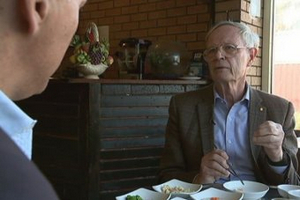
"It was emotional to be out there on the reef," he says after we order - a barbecued barramundi shared between us, following an appetiser of chargrilled flat breads.
"We dove first on a spot that was utterly decimated, with 98 per cent mortality. This was on the spot [David Attenborough's] Blue Planet II had filmed those amazing things about the great spawning of coral," he tells me.
"It was one of most spectacular places on the whole reef, and apparently one of the most remarkable sites in the whole world. And now, you may as well go dive on a parking lot some place.”
The reef a kilometre further out, where merely half the corals had died, offered some cheer. "There was still great beauty and a great sense of what an enchanted corner of God’s brain this all was."
McKibben's own wits don't seem to get much downtime, either.
A prolific writer, the lanky Vermonter - when he's not researching or campaigning around the world - was among the first to popularise climate change as a major threat with his 1989 book, The End of Nature. 
His working title for the three-decade anniversary update next year - “Falter: Has the human game begun to play itself out?” - suggests things aren't looking up.
“Thirty years ago, I didn’t anticipate how quickly the world would change, and I didn’t anticipate how slowly the political world would respond," McKibben says. "I was remiss on both counts."
He isn't letting up though. To anyone following his Twitter feed, it's evident McKibben remains passionate about many issues - from lawsuits against oil giants for their climate impact, new worrying science such as confirmation of a slowdown in the Gulf Stream, to US President Donald Trump's latest announcement.
IMAGE
McKibben's journalistic nous was nurtured as an undergraduate at Harvard where he "theoretically" majored in government. In reality, he spent "day after day after day" on The Harvard Crimson, the campus newspaper that doubles as an incubator for future New York Times or Washington Post talent.
"I’m sure I wrote more words per day in my college years than any other part of my journalistic career,” he muses.
McKibben's news nose means he appreciates the difficulties journalists have keeping the climate issue in the public eye.
That's despite the science being basically settled since the first Intergovernmental Panel on Climate Change report in 1994, and the mounting evidence of more frequent and more extreme weather events as atmospheric concentrations of greenhouse gases continue to climb.
“Although [climate change is the] most important thing happening in the world every single day, it’s never the most dramatic, urgent thing on any particular day,” he says.
“It may be journalism is just a reflection of the brain of our species, which is not good at reacting.”
I raise the point that news on the climate science front also tends to be negative, citing the recent discovery of algae forming on the warming Greenland ice sheets, darkening the surface and speeding the melt.
The Great Barrier Reef is in "deep trouble" as climate change and other threats mount, scientists say. Photo: Jason South
“We’ve not caught a significant break from physics or chemistry or biology in the 30 years I’ve been working it," he agrees. "Instead, virtually everything’s come back worse than imagined."
Indeed, some processes - such as ocean acidification as the seas absorb more carbon dioxide from the atmosphere - were barely foreseen when The End of Nature first went to print, he says.
For many Americans, the election of the pro-fossil fuel President Trump - who has also sought to gut government climate action - has added a degree of dismay that few liberals saw coming.
"[It's] as if everybody’s taken a dose of reverse Prozac, and they’re just anxious and jittery at all time,” McKibben says.
“The one good thing to say about the Trump era is that the resistance has grown dramatically,” says Bill McKibben. Photo: AP
“It turns out to be an under-appreciated virtue of all former presidents that you could forget about them for weeks at a time,” he adds. “This guy, every 45 minutes, he rings a little bell and you have to go stare at him for a while.”
One way McKibben responded was to step up his writing, producing a mischievous debut novel, Radio Free Vermont, in which his beloved state seeks to secede from the United States.
“Nobody was in the mood for anything dark," he says. "It’s half a love letter to my small quirky home state [that produced Democratic presidential candidate and former socialist mayor Bernie Sanders], and half a kind of mash note to the resistance, of which I’ve sort of been a part for, I guess, 15 years."
“The one good thing to say about the Trump era is that the resistance has grown dramatically.”
His 350.org now employs 100 people around the world, which he claims makes it the biggest such group devoted solely to tackling global warming.
The name refers to the 350 parts per million level of carbon dioxide in the atmosphere considered by some scientists as a "safe concentration" for a stable climate. That's well below the current CO2 level, which is 410-plus and rising.
The group is "a hell of a lot bigger than it was 10 years ago, when I started it with seven college kids," he says.
"But it’s pathetic, you know," McKibben adds with a self-deprecating chuckle. "Any halfway ambitious mid-sized oil companies spends more money lobbying in a quarter than our budget for a year, and there are hundreds of them.”
The future, he says, hinges on a contest between technology, with the promise of renewable energy to displace coal, oil and gas, and the physics of a climate we are shifting.
"Basically, it’s a race, and the job of movements [like 350.org] is to try to make that race come out the right way," he says.  "Left to our own devices, we’ll do [the transition] too slowly. Maybe we can goose the process.”
Two emerging trends offer McKibben some hope. One is the "literal miracle" of a solar panel, which can bring light and communications to poor tropical villages just by taking "a plate of glass and pointing it at the sun",  as he witnessed last year in Ghana.
Bill Kibben calls the solar panel a "literal miracle". Photo: Justin McManus
"They’d just put in, a week before in this rural, remote community, a solar micro grid - maybe an array of 50 panels and the most rudimentary wire into each hut – and they kept handing me cold bottles of water to drink, for which I was grateful because it was very hot.
"But in my predictably clueless Western way, it took me a good 15 minutes to figure out why they would be so proud to be doing it," he adds. "Nobody had ever had a refrigerator. Almost literally, the concept of cold had heretofore been an irrelevant concept."
The other promising development has been "the remarkable emergence of frontline communities in general, and indigenous communities in particular, around the world at the absolute head of this fight” against fossil fuels, McKibben says.
“We work so much alongside and behind our indigenous colleagues everywhere - in Keystone, Standing Rock and Kinder Morgan [pipeline tussles in North America], in the Pacific Islands, in the Adani fight [in Queensland], wherever."
A protest march to a sacred burial ground at the Standing Rock Indian Reservation in North Dakota, in 2016. Photo: New York Times
"Standing Rock [in North Dakota] was just an amazing scene" led by Sioux protesters, McKibben says. "And one of the things that made me saddest about Trump’s election was losing that overnight - that pipeline would have been the first constructed pipeline to never go into operation."
As our chat winds down, the waiter comes to inquire as to the satisfaction with our meal, saying he hadn't wanted to disturb our discussion.
"It was really good," McKibben says, joking: “We were literally solving the problems of the world today."
"Good, at least somebody’s doing it," the waiter says with a smile.

Links

Friday, June 08, 2018

Is Australia’s Current Drought Caused By Climate Change? It’s Complicated

The Conversation - Andrew King | Anna Ukkola | Ben Henley

IVAN MCDONNELL/AAP
Much of southern Australia is experiencing severe drought after a very dry and warm autumn across the southern half of the continent. Australia is no stranger to drought, but this recent dry spell, and Prime Minister Malcolm Turnbull’s visit to drought-stricken parts of the country, has prompted discussion of the role of climate change in this event.
Turnbull said that farmers need to “build resilience” as rainfall “appears to be getting more variable”. This prompted former Nationals leader John Anderson to warn against “politicising” the drought by invoking climate change. This in turn was followed by speculation from numberous commentators about the links between climate change and drought.
So are droughts getting worse, and can they be attributed to climate change? Drought is a complex beast and can be measured in a variety of ways. Some aspects of drought are linked with climate change; others are not.

Recent warm and dry conditions have resulted in drought over parts of southern Australia. Bureau of Meteorology
 How do we measure drought?
In Australia, the Bureau of Meteorology uses rainfall deficiencies to identify regions that are under drought conditions.
Droughts are also exacerbated by low humidity, higher wind speeds, warmer temperatures, and greater amounts of sunshine. All of these factors increase water loss from soils and plants. This means that other metrics are often used to describe drought which go beyond rainfall deficiencies alone. These include the Palmer Drought Severity Index and the Standardised Precipitation Evaporation Index , for example.
This means that there are hundreds of metrics which together can provide a more detailed representation of a drought. But this also means that droughts are less well understood and described than simpler phenomena such as temperature and rainfall.
Hydrological drought, often defined by a period of low streamflow, is a response to numerous upstream processes that are unique to each river system. Hydrologists and water planners therefore often focus on directly observing and modelling runoff from water catchments.
The point here is that droughts can be multidimensional, affecting agriculture and water supplies on a wide range of spatial and temporal scales. A seasonal-scale drought that reduces soil moisture on a farm, and a decade-long drought that depletes reservoirs and groundwater supplies, can both be devastating, but in very different ways.

So is climate change affecting Australian droughts?
As we have so many ways of looking at droughts, this is a more complex question than it might first sound. Climate change may affect these drought metrics and types of drought differently, so it is hard to make general statements about the links between human-induced climate change and drought.
We know that over southern Australia, and in particular the southwest, there has been a rapid decline in winter rainfall, and that this has been linked to climate change. In the southeast there has also been a decline but the trend is harder to distinguish from the year-to-year variability.

Winter rainfall in Southwestern Australia has been in decline since the 1960s. Bureau of Meteorology
For recent short-term droughts in southern Australia, analyses have found an increased likelihood of rainfall deficits related to human-caused climate change. Also, it has been suggested that the character of droughts is changing as a result of the human-induced warming trend.
There is some evidence to suggest that widespread and prolonged droughts, like the Millennium Drought, are worse than other droughts in recent centuries, and may have been exacerbated by climate change. But the role of climate change in extended drought periods is difficult to discern from background climate variability. This is particularly true in Australia, which has a much more variable climate than many other parts of the world.

What does the future hold?
Future projections of drought are also difficult to constrain, as they vary across Australia and depend on the measure of drought being used. Climate models project a continuing decline in rainfall over southern Australia over the next century. Dry conditions like those seen in southeast Australia in 2006, for example, are projected to become more frequent under even low global warming targets associated with the Paris Agreement. Rainfall projections for other parts of the continent are more uncertain.
Rainfall is projected to become more extreme, with more intense rain events and fewer light rain days. This would potentially influence what future droughts look like, and how and where water moves through the land.
River flows are also projected to decline in parts of the country, with consequences for water supply to cities, ecosystems and agriculture. In the southwest, declining rainfall has led to drastic reductions in river flows since the 1970s. This trend is expected to continue. Elsewhere, changes are more uncertain but studies have suggested that the southeast could also experience declining river flows in the coming decades.
Part of the challenge of projecting future change is related to how temperature and precipitation vary together. The relationship is a double-edged sword. Increased greenhouse gas emissions mean an increased probability that low-precipitation years are also warm, suggesting that under climate change droughts may be hotter in some parts of the world. But dry conditions also often result in warmer local temperatures, increasing water loss from soils and plants.

Droughts are tricky
Compared with other extreme weather types, it is hard to make useful statements about how climate change is altering droughts and their impacts. Protracted droughts are also rarer than many short-term natural hazards such as heatwaves. We need much longer records to reliably understand how they are changing, but these are not always available.

Compared to heatwaves and cold spells it is harder to assess the role of climate change in droughts. National Academy of Science
There is some evidence to suggest that climate change is exacerbating drought conditions in parts of Australia, especially in the southwest and southeast. Much more work is needed to understand the intricacies of the effects of climate change on different aspects and types of drought.
With the uncertainties of a rapidly changing climate we need to bolster our adaptation plans so we are ready for the next big dry.

Links

Move To Renewables A 'Good Thing', Nationals' David Littleproud Says

The Guardian -

David Littleproud: ‘The climate is going to change and we’ve got to move with it.’ Photograph: Lukas Coch/AAP
The agriculture minister, David Littleproud, says the climate is changing and the transition in the energy market – with renewables displacing traditional power generation sources – is “exciting, not only for the environment but for the hip pocket”.
In an interview with Guardian Australia, the Queensland National said the climate had been changing “since we first tilled the soil in Australia” and he does not care whether the change is due to human activity or not.
While some colleagues in the National party have long queried whether humans are contributing to global warming, and have been openly hostile to the advance of renewable energy, Littleproud said: “I’m not losing any sleep on that, whether you want to prove it is manmade or not – I want to be pragmatic.
“The climate has been changing since we first tilled the soil in Australia and the reality is farmers have been adapting to it,” the agriculture minister said. “Farmers are always at the cutting edge of science and technology, and they’ve been adapting since we first tilled the soil here.
“I believe the climate is changing. Whether it is manmade or not, I don’t really care. The reality is we are seeing disruption, particularly with renewables, and we are going to see cleaner air. I try not to live in cities, you do feel the effects ... so it’s a good thing that renewables are coming on.
“In fact, in my own electorate [of Maranoa in south-west Queensland] I’ve got all of the above. I’m about to have one of the largest solar farms in the southern hemisphere, one of the biggest wind farms in the southern hemisphere. I’ve got geothermal and I’ve got four coal-fired power stations. Two of those are super critical.
“The disruption that’s happening with the technology, moving towards renewable energy, particularly in storage for base load, is exciting. I think it is a good thing.”
While some government colleagues have championed prolonging the life of coal-fired power plants, Littleproud said economics rather than a culture war would ultimately determine Australia’s future energy mix. “Economics will win out in the end and if base load power can be stored in particular, that’s an exciting thing for the environment and everyone’s hip pocket.”
Littleproud has been on the road for much of the week with the prime minister, Malcolm Turnbull, visiting drought-affected regions of New South Wales and Queensland.
The south-east of Australia this year has experienced record high temperatures during an unseasonably dry and hot autumn, prompting fire bans and warnings from authorities.
David Littleproud campaigning with prime minister Malcolm Turnbull in Queensland this week. Photograph: Lisa Alexander/AAP
In its latest winter outlook, the Bureau of Meteorology is forecasting warmer and drier-than-average conditions across large parts of the country. It suggests winter rainfall is likely to be below average for NSW, South Australia, northern Victoria and western parts of Western Australia.
Turnbull this week said there was “no doubt that our climate is getting warmer”. He said the farming community needed to concentrate on becoming more resilient and focus on adaptation to a climate that was getting warmer and drier.
Littleproud said there was a place for both mitigation strategies to try and reduce the most damaging impacts of climate change, and also for adaptation.
“No matter whether you mitigate or adapt, the climate is going to change and we’ve got to move with it,” he said. “You have to use the best science available at the time – you mitigate as best you can ... listen to the scientific evidence, because this should be predicated on science not emotion.
“If there are mitigation efforts to lessen the impact, then we should explore those, but we have to continue to adapt as we have since we first inhabited Australia.”
He said he was currently working with state counterparts in the agriculture portfolio to develop “a national strategy around climate change adaptation”, which would include better collaboration across state borders, more research and development, including developing more drought-resistant grains and fibres, and looking at the genetics of livestock, and “understanding the weather better”.
Asked whether some Australian farmers were hanging on in areas made unviable for agricultural production because of the impact of climate change, Littleproud said: “I think ultimately the market and economics determine that.
“I honestly believe, having been a bank manager that sat around farmers’ kitchen tables, the greatest custodians of the land are farmers because their profit and loss is intrinsically tied to the health of their land. They don’t make a quid unless their environment and their farming is at its best.”
He said farmers in drier areas were deploying active strategies, like reducing their stocking densities, and some farmers he had met in regional Queensland this week were also engaged with traditional owners about land management.
“They’ve learned how to manage that land, in some ways learning from how Indigenous Australians manage the land and techniques they’ve used,” he said.
Asked whether he accepted that agriculture and transport industries had to reduce their emissions to ensure Australia met its commitments under the Paris agreement, Littleproud said emissions reduction had to be “responsible”.
I think we are already reducing emissions
David Littleproud
The latest official emissions data shows pollution increased by 1.5% in the year to December 2017. Australia’s emissions levels are now higher than they were in 2012 and have climbed by 3.6% since the carbon price was repealed in 2014.
Emissions are increasing in most sectors of the economy – in waste, agriculture and transport. Only one sector of the economy has recorded a decrease – the electricity sector – because ageing coal-fired power plants have exited the system, and new renewables projects are coming on stream.
“We’ve still got to be able to reduce the bills,” Littleproud said. “We’ve got to make sure the transition is done with people being able to turn their heaters on, and farmers turning their pumps on.
“I think we are already reducing emissions. We’ve made a commitment under the Paris agreement and we are moving towards that in a sensible and methodical way.
“As disruption happens in the technology space, [emissions reduction] will increase. In my own electorate, people are self-sustaining through solar. The reality is that type of disruption is happening and that is an exciting thing not only for the environment, but for the hip pocket.”

Links

Climate Change-Related Disaster Relief Is Increasing Demand On Defence Department, Senate Hears

ABC News - Ben Deacon

Private Daniel Bond and a Vanuatu resident work together on building repairs after Cyclone Pam. (Supplied: Tom Gibson/ABIS )
The Department of Defence has spelled out clearly to a Senate enquiry that climate change is increasing demand and will create "concurrency pressures" for the Australian Defence Force as a rise in disaster relief operations continues.
"The ADF is … built around the most demanding and most complex of its roles, the warfighting role," the Defence Department told a Senate enquiry into climate change and security last month.
"Due to the nature of its capabilities it is able to make a contribution to Humanitarian Assistance and Disaster Relief (HADR), though the force is not structured around this task."
At the moment, while Australia has no large-scale war commitments, Defence says its can handle the workload.
"However, the forecast level of commitment may create concurrency pressures for Defence from as early as the middle of the next decade, or earlier if climate change-related impacts on security threats accelerate."
A graph supplied to the Senate shows the number of ADF disaster missions increasing alongside the number of disasters across the Asia-Pacific. (Supplied: Department of Defence)
 Defence said climate change could magnify regional instabilities, causing security problems for Australia.
"Climate change can act as a 'threat multiplier'."
"Climate change may also eventually contribute to greater irregular migration pressure in vulnerable countries to Australia's north, potentially becoming a substantial security threat for Australia."
The Senate report concluded that "the consensus from the evidence (is) that climate change is exacerbating threats and risks to Australia's national security".
"These include sea level rise, bushfires, droughts, extreme rainfall events, and higher-intensity cyclones".
Leading aircraftman Aaron Townsend carries supplies to be flown to the Philippines for the Typhoon Haiyan relief effort. (Supplied: Glen McCarthy/ADF)
Currently serving senior defence figures in Australia rarely speak publicly about climate security.
"To do that would necessarily mean putting your head above the parapet, so to speak," said Associate Professor Matt McDonald from the University of Queensland.
"That's where I think there is a concern — that you don't want to be engaging in what is a toxic politics around climate change in Australia."
Admiral, Home Affairs see climate change as common threat
Contributing to the enquiry was the former head of the Australian Defence Force, Admiral Chris Barrie.
Admiral (ret.) Chris Barrie has raised the impact of a future threat of a Cape Town-style water crisis right across Asia. (ABC News)
When he was the Defence chief, it was his job to perceive future threats to Australia.
Now retired, the Admiral worries that climate change could cause huge security issues for the nation and no longer bound by office he is free to speak his mind.
Admiral Barrie has posed the scenario of what would happen if a Cape Town-style water crisis hit right across Asia, driven by receding glaciers in the Himalayan mountains.
"I'm talking China, around the Mekong river into Burma, Bangladesh, India, Pakistan. What will billions of people be doing about that problem?" he said.
"Well, one of the scenarios of course is, I think, they'll be looking for a new home."

Australia the Pacific pariah
Australia's stance on climate change and coal puts it increasingly at odds with its Pacific island neighbours, writes Wesley Morgan of the University of the South Pacific.

The former Department of Immigration and Border Protection, now called Home Affairs, has also followed the logic of threat multiplication in its Senate enquiry submission.
"Climate change is likely to exacerbate the complexity and unpredictability of existing migratory pressures around the world and for Australia," it wrote.
"In most cases, climate change-related migration will not eventuate as straightforward cause and effect, but will be shaped by the interaction of climate change with cultural, economic and political processes."

Environment's 'threat multiplier' gets on Defence radar
Military interest in the consequences of climate change can be traced back to a landmark report commissioned by the US Department of Defense in 2007.
The report, National Security and the Threat of Climate Change, was overseen by Sherri Goodman, a former deputy undersecretary of Defense.
She assembled a military advisory board of twenty retired admirals and generals who concluded that "projected climate change poses a serious threat to America's national security".
In contrast to the science, Donald Trump has said climate change was created by and for the Chinese in order to make US manufacturing uncompetitive. (Reuters: Carlos Barria, file photo)
Ms Goodman coined the term "threat multiplier" — meaning climate change may exacerbate existing threats rather than be a threat unto itself.
She reprised her 2007 message in a submission to Australia's recent Senate enquiry, advising Government to "recognise climate change as a global existential risk, and a direct threat to the national security of Australia".
The term and the ideas in the report had already caught on in Washington.
The Trump administration's current US Defense Secretary, General James 'Mad Dog' Mattis, at his confirmation hearing, seemed out of lock step with his soon-to-be commander-in-chief, stating:
"Climate change can be a driver of instability and the Department of Defense must pay attention to potential adverse impacts generated by this phenomenon."
Mr Trump has previously said the concept of climate change was created by and for the Chinese in order to make US manufacturing uncompetitive.

Study reinforces regional climate issues
A new study led by Australian scientist Dr Andrew King from the University of Melbourne paints a stark picture of this interaction between climate change and economics among Australia's neighbours in the Asia-Pacific region.
A map produced for the paper titled The Inequality of Climate Change from 1.5 deg C to 2 deg C of Global Warming shows a sea of red to Australia's north.
It indicates that poorer, tropical countries from India to Melanesia will notice a disproportionate amount of abnormal heat as temperatures increase by more than 1.5 degrees Celsius.
Dr King's research shows poorer, tropical regions will be disproportionally affected by climate change. (Supplied: Andrew King/University of Melbourne)
Comparatively wealthy Australia on the other hand is predicted to be once again the lucky country.
Increases in temperatures here would not be as noticeable.
"We're using a quantitative measure of local climate change and then overlaying that with population data and GDP data," Dr King said.
"What we're really showing, and this does compliment what studies have shown before, that it's the poorest who will be worst affected by climate change."

Links

Thursday, June 07, 2018

Fake News And Climate Change: Young People Debate Key Issues On Q&A Special

ABC News - Mazoe Ford

From top L to R, Q&A panellists Daniel Yim, Maya Sathiamoorthy, Geordie Brown, Pinidu Chandrasekera, Solli Raphael and Zahra Bilal. (ABC News: Mazoe Ford)
Why aren't young people listened to? Are kids doing enough to pressure adults to address climate change? And how do you combat fake news?
These were just some of the questions tackled by the first ever Behind the News Q&A kids panel on the ABC.
Six young Australians aged between 13 and 19 formed the panel to debate some of the biggest issues facing their generation, watched by an audience filled with children, some as young as eight.
School students also made up the Q&A audience. (ABC News: Mazoe Ford )
 On climate change, they were adamant that young people must do more to force adults into action.
"I definitely think kids should try to spread their opinions on climate change because this is the world that we're going be living in, this is what we have to take care of, so we should really take responsibility for our world," Maya Sathiamoorthy, 14, said.
Solli Raphael, 13, said young people should take action now with small steps and not wait for adults to act.
"You don't have to be a prime minister or someone powerful to make a change on climate change," he said.
"Like just if we see [rubbish]… pick it up and put it in the bin — it's a small thing but it does make a difference to climate change."

'Fake news teaching us to be more critical'
In the half-hour special, the panel tackled other important issues such as bullying, whether to raise the voting age, social media, and fake news.
"Headlines and flashy news get a lot of clicks and get a lot of attention but … you need to read from different sources and you need to read lots before you can be sure that you've understood and know what the truth is," Daniel Yim, 17, said.
Zahra Bilal, 15, added that young people have developed a level of distrust in the news.
"I think we have had to learn that facts have many faces and not everything we read is true," she said.
"So I think it's good that fake news has come out because it has taught us to be so much more critical of what we read," she said.
The special is the first Behind the News Q&A panel. (ABC News: Mazoe Ford )
The panel also spoke about why they believe adults in positions of power need to listen more to young people's voices.
"There are adults out there who don't necessarily know what we're going through as kids and they don't know the sort of experiences we are having," Geordie Brown, 19, said.
"We have to come together and create a voice … we have [to] create [opportunities] for each other and ourselves, and what that does is it gains the respect of adults and it shows them we do care and we want to make a difference."
Pinidu Chandrasekera, 16, said he felt inspired by young people in other countries who were making their voices heard.
"We only have to go to America where kids our age are all banding together and really driving a huge movement for gun reform and I think we've seen it before back in the 1970s against the Vietnam war," he said.
"It's an adult world, they dominate the news and they dominate politics, but as kids we have a powerful voice if we can come together and really show society what we want to change."

Links

Lethal Heating is a citizens' initiative