Wednesday, August 08, 2018

State Government Confirms: ‘NSW Is Now 100 Per Cent In Drought’

NEWS.com.au - Megan Palin

THE entire state of NSW has been declared in drought as farmers battle the brunt of the crisis and some regions are put on extreme water restrictions, limiting residents to three-minute showers.
Drought ravaged north west NSW is battling through one of the worst dry spells in history. This aerial image shows wandering sheep looking for food at James Foster's property 90km west of Walgett. Picture: Sam Ruttyn. Source: News Corp Australia
THE entire state of NSW is now impacted by drought as extreme measures including water restrictions are tightened in a bid to combat the crisis.
According to the Department of Primary Industries, 61 per cent of NSW is either in drought or intense drought, while nearly 39 per cent is drought affected. “This is tough,” NSW Primary Industries Minister Niall Blair said in a statement on Wednesday.
“There isn’t a person in the state that isn’t hoping to see some rain for our farmers and regional communities,” he said.
A drier-than-expected June and July has left many farmers with failing crops, a short supply of water and diminishing livestock feed. In some regions, water restrictions have been tightened to the point that residents can only do a maximum of two loads of washing a week and take three minute showers.
Drought conditions are affecting farmers in NSW. Cam Armstrong on a dried up dam on his sheep farm in Cassilis, NSW. Picture: Liam Driver. Source: News Corp Australia
Less than 10 millimetres of rain was recorded in the western, north west, and central areas of NSW over the past month and drier-than-normal conditions are forecast for the next three months across the majority of the state. The combined drought indicator — which takes in rainfall, soil water, plant growth and long term climate data — shows no part of NSW is recovering despite some recent rain.
“Producers are now faced with some very difficult decisions on whether to graze sown crops or rely on potential rainfall in the next two months in order to increase yield production,” Mr Blair said.
“Some areas of the state did receive some welcome rainfall this month that has provided a little relief for stock and domestic water; unfortunately though it will not even come close to the recovery needed for most farmers.
“The forecast suggests an increase of drier than normal conditions for the next three months across the majority of NSW but I want every farmer and community to know that we will stand with them through this challenging time and continue to make sure we have the right support available.”
Prime Minister Malcolm Turnbull earlier this week toured drought-stricken communities to announce $12,000 grants for each affected farming family. The NSW government has also doubled its funding commitments to struggling farmers with a total of $1 billion pledged towards the growing crisis.
On the more extreme end of the scale, residents in the small town of Murrurundi in the state’s Upper Hunter Region have been placed on level six water restrictions which limits them to two full washing loads of clothes a week and three-minute showers.
The restrictions are intended to buy residents another three or four months of water, with the town otherwise expected to completely run out within weeks.
Upper Hunter Shire Mayor Wayne Bedggood said the council was using the bought time to seek additional sources of water.
“After level six restrictions, we face emergency measures. Field work is underway to find new bore locations and we are seeking funds from the state government for new pipe infrastructure and — in the worst case scenario — to truck more water into town,” he said.
“Under the current weather conditions and infrastructure, the system would only provide sufficient potable water until the end of this year, so we need to find other sources, prior to the completion of the Scone to Murrurundi pipeline in 2020.”
State-owned corporation WaterNSW manages rivers and water supply systems, including 40 dams. Executive manager for systems operations Adrian Langdon told the ABC that the long-range forecast looked ahead three months and dry conditions were predicted to continue. He said without rain, there was not a lot WaterNSW could do to alleviate water scarcity in places like Murrurundi, the ABC reports.
“We’re reliant on other sources such as groundwater supplies and those types of things to support these communities,” Mr Langdon said.

Spotlight on NSW farmers’ mental health as drought grips State

Links

Abbott Policies Reduced Effectiveness Of Foreign Aid To Combat Climate Change

The Guardian - 

Exclusive: Government report says change in priorities from 2013 saw a loss of expertise and project oversight
Tropical Cyclone Pam rips through Kiribati in 2015. The island was a recipient of Australian foreign aid, which was cut by the Abbott government. Photograph: Mike Roman/Red Cross Australia/EPA
A decreased emphasis on climate change and cuts to the foreign aid budget under the Abbott government caused a loss of expertise, a lack of oversight and early closure of some projects, according to an internal government report.
Two-thirds of selected projects by the Department of Foreign Affairs and Trade achieved a modest or significant impact on climate outcomes, the evaluation said.
But despite Australia spending $599m on climate-related aid investments between 2010 and 2013, the report said that the resourcing of such projects then began to decline.
“From this time to the Paris Agreement at the end of 2015, Australia did not provide dedicated additional climate financing, with climate action subsumed into general aid programming.”
Although the report does not mention the 2013 election of the Abbott government, it says there was “a loss of climate-specific expertise from the aid program as funding and priorities changed”. It adds that programming choices were “decentralised to posts which also had to manage reductions in the broader aid program at this time”.
In some cases “climate change investments were rebranded in 2014 (for example, as food security, water security or disaster preparedness), as climate was de-emphasised in the Australian policy context”, it said.
“Staff and senior managers spent a considerable amount of time internally rebranding the work and many lost the ability to report on climate-related outcomes as these objectives and indicators were removed,” it said.
“Many other investments lost impetus and were closed early as staff incentives abated.”
The Abbott government cut foreign aid by a total of $11bn over the medium term, reducing Australia’s aid program to the lowest levels since the creation of a formal aid program more than 40 years ago.
At the Paris climate conference in December 2015, Malcolm Turnbull announced Australia would provide at least $1bn over five years to build climate change resilience and reduce emissions in developing countries.
The evaluation examined a sample of 26 projects valued at $641.2m that started between 2006 and 2014. It found that nine projects achieved or were likely to achieve “significant climate-relevant outcomes” and a further nine would achieve “modest” outcomes.
The remaining eight projects were either unlikely to or would not achieve climate outcomes or were not designed with climate outcomes in mind.
The report said the majority of investments “proved effective” but there was less evidence that the results would achieve climate outcomes because “monitoring and the subsequent reporting of climate change results was often inadequate and inconsistent”.
The department elevated climate change as a priority for aid in July 2016, but the report said its strategy and implementation plan was scheduled for completion this year.
In addition to completing this plan, the report recommended the department routinely collect information to track the effectiveness of its climate change investments and strengthen internal design and staff capacity for climate change projects.
In its response, the department said the report contained “valuable analysis and insights that can directly inform more effective climate change action”.
“The department agrees broadly with all the evaluation’s recommendations and with its conclusions.”
The Australian Council for International Development’s development economics adviser, Amrita Malhi, said the evaluation showed that up to 2013 DFAT’s efforts on climate change action were “bearing fruit” but then climate objectives were “stripped out and investments closed down”.
“After five years, it is only now that there are early signs of recovery and climate change is being considered as a more important component of the aid program,” she said. “Compared to our allies, like the UK, we are now playing catch-up.”

Links

Global Wind Energy Giants Blast Weak Emissions Target In National Plan

Fairfax - Cole Latimer | Peter Hannam

Two of the world's biggest wind turbine makers have weighed in against the National Energy Guarantee, calling for a more ambitious target because it may leave the electricity sector contributing only a tiny portion of Australia's Paris climate goal.
GE, the company that built the world's first ever coal-fired power station, said the Turnbull government's setting of an emissions reduction target of 26 per cent of 2005-levels by 2030 fell far short of what the power sector could deliver.
GE built the world's first coal-fired power station in the US, and owns three in Australia, but is now aggressively growing its renewable energy operations. Photo: Nick Moir

“The new target being set will see [the power sector] contribute about one-twentieth of the emissions reduction required to meet our Paris commitments," Steven Oswald, head of GE's Australian renewables, said. "It’s a sector that can do so much more."
John Titchen, managing director of the Australian operations of Chinese turbine giant Goldwind, echoed Mr Oswald's concerns, though placed the electricity industry at a slightly higher level at "less than a tenth" of the total contribution needed by Australia to meet its international commitments.
"So there's another more than 90 per cent of the task that is not really defined as to how it is going to be addressed," Mr Titchen told an energy summit in Sydney last week.
The two companies' position is more forthright than some of the industry groups, such as the Clean Energy Council, which generally support the policy while calling for more ambition.
The Turnbull government is pressing states and territory governments to sign off on the plan at a meeting in Sydney on Friday that it would then take to the federal Coalition partyroom for approval the following Tuesday.
Federal Environment and Energy Minister, Josh Frydenberg, dismissed these concerns.
"The report of the independent Energy Security Board makes clear that an additional 38 million tonnes of abatement will occur under the government's target, and that without a concrete mechanism in place there is no guarantee that emissions reduction will follow," he said.
Mr Titchen also questioned whether the power sector would even meet the 26 per cent reduction since the scheme only covers the eastern states that are part of the National Electricity Market. Generators in WA and the NT, supplying about 20 per cent of national demand, would be able to continue to increase emissions.
Both executives noted that the industry had rebounded after stalling in 2014 when the Abbott government reviewed the Renewable Energy Target, ultimately cutting the 2020 goal by about one-fifth to 33,000 gigawatt-hours of clean energy by the end of this decade.
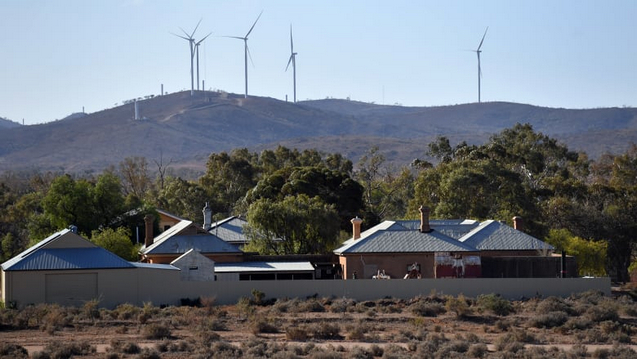
Wind farms, like Silverton outside of Broken Hill, NSW, are springing up across Australia. Photo: Mick Tsikas
Mr Oswald said there were several "lost years...The target was compressed into the last three years of the scheme, which caused such an upswing" in the industry now.
He said the industry was now "broadly supportive of the framework of the National Energy Guarantee" but there remained concerns about any last-minute additions to the policy that could “soften the drivers to reduce emissions”.
Mr Titchen's worries including the difficulty any future government will have when it comes to lifting the emissions target – or other settings – in the future.
The course we set now "is the course we're going to live with for some period," Mr Titchen told the summit's dinner last week. "I'm not sure that we're going to make an easy correction if we don't get it right at this point."
GE and Goldwind are vying for bragging rights as the biggest suppliers of wind energy in Australia.
GE currently has the largest number of simultaneous wind farm construction projects in Australian history, with six projects comprising 311 turbines, that would generating 1.1 gigawatts, or the equivalent of the power needs of about 620,000 homes.
Goldwind's Stockyard Hill Wind Farm in Victoria will be the largest in the southern hemisphere and alone could supply about 390,000 homes. The company is on track to supply more than a million homes when current or completed projects are taken into account.

Links

Tuesday, August 07, 2018

Domino-Effect Of Climate Events Could Push Earth Into A ‘Hothouse’ State

The Guardian - 

Leading scientists warn that passing such a point would make efforts to reduce emissions increasingly futile
Polar bears on sea ice: the loss of the Greenland ice sheet could disrupt the Gulf Stream, which would in turn raise sea levels and accelerate Antarctic ice loss. Photograph: Paul Goldstein/Cover Images 
A domino-like cascade of melting ice, warming seas, shifting currents and dying forests could tilt the Earth into a “hothouse” state beyond which human efforts to reduce emissions will be increasingly futile, a group of leading climate scientists has warned.
This grim prospect is sketched out in a journal paper that considers the combined consequences of 10 climate change processes, including the release of methane trapped in Siberian permafrost and the impact of melting ice in Greenland on the Antarctic.

Climate cascade: feedback loops could amplify one another,
pushing Earth towards ‘hothouse’ state, warn scientists

Guardian graphic. Source: Stockholm Resilience Centre

The authors of the essay, published in Proceedings of the National Academy of Sciences, stress their analysis is not conclusive, but warn the Paris commitment to keep warming at 2C above pre-industrial levels may not be enough to “park” the planet’s climate at a stable temperature.
They warn that the hothouse trajectory “would almost certainly flood deltaic environments, increase the risk of damage from coastal storms, and eliminate coral reefs (and all of the benefits that they provide for societies) by the end of this century or earlier.”
Fifty years ago, this would be dismissed as alarmist, but now scientists have become really worried
Johan Rockström, executive ​director, Stockholm Resilience Centre
Rockström and his co-authors are among the world’s leading authorities on positive feedback loops, by which warming temperatures release new sources of greenhouse gases or destroy the Earth’s ability to absorb carbon or reflect heat.
Their new paper asks whether the planet’s temperature can stabilise at 2C or whether it will gravitate towards a more extreme state. The authors attempt to assess whether warming can be halted or whether it will tip towards a “hothouse” world that is 4C warmer than pre-industrial times and far less supportive of human life.
Katherine Richardson from the University of Copenhagen, one of the authors, said the paper showed that climate action was not just a case of turning the knob on emissions, but of understanding how various factors interact at a global level.
“We note that the Earth has never in its history had a quasi-stable state that is around 2C warmer than the preindustrial and suggest that there is substantial risk that the system, itself, will ‘want’ to continue warming because of all of these other processes – even if we stop emissions,” she said. “This implies not only reducing emissions but much more.”
New feedback loops are still being discovered. A separate paper published in PNAS reveals that increased rainfall – a symptom of climate change in some regions - is making it harder for forest soils to trap greenhouse gases such as methane.
Previous studies have shown that weakening carbon sinks will add 0.25C, forest dieback will add 0.11C, permafrost thaw will add 0.9C and increased bacterial respiration will add 0.02C. The authors of the new paper also look at the loss of methane hydrates from the ocean floor and the reduction of snow and ice cover at the poles.
Rockström says there are huge gaps in data and knowledge about how one process might amplify another. Contrary to the Gaia theory, which suggests the Earth has a self-righting tendency, he says the feedbacks could push the planet to a more extreme state.
As an example, the authors say the loss of Greenland ice could disrupt the Gulf Stream ocean current, which would raise sea levels and accumulate heat in the Southern Ocean, which would in turn accelerate ice loss from the east Antarctic. Concerns about this possibility were heightened earlier this year by reports that the Gulf Stream was at its weakest level in 1,600 years.
Currently, global average temperatures are just over 1C above pre-industrial levels and rising at 0.17C per decade. The Paris climate agreement set actions to keep warming limited to 1.5C-2C by the end of the century, but the authors warn more drastic action may be necessary.
“The heatwave we now have in Europe is not something that was expected with just 1C of warming,” Rockström said. “Several positive feedback loops are already in operation, but they are still weak. We need studies to show when they might cause a runaway effect.
Another climate scientist – who was not involved in the paper – emphasised the document aimed to raise questions rather than prove a theory. “It’s rather selective, but not outlandish,” said Prof Martin Siegert, co-director of the Grantham Institute. “Threshold and tipping points have been discussed previously, but to state that 2C is a threshold we can’t pull back from is new, I think. I’m not sure what ‘evidence’ there is for this – or indeed whether there can be until we experience it.”
Rockström said the question needed asking. “We could end up delivering the Paris agreement and keep to 2C of warming, but then face an ugly surprise if the system starts to slip away,” he said. “We don’t say this will definitely happen. We just list all the disruptive events and come up with plausible occurrences … 50 years ago, this would be dismissed as alarmist, but now scientists have become really worried.”
“In the context of the summer of 2018, this is definitely not a case of crying wolf, raising a false alarm: the wolves are now in sight,” said Dr Phil Williamson, a climate researcher at the University of East Anglia. “The authors argue that we need to be much more proactive in that regard, not just ending greenhouse gas emissions as rapidly as possible, but also building resilience in the context of complex Earth system processes that we might not fully understand until it is too late.”

Links

Earth At Risk Of 'Hothouse Climate' Where Efforts To Reduce Emissions Will Have No Impact, Study Finds

ABC News - Elise Pianegonda

A "hothouse" climate could trigger earth processes like a major reduction of Antarctic sea ice.
(Australian Antarctic Division: Richard Youd)
Key points:
  • Study found the climate is heading for a tipping point that could make the planet uninhabitable
  • It could cause temperatures up to 5C higher than pre-industrial averages
  • Current global efforts to curb emissions are "unlikely" to prevent the dangerous situation
If humans cause the earth's global average temperature to increase by a further 1 degree Celsius, the world could face a "hothouse" climate and trigger further warming — even when all human emissions cease, an international study has found.
The study titled Trajectories of the Earth System in the Anthropocene, which involved researchers from around the world, was published in the international journal Proceedings of the National Academy of Sciences of the United States of America (PNAS).
It found the Earth was heading for a tipping point, known as a "hothouse" climate, which could lead to average temperatures up to 5C higher than pre-industrial temperatures and rises in sea level of between 10 and 60 metres.
Lead researcher Professor Will Steffen from the Australian National University (ANU) said at that point much of the earth would be uninhabitable.
He explained that if human emissions raised global temperatures to 2C above pre-industrial temperatures it could trigger earth system processes — or feedbacks — that could then cause further warming.
"The real concern is these tipping elements can act like a row of dominoes," Professor Steffen said.
"Once one is pushed over, it pushes Earth towards another.
"It may be very difficult or impossible to stop the whole row of dominoes from tumbling over."
Current efforts 'unlikely' to help avoid tipping point
Professor Steffen said global average temperatures were currently just over 1C above pre-industrial temperatures and rising at 0.17C each decade.
"Even if the Paris Accord [Agreement] target of a 1.5C to 2C rise in temperature is met, we cannot exclude the risk that a cascade of feedbacks could push the Earth system irreversibly onto a 'hothouse Earth' pathway," the study said.
"As yet [these initiatives] are not enough to meet the Paris target."
Professor Steffen said countries needed to work together to "greatly accelerate the transition towards an emission-free world economy".

Where is the urgency in
Australia's climate policy?
Australia needs to stop pretending
we're tackling climate change.

And he said while humans were not the sole cause of temperature changes on Earth, the current efforts by nations to reduce emissions and stop average temperatures rising by a further 1C were "unlikely to help avoid this very risky situation".
"If the threshold is crossed, the resulting trajectory would likely cause serious disruptions to ecosystems, society, and economies," the study said.
"Collective human action is required to steer the Earth system away from a potential threshold and stabilise it in a habitable interglacial-like state."
The authors of the study examined 10 feedback processes, some of which could cause "the uncontrollable release" of carbon back into the atmosphere, after it had been stored in the earth.
Some of the processes also included permafrost thaw, Amazon rainforest dieback, a reduction of northern hemisphere snow cover, a loss of Arctic summer sea ice, and a reduction of Antarctic sea ice and polar ice sheets.
The study did not lay down a timeframe for when such events would begin to occur, but theorised — if the threshold was crossed — it could be within a century or two.
"The impacts of a hothouse earth pathway on human societies would likely be massive, sometimes abrupt, and undoubtedly disruptive," the study said.

Links

Our Climate Plans Are In Pieces As Killer Summer Shreds Records

CNN - Angela Dewan

Josh Edelson AFP / Getty Images
Deadly fires have scorched swaths of the Northern Hemisphere this summer, from California to Arctic Sweden and down to Greece on the sunny Mediterranean. Drought in Europe has turned verdant land barren, while people in Japan and Korea are dying from record-breaking heat.
Climate change is here and is affecting the entire globe -- not just the polar bears or tiny islands vulnerable to rising sea levels -- scientists say. It is on the doorsteps of everyday Americans, Europeans and Asians, and the best evidence shows it will get much worse.
This summer, 119 people in Japan died in a heat wave, while 29 were killed in South Korea, officials there say. Ninety-one people in Greece died in wildfires, and ongoing fires in California have taken at least eight lives. Spain and Portugal sweltered through an exceptionally hot weekend with a heat wave that has killed three people in Spain and pushed temperatures toward record levels.

Deadly heat waves will become more frequent and occur in more places on the planet in coming decades, according to a study published last summer in the journal Nature Climate Change. Extreme heat waves are frequently cited as one of the most direct effects of man-made climate change.
Remarkably, scientists can now work out in just a matter of days how much human-induced climate change has had to do with a particular weather event, using a combination of observation, historical data and current information from weather stations.
"The European heat wave was at least twice as likely to happen because of human intervention. Based on findings in Ireland it was double -- and we know that with very high confidence -- and based on data from all other weather stations it was more than double," said Karsten Haustein from the World Weather Attribution Project, part of Oxford University's Environmental Change Institute. 
Scientists have been able to use this kind of modeling for more than a decade, but improved technology now allows them to do it nearly in real time, letting people understand the links between what they are seeing and climate change.
Despite the deadly summer, overwhelming evidence that humans are altering the planet, and ever-improving science that links specific weather events to global warming, the international politics around the issue of climate change are in disarray. And there are alarming signs that the planet may be in worse shape than ever before.
A house is caught up in the Carr fire in Redding, California, on July 27. Josh Edelson AFP / Getty Images
Carbon levels highest in 800,000 years
A report released Wednesday by the US National Oceanic and Atmospheric Administration (NOAA) gave the Earth in 2017 a grim report card.
The major greenhouse gases -- carbon dioxide, methane and nitrous oxide -- all rose to record levels last year. The global average carbon dioxide concentration was the highest ever recorded, and higher than at any point in the past 800,000 years, according to ice-core data.
Spending on oil and gas increased last year, pushing up the share of fossil fuels in energy supply investment for the first time since 2014, according to the International Energy Agency. Investment in renewable energy dropped 7%, while demand for coal rose, largely to keep Asia's furnaces burning as the region rapidly develops.
And last year also saw US President Donald Trump announce his plan to pull the US from the Paris Agreement, in a striking blow to global action on climate change. The US is the world's second-biggest emitter of carbon dioxide, and a pact without the powerhouse nation is significantly weakened.
The symptoms of climate change were also dramatic. Last year was the second or third-hottest year on record, depending on the dataset used, following three record-breaking hot years, the NOAA report showed. It was the hottest year on record without an El Niño, the natural weather event that adds to the warming of the seas and the whole planet.
A new record for global sea levels was set. Unprecedented coral bleaching occurred, and both the Arctic and the Antarctic saw record-low levels of sea ice, as warmer air and seas continued the trend of thinning out the polar ice.

Most Americans accept man-made climate change is real
The Earth has been getting steadily warmer since humans began using high levels of fossil fuels in the 18th to 19th centuries, during the Industrial Revolution. The planet has already warmed by around 1 degree Celsius since the late 19th century.


More and more Americans are starting to accept climate change is happening, despite Trump's pledge to pull the US from the Paris Agreement.
American acceptance of climate change returned to an all-time high of 71% in October last year after sliding significantly from around a decade ago, according to the Yale Program on Climate Change Communication, which conducts quarterly surveys on attitudes to global warming. It has dropped to 70% this year so far.
Some 58% of Americans believe that climate change is mostly man-made, a clear majority but a lower percentage than in most other developed nations.
This understanding that climate change is at least happening has a lot to do with what people are seeing and experiencing, according to the Yale program's director, Anthony Leiserowitz.
After the US was hit with several catastrophic hurricanes, the number of people who felt global warming was affecting US weather "a lot" leaped to 33% last October from 25% in May, five months earlier. That number went back down when winter came and extreme weather events subsided.
People walk through flooded roads in Houston, Texas, on August 27, 2017 as Hurricane Harvey hit the city.
"People are increasingly connecting the dots when they see these weather events happening across the United States," Leiserowitz said.
"It's about the pattern -- if an extreme event happens once or twice, it's just a coincidence, but three, five, 12, 22 times, seeing record-setting events, seeing 1,000-year event after 1,000-year event happen frequently, people begin to see that larger pattern, that climate change is actually affecting the weather today. And that's a new concept for many Americans."
This increase in awareness appears to be happening in Redding, California. The Carr Fire has torched more than 130,000 acres of land -- the equivalent of nearly 100,000 football fields -- and it became so big and hot this week, it created its own weather system.
Firefighter Gabriel Lauderdale, 29, has lived all his life by the forest near Redding, and he says even that's enough time to have noticed the pattern and behavior of wildfires change dramatically.
"There seems to be more destructive wildfires and they're happening more frequently," said Lauderdale.
"It used to be that a 10,000-acre fire was a large fire, and in these cases, we're seeing many exceed 100,000 acres, and they reach that size relative quickly. They move into homes and businesses, and they move very fast from structure to structure."

The US pulls the plug on Paris
The Paris Agreement in 2015 was widely celebrated as an achievement, but it has major flaws -- it is not legally binding, it's unenforceable and soon it is likely to lack one of the world's biggest polluters.
The agreement's predecessor, the Kyoto Protocol, was much stronger. It set ambitious and legally binding emissions reduction targets. But it too had its problems.
It included only developed nations, so China, the world's biggest carbon emitter, was not obliged to make reductions.
This was always a sticking point for the US. George W. Bush in 2001 pulled his country out of the Kyoto agreement, which Congress had never ratified.
Kyoto's other major flaw was that although it was legally binding, no one was ever sanctioned for over-polluting.
So the success of Paris lies in the fact that it at least engaged more than just developed nations. Those who ratify it make pledges to combat climate change as their countries see fit, and they are obliged to report on them transparently, in more of a name-and-shame system than one with mutually set goals.
Another success of Paris is the recognition that the world should try to contain warming to 1.5 degrees Celsius above pre-industrial levels, or two degrees as a worst-case scenario.
The agreement, however, did not include the legally binding goals to reduce carbon emissions that were sought by Europe but largely opposed by the US.
Cars are blocked after a wildfire caused a road closure in Kineta in Greece on July 23.
Now the world is left with a watered-down agreement, and the country that pushed strongly for that dilution is no longer playing along.
Todd Stern, the chief US negotiator in Paris, and the Obama administration are credited with bringing the US back into the fold after pulling out of Kyoto. But, Stern said, they knew they would never get binding targets past Congress, so they went into talks seeking an agreement that wouldn't need Congressional approval.
Stern denies, however, that the US was the only one against binding targets, saying he would be "stunned" if all countries had agreed to get on board.
He made clear his strong disapproval of Trump's announcement the day after it happened, and he has written op-ed after op-ed warning of the dangers of doing so.
"It's a completely mind-bogglingly, ill-informed and unwise decision for so many reasons," Stern told CNN, adding that the US was "too big and influential" to be left out.
Trump has governed with his "America First" agenda at the forefront of his policy making and had argued that the Paris Agreement placed "draconian" financial burdens on the American people.
"I was elected by the citizens of Pittsburgh, not Paris," he said upon making his announcement in June last year.
With the Paris Agreement being largely non-binding and with the US out of the deal, environmental groups are calling on the rest of the world to make stronger commitments.
"All other nations have to ditch incremental action for transformational change," said Claire Norman, speaking for Friends of the Earth in the UK.
"Other nations will need to step up -- especially the UK, we used to be world-leading -- and use every diplomatic and economic tool to compel the US to act." 

Links

Monday, August 06, 2018

Farming Impact Of Australia's Worst Drought In Living Memory

Reuters - Reuters Staff

The worst drought in living memory is sweeping parts of eastern Australia, leaving farmers struggling to cope and asking questions about their future.
A dead tree lies in a drought-effected paddock on farmer Tom Wollaston's property located west of the town of Tamworth in New South Wales, Australia, June 2, 2018. REUTERS/David Gray


Record-low rainfall in some regions and successive seasons of above-average temperatures have blighted vast tracts of Australia’s grazing and crop land.


While the weather has improved in parts of Western Australia, winter rain has gone missing across much of the country’s east, leaving farmers praying for rain after planting seed in dry soil or culling cattle and sheep they can no longer afford to feed.
New South Wales, which just recorded its fifth-driest July on record, has been hardest hit. About 99 percent of the state – which accounts for a quarter of Australia’s agricultural output by value – is now officially in drought.


The maps below show the impact of drought on vegetation. Eastern Australia has suffered major losses since 2016, the most recent year without major drought.


A Dust Bowl
With grazing pastures turned to dust and feed costly and scarce, the drought is having a major impact on livestock.


Farmers have been shipping in hay from growers in the country’s west or the far north to feed their livestock. Even those sources are now being depleted, however, and as grain silos in the south are emptied, desperate owners are being forced to slaughter animals, even if it means it will take years for herds to recover.
The cull will ultimately leave the size of Australia’s national herd at a record low, ushering in a prolonged period of livestock rebuilding and higher prices for the industry.


Under The Surface
Seeds rely not only on rainfall but also moisture already in the soil, which carries nutrients for plant growth and regulates soil temperature. The drought has devastated large swathes of eastern Australia’s crop land, which supplies about a third of the nation’s wheat.

An irrigated paddock can be seen next to a ploughed paddock on a farm located on the outskirts of the town of Mudgee in New South Wales, Australia, July 18, 2018. REUTERS/David Gray 

Australia’s last winter was the warmest since records began more than a century ago and one of the 10 driest, sapping moisture from the earth. Dry conditions since have only made things worse, leaving farmers to plant dry and hope for rain to salvage their crops.


Last year, drought cut Australia’s output to the lowest level in a decade. This season has got off to an even worse start, with farmers planting in some of the driest soil in years.


Australia’s official forecaster has trimmed its estimate of this year’s wheat crop to 21.9 million tonnes, but warned yields would fall further without rain. Some private forecasters say the crop could be as low as 13 million tonnes, which would be the lowest since the drought-stricken 2008 harvest.

Looking Deeper
The ground in drought-hit regions has dried out to such a depth that it is even killing large trees. Scientists have reported more swathes of forest are dying off, while farmers point to trees that have survived 100 years on their properties but which are now dying before their eyes.
Deep-rooted vegetation can access moisture down to levels of about 6 meters (yards). However, these areas have been too dry for too long, and the effects are becoming visible.


The map below shows deep soil moisture over the last year relative to normal levels. The east is hardest hit, with large areas of New South Wales and Queensland seeing extreme deficiencies.


The current dry period is not as extensive as the Millennium drought of 1997-2005, which devastated nearly 50 percent of the country’s agricultural land and was associated with two El Nino systems, which bring hot, dry weather to Australia.
But analysts and industry experts worry about how badly conditions have already deteriorated, especially since El Nino weather may be just around the corner.
“Drought is a little bit like cancer,” says Margo Wollaston, who lives with her cattle farmer husband, Tom, 70, outside Tamworth in northwest New South Wales. “It sort of eats away at you, and it just gets drier and drier and more severe and more severe.”

Links

Lethal Heating is a citizens' initiative