05/11/2018

Ten Simple Changes To Help Save The Planet

BBC - Diego Arguedas Ortiz

We know that climate change is happening – but there are plenty of things individuals can do to help mitigate it. Here’s your handy guide to the most effective strategies.


In a new report published in September 2018, the world’s leading climate scientists made their starkest warning so far: our current actions are not enough for us to meet our target of 1.5C of warming. We need to do more.
It’s settled science that climate change is real, and we’re starting to see some of the ways that it affects us. It increases the likelihood of flooding in Miami and elsewhere, threatens the millions of people living along the Brahmaputra River in north-eastern India and disrupts the sex life of plants and animals.
So we don’t need to ask whether climate change is happening – or whether humans are causing it. Instead, we need to ask: “what can we do?”
What can you do that will have the biggest impact? Here’s our guide.

1. What is the single most important thing humanity has to do in the coming years – and what does that mean for me?
The number one goal? Limiting the use of fossil fuels such as oil, carbon and natural gas and replacing them with renewable and cleaner sources of energy, all while increasing energy efficiency. “We need to cut CO2 emissions almost in half (45%) by the end of the next decade,” says Kimberly Nicholas, associate professor of sustainability science at the Lund University Centre for Sustainability Studies (LUCSUS), in Sweden.
To mitigate climate change, the number one goal is to replace fossil fuels with renewable energy sources (Credit: Getty)
The road towards that transition includes daily decisions within your reach – like driving and flying less, switching to a ‘green’ energy provider and changing what you eat and buy.
Of course, it’s true that climate change won’t be solved by your buying or driving habits alone – although many experts agree these are important, and can influence others to make changes too (more on that later). Other changes are needed that can only be made on a bigger, system-wide basis – like revamping our subsidy system for the energy and food industries, which continue to reward fossil fuels, or setting new rules and incentives for sectors like farming, deforestation and waste management.
One good example of the importance of this regards refrigerants. An advocacy group of researchers, business-people and NGOs called Drawdown found that getting rid of HFCs (chemicals used in fridges and air conditioning)  was the number-one most effective policy to reduce emissions. That’s because they are up to 9,000 more warming for the atmosphere than CO2. The good news is that we have made global progress on this, and two years ago 170 countries agreed to start phasing out HFCs in 2019.
This is important because we need “unprecedented changes in all aspects of society to deal with climate change, says the IPCC report. “Everyone is going to have to be involved," says Debra Robert, co-chair of the Intergovernmental Panel on Climate Change (IPCC), the group tasked with the report.

2. Changing how industries are run or subsidised doesn’t sound like anything I can influence... can I?
You can. Individuals need to exercise their rights both as citizens and as consumers, Robert and other experts say, putting pressure on their governments and on companies to make the system-wide changes that are needed.
Another way, increasingly undertaken by universities, faith groups and recently even at a countrywide level, is to ‘divest’ funds out of polluting activities – such as avoiding stocks in fossil fuels, or banks that invest in high-emission industries. By getting rid of financial instruments related to the fossil fuel industry, organisations can both take climate action and reap economic benefits.

3. Other than that, what’s the best daily action I can take?
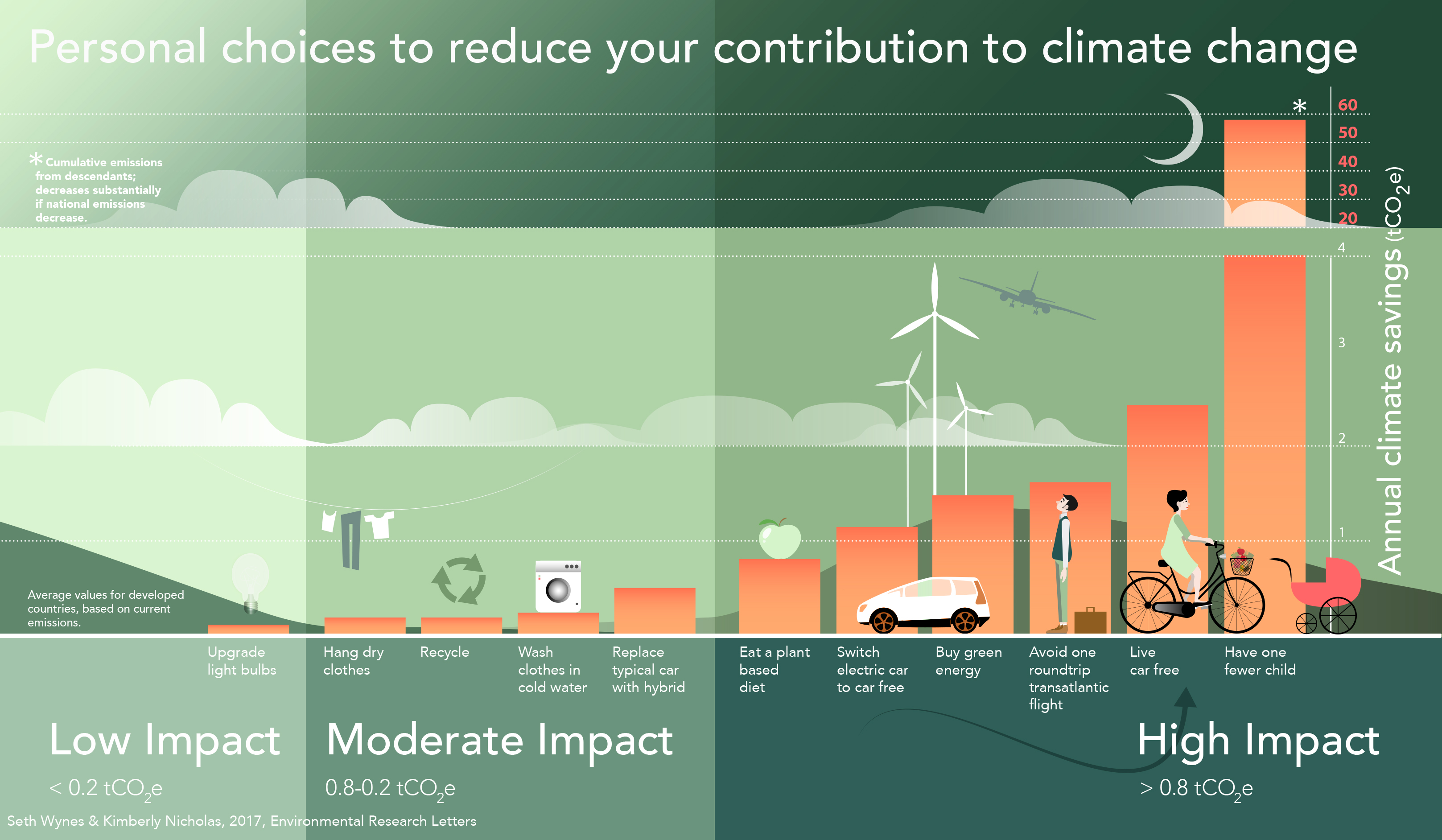
One 2017 study co-authored by Lund University’s Nicholas ranked 148 individual actions on climate change according to their impact. Going car-free was the number-one most effective action an individual could take (except not having kids – but more on that on that later). Cars are more polluting compared to other means of transportation like walking, biking or using public transport.
One ranking found that going car-free is the most effective action one person can take (Credit: Getty)
In industrialised countries such as European nations, getting rid of your car can reduce 2.5 tonnes of CO2 – about one-fourth of the average yearly emissions (9.2 tonnes) contributed by each person in developed countries of the Organisation for Economic Co-operation and Development (OECD).
“We should choose more efficient vehicles and, whenever possible, switch directly to electric vehicles,” says Maria Virginia Vilarino, co-author of the mitigation chapter in the IPCC’s latest report.

4. But isn’t renewable energy extremely expensive?
Actually, renewables like wind and solar are becoming increasingly cheap across the world (although final costs are subject to local circumstances). The latest report from the International Renewable Energy Agency (Irena) found that several of the most commonly used renewables, like solar, geothermal, bioenergy, hydropower and onshore wind, will be on par with or cheaper than fossil fuels by 2020. Some are already more cost-effective.
Solar energy is now the cheapest source of electricity for many households in Latin America, Asia and Africa (Credit: Getty)
The cost of utility-scale solar panels has fallen 73% since 2010, for example, making solar energy the cheapest source of electricity for many households in Latin America, Asia and Africa.  In the UK, onshore wind and solar are competitive with gas and by 2025 will be the cheapest source of electricity generation.
Some critics argue that these prices disregard the price of integrating renewables on the electricity system – but recent evidence suggests these costs are ‘modest’ and manageable for the grid.

5. Could I make a difference by changing my diet?
That’s a big one, too. In fact, after fossil fuels, the food industry – and in particular the meat and dairy sector – is one of the most important contributors to climate change. If cattle were their own nation, they would be the world’s third largest emitter of greenhouse gases, after China and the US.
If cattle were their own nation, they’d be the world’s third largest emitter of greenhouse gases (Credit: Getty)
The meat industry contributes to global warming in three major ways. Firstly, cows’ burping from processing food releases lots of methane, a greenhouse gas. Secondly, we feed them with other potential sources of food, like maize and soy, which makes for a very inefficient process. And finally, they also require lots of water, fertilisers that can release greenhouse gases, and plenty of land – some of which come from cleared forests, another source of carbon emissions.   
By reducing your consumption of animal protein by half, you can cut your carbon footprint by more than 40%
You don’t have to go vegetarian or vegan to make a difference: cut down gradually and become a ‘flexitarian’. By reducing your consumption of animal protein by half, you can cut your carbon footprint by more than 40%. A larger-scale approach could be something like banning meat across an organisation, as office-sharing company WeWork did in 2018.
This explainer of sustainable diets by the World Resources Institute (WIR) and its longer associated report provides more answers to questions about food and carbon emissions.

6. How harmful are my flying habits?
Planes run on fossil fuels, and we haven’t figured out a scaleable alternative. Although some early efforts to use solar panels to fly around the world have had success, we are still decades away from commercial flights running on solar energy.
A normal transatlantic flight can release around 1.6 tonnes of CO2 – almost as much as the average yearly emissions of one person in India.
A normal transatlantic flight can release around 1.6 tonnes of CO2, according to Nicholas’s study – almost as much as the average yearly emissions of one person in India. This also highlights the inequality of climate change: while everyone will be affected, only a minority of humans fly and even fewer people take planes often.
There are groups of scientists and members of the public who have decided to give up flying or who fly less. Virtual meetings, holidaying in local destinations or using trains instead of planes all are ways to cut down.
Wondering how much your travel contributes to climate change? Measure your carbon emissions in this calculator by the International Civil Aviation Organization (ICAO).

7. Should I be shopping differently?
Most likely. That’s because everything we buy has a carbon footprint, either in the way it is produced or in how it is transported.
For instance, the clothing sector represents around 3% of the world’s global production emissions of CO2, mostly because of the use of energy to produce attire. The hectic pace of fast fashion contributes to this figure as clothes are discarded or fall apart after short periods.
The clothing sector makes up about 3% of the world’s CO2 emissions (Credit: Getty)
International transport, including maritime and air shipping, also has an impact. Groceries shipped from Chile and Australia to Europe, or the other way around, have more ‘food miles’ and usually a higher footprint than local produce. But this is not always the case, as some countries grow out-of-season crops in energy-intensive greenhouses – so the best approach is to eat food that is both locally grown and seasonal. Even so, eating vegetarian still beats only purchasing local.

8. Should I think about how many children I have (or don’t have)?
Nicholas’s study concluded that having fewer children is the best way to reduce your contribution to climate change, with almost 60 tonnes of CO2 avoided per year. But this result has been contentious – and it leads to other questions.
One is whether you are responsible for children’s climate emissions, and the other is where are these babies born.
If you are responsible for your kids’ emissions, are your parents responsible for yours? And if you are not, how should we consider the fact that more people will likely have more carbon emissions? We also could ask whether having offspring is a human right beyond questioning. And we could ask if having children is necessarily a bad thing for solving climate change: our challenges may mean we will need more problem-solvers in future generations, not fewer.
Those are hard, philosophical questions – and we’re not going to try to answer them here.
Children lead to more CO2 emissions – but they may also be future environmentally-minded problem-solvers (Credit: Getty)
What we do know is that no two people have the same emissions. Although the average human releases around 5 tonnes of CO2 per year, each country has very different circumstances: developed nations like the US and South Korea have higher national averages (16.5 tonnes and 11.5 tonnes per person, respectively) than developing countries like Pakistan and Philippines (around 1 tonne each). Even within national borders, richer people have higher emissions than people with less access to goods and services. So if you choose to take this question into account, you have to remember that it’s not just about how many children you have – it’s where (and who) you are.

9. But if I eat less meat or take fewer flights, that’s just me – how much of a difference can that really make?
Actually, it’s not just you. Social scientists have found that when one person makes a sustainability-oriented decision, other people do too.
Here are four examples:
Social scientists believe this occurs because we constantly evaluate what our peers are doing and we adjust our beliefs and actions accordingly. When people see their neighbours taking environmental action, like conserving energy, they infer that people like them also value sustainability and feel more compelled to act.

10. What if I just can’t avoid that flight, or cut down on driving?
If you simply can’t make every change that’s needed, consider offsetting your emissions with a trusted green project – not a ‘get out of jail free card’, but another resource in your toolbox to compensate that unavoidable flight or car trip. The UN Climate Convention keeps a portfolio of dozens of projects around the world you can contribute to. To find out how many emissions you need to ‘buy’ back, you can use its handy carbon footprint calculator.
Whether you are a coffee farmer in Colombia or a homeowner in California, climate change will have an impact on your life. But the opposite is also true: your actions will influence the planet for the coming decades – for better or for worse.

Links

04/11/2018

‘You’re Much More Powerful Than You Think’: How You Can Combat Climate Change

Australian Geographic -  Isabella Lamshed

It’s easy to feel overwhelmed following the release of the IPCC report, but we spoke with climate change activist Anna Rose about some of the effective ways you can help.
The Intergovernmental Panel on Climate Change released a report on the impacts of global warming, which found that we have only 12 years left to limit the Earth’s rising temperature to a maximum of 1.5°C. IMAGE CREDIT: Shutterstock 
THE WORLD’S leading scientists have warned that urgent action is required to minimise the damaging risks of climate change before it’s too late.
The Intergovernmental Panel on Climate Change released a report on the impacts of global warming, which found that we have only 12 years left to limit the Earth’s rising temperature to a maximum of 1.5°C, or we’ll see catastrophic impacts such as worsening droughts, more severe floods, mass extinction and devastating heatwaves.
The urgency of the message in this report is clear – we need to act now. But for many of us, this can be an overwhelming thought. How can we, as individuals, have any real impact on climate change?
Anna Rose, co-founder of the Australian Youth Climate Coalition, Strategic Campaign Manager for Farmers for Climate Action, and self-proclaimed ‘professional greenie’, says every single person is vital in the fight for climate justice.

Anna’s climate story
Anna Rose, who was awarded Australian Geographic Conservationist of the Year in 2014, is an expert in individual action to inspire collective change, and her experiences in environmental activism started at a young age.
Growing up with grandparents on a drought-stricken farm in north-western NSW taught her the basics about climate change, and from there her interest grew. “I realised that climate change wasn’t just an issue about polar bears, it was about people, and rural communities that I had been lucky enough to spend so much time in as a kid,” she says.
By the time Anna had finished Year 12, she’d already helped coordinate a joint campaign with the Worimi Traditional Owners of the NSW mid-north coast and the Wilderness Society, which successfully prevented international mining giant, BHP, from building a new mine on Aboriginal land.
This was paramount to Anna’s story, as the campaign showed her “that we live in a country where it is possible for change to come from the bottom up, not just the top down,” she says.
Between becoming the National Environment Officer with the National Union of Students during her time at university, setting up the largest youth climate movement Australia has ever seen, the AYCC, and playing a pivotal role in turning Earth Hour into an internationally celebrated movement, Anna has developed a wealth of knowledge when it comes to climate action.

“Start where you are”
Anna believes that anyone can work to make a difference to climate change just as she did, and one of her biggest tips is to “start where you are”.
“I was in school, so I set up an environment group in my school. Then I was at university, so I formed a group and we launched a campaign calling for the university to do more on climate change.”
Looking at what’s around you and making the most of your existing relationships and communities can be a powerful first step. “We are much more powerful than we think,” Anna says.


Young People Changing the World - Australia

Use your social power
Many people, according to Anna, don’t realise the influence they have on the people around them. “We know from research that the second most trusted messenger on climate change is people’s friends and family – second only to climate scientists. So having those conversations even when it feels awkward is so important,” she says.
Anna urges us to do this in every situation, even suggesting bringing up the weather at a barbeque to make a subtle segue onto the topic of climate. Conversations like this could be monumental in changing how people think about climate change.
“We have to talk about it,” she says. “It’s here, it’s urgent. We can’t not talk about this anymore.”
Talking about climate change can sometimes be difficult, but Anna says we have to start with the solutions.
“The climate problems are big and overwhelming, but a lot of people don’t understand that we already have the solutions. Who wants to talk about a problem, if they think there’s no solution? So start with the solutions, and I find it’s much easier.”

Use your political power
Anna advises to not be disheartened by politics, but instead to actively engage in it. Call your MP, send them a message, talk to your local council and “just call to have a chat about the environment, and tell them that you care,” Anna says.
“You don’t have to know all the facts, but letting them know what you think is a hugely important thing that you can do, because they represent us at the end of the day.”

Use your consumer power
In the same way that you can vote for who you want in parliament, you can use your dollar to vote for what products you want to see in the market. “Make sure you’re not buying stuff you don’t need, and where you are buying things that you do need, choose more responsible products.”
Ethically made, sustainably sourced and locally produced products are where we should be investing our cash, according to Anna. “Support your local farmers and get your fruits and veggies from the local farmers markets,” she says. But Anna cautions us to look at our consumption in all aspects of our life, not just at the supermarket.
“We should all be thinking about things like superannuation and banking – are yours fossil free? Your toilet paper – is it sustainable?” There are many alternatives out there that invest your money in environmentally and socially positive projects.
Anna suggests being aware of your media consumption, too. “Try to engage in media from places that are putting out important and accurate stories on the climate and environment, and share those stories with your family, friends and around the workplace,” she says.
By the time Anna had finished Year 12, she’d already helped coordinate a joint campaign with the Worimi Traditional Owners of the NSW mid-north coast and the Wilderness Society.
Use your employee power
We spend a large majority of our waking hours in our place of employment, which Anna says is a great place to kick-start some environmental action and awareness amongst your peers. “It comes back to that idea of starting where you are.
“Think about what you can do in your workplace to take action on climate change, or what your place of employment can do. That might be in the supply chains or through what the company purchases, what they invest in, or whether they use renewables.”
Aside from largescale production changes, Anna says there are “so many little things you can do.” If you work in a café, you can put up a sign saying “we support climate action”, or incentivising the use of reusable cups. “Workplaces are such a powerful space for change,” Anna says.

Remaining positive
Despite the confronting news from the recent report about the state of our planet, it’s important to remain positive.
“[Climate action] is the biggest movement in human history, and being part of that and seeing how much progress people are making every day gives me the courage and determination to keep going, and allows me to remain hopeful for the future,” she says.
“We need legislative action, we need cultural change, but we also need individuals. And that’s one of the first steps.”

Links

Former UN Climate Chief Says World Doesn't Need Australia's 'Toxic' Coal

Fairfax - Nicole Hasham

Former United Nations climate chief Christiana Figueres has repudiated Australian mining giant BHP for its refusal to stop mining coal, suggesting the decision is uneconomic and poor nations do not need the “toxic” and “expensive” fossil fuel.
BHP chief executive Andrew Mackenzie said this week the company is “not going to move away from coal mining”.
BHP Billiton chief executive Andrew Mackenzie says the company will continue to mine coal, despite climate change concerns.
His position comes despite a warning last month by the Intergovernmental Panel on Climate Change that coal must be virtually phased out by 2050 if the world is to keep global warming below the 1.5 degree threshold, beyond which the effects of climate change would be catastrophic and, in many cases, irreversible.
Addressing shareholders on Thursday, Mr Mackenzie said BHP had a moral obligation to combat climate change, but the developing world needed coal to lift citizens out of poverty.
“For many countries in the world, coal is still their cheapest source of energy, their most reliable source of energy,” he said.
“To deny them that right away would run the risk of actually plunging them ... into poverty or preventing them from ever lifting themselves out of poverty or even getting onto the grid.”
Mr Mackenzie said BHP “will not be emitting any additional molecule of CO2 into the atmosphere from 2050 onwards”. This would occur by using low- or zero-emissions power in its operations, supporting reforestation and wilderness preservation and “just making everything much more efficient”.
In response to the comments, Ms Figueres, the former executive secretary of the United Nations Framework Convention on Climate Change, said poorer nations did not need Australia’s coal.
“Developing nations will unlock the solutions to poverty with renewable energy. Not with toxic, expensive coal,” she said.
Former UN climate chief Christiana Figueres says the developing world does not need Australia's "toxic, expensive" coal. Credit: Reuters
Solar and wind power were already cheaper than fossil fuels in many markets and “renewable energy will out-compete fossil fuels everywhere by 2020”, she said, adding that investors were “withdrawing from coal on all fronts”.
The World Bank, among other financiers, has largely ruled out funding new coal plants. It says coal contributes to poverty through air pollution, which causes illness, and climate change, to which the poor are particularly vulnerable.
Ms Figueres, who led the Paris climate talks in 2015, said as well as the health impacts, global warming was hurting the environment and “contributing to the die-off of the beloved Great Barrier Reef”.
BHP mostly mines coking coal used to make steel and iron. It also mines thermal coal, which is burned for electricity. This includes the large Mount Arthur mine in NSW, and a major stake in Colombia’s Cerrejon mine where a massive expansion is proposed.
Mr Mackenzie said there was “no real alternative” to coking coal, which produces significant emissions when used to make steel. This meant those emissions must be cut through carbon capture and storage, in which BHP is investing, he said.
BHP boss Andrew Mackenzie says the company is committed to becoming carbon neutral by 2050. Credit: Bloomberg
Veteran physicist and climate scientist Bill Hare, founder of international think tank Climate Analytics, said renewable hydrogen could replace coal in steel production.
Such use of hydrogen is at the experimental stage, however, the capture and storage of carbon is also unproven at large scale.
“By backing coal only weeks after the world scientific community has spoken on the urgent need to phase this out, [BHP] is turning its back on the future,” Dr Hare said, adding that claims coal was needed to overcome poverty was “a denial of science”.
Meantime, the ACT is nearing its goal of sourcing all electricity from renewable sources by 2020.
The Crookwell 2 wind farm, near Goulburn, has begun feeding electricity into the grid and is expected to produce enough electricity to power about 42,000 Canberra homes.
Federal Energy Minister Angus Taylor, who has campaigned against wind farms, did not attend a launch event on Saturday despite the project being located in his electorate. A spokesman said Mr Taylor had a “prior engagement”.
ACT Climate Change Minister Shane Rattenbury said the wind farm was “a key milestone as we progress towards our ambitious clean-energy future” and would provide significant flow-on benefits to the region.

Links

The Study Of Earth As An Integrated System

NASA

Extreme Ultraviolet Imaging telescope (EIT) image of the sun with a huge, handle-shaped prominence, taken in 1999. Solar radiation is a primary driver of climate.
Earth system science is the study of how scientific data stemming from various fields of research, such as the atmosphere, oceans, land ice and others, fit together to form the current picture of our planet as a whole, including its changing climate.
Climate scientists separate factors that affect climate change into three categories: forcings, feedbacks, and tipping points.

Forcings: The initial drivers of climate.
  1. Solar Irradiance. Solar radiation is the source of heat for planet Earth. Scientists also use evidence from proxy measurements, such as sunspot counts going back centuries and ancient tree rings, to measure the amount of sun that reaches Earth’s surface. The sun has an 11-year sun spot cycle, which causes about 0.1% of the variation in the sun’s output.1 The solar cycle is incorporated into climate models.

  2. Greenhouse gas emissions. Since the industrial revolution, concentrations of greenhouse gases such as carbon dioxide (CO2), methane (CH4), and nitrous oxide (N2O) have risen in the atmosphere. Burning fossil fuels such as coal, oil and gas has increased the concentration of atmospheric carbon dioxide (CO2) from 280 parts per million to 393 parts per million.2 These greenhouse gases absorb and then re-radiate heat in Earth’s atmosphere, which causes increased warming.

  3. Aerosols, dust, smoke, and soot. Very small airborne particles come from both human and natural sources and have various effects on climate. Sulfate aerosols, which result from burning coal, biomass, and volcanic eruptions, tend to cool the Earth. Other kinds of particles such as black carbon have a warming effect.3 The global distribution of aerosols is being tracked from the ground and from satellites.
Climate feedbacks: processes that can either amplify or diminish the effects of climate forcings. A feedback that increases an initial warming is called a "positive feedback." A feedback that reduces an initial warming is a "negative feedback."
  1. Clouds. Clouds have an enormous impact on Earth's climate, reflecting about one third of the total amount of sunlight that hits the Earth's atmosphere back into space. Even small changes in cloud amount, location and type could have large consequences. A warmer climate could cause more water to be held in the atmosphere leading to an increase in cloudiness and altering the amount of sunlight that reaches the surface of the Earth. Less heat would get absorbed, which could slow the increased warming.

  2. Precipitation. Global climate models show that precipitation will generally increase due to the increased amount of water held in a warmer atmosphere, but not in all regions. Some regions will dry out instead. Changes in precipitation patterns, such as increased water availability, may cause an increase in plant growth, which in turn could potentially removing more carbon dioxide from the atmosphere.

  3. Greening of the forests. Natural processes, such as tree growth, remove about half of human carbon dioxide emissions from the atmosphere every year. Scientists are currently studying where this carbon dioxide goes. The delicate balance between the absorption and release of carbon dioxide by the oceans and the world’s great forested regions is the subject of research by many scientists. There is some evidence that the ability of the oceans or forests to continue absorbing carbon dioxide may decline as the world warms, leading to faster accumulation in the atmosphere.

  4. Ice albedo. Ice is white and very reflective, in contrast to the ocean surface, which is dark and absorbs heat faster. As the atmosphere warms and sea ice melts, the darker ocean absorbs more heat, causes more ice to melt, and makes the Earth warmer overall. The ice-albedo feedback is a very strong positive feedback.
Climate tipping points: When Earth’s climate abruptly moves between relatively stable states.
  1. Ocean circulation. As Arctic sea ice and the Greenland ice sheet melt, ocean circulation in the Atlantic may divert the Gulf Stream. This and/or other changes would significantly change regional weather patterns. A change in the Gulf Stream could lead to a significant cooling in Western Europe. This highlights the importance of ocean circulation in maintaining regional climates.

  2. Ice loss. Due to the strong positive feedback of the ice albedo, if enough ice melts, causing Earth’s surface to absorb more and more heat, then we may hit a point of no return. Shrinking ice sheets contribute to sea level rise. Many hundreds of millions of people live near a coast, so our ability to predict sea level rise over the next century has substantial human and economic ramifications.

  3. Rapid release of methane. Deposits of frozen methane, a potent greenhouse gas, and carbon dioxide lie beneath permafrost in Arctic regions. About a quarter of the Northern hemisphere is covered by permafrost. As the environment warms and the permafrost thaws, these deposits can be released into the atmosphere and present a risk of runaway warming.4
Footnotes
  1. Claus Frohlich and Judith Lean, “Solar radiative output and its variability: evidence and mechanisms,” The Astronomy and Astrophysics Review, 2004, doi:10.1007/s00159-004-0024-1. 
  2. Trends in Atmospheric Carbon Dioxide, National Oceanic & Atmospheric Administration, 2013. http://www.esrl.noaa.gov/gmd/ccgg/trends/
  3. NASA's Earth Observatory, "Aerosols: Tiny Particles, Big Impact," 1999. 
  4. A. Vaks et al, "Speleotherms Reveal 500,000-Year History of Siberian Permafrost," Science, April 12, 2013: Vol. 340 no. 6129 pp. 183-186, doi: 10.1126/science.1228729
Links

How The Fossil Fuels Industry Taxes Us To Death — Literally

Independent Australia - 

The Government has prioritised economically supporting the fossil fuels industry instead of tackling urgent climate change issues.
Pollution kills 9 million people annually yet our Government still won't act. (Image via Flickr)

AUSTRALIA'S CLIMATE CHANGE culture war is a hideous spectacle. Despite the obvious reality of human-caused climate change and the urgent need to act, the powerful fossil fuels industry (FFI) has captured the Coalition Government to wring the last dollar of profit from their soon-to-be stranded assets.
The Coalition has proudly undone policies designed to mitigate climate change, notably in scrapping the carbon pricing scheme and reducing the federal Renewables Energy Target (RET). These government actions were driven by willful ignorance, lavish campaign contributions and the persistent revolving door between government and industry delivering financial reward and influence to those eager to act against the common good.
One conservative ideological obsession is the incessant complaining about subsidies to the renewable energy sector. Such support is provided by federal and state RET programs, about $2.5 billion annually for investment by the Clean Energy Finance Corporation (CEFC) and Australian Renewable Energy Agency (ARENA), and various initiatives by state governments.
Yet the same ideologues who stridently oppose renewable energy subsidies remain silent or actively rent-seek for more support to the FFI. Research demonstrates that FFI subsidies tower over those received by renewables.

IMAGE
Link

Negative externalities
Externalities are a cost or benefit imposed upon third parties who were not party to the transaction that generated the cost or benefit. The FFI generates negative externalities in pollution costs though few see how pervasive these are.
There have been numerous studies published, typically in developed nations, attempting to estimate just how widespread the costs have become.
The following lists some of the research:
  • Globally, the FFI has looted an average US$12.7tn (1995-2013) to US$27tn (1959-2013), rising to an upper range of US$115.5tn (1995-2013) to US$246.1tn (1959-2013);
  • The single largest global externality arises from coal power generation and, in aggregate, all externalities equated to US$7.3tn or 13 per cent of global GDP in 2009;
  • The cost of coal in the U.S. conservatively doubles to triples the price of electricity from coal per kWh generated;
  • The U.S. EPA’s estimate of the social cost of carbon of US$37 per ton was found to be a gross underestimate and instead ought to be closer to US$220, demonstrating the costs are many times larger;
  • If FFI externalities were internalised, a gallon (3.8 litres) of petrol would cost an extra US$3.8, US$4.8 for diesel and electricity generated from coal would rise US24c per kWh and US11c for gas;
  • The total social cost of a gallon of petrol was estimated in a 1998 report at between US$5.60 and US$15.14, rather than the then market price of US$1;
  • Energy subsidies reached US$5.3tn or 6.5 per cent of GDP globally in 2015, with coal accounting for the largest portion;
  • A summary of 63 external cost estimates demonstrates coal, oil and gas have the largest maximum, mean and median costs in terms of cents per kWh generated;
  • The health costs arising from air pollution stemming primarily from the FFI in Australia has been estimated from $11.1bn to $24.3bn;
  • The cost of deaths from air pollution, mostly generated from coal and oil consumption, was estimated at US$1.5tn in OECD nations in 2010 and US$5.8bn in Australia;
  • The cost of air pollution in the Greater Sydney area was estimated at a midpoint of $4.7bn annually between 2000-2002; and
  • Australia’s energy sector receives a carbon subsidy of between $14bn to $39bn annually, with the electricity industry accounting for between $7bn to $20bn.
There is no time series available demonstrating the ongoing negative externalities arising from the consumption of gas and black and brown coal in the generation of electricity nationwide, so I’ve developed a general estimate. This report calculates that greenhouse and health care costs amount to $52/MWh for brown coal, $42/MWh for black coal and $19/MWh for gas in Australia. In 2017, these costs amounted to $8.2bn for electricity generation alone.
This estimate likely understates the true cost, especially for gas, given numerous other issues not considered. These consist of groundwater pollution, permanent changes in groundwater pressures, risks of desertification of large inland areas within a couple of decades, fugitive emissions and, worst of all, the toxic by-product of contaminated salt.


Tax concessions
Australia’s tax concessions (tax expenditures) for the FFI are enormous, estimated at $11bn for 2018, sourced from Federal Government budget papers. This does not include state-based royalty holidays. As the IMF argued correctly, tax concessions compromise fairness, tend to be inefficient and poorly targeted and are vulnerable to industry lobbying.
Given Australia offers the largest tax concessions relative to GDP in the OECD and the FFI already benefits enormously from polluting without limit, no argument can be mounted to support them. Further, the nation has lost around $90bn in rent resource taxes from the oil and gas industries.

Miscellaneous subsidies
There are numerous other supports provided to the FFI. These mainly involve Federal and State Government assistance via infrastructure, capital investment and research support. The Export Finance and Insurance Corporation (EFIC) also aids the expansion of the FFI.
Not well known is the condition for licencing new coal mines, including expansions, is that such mines are obliged by government to provide their output to coal-fired generators at prices far below export rates. Otherwise, generators would have to purchase coal at current export rates, sharply increasing costs and rendering the plants unprofitable.
Although the FFI have made stupendous profits, corporate owners have often refused to or only partially funded the cost of rehabilitating abandoned and exhausted coal mines, leaving extensive damage to the surrounding environment (another negative externality). Just filling the holes and craters from mining is estimated at a conservative $18bn. Taxpayers will have to foot the bill for rehabilitation or tolerate toxic sites and landscape scars of staggering size.
To date, there has been insufficient research to know the full extent of these miscellaneous subsidies, though they no doubt amount to many billions of dollars annually.

IMAGE
Link

Private taxes are enormous
One of the greatest deceptions imposed upon us is the pretence that taxes are levied only by government. As I’ve explained elsewhere, capitalist markets impose their own form of taxation and hence wealth and income redistribution.
These market-imposed taxes should be called private taxes, for obvious reasons. Clearly, negative externalities are a form of private tax, as people unwillingly bear these costs which benefit those who own and control the FFI.
Unlike public taxes which are measured to the dollar for as far back as the 18th century and are subject to endless research and commentary, private taxes like external costs are simply ignored. This suits polluters and free-riders just fine.
While the framework of mainstream neoclassical economics is technically capable of understanding and calculating private taxation, the real problem arises in recognising the sheer extent of the problem.
In the early 1970s, U.S. economist E.K. Hunt challenged the reigning orthodoxy by explaining that the general assumption of efficient markets is unlikely to hold given the presence of catastrophic deluges of externalities. Hunt argued that the profit motive provided every incentive to externalise costs, which meant capitalist economies would be suffocated by externalities. Here, he accurately inverts the famous maxim of Adam Smith:
Every individual necessarily labours to render the annual external costs of the society as great as he can. He generally, indeed, neither intends to promote the public misery nor knows how much he is promoting it. He intends only his own gain and he is in this, as in many other cases, led by an invisible foot to promote an end which was no part of his intention. Nor is it any better for society that it was no part of it. By pursuing his own interest he frequently promotes social misery more effectually than when he really intends to promote it.
His analysis was further refined by U.S. economists Michael Albert and Robin Hahnel in their book Quiet Revolution In Welfare Economics. They argue that ‘in postfeudal history, a plausible case can be made that no economic failure has contributed more to the waste of productive resources than misallocations of markets uncorrected for external effects.’
Hunt, Albert and Hahnel argued that externalities were one of the major flaws of capitalism, though it did not revolve around a handful of large polluters. Instead, billions of individuals and firms each emit a small externality (such as a daily car trip). While individually rational, the aggregate of these billions of small externalities is a social and ecological disaster.
Their research may sound like an exaggeration if not for climate change, which, given its adverse effects, is arguably the largest private tax in history (the privatisation of land rent is a potential contender). Poisoning of the oceans, resource depletion and widespread banking and financial risks are other major uncorrected externalities.
The evidence demonstrates millions of lives and billions of livelihoods are imperilled by climate change, stemming from the inefficiencies and rational insanity of capitalist markets and the FFI. No other economic system in history has threatened the planet with global environmental ecocide. Pollution kills 9 million people annually, which every 11 years equals the highest estimate for the numbers who died under communism.

IMAGE

Enter the conservative nanny state
Cost externalisation is a policy favoured by the corporate elite to internalise the benefits while externalising costs onto others. The political oligarchy ensures the public has limited to non-existent political representation to defend themselves against the onslaught of private taxation.
Conservative forces such as the Coalition and IPA claim to support lower taxes — a form of deliberate deception. Their agenda is to reduce public taxes to make room for private taxes, which explains their visceral attacks on the carbon pricing scheme. Extensive redistribution and taxation are considered perfectly acceptable when the corporate sector engages in it, legally stealing with impunity.
In addition to making super-profits by levying enormous private taxes, the highly-concentrated oligopolistic FFI pays little or no corporate income tax, as revealed by investigative journalist Michael West. This is achieved through financial engineering using trusts, tax-free havens, loopholes and a severe lack of transparency.
Not to be outdone, the Coalition wants to subsidise the construction of new coal power plants and indemnify these plants against future carbon-related liabilities. The Government has suggested policies that pervert decent ACCC recommendations to benefit some of the most powerful FFI corporations.

Conclusion
There is no need for a single cent of support for renewables if the subsidies to the FFI are removed. Electricity prices from coal and gas generation would rapidly become prohibitively expensive if the total social costs imposed were fully reflected in market prices.
Pricing externalities into oil derivatives like petrol, diesel and kerosene would also cause internal-combustion vehicle usage costs to skyrocket. We would see a staggering investment shift into renewables (far greater than what is currently occurring) and the FFI exposed as an economic fraud.
The evidence shows the FFI would not exist if not for its ability to loot via cost externalisation. FFI profits are therefore maintained by levying enormous widespread private taxes upon the public, the environment and future generations.
The FFI has done untold damage while incessantly rent-seeking and lying to maintain illegitimate privileges. No other industry threatens our welfare as does the FFI, which perfectly illustrates the rational insanity promoted by unfettered capitalist markets.
Despite the hold the FFI has upon a bankrupt and authoritarian system of political oligarchy, the FFI is destined to die a much-deserved death. Research by Stanford academic Tony Seba and futurist Ramez Naam demonstrates that solar PV, wind, battery storage and autonomous electric vehicles are exponential, disruptive technologies that will transform economies rapidly during the 2020s to be almost entirely renewable by 2030.


Clean Disruption of Energy and Transportation


Foundation In Exponentials: Energy

Links

Supreme Court Refuses To Block Young People’s Climate Lawsuit Against U.S. Government

Washington Post - Robert Barnes | Brady Dennis

Willamette University student Arabella Wood, right, rallies with others in Eugene, Ore., on Oct. 29, 2018, to support a climate change lawsuit brought by 21 young people against the federal government in 2015. On Nov. 2, the U.S. Supreme Court refused a federal government request to disallow the lawsuit. (Andy Nelson/AP)
The Supreme Court on Friday night refused to halt a novel lawsuit filed by young Americans that attempts to force the federal government to take action on climate change, turning down a request from the Trump administration to stop it before trial.
The suit, filed in 2015 by 21 young people who argue that the failure of government leaders to combat climate change violates their constitutional right to a clean environment, is before a federal judge in Oregon. It had been delayed while the Supreme Court considered the emergency request from the government.
Justices Clarence Thomas and Neil M. Gorsuch would have stopped the suit. The other justices did not indicate how they voted on the government’s request.
The court’s three-page order said the government should seek relief from the U.S. Court of Appeals for the 9th Circuit. It noted the government’s assertion that the “suit is based on an assortment of unprecedented legal theories, such as a substantive due process right to certain climate conditions, and an equal protection right to live in the same climate as enjoyed by prior generations.”
The justices acknowledged that the 9th Circuit had previously turned down the government but said those decisions came when there was a “likelihood that plaintiffs’ claims would narrow as the case progressed.” That no longer seems the case, the unsigned opinion said, suggesting the possibility that the 9th Circuit might see things differently now.
And it left open the possibility that the government could return to the Supreme Court.


The United Nations panel on climate issued a report warning of unprecedented temperature rise between 2030 and 2052 if global warming continues. (Reuters)

The goal of the lawsuit is to compel the government to scale back its support for fossil fuel extraction and production and to support policies aimed at reducing the greenhouse gas emissions that contribute to global warming.
“We’ve been confident throughout this case that we would get to trial, and I believe we will get to trial,” Julia Olson, the attorney for the youths and executive director of Our Children’s Trust, said in an interview with The Washington Post on Friday evening. “We have overcome everything the government has thrown at us. It is not luck. It is the strength of the case and the strength of the evidence and the strength of the legal arguments we are making.”
The Obama and Trump administrations had repeatedly asked lower courts to dismiss the lawsuit, questioning its merits, saying discovery requests were “burdensome” and arguing that the suit would usurp the authorities of Congress and federal agencies.
The plaintiffs “seek nothing less than a complete transformation of the American energy system — including the abandonment of fossil fuels — ordered by a single district court at the behest of ‘twenty-one children and youth,’ ” Solicitor General Noel J. Francisco wrote in a brief to the Supreme Court.
“As the government has maintained since first moving to dismiss this suit in 2016, [the] assertion of sweeping new fundamental rights to certain climate conditions has no basis in the nation’s history and tradition — and no place in federal court.”
Francisco acknowledged that he was asking for “extraordinary relief” by asking the high court to intervene before a trial began. But he said the unique nature of the lawsuit deserved such an exception.
If the long trial were allowed to proceed, “it could well be years into the future” before the government could “seek relief from such an egregious abuse of the civil litigation process and violation of the separation of powers.”
The government has made similar arguments in lower courts, but time and again, judges allowed the case to proceed. The government also went to the Supreme Court this summer seeking a stay, but the court in an unsigned opinion called the request “premature.”
In a 103-page filing this week intended to keep the trial on track, the plaintiffs argued that the Trump administration would not suffer “irreparable” harm in having to go through with the case.
“This case clearly poses profoundly important constitutional questions, including questions about individual liberty and standing, the answers to which depend upon the full evaluation of evidence at trial,” the lawyers wrote, adding: “These young plaintiffs, mere children and youth, are already suffering irreparable harm which worsens as each day passes with more carbon dioxide accumulating in the atmosphere and oceans.”
The young activists also used the chance to once again demand that the courts compel the government to “cease their violation of plaintiffs’ rights, prepare an accounting of the nation’s greenhouse gas emissions, and prepare and implement an enforceable national remedial plan to cease the constitutional violations by phasing out fossil fuel emissions and drawing down atmospheric CO2.”
Olson said the youth plaintiffs were filing a request with the district court in Oregon for a hearing soon in hopes of moving toward the long-awaited trial.
Officials at the Department of Justice could not be reached immediately for comment Friday.

Links

03/11/2018

Instead Of 'Fair Dinkum' Power, How About Some 'Fair Dinkum' Action?

The Guardian - 

Labor was lashed for doing something about carbon emissions; the Coalition is being lambasted for doing nothing
Former Labor minister Greg Combet says if the world is to do what is necessary to contain warming at 2C, then almost all coal-fired power will be gone by 2040. Photograph: Julian Smith/AAP 
Seven years ago, Greg Combet, then a Labor minister, implemented a carbon price in a minority parliament, an experience so arduous it helped curtail his political career. Now, safely outside political life, he looks on with bemusement about where the climate and energy debate has washed up.
On Tuesday, Combet launched a new report by the Industrial Relations Research Centre at the University of New South Wales investigating how countries such as Australia can achieve a fair transition for coal workers displaced as the economy decarbonises.
It got a bit lost in the wash of the week – let’s face it, it’s hard for substance to compete with the rolling spectacle of political dysfunction – but it’s an interesting bit of analysis funded by the CFMEU’s mining and energy division.
In 2011 Combet had to fight almost everyone in the country to get the clean energy package legislated. Business was hostile. The energy sector was hostile. Barnaby Joyce was screeching apocalyptically about $100 lamb roasts.
But while Combet’s experience was everyone shouting at him for doing something, we’ve now come full circle. Now, all the shouting is about the current government doing nothing.
Business and energy retailers are on the frontline of increasingly frantic calls for policy certainty. The Gillard government would have killed for the conditions the Coalition has blown away over the last three years with reckless abandon.
In any case, Combet ventured out this week about the future of coal. He insists the outlook is clear. If the world, and specifically Australia, is to do what is necessary to contain warming at 2C, then almost all coal-fired power will be gone by 2040. “That’s only 22 years away,” he tells Guardian Australia. “The energy companies get it. This is very much front of mind for the asset holders, and they want rational policy. They aren’t fighting it anymore. They don’t want stranded assets.”
A hands off approach has left many retrenched workers and their communities with very difficult transition problems
He says the energy market is going to transition “whether or not we’ve got Scott Morrison at the helm” and government owes it to people who will be materially affected in the transition to play it straight.
“Workers in coal power stations need to know the truth. You really have to tell people the truth about structural change when it’s coming – you can’t be populist about it”.
Earlier this year I asked the resources minister Matt Canavan whether he felt an obligation to help Australian communities face up to the inevitability of a carbon-constrained future. He responded as if I’d committed a thought crime.
Labor, for its part, is putting a package of measures together. It’s likely to include a new statutory authority to oversee the transition and the programs intended to ameliorate it; specific industrial relations arrangements to ensure workers are managed through the process; and programs to drive economic diversification.
Labor took a policy on coal transition to the last federal election, but it has to be re-engineered in some respects to take into account lessons learned from the closure of the Hazelwood plant, and also to reference the requirements of the reliability obligation in the national energy guarantee.
Scott Morrison dumped the emissions reduction component of the Neg – it was a casualty of the Liberal leadership implosion – but Labor is likely to keep the policy with its own tweaks. A Labor Neg will have a higher emissions reduction target than the 26% proposed by Malcolm Turnbull, which will drive coal closure, but the reliability obligation (which requires retailers to provide sufficient quantities of dispatchable power to the grid) could mean that some coal persists in the system in a reserve capacity.
Labor’s objective is to land the policy before the party convenes in Adelaide in mid-December for its national conference.
The government’s new energy minister, Angus Taylor, is pushing in the opposite direction. Taylor is a bright bloke, with a lot of expertise in energy, which makes some of the positions he is pursuing hard to comprehend.
While the science says the energy sector has to transition, and quickly, Taylor is digging in for coal. He’s signalled he wants to extend the life of existing plants and achieve new investment in generation by offering government support, including the possible indemnification of new coal-fired power from future carbon risk, which transfers the risk of these projects from private proponents to taxpayers.
Taylor will also meet with the energy companies in Sydney next week to waggle his finger censoriously at them over their pricing behaviour. Now, why? Because he needs an outcome on that before voters go to the polls next year, because Morrison, in the spirit of handing on a poisoned chalice, has dubbed him the minister for getting power prices down.
Power prices are high, and it would be terrific if they were lower. Ministers should stick up for the interests of consumers, that’s a given, but we also need ministers to think about interests that extend further than the next six months – something this government has become incapable of doing, which is what happens when the sum of your mistakes forces you to live minute to minute, without much care for whether anything connects to anything else, or whether things make sense.
As the chairman of the Clean Energy Finance Corporation, investment banker and company director Steven Skala, noted this week, the transition is on in the energy market. It can’t be reversed. Business has moved. The financial markets have moved. “The question now is not one of direction, but of pace,” he said.
Unlike some disruptions, which present too quickly for governments to ameliorate the effects, we can see this one coming. We are living through the first phase of it.
When it comes to Australia’s 8,000 coal workers and the communities that depend on those workers spending their incomes locally, governments can either pretend they can hold back the future, indulging inane, virtue signalling with Alan Jones about “fair dinkum” power while letting real people be crunched in the transformation, or they can act to make the shift as just as possible.
The report Combet launched this week warns that a hands off approach has left many retrenched workers and their communities with very difficult transition problems.
“Because of lack of subsequent support, some problems – like intergenerational unemployment, poverty and poor physical and psychological health – continue and worsen with time, becoming entrenched and systemic,” it says. “These people, their families and communities have been left to carry the main costs of structural adjustment. This represents a very unfair transition.”
So here’s a thought.
Instead of “fair dinkum” power, perhaps we could contemplate some “fair dinkum” action?

Links

Lethal Heating is a citizens' initiative