12/03/2019

From Antarctica To Costa Rica, Women Team Up To Build A Climate-Safe Future

ReutersMegan Rowling

Women are leading efforts to achieve the world's climate goals - but more need to be involved, leaders say
Executive Secretary of the UN Framework Convention on Climate Change Patricia Espinosa (R) and ex secretary Christiana Figueres are applauded after receiving the 2016 Princess of Asturias award for International Cooperation from Spain's King Felipe, alongside Queen Letizia during a ceremony at Campoamor theatre in Oviedo, northern Spain October 21, 2016. REUTERS/Vincent West
BARCELONA - When former U.N. climate chief Christiana Figueres spent 20 days on a boat with 80 female scientists in Antarctica in January, she observed more than icebergs, whales and penguins.
She also saw how easily those women gravitated towards a shared purpose of saving the planet.
"It wasn't about, 'How do I improve my career, how do I get to the top of my ladder?' It was, 'How do I use my skills, my expertise, my knowledge and my practice to contribute to a global issue?'," said the Costa Rican ex-diplomat, who leads Mission 2020, an international campaign to cut carbon emissions.
Figueres spoke to the Thomson Reuters Foundation ahead of International Women's Day, which this year has a theme of promoting the role of women in innovation and technology.
While those areas offer "unprecedented opportunities", women are held back by their under-representation in related professions, and by a growing digital divide along gender lines, according to UN Women.
Figueres noted that women on the "Homeward Bound" Antarctica expedition - all working in science, technology, engineering, maths or medicine - wanted to make sure their work would help address climate change.
"I do have the feeling that we women tend to be more collaborative, we tend to be more long-term, we tend to be more global in our thinking because of our innate stewardship role ... in society," she said.
That sentiment is playing out back in her home country, which last month launched an ambitious economy-wide plan to decarbonise the country by 2050, aiming to show other nations what is possible in tackling climate change.
A key figurehead of that vision is the president's wife Claudia Dobles Camargo, an architect and urban planner who has coordinated many of the country's green public transport initiatives, including an electric train project.
Andrea Meza, climate change director at Costa Rica's Ministry of Environment and Energy, said women were spearheading her country's push to produce no more emissions than it can offset through efforts such as protecting its extensive forests.
From the first female CEO of the nation's electricity utility to the planning minister and agriculture vice-minister, women in top government jobs were collaborating on a clean development vision for Costa Rica, she noted.
"We are the ones with voices, and we want to demonstrate that women can lead in this area," she said.
The same is happening at the local level too, she added, with women in rural communities driving efforts to fight climate change and improve lives into the bargain.
A woman is seen in an Ikea shop in a mall in Rome, Italy, May 19, 2017. REUTERS/Max Rossi
Feminist Design
Patricia Espinosa, the executive secretary of UN Climate Change, said women were at the heart of that same struggle around the world.
Some of their efforts are gaining wider recognition through the U.N. Momentum for Change initiative, which recognises successful climate projects run by and for women.
They range from a campaign to get women cycling on the streets of war-torn Damascus to a "feminist electrification" drive in Haiti, and Indian women making compost from ceremonial flowers while cleaning up the River Ganges.
"We must build smarter (and) we must build with the future in mind," Espinosa said in emailed comments.
"Women must not only be a 'voice at the table' but play a key role in planning, designing, building and managing how that infrastructure and those communities are built."
International Women's Day this year aims to explore, among other things, ways to build services and infrastructure that meet the needs of women and girls.
That's already happening at the world's biggest furnishings retailer IKEA Group, where the typical customer is a woman and about half of top executives are female, said its chief sustainability officer Pia Heidenmark Cook on the sidelines of a forum on climate-wise infrastructure in Barcelona this week.
survey carried out by the Swedish company of public attitudes to climate change in 14 countries, published last September, showed younger people and women were more concerned and interested in acting on the issue than men, she added.
But doing so does not require "something new and fancy" - rather it means simply acting to ensure it is safe to breathe the air, drink the water, and be secure and healthy, she noted.

Women's Money Talks
Younger women are increasingly aware of the threats global warming poses to those rights - a concern seen in their leadership of school strikes demanding climate action, many inspired by Swedish teen Greta Thunberg, observers say.
Kirsten Snow Spalding, programme director for the U.S.-based Ceres Investor Network on Climate Risk and Sustainability, believes they may start to care more about how their money is invested.
Her organisation is looking to work with wealth management firms whose prosperous clients include millennials.
"My guess is that there are many more women in that group than there were 20 years ago," she said.
For some of them, sustainability is likely to be a higher investment priority, and could lead them to accept larger risks to achieve it, she added.
For now in the United States, there is anecdotal evidence of women stepping up their influence over infrastructure investment at the country's biggest pension funds, said Snow Spalding, a priest and former chief deputy treasurer of California.
U.N. climate chief Espinosa said there was a need for more women to get involved to achieve equal participation and leadership in innovation, tech and sustainable infrastructure.
The change "must take place not only at the negotiations table, but in classrooms and communities throughout the world", she added.

Links

Climate Change And The Power Of One

Press Republican

Greta Thunberg protesting outside Sweden’s Parliament.

Those of us of a certain vintage might remember a memorable photograph/video from June 5, 1989, of an incident that took place on the north side of Tiananmen Square in Beijing, China. It was the day after the military used deadly force to break up a protest nearby.
As a long column of tanks approached down the middle of a broad avenue, an unarmed, unidentified man calmly stepped in front of the lead tank forcing it to a stop.
As the tank tried to go around him, the man moved with it in order to remain in front of the tank in a non-violent action.
Photos and a video of this event (Wikipedia, “Tank Man”) were “smuggled out to a worldwide audience. Internationally, it is considered one of the most iconic images of all time.”

Business as usual
Another, more recent image from September 2018 also stands out as a powerful visual in a peaceful protest.
The image here may be more subtle in the sense that no tanks or armed police are present.
But the cause here is for “Climate Justice.”
Greta Thunberg, who has been in a recent climate article published in this paper, positioned herself in front of the stone edifice of Sweden’s Parliament.
Based on her study of climate change, and reports from the U.N. International Panel on Climate Change, she is alarmed that the powers that be, both political and business, are not taking the threat to our planet seriously.
It is business as usual.
The image (above) of the then-15-year-old student, protesting all by herself during school hours is powerful by itself.
Her modesty, sincerity, and articulate presentation of the dangers of climate change and a warming planet, and to her future, inspired the U.N. Council of Parties — or COP24 — to give her the platform to speak to a worldwide audience.

Speaking her mind
The meeting was held in Katowice, Poland in December 2018.
She spoke for only 3-and-a-half minutes but captured the whole issue of climate change and the lack of responsibility of our leaders to address it so that she, and tens of millions of other young people, have a future.
Now 16, she was also invited to Davos, Switzerland in January 2019, to give a similar address to an audience of business leaders, the wealthy and many political leaders.
To keep her carbon footprint small and to be consistent with her beliefs, she traveled from Stockholm to Davos by train. It took about 32 hours.
She shunned an extravagant hotel room and slept in a tent.
Meanwhile 1,500 private jets landed with other attendees.

Youth movement
Her actions have since sparked interest and ignited protests around the world including the U.S.
The theme is basically keep fossil fuels in the ground, stop CO2 emissions, move to clean renewable energy, now.
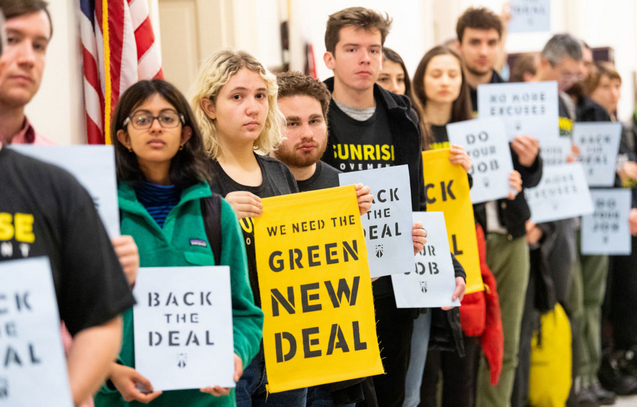
In January 2019, when the new Congress was being sworn in, many students urged our legislators to move on a “Green New Deal” which centers around clean, renewable energy.
Students and youths in a hallway of Congress. Michael Brochstein/SOPA/Images/LightRocket
Strike for change
The United Kingdom has seen a large number of protests in many cities throughout the country recently. In February thousands of young people in Britain left their classrooms to take part in “a growing movement to protest the lack of action on climate change.”
This global movement is known as “Youth Strike for Change,” with protests from Tasmania to Europe.
They want climate change to be treated like a crisis it is by their politicians.

Just 12 years
The recent Intergovernmental Panel on Climate Change report supports their contention that climate change is serious, dangerous and needs to be addressed now.
We have just 12 years to avoid the more serious consequences of catastrophic climate change.
More than 10,000 youths in Leuven, Belgium have skipped school for the fifth Thursday in a row.
Some climate change deniers claim that these events “are being manipulated by politicians and environmental organizations.”
Indeed, one Belgian Environment Minister was forced to resign after she said she had security confirmation that these recent demonstrations were staged as a plot against her.
Meanwhile, NASA just confirmed that the last 5 years are the “Hottest Years On Record Globally”.


Links

Trump’s Climate Policies Face 6 Big Legal Battles This Year

Grist

Letitia James is an American lawyer, activist, politician and Attorney General of New York.
Newsday LLC / Contributor
The Trump administration has been chipping away at the bedrock of environmental protection in the United States. It didn’t happen overnight. But slowly, like toxic mold spreading through a home, polluter-friendly policies have started to build up.
Left unchallenged, the administration’s relaxed rules on pollution could add more than 200 million tons of carbon dioxide to the atmosphere each year by 2025, a new report from The State Energy & Environmental Impact Center finds. “In short, the Trump administration is prepared to take us over the climate cliff,” the authors state.
But lawyers are putting up a good fight. Here are six pieces of noxious Trump-era policy that state attorneys general are gearing up to battle in court this year, as laid out in the report:
  1. The so-called “Affordable Clean Energy Rule,” proposed by the EPA last August, would allow fossil fuel-fired power plants to pollute even more than they already do. The rule would replace the Obama-era Clean Power Plan and could result in 1,630 more premature deaths and 120,000 more asthma attacks by 2030, according to the report. Twenty-one state attorneys generals are opposing the new rule, led by Letitia James of New York and Maura Healey of Massachusetts.
  1. The Trump administration’s rollback of 2012 clean car regulations would add an additional 16 to 37 million metric tons of CO2 to the atmosphere by 2025. The proposal would also revoke a waiver that allows California, which accounts for more than 40 percent of the country’s cars, to set stricter fuel economy standards than the federal government. A group of state attorneys general, led by California Attorney General Xavier Becerra, is fighting the proposal.
  1. The EPA’s pending repeal of a 2016 rule would loosen emissions requirements for glider trucks, some of the dirtiest vehicles on our highways (they typically release 20 to 40 times more pollution than other trucks). In November 2017, former EPA administrator Scott Pruitt tried to reopen an old loophole that allows glider trucks with old, dirty engines to pass as new. Anti-pollution proponent Becerra is also leading the fight against this move on the basis that it undermines the Clean Air Act.
  1. The EPA is trying to weaken methane emissions standards for new oil and gas equipment. The proposal would also allow the industry to monitor methane leaks less frequently. These changes would result in the release of about 380,000 tons of methane — a greenhouse gas that’s 86 times more potent than CO2 in the short-term — between 2019 and 2025. James of New York is leading the multi-state coalition challenging the EPA’s proposed rule.
  1. The EPA is failing on its obligation to reduce methane emissions from old sources. Oil and gas operations prior to 2012 are responsible for up to 90 percent of methane emissions, and under the Clean Air Act, the EPA is legally obligated to address these sources. The agency hasn’t exactly done that — prompting a coalition of state attorneys general, led by James, to sue.
  1. In September 2018, the Trump administration repealed the 2016 Methane Waste Prevention Rule, which would have cut emissions by at least 175,000 tons a year. The original rule would reduce the waste of natural gas (from, say, leaks or venting) on public and Native American lands. In ongoing litigation, Becerra and New Mexico Attorney General Hector Balderas have challenged the repeal.
Americans are already feeling the effects of the Trump administration’s changes to environmental policy on the ground. As a New York Times investigation showed, some daycare facilities in California now take into account the spraying schedules for chlorpyrifos (a pesticide the Obama administration had moved to ban), a waterway in West Virginia is still being polluted with hundreds of pounds of selenium, and a coal plant in Houston is releasing harmful amounts of sulfur dioxide into the air with no consequences.

Links

11/03/2019

Striking For The Future: From Australia To Japan To India, Youths Will Skip School On March 15 To Protest Against Climate Change


  • Students from at least six Asian countries will take part in Global Strike for Future
  • But authorities in some countries have warned students not to disrupt classes
A carnival float depicts the school strikes ‘Friday for Future’ with Greta Thunberg during a traditional carnival parade in Düsseldorf, Germany, on March 4. Photo: AP
On March 15, students from at least six countries in Asia will be part of a global school strike to demand concrete action from governments to tackle climate change.
They come from secondary schools and universities in Australia, Bangladesh, India, Japan, New Zealand and South Korea, and will join their peers in the Americas and Europe to take part in the Global Strike for Future.
“We are the ones who will inherit this earth. We deserve to have a say about the kind of future we have, which at this stage could be non-existent unless we stand up and show the politicians how important this is to us,” said 18-year-old Sophie Handford, who has completed high school and is coordinating the strikes in New Zealand.
The protest comes a month after about 10,000 youngsters staged a nationwide school strike across 60 cities in Britain, showing how a grass roots movement inspired by a Swedish girl last summer had taken off.
Students taking part in a climate change protest in London on February 15. Photo: EPA


Greta Thunberg, 16, had planted herself in front of the Swedish parliament in August handing out fliers that said: “You grown-ups do not give a s*** about my future.” Many students around the globe have also been striking every Friday since Thunberg started her protest.
The students interviewed for this article said the movement was largely decentralised, with them learning about the strike on social media. Some kept in touch with other coordinators from abroad through encrypted messaging apps.
A number of them wrote an open letter that British newspaper The Guardian published on March 1. “We demand justice for all past, current and future victims of the climate crisis, and so we are rising up,” the letter said.
“There have been fires in some places where it has become so dry and rising sea levels are hitting our friends in the Pacific hard. We are also fighting for them so they are able to remain in their homes,” said Handford.
This is the first time that New Zealand’s young people will be striking in 24 cities including Auckland and Christchurch to demand the government to limit global warming to no more than 1.5 degrees Celsius (2.7 degrees Fahrenheit). Some of their demands include fast tracking paths to reach emission targets and stopping all exploration and extraction of fossil fuels.
Swedish climate activist Greta Thunberg. Photo: AFP
In Bangladesh, another first time strike is being organised in Dhaka, Sundarbans and Sylhet by 24-year-old Sabbir Ahmed, who emphasises that this country’s low-lying areas will be most affected by rising sea levels caused by climate change. Sabbir graduated in 2017 and has been working with youth groups to develop professional skills.
“Bangladesh has already seen some unusual weather patterns. Temperatures in the summer rise up to 38 degrees Celsius or more, and last rainy season the floods caused heavy losses to agricultural production,” said Sabbir, who wants governments of industrialised nations to take more responsibility for reducing emissions.
The impact of climate change is already being felt throughout the world, but lower-income countries across Asia, Africa, and the Middle East do not have the resources to adapt to the changes, said Harald Heubaum, an associate professor in global energy and climate policy at the SOAS University of London.
He said developed countries in Europe and North America need to do more in terms of reducing emissions to mitigate the effects of climate change.
“The main polluters, including China and increasingly, India as well, need to invest a lot more so the least developed countries – those that haven’t caused problems, but face [the] consequences because they can’t adapt – can deal with this effectively,” Heubaum said.
China, the United States and India have the highest emissions in the world in 2015, according to the independent Union of Concerned Scientists.
An Indian man cools himself under a public fountain on a hot afternoon in New Delhi. Photo: AP
Indian teen Vidit Baya is demanding his government take action. “Our future is in their hands and we want them to take action not just for us but for the sake of the planet, its people and its survival,” said 17-year-old Baya, who is one of the organisers of the strike in India.
He said India’s status as a developing nation means the government needs to invest in renewable energy such as solar power instead of sticking to “ancient technology” like coal. “With seven out of the 10 most polluted cities in the world in India, it is a shame our condition is getting worse,” he said.
Strikes will take place in Delhi and Udaipur next Friday, and Baya’s team is organising more mass rallies every two months. His group is also working to educate people by going door-to-door and holding open meetings every Friday for youths to share ideas on how to create a better future.
However, Baya said schools and parents have reservations about allowing their children to take part in activism. “Many parents fear their kids might get in trouble with the wrong people. They also think we should focus on our studies and think only about our careers,” he said.
“But our parents and schools do not understand the land is dying,” said Baya, adding many schools refused to let students join environmental campaigns and activities organised by non-governmental organisations and the government.
Hong Kong’s Education Bureau is also opposed to the strike, saying on February 28 that the movement would disrupt order in schools.
Australians protesting against climate change in Brisbane in December. Photo: EPA
In Australia, where 15,000 students walked out of their schools on November 31 last year, students have also been warned against taking part in the upcoming strike. New South Wales education minister Rob Stokes said in an interview that students and teachers who did not show up would be punished, which earned him a swift rebuttal from Greta Thunberg herself.
“Your statement belongs in a museum,” wrote Thunberg on Twitter.
School principals in New Zealand have also warned students who strike they will be marked as truants, local media reported on Thursday.
Yet, the youth movement has caught the attention of climate scientists worldwide, who have written a letter of support for the young strikers published in The Guardian on February 13.
“The global youth movement and organisation is indeed impressive,” said Peter deMenocal, director of the Centre for Climate and Life at Columbia University in New York.
“The breadth and authenticity of this youth movement can turn the tide of public opinion,” said deMenocal, who has worked with leaders of the strike in the US.
An open-cut coal mine in Singleton in Hunter Valley north of Sydney. The Australian government has continued to push for coal as an energy source. Photo: AFP 
This really is a grass-roots movement organised by the youthAustralian organiser Zel Whiting
 Australian organiser Zel Whiting, who has worked with a larger team to pull together not just the Australian protest but internationally as well, is adamant the strikes are necessary. “Climate-based decisions are decisions that can’t be undone in 20 years’ time,” said the 13-year-old.
Whiting is frustrated with the current Australian government, which has continued to push coal as an energy source for the country. “That will devastate our environment, but we’re starting to sway the general public to our side, which is really good,” he said.
The Australian youth has also managed to gain the support of labour unions, but at the same time, Whiting said, the hardest hurdle to overcome is convincing dismissive adults who think the kids are being used by politicians.
“This really is a grass-roots movement organised by the youth, and climate justice should be totally apolitical and focus on communicating with governments,” said Whiting. “People need to realise that climate change is going to be a problem for their future and for their children for a long time.”

Links

Woman Fest Founder Plans Training Camp For Climate Rebels

The Guardian

Spring Uprising festival in Bristol will feature bands and civil disobedience instruction
School pupils gathered in Parliament Square last month to protest against government inaction over climate change. Photograph: Guy Smallman/Getty Images 
The woman behind the UK’s first female-only festival is setting up a climate activism training camp to instruct hundreds of young people in civil disobedience before a series of environmental protests planned for the coming weeks.
Tiana Jacout is putting on the Spring Uprising festival in Bristol this month for people taking part in the ongoing school strikes and the Extinction Rebellion protests planned for 15 April.
The two-day event will offer the usual festival diet of live bands and DJs alongside civil disobedience training and sessions on climate solutions.
Jacout said: “With thousands of people coming together to face the climate and ecological emergency, this event is intended to help people prepare, organise and celebrate for this historic moment in time together.”
Last month more than 10,000 young people took to the streets across the UK as part of the growing school strike movement. Up to 150,000 people around the world are expected to take part in a global school strike on 15 March.
Separately, thousands of protesters are expected to descend on London on 15 April as part of a global climate action organised by Extinction Rebellion.
The group, known as XR, has established groups in countries around the world and has the support of hundreds of senior academics and scientists.
It is demanding that the UK government tell the truth about the scale of the ecological crisis and enact legally binding policies to reduce carbon emissions to zero by 2025. It also wants the creation of a citizens’ assembly to oversee the transformation to a sustainable economy.
Activists closed down five London bridges for several hours in November, and they say this time they intend to bring widespread disruption to London until their demands are met.
 Tiana Jacout
Photograph: Antonio Olmos/The Observer 
Jacout said the festival was a chance for people who were considering getting involved in climate campaigns to “come together, get trained, get organised and have a damn good time doing it”.
She added: “One of the real challenges of being in this movement is that every week there is a new scientific study coming out that shortens the time we have left to take action. That is why we need to come together and look after each other. Taking part in civil disobedience is high adrenaline and you need to be looked after and cared for. That, along with training and preparation, is what this festival is about.”
The event, on 16 and 17 March, has sold more than 700 tickets and has the backing of music industry and festival organisers such as Boomtown, Buddhafield and Burn Punk. A dozen music acts including Sam Lee, Dizraeli, Mesadorm, Bellatrix, Pete the Temp, Honeyfeet, Nick Mulvey and the High Breed have been confirmed.
Jacout, who staged Woman Fest last year, said that although non-violent civil disobedience was at the heart of the emerging environment protest movements, “many of the people who have come forward to join may not have been in that situation before”.
“As we saw from our demonstrations in November we are entirely peaceful and although there were lots of police around it was all calm and friendly, but we think that people can’t be too well trained or briefed and the more support we can give each other the more successful the rebellion can be,” she said.
The event will include a talk from school strike activists and video linkups with XR groups around the UK and the rest of the world.
“This is the next step in our response to the threat to life we all face, a potentially life-changing event for attendees,” Jacout said. “For people who have not been involved in XR before, this is perfect moment to come down and see what we are about, to meet and make friends and get properly involved.”

Links

Veterans Are Concerned About Climate Change, And That Matters

The Conversation |  | 


Naval Station Norfolk in Virginia, the Navy’s largest base, is endangered by sea level rise. Mass Communication Specialist 2nd Class Ernest R. Scott
News that the Trump administration plans to create a panel devoted to challenging government warnings about climate change has been met with opposition from members of the U.S. military. Citing concerns about the effects of climate change on national security, more than four dozen top-ranking military officials came out in opposition to the Trump administration’s plan.
Military concern about the effects of climate change on national security is not new. Months before former Secretary James Mattis left the Defense Department in January 2019, he acknowledged that increased coastal flooding and tropical storms, resulting from rising average global temperatures, pose a threat to as many as one-third of U.S. military bases.
In addition to its potential effect on military infrastructure, climate change could pose threats to global security. A recent IPCC report predicts that rising global temperatures, drought and other extreme weather patterns are likely to become more frequent and severe across the globe. This could create competition and conflict for increasingly scarce water and agricultural resources, particularly in the developing world or in fragile states.
Although climate change could pose major risks to national security, few have asked current and veteran members of the armed forces what they think about climate change and its potential effects. Our new survey research finds that most U.S. veteran members of the armed services in our sample think that the planet is warming, and many of them are concerned about what climate change means for U.S. security.

Combating climate change: A call to arms?


Former Secretary of Defense James Mattis, pictured Nov. 26, 2018 in Doral, Florida. Brynn Anderson/AP Photo
Past and present members of the military are more likely to support politically conservative views than politically liberal ones. But to characterize the military as uniformly conservative misses an important element of nuance.
Numerous surveys of active duty service members and veterans in the early 2000s demonstrated that enlisted members of the military tended to vote in patterns similar to their civilian counterparts. However, recent research has pointed to a shift rightward within the military and found that higher-ranking officers and younger vets are especially more likely to be conservative, identify as Republicans, and support President Trump than nonveterans.
Despite their conservative tendencies, there is reason to suspect that armed forces members are concerned about the effects of climate change – a position held most commonly by ideological liberals. Service members might, for example, have observed the impact of major storms or rising sea levels on the day-to-day functioning of military bases. Or they could have used weapons systems that run on renewable energy sources, including aircraft, tanks and solar energy-powered backpacks.
The Pentagon is continuing to take steps to address climate change, despite President Trump saying such preparation should stop. U.S. military personnel are thus likely to have more experience with climate change effects, solutions to it or both.

Our study
To study past and present military personnel’s attitudes about climate change, we conducted a survey between Jan. 17-21, 2019 of 293 U.S. active duty or veteran service members, recruited via the online service Lucid. While this sample is not perfectly representative of the military writ large, it is both ideologically and demographically diverse. Our sample closely resembles veteran population benchmarks on race, educational attainment, and, perhaps most importantly, party identification.
We asked two related questions. First, we asked respondents which of the following statements is closest to their view: (1) “The Earth is getting warmer mostly because of human activity such as burning fossil fuels;” (2) “The Earth is getting warmer mostly because of natural patterns in the Earth’s environment; (3) "There is no solid evidence that the Earth is getting warmer;” or (4) “not sure.”
If respondents answered that the Earth is getting warmer, we then asked how likely it is that “U.S. military bases in coastal or island regions will be damaged by flooding or severe storms” and that “Drought and famine will cause international military conflict for food and water resources.”
First, the survey results showed that even though veterans and active duty service members tend to be politically conservative, their levels of belief in human-caused climate change are virtually the same. In our sample, 44 percent of veterans and active duty service members expressed belief in anthropogenic climate change. This tracks closely with nationally representative estimates of anthropogenic climate change consensus in the U.S. adult population. A 2016 Pew survey that featured a question identical to ours found about 48 percent believed in anthropogenic climate change (although some surveys asking other versions of this question, like this 2018 survey from Gallup, sometimes find higher levels). The results also track closely with a recent survey on the Lucid platform, used to conduct our study, which found that about 50 percent of Americans believe in human-caused climate change.
Second, we found that many veterans and active duty service members are concerned about the effects that climate change might have on security. More than three-quarters, 77 percent, of respondents consider it fairly or very likely that military bases in coastal or island regions will be damaged by flooding or severe storms as a result of climate change. Fewer veterans and active duty service members – 61 percent – consider drought and famine-driven international military conflict over food and water resources fairly or very likely to occur.
Third, we found that veterans and active duty service members who accept the scientific consensus on the causes of climate change are considerably more likely to be concerned about its effects on national security than those who do not.
To be specific, 87 percent of veterans and active duty service members who accept anthropogenic climate change consider damage to U.S. military bases in coastal or island regions due to flooding or severe storms fairly or very likely to occur, compared to 64 percent of those who do not accept anthropogenic climate change. And, 70 percent of veterans and active duty service members who accept anthropogenic climate change consider drought and famine causing international military conflict for food and water resources fairly or very likely to occur, compared to 49 percent of those who do not accept anthropogenic climate change.

Why this matters


U.S. citizens appreciate and respect veterans. Some believe that veterans’ views on climate change could influence others. fiyaazz/Shutterstock.com
Belief in climate change among past and active military personnel is noteworthy, because veterans are an important and influential voting block in American politics. Veterans comprise about 7 percent of the U.S. voting population, and millions of dollars are spent every year trying to win their political support, and advance their policy priorities US$13 million in independent expenditures.
Service members’ views could also affect the views of civilians, thus also pressuring political leaders to take action. The American public is deferential to and has a high degree of trust in the military. If enough veterans express concern about climate change, this reliably conservative voting bloc may push Republican officials to take policy action on climate change.

Links

Generation Greta Will Step Up Their Climate Strikes On 15 March

Medium - Alexander Verbeek

On this cold and rainy morning, I joined Greta Thunberg in front of the Swedish parliament for her climate strike.


It is just 29 weeks ago that she sat there for the first time. All alone, since nobody she had asked wanted to join her. But she didn’t give up and she is now the founder of an international youth movement that challenges the world’s leaders to act on climate change.
Her ‘Fridays For Future’ protest has inspired and mobilised hundreds of thousands of students all over the world. Together they ask us, the grown-ups, to look into the mirror. We have to shamefully admit that our generation made a mess of our global environmental responsibilities, as well as quite a few other tasks to keep this planet a liveable place.
Today, on International Women’s Day, she was awarded as ‘Woman of the Year’ by two Swedish newspapers.
Many famous, inspiring leaders would never have been recruited if you would have asked a specialised agency to find you a new leader. And I guess that 16-year old Greta would not have met any of the criteria a recruitment office would use to search for a new inspiring global leader. But for me, and millions of others, she is a source of inspiration. Her direct communication is the wake up call that the world needs. Especially now that we have nearly run out of time to act.
Last November, I saw her speak at the Stockholm TEDx event, not far from where her climate strike had started in the summer. The huge conference hall seemed even more intimidating when the small, then 15-year old, Greta walked on stage. But she captivated the audience with the most clear call for climate action I had ever heard. There is no time to lose for a rapid reduction of greenhouse gas reductions, we don’t need to wait for more research, and all of us, including our leaders, need to act now.
Soon after, she travelled by public transport to COP24 in Katowice, where she told world leaders to stop behaving like children: “you are not mature enough to tell it like it is, even that burden you leave to us children”.
When she arrived by train in Davos, she told the world’s business leaders it is insane for a record 1500 of them to arrive by private jet to discuss climate change.
The movement that Greta started is still growing. On Friday 15 March, 860 actions are planned in 75 countries, and the list is still growing.
This massive youth movement seems to become an intergenerational conflict at a scale that we have not seen since the late 1960s. While politicians tell them to go back to school, there is no stopping them and it may soon be about more than just climate change.
While Greta keeps focussed on the climate message, other young people will add governance, economy, equality, justice and power relations on Generation Greta’s wish list for change. Politicians better pay attention.
Every year on 10 December, I am surprised that we still don’t have a Nobel Prize for the Environment. But until that issue is resolved, I hope that Greta Thunberg will be this years’ Nobel Peace Prize laureate.

Links

Lethal Heating is a citizens' initiative