20/05/2019

Labor Lost The Unlosable Election – Now It's Up To Morrison To Tell Australia His Plan

The Guardian

The big losers are action on the climate emergency and the likelihood that Labor will never be as ambitious with its policies again
Scott Morrison has won the 2019 Australian election. Now he will have to come up with a more substantial policy offering than was apparent in the campaign. Photograph: Rick Rycroft/AP 
There are a number of unknowns with Saturday night’s result – including whether Scott Morrison will govern in majority or in minority.
But some things can be known. This was an election in large part about the climate emergency, and the field evidence shows Australia in 2019 is deeply divided about the road ahead.
Some voters clearly want action. Inner metropolitan Australia swung to Labor in its safe seats and in safe Liberal seats, such as Kooyong, North Sydney and Higgins, and the voters of Warringah also showed Tony Abbott, the chief climate wrecker, the door – but the outer suburbs and regional Australia swung in the other direction. Queensland was an absolute disaster zone for Labor, with the ALP clubbed, with the help of Clive Palmer and Pauline Hanson, in coal country.
Bill Shorten is finished as Labor leader, and Anthony Albanese is his most likely successor, although others are weighing up their options.
Chris Bowen, who suffered a 7% negative swing on Saturday night, has not ruled out running, and the Victorian rightwinger Richard Marles ducked a question about his intentions on Saturday night. It will be interesting to see the intentions of the Queensland rightwinger Jim Chalmers, and Tanya Plibersek.
Bill Shorten led Labor to a shock defeat in Saturday’s election. Photograph: Mike Bowers/The Guardian 
Given that Labor is shellshocked by this result, shellshocked and shattered, it is unclear whether the party will stick with its big-target election policies, including the climate offering.
While some on Saturday night were more inclined to blame franking credits, Shorten’s substantial unpopularity with voters and a poor campaign rather than climate policy for the defeat, it is unclear, as of now, whether the opposition will have the resolve to go to another election championing an ambitious policy.
In his concession, Shorten noted that the divisions on the climate crisis were etched into Saturday night’s result, and he said “for the sake of the next generation, Australia must find a way forward” on the issue.
Albanese – who will certainly stay the course on climate if he is the succession plan – sent a strong signal on Saturday night that Labor was a progressive political movement and would remain so. Labor existed, Albanese said, “to change the power balance in society, whether that be economic power, political power or social power – that is our task and it is one that I will continue to pursue whether in government or, if we aren’t fortunate to be in government in whatever capacity over the coming days, weeks, months and years”.
While Labor attempts to recover and recalibrate after losing the unlosable election, Scott Morrison, victorious in Sydney, gave thanks to miracles, and the Liberal party’s campaign director, Andrew Hirst, and to Queensland and the “quiet Australians” who stuck with the Coalition despite the government spending two terms in office giving them every reason not to.
Morrison is the hero of the hour for the Liberal party and rightly so, having pulled them out of the fire with a negative, ruthlessly efficient, gravity-defying solo act that convinced a majority of Australians in the right seats that if they didn’t trust Shorten, they couldn’t trust Labor.
The Liberal leader will emerge from the experience of the past six months with his authority enhanced among colleagues who have lived to roil, particularly if he pulls them all back into governing in majority, which is what backroom strategists in the Liberal party are predicting will be the end result.
Morrison spent zero time during this campaign telling anyone what he would do with this authority in the event it was conferred upon him by the voters – so that task awaits Australia’s prime minister-elect, beginning Sunday.

Links

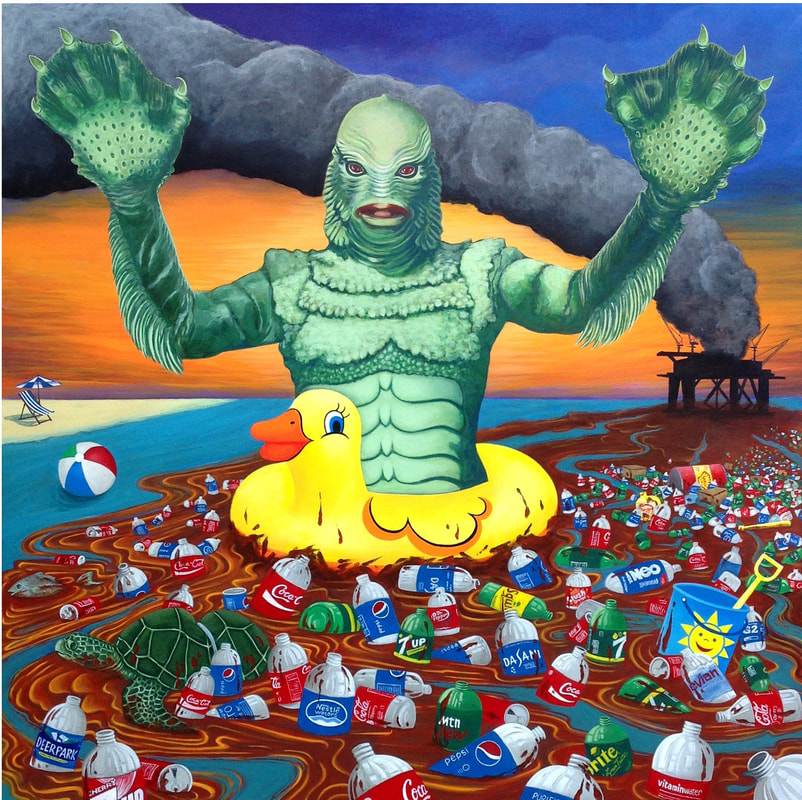
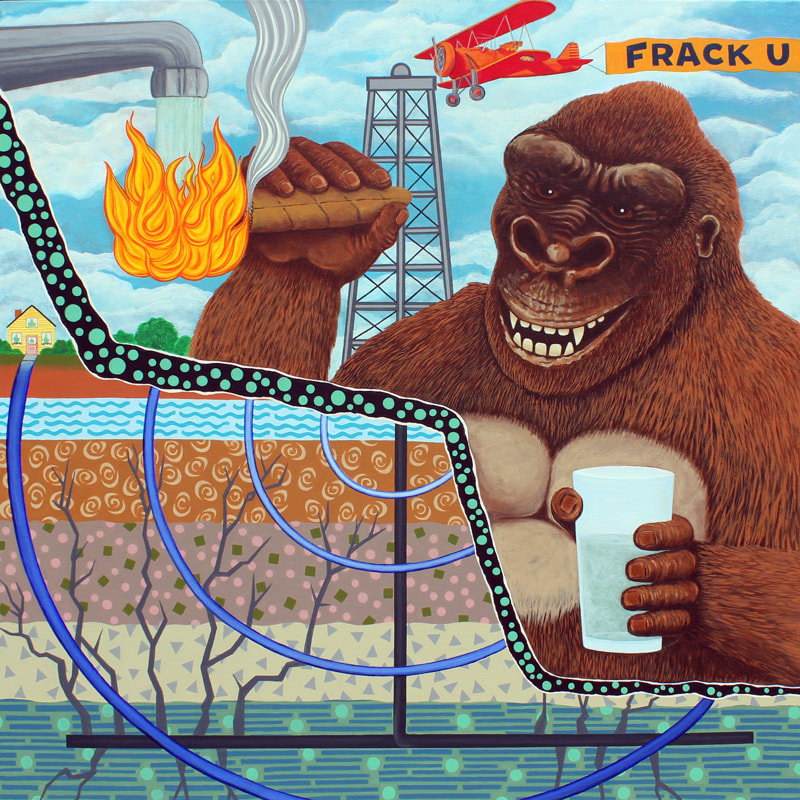
Here There Be Monsters (Made Of Coal, Plastic And Pesticides)

The Revelator - John R. Platt

A series of paintings by artists Laura and Gary Dumm seeks to challenge viewers with images of pop-culture monsters facing ecological collapse. 
© Laura and Gary Dumm
Sometimes the latest bad environmental news makes us want to scream like someone in a horror movie who’s just come face to face with Frankenstein’s monster.
Frankenstein’s monster isn’t too happy about the news, either.
Neither are the Creature from the Black Lagoon, King Kong, Chucky or other horror-movie monsters who appear in a recent set of paintings by artists Gary and Laura Dumm of Cleveland, Ohio.

“Old King Coal” © Laura and Gary Dumm
The paintings — exhibited as the “Here There Be Monsters” series — depict the iconic characters surrounded by smog, pesticides, plastic pollution, oil, fracking flames and soon-to-be extinct species.
It’s a quirky, powerful series of paintings created by a duo with a long history of commenting on society through their work. Gary, 71, is a cartoonist and graphic novelist perhaps best known for his decades-long collaboration with “American Splendor” writer Harvey Pekar. Laura, 68, is a pop-art painter whose work often touches upon issues related to animals or social rights. Together they’ve worked together on numerous projects, with their environmental series being one of their most striking.

“Burning in Water, Drowning in Plastic” © Laura and Gary Dumm
We contacted the Dumms to talk about protest art and their look at the real-life monsters affecting the environment.

What inspired you to develop this monstrous series?
Gary: We were looking for a way to do some serious collaborative works about the environment, and Laura first suggested doing a series about bugs and how certain issues like pesticide overuse were affecting them and the environment. We tried our damnedest to come up with something viable, but nothing was working well enough…until I came up with the broader idea of using classic horror monsters from movies as the main characters. Thinking about the fact that most of the monsters were failed scientific experiments made them a good match as recognizable vehicles for expressing some complex ideas. We agreed that these icons could be the “hook” to draw in viewers and also be the messengers for things that we had to say about threats to our environment. And the addition of humorous touches, to leaven the serious subject matter, has proven to be both popular and thought provoking in peoples’ reactions to this series.

Did you have any challenges in completing the series?
Laura: The only challenge is the usual one: coming up with good ideas that resonate with both of us. There’s lots of research, thinking, discussion and sketching done to get each resulting piece to say what we want in a manner that simultaneously strong while not being a diatribe. We feel that we’ve come up with some wonderfully surrealistic and humorously bizarre paintings that hopefully resonate and stay with most viewers. Unfortunately, it appears that there are still too many dire subjects left for us to tackle about the future of our planet. We won’t be short of subject matter.

“The Four Horsemen of Extinction” © Laura and Gary Dumm
What do you hope viewers will learn or experience through this work? 
Gary: We hope to inform the public. When someone looks at any of the paintings they are first attracted by the monster or the color. After they stop, read the title, enjoy the monster, then they focus on the message and hopefully a conversation will follow. We had one person tell us he “doesn’t buy water in plastic anymore because of our painting.” One college-educated person had no idea what GMOs or Monsanto were. After talking about our “Scream of the Butterflies,” she did more research and became more informed.

“Scream of the Butterflies” © Laura and Gary Dumm
What comes next — for this series, or for you?
Laura: We do love collaborating for a cause, so when the right ideas hit us we will make time to continue this series.

Here There Be Monsters
DummArt
Click to enlarge image


Links

These Are The Cities Doing The Most To Combat Global Warming

Bloomberg | 

➤Group’s ‘A-list’ shows Boston, London and Sydney in the lead
➤Reykjavik says it already is running 100% on renewables

The U.K.'s Roadmap to Zero Carbon Emissions by 2050

Cities, which are home to more than half the world’s population, are stepping up efforts to slash pollution, often wresting the fight against climate change away from national governments.
That’s the conclusion of CDP, a non-profit group that pushes institutions to detail their greenhouse-gas emissions. Often able to move faster than their national counterparts, metropolitan authorities from London to Sydney and Boston are among a group of 15 setting out the most rigorous plans to achieve carbon or climate neutrality by 2050.

Pushing Green Ambition
Cities across the globe that are front-loading aggressive climate change goals
Note: Includes only cities with target of 50% or more cut in emissions from their respective baseline year
Sources: CDP Climate A List, Bloomberg
The moves are evidence of ambition by local authorities to do their part in reining in global warming, almost two-thirds of global emissions come from cities. CDP wants to draw attention to their actions to encourage others to make similar commitments.
“Cities are doing a lot of the work, but they can’t get there alone,” said Kyra Appleby, global director of cities, states and regions at CDP. “Businesses need to act, national governments need to act as well, people need to change their own behavior in order for us to limit carbon emissions.”

Source: CDP
A smaller group consisting of five cities including Paris and San Francisco have set themselves 100% renewable energy targets. Reykjavik, population 123,000, says it already uses 100% renewable power. How fast other cities get to that point is largely down to the policies they enact.
Paris gets 35% of its energy from clean sources, and San Francisco gets almost 60% of its power from renewables, CDP said.
Almost 7% of the 625 cities that took part in the report were given the highest rating -- joining the CDP “A-list.” Among the top scoring, only 28 have set goals for carbon neutrality (balancing emissions of greenhouse gases), climate neutrality (designing wider policies to reduce the overall impact of human activity to the environment) or cutting emissions by half or more.
More than 20 U.S. cities got the highest rating showing how mayors and city level lawmakers can take the initiative on climate change in spite of a president who has repeatedly played down the effects of global warming.
Since the 2015 Paris Agreement that committed the world to slowing down global warming, the narrative has shifted from a problem that the world faces in the future to an issue that exists today. That was sped up by a 2018 United Nations report that spelled out the need for rapid action to grapple with a warming planet -- and what would happen to ecosystems if temperatures increased another half degree Celsius.
Cities have formed alliances to share knowledge and push for change -- like the C40 initiative that has 94 cities committed to implementing ambitious climate goals. Protests over the global warming have become more urgent with activists calling for climate emergencies to be declared.
CDP gives an “A” rating to any city that reports publicly on its climate adaptation and action plans as well as reporting on emissions inventories and reduction targets. The worst performing cities are handed a “D” although CDP doesn’t make those public.
“Cities are real hot spots of innovation, business and human life on earth so it’s crucial that cities are acting in order for us to meet the targets,” Appleby said.

Links

19/05/2019

Why The Guardian Is Changing The Language It Uses About The Environment

The Guardian

From now, house style guide recommends terms such as ‘climate crisis’ and ‘global heating’
The destruction of Arctic ecosystems forces animals to search for food on land, such as these polar bears in northern Russia. Photograph: Alexander Grir/AFP/Getty Images
The Guardian has updated its style guide to introduce terms that more accurately describe the environmental crises facing the world.
Instead of “climate change” the preferred terms are “climate emergency, crisis or breakdown” and “global heating” is favoured over “global warming”, although the original terms are not banned.
“We want to ensure that we are being scientifically precise, while also communicating clearly with readers on this very important issue,” said the editor-in-chief, Katharine Viner. “The phrase ‘climate change’, for example, sounds rather passive and gentle when what scientists are talking about is a catastrophe for humanity.”
“Increasingly, climate scientists and organisations from the UN to the Met Office are changing their terminology, and using stronger language to describe the situation we’re in,” she said.
The United Nations secretary general, António Guterres, talked of the “climate crisis” in September, adding: “We face a direct existential threat.” The climate scientist Prof Hans Joachim Schellnhuber, a former adviser to Angela Merkel, the EU and the pope, also uses “climate crisis”.
In December, Prof Richard Betts, who leads the Met Office’s climate research, said “global heating” was a more accurate term than “global warming” to describe the changes taking place to the world’s climate. In the political world, UK MPs recently endorsed the Labour party’s declaration of a “climate emergency”.
The scale of the climate and wildlife crises has been laid bare by two landmark reports from the world’s scientists. In October, they said carbon emissions must halve by 2030 to avoid even greater risks of drought, floods, extreme heat and poverty for hundreds of millions of people. In May, global scientists said human society was in jeopardy from the accelerating annihilation of wildlife and destruction of the ecosystems that support all life on Earth.
Other terms that have been updated, including the use of “wildlife” rather than “biodiversity”, “fish populations” instead of “fish stocks” and “climate science denier” rather than “climate sceptic”. In September, the BBC accepted it gets coverage of climate change “wrong too often” and told staff: “You do not need a ‘denier’ to balance the debate.”
Earlier in May, Greta Thunberg, the Swedish teenager who has inspired school strikes for climate around the globe, said: “It’s 2019. Can we all now call it what it is: climate breakdown, climate crisis, climate emergency, ecological breakdown, ecological crisis and ecological emergency?”
The update to the Guardian’s style guide follows the addition of the global carbon dioxide level to the Guardian’s daily weather pages. “Levels of CO2 in the atmosphere have risen so dramatically – including a measure of that in our daily weather report is symbolic of what human activity is doing to our climate,” said Viner in April. “People need reminding that the climate crisis is no longer a future problem – we need to tackle it now, and every day matters.”

Links

The Climate Crisis Is A Story For Every Beat

Columbia Journalism Review - Rosalind Donald

The Ivanpah Solar Electric Generating System, in the Mojave Desert. Photo via Climate Visuals.
Ten years ago, climate journalist Brian Kahn watched coverage of the United Nations Climate Change Conference in Copenhagen. At the time, the momentum seemed unstoppable. There were negotiations over a global framework for tackling climate change. Climate scientists’ conclusions in reports leading up to the meeting were stark and urgent. He felt the dam would break, and climate change would be everywhere: in political debate, in bars, at PTA meetings, certainly on the news.
Now he can’t imagine what he was thinking.
Coverage by climate journalists has never spurred a comprehensive social response, nor has it reshaped journalism itself. We now better recognize the difficulties of communicating climate change, but it still gets scant attention and resources in newsrooms. Many outlets still insist on  false balance, in which fringe views are presented on a par with the more established scientific consensus.
“The timeframe in which science happens and the timeframe in which news happens are just fundamentally mismatched,” Susan Matthews, Slate’s science editor, says. “That problem is just so much larger when it comes to climate change.”
Climate change is an economic story and a public health story; global warming shapes supply chains, water resources, tech infrastructure, community development and loss, and on and on. Yet climate coverage has historically been relegated to the science and environmental beats, outside the realm of hard news.
“There’s a feeling still amongst a certain generation of editor that being an environmental journalist is a bit campaigner-y,” Leo Hickman, editor of Carbon Brief, a publication focused on explaining climate science and policy says. “And that’s reinforced the ghettoization of climate change as a subsection of environmental journalism.” (Disclosure: I previously worked for Carbon Brief.)
It’s both an environmental issue and an everything issue. It’s what’s going to happen to mountain goats, but at the end of the day we’re also talking about the most pressing economic story of our time.
That perception of climate coverage has only started to shift. Science and environmental journalists have looked for new angles on climate change in order to demonstrate its impacts in ways that appeal to new audiences. Kahn, now a senior reporter for Gizmodo’s Earther and a lecturer in the Climate and Society program at Columbia University’s Earth Institute, covers classic climate science stories such as new research and threats to beloved species, but also looks at the implications of US cities’ climate policies, climate discussions in the presidential race,  and the ways inequality dramatically exacerbates the impacts of extreme weather.
“Climate change is a strange kind of dual issue—it’s both an environmental issue and an everything issue,” Kahn says. “It’s what’s going to happen to mountain goats, but at the end of the day we’re also talking about the most pressing economic story of our time.”
Journalists outside the science and environment beats are slowly beginning to pick up on climate stories. In 2017, the Carbon Disclosure Project released a report attributing more than 70 percent of global greenhouse gas emissions to just 100 companies. Sara Law, CDP North America’s Vice President of Global Initiatives, says journalists picked up the news as a business story. “More and more journalists are understanding that the corporate world has a major role to play,” Law says.
Still, research shows the overall volume of climate coverage remains thin, and mainstream coverage is episodic. Last year, an analysis of news coverage following two key climate reports in CJR showed a lack of sustained attention from US news media; big spikes in reporting fell away almost immediately. And a study by Media Matters for America showed that coverage of climate change on ABC, CBS, NBC, and Fox—primary sources of news for most people—fell by 45 percent between 2017 and 2018.
James Painter, a research associate at Oxford University’s Environmental Change Institute, says other parts of the world also fail to cover climate change as much as he would hope. “It is worrying that in some parts of the world, like Russia and parts of eastern Europe, and in parts of the global south, the amount of coverage remains relatively low,” he says. “Television is key, as it remains the most trusted and used source in many countries.”
Environmental journalists identify a few popular impediments to climate-change coverage. Last year, more than 500 members of the Society of Environmental Journalists completed a survey by George Mason’s Center for Climate Change Communication. Of those respondents, two-thirds identified insufficient time for field reporting as an obstacle, and more than half identified a lack of time or space at their new outlet. Forty-one percent said insufficient training in climate science hampered their reporting, and one-in-four respondents said they lacked support from management.
Climate Matters in the Newsroom—a new collaborative program run by the grant-funded Climate Communication nonprofit, George Mason University’s Center for Climate Change Communication, and Climate Central—hosts in-person training sessions to help local newsrooms work through obstacles such as those flagged in the SEJ survey. “It’s not always about creating another story,” Susan Hassol, Climate Communication’s director, says. “It may be about incorporating climate change into a piece you’re already doing. So people are reading and hearing stories they are interested in, and they can see how climate change relates to those topics, even though they may not necessarily be seeking out a climate change story.”
Climate-change coverage can seem repetitive. Journalists too often fit new events into existing narratives—something Andrew Revkin, who has covered climate change for ProPublica and The New York Times, terms “narrative capture.” Stories that link extreme weather and climate change can overlook other relevant factors; Revkin mentions the California wildfires, and notes the role that development played in contributing to damage and loss.
“You have to have a systems approach to thinking, ‘Well, what actually happened here?’” Revkin says. “But when you do that, it misses the narrative that everything that’s burning or flooding is global warming.”
Since Elizabeth Kolbert’s influential New Yorker feature, “The Siege of Miami,” national outlets regularly cover the city’s vulnerability to rising seas and the hubris of its building boom. But  they pay less attention to the climate-related policies the city is putting in place, including a resilience strategy that includes a commitment to address affordable housing. “These narratives tend to miss resilience efforts—which are just getting started and are not always well-run, but still, they’re happening,” Kate Stein, a climate reporter based in Miami, says.
Homogeneous newsrooms are particularly vulnerable to narrative capture. “Imagine how much more informative the media landscape would be if newsrooms stopped simply hiring in their own image,” Leah Cowan, a writer for gal-dem, a British magazine written by women and non-binary people of color, says. “So often, analysis of critical issues such as climate change are rooted in a particular ethnocentric and Eurocentric perspective.”
Cowan cites the UK’s role in the global climate crisis, which stems from a history of extractive colonialism and continues through entities such as UK-traded fossil-fuel companies operating across Africa, as an example. Rather than thinking about how empire and its legacies continue to drive the climate crisis, Cowan says, the media tend to focus on “individual actions to combat environmental degradation, such as high-profile campaigns to reduce single-use plastic straws in the UK which are harmful to turtles,” while ignoring or misreporting efforts by minority-led groups such as Black Lives Matter to call attention to the ways privilege protects some people from climate change’s effects. As companies continue to make money out of the spotlight in regions vulnerable to climate impacts and political unrest, the UK—which does not count offshore emissions in its carbon emissions totals—holds itself up as an international climate leader.
People just don’t think it’s normal to talk about climate change, and that’s not just true of journalists. It’s true across society.
Science, the bedrock of climate journalism, also suffers from structural biases. “Science can can be just as extractive as any other kind of industry,” Brentin Mock, a staff writer at CityLab, says. For example, Hawaii’s thin air is particularly conducive to both stargazing and measuring atmospheric carbon dioxide concentrations. But Mauna Loa and Mauna Kea, volcanoes which house NASA- and NOAA-constructed research facilities, are sacred areas for native Hawaiians, who have objected to the sites’ expansion since their creation in the 1960s.  Should optimal conditions for observation take priority over thousands of years of cultural connection? How might scientists work with traditional ecological knowledge while showing it appropriate respect? More journalists might ask such questions of scientists. And, as  journalism scholar Dr. Candis Callison wrote earlier this year, learning from and hiring indigenous journalists could help their efforts.
Discussions about climate-change journalism often overlook newsrooms’ visual vocabularies for talking about it. A quick image search on Google for “climate change” reveals a dismal selection of lone polar bears, melting ice, and anonymous smoke. But humans need to see themselves in the climate change story in order understand the human connection to its causes, consequences, and potential solutions, Dr. Adam Corner, Research Director at Climate Outreach and an Honorary Research Fellow in the School of Psychology, Cardiff University, argues. Climate Visuals, an image repository co-founded by Corner, provides hundreds of pictures for use, with explanations based on research about why certain images might connect with audiences.
“There’s no shortage of amazing climate and energy photography out there, but it doesn’t get the mainstream bandwidth,” he says. “A more diverse, human-focused visual language that joins the dots between climate impacts, our health and wellbeing, and the human impact of low-carbon technologies would revolutionize the visual meaning of climate change.”
Collaborations such as such as Mother Jones’ Climate Desk  and The Invading Sea, a joint effort from four Florida news outlets, have opened up new avenues for reporting as cash-strapped news organizations search for ways to share expertise. By pooling efforts, outlets can complement each other’s strengths: specialty outlets such as  Inside Climate News have time and space to do deep dives into data, science, and policy; Earth Journalism Network offers a global platform to climate reporting from around the world; national newspapers such as the Times can invest in specialized climate desks and have an unmatched ability to set the agenda for discussion; many local outlets enjoy high levels of trust from their audiences.
Climate change is not yet what sociologists call a “social fact.” Silence is still the norm, even among people who say they accept that climate change is happening. “People just don’t think it’s normal to talk about climate change, and that’s not just true of journalists,” Dr. Alice Bell, a writer and co-director at 10:10 Climate Action, says. “It’s true across society.” Journalism too often reflects and reinforces this problem of silence, abetting years of lackluster policy debate and ever-rising emissions. But journalists should not underestimate their role in helping to change that landscape, no matter their beat.
“It’s really hard to say that this is something you should care about as much as affordable housing, as much as national security,” Alex Harris, the Miami Herald’s climate change reporter, says. “But it affects each and every one of those things. So if you’re doing a service to your beat—no matter what you write about, nationally or locally—if you are including this context, it makes you smarter.”

Links

Can Comedy Help Communicate Climate Change?

Australian Geographic

ASMR (Autonomous Sensory Meridian Response), comedy AND climate change? You have to see it to believe it.


MEET ISSY Phillips, a young Australian comedian who believes she can harness the power of comedy to make people listen to the stories of climate change, with the help of autonomous sensory meridian response (ASMR) – sounds that evoke a visceral reaction in people, like fingers scraping down a blackboard.
Last month, at the TedX Youth event Issy performed her new show, Could ASMR be the Answer to Climate Change? She’d been approached by TedX, who were interested in her ASMR work, but she wanted to make the performance meaningful.
“I’m passionate about climate change,” Issy says. “And I thought by framing it as a talk, but making it into a performance, would catch people.”
For her, it was risk. “Whenever I do stand-up or ASMR people are prepared to laugh, but I thought how is this going to go down with an audience that’s ready to have their thoughts ‘disrupted’?
The audience loved it.
“People switch off if it feels too big,” she says. “So picking things that wouldn’t isolate the audience and then presenting them through the lens of ASMR, that’s how I wanted to represent those ecological issues. The way it sounds, the crunching, it gets people.”
Issy’s hoping more comedians catch on. “It’s a part of a broader consciousness of people who know we have to do something and we have to act.
“For me I’m a comedian, so if I can use my tool set to get people to recognise that we have to do something and then they use their tool set, it kind of tumbles.
“We don’t have time to sit on our hands.”

Links

18/05/2019

Waste Not — If You Want To Help Secure The Future Of The Planet

New York TimesTatiana Schlossberg

Keiran Whitaker, the chief executive of Entocycle, which takes so-called pre-consumer local food waste and feeds it to fly larvae, which eats the waste and converts it to protein. Credit Andrew Testa for The New York Times
If there’s one vital, but underappreciated, subject in the conversation about climate change, it’s waste: how to define it, how to create less of it, how to deal with it without adding more pollution to the planet or the atmosphere.
The issue has gained some acceptance, whether in the form of plastic straw bans or anxiety about e-commerce-related cardboard piling up.
But experts say these aren’t necessarily the biggest problems. Reducing the damage from waste might require expanding the traditional definition of waste — not just as old-fashioned garbage, but as a result of wild inefficiency in all kinds of systems, which often results in emissions of greenhouse gases, among other problems.
Companies and organizations around the world are taking on the challenge. Some are using materials traditionally considered waste and making them into something entirely new — and often unrelated — to their original purpose.
Others are avoiding the creation of waste through greater efficiency and new technologies. Here are three examples of efforts underway:

Entocycle
A British company trying to revolutionize the animal feed industry

When Keiran Whitaker was working as a scuba diving instructor, witnessing the destruction of tropical rain forests, often because of industrial food production, he decided he needed to put his environmental design degree to good use.
“We’re obliterating our natural ecosystems predominantly to produce monocrops that go into the industrial food web, and what’s bad on land is even worse underwater,” he said, referring to the destruction of rain forests and the bleaching of coral reefs.
According to a 2013 study from the University of Minnesota’s Institute on the Environment, just under 40 percent of global crop calories are used to feed animals, most of them from corn and soybeans grown at an industrial scale. It’s a particularly inefficient way to feed people: It takes about 100 calories of grain to produce just three calories’ worth of beef, or 12 of chicken.
Counting dead Black Soldier flies, and flies in an atmosphere and light controlled room where they will produce eggs. Credit Andrew Testa for The New York Times
Part of the Entocycle team at work in one of its labs, and flour made from its dried larvae. Credit Andrew Testa for The New York Times
So he is trying to fix the system, mostly by changing the food our food eats. The result is Entocycle, Mr. Whitaker’s start-up based in London, which takes so-called pre-consumer local food waste — created in the manufacturing of food products — and feeds it to Black Soldier fly larvae, which eat the waste and convert it to protein.
He said that about 97 percent of the insects are then ground into a flour high in amino acids, which, combined with other ingredients, can be made into feed pellets for animals. The flies’ excrement, known as frass, can be used as crop fertilizer. Eventually, the insect flour could be directly consumed by people. (While that might make some people cringe, Mr. Whitaker said he’s not “grossed out” by the insects.)
Timothy G. Benton, a professor at the University of Leeds, who is focused on food security and sustainability, said he doubted that a company like Entocycle could do enough to transform the food system.
But Mr. Whitaker, the chief executive, is more hopeful. If his model takes off (it currently is not producing at scale), more land could be used to feed people, and fewer forests would be razed for cropland or pasture; fertilizer production, responsible for 1 percent to 2 percent of global greenhouse gas emissions, according to a report from the Australian government, would be avoided, as would the nutrient pollution created from runoff. Enormous quantities of wild fish are also used to make animal feed, so this could also help ease global overfishing.
“How do you produce enough food to feed the world, and how do you produce a safe environment for us to live in?” Mr. Whitaker said. “They seem to be mutually exclusive, but they have to be fundamentally tied together.”
Dried Black Soldier fly larvae. Credit Andrew Testa for The New York Times
Spinnova
A company in Finland that produces clothing fiber from plants

According to its government, Finland’s forests have about 10 trees for every person in the world. It is perhaps not surprising then that a company aiming to reinvent the way we make clothing from wood is Finnish.
The second and third most common textile fibers are already made from plants — cotton and viscose rayon.
Most viscose rayon is made from wood pulp, but the process of making it typically uses so many chemicals in such vast quantities that some experts said it shouldn’t really count as a natural plant fiber.
Additionally, traditional rayon production has been linked to harmful forestry practices. The Rainforest Action Network has found that about 120 million trees from existing forests are cut down for textiles every year.
Enter Spinnova, a Finnish textile fiber company founded by two former physicists, Janne Poranen and Juha Salmela, who used to work in pulp and paper development and research at Finland’s national research center.
After learning how spiders make silk, Mr. Salmela wondered if it might be possible to spin plant fiber in the same way.
It is. Spinnova uses a mechanical method to produce fiber, currently in a pilot stage. Their process uses about 99 percent less water than cotton production (one study showed that about 2,900 gallons of water can be produced to make a pair of jeans), without any harmful chemicals.
They use wood pulp harvested from Brazilian wood, in partnership with Suzano, one of the world’s largest paper pulp producers and one of Spinnova’s shareholders. The forestry practices and the wood pulp produced are certified as sustainable by the Forest Stewardship Council. This has a climate benefit as well because forests (especially well-managed ones) absorb much of the carbon dioxide released into the atmosphere. Spinnova plans to eventually use agricultural waste material and discarded clothing to produce fibers.
Lenzing, a manufacturer of wood-based textile fibers that uses a closed-loop chemical production process, is one of Spinnova’s shareholders. Spinnova has also received support from Marimekko, a Finnish retailer.
“Sustainability is our main driver,” Mr. Poranen said. “For me, it has been extremely important that you don’t have to think why you’re doing what you’re doing. It’s totally new and totally sustainable for the whole globe.”

Tokyo 2020
The Organizing Committee of the Olympic and Paralympic Games in Tokyo

Paralympic torches to be used in the Tokyo 2020 Olympics Games. They are 30 percent recycled aluminum. Credit Koji Sasahara/Associated Press
Although Japan has a relatively sophisticated recycling system, like other countries it has a problem with electronic waste, or e-waste.
It’s the result of the disposal of vast — and growing — amounts of appliances and gadgetry, including cellphones, computers and TVs, which can leak dangerous chemicals into the environment.
The Organizing Committee of the Olympic and Paralympic Games thought it could bring attention to the problem by making the medals for next year’s games — about 500 — from metals retrieved from donated e-waste.
At sites in more than 1,500 of Japan’s municipalities and about 2,400 NTT Docomo electronics stores, over 47,000 tons of discarded electronics were collected, including more than five million cellphones, according to Masa Takaya, a spokesman for the Tokyo 2020 Olympics.
By June 2018, the organizers had already collected enough bronze; by October 2018, they had more than 93 percent of the gold and 85 percent of the silver, he said, adding that the organizing committee anticipates that it will be able to make all of the medals from the donated items.
Recovering these metals also avoids additional mining, which is environmentally destructive and energy intensive.
The recycling industry, in which people break apart devices and remove copper, gold and other materials, has negative health consequences, according to the Lancet, and toxic chemicals from improper disposal can also get into the environment, causing pollution. And the problem could get worse. About a third of the global population was expected to have an internet-connected phone by 2017, according to a report from eMarketer. In the United States, the typical home has 65 electronic appliances, according to a study from Natural Resources Defense Council.
This initiative will not solve the e-waste crisis — that will likely come from governments and electronic companies, said Vanessa Gray, an official at the International Telecommunication Union, a U.N. agency specializing in information and communications technology. But she said attention to the issue is important, because many people don’t know even what e-waste is and why it matters.
“Just for that, the Olympics story is really good,” she said. “In the end, it shows that the way we do things at the moment has terrible consequences for society, in terms of the negative health impacts and obviously impacts to climate change.
“It’s time for a system update.”

Links

Lethal Heating is a citizens' initiative