05/07/2019

Koalas On The Decline — Dangerous New Threats, Emerging Solutions

The RevelatorGloria Dickie

The Australian icon could lose its fight against climate change, disease, habitat destruction and cars — but not if dedicated conservationists get the tools they need to protect the species.
Photo: University of Sydney
Ten years ago the shaky video of a dehydrated, wildfire-damaged koala captured headlines and the world’s attention.
Crouched next to a charred tree trunk, a volunteer firefighter named David Tree gingerly poured bottled water into the open mouth of the burned koala. A tiny gray paw rested in his own large, calloused hand, allowing the animal to remain upright as she drank.


The young koala, later nicknamed “Sam,” quickly became the iconic emblem of the fires — the first stages of what would be known as the Black Saturday bushfires that burned through the forests of southeastern Australia in February 2009. The fires occurred during a massive heatwave. They burned more than 1.1 million acres, killed 180 people, and caused more than 1 million animal fatalities.
Sam, who was lucky to survive, received treatment at a nearby wildlife center for second-degree burns.
Unfortunately she didn’t last long. Veterinarians soon discovered she was also suffering from severe cysts caused by inoperable chlamydia, one of a few diseases plaguing wild koalas. With no other options, Sam was euthanized that August.
Today her remains reside at the Melbourne Museum, where she serves as a symbol of not only the bushfires but the multitude of threats facing Australia’s wild koalas.
Those threats have taken a terrible toll on koalas (Phascolarctos cinereus), which once numbered in the millions. This May the nonprofit Australian Koala Foundation announced that the marsupials’ wild populations have fallen below 80,000 individuals and the species may now be “functionally extinct.”
In this case “functionally extinct” means that populations have been reduced so drastically that the animals no longer play a significant role in the ecosystem.
The news made headlines, but other biologists countered that while koalas have declined tremendously, the Australian endemics have not yet reached functional extinction. Regardless, koalas are indeed facing a whammy of threats in the country, and without serious and timely intervention it might not be long before the marsupial goes the way of another famous Australian animal, the extinct Tasmanian tiger.
But even as the koala’s decline continues, many people are stepping up to help — and what they’re learning may help the species survive the newest threat from climate change.

A History of Decline, an Uncertain Future
The koala was once ubiquitous in eastern Australia, ranging from tall eucalyptus forests to low woodlands and coastal islands.
Even today “they cover a huge geographic range,” says Christine Hosking, a koala biologist at the University of Queensland’s Global Change Institute. Indeed koalas can still be found in all four of the country’s six eastern states, although their remaining habitats have shrunk and become fragmented from each other, and many sites hold increasingly few animals.
“Population sizes vary from place to place,” Hosking says. “That’s why you can’t come up with a statement saying they’re all functionally extinct. However, some pockets aren’t doing so well.”
The decline was a long time coming. The fur trade was the first to decimate the koala population. Between 1890 and 1927, more than 8 million pelts were exported to England, according to research compiled by the Australian Koala Foundation.
Habitat loss followed. Eucalyptus groves were bulldozed for suburbs. People moved in. If the koalas weren’t killed by cars when crossing roads, they’d be found dangling in the jaws of pet dogs.
A koala injured by powerlines. Photo: Ausgrid (CC BY 2.0)
Then came chlamydia, thought to have crossed over to koalas from imported sheep and cattle. The marsupials are keenly susceptible to the sexually transmitted disease, especially when stressed by other factors. In some areas more than 50 percent of koalas exhibit symptoms, which can often prove fatal in its late stages. Climate change and heat stress, therefore, are only the latest in a series of unfortunate events for the vulnerable koala.
Hosking conducts scientific models to understand how climate change has and will affect the koala’s range. She’s found that koalas, already facing reduced and fragmented habitats, will likely now move eastward to the coast, which has a more moderate climate compared to the inland areas increasingly experiencing extreme heat and drought.
“The farther you go inland, there’s already evidence of koala populations crashing by as much as 80 percent,” she explains.
Koalas, it turns out, can’t handle the heat. “We did some modeling on the thermoregulation of koalas and found that over 37 degrees Celsius (98.6 degrees Fahrenheit) seems to be about their threshold.” As the climate changes, Australia frequently experiences 10 days in a row of 45 degrees Celsius (113 degrees Fahrenheit). “They’re not coping with that at all. There’s heat stress, lack of water, and their food trees are drying out,” says Hosking.
But moving east also means moving into more urbanized areas. That’s why scientists are hoping to mitigate this migration, using new tools to save the species.

Drink Up
Koalas get most of their moisture from eating juicy eucalyptus leaves, but they’re limited by how much they can eat.
“Not only are these leaves not particularly nutritious, they’re full of toxins,” explains Valentina Mella, a researcher at the University of Sydney. Koalas have developed a specialized intestinal tract to deal with the toxins, but, they have to wait until they’ve digested the toxins before eating more. “If you’re thirsty and there’s no water, it’s not as simple as, ‘I’ll just have another bunch of leaves.’ ”
Can human assistance help koalas get past that biological limitation? In 2016 Mella and her team placed 10 pairs of drinking stations across the Liverpool Plains in New South Wales, an area where koalas hadn’t been doing well. They wanted to see if the marsupials would supplement their all-leaf-diet with water found in tanks on the ground and in trees. To her surprise, when presented with the opportunity, the koalas were enthusiastic drinkers. Mella documented more than 600 visits by koalas during the course of a year. Other species such as sugar gliders, brushtail possums, kangaroos and echidnas also took advantage of the tanks. During hot and dry periods, the koalas chugged down even more.
This gives Mella hope that conservationists might be able to help the species by maintaining water stations in the wild for koalas — something that’s already done in rangeland for domestic cattle. Based on this research, the New South Wales government has already adopted water stations as a strategy to assist koalas during heatwaves and droughts
Dr. Valentina Mella with a koala joey during research fieldwork Gunnedah, NSW. Photo: University of Sydney
The next step, Mella says, will be to assess exactly how the water stations affect the overall health and survival of koalas.
“On the properties where we have these stations, we check on the ‘regular drinkers’ every six months. So far, they seem to be okay,” she says. But that’s just in terms of heat and dehydration. “When you add in the disease situation, then it’s a whole different story. Water is not a medicine. It can’t cure. But it probably helps in terms of making the animal more healthy to fight the infection.”

Medicine for Marsupials
To help koalas battling disease, dog bites, and automobile collisions, koala hospitals still play an essential role.
At the Port Macquarie Koala Hospital in New South Wales, about 200 koalas pass through the facility every year. That’s down from around 300 in previous years. “There are just fewer koalas now,” says Cheyne Flanagan, clinical director at the hospital.
Of the koalas that come in with chlamydia, about 40 percent are euthanized due to severe damage to their urogenital tracts. The other 60 percent can be treated with antibiotics or surgery. In addition to affecting internal organs, chlamydia also affects koalas’ eyes, causing infections or an overgrowth of tissue.
Recovering in a koala hospital. Photo: Tobias Spaltenberger (CC BY-SA 2.0)
“We’ve made progress,” says Flanagan. “It’s definitely better than it used to be because a lot of research is going on. We’ve learned what drugs are knocking chlamydia down. You can never cure chlamydia… but you can put it in remission and sometimes, if the koalas are healthy enough, their own immune system kicks in and keeps it under control.”
Antibiotic treatment has been problematic in the past because it often kills the gut microbes that allow koalas to eat eucalyptus leaves. But scientists have recently discovered one particular protective microbe that, if kept alive, allows the koala to survive the course of antibiotics. Researchers are also working on alternative treatments, such as fecal transplants, probiotics and a chlamydia vaccine.
Yet pressure on state and federal government from the international community, Flanagan says, is still critical. “Some of the laws for biodiversity in this country are disgusting.”

Australia’s Federal Failure, a Local Opportunity
Before the federal election in May, koala conservationists had hoped to turn the tide after decades of apparent governmental neglect.
In its press release ahead of the vote, the Australian Koala Foundation wrote that it had spent 31 years working with “13 environment ministers, many of which could be described as the ‘Who’s Who’ of the political elite and nothing has happened except dead koalas in the wild… No one has written anything to protect the koala in the last six years of government.” A national recovery plan, mandated by law, has never been established.  Notably, Australia’s Department of Environment and Energy web page for koalas still says, as of this writing, that the planned publication date of a recovery plan for the species “is expected to be late 2014.”
Further federal progress seems unlikely. On May 18 Australian citizens re-elected the Liberal-National Coalition, notorious for its refusal to sharply reduce carbon emissions and coal. Opposing parties had made far bolder promises on addressing climate change.
Though the federal election was a disappointment to most environmentalists, Hosking notes it’s now up to local and state governments to play the bigger roles in koala conservation.
“There’s a lot of lobbying going on with local government,” she says. “And we’re trying to engage more with state-level governments right now to come up with strategies to protect the koalas. It’s a matter of keeping populations viable, allowing them to move safely and stay healthy. It’s really difficult. It’s gloomy. But it’s certainly not over.”

Links

Climate Change Probably Added 4C To Europe's June Heatwave: Study

ReutersSusanna Twidale

LONDON - Man-made climate change probably made last month’s European heatwave, in which southern France experienced a national record 45.9 degrees Celsius (114.6 Fahrenheit), 4C (7F) hotter than it would otherwise have been, scientists said on Tuesday.
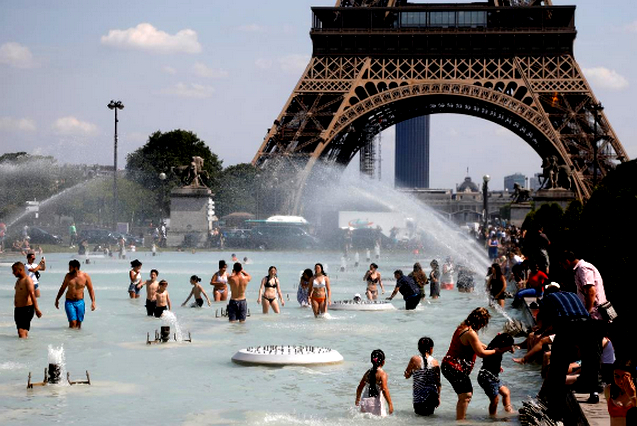
People cool off in the Trocadero fountains across from the Eiffel Tower in Paris as a heatwave hit much of the country, France, June 25, 2019. REUTERS/Charles Platiau
“Climate change is no longer an abstract increase in global mean temperature, but a difference you can feel when you step outside in a heatwave,” said Geert Jan van Oldenborgh, Senior Researcher at the Royal Netherlands Meteorological Institute and one of the paper’s authors.
“The observations show ... similarly frequent heat waves would have likely been about 4C cooler a century ago,” said the report by the World Weather Attribution group of scientists.
It also said that climate change had made the record-breaking heatwave at least five times more likely.
“We experienced a heatwave whose intensity could become the norm in the middle of the century,” said Robert Vautard, senior scientist at France’s CNRS institute.
Climate scientists have long said that a warming of the earth’s surface caused mainly by industrial-era emissions of carbon-dioxide from fossil fuels will make weather events more extreme, and make those extremes - such as storms, drought and flooding - more frequent.
The World Weather Attribution group used computer models over three days from June 26-28 to calculate the temperatures they would otherwise have expected.
France’s new record modern-day temperature, registered in Gallargues-le-Montueux, in the southerly Provence region, was nearly two degrees above the previous high recorded in August 2003.
Meteorologists say a weakening of the high-level jet stream over Europe is increasingly causing weather systems to stall and leading summer temperatures to soar.
The World Meteorological Organization said on Friday that 2019 was on track to be among the world’s hottest years, and that 2015-2019 would then be the hottest five-year period on record.
It said the European heatwave was “absolutely consistent” with extremes linked to the impact of greenhouse gas emissions.

Links

Antarctic Sea Ice Declining ‘Precipitously’ Since 2014, Study Finds

Mongabay - 

Sea ice in Admiralty Bay, King George Island, Antarctica. Image by Acaro via Wikimedia Commons (CC BY-SA 3.0).

Key Points:
  • After decades of overall increase, Antarctica’s sea ice has been rapidly decreasing since 2014, according to a new study.
  • Between 2014 and 2017, Antarctica suffered a precipitous decline, losing more yearly average sea ice in just three years than that observed in the Arctic over a period of 33 years.
  • There was a small increase in the yearly average sea ice in Antarctica from 2017 to 2018, but there has been a decline in 2019 again. Whether the small uptick in 2018 is a blip in an otherwise long-term downward trend of Antarctic sea ice extent or the start of a rebound, is difficult to say, Claire Parkinson of NASA writes.
  • Whether the changes are because of climate change or something else also remains to be seen, researchers say.
For decades, sea ice in Antarctica has increased while that in the Arctic has declined drastically. But in a puzzling turn of events, Antarctic sea ice has been decreasing rapidly since 2014, a new study has found.
Whether the changes are because of climate change or something else remains to be seen, study author Claire Parkinson of NASA’s Goddard Space Flight Center says.
Parkinson, who analyzed satellite measurements of Antarctic sea ice over a 40-year period from 1979 to 2018, found that the yearly average sea ice extent peaked in 2014.
But over the next three years, from 2014 to 2017, the sea ice extent hit its lowest average annual levels.
Where the yearly average sea ice extent was a record-high at 12.8 million square kilometers (5 million square miles) in 2014, it reached 10.75 million square kilometers (4 million square miles) in 2017, with a record-low average monthly sea ice extent of 2.29 million square kilometers (0.88 million square miles) in February 2017.
In fact, between 2014 and 2017, Antarctica suffered a precipitous decline, Parkinson writes, losing more yearly average sea ice in just three years than that observed in the Arctic over a period of 33 years.
Is this downward trend going to continue? Researchers aren’t sure.
“But it raises the question of why, and are we going to see some huge acceleration in the rate of decrease in the Arctic? Only the continued record will let us know,” Parkinson told the Guardian.
Despite multiple hypotheses, researchers are yet to figure out why Antarctica’s sea ice extent has generally increased since 1979.
The cause of the recent decline, too, is a mystery.
The satellite measurements, for example, showed a small increase in the yearly average sea ice in Antarctica from 2017 to 2018, but there has been a decline in 2019 again. Whether the small uptick in
2018 is a blip in an otherwise long-term downward trend of Antarctic sea ice extent or the start of a rebound, is difficult to say, Parkinson writes in the paper.
Moreover, even during the decades of overall increase in Antarctic sea ice, there have been periods of declines followed by an increase.
“There was a period in the 1970s when the Antarctic also had a huge decrease in sea ice and then increased,” Parkinson told New Scientist.
“So it could be this huge decrease over a few years [2014 to 2017] is going to reverse.”
Parkinson had previously shown that the increases in Antarctic sea ice through 2014 did not compensate for the rapid loss of sea ice in the Arctic.
This was because “the decreases in Arctic sea ice far exceed the increases in Antarctic sea ice,” she told NOAA Climate.gov in March this year.

Sea ice extent in Antarctica has plunged since 2014
Annual average extent in square kilometres
Guardian graphic | Source: Parkinson, PNAS, 2019
The Antarctic represents a complex system, and Parkinson says she hopes the 40-year satellite data will spur more research.
“I hope that the 40-y record discussed in this paper will encourage further studies into the atmospheric and oceanic conditions that could have led to the extremely rapid 2014-2017 decline of the Antarctic sea ice cover, the comparably rapid decline in the mid-1970s, and the uneven but overall gradual increases in Antarctic sea ice coverage in the intervening decades,” she writes in the paper.


Antarctic sea ice plunges from record high to record lows

Links

04/07/2019

This Was The Hottest June In History, And Summer Is Just Getting Started

Grist

Mustafa Yalcin / Anadolu Agency / Getty Images   
If sometime during the past month you wiped sweat from your brow and thought, “Damn, it’s hot!” then congrats, your body knows what’s up. This past month was the hottest June ever recorded on planet Earth, according to the European Union’s Earth observation program, which announced the new record on Tuesday.
The unprecedented heat brought death, destruction, and misery to huge swaths of the planet. By the middle of June, more than 35 people had died as temperatures soared past 120 degrees Fahrenheit in India. France set a new national temperature record: 115 degrees. Multiple wildfires broke out in Spain, one of them, a 10,000-acre blaze, might have started when heat caused a pile of manure to burst into flames. One European heat map turned such a violent shade of red it looked like an open-mouthed skull in mid-scream (you have to see it to believe it). And, get this: Summer is just getting started.
In Europe, June temperatures were 3.6 degrees Fahrenheit higher than normal, according to the European program called Copernicus. Globally, temperatures were about a fifth of a degree higher than normal for the month, beating out the record set in 2016.
Here’s another worrisome finding from the report : If you compare the last several days of June to the average for the same several days between 1981 to 2010, temperatures this year were around 10 to 18 degrees F higher than normal over much of Western Europe — France, Germany, northern Spain, northern Italy, Switzerland, Austria, and the Czech Republic.
Super weird that temperatures just decided to spike like that. There’s no way humans have anything to do with it, right?
Heat waves like the one that just gripped Europe are not always directly linked to anthropogenic climate change, but extreme weather events are made worse by higher concentrations of greenhouse gases.
Another report released Tuesday from World Weather Attribution found that such heat waves are happening about 10 times more often now than they were a century ago. “Every heatwave occurring in Europe today is made more likely and more intense by human-induced climate change,” the report said.
Perhaps all this sweltering weather will spur governments to fulfill their commitments to slash carbon emissions. Barring that, it’s probably time to invest in a good air conditioner (and, yes, we know that comes with plenty of problems, too).

Links

Heatwave - Climate Change Connections In One Simple Analogy

ForbesMarshall Shepherd

Dr. J. Marshall Shepherd
Dr. Marshall Shepherd is a leading international expert in weather and climate.
He was the 2013 President of American Meteorological Society (AMS) and is Director of the University of Georgia’s (UGA) Atmospheric Sciences Program.
Dr. Shepherd is the Georgia Athletic Association Distinguished Professor and hosts The Weather Channel’s Weather Geeks Podcast, which can be found at all podcast outlets. 
Prior to UGA, Dr. Shepherd spent 12 years as a Research Meteorologist at NASA-Goddard Space Flight Center and was Deputy Project Scientist for the Global Precipitation Measurement (GPM) mission
A devastating heatwave is happening in Europe right now. Temperature records are falling and not just by a small margin. The death toll is starting to rise and is prompting memories of the 2003 European heatwave that killed 30,000 to 50,000 people according to most estimates. The World Meteorological Organization tweeted on Friday:
For the first time on record, #France sees a temperature above 45°C. Villevieille measured 45.1°C this afternoon at 1459, topping the previous record of 44.3°C set just an hour previously, per @meteofrance  #heatwave #climatechange
According to meteorologists at Weather.com, a large high pressure system over Europe is the "weather" factor responsible for the heatwave.  Weather is, in part, governed by the space-time patterns of a series of waves in that fluid overhead called the atmosphere. It exhibits natural and day-to-day variability. An atmospheric "road block," if you will, near Greenland responsible for record melting there is also altering the aforementioned global wave pattern and causing extreme heat in Europe. Some voices will roll out the predictable narrative that heatwaves happen naturally. They do. However, an increasing body of scientific literature and simple common sense tells us that something else is going on too.

Oppressive heat is ravaging Europe. European Space Agency
University of Georgia atmospheric sciences professor John Knox offered one of the most compelling and clear analogies to explain why an anthropogenic climate change signal is increasingly associated with events like the European heatwave. Knox wrote:
The old record for the nation was 44.1C (111.4F), from the deadly 2003 heat wave in Europe. So, France just bested its high temperature by 3 degrees Fahrenheit. That's a lot. As with, say, 100-meter dash records in seconds, national temperature records in degrees should be broken in tenths, really hundredths--not integer values.If this were the world of track and field, a new record of this extremity would prompt immediate concerns about doping. The runner is fast, but no way is he or she THAT fast.
By the way, an astute Tweet noted by @robsobs pointed out, "Note that at least 12 other “runners” beat the previous record as well, and all of this happened before the usual peak heat period."

Persistent high pressure aloft is part of the weather pattern explaining the current European heatwave. Tomer Burg's Model Page
Of course, you have the small but very loud crowd that will spew cliche and irrelevant points that actual climate scientists are aware of or have long considered. For example, I saw a person imply that it is not a big deal to have a heatwave in the summer. Professor Knox agrees but points out that summer in France can be hot, but it should not be this hot and certainly not this early. Further, actual climate scientists have assessed how contemporary extreme events are linked to climate change. Previously in Forbes, I summarized the 2016 National Academy of Science report on attribution:
Confidence is greatest for extreme events related to aspects of temperature (e.g. extreme heat and lack of extreme cold events). Attribution science is relatively young but has advanced rapidly. The National Academy panel noted that attribution is most reliable when there are sound physical principles, consistent observational evidence, and the ability for numerical models to replicate the event. These "three legs of the stool" were used as benchmarks to rate the confidence.
The graphic  below conveys that there is very high confidence that the "fingerprint of climate change" is smudged all over the current generation of heatwaves on Earth. Numerous studies affirm that heat waves are increasing (and will continue to) in frequency or intensity as climate changes. A 2018 study in Environmental Research Letters found that across 571 cities:
  • heatwave days increase in future climate model scenarios, particularly in southern Europe
  • the greatest heatwave temperature increases are in central Europe
Another climate zombie theory (something that keeps coming up though scientists have long disproven it) seen floating around the Internet is that all of the numbers are wrong because the thermometers are in cities or near asphalt. You will typically see some cherry-picked image of a thermometer near a road or building. I always find this one to be amusing because climate scientists are smart enough to know about urban biases. In fact, I wrote an entire article (link) about this misguided attempt to confuse people.
The current heatwave is very dangerous. The combination of record high maximum and minimum temperatures is a double whammy for humans. Warm nighttime temperatures are particularly dangerous for vulnerable populations like the elderly, children, or people without sufficient air conditioning.
As I close, it should be noted that not once did I mention a polar bear or the year 2080. These are "here and now" concerns.

Confidence in extreme weather events and linkages to climate change. National Academy of Science report

Links

It’s Time To Change The Climate Disaster Script. People Need Hope That Things Can Change

The Guardian*

The climate story must balance talk of urgency with hopeful and creative ideas if we are to inspire positive change 
‘The future of our planet – and how it is possible to save it – is a story worth telling.’ Extinction Rebellion activists in London. Photograph: Jamie Lowe/Courtesy of Extinction Rebellion 
“Hell  is coming,” one weather forecaster tweeted this week, warning not of further political turmoil but of the hottest heatwave in decades that’s advancing across continental Europe. Extreme weather events like this remind us that climate change is not a remote and distant threat – but a reality that is already taking an unacceptable human toll.
In recent months, Extinction Rebellion and the school climate strike have turned up the heat on the climate debate. They’ve both done an astonishing job of getting the climate change back on the public and political agendas. Their warnings of impending apocalypse, disruptive tactics and robust demands that others “tell the truth” about climate change have made huge waves. Parliament has declared a climate emergency. The Guardian has updated its own editorial guidelines to use language that accurately reflects the threat that climate change poses.
These demands and promises to tell the truth are based on a core premise: if people knew how bad this was we’d do differently. My organisation studies how we respond to and are shaped by the stories the we hear. I welcome the renewed energy within the climate movement – and the recognition of the power of language. But I fear we risk underplaying the part of “the truth” that could set us free.
Most people in the UK know climate change is a big problem. We understand it poses a grave threat to the future of our world. But we’re not trying to save ourselves – at least, we’re not trying hard enough.
Communications science offers some clues as to why we might be locked in this collective paralysis – somewhat able to see the problem but unable to deal with it. Our brains are hardwired to jump to conclusions without us noticing we’re doing it. When faced with serious and complex challenges such as climate change, we jump to “can’t be done” more readily than “let’s work through this problem and see the solutions”. While bleak, “nothing can be done” is a more rewarding conclusion because it’s quicker and easier to think.
The tendency to think fatalistically is fuelled by the stories we hear every day. The word “crisis” appears in our media dozens of times each week, appended to everything from poverty to patisseries, climate change to chick peas. It is background noise. Stating loudly that problems exist and have reached crisis point does not help us to move beyond said crises, especially if they are hard to understand and tough to tackle.
The stories we hear and tell matter. They shape how we understand the world and our part within it. Just as hearing migrants described in dehumanising ways flips a switch in our minds and creates automatic negative responses, a steady stream of wholly negative language and ideas creates mental shortcuts to despair and hopelessness.
Research is clear that to overcome fatalism and inspire change we must balance talk of urgency with talk of efficacy – the ability to get a job done. Too little urgency and “why bother?” is the default response. Too much crisis and we become overwhelmed, fatalistic or disbelieving – or a disjointed mixture of all three, which is where most of us get stuck when anyone talks about climate change.
We are all swayed by what we think other people think and what we see as normal. In post-war Rwanda a radio soap opera succeeded where other attempts to change relationships and interactions failed. By depicting positive relationships between opposing ethnic groups, the soap made these relationships seem normal and improved dynamics.
‘Extinction Rebellion and the schools climate strike have turned up the heat on the climate debate.’ Student climate protests in London. Photograph: Peter Marshall/Alamy Stock Photo
We need to change what’s normal and what’s perceived to be normal. And at the moment we think, and are constantly told, that most people don’t care enough. And the ones who do care are often not relatable to most people. We’re led to believe that inaction is the norm and that not much can be done. Upping the ante only by doing more to illustrate the scale of inaction and the high stakes doesn’t change this, it compounds it.
When Martin Luther King inspired a nation and the world he led with the dream, not the nightmare. When JFK persuaded the American public to support the Apollo programme he balanced the need to act with the ability to do so: “We choose to go to the moon in this decade and do the other things, not because they are easy, but because they are hard; because that goal will serve to organise and measure the best of our energies and skills, because that challenge is one that we are willing to accept, one we are unwilling to postpone, and one we intend to win.”
This is not the story being told about climate change. Instead we’re stuck in a climate disaster movie – and it’s not even a very good one. The threat is complex and can feel remote, but we’re told the chances of survival are slim. There are constant warnings but few heroes in sight. Our response is predictable: we switch off or we change the channel.
The climate story can evolve from its current emphasis on chastisement and detachment. The future of our planet – and how it is possible to save it – is a story worth telling. And retelling in ever more interesting and inspiring ways.
To help us avoid the worst effects of climate change we need a steady stream of stories that bring to life our capacity to dream big and get things done. We need high doses of creativity and ingenuity from a wide range of different voices. We need stories that show real life – and real life as it could be. We need to be able to see, feel and taste what we could do if leaders led and hope triumphed.

*Nicky Hawkins is a communications strategist for the FrameWorks Institute

Links

03/07/2019

NSW Set To Fall Short Of Climate Targets But Victoria On Track

Sydney Morning HeraldNicole Hasham

NSW and Queensland appear set to fall short of their self-imposed targets for cutting greenhouse gas pollution and phasing out fossil fuels, as responsibility for climate action in the electricity sector increasingly falls to the states.
But analysis by research and advisory group Green Energy Markets found Victoria, South Australia and Tasmania are on track to hit their climate goals.
NSW and Queensland must make up ground to meet their climate targets in the electricity sector, analysis has found. Credit: Michele Mossop
Electricity is considered the most cost-effective sector of the economy in which to slash greenhouse gas pollution, largely because zero-emission wind and solar technology already exists.
However, Australia's renewable energy target peaks in 2020 and since the collapse of the National Energy Guarantee last year, the Morrison government has not had a major policy to cut emissions in the sector. This leaves state policies as the key driver of investment in renewable energy generation.
Green Energy Markets examined progress on climate targets by the five eastern-most states that make up the national electricity market.
It found the most populous state, NSW, was not on pace to meet its target of net-zero emissions from the electricity sector by 2050.
On current trends, renewables would comprise 28 per cent of NSW's total electricity use by 2030, based on expected rooftop solar uptake and new wind and solar projects. This was well below the 46 per cent renewables share needed by 2030 if NSW was to meet its 2050 target, the report said.
NSW needs almost 5000 megawatts of new renewable energy projects over the next decade to bridge the gap.
Green Energy Markets director Tristan Edis said there had been commitments to construct 2800 megawatts of renewables projects in NSW over the past three years, so the state's catch-up task was "readily achievable" by 2030.
The Queensland Labor government wants renewables to make up 50 per cent of the electricity mix by 2030. However, the state is currently tracking towards a 29 per cent renewables share, based on existing wind and solar commitments and expected rooftop solar growth.
Hydro Tasmania's Devils Gate Dam spill. The state is tracking well to meet its target for 100 per cent renewable energy, including hydro power, by 2022.


If all states achieved their targets, enough construction jobs would be created to employ 32,000 people for a year, the analysis showed.
Victoria was already close to achieving its goal of 40 per cent electricity generation from renewable sources by 2025, the report found. It required just 2000 megawatts of new projects to reach its target of 50 per cent renewables by 2030.
South Australia was on track to meet its goal that renewables comprise 73.5 per cent of electricity consumption by 2030, and Tasmania did not need any new projects to reach its 100 per cent renewables goal by 2022.
A spokeswoman for the NSW Department of Planning, Industry and Environment said the state was “reducing emissions at one of the fastest rates in Australia”.
“The government is supporting record investment in solar and wind and, in the last five years, energy generation from these sources has tripled in NSW,” she said.
Between 2018 and 2022 the NSW government will spend $1.4 billion to drive investment in renewable energy, emerging technology and climate action.
Queensland Energy Minister Anthony Lynham said the Palaszczuk government was on track to meet its 50 per cent renewable target by 2030, citing a recent report by the Clean Energy Council that described the state as "the renewable energy construction capital of Australia".
"Despite the lack of any coherent or consistent energy policy from the commonwealth government, Queensland continues to embrace a renewable future," Dr Lynham said, adding that the states "have been left alone to do the heavy lifting on tackling climate change".

Links

Lethal Heating is a citizens' initiative