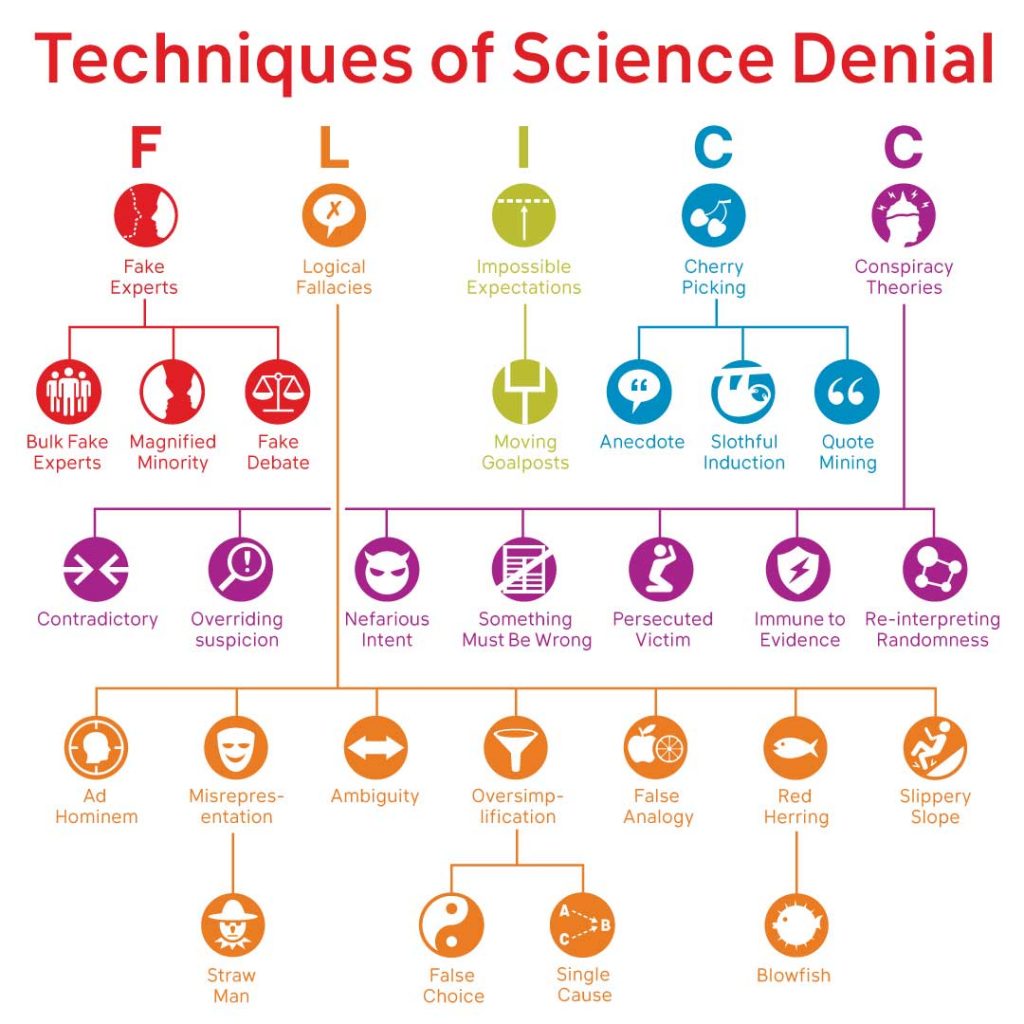
In 2007, Mark Hoofnagle suggested on his Science Blog Denialism that denialists across a range of topics such as climate change,
evolution, & HIV/AIDS all employed the same rhetorical tactics to
sow confusion. The five general tactics were conspiracy, selectivity
(cherry-picking), fake experts, impossible expectations (also known as
moving goalposts), and general fallacies of logic.
Two years later, Pascal Diethelm and Martin McKee published an article in the scientific journal European Journal of Public Health titled Denialism: what is it and how should scientists respond? They
further fleshed out Hoofnagle’s five denialist tactics and argued that
we should expose to public scrutiny the tactics of denial, identifying
them for what they are. I took this advice to heart and began including
the five denialist tactics in my own talks about climate misinformation.
In 2013, the Australian Youth Climate Coalition invited me to give a workshop about climate
misinformation at their annual summit. As I prepared my presentation, I
mused on whether the five denial techniques could be adapted into a
sticky, easy-to-remember acronym. I vividly remember my first attempt:
beginning with Fake Experts, Unrealistic Expectations, Cherry Picking…
realizing I was going in a problematic direction for a workshop for
young participants. I started over and settled on FLICC: Fake experts,
Logical fallacies, Impossible expectations, Cherry picking, and
Conspiracy theories.
As I begun developing the Cranky Uncle game,
I began a series of fallacy quizzes where I gradually built the
taxonomy up as I introduced people to an ever-growing collection of
denial techniques (note the differing difficulty levels between quiz #1 and quiz #8).
When I visited Brisbane in December 2019, I asked the University of
Queensland if I could record a video explaining the updated FLICC
taxonomy. They agreed but once they saw my script, including
explanations and definitions of each denial technique, they suggested I
divide the video into a three-parter. Always a sucker for a trilogy, I agreed – here are the three videos:
As well as the videos, this post includes written definitions and
examples of each denial technique. I will continue to update this table
as the taxonomy evolves in the future.
TECHNIQUE
DEFINITION
EXAMPLE
Ad Hominem
Attacking a person/group instead of addressing their arguments.
“Climate science can’t be trusted because climate scientists are biased.”
Ambiguity
Using ambiguous language in order to lead to a misleading conclusion.
“Thermometer readings have uncertainty which means we don’t know whether global warming is happening.”
Anecdote
Using personal experience or isolated examples instead of sound arguments or compelling evidence.
“The weather is cold today—whatever happened to global warming?”
Blowfish
Focusing on an inconsequential aspect of scientific research, blowing it out of proportion in order to distract from or cast doubt on the main conclusions of the research.
“The hockey stick graph is invalid because it contains statistical errors.”
Bulk Fake Experts
Citing large numbers of seeming experts to argue that there is no scientific consensus on a topic.
“There is no expert consensus because 31,487 Americans with a science degree signed a petition saying humans aren’t disrupting climate.”
Cherry Picking
Carefully selecting data that appear to confirm one position while ignoring other data that contradicts that position.
“Global warming stopped in 1998.”
Contradictory
Simultaneously believing in ideas that are mutually contradictory.
“The temperature record is fabricated by scientists… the temperature record shows cooling.”
Conspiracy Theory
Proposing that a secret plan exists to implement a nefarious scheme such as hiding a truth.
“The climategate emails prove that climate scientists have engaged in a conspiracy to deceive the public.”
Fake Debate
Presenting science and pseudoscience in an adversarial format to give the false impression of an ongoing scientific debate.
“Climate deniers should get equal coverage with climate scientists, providing a more balanced presentation of views.”
Fake Experts
Presenting an unqualified person or institution as a source of credible information.
“A retired physicist argues against the climate consensus, claiming the current weather change is just a natural occurrence.”
False Analogy
Assuming that because two things are alike in some ways, they are alike in some other respect.
“Climateskeptics are like Galileo who overturned the scientific consensus about geocentrism.”
False Choice
Presenting two options as the only possibilities, when other possibilities exist.
“CO2 lags temperature in the ice core record, proving that temperature drives CO2, not the other way around.”
Immune to evidence
Re-interpreting any evidence that counters a conspiracy theory as originating from the conspiracy.
“Those investigations finding climate scientists aren’t conspiring were part of the conspiracy.”
Impossible Expectations
Demanding unrealistic standards of certainty before acting on the science.
“Scientists can’t even predict the weather next week. How can they predict the climate in 100 years?”
Logical Fallacies
Arguments where the conclusion doesn’t logically follow from the premises. Also known as a non sequitur.
“Climate has changed naturally in the past so what’s happening now must be natural.”
Magnified Minority
Magnifying the significance of a handful of dissenting scientists to cast doubt on an overwhelming scientific consensus.
“Sure, there’s 97% consensus but Professor Smith disagrees with the consensus position.”
Misrepresentation
Misrepresenting a situation or an opponent’s position in such a way as to distort understanding.
“They changed the name from ‘global warming’ to ‘climate change’ because global warming stopped happening.”
Moving Goalposts
Demanding higher levels of evidence after receiving requested evidence.
“Sea levels may be rising but they’re not accelerating.”
Nefarious intent
Assuming that the motivations behind any presumed conspiracy are nefarious.
“Climate scientists promote the climate hoax because they’re in it for the money.”
Overriding suspicion
Having a nihilistic degree of skepticism towards the official account, preventing belief in anything that doesn’t fit into the conspiracy theory.
“Show me one line of evidence for climate change… oh, that evidence is faked!”
Oversimplification
Simplifying a situation in such a way as to distort understanding, leading to erroneous conclusions.
“CO2 is plant food so burning fossil fuels will be good for plants.”
Persecuted victim
Perceiving and presenting themselves as the victim of organized persecution.
“Climate scientists are trying to take away our freedom.”
Quote Mining
Taking a person’s words out-of-context in order to misrepresent their position.
“Mike’s trick… to hide the decline.”
Re-interpreting randomness
Believing that nothing occurs by accident, so that random events are re-interpreted as being caused by the conspiracy.
“NASA’s satellite exploded? They must be trying to hide inconvenient data!”
Red Herring
Deliberately diverting attention to an irrelevant point to distract from a more important point.
“CO2 is a trace gas so it’s warming effect is minimal.”
Single Cause
Assuming a single cause or reason when there might be multiple causes or reasons.
“Climate has changed naturally in the past so what’s happening now must be natural.”
Slippery Slope
Suggesting that taking a minor action will inevitably lead to major consequences.
“If we implement even a modest climate policy, it will start us down the slippery slope to socialism and taking away our freedom.”
Slothful Induction
Ignoring relevant evidence when coming to a conclusion.
“There is no empirical evidence that humans are causing global warming.”
Something must be wrong
Maintaining that “something must be wrong” and the official account is based on deception, even when specific parts of a conspiracy theory become untenable.
“Ok, fine, 97% of climate scientists agree that humans are causing global warming, but that’s just because they’re toeing the party line.”
Straw Man
Misrepresenting or exaggerating an opponent’s position to make it easier to attack.
“In the 1970s, climate scientists were predicting an ice age.”
As global heating makes coral bleaching a regular event, scientists are urgently seeking ways to help the world’s biggest reef survive
Zoe Richards has seen great changes in the corals off Lizard Island since she started monitoring them in 2011. Photograph: Mike Emslie
When coral scientist Zoe Richards left the Great Barrier Reef’s Lizard Island in late January, she was feeling optimistic.
Richards is a taxonomist. Since 2011 she has recorded and monitored 245 coral species at 14 locations around the island’s research station, about 270km north of Cairns.
In 2017 she saw “mass destruction of the reef”. Back-to-back mass bleaching in 2016 and 2017, and cyclones in 2014 and 2015, had wreaked havoc.
But in January, she saw thousands of new colonies of fast-growing Acropora corals that had “claimed the space” left by dead and degraded corals. In a three-year window without spiralling heat or churning cyclones, some corals were in an adolescent bloom – not mature enough to spawn, but getting close.
“It was an incredible recovery,” says Richards, of Curtin University. “But I knew if it was hit again, it would be trouble – and that’s exactly what happened.”
In 2020, mass bleaching returned to Lizard Island – perhaps not as badly as in previous years – but enough, says Richards, to turn the clock back on the recovery she had seen.
This summer has delivered a third mass bleaching for the reef in just five years. The back-to-back bleaching of 2016 and 2017 was mostly confined to the northern and central sections.
Data from aerial surveys is still being analysed, but the Great Barrier Reef Marine Park Authority has said preliminary results suggest the 2020 bleaching had a much broader footprint.
When bleaching is mild, corals can and do recover, although it can make them more susceptible to disease. But severe bleaching can kill corals. Estimates are that the 2016 bleaching killed about 29% of the reef’s shallow water corals and the 2017 event took another 19%.
Some scientists are now concerned global heating may have reached a point where tropical reefs bleach almost every year.
What this means for the reef in the coming decades is an area of live research and debate among scientists.
Can we fix it?
Scientists Guardian Australia spoke to say the reef’s fortunes hang on the answers to two questions.
The first is whether governments around the world will make deeper cuts to greenhouse gas emissions than they have already agreed and, if so, how close they will get to keeping global heating to 1.5C.
A second is whether efforts to first identify and then deploy a swathe of potential measures that could reduce the impact of rising temperatures will be successful.
What seems clear is that without some human intervention, the magic of the world’s greatest coral reef system will be lost.
Prof Peter Mumby, professor of coral reef ecology at the University of Queensland, is the chief scientist at the Great Barrier Reef Foundation – the once-small not-for-profit that was awarded a controversial $443m government grant in 2018.
I’m fearful that in the next 10 years we will see the loss of coral across the planet at phenomenal rates Ove Hoegh-Guldberg
He said the 2020 bleaching “is giving us greater pause, given it seems we can see quite frequent coral bleaching events earlier than people had previously expected”.
Mumby says bleaching events have been “patchy”, and the fact that some areas have escaped “means there’s an opportunity for management”.
What keeps the reef functioning as a single ecosystem is the way each reef connects to another through the way corals reproduce. They all either spawn, or produce larvae, that can float in the water column and settle on nearby reefs.
Mumby and colleagues have identified about 100 reefs along the GBR that are well spread, well connected to other reefs by ocean currents, and tend to experience cooler temperatures.
He says making sure those reefs stay as healthy as possible – in particular by managing outbreaks of the coral-eating crown of thorns starfish – could be crucial in keeping the wider reef viable.
The reef’s unrivalled size and diversity – almost 4,000 reefs, cays and islands stretching for more than 2,000 kilometres – gives it extra resilience, he says. Climate change is still the reef’s biggest threat and society will need to focus on tackling it, “but there needs to be a way to adapt to how we manage reefs so that they can roll with the punches – we have to do both those things”.
The Australian Institute of Marine Sciences (AIMS) has produced an as-yet unpublished study, sent to the federal government, that reviews more than 160 different interventions that have been suggested for the reef, identifying about 40 that could be worth further study.
Heat-stressed corals off Lizard Island in February 2020. Photograph: Dr Lyle Vail, Director of the Australian Museum’s Lizard Island Research Station
Dr Lina Bay, a principal research scientists at AIMS, says one promising area of study is what’s known as “assisted gene flow”, where the spawn of corals with better tolerance for heat could be captured and then dispersed.
“Not all corals are created equal,” she says. “Some have a higher stress tolerance than others. Over many years we’ve shown that the variation in bleaching tolerance is hereditable – it gets passed from parents to offspring.”
She says these differences can exist even among the same species, meaning those corals can be selectively grown in a lab setting to promote more heat tolerance.
AIMS scientist Dr Neal Cantin has just finished a three-year experiment with one fast-growing coral species called Pocillopora acuta, which behaves like a weed by filling in the gaps when less hardy corals die off.
Starting with 90 parent specimens taken from three different parts of the Great Barrier Reef, Cantin and colleagues grew 7,500 offspring and then subjected them to rising levels of CO2 and temperatures of up to 2C warming.
Even at high temperatures, some of these corals survived, and they were able to tolerate higher levels of heat as the experiment went on.
Having a street-fighting weedy coral like this is important, says Cantin. Dead areas of coral reefs tend to get covered in algae, but Cantin says a weedy coral that can compete with the algae can then make room for slower-growing corals to also grow.
“The whole goal of a lot of these interventions is to work with species that can be successful on their own. We won’t be able to work with 600 species of corals, but we could probably work with 20 that fill the functional roles of a healthy reef community.
“You can’t deny bleaching events are becoming more frequent and more severe and they’re impacting across a bigger area than before. We can just document that demise, or we can learn from it and have some corals for future generations.”
A bleached specimen of Acropora clathrata on the Great Barrier Reef. Photograph: Zoe Richards
That demise is clear and it happens at scale, and also in detail. Zoe Richards has already seen evidence of likely local extinctions of some corals at Lizard Island. One is a spiralised plate coral – Acropora clathrata – that she hasn’t been able to find for years.
“It’s these silent extinctions that go on,” she says.
“The entire reef is operating like one big meta population with sub-populations that are connected to each other. If you successively take out nodes in that population, sooner or later you will end up with parts that don’t connect. It will be fragmented into subsets that will continue to erode in terms of diversity. It’s degradation of the [coral] community at a very large scale.”
‘At 3C, you basically have nothing’
Prof Ove Hoegh-Guldberg, of the University of Queensland, has done pioneering work on the study of coral bleaching going back to the mid-1980s.
He remembers Lizard Island as a “picture perfect” place to do research on corals in the late 80s, when his research there found rising temperatures caused corals to lose their “symbionts” – the algae that lives in the coral and gives them much of their nutrients and colour.
The Great Barrier Reef’s first major mass bleaching event happened in 1998. There was another in 2002, and again in 2016, 2017 and 2020.
Hoegh-Guldberg says: “We knew there was a temperature effect, and we knew that temperatures were going up. At the end of the 90s, I could put those two things together.”
The year after the reef’s first mass bleaching, Hoegh-Guldberg took climate models to forecast that if greenhouse gas emissions kept growing then, by 2020, “the average bleaching event is likely to be similar or greater than the 1998 event”.
As 2020 approached, the models showed reefs across the northern, central and southern regions would see between eight and 10 bleaching events per decade.
“I wished I’d been wrong” he says. “I think I said at the time that I’d have egg on my face if I was wrong. But there’s no egg on my face.”
Corals at Lizard Island had been showing signs of recovery before this year’s bleaching. Photograph: Dr Lyle Vail, Director of the Australian Museum’s Lizard Island Research Station
Hoegh-Guldberg says manually replanting corals is uneconomic at scale but there’s merit in helping the dispersal of coral larvae, pointing to a technique being developed by a scientist at Southern Cross University that captures millions of larvae in floating pools.
But he says the main game is keeping global heating down.
“Let’s say we get to 1.5C and then we can stabilise – that’s really the last call for reefs. Corals will come back and there will be winners and losers, but you’ll have a functional reef that supports fisheries and tourism.”
The problem is that right now, government pledges under the Paris agreement are enough to raise temperatures by 3C – not 1.5C.
“At 2C all the reef-building corals have plummeted and instead you are looking at the dominance of other organisms like algae. At 3C you basically have nothing.
“I’m fearful that in the next 10 years we will see the loss of coral across the planet at phenomenal rates,” he says. “That’s what keeps me up at night.”
Airlines, farmers and plastic bag makers look for relief amid the pandemic. But the coal industry, and wind and solar energy concerns, lose out in the relief bill.
New York Mayor Bill De Blasio hands out reusable bags on Feb. 28, 2020, ahead of a plastic bag ban. The ban was postponed because of the coronavirus pandemic. Credit: Lev Radin/Pacific Press/LightRocket via Getty Images
With
the attention of lawmakers and government agencies focused on the
global coronavirus pandemic, polluting industries have seized on the
opportunity to advance their own interests.
In the days leading up to President Donald Trump's signing of a $2.2
trillion relief bill, lobbyists descended on Washington in an attempt to
squeeze as much as possible out of the U.S. Treasury.
Some industries,
including agriculture and aviation, got major boosts; others, notably
coal and clean energy, were left disappointed.
As the number of infections and deaths from the coronavirus pandemic
continues to rise and the economic fallout starts to hit more Americans,
industries are scrambling to stay afloat and save jobs. But some,
critics say, are exploiting the situation to their advantage,
potentially at a cost to the climate.
This week, after a request from the oil industry, the Environmental Protection Agency issued a suspension of its enforcement of environmental laws, a move that critics say will let the industry pollute indefinitely.
Environmental
and advocacy groups say they are concerned that other agencies will
follow suit, allowing industries to capitalize on the crisis. And some
are already trying to get what they can.
The
plastics industry, for example, is using the COVID-19 pandemic to try
to save what has become in many peoples' minds a global villain—the
single-use plastic bag. Their
actions come after a growing number of states and cities have banned
plastic bags or slapped fees on their use in retail and grocery stores.
Plastic bags and all kinds of other plastics are choking the oceans,
with microscopic bits of plastic getting into human bodies, giving the
industry a bad reputation. And plastics manufacturing and incineration are contributing to global warming.
But seeing an opportunity in the global crisis, the Plastics Industry
Association has asked the U.S. Department of Health and Human Services
to declare the bans on plastic bags a health risk, and "to speak out
against bans on these products as a public safety risk and help stop the
rush to ban these products by environmentalists and elected officials
that puts consumers and workers at risk."
The
industry cites studies or reports, including at least one paid for by
the plastics industry, that claim dirty reusable bags spread germs.
Those are findings that are disputed by others, including Greenpeace,
which describes the industry efforts as "a profit-driven distraction."
But the industry is succeeding in getting some traction, at least temporarily:
Maine delayed its ban on single-use plastic bags from April 22 to Jan. 15, 2021.
New Hampshire Gov. Chris Sununu temporarily banned reusable bags in grocery stores, as did Massachusetts Gov. Charlie Baker, who also lifted all local plastic bag bans in his state.
Charleson, South Carolina, had banned plastic bags effective on Jan. 1, but last week suspended that ban for 60 days, as part of its response to COVID-19.
New York, the epicenter of the coronavirus outbreak in the
United States, has delayed enforcing its new statewide plastic bag ban
until April 1, but officials said that's only because of a legal
challenge unrelated to the pandemic.
Some retail stores are prohibiting their customers from using
reusable bags while others still allow them, or do so only if customers
fill them.
To Judith Enck, a former regional administrator for the U.S.
Environmental Protection Agency who runs the Beyond Plastics campaign,
the industry's efforts are unfortunate.
"I am quite disturbed that the plastics industry is exploiting this
pandemic with unfounded information," Enck said, adding, "What I am most
worried about is permanent repeal of plastic bag bans."
The
relief package passed by Congress directs $14 billion to the country's
farms through the Commodity Credit Corporation, a Depression-era program
designed to stabilize farm income and ensure stable supplies of major
crops. It also directs another $9.5 billion to fruit and vegetable
growers, livestock producers and those farmers who sell directly to
markets.
The infusions were welcomed across the board by progressive and
conservative farming groups. But some advocates for climate-friendly
farming are concerned that the dollars will end up with mega-farms and
multinational agriculture corporations that have pushed against
sustainable, climate-forward farming.
Over the last two years, the Trump administration has given American
farmers nearly $28 billion in bailouts to compensate for losses linked
to the administration's trade war with China. Critics said most of that
went to larger farms and worry the new funds could be spent the same
way.
"The defining element of this aid package is a total lack of
specificity," said Eric Deeble, policy director for the National
Sustainable Agriculture Coalition. "It's not that people didn't try to
do hard work; it's just that when they tried to get specific, it started
to fall apart."
That means Agriculture Secretary Sonny Perdue will decide who gets
the aid and how much. His past record suggests it will flow to the
biggest farms.
"Perdue's handling of the trade aid payments shows
his preference for large-scale commodity farmers," said Ben Lillilston,
director of rural strategies and climate change at the Institute for
Agriculture and Trade Policy. "Within the $9.5 billion, will the bulk of
the money go to big feedlots and mega-dairies? That's a big concern,
given Perdue's preference for those types of operations."
Democrats had originally proposed
a $50 billion stimulus measure for the airline industry that would
require airlines to go carbon neutral for domestic flights by 2025 and
would also provide funding to develop lower-carbon fuels. Both those
measures were cut from the package passed in Congress this week, which
included nearly $60 billion for airlines with no green strings attached.
The
emissions-reducing measures wouldn't have been out of line with what
the airline industry is already trying to do. A decade ago, the
International Air Transport Association (IATA) set a number of ambitious targets
to combat the industry's contributions to climate change, including
binding the trade group's hundreds of member airlines to participate in
carbon offset schemes starting in 2027.
Without assistance, however, those plans could take a back seat. Offset schemes could already cost airlines at least $6.2 billion a year over the next five years, according to an analysis by Citigroup.
Commercial
aviation is responsible for 2.4 percent of the world's greenhouse gas
emissions and could account for up to a quarter of the world's carbon
budget by 2050, according to a 2019 study by the International Council on Clean Transportation.
But
as the coronavirus outbreak has led to steep declines in air travel,
many airlines have been focused on mere survival. IATA's most recent estimate
projects global aviation passenger revenues this year plummeting $252
billion, or 44 percent below 2019 revenues. And the group's CEO
Alexandre de Juniac this week called for $200 billion in international
relief to prevent a total collapse of the industry.
Whatever gets the aviation industry that support is what's most
important, said Chris Goater, IATA's manager of corporate
communications. "We are primarily focused on the survival of industry at
this point," he said. "If leaving provisions out of the bill enables it
to be passed, then that is worth it."
The coal industry, which
was in free fall long before the coronavirus hit, tried to benefit from
the stimulus bill, but was left out of the package. The industry's requests—relief on taxes supporting abandoned mine
clean-up and workers stricken with black lung disease and a reduction in
royalty payments to the federal treasury for coal mined from federal
lands—were not new and an industry spokesman said the industry will keep
asking for them.
Congress in December had just fully restored the excise tax on coal that funds benefits to coal miners with black lung disease.
"It's essential that policymakers thoughtfully consider ways to
ensure the coal sector can provide uninterrupted operations," said Conor
Bernstein, spokesman for the National Mining Association. Friday,
Bernstein said the bill has some tax provisions that will help all
industries, including mining. "We will keep making the case for more
specific action as the government continues to look for ways to support
critical industries and lift the economy.
A spokesman for Senate Majority Leader Mitch McConnell, the Kentucky Republican who sees himself
as a friend of the coal industry, provided only a vague, one-sentence
response to questions about what happened to the mining industry's
request. McConnell has been "working hard" to help coal families and
employers, the spokesman said.
Advocates for coal miners were incensed by the industry's requests.
Rebecca Shelton, with the Appalachian Citizen Law Center in eastern
Kentucky, called the National Mining Association's request "particularly
egregious" because "those with black lung disease are likely to be very
vulnerable to COVID-19 and yet the industry wants to reduce funding for
the trust fund that many miners with black lung disease rely upon."
The coal industry has experienced waves of bankruptcies and
consolidations as it has struggled to compete with cheaper natural gas
and increasingly less expensive wind and solar energy, said Chiza Vitta,
an analyst with S&P Global Ratings.
As such, it is not a typical candidate for a bailout, he said.
"Normally, you give bailouts to companies that can thrive going forward," Vitta said.
Renewable
energy trade groups also hoped their industries would get something in
the stimulus legislation, including extensions and expansions to tax
credits that had narrowly missed being included in a budget bill in December. After the tax credit proposals were not included this week, the major
solar and wind trade associations issued conciliatory statements.
"As
Congress continues to address the ongoing COVID-19 crisis, we
appreciate that they are prioritizing relief for families and small
businesses," said Abigail Ross Hopper, president and CEO of the Solar
Energy Industries Association.
Hopper said
some of the aid in the legislation will help people in the solar
industry, but lamented that her group did not get anywhere near what it
wanted. A few days earlier, she had warned
that up to 125,000 jobs—about half of the solar industry—could be lost
because of the economic disruption caused by coronavirus, and asked
Tom Kiernan, CEO of the American Wind Energy Association, praised
Congress for taking action to help workers, before adding that the wind
industry is "disappointed clean energy sector relief did not make it
into the phase three stimulus package."
Hopper and Kiernan both said they are looking to future measures to
potentially provide the aid to their industries that did not make into
this bill.
And lawmakers have hinted that this week's stimulus is probably not the last.
"Big new infrastructure costing billions is not the best way to accelerate decarbonization"
Credit: BlackRockSolar/flickr
Small-scale clean energy and low carbon technologies—such as solar
panels, smart appliances and electric bicycles—are more likely to push
society toward meeting climate goals than large-scale technologies,
according to a new study from a team of international researchers.
The findings, published today in Science,
suggest governments and investors around the world should prioritize
small-scale, low carbon technologies in policy design and research
development in order to reduce emissions responsible for climate change
in a more efficient and just way.
The study authors make their case for small-scale climate change solutions.
For years, scientists have issued stark warnings that, without drastic
cuts to greenhouse gas emissions, we will further warm the planet and
increasingly experience "substantial" consequences—wildfires,
droughts, flooding, coral reef die-offs, food shortages.
A
groundbreaking 2018 study from the Intergovernmental Panel on Climate
Change found that the planet is on a trajectory to warm by as much as
2.7-degrees Fahrenheit (compared to pre-industrial temperatures) by
2040.
The message from climate scientists has been clear and consistent—we have to act fast.
In the new study, researchers examined how to best attack the problem
with available technologies.
They collected information on a wide
assortment of energy technologies and examined their viability to help
push countries toward meeting international climate change goals,
defined in the study as needing to cut greenhouse gas emissions in half
within the next decade and to net-zero by 2050.
They tested how well each technology performed in cost, innovation,
accessibility, social return, equality of access, investment risk and
other characteristics.
The team divided technologies into two categories: "lumpy" technologies
such as nuclear power, carbon capture, high speed transit, whole
building retrofits; and "granular" technologies such as solar panels,
electricity storage batteries, heat pumps, smart thermostats, electric
bikes, and shared taxis.
They found the granular options "can help drive faster and fairer
progress towards climate targets," said lead author Charlie Wilson, a
researcher at the Tyndall Centre for Climate Change Research at the
University of East Anglia, in a statement.
"Big new infrastructure costing billions is not the best way to
accelerate decarbonization," Wilson said. "Governments, firms,
investors, and citizens should instead prioritize smaller-scale
solutions, which deploy faster. This means directing funding, policies,
incentives, and opportunities for experimentation away from the few big
and towards the many small."
Wilson and colleagues wrote the granular tech was "associated with
faster diffusion, lower investment risk, faster learning, more
opportunities to escape lock-in, more equitable access, more job
creation, and higher social returns on innovation investment."
They cautioned that small-scale technology is not always the answer—for
example, there are no alternatives for planes or industrial plants.
"Smaller scale innovations are not a panacea," said co-author Nuno
Bento, a researcher at the University Institute of Lisbon, in a
statement.
However, these smaller technologies are, in general, quicker to get to
market and less complex. This accessibility means more jobs—which makes
them an easier sell for policymakers crafting climate change plans.
"Large 'silver bullet' technologies like nuclear power or carbon
capture storage are politically seductive," said co-author Arnulf
Brubler, a researcher at the International Institute for Applied Systems
Analysis, in a statement.
"But larger scale technologies and infrastructures absorb large shares
of available public resources without delivering the rapid
decarbonization we need."
David Farrier’s idea in this book is to try and imagine our present moment of
climate and ecological crisis from a far-distant future. What fossil
traces will post-industrial human civilisation leave behind for the
future to find? Roads and vast cities, long abandoned and forgotten,
will show up as layers in the geological strata; our buried radioactive
waste will still be deadly; our throwaway plastic will persist until
eventually “over the coming millennia, hydrocarbons leach from the
fossil plastic, accumulating in small deposits and setting in motion a
slow chemical return” to its origins as oil.
Future archaeologists may
comment on the dreary sameness of our collective biomass: almost all of
it Homo sapiens, along with the few species we like to eat.
Which future archaeologists would those be, by the way? Sometimes
Farrier is addressing human generations to come; at other times he’s
thinking on timescales longer than any species is likely to last, let
alone ours with its over-sophistication and bad habits.
One
microbiologist fantasises that some day a “commune of evolved bees” will
encourage bee-scientists to study the Anthropocene as “a warning for all hive-kind”.The transience of what appears indestructible has been a rich theme
in poetry and story. The mists shift on a bleak hillside in Kurosawa’s Throne of Blood, where bloody Cobweb Castle is visible, now vanished and forgotten; Saxons write poems
about stumbling on the ruins of Roman Aquae Sulis; Batman chases
villains round the fallen grandeur of Gotham City.
Farrier’s argument is
nuanced slightly differently, channelling our contemporary angst. It’s
not only that our way of life is transient. Our heedless interventions
in the life of the planet – herding, ploughing, planting, building,
mining, smelting, processing, communicating – have degraded its
complexity and beauty in ways that will long outlast us, leaving their
ineradicable taint. “We live in the shadow of an eclipse that will
endure perhaps as many as ten million years before sound, shape and
colour return in full to the land and the oceans.”
An uninitiated eye can only glide over Farrier’s summaries, adding them on to the mounting heap of glum
The climate and ecological crisis hurts us: and not only materially,
physically. It hurts in the imagination, in the stories we tell. An idea
of nature’s boundlessness, the recurring seasons, the ocean’s endless
renewal – vaster than we are and cruelly, consolingly indifferent to us –
has salved our private and public despairs, perhaps often almost
unconsciously, through plagues and floods and wars, tragic ending after
tragic ending. I remember the happiness I felt when we were shown black
and white slides, in school, of the equatorial forest – much too long
ago for any warning that it was threatened. My happiness didn’t make me
want to go there; I just needed it to be there. Nature holds together
our sense of being, organically, at the root; and it’s therefore in the
roots of our language. We didn’t know how fundamental our trust was in
“the treasure of nature’s germens” – that’s Macbeth invoking chaos –
until news came that the treasure after all couldn’t be counted on.
And
therefore the language and style in which we address the crisis are
all-important. Obviously there’s a first responsibility for the words to
produce effects: an urgent need to change minds, change governance,
change practices. And then alongside that there’s the other
responsibility that words have: to put up their supple resistance to
stupidity and ugliness and evil, so that our consciousness of what’s at
hand has form, and we can bear it. There’s a fascinating chapter in
Farrier’s book on two contrasting approaches to burying nuclear waste.
How can we warn the far future not to dig where we’ve put it, when we
know that the future won’t understand our language?
Olkiluoto nuclear power plant … the world’s first underground repository for highly radioactive nuclear waste, on the island of Eurajoki, western Finland. Photograph: Sam Kingsley/AFP/Getty Images
Near Carlsbad, New Mexico, the Waste Isolation Pilot Plant has
devised a scheme that sounds like a computer game: “Five levels of
warning messages, rising in complexity, and a mix of monoliths, buried
clues and archives … accompanied by faces of disgust and repulsion,
modelled on Edvard Munch’s The Scream … A thirty foot earthen
berm, studded with magnets and radar reflectors to signal an anomaly,
will enclose the inner ring of granite markers.” In Finland meanwhile,
they’ve decided that “given the long lifespan” of their nuclear waste
repository on Olkiluoto island – it will probably be buried at some
point under another ice age – “it would be foolish to try to mark it”.
They will “bury the waste in specially designed copper canisters;
backfill the hole; and retreat, without leaving a single trace
aboveground”; it’s meant to be forgotten. This difference, too, feels
like a choice about language; it’s aesthetic as well as practical. Only
one of those options is in good taste.
Farrier’s book is full of fascinating things, yet doesn’t in its
totality work for me. Its central conceit, to begin with – that idea of
viewing, in some unimaginably distant future, the fossils left behind by
our Anthropocene – feels strained because such a future is indeed
impossible to imagine. The very terms of our love for our planet will no
doubt turn out in deep time to be so much stardust – or carbon, or
whatever; we can’t begin to know in what ways our depredations might
matter, on the timescale proposed here. No doubt Farrier wants the
future-fossil idea to work as a rhetorical device, reminding us of the
sheer size of our disaster now; but the harder he works to conjure the
geological scale of the problem, the more tempting it is for his
language to become vatic and sententious. “Fragments of artificial glass
will be glazed with cataracts, like glaucomatous eyes staring blindly
into the dark.”
Farrier’s
a literary critic and not a scientist, and the book is intended for a
lay readership; but there just isn’t room here to begin to lay out the
complexities of these diverse scientific disciplines. A reader might
finish his chapter on jellyfish convinced that they’re taking over the
sea (“the ocean’s one lonely god will be frilled and eyeless, drifting
placidly and implacably through its vast, empty dominion”), but ocean
scientist Juli Berwald, in her book Spineless,
resists any certainty even as to whether jellyfish numbers are on the
rise. Each “ecosystem in the ocean”, she writes, “has its own unique
characteristics, with distinctive vulnerabilities, threats, and
resiliences”. A reader can’t conceivably do justice to the chunks of
science in Footprints: the account of lateral gene-swap
transfer, for instance, or palaeoclimatologists’ varying theses of the
rhythms of ice ages. An uninitiated eye can only glide over Farrier’s
summaries, taking what’s there on trust and adding it on to the mounting
heap of glum. “The shadows are racing onwards … life is collapsing into
darkness and silence.”
It’s not that there isn’t plenty to be glum about: glum, anxious,
desperate even. We have to hope to turn this stinking, filthy tanker of
our civilisation around: do something globally, for the first time ever,
for our collective good. Not easy. And things won’t ever all be all
right again anyway, or all pristine, even at the best – they never were.
Nature itself isn’t pristine, that’s a fallacy that belongs with the
dream of original sin. If it’s the right moment for jeremiads, though,
let’s at least have scorching ones, and not the lyric soulfulness of an
admonitory headteacher. “Behold, mine anger and my fury shall be poured
out upon this place, upon man, and upon beast, and upon the trees of the
field, and upon the fruit of the ground: and it shall burn, and shall
not be quenched” (Jeremiah VII, 20). Links
UNSW leads new group of 40 universities to form a new Climate Alliance
to accelerate climate action, despite current focus on Covid-19
pandemic.
Vision
The Climate Alliance will provide a
central hub for universities to share the latest climate research with
the public and enable greater collaboration between leading research
teams, supporting global leaders, policy makers and industry in planning
for and responding to climate change.
A group of 40 leading international universities have formed a new
“Climate Alliance” to accelerate climate action, saying these efforts
remain crucial even during the global disruption caused by the Covid-19
pandemic.
The formation of the alliance has been led by UNSW
Sydney, with members agreeing that the urgent threat posed by climate
change meant that global cooperation and action on climate change could
not be delayed.
The International Universities Climate Alliance
(IUCA) will support collaboration on climate change research across 40
international universities, including Australia’s UNSW Sydney, Monash
University, the University of Melbourne and the University of Tasmania.
International
members of the alliance include the King’s College London, the National
University of Singapore, New York University and the TERI School of
Advanced Studies.
The IUCA will focus on ensuring governments, the
media and the general public have access to accurate information on
climate science, the expected impacts and measures to mitigate and adapt
to climate change.
“The climate alliance will elevate the voices
of exceptional researchers by providing a new, global platform for
universities to communicate climate research with authority
internationally,” UNSW President and Vice-Chancellor, Professor Ian
Jacobs, said.
“This new platform is needed now more than ever as
the world grapples with providing a coordinated approach to tackling
climate change.”
“This new Alliance will be at the forefront of the international conversation around addressing climate change.”
The
alliance will look to facilitate collaboration across a range of fields
relevant to climate change, including science, economics, engineering,
law, social science and planning.
The universities said that while
it was important that governments focused on the immediate response to
the Covid-19 pandemic, the threats posed by climate change remain, and
it made sense for climate scientists to continue their efforts.
In
fact, UNSW climate researcher professor Matthew England said that he
hopes the new alliance between 40 of the world’s leading climate change
research institutions would accelerate action on climate change.
“Worldwide
interest to act on climate change has been growing but the pace of that
change has been far too slow. The alliance aims to accelerate climate
action and ensure mitigation efforts are properly factored in with
adaptation actions,” England said.
Many Australian universities,
including UNSW Sydney, have ramped up efforts in response to Covid-19,
but in driving the formation of the new climate change alliance,
acknowledged that not all of its academics have a central role to play
in the immediate response.
“While universities like UNSW have set
up a special COVID-19 Rapid Response Research initiative, not all of our
researchers are able to lend expertise to the virus effort, and so
other work will continue within the constraints of the current
pandemic,” England said.
“As hard as it is to comprehend amid
virus information saturation, the climate change emissions pathway, with
every delay, becomes so much harder to overcome.”
England pointed
to the findings of a survey of community attitudes undertaken by UNSW
that showed two-thirds of people supported the formation of a global
alliance of climate change researchers.
A similar number of people
said that the Australian government still needs to introduce a
comprehensive policy on climate change.
“With
various scientific and government-related reports across many nations
demonstrating that climate change is causing more extreme events, it is
understandable that people feel frustration about a lack of government
policy and leadership in tackling this issue.”
The world is getting warmer, the weather is getting worse. Here's everything you need to know about what humans can do to stop wrecking the planet.
Illustrations by Radio
The world is
busted. For decades, scientists have carefully accumulated data that
confirms what we hoped wasn’t true: The greenhouse gas emissions that
have steadily spewed from cars and planes and factories, the
technologies that powered a massive period of economic growth, came at
an enormous cost to the planet’s health. Today, we know that, absent any
change in our behavior, the average global temperature will rise as
much as 4 degrees Celsius by the end of the century. Global sea levels
will rise by up to 6 feet. Along with those shifts will come radical
changes in weather patterns around the globe, leaving coastal
communities and equatorial regions forever changed—and potentially
uninhabitable.
Strike that. We are
already seeing the effects of a dramatically changed climate, from
extended wildfire seasons to worsening storm surges. Now, true, any
individual weather anomaly is unlikely to be solely the result of
industrial emissions, and maybe your particular part of the world has
been spared so far. But that’s little solace when the historical trends
are so terrifyingly real. (Oh, and while it used to take mathematicians
months to calculate how the odds of specific extreme weather events were
affected by humans, they’ve knocked that data-crunching time down to
weeks.)
Thankfully, it seems most of the world’s nation-states are beyond quibbling over the if of climate change—they’re moving rapidly onto the what now?
The 2015 Paris climate agreement marked a turning point in the
conversation about planetary pragmatics. Renewable energy in the form of
wind and solar is actually becoming competitive with fossil fuels. And
the world’s biggest cities are driving sustainable policy choices in a
way that rival the contributions of some countries. Scientists and
policymakers are also beginning to explore a whole range of last-ditch
efforts—we’re talking some serious sci-fi stuff here—to deliberately,
directly manipulate the environment. To keep the climate livable, we may
need to prepare for a new era of geoengineering.
How this Global Climate Shift Got Started
If
we want to go all the way back to the beginning, we could take you to
the Industrial Revolution—the point after which climate scientists start
to see a global shift in temperature and atmospheric carbon dioxide
levels. In the late 1700s, as coal-fired factories started churning out
steel and textiles, the United States and other developed nations began
pumping out its byproducts. Coal is a carbon-rich fuel, so when it
combusts with oxygen, it produces heat along with another byproduct:
carbon dioxide. Other carbon-based fuels, like natural gas, do the same
in different proportions.
When
those emissions entered the atmosphere, they acted like an insulating
blanket, preventing the sun’s heat from escaping into space. Over the
course of history, atmospheric carbon dioxide levels have varied—a lot.
Models of ancient climate activity, hundreds of millions of years back,
put carbon dioxide levels as high as several thousand parts per million.
In the past half-million years or so, they’ve fluctuated between about
180 and 300 parts per million. But they haven't fluctuated this fast.
Today, atmospheric CO~2~ is at 407 ppm—roughly one and a half times as
high as it was just two centuries ago. And we know for certain that
extra greenhouse gas is from humans; analysis of the carbon isotopes in
the atmosphere show that the majority of the extra CO~2~ comes from
fossil fuels.
Radiation from the sun hits the Earth’s atmosphere. Some of it travels down to warm the Earth's surface (A), while some of it bounces right back into space (B). Some of the energy, though, is absorbed by molecules of greenhouse gases—carbon dioxide, water, methane, and nitrous oxide—that prevent it from escaping (C). Over time, the trapped energy contributes to global warming.
The result: extreme weather. There’s global warming, of course; the
Earth’s average temperature has increased 1.1 degrees Celsius since the
late 19th century. But it goes further. As oceans absorb heat and polar
ice sheets melt, hurricane seasons become more severe as warm water from
the oceans kicks warm, moist air into the atmosphere. Sea levels
rise—about 8 inches in the past century. Critically, the rate of these
changes is increasing.
One of the more visible consequences of climate change is playing out in California. In recent years, wildfires have grown measurably more intense
thanks to climate change. They burn hotter and faster, leading to
catastrophes like the Camp Fire north of San Francisco, which virtually obliterated
the 27,000-person town of Paradise, becoming the deadliest and most
destructive wildfire in state history. It's a matter of terrible timing:
Usually California gets at least a little bit of rain in the fall that
rehydrates vegetation, but no longer. This dryness coincides with
seasonal winds that whip in from the east, further drying out vegetation and providing a turbo boost for fires.
Then
in late 2019, Australia suffered an unprecedentedly brutal fire season,
giving the world perhaps the most dramatic manifestation of the climate
crisis to date. In an average year, 1 percent of Australia’s famous
eucalyptus forests might burn. But in the 2019–2020 fire season, 21 percent went up in flames, obliterating whole ecosystems
and likely dooming many species into extinction. The conflagrations
were so bad, models predicted it would be 80 years before something like
that happened.
Meanwhile, at the Earth’s poles, landscapes are
transforming quickly and dramatically. The Arctic and Antarctica are
warming twice as fast as the rest of the planet, which is of course
leading to the rapid melting of glaciers, which in turn raises sea
levels. But the land itself is also in literal upheaval. As frozen soils
known as permafrost rapidly thaw, [massive
holes](https://www.wired.com/story/abrupt-permafrost-thaw/) are opening
up in the Arctic. This releases CO2 and the even more potent
greenhouse gas, methane, kicking off a terrible feedback loop: More
emissions from the Arctic landscape means more warming, and more
thawing, and more emissions.
As glaciers continue to pour
meltwater into the ocean, sea levels are quickly climbing. And it’s not
just the volume of extra water in the oceans that people have to worry
about: As water warms, it expands, pushing sea levels even higher. Miami
is already seeing more severe flooding, and on the other side of the world in Indonesia, Jakarta is both drowning in rising seas and sinking because the city has pumped up too much groundwater, leaving the land to collapse like an empty water bottle.
By the Numbers
1.9 million
The
number of homes in the US that could end up underwater if sea levels
rise 6 feet by 2100, as models suggest. The Miami area would be
particularly devastated: Nearly 33,000 homes would end up underwater, at
a total loss of $16 billion.
13.2 percent
The
decline in arctic sea ice per decade since 1980. Melting sea ice and
land ice sheets causes a warming spiral: On account of being white, ice
bounces light back into space, while exposed, darker land absorbs more
of the sun’s energy.
2,625 feet
The
decrease in thickness of Alaska’s Muir Glacier between 1941 and 2004.
During that same period, the front of the glacier retreated 7 miles.
All of this has led 97 percent of climate scientists to agree that
warming trends are very likely the result of human activity. And in
1988, that bulk of research led to the founding of the United Nations’
Intergovernmental Panel on Climate Change, which has now issued five
assessment reports documenting all the available scientific, technical,
and economic information on climate change. The fourth report, in 2007,
was the first to clearly state that the climate was unequivocally
warming—and that human-created greenhouse gases were very likely to
blame.
Just because the panel came to a consensus doesn’t mean
everyone else did, though. In 2009, climate scientists had their own
WikiLeaks scandal, when climate deniers released a trove of emails from
scientists, including the one behind the famous 1999 “hockey stick”
graph showing a sharp upturn in global temperature after the Industrial
Revolution—one that was clearly sharper than the many global warmings
and coolings the Earth has seen. Excerpts taken out of context from
those emails showed that researcher, Michael Mann, purportedly
conspiring to statistically manipulate his data. Placed back in context,
they clearly didn’t.
Political controversy has continued to call into question scientists’
consensus on data supporting the concept of human-caused climate
change, motivated by the financial incentives of the fossil fuel
industry. But in 2015, the world’s leaders appeared to transcend those
squabbles. On December 12, after two weeks of deliberations at the 21st
United Nations Conference on Climate Change in Le Bourget, France, 195
countries agreed on the language in what’s known as the Paris agreement.
The goal is to keep average global temperature increase to below 2
degrees Celsius above pre-Industrial levels, and as close to 1.5 degrees
as possible. It does so by having each country submit a commitment to
reduce emissions and collectively bear the economic burden of a shift
from fossil fuels—while acknowledging that developing nations would be
denied a certain amount of growth if they had to give up cheap energy.
On
November 4, 2016, the Paris agreement officially entered into force,
just four days before Donald Trump would be elected president of the
United States on a campaign promise to pull out of the agreement. And on
June 1, 2017, Trump made good on that promise, saying that “the United
States will withdraw from the Paris climate accord, but begin
negotiations to reenter either the Paris accord or a really entirely new
transaction on terms that are fair to the United States, its
businesses, its workers, its people, its taxpayers.” Technically, the
United States remains in the agreement until 2020, which is the earliest
Trump can officially withdraw.
What's Next for Climate Change
The
good news is, the global community is pretty united on the risks of
climate change. The science is getting good enough to link specific
extreme events—anomalous hurricanes, extreme flooding events—directly to
human-caused climate change, and that’s making it easier to build a
case for dramatic action to stem the damage. But what should those
actions be?
The
most obvious solution to climate change woes is a dramatic shift away
from fossil fuels and toward renewable energies: solar, wind,
geothermal, and (deep breath) nuclear. And we’re making solid progress,
growing our renewable electricity generation about 2.8 percent every
year worldwide.
We also must fix our fundamentally broken relationship with the land itself. In the summer of 2019, the IPCC released a report warning that by abusing land, we’re greatly exacerbating climate change. Destroying forests removes an important carbon sink—CO2
goes in and oxygen comes out. Not helping matters are the supercharged
wildfires like California’s spewing all that captured carbon into the
atmosphere. Skyrocketing demand for meat worldwide means more cows
burping more methane: The global food system as a whole is responsible
for a stunning 37 percent of emissions. Making that system more efficient would put a huge dent in global greenhouse gas emissions.
Still,
there’s an increasing understanding that even if every country that
originally signed up for the Paris agreement meets every single one of
their stated goals, the Earth is still set to experience some dramatic
changes. In certain ways, we've already passed tipping points:
Even if we stopped emitting today, we'd still see dramatic effects. The
greenhouse gases are already in the atmosphere, and we're locked into a
certain amount of warming. And that means we need to start preparing
for a different kind of climate future—primarily, in the way we build.
The floods will come, forcing us to make new rules governing building.
An ever-lengthening wildfire season will discourage building along the
wildland-urban interface. And people will stream in from regions made
uninhabitable by drought or heat or flooding, forcing other countries to
adapt their immigration policies to a new class of refugees.
All
of those changes will cost money. That was one of the primary motivators
for the Paris agreement: Switching away from cheap fossil fuels means
that businesses and companies are going to need to take a financial hit
to ensure a profitable, livable future. Which is why many of the
solutions to climate change have nothing to do with climate science, per
se: They have to do with economics.
By the Numbers
407.6 parts per million
The concentration of CO2 in the lowest layer of our planet’s atmosphere. Compare that to 380 ppm just a decade ago.
75 percent
The
portion of humanity that could face deadly heat waves by 2100 if major
cuts to CO~2~ emissions are not made. By the middle of this century, the
American South could see a tripling of days per year that hit 95
degrees.
2 degrees Celsius
The
goal for maximum global temperature rise from pre-Industrial levels, as
outlined in the Paris agreement. Unfortunately, a study published last
summer determined that the chance of hitting that goal by 2100 is a mere
5 percent. The reality is, the rise could be as much as 4.9 degrees
Celsius.
1.5 degrees Fahrenheit
The
rise in sea surface temperature between 1901 and 2015. Warming seas are
a particular problem for coral, which release the photosynthetic algae
they use to extract energy from sunlight when they’re stressed and
bleach to death.
One particularly powerful method is a carbon tax. Economists roundly agree that if you want to cut emissions, you better charge emitters like utility companies a fee for all that CO2
they release. Yes, those utilities would pass those costs on to
customers, but the fee the government charges would come back to
households as a “carbon dividend.” As the fee increases year over year,
polluters will pay more and more, and switch to renewable sources of
energy to emit less and less. Countries like Canada and Sweden have
already shown this kind of carbon tax to dramatically cut emissions.
Socially
conscious investors, for their part, are making a difference by holding
businesses to account for their impacts on the climate—and the ways in
which climate change will impact their business. Last year, a collective
of small-scale pension systems forced Occidental Petroleum, one of the
country’s largest oil companies, to disclose climate risk in its
shareholder prospectus; ExxonMobil caved to pressure in December 2017.
Places with large endowments, like universities, are facing political
pressure to divest from the fossil fuel industry.
These are all
indirect ways of holding the fossil fuel industry accountable for the
financial toll it takes on the Earth with every gigaton of greenhouse
gases emitted. But there are more direct ways they can pay up, too.
After reporting by Inside-Climate News revealed in 2015 that
ExxonMobil has long known about the risks of climate change, the company
is being investigated by attorneys general in multiple states to
determine if it violated consumer or investor protection statutes. The
city of San Francisco is suing the five largest publicly-held producers
of fossil fuels to get them to pay for infrastructure to protect against
rising sea levels. New York City followed with a similar suit.
Let’s
say those suits succeed, and at-risk cities get some help making the
massive infrastructure updates necessary to protect their coastline
investments. After doing everything we can to reduce further carbon
emissions and protect life and property from the dangers of a changing
climate, it still won’t be enough to keep global temperatures from
rising beyond that 2-degree-Celsius tipping point. So that’s when
humanity goes into proactive mode, potentially unleashing a
controversial set of experimental technologies into the atmosphere. This
is geoengineering: Removing carbon dioxide and reducing heat through,
let’s say, *experimental* means. Like salt-spraying ships, and
supersized space mirrors.
One of the great hopes of the IPCC’s latest
report is that we can pull carbon dioxide directly out of the
atmosphere and store it underground through a process called bioenergy
with carbon capture and storage. But that technology doesn’t exist yet.
Another strategy attempts to reduce heat by injecting sulfate particles
into the atmosphere, reflecting solar radiation back into space—but that
could trigger too much global cooling. Put mildly, most of the
propositions for geoengineering are underdeveloped. The drive to
complete those ideas will depend on the success of global cutbacks in
the decades to come.
Learn More
The Dirty Secret of the World’s Plan to Avert Climate Disaster When
the United Nations’ Intergovernmental Panel on Climate Change issued
its fifth assessment report in 2014, it laid out 116 scenarios for
keeping average global temperature rise under 2 degrees Celsius. The
tricky thing is, 101 of them rely on a carbon dioxide-sucking technology
that doesn’t exist yet.
Renewables Aren’t Enough. Clean Coal Is the Future The
world can’t wean itself off of coal in an instant—so before
transitioning to fully renewable fuels, capturing and storing the carbon
emitted from coal plants will be critical to meeting the Paris
agreement goals. In this 2014 feature, Charles C. Mann visits GreenGen, a
billion-dollar Chinese facility that’s one of the most consequential
efforts to realize that technology, extracting CO2 from a coal-fired power plant to store it underground.
Nations Be Damned, the World's Cities Can Take a Big Bite Out of Emissions At
the C40 Mayors Summit, leaders from around the world meet to discuss
how their cities (more than 40, now) can fight climate change. If every
city with a population over 100,000 stepped up, they could account for
40 percent of the reductions required to hit the Paris climate goals.
The US Flirts With Geoengineering to Stymie Climate Change Geoengineering
solutions to climate change—doing stuff like spraying sulfate particles
into the atmosphere to keep temperature down—could have catastrophic
side effects. Which is why we need more research before considering
them. One congressman introduced a bill that would set the National
Academies of Science to the task.
The World Needs Drastic Action to Meet Paris Climate Goals WIRED
science reporter Nick Stockton traveled to Paris at the end of 2015 to
see the negotiations that led to the signing of the global climate
agreement. He came away invigorated but daunted by the challenge of
converting all the industries represented—from agriculture to
transportation to concrete—away from fossil fuels. Here’s what needs to
be done.
Climate Change Causes Extreme Weather—But Not All of It Scientists know that accumulated CO2
means higher temperatures, longer dry spells, and bigger storms. But
ask them whether global warming caused a Midwest heatwave, the
California drought, or a New York hurricane, and they’ll explain ad
nauseam how hard it is to untangle whether any single weather event is
due to natural variation or climate change. Hard, but not impossible.
Take a Good Look, America. This Is What the Reckoning Looks Like What's
clearer, though, is the effect of global warming on California
wildfires. In just the last year, the state has been ravaged by seven of
the 20 most destructive fires in state history. The problem is a
combination of high winds, human developments in the wrong places, and a
warming planet. Now it's a question of how California can adapt.