15/05/2021

(AU The Guardian) Australia Stands Alone In Not Having A Significant Climate Plan, Says UK Expert

The Guardian

Nigel Topping says the Morrison government will face ‘a certain amount of pressure’ at the G7 meeting in Cornwall in June

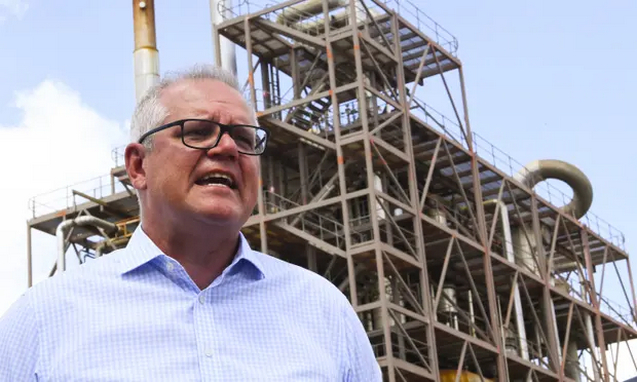
A leading climate expert says Australia is alone among major countries in having no significant climate plan. Photograph: Dan Peled/AAP

A leading UK climate official says Australia is alone among major countries in that neither its national government nor opposition have a significant climate plan, and frustrating local business leaders.

Nigel Topping, the UN’s “high-level champion” whose role involves global outreach to drive global ambition ahead of the Cop26 climate conference in Glasgow in November, said he had not seen another country in which no major political party had a plan to significantly reduce greenhouse gas emissions.

The Morrison government would face “a certain amount of pressure” to lift its ambition on climate at the G7 meeting in England next month, where Australia is one of four invited guest nations.

All G7 members have targets to cut emissions by at least 40% below 2005 levels by 2030 and reach net zero emissions no later than 2050.

Topping said on Thursday night that in discussions with Australians there had been a strong sense that state governments and the private sector were committed to the race to net zero campaign, but that business leaders had bemoaned there was “neither a plan nor a counter plan” at a federal level.

“I have heard a couple of times people saying that no one’s got a plan,” he said. “I have picked up from several business voices that there is some frustration over the lack of that.”

Speaking at an early webinar hosted by the Australia Institute, Topping said the international community was pleased the Morrison government had recently begun talking about a target of net zero emissions by 2050 “somewhat tentatively”, but it was not a “signal which matches the ambition and expectations of other wealthy developed countries”.

The Morrison government has not joined more than 100 countries in setting a formal mid-century net zero emissions goal, and has resisted pressure from the US, Britain and the European Union to increase its 2030 target.

Scott Morrison told a recent climate summit hosted by the US president, Joe Biden, that the country wanted to reach net zero “as soon as we possibly can”.

The prime minister said his government supported a “technology, not taxes’’ approach.

While other developed countries have committed tens of billions to drive action, the federal budget this week included little spending on addressing the climate crisis.

The government’s 2030 emissions target – a minimum 26% cut compared with 2005 – has not been increased since it was set six years ago, and analysts have found it “insufficient” given what is required. Scientists have recommended at least a 50% cut.

Climate pledges compared: 2030 emissions reduction targets relative to 2005 levels
Showing the minimum pledge value if there is a range

Guardian graphic | Source: Investor Group on Climate Change


Labor has backed a 2050 net zero emissions goal, but dropped its 2030 target after losing the 2019 election.

It said it would release a roadmap to get to net zero before the next election.

In his budget reply on Thursday night opposition leader Anthony Albanese said positive action on the climate crisis would “create jobs, lower energy prices and lower emissions”, and promised a $100m energy apprenticeship plan.

Topping said Australia would be accepted “with open arms and civilly, as a friend” at the G7 in Cornwall, but would face “a certain amount of pressure given that everybody else has made very clear that they are getting to net zero by 2050”.

Australia is one of four guest nations at the G7 along with India, South Korea and South Africa.

He said the US had a target of at least a 50% cut by 2030, the EU 55% and Britain 68% (the latter two compared with 1990 levels). Germany has promised to reach net zero by 2045.

“We know that’s what the leading developed countries need to do to implement the Paris agreement, so I’m sure there will be a lot of polite pressure on the side to join that group,” Topping said.

He said there would also be pressure “to move away from the rhetoric that you can have a plan without a target which, of course, any business person knows is just silly”.

“If you have a plan without a target actually you’re just loosey-goosey,” he said.

“A plan starts with a clear target.

"If you’re going to try to run a marathon you know the mile times that you’ve got to keep clocking up.

"If you can’t put those up in practice, and if you can’t get the first three miles out in time, then you’re behind in the race and you may never catch up.

“This is not about doing the right thing, or the green thing, or the ethical thing or the responsible thing. It is about all those things, but fundamentally this is an issue of corporate and national competitiveness.”

Pressure on Australia to do more on climate has been growing. Last month the Biden administration said Australia needed to cut emissions faster, and the UK, France and the UN last year refused Morrison a speaking slot at a global climate ambition summit after he did not offer any new policies.

Topping said Australia was well placed to succeed in the race to a zero emissions economy given its abundant clean natural resources. The transition elsewhere was going “exponentially fast”, with targets that appeared aggressive two years ago now looking conservative.

He cited the recently announced Glasgow financial alliance for net zero, under which 160 banks and firms with more than US$70tn in assets pledged to cut their emissions and ensure their investment portfolios aligned with climate science.

Moody’s Investors Service said the evident acceleration to reduce emissions to net zero would increase credit risks and the cost of doing business for major emitters.

“The countries that are on the front foot are able to manage and ensure it’s a transition that leads to jobs growth as well as economic growth,” Topping said. “I’m just sort of sensing a bit of confusion and frustration among people I’ve spoken to in Australia that you don’t have that clarity.”

Links

(The Conversation) How Climate Change Is Erasing The World’s Oldest Rock Art

The Conversation |  |  |  | 

This Warty Pig is part of a panel dated to more than 45,500 years in age. Basran Burhan/Griffith University, Author provided

Authors
In caves on the Indonesian island of Sulawesi, ancient peoples marked the walls with red and mulberry hand stencils, and painted images of large native mammals or imaginary human-animal creatures.

These are the oldest cave art sites yet known — or at least the oldest attributed to our species. One painting of a Sulawesi warty pig was recently dated as at least 45,500 years old.

Since the 1950s, archaeologists have observed these paintings appear to be blistering and peeling off the cave walls. Yet, little had been done to understand why.

So our research, published today, explored the mechanisms of decay affecting ancient rock art panels at 11 sites in Sulawesi’s Maros-Pangkep region. We found the deterioration may have gotten worse in recent decades, a trend likely to continue with accelerating climate change.

These Pleistocene (“ice aged”) cave paintings of Indonesia have only begun to tell us about the lives of the earliest people who lived in Australasia. The art is disappearing just as we’re beginning to understand its significance.

Australasia’s rock art

Rock art gives us a glimpse into the ancient cultural worlds of the artists and the animals they may have hunted or interacted with. Even rare clues into early people’s beliefs in the supernatural have been preserved.

Climate change could erase ancient Indonesian cave art.

We think humans have been creating art of some kind in Australasia — which includes northern Australia, Papua New Guinea and Indonesia — for a very long time. Used pigments are among the earliest evidence people were living in Australia more than 60,000 years ago.

Tens of thousands of distinctive rock art sites are scattered across Australasia, with Aboriginal people creating many styles of rock art across Australia.

Until as recently as 2014, scholars thought the earliest cave art was in Europe — for example, in the Chauvet Cave in France or El Castillo in Spain, which are 30,000 to 40,000 years old. We now know people were painting inside caves and rockshelters in Indonesia at the same time and even earlier.

Hand stencils in one of the study sites at Leang Sakapao cave. Linda Siagian, Author provided
 
Ongoing surveys throughout Australasia turn up new rock art sites every year. To date, more than 300 painted sites have been documented in the limestone karsts of Maros-Pangkep, in southern Sulawesi.

Cave paintings in Sulawesi and Borneo are some of the earliest evidence we have that people were living on these islands.

Tragically, at almost every new site we find in this region, the rock art is in an advanced stage of decay.

Big impacts from small crystals

To investigate why these prehistoric artworks are deteriorating, we studied some of the oldest known rock art from the Maros-Pangkep region, scientifically dated to between at least 20,000 and 40,000 years old.

Expanding and contracting salt crystals are causing rock art to flake off the cave walls. Linda Siagian, Author provided

Given these artworks have survived over such a vast period, we wanted to understand why the painted limestone cave surfaces now appear to be eroding so rapidly.

We used a combination of scientific techniques, including using high-powered microscopes, chemical analyses and crystal identification to tackle the problem. This revealed that salts growing both on top of and behind ancient rock art can cause it to flake away.

Salts are deposited on rock surfaces via the water they’re absorbed in. When the water solution evaporates, salt crystals form. The salt crystals then swell and shrink as the environment heats and cools, generating stress in the rock.

In some cases, the result is the stone surface crumbling into a powder. In other instances, salt crystals form columns under the hard outer shell of the old limestone, lifting the art panel and separating it from the rest of the rock, obliterating the art.

On hot days, geological salts can grow to more than three times their initial size. On one panel, for example, a flake half the size of a hand peeled off in under five months.

Climate extremes under global warming

Australasia has an incredibly active atmosphere, fed by intense sea currents, seasonal trade winds and a reservoir of warm ocean water. Yet, some of its rock art has so far managed to survive tens of thousands of years through major episodes of climate variation, from the cold of the last ice age to the start of the current monsoon.

Limestone karsts of Maros and Pangkep Regencies, in South Sulawesi, Indonesia. Shutterstock

In contrast, famous European cave art sites such as Altamira in Spain and Lascaux in France are found in deep caves, in more stable (temperate) climates, so threats to rock art are different and generally weathering is less aggressive.

But now greenhouse gases are magnifying climatic extremes. In fact, global warming can be up to three times higher in the tropics, and the wet-dry phases of the monsoon have become stronger in recent decades, along with more numerous La Niña and El Niño events.

The net effect is that temperatures are higher, there are more hot days in a row, droughts are lasting longer, and other extreme weather such as storms (and the flooding they cause) are more severe and frequent.

What’s more, monsoonal rains are now captured in rice fields and aquaculture ponds. This promotes the growth of art-destroying salt crystals by raising humidity across the region and especially in nearby caves, prolonging the shrink and swell cycles of salts.

Makassar’s culture heritage department, Balai Pelestarian Cagar Budaya, undertaking rock art monitoring in Maros-Pangkep. Rustan Lebe/Griffith University, Author provided

What happens now?

Apart from the direct threats associated with industrial development — such as blasting away archaeological sites for mining and limestone quarrying — our research makes it clear global warming is the biggest threat to the preservation of the trpoics’ ancient rock art.

There’s a pressing need for further research, monitoring and conservation work in Maros-Pangkep and across Australasia, where cultural heritage sites are under threat from the destructive impacts of climate change.

In particular, we urgently need to document the remaining rock art in great detail (such as with 3D scanning) and uncover more sites before this art disappears forever.

If humans are ultimately causing this problem, we can take steps to correct it. Most importantly, we need to act now to stop global temperature increases and drastically cut emissions. Minimising the impacts of climate change will help preserve the incredible artworks Australasia’s earliest people left to us.

Links

(USA New Yorker) It’s Time To Kick Gas

The New Yorker

And do it as quickly as possible

Natural gas—which is primarily made of methane—leaks unburned at every stage from fracking to combustion. Photograph by Ed Kashi / VII / Redux

Author
Bill McKibben is a founder of the grassroots climate campaign 350.org and a contributing writer to The New Yorker. He writes The Climate Crisis, The New Yorker’s newsletter on the environment.
We’re used to the idea that CO2—one carbon atom, two oxygen atoms—is a dangerous molecule. Indeed, driving down carbon-dioxide emissions has become the way that many leaders and journalists describe our task.

But CH4—one carbon atom combined with four hydrogen atoms, otherwise known as methane—is carbon dioxide’s evil twin. It traps heat roughly eighty times more efficiently than carbon dioxide does, which explains why the fact that it’s spiking in the atmosphere scares scientists so much.

Despite the pandemic lockdown, 2020 saw the largest single increase in methane in the atmosphere since we started taking measurements, in the nineteen-eighties. It’s a jump that, last month, a scientist at the National Oceanic and Atmospheric Administration called “fairly surprising and disturbing.”

If there’s any good news, it’s that the spike in methane doesn’t—yet—seem to be coming in large percentages from the runaway melt of methane-ice formations beneath the polar oceans or those in tundra soils. That would be a nightmare scenario because there wouldn’t be anything we could do about it—it’s global heating on automatic. For the moment, most of the increase seems to be from sources we can control: rice paddies, livestock, and, especially, the rapid rise in drilling and fracking for gas.

Two decades ago, people thought that natural gas, though a fossil fuel, might help slow climate change because, when you burn it in a power station, it produces less carbon than burning coal does. Now we understand that natural gas—which is primarily made of methane—leaks unburned at every stage from fracking to combustion, whether in a power plant or on top of your stove, in sufficient quantities to make it an enormous climate danger.

The Trump Administration abandoned any effort even to reduce that leakage, an absurd gift to the fossil-fuel industry that the Biden Administration is preparing to take away. But plugging leaks isn’t enough: we’ve got to stop producing natural gas as quickly as possible, and replace it with renewables that generate neither carbon nor methane. As I wrote last month, that’s now entirely possible; sun and wind power have become so cheap so fast that they’re more economical than gas, and batteries are coming down the same kind of cost curve, so nightfall is no longer the problem it once was.

But there are other reasons to kick gas. A report from Australia’s Climate Council, released last week, finds that the health impact of having a gas cooktop in your home is roughly equivalent to having a cigarette smoker puffing away in the corner, and accounts for about twelve per cent of childhood asthma. “It’s odourless, it’s invisible, it’s a bit of silent enemy,” the C.E.O. of Asthma Australia said. “People might feel differently if they understood that their gas appliances were emitting a range of toxic substances.”

That is why the gas industry has lobbied so hard to prevent that perception. In at least fourteen U.S. states, the industry lobby is pushing bills that would prevent local governments from restricting the use of gas; a particular threat comes from the new appliances—chiefly air-source heat pumps and water heaters, and induction cooktops—that are now widely available and increasingly cheap. (Even the Wall Street Journal, whose opinion pages unfailingly defend the oil-and-gas industry, admitted in a review that induction cooking is “safer and faster than gas.”)

Indeed, leaked documents obtained last week by E&E News show that fifteen big gas utilities have mounted a Consortium to Combat Electrification. “None of these companies want to write their own obituary,” Deborah Gordon, a former petroleum engineer now at the Rocky Mountain Institute, an energy think tank, said. “If you’re going to bend this curve, and we bend it quickly, there are going to be casualties. Some will transform, some will consolidate, some will go away.”

At the moment, however, they’re still very much here, and they might as well call the effort a Consortium to Promote Asthma and Melt the Poles. But, if we can kick gas quickly, there’s some hope that lies in the structure of that CH4 molecule: it only lasts about ten years in the atmosphere, as opposed to a century for carbon dioxide.

This means that, if we can somehow reduce emissions dramatically, it will fade fast, buying us a little time to take on carbon. “If we can make a big enough cut in methane in the next decade, we’ll see public-health benefits within the decade, and climate benefits within two decades,” Drew Shindell, an earth scientist at Duke University who has worked extensively on methane, told the Times.

But it had better happen fast. Here’s Euan Nisbet, a climate scientist at Royal Holloway, University of London, reacting to last month’s news of spiking methane levels: “I knew it was bad, but I didn’t know it was this bad. This breaks my heart.”

Passing the Mic

Christina Conklin, an artist, writer, and researcher, and Marina Psaros, a sustainability expert, will publish “The Atlas of Disappearing Places: Our Coasts and Oceans in the Climate Crisis” in July. With maps and text, it explores port cities and coastlines that may be obliterated by rising seas—Shanghai, Houston, New York, the Cook Islands, and Bến Tre, in Vietnam. I spoke with Conklin, who lives next to the Pacific, in Half Moon Bay, California. (Our conversation has been edited.)

Bill McKibben: Humans built many of their most important settlements along the ocean for obvious reasons, but how should we be thinking about that now?

Christina Conklin: The hard truth is that seas are going to rise for centuries to come—it could be at least three feet this century and much more after that. This is difficult to absorb, but we need to have realistic, civic conversations about moving to higher ground in the coming decades. Water always finds its level, so we will need to rebuild over time, finding ways to fairly relocate vulnerable communities away from flood zones.

Strengthening storms and rising seas may be the easier climate challenges to address: all we need to do is move out of the way. Actually, changing ocean chemistry and warming waters are far more critical in my view, because they are altering the living system of the ocean itself, which is the foundation and source of life on earth.

The fact is, our current addiction to fossil fuels is causing ocean acidification, deoxygenation, and warming that is throwing many marine ecosystems into crisis. Half the stories in “The Atlas of Disappearing Places” cover these impacts on food webs, feedback loops, and basic biological processes. I illustrated it with ink-on-seaweed maps to convey the scope and scale of the issues.

Bill McKibben: What’s a place that really illustrates our troubles?

Christina Conklin: The Cook Islands is a good example. It is a tiny island nation in the South Pacific that voted in 2017 to designate its territorial waters as the world’s largest marine protected area. The commitment reflected Cook Islanders’ values and heritage as an indigenous, seagoing people, and also allowed for sustainable development.

Around the same time, a few powerful people invited seabed-mining companies to “explore” the possibility of scraping manganese nodules off the seafloor in these waters, potentially destroying the ecosystem—and the Prime Minister gave in to pressure for quick profit. [Last year, the government said that it would allow mining to offset the loss of tourism business during the pandemic.] This sort of conflict between local communities and extractive industries is often out of sight, but every choice we make has an environmental impact somewhere.

We each have the responsibility—the response-ability—to imagine and build healthy societies. Each of the book’s twenty chapters envisions a “future history” from the year 2050, showing things that we can do to change the story from one of heedless consumption to one of resilient, regenerative culture.

Bill McKibben: And what’s a place that gives you some sense of how humans are, well, rising to the rising sea level, and figuring out some possibilities?

Christina Conklin: I think often of Leo Manston, a six-year-old boy who spoke at a county-council meeting in Kent, England, in 2019, and asked them to consider including children on their climate-change committee. His mom, Laura, was new to climate activism, having recently learned how dire the climate crisis is, at an Extinction Rebellion march, in London.

I so admire the determination, joy, courage, and creativity of Extinction Rebellion’s nonviolent-resistance methods. We can learn a lot from them about how to work for change, individually and collectively.

That said, the British government is making poor planning decisions regarding sea-level rise and is kicking the can on carbon emissions, so my story about rising seas in the Thames estuary is largely a cautionary tale. But perhaps it will help people wake up to the disastrous floods that will eventually happen if more is not done to face the planetary emergency of intersecting crises we now face. As you know, we have only a few years to change our path.

Climate School


The Texas Observer
carries a fine profile of the environmental-justice pioneer Robert Bullard, describing a 1979 study of his that found landfills and waste dumps mostly situated in Houston’s communities of color. “To this day, low-income communities of color are significantly more likely than white residents to live near hazardous waste and air pollution,” the magazine reports.

António Guterres, the Secretary-General of the United Nations, called on all international lending agencies to stop funding big fossil-fuel infrastructure projects. “We can no longer afford big fossil fuel infrastructure anywhere,” he said. “Such investments simply deepen our predicament.”

If someone tells you that a small ball of fungi will help your lawn sequester a ton of carbon dioxide every year, it’s possible that their claims should be investigated closely, at least according to reporting from Zahra Hirji for BuzzFeed News.

As noted above, gas causes lots of asthma and premature deaths. New studies show that biomass burning does the same. In fact, setting fire to biomass, gas, and wood now cause more premature deaths in the U.S. than burning coal.

News broke Saturday of a cyberattack shutting down the Colonial Pipeline system, which carries gasoline and jet fuel from Texas up the East Coast. The independent journalist Robbie Jaeger has been following up on the story of last year’s gasoline spill from the pipeline in North Carolina— which the company originally pegged at sixty-three thousand gallons, but turned out to be at least 1.2 million gallons. Reviewing documents, Jaeger found that the company only inspected less than half the length of the pipeline the year before the accident, even though much of the pipe is forty years old.

Naomi Klein offers up a remarkable piece of reporting and thinking from the Sierra-foothills town of Chico, California, where residents displaced by forest fires in recent years are now being evicted from encampments in which they’re trying to keep their lives going. Her article provides a sharp warning of what it will mean to live on a planet with ever more climate refugees.

Scoreboard


 The veteran energy analyst (and Seattle resident) Dave Roberts argues that Washington State now has the most progressive climate policy in America. “Spoiler: the one weird trick is electing Democrats,” he writes. Meanwhile, Kate Aronoff points out that BP may have figured out a way to play both sides of the carbon-pricing policy that Washington Governor Jay Inslee is expected to sign into law.

Legislation has been introduced in the New York State Assembly that would place a moratorium on cryptocurrency mining in the state while its effects on energy use are investigated. Grist has a detailed account of a once defunct power plant on Seneca Lake that’s now burning gas to mine bitcoin and was featured in a New Yorker story by Elizabeth Kolbert.

Amsterdam has become the first city to start banning fossil-fuel advertisements, beginning in its subway system. “Advertisements that portray fossil fuels as normal and aggravate climate disruption have no place in a city or country that has complied to Paris,” the campaign coördinator Femke Sleegers said.

Writing in CleanTechnica, the energy analyst Michael Barnard makes the case that small, modular nuclear reactors may not be the lifesaver that advocates have been hoping for. He writes that they “won’t achieve economies of manufacturing scale, won’t be faster to construct, forego efficiency of vertical scaling, won’t be cheaper, aren’t suitable for remote or brownfield coal sites, still face very large security costs, will still be costly and slow to decommission, and still require liability insurance caps.”

Research from Oxford Brookes University, in England, indicates that vertical-axis wind turbines—look at the picture!—may be more efficient than the giant sweeping blades that we’ve grown accustomed to, primarily because they don’t rob one another of wind and can be spaced more closely together.

The Green Party seems likely to share power in Germany—or even control the country outright—after elections this fall, new polling suggests. “The timing would make this a continental game-changer,” the Guardian notes in an editorial. “Germany’s Greens have the potential to become the leading force in a rehabilitation of progressive politics in Europe.”

Last week, I mentioned the frightening news that the Amazon forest has flipped from a carbon sink to a carbon source. New data indicate that the same thing has happened to Canada’s vast boreal forest. Barry Saxifrage outlines the numbers in a revealing report for the National Observer, adding, “It’s bad news for Canada’s plans to use forest ‘offsets’ to green-light extra fossil fuel burning.”

Warming Up


 Seth Bernard is one of my all-time favorite songwriters. Also a ripping guitarist, he’s helped build a community of musician-activists across his native Michigan, who work on issues environmental and social. Now he’s offered up “The Time Has Come,” a climate anthem that he’s releasing to aid local climate campaigners. Here’s the chorus:
We never give up,
keep showing up.
In love we trust;
the Earth loves us.
Links

14/05/2021

(AU The Guardian) The 2021 Federal Budget Was Light On Climate And Environment Measures. But Here’s What You Should Know

The Guardian

The Morrison government prefers a gas-fired recovery to a green one and has offered no new support for renewable energy or electric vehicles

Scott Morrison visits an oil refinery in Gladstone in January. The 2021 federal budget pledged $279.9m to help big emitters reduce energy consumption and emissions. Photograph: Lukas Coch/AAP

Guardian Environmental Investigations
There was little talk of the climate crisis or the environment in Tuesday’s budget, perhaps because the Morrison government has succeeded in framing them as side issues.

But once you dig into the detail there is plenty to know. Here are some key points.

Will there be a green recovery?

Not based on this. There has been a global push for a climate-focused move to kickstart economic growth from the pandemic, pushed by the International Monetary Fund, the United Nations and several national leaders.

The response has been mixed, but countries that Australia likes to compare itself with have embraced the idea.

The US president, Joe Biden, has proposed a US$2tn infrastructure plan to drive “transformational progress” in tackling climate change, including US$174bn for electric vehicles and support to make the electricity grid emissions-free by 2035.

Germany has dedicated US$47bn to green recovery measures, including $9bn to “green hydrogen”.

Even fossil fuel-rich Canada has committed more than US$36bn to clean energy.

In contrast, the UN environment program found Australia had done the least among the world’s 50 largest economies to drive a green recovery. There is nothing to change that in the budget.

The government remains averse to even using the word “climate”. It appears in just two items in the 197 pages of budget paper number two, which lays out proposed spending measures for the next four years.

Elsewhere, a table dedicated to “climate spending” confirms just 0.3% – 30c in every $100 – of budget spending is dedicated to addressing the climate crisis. The government expects that to fall to 0.2% in 2022-23.

Does the budget support a gas-fired recovery, as the government has promised?

Yes, to some extent. It includes $58.6m in new funding for the industry over four years, including for expanding pipelines, a new gas import terminal, gas storage facilities and a gas supply hub at Wallumbilla in Queensland.

There is also $30m for a company owned by the iron ore magnate Andrew Forrest to help its early works on a new gas-fired power station. Why Forrest, a billionaire, needs public money has not been explained.

The Coalition is backing a gas plant that also runs on hydrogen. Is this the future or a folly? Read more There is a further $24.9m for new gas-fired power plants to become “hydrogen-ready” – a contentious approach given experts say hydrogen is more likely to be used to reduce emissions in other sectors, such as steel production, than to compete with existing cheap and clean alternatives in electricity generation.

But there is no money for a new $600m publicly owned gas plant in the Hunter Valley, which the government threatened to build if the private sector did not commit to building new gas generators to replace the Liddell coal plant when it closes in 2023.

It is unclear if the government has been satisfied by commitments by EnergyAustralia and Forrest, or if that decision is yet to be made. The head of the government’s Energy Security Board, Kerry Schott, has said the economic case for new gas power in New South Wales when Liddell closes “doesn’t stack up”.

A reminder: Gas is sometimes described as emitting about half as much as coal when burned, but studies have suggested its impact is much higher once methane leaks during extraction and piping are counted.

What about renewable energy?

Not much to see here. The government has made clear it thinks solar and wind no longer need public funding to be competitive, and it does not see its role as hastening their expansion as part of a clean transition.

Instead, the budget includes previously announced support for “low emissions” technology development – $263.7m for long-promised but little-delivered fossil fuel carbon capture projects and $275.5m for four “clean hydrogen” export hubs that could run on renewable energy or fossil fuels with carbon capture and storage.

The former Liberal prime minister Malcolm Turnbull has described producing hydrogen with coal or gas as a “delaying tactic” pushed by the fossil fuel industry.

There is also $30m for a big battery and microgrids in Northern Territory Indigenous communities and $19.3m for a renewable energy microgrid in the Daintree.

The single biggest bit of spending on emissions reduction was announced in April before Biden’s climate summit – $639m for “low emissions international technology partnerships”, which the government now says include developing a carbon offset scheme in the Indo-Pacific.

Any more funding for fossil fuel operations?

Yes. One of the most significant climate announcements in the budget is $279.9m over a decade to establish a “below baseline crediting mechanism” to help big emitters reduce energy consumption and emissions.

This refers to what is known as the “safeguard mechanism”, which was supposed to prevent national industrial emissions increasing above historical levels. In practice, as Guardian Australia has reported, industrial businesses have been allowed to lift their emissions limits – known as baselines – without penalty.

Cutting through the budget spin: breaking down the Coalition’s cash splash Read more A program to award carbon credits to polluters that reduce their emissions below their baseline level could be a significant step – but only if baselines are reduced over time to help cut national CO2 emissions, and companies that emit above their baselines are required to buy credits.

Under this design, the errant polluters would buy credits from the companies that cut emissions, creating a form of carbon market, and there would be an incentive for everyone to clean up their act.

If the amount industrial polluters were allowed to emit was meaningfully reduced year-on-year it would eventually effectively make it uneconomic to emit CO2 in many cases.

But the government has said it will not introduce anything that looks like carbon pricing. It suggests it may commit hundreds of millions of taxpayer dollars to just help profitable industrial facilities cut emissions. The design of this mechanism will be key.

What about other technologies – clean cars, for example?

There is nothing in the budget for electric vehicles, continuing the government’s position of resisting a global push to offer incentives to rapidly expand the use of clean cars.

But the government will pay an undisclosed sum to attempt to shore up petrol production in Australia, and has kicked in another $50.7m to build oil stocks after the announcement that two of the country’s remaining four refineries would close.

There is also some money to improve understanding of how much carbon is stored in soil, including more than $100m over the next two years to help farmers improve measurement.

This is in line with the government last year announcing soil carbon as one of five priorities in its low-emissions technology statement.

What about nature?

It loses out, again. The Coalition has significantly cut funding for environment programs since coming to power and there is little change here.

An analysis by the Australian Conservation Foundation this week calculated funding for biodiversity protection – threatened species and ecosystems – had fallen 28% since the Coalition was elected in 2013.

This budget includes another $29.1m to protect native species from feral and invasive pests, but spending on biodiversity is then forecast to fall over the next three years until it is less than half what it was in 2013.

There is $29.3m dedicated to changes to the national environment laws, the Environment Protection and Biodiversity Conservation Act, but the bulk will go to increasing the speed at which development proposals are assessed and approved.

Reminder: Graeme Samuel, the former competition watchdog head, found in an official review that the EPBC Act was failing, and the government would be accepting the decline of environmental landmarks and the extinction of threatened animals, plants and ecosystems unless it embraced fundamental reform.

The government has a better story to tell on ocean protection, where it has confirmed a previous announcement of $100.1m to restore “blue carbon” ecosystems.

It includes $40m for marine parks, including plans to expand protection into the Indian Ocean off northern Western Australia. This has been applauded by scientists and local fishers.

Anything else?

The government has increased support for its promise to improve recycling, including $67m to divert organic food waste away from landfill.

There is also $209.7m over four years for a previously announced Australian Climate Service that will “transform the Commonwealth’s capacity to anticipate and prepare for more extreme weather events”.

This has been welcomed by the science community and some in industry, which is increasingly aware it will need this information as extreme weather is exacerbated by global heating.

Where to from here?

Big decisions on climate lie ahead. The government is due to release a long-term emissions reduction strategy before the climate summit in Glasgow in November and before then will come under renewed pressure to do more when Scott Morrison is a guest at the G7 leaders’ summit in England next month.

All G7 member countries have shifted their focus to climate commitments over the next decade, announcing more ambitious goals for 2030.

The British hosts have invited four democracies who are yet to take that step – Australia, India, South Korea and South Africa – for a reason.

On nature protection, the government is still trying to change the EPBC Act to shed some of its responsibilities and hand greater approval powers for development to the states.

It is yet to formally respond to the Samuel review, but has effectively rejected a recommendation that it introduce stronger national environmental standards to improve wildlife protection.

Despite warnings the country faces an extinction crisis, there is no suggestion that will change.

Links

(AU SMH) Turnbull Says ‘Right Wing Craziness’ Drives The Government On Climate

Sydney Morning HeraldNick O'Malley

Malcolm Turnbull says only the threat of losing seats or power would drive the federal government to adopt what he believes to be a credible international position on carbon pollution reduction as he voiced disappointment in the lack of clean energy commitments in the budget.

“I’d say only the prospect of electoral defeat, whether that’s at the hands of the Labor Party, which would seem implausible, or independents who are supporters of climate action,” Mr Turnbull said in response to a question about what would prompt more government action after a speech at a conference hosted by the Smart Energy Council.

NSW Energy & Environment Minister Matt Kean with former prime minister Malcolm Turnbull at the Smart Energy conference on Wednesday. Credit: Steven Siewert

Mr Turnbull likened what he called climate denialism in the Coalition to the prevalent false view in the United States Republican Party that President Joe Biden had stolen the presidential election from Donald Trump, saying both narratives were driven by right-wing ideology reinforced by conservative media, including outlets owned by the Murdoch family.

Mr Turnbull said Australia could increase its commitments to reduce carbon pollution and have cheaper energy as a result if it was not for entrenched coal support in the government.

“This is the craziness right? ... Those people who want to hang on to coal and gas are basically arguing for higher electricity prices and higher emissions,” he said.

Climate policy
Australia pressured to step up climate action during G7 talks
“It is this loopy way in which coal and gas and climate change have been turned into ideological issues by that sort of right-wing, largely Murdoch media, political ecosystem.”

Mr Turnbull said he believed moderates had been passive by comparison to the Right in the Coalition due to the Right’s support from the “toxic combination of the fossil fuel lobby, right-wing partisan media, and right-wing sentiment”.

He again voiced his support for the independent candidate Kirsty O’Connell in the NSW Upper Hunter byelection over the Nationals’ David Layzell.

Mr Turnbull said he was disappointed the federal budget did not include more support for clean energy infrastructure, saying no new major investments in urgently needed long-term storage projects had been made since he announced the Snowy Hydro 2 project and the plan to link Tasmania’s hydro power to the mainland via an undersea cable.

He said the national grid needed the equivalent of eight times the long duration storage capacity of the Snowy Hydro 2 pumped hydro project to support the amount of renewable energy needed to ensure reliable cheap power.

Economist Nicki Hutley told The Sydney Morning Herald and The Age she was also disappointed the government did not provide better support to clean energy or the environment in the budget.

“This budget was an opportunity for a game changer on climate, but there was nothing there. Around the world average [national] spending from COVID-19 recovery packages on clean energy is 20 per cent, in Australia it is 0.02 per cent,” she said.

“The word ‘renewables’ did not appear. They could have stimulated the economy, created jobs and created a positive environmental outcome, but they chose not to,” she said.

Emissions
Morrison eyes deeper emissions cuts, but avoids deadline to hit net zero
Australia has set a modest greenhouse gas reduction target for 2030, and no other longer-term deadlines.

Under the Paris climate agreement Australia is committed to reducing emissions by 26 to 28 per cent by 2030.

The nation has not set a target to reach net zero, with the government saying it would get there as soon as possible through technologies, but warning of the economic risks of setting deadlines without a complete picture of where the emissions reductions would come from, and what they would cost.

Australia’s approach is at odds with other developed nations’ increasingly ambitious climate policy, with the US, UK, Japan and Canada committing to reach net zero by mid-century and setting ambitious emissions reduction goals for 2030.

Treasurer Josh Frydenberg used his budget speech to emphasise the government’s climate ambitions.

“Australia is on the pathway to net zero and our goal is to get there as soon as we possibly can, preferably by 2050,” he said. “We will do this with a practical, technology-focused approach. Technology not taxes.”

Paris Agreement
Morrison’s long walk to net zero
“In this budget we are investing a further $1.6 billion to fund priority technologies, including clean hydrogen and energy storage.”

Mr Turnbull spoke at the conference after NSW Energy

 Minister Matt Kean, who recently appointed him and then sacked him as chairman of the newly created Net Zero Emissions and Clean Energy Board, created to advise the state government on emissions reductions.

Smart Energy Council chief executive John Grimes told the conference Australia risked becoming the Kodak of nations by missing out on massive opportunities in clean energy due to the “willful” blindness of the federal government.

“We have to change our thinking from one of extraction to one of creation,” he said, arguing by electrifying manufacturing with renewables Australia could export value-added goods rather than “dirt”.

He said because energy was a cost in nearly every economic transaction, bringing down its costs benefited the entire economy.

Links

Lethal Heating is a citizens' initiative