Here's another reminder of the precarious position that the world's climate
and ecosystems are in: a new study estimates that global warming could push
the Antarctic ice sheet past a tipping point in as little as 10 years.
In other words, the point of no return in terms of ice sheet loss is arriving
earlier than previously thought, and we may well already be in the midst of
it. That could have serious consequences when it comes to sea level rise
globally, and the local habitats that animals in Antarctica rely on.
To get a better idea of what's happening right now, the researchers went back
into the past, looking at the continent's history over the last 20,000 years –
back to the last ice age – through ice cores extracted from the sea floor.
"Our study reveals that during times in the past when the ice sheet retreated,
the periods of rapid mass loss 'switched on' very abruptly, within only a
decade or two,"
says paleoclimatologist Zoë Thomas, from the University of New South Wales in Australia.
"Interestingly, after the ice sheet continued to retreat for several hundred
years, it 'switched off' again, also only taking a couple of decades."
As icebergs break off Antarctica, they float down a major channel known as
Iceberg Alley. Debris released from these icebergs accumulates on the
seafloor, giving researchers a record of history some 3.5 kilometers (2.2
miles) under the water.
By combining this natural logbook of iceberg drift with computer models of ice
sheet behavior, the team was able to identify eight phases of ice sheet
retreat across recent millennia. In each case, the ice sheet destabilization
and subsequent restabilization happened within a decade or so.
The results published by the researchers augment modern satellite imagery,
which only goes back around 40 years: they show increasing losses of ice from
the interior of the Antarctic ice sheet, not just changes in ice shelves
already freely floating on the water.
"We found that iceberg calving events on multi-year time scales were
synchronous with discharge of grounded ice from the Antarctic ice sheet,"
says glaciologist Nick Golledge, from the Victoria University of Wellington in New Zealand.
The study showed the same sea rise pattern happening in each of the eight
phases too, with global sea levels affected for several centuries and up to a
millennium in some cases. Further statistical analysis identified the tipping
points for these changes.
If the current shift in ice in Antarctica can be interpreted in the same way
as the past events identified by the researchers, we might already be in the
midst of a new tipping point – something we've seen in
other parts
of the world and the Arctic
in recent years.
"If it just takes one decade to tip a system like this, that's actually quite
scary because if the Antarctic Ice Sheet behaves in future like it did in the
past, we must be experiencing the tipping right now", Thomas
says.
Further evidence for these tipping points can be found in cores
previously analyzed
from the region, the researchers report, and the latest study also matches up
with
earlier models
of ice sheet loss from the region.
"Our findings are consistent with a growing body of evidence suggesting the
acceleration of Antarctic ice mass loss in recent decades may mark the
beginning of a self-sustaining and irreversible period of ice sheet retreat
and substantial global sea level rise,"
says geophysicist Michael Weber, from the University of Bonn in Germany.
Emails show the man hired to review Scott Morrison’s climate model helped
Angus Taylor with last election’s climate scare.
Former head of the Australian Bureau of Agricultural and Resource
Economics Brian Fisher. Credit: Supplied
In the lead-up to the last election, just as now, the Morrison government was in
political trouble on climate change policy.
Labor had a comprehensive plan to
cut greenhouse gas emissions by 45 per cent by 2030. The government had nothing
new to propose.
But it had a secret weapon and on February 20, 2019, it used it. That
day, Rupert Murdoch’s national broadsheet, The Australian, ran
a front-page headline that read: “Carbon cut apocalypse: cost of ALP
energy plan”.
The story below that headline was replete with big, scary numbers. It
said Labor’s policy would “push electricity prices 50 per cent higher,
cost workers up to $9000 a year in lower wages and wipe $472 billion
from the economy over the next decade”. This was “according to the first
independent modelling of the energy policies of both the government and
opposition”.
The story quoted the work’s author, Brian
Fisher, a former head of the Australian Bureau of Agricultural and
Resource Economics (ABARE) and go-to numbers guy for Australian fossil
fuel miners.
He voiced his frustration at “how deficient and even
outright dishonest the climate debate continues to be” when the
“inescapable” reality was that whoever won the election, Australia would
suffer an economic hit.
Fisher told The Australian he expected to be “kicked” by both
sides of politics for this assessment.
But Fisher was never going to be “kicked” by the Morrison government.
When The Australian ran its story, he had already been in
communication with the government for many weeks, if not months.
Energy
Minister Angus Taylor and his office were liaising with Fisher as he
drafted his modelling.
An email trail obtained under freedom of information and given to
The Saturday Paper makes that very clear.
Seven
weeks before Fisher’s modelling came out – and instantly landed on the
front page of The Australian – Taylor sent an email to his
staff “team”, saying he had begun working on a piece for publication
that compared electricity prices state by state, using draft numbers
from Fisher, but “these will need to be updated when we get the final
ones”.
In the meantime, he told his staff, they should start working on a
comparison of electricity prices “Labor v Coalition” and exploring the
“implications” of Labor’s emissions target.
“We need to think about the timing of this with respect to Fisher’s
modelling work,” Taylor wrote.
A great deal of the FoI material obtained by The Australia Institute was
redacted, so it is unclear how long the minister’s office and the
modeller had been exchanging information.
But clearly the
government had detailed knowledge of what was coming, and saw it as
important that “one of Australia’s most respected advisers on climate
change and the economic impact of current and future climate and energy
policies” should provide support for its claim that Labor’s proposal
would put a “wrecking ball through the economy”.
On the day Fisher’s work became public, a list of talking points and a
draft media release were ready to go. And the government hammered the
issue of the alleged high cost of Labor’s climate policies relentlessly
until the election, aided by repeated interventions in the debate by
Fisher.
In fact, the work that informed The Australian’s original story
– entitled “Economic consequences of some alternative Australian climate
policies” – was only a four-page taste of what was to come.
Months later, when questioned at a seminar at the Australian
National University, Fisher said he only put up a summary because the
full modelling was out for review, and claimed he did not know how the
newspaper found his report within minutes of it being uploaded to his
website.
The full version was released on March 11. On May 1, Fisher released a
third effort. Abandoning all pretext of political impartiality, it was
titled: “Economic consequences of Labor’s climate change action plan.”
Speaking to The Saturday Paper, Fisher defended his work
largely by referencing the complexity of his model.
“The model that I use, which is basically my version of the government
model, updated and changed many times since I left government in 2006,
has got over a million equations in its most detailed form,” he said.
“So, you know, these things are difficult to use. And difficult to
understand.”
The report he released was roundly condemned by most other economists
and energy experts. As The Australia Institute summarised: “Brian
Fisher’s latest model of climate costs was off-the-chart.
"It
shows cost to GDP [gross domestic product] impacts that were five to ten
times larger than every other economy-wide model, including those from
Warwick McKibbin, Climateworks, ANU, CSIRO, Victoria University and
three major reports from Commonwealth Treasury.”
Kane Thornton, chief executive of the Clean Energy Council, said: “This
report, its input assumptions and modelled outcomes, are total garbage.
Any politician using this to compare/critique energy policies should be
laughed at.”
Almost three years on, the Morrison government is again playing games
with climate modelling – and again Fisher is involved.
A couple of weeks ago, on October 25, officials from Taylor’s department
confirmed to a senate estimates committee that Fisher had been paid
$100,000 for help in its climate modelling. He is listed in the
modelling's acknowledgements as one of its peer reviewers.
Fisher tells The Saturday Paper there may be more to his
involvement than has been revealed. “There is potentially other work
that might be mentioned in the future in the context of the model when
it’s released. I do have a contract. And I can’t discuss it with you.”
The day after the estimates revelation, the government’s much-hyped but
insubstantial plan for getting Australia to net-zero emissions by 2050
was released.
Morrison said the modelling would show Australia’s gross national income
would grow 1.6 per cent under the plan. Nearly 62,000 new regional
mining and heavy industry jobs would be created and the average
Australian would be nearly $2000 better off.
The modelling, finally released yesterday, is starkly at odds with
the Fisher modelling it used at the last election, which said that even
the government’s modest 26-28 per cent reductions target would lead to
78,000 fewer jobs, a $9000 cut to real wages and a $19 billion hit to
GDP by 2030.
How can this be?
The explanation, says one economist with 20 plus years as a modeller,
first at ABARE when it was headed by Fisher and then for several big
consulting companies, is that underlying every one of the hundreds of
thousands, sometimes millions, of equations that modellers run through
their computers are assumptions.
“And the assumptions you put in define the space the model can move in
when you run the simulations,” he says.
If you are, for example, modelling future electricity prices: “Before
the model starts, you basically have to dial in what are the relative
costs of all the technologies – coal, oil, gas, brown coal, nuclear,
hydro, other renewables. If you dial in a very expensive renewables
price, then … the cost of addressing climate change turns out very
expensive.”
And the fact is, 20 years ago, renewables were relatively expensive.
Their cost has come down dramatically and is likely to continue to come
down dramatically. Thus the inherent problem for modellers: how do you
make accurate projections of the future when technology costs are
rapidly changing? Do you assume current costs or take a guess at future
costs?
Historically, says the expert, even the best-intentioned modellers
tended to make conservative assumptions. Still, he says, all around the
world, modelling was a well-intentioned exercise, usually done by
academics, with the results couched in terms only understandable to, and
sometimes honestly contested by, other experts.
Australia, however, has led the world in the politicisation of
modelling, he says. And Brian Fisher, as executive director of ABARE,
played a big role in that. Under his leadership, says the former ABARE
modeller, the organisation developed a model called Megabare.
“ABARE spent a lot of time and money converting theoretical,
academic-type models into a tool that spoke the language of government,
that convinced the public that these models were producing numbers that
made sense in a political context.”
In February 1998, the federal ombudsman issued a scathing critique of
the way ABARE operated under Fisher, following a complaint by the
Australian Conservation Foundation that it had been denied membership of
a group called the Gigabare steering committee, which provided input to
its modelling activities.
Membership of the steering committee cost $50,000, which the ACF could
not afford, unlike other members including Exxon and the Australian Coal
Association.
The ombudsman’s report found that ABARE had
“adopted a funding structure and administrative practices for its
climate change research projects which failed to adequately protect
ABARE as a public sector research agency from allegations of undue
influence by vested interests”.
Fisher has a long record of producing work that supports fossil fuel
projects and attaches enormous assumed cost to emissions abatement.
Under the Howard government, he played an integral role in negotiating
Australia’s minimal commitment to emissions reduction at the 1997 Kyoto
climate change conference.
His critics are many and harsh, none more so than Guy Pearse, a staffer
to former Environment minister Robert Hill, whose insider account of the
Howard government’s climate failings in his book,
High and Dry, included Fisher among a “Prime Minister’s Eleven”
of people most responsible.
“Time and again results that Fisher presented in his [ABARE] reports to
government and the scenarios and assumptions behind them lent themselves
to misrepresentation by the Howard government,” Pearse wrote. “They
routinely overstated the costs of cutting emissions, and they never
factored in the financial benefits of action, or the costs of inaction.”
After leaving ABARE, Fisher went into consultancy, sometimes for
government, often for the proponents of fossil fuel projects.
Rod Campbell, economist and research director at The Australia
Institute, notes Fisher continues to get government work. In January he
was appointed to the emissions reduction assurance committee (ERAC) to
provide advice on expenditure to the government’s Emissions Reduction
Fund.
In estimates, Greens Senator Sarah Hanson-Young called Fisher a climate
denier. That’s not accurate; he accepts the science, he says, he just
thinks dealing with it will be significantly more expensive than most
people think, and probably won’t achieve the outcomes the science says
the world must achieve.
“Unfortunately, if people think the world is going to be net zero by
2050, and we’re going to reach a 1.5 degree increase target, then I
don’t think that’s happening,” he tells The Saturday Paper.
“I’d say we’re on a pathway greater than two, at least.”
How does he square those beliefs with his involvement in a government
modelling exercise that suggests – on the limited evidence available so
far – that Australia can reach net zero and prosper at the same time?
He doesn’t. He had nothing to do with the assumptions – just the
simulations or sims. “I was engaged to try and give them some guidance
on how best to run particular sims in the model,” he says. “I haven’t
been involved in the modelling directly.”
Fisher still largely stands by the results of his 2019 modelling,
notwithstanding a few minor “parameter” changes.
“Basically, I just cannot see how you can transform the Australian
economy from one that’s been … heavily based on fossil fuels for living
memory, to one that effectively doesn’t use any of them at all. Or if it
is using them, has to sequester the emissions.”
So why is he not producing modelling to that effect? Like everyone else,
he says, he’s waiting to see the details of the government’s plan.
“I might do the same thing again, before the next election,” Fisher
says. “Just depends on how I’m feeling on the day.”
Possibly. But it remains highly unlikely, even with the Morrison
government’s new commitments to change, that we will see a Murdoch front
page to match the shifting reality: “Carbon cut apocalypse: cost of
Morrison energy plan”.
Dr John Hewson AM is an honorary professor at the Crawford School of
Public Policy, Australian National University, and is a former
leader of the Liberal party.
Is Scott Morrison’s latest slogan – “can-do capitalism” – simply an
overarching abrogation of his responsibility to provide good government in
our national interest?
Essentially he wants to leave it to market
forces, to the private sector, to meet the challenges his government faces,
thereby hoping to wedge Anthony Albanese and the opposition by somewhat
hypocritically tagging them as “Big government”, “Socialists”,
“Interventionists”, “Regulators”, “Mandators” and the like.
There should be little doubt that Morrison can pivot. Expect more slogans
to come. He clearly demonstrated this flexibility in response to the
pandemic. He and Treasurer Josh Frydenberg had barely uttered “Back in
black” than they were out there spending and regulating, ostensibly to
cushion the economic and social impacts of the medical response to
Covid-19, built on social distancing and significant restrictions on
various sectors and freedoms.
The Morrison government soon
became one of the highest-spending and most intrusive governments in our
history. Yet this hasn’t stopped them from attempting to so tag the
opposition, still referring back to the Rudd government’s response to the
global financial crisis.
It has always been an identifying element of so-called Liberal–National
ideology to advocate for reliance on market forces and private initiatives
when and wherever possible, claiming to believe in small government and
low levels of regulation.
Yet this has always implied that
government has a clear responsibility to set the legislative, regulatory
and broader policy framework within which market forces were to be
unleashed to work to their full potential in terms of enhancing
efficiency.
Moreover, it was recognised that there were
occasions on which it could be said that markets had failed to deliver
socially and politically acceptable outcomes, necessitating the government
to step in and adjust these outcomes to be more acceptable.
A
particular focus here is on what economists call externalities, of which
there are “good” and “bad” examples. The role of government in this model
was to collect and accentuate the good and to minimise the bad.
Can you ever imagine world leaders wanting to be lectured along
these lines? Can’t you just see Joe Biden, Boris Johnson, Emmanuel
Macron and Angela Merkel holding their breath, leaning in, to hear
the wisdom of ‘that fella Down Under’ as he struts and smirks his
way through his description of the Australian character?
Can you ever imagine world leaders wanting to be lectured along these
lines? Can’t you just see Joe Biden, Boris Johnson, Emmanuel Macron and
Angela Merkel holding their breath, leaning in, to hear the wisdom of
‘that fella Down Under’ as he struts and smirks his way through his
description of the Australian character?
Clearly Morrison doesn’t get the significance of the framework – or simply
doesn’t want to get it. The market and the private sector want certainty
to invest. They need to minimise the risks of a sudden change in policy
and more than that, they need policy detail to make decisions.
Policy development and implementation have been the defining weaknesses of
the Morrison government. In this respect it is worth recalling Morrison’s
initial briefing to the public service, condescendingly instructing them
that he saw their role as being confined to “service delivery” – that he
and his ministers were responsible for policy development. This was a
pointless and meaningless statement then as it is now.
Morrison won’t be able to push his desired contrast between his
market-based approach and the bigger government response that he likes to
try to tag the ALP with, because to work well, markets need more than a
little government involvement.
Globally, “can-do capitalism” can be blamed for undermining
democracy and can be seen as a major cause of climate change.
Globally, “can-do capitalism” can be blamed for undermining democracy and
can be seen as a major cause of climate change.
Unfortunately,
businesses have often “gamed” the capitalist system, skewing benefits to
themselves and shareholders at the expense of other stakeholders.
Governments have often corrupted the capitalist system by governing in the
interests of a few of their mates and donors – what is called “crony
capitalism”.
Clearly it was unregulated, unconstrained capitalism that governments
encouraged to drive the Industrial Revolution, powered by fossil fuels.
This ignored the bad externality of carbon emissions and other
social and environmental impacts, which have produced the climate crisis
that now challenges governments globally with the threat of catastrophic
consequences for the planet and our lives on it, in the event of failure.
With this background, it is instructive to take a look at what Morrison
actually said about “can-do capitalism”.
In a question and answer session following his recent speech to the
Victorian Chamber of Commerce and Industry, Morrison claimed, “We are
primed and ready to go in this country. We’re set up, but we’ve got to
make sure that governments in Australia remember that we are a can-do
capitalist country, not a don’t-do government’s country.”
It seems his motivation in making this statement was more about a desire
to test an election message about the comparison between the LNP and the
ALP, hoping to wedge the latter, rather than to document the detail of his
can-do capitalist approach.
Indeed, Morrison went on to claim that at “events” he attends overseas
people will come up to him and say Australians are “hopelessly”
optimistic.
“And I go, ‘Yes,’ ” he said. “Because we see the world
differently and we look at things like climate change and go, ‘We can deal
with that.’ We’re not going to be beaten by it. We’re not going to get
depressed about it. We’re going to fix it, because that’s what you do in
Australia. You don’t whinge and whine about it. You just get on with it
and you get through the challenge.”
How realistic does this sound? Can you ever imagine world leaders wanting
to be lectured along these lines? Can’t you just see Joe Biden, Boris
Johnson, Emmanuel Macron and Angela Merkel holding their breath, leaning
in, to hear the wisdom of “that fella Down Under” as he struts and smirks
his way through his description of the Australian character?
Morrison ended that meeting, obviously not paying much attention to his
own words, when he said, “The pandemic has taught us not to take our
economy and our freedoms for granted. And, so, the choices we make about
that and the importance of the leadership that is needed to protect our
country, to ensure that our economy is secured and our recovery is
secured, I think is the big reminder for me.”
Surprisingly, he failed to then allude back to his earlier remarks, where
he could have said, “I hereby abrogate all responsibility for that
leadership and am leaving our response to the market, to can-do
capitalism.”
It is difficult for me to accept that Morrison is still not taking the
climate crisis seriously. Although his government signed the agreement
reached at the United Nations Climate Change Conference (COP26) in
Glasgow, which included a pledge to regularly update emissions reduction
commitments, Morrison has already backed off on this promise.
His actions will only compound our poor global standing as the
leading laggard on climate action, having had the hide to parade around
COP26 with his shallow commitment to net zero by 2050, developed in high
farce with the Nationals, and with no clear policies or pathway to get
there, while deliberately misleading others as to our history of emissions
reductions.
It should be recognised that the declared targets of the Glasgow
participants are not nearly enough to keep the world to a maximum warming
of 1.5 degrees Celsius over pre-industrial times. As things now stand,
even if existing commitments are met, the world will still warm by 2.7
degrees on some models. It is still all to be done to save the planet.
Climate change is now an existential risk
Climate change is now an existential risk. Australia simply cannot
downplay its essential role in this as one of the world’s largest miners
and exporters of fossil fuels. So many countries, particularly the island
countries that are disappearing with sea level rise, are looking for a
lead from Australia on this.
It’s hard to imagine that this could ever occur when you see the Nationals
celebrating the final edits to the Glasgow communiqué, which soften the
wording on coal.
Morrison simply should not be allowed to fob off this challenge with some
vague reliance on so-called can-do capitalism without details of the
essential regulatory and policy framework to provide the confidence that
it is achievable.
Otherwise, Morrison leads a can’t-do
government in a won’t-do country.
John Kerry, the U.S. presidential special envoy for climate,
surrounded by other negotiators during COP26. UNFCCC, CC BY-NC-SA
Author
Rachel Kyte is Dean of the Fletcher School, Tufts University.
How much the world achieved at the Glasgow climate talks – and what happens now
– depends in large part on where you live.
In
island nations
that are losing their homes to sea level rise, and in other highly vulnerable
countries, there were bitter pills to swallow after global commitments to cut
emissions fell
far short of the goal
to keep global warming to 1.5 degrees Celsius (2.7°F).
For large middle-income countries, like India and South Africa, there were signs
of progress on investments needed for developing clean energy.
In the developed world, countries still have to internalize, politically, that
bills are coming due – both at home and abroad – after decades of delaying
action on climate change. The longer the delay, the more difficult the
transition will be.
As
a former senior U.N. official, I’ve been involved in the climate negotiations for several years. Here are
five key elements to watch over the coming year as countries move forward on
their promises.
Indian Prime Minister
Narendra Modi’s announcement
in the first days (much to the surprise of Indian observers) that India would
reach net zero emissions by 2070 and generate 50% of its energy from renewables
by 2030 helped
lower that trajectory to 2.4°C.
Countries agreed to return for the
next round of climate talks
in November 2022 in Sharm el-Sheikh, Egypt, with stronger commitments to put the
world on track for 1.5°C.
That turns the spotlight back on national action. China reminded everyone, while
throwing shade at the U.S., that goals must be backed with plans for
implementation.
U.S. Cabinet members and Congressional leaders had
much to say in Glasgow about being “back,” after the previous administration
withdrew from the Paris climate agreement. Yet they had little to offer in terms of the U.S. share of the finance, and
the world cast a worried eye over its continued partisan politics.
More South Africa deals, please
While all countries are important for reaching the world’s climate goals, some
are more important than others.
Countries that are high emitters and heavily dependent on coal will be a focus
of international attention in the coming months, not just to
phase down coal
but importantly to fund a just transition to green sources of energy and the
necessary electricity infrastructure.
The poster child for this approach is South Africa, where a
presidential commission
has worked for three years to develop a just transition plan and has been
able to attract US$8.5 billion
from the U.K., the EU, the U.S. and others to help them execute on it. That,
coupled with guarantees and other financial aid that could help draw further
private investment, could become a replicable model.
The key was national ownership. In the year ahead, look for plans to come
together in Indonesia and Vietnam and other countries needing to fast forward
away from coal.
Getting climate finance flowing
Many developing countries already have national platforms to deliver on their
commitments, but throughout Glasgow’s conference halls, officials complained
that finance wasn’t flowing to help them succeed.
This isn’t just a climate finance problem. Many countries are also facing
economic disruption from the COVID-19 pandemic and have chafed at the way
international financial institutions fail to address issues of access to finance
and trade.
Advanced economies didn’t come to Glasgow ready to
provide even the $100 billion a year in finance
promised a decade ago, which shrank the landing zone for agreement on all issues.
The Chinese
calculate the value of growth
lost through a few measures, such as floods and heat. Unsurprisingly it amounts
to trillions of dollars. It may be a useful exercise whenever a government balks
at the “cost” of climate action.
In the end, governments agreed to reach the $100 billion annual climate finance
target within the next two years and agreed that adaptation funding should
double. But with the U.N. Environment Programme estimating that
adaptation funds will need to quadruple
by 2030 from today’s $70 billion, there’s a long way to go.
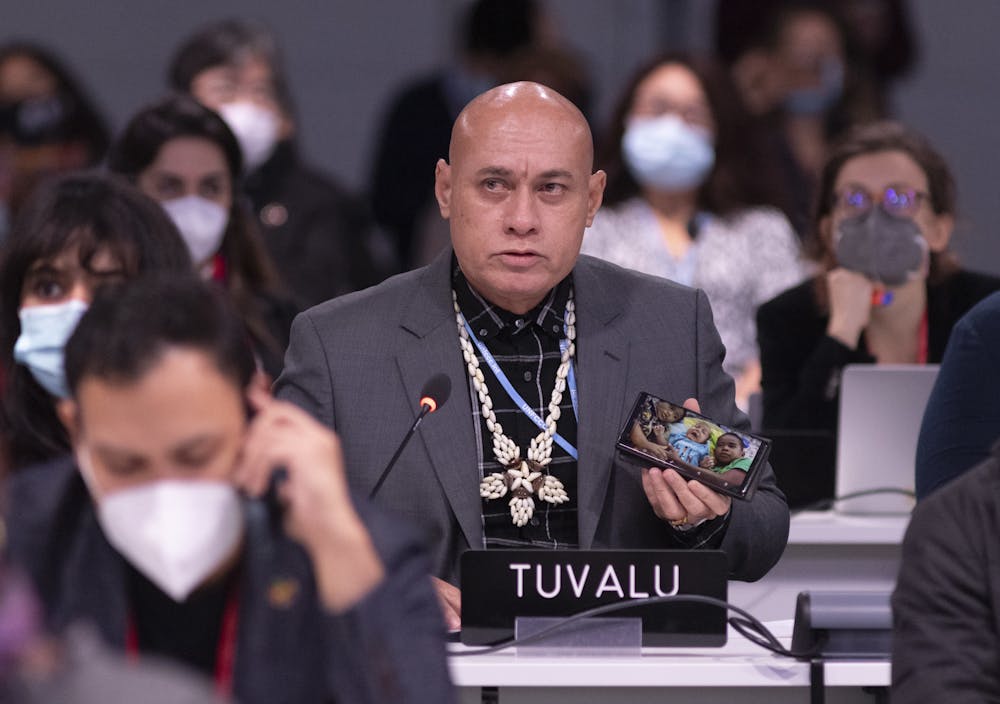
Tuvalu Finance Minister Seve Paeniu gave an emotional speech as the
conference ended.
The Glasgow Climate Pact also criticized the traditional channels of public
funds that set the conditions for finance to flow, including the International
Monetary Fund and the World Bank.
Look for G7 and G20 countries, the
largest shareholders of these institutions, to examine how they can be managed
differently to respond to the climate emergency. All eyes are on Italian Prime
Minister Mario Draghi, current president of the G20 and an experienced central
banker.
In the first week of Glasgow, the titans of the financial industry heralded the
Glasgow Financial Alliance for Net Zero
– the commitment by financial institutions representing $130 trillion in assets
to accelerate the transition to a net-zero emissions economy.
The
shifts within financial markets away from exposure to carbon emissions was
palpable. But without more detail, the announcement attracted cries of “greenwashing.”
Organizers of the alliance will need to work hard to hold members to account,
and throw out those still underwriting the coal industry, for example.
The principle of getting everyone pledged and in the tent and then
making them improve has been used before, for example, the
Net Zero Asset Managers Initiative.
But this only works with transparency, and buried among the press
releases was their report that, of the advertised $57 trillion of the
initiative’s assets under management, only an estimated
35% is actually in line
with net zero.
The U.N. secretary-general
announced an expert group
to propose clear standards for companies and others making net zero commitments,
partly in response to furor around greenwashing. That group is expected to
report back in 2022.
At the heart of Glasgow was a new seriousness
around transparency, credibility, integrity and accountability. Watch this
unfold this coming year.
The third leg of a wobbly stool: Loss and damage
Climate action is a three-legged stool – mitigation, adaptation and loss and
damage.
Loss and damage was mentioned an unprecedented 12 times in the
final Glasgow texts, but without commitments to funding or mechanisms to secure funding. Loss and
damage, or reparations, can be understood this way: you broke it (or endangered
it), you pay for it.
But, afraid of lawsuits in
international courts
– which the U.S. does not belong to – or afraid of the costs, developed
countries have opposed progress on the issue in recent years.
Developing countries left Glasgow disappointed, but there was no escaping the
debate. Watch for a design of a mechanism to help pay for loss and damage and
plans to start funding it. With the next year’s U.N. climate conference in
Africa, this will move center stage.
There’s a Scottish proverb, “fools look to tomorrow, wise men [sic] use
tonight.” There were wise people in Glasgow, and fools too. But there’s not a
night to lose in the year ahead.
Dr Sali Bache is the international policy lead at ClimateWorks, with a focus
on the Asia Pacific region. She is involved in policy analysis and
development, and impact and opportunity scoping for climate and blue
carbon work in the region.
To date, archipelagic Southeast Asian and South Pacific island countries,
including Australia, have led the way in seeking to include oceans as part of
all discussions regarding climate change challenges and solutions.
This is understandable. With their surrounding ocean territories greater
than their land mass, these island states are already experiencing the
impacts of our changing climate. But this isn’t just a regional
concern. Oceans cover more than 70% of our planet, so why aren’t they
central to climate talks?
Mounting evidence reveals the substantial impact climate change has on
oceans and marine ecosystems. Across Southeast Asia and the Pacific Islands,
this includes rising sea levels, erosion and coastal inundation.
Sandbags on a beach in Fiji.
The region is already recognised as the most disaster-prone in the world, with
flooding, storm surges and landslides killing, on average, 43,000 people in
the Asia-Pacific every year. There’s also evidence of climate change
intensifying and prolonging extreme weather events such as tsunamis, as well
as contributing to the loss of marine habitats and species – including key
human food sources – through ocean acidification.
In an area that’s home to two-thirds of the world’s hungry (nearly 500
million people) and relies on the ocean for 20% of its protein, this change
is catastrophic.
Sea-level rise (SLR) in the western Pacific Ocean has been increasing at a
rate two to three times the global average, resulting in almost 30
centimetres of net rise since 1990. And for some areas within Asia, an
increase in sea levels of just 30 centimetres (the length of a school ruler)
can result in 45 metres of land incursion and erosion.
The Asia-Pacific is particularly vulnerable to SLR due to its topography,
with 97% of South Pacific islands and half of Asia residing in low-lying
coastal areas. The risk is exacerbated by socioeconomic conditions impacting
communities’ ability to cope with, or adapt to, such climate-generated
change.
Countries such as Bangladesh, where residents are attempting to adapt their
livelihoods to accommodate rising seas and increased salinity, will within
the next 30 years see the migration of 200,000 people from the coastal
delta area every year.
Indonesia plans to move its capital to Borneo, in light of recent dangerous
flooding and dire predictions of much worse to come.
In the Pacific, some countries without safe areas to relocate have embarked
on the preemptive acquisition of land in other states. This includes
Kiribati, whose former president has purchased a large plot in Fiji as
a refuge, should his atoll homeland become uninhabitable.
The other side to the oceans equation – one of opportunity Oceans also offer a substantial part of the solution to climate change.
In fact, ocean-based mitigation could provide more than 20% of the
emissions reductions needed to keep warming below the now widely accepted
1.5°C target, through actions including changes to maritime industry
practices, offshore renewable energy generation, human food production,
and consumption shifts to sustainable “blue foods” and “blue
carbon” sinks.
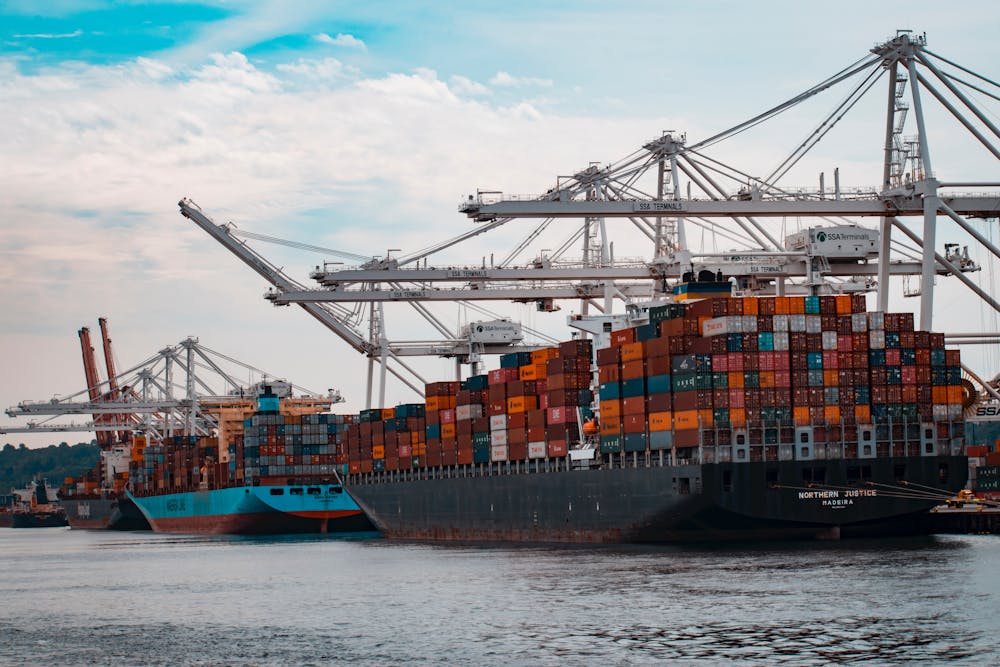
This is of particular significance to the Asia-Pacific. In relation to the
shipping industry, more than 60% of cargo traffic passes through Asian
ports, while the Pacific Island states are heavily reliant on cargo for many
of their needs, and the Marshall Islands is the third-largest vessel
registry in the world.
Similarly, the region is significant in regard to blue carbon, the
South Pacific having defined itself as a “blue ocean” continent with an
ocean territory of more than 30.5 million km².
"Nations must ensure the ocean is more prominent in climate discussions –
because the ocean & its health is integral to the heritage, economies
& livelihoods of Small Island Developing States, & crucial to the
world’s climate."
@andersen_inger
at
#COP26https://t.co/hDAS3Xmyrp
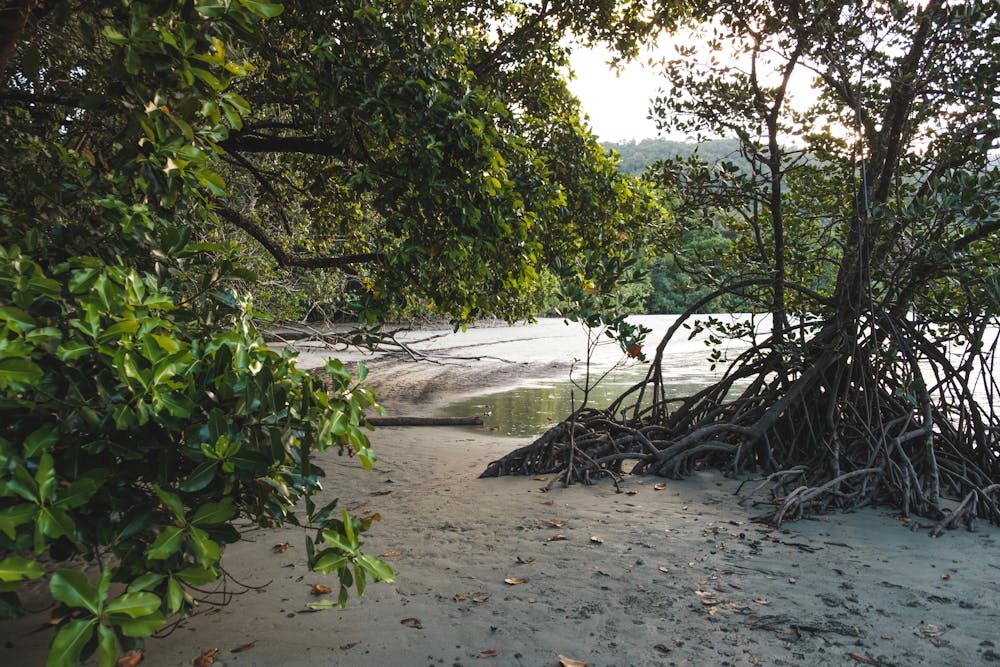
The Asia-Pacific region also dominates in terms of coastal blue carbon
ecosystems. For example, in regard to mangroves, Indonesia has the greatest
stock in the world, with Australia coming in second – at 17% and 10%,
respectively. These and other blue carbon coastal ecosystems such as tidal
marshes and seagrasses act as impressive “vacuums” for carbon dioxide,
storing more carbon per unit area than terrestrial forests.
However, oceans inclusion in climate talks remains piecemeal and
inconsistent.
In 2006, UNFCCC greenhouse gas emission inventory guidelines were revised to
include “offshore areas over which the country has
jurisdiction”. However, the guidelines were inconsistent in their
methodology for allocating emissions from different maritime sectors,
leaving ships and aircraft engaged in international transport as external to
the scope, allocating waterborne navigation emissions on international trips
as split between country of departure and arrival, and fishing vessels
emissions based upon the country delivering the fuel, with military fuel use
categorised under “non-specified”.
Other elements weren’t extended beyond the shoreline until 2013, when the
IPCC wetland supplement provided methodologies for coastal wetland sinks and
sources. Unlike on land, however, their inclusion is optional.
Momentum for the inclusion of oceans in climate talks began to grow in 2014,
with recognition of the critical role of the UNFCCC process in the UN
General Assembly annual resolution on the Oceans and the Law of the Sea, and
the IPCC in its
AR5 Synthesis Report
stating that climate change and acidification was altering the ocean at an
unprecedented rate.
With the omission of oceans and coasts as part of the Paris Agreement
negotiating text, 2015 marked a turning point. The efforts of some states to
have oceans included in climate data and ambition then escalated, aided by
2015 COP co-president Fiji – a vocal advocate for ocean-climate linkages.
Australia, too, has participated in coalitions and in other forums with
other countries in the region, contemplating the impact of climate change on
oceans and considering potential mitigation measures. Of influence has been
the
High Level Panel on a Sustainable Ocean Economy, of which Indonesia and Palau are also members, and the
Because the Ocean Initiative, which additionally includes the Marshall Islands, New Zealand and
Singapore.
Mobilisation of the ocean community
A series of initiatives, including the re-emergence of Oceans Day at the
2015 COP, saw the major mobilisation of the ocean community, which has
since sought to foster political momentum for oceans engagement. The first
“Because the Ocean” declaration urged the creation of an Ocean Action
Plan under the UNFCCC, and the following year a second declaration called
for the inclusion of oceans in national reporting of emissions, and
pledged reduction contributions.
These important steps and the ongoing mobilisation of action led to the
first inclusion of oceans in the UNFCCC output document at COP25 in 2019,
and the coining of the title the “Blue COP”.
In the intervening years, this prompted an
Ocean and Climate Change Dialogue. To herald the COP26 another “Blue COP”, the world needed to step up
in its ocean-climate commitment. In the event, the Glasgow Climate Pact did
again acknowledge the oceans. It also committed to the Ocean and Climate
Change Dialogue becoming a permanent annual event, and to the consideration
by UNFCCC bodies of how to “integrate and strengthen ocean-based action
into existing mandates and workplans”.
While these are positive measures, they’re all UNFCCC-oriented, and at
this stage require no action by state parties.
Our @COP26#GlasgowClimatePact
call for an annual dialogue to strengthen ocean-based action succeeds,
ensuring that the work to integrate ocean and climate change across the
@UNFCCC will
continue. Read the reaction from ocean groups across the world: 👉
https://t.co/NzCRB8hazV
It remains today that we’re without systematic inclusion of the offshore in
greenhouse gas inventories, and the range of other Paris Agreement
instruments. Still, countries’ reporting areas aren’t aligned with the zones
of sovereignty prescribed in the UN Convention on the Law of the Sea – the
international treaty establishing a legal framework for maritime areas,
protection and activities.
Given the magnitude of oceans’ impacts on both climate and emissions, such
exclusions risk the integrity of the emissions data and activities that
underpin our global climate efforts, as well as the health of the ocean
itself.
Countries at COP26 had an opportunity to put ocean impacts and mitigation on
the main stage. On the first day of the event, the Because the
Ocean Initiative released a new declaration, calling for the systematic
inclusion of oceans in UNFCCC and Paris Agreement processes, and enhanced
ocean-climate action.
Although a step in the right direction, the actual impact of the Glasgow
Climate Pact will remain uncertain until the next COP, dependant on how the
UNFCCC bodies respond to these directives, and what then occurs in regard to
obligations of state parties and oceans resource allocation.
The world is watching, but perhaps those in Southeast Asia and Pacific
Island countries are watching most keenly.
Climate change is commonly discussed as though it’s a uniquely atmospheric
phenomena. But the crisis is deeply entwined with the ocean, and this has
largely been neglected in international climate talks.
The latest international climate negotiations made some progress by, for the
first time,
anchoring oceans
permanently into the multilateral climate change regime. But the
Glasgow Climate Pact
is still leagues from where it needs to be to adequately reflect the
importance of oceans to our climate system.
Most countries have targets for land-based emissions – but there are no such
targets for oceans. Yet the ocean plays a vital role in helping balance the
conditions humans and most other species need to survive, while also offering
a substantial part of the solution to stop the planet warming over the crucial
limit of 1.5℃ this century.
So how can oceans help us tackle the climate crisis? And what progress has
been made in international negotiations?
The consequences of this are profound, including the thermal expansion
of water (the key cause of sea level rise), ocean acidification,
deoxygenation
(oxygen loss), and forcing marine life to redistribute to other places.
Alarmingly, this may one day lead the ocean to reverse its role as a carbon
sink and release CO₂
back into the atmosphere, as its absorption ability declines.
Oceans can also provide climate-safe, sustainable food choices. Current food
systems, such as emissions-intensive agriculture, fishing, and processed foods
are responsible for
one-third of global emissions. Considerable environmental (and health) benefits can be gained by shifting
our diets to sustainable “blue foods”.
These include seafoods sourced from fisheries with sustainable management
practices, such as avoiding overfishing and reducing carbon emissions. Markets
and technologies should also be geared towards the large-scale production and
consumption of aquatic plants such as seagrasses.
There’s also a wealth of opportunity in “blue carbon” – capturing CO₂ in the
atmosphere by conserving and restoring marine ecosystems such as mangroves,
seagrasses and salt marshes.
However, the success of nature-based solutions
depends on a healthy ocean ecosystem. For example, there are emerging concerns
around the impact of
plastic pollution
on plankton’s ability to absorb CO₂.
Conserving mangroves is an important way to sequester carbon from
the atmosphere.Shutterstock
For more than a decade, the inclusion of oceans in climate talks has
been piecemeal and inconsistent. Where they have been part of negotiations,
including at COP26, talk has focused on the potential for coastal areas to
adapt to climate change impacts such as sea-level rise, as first raised in
international fora
in 1989
by small island states.
The final COP26 agreement, known as the
Glasgow Climate Pact, made slight progress.
The pact recognised the importance of ensuring the
ocean ecosystem’s integrity. It established the “the Ocean and Climate Change Dialogue” as an annual
process to strengthen ocean-based action. And
it invited
UNFCCC bodies to consider how to “integrate and strengthen ocean-based
action into existing mandates and workplans” and report back.
While these are positive measures, at this stage they don’t require action
by parties. Therefore, they’re only a theoretical inclusion, not
action-oriented.
We still lack national targets and clear, mandatory international
requirements for countries to consider sinks, sources and activities beyond
the shoreline in their climate planning and reporting.
Where COP26 did progress was its focus on whether ocean impacts and
mitigation will finally be brought into the mainstream climate agenda.
For
the first time in five years, a new
“Because the Ocean” declaration
was released, which calls for the systematic inclusion of the oceans in the
UNFCCC and Paris Agreement process.
A delegate from Tuvalu, a Pacific Island nation facing the
existential threat of sea level rise, speaks at
COP26.EPA/ROBERT PE
What do we do now?
What’s now needed is a list of mandated requirements that ensure countries
report on and take responsibility for climate impacts within their maritime
territories.
But as COP26 president Alok Sharma said of the summit as a whole, it was a
“fragile win”. We still lack any reference to consistency with existing
mechanisms, such as the
law of the sea convention
or how funding will be allocated specifically to oceans.
As such, the actual impact of COP26 on the inclusion of oceans in climate
action remains uncertain. It will depend on how the UNFCCC bodies respond to
these directives, and their success in extending obligations to state
parties.
Responding to the climate crisis means we need to stop pretending the ocean
and atmosphere are separate. We must start including ocean action as a
routine part of climate action.