25/11/2021

(AU) From Rhetoric To Action – Academies Release Joint Statement On COP26

Australian Academy of Science


The presidents of Australia’s five learned academies have issued a joint statement on COP26 and Australia's path to net-zero emissions.

The statement promises the academies’ independent voice and convening power, which harnesses the collective expertise and resources of nearly 3,500 Fellows across the academies, to provide insights, solutions and knowledge.
[The presidents] recognise that our Academies’ collective expertise and leadership is critical to addressing the widespread and intergenerational impacts of climate change.
Photo:Gustavo Fring via Pexels.

From the statement

 “[The presidents] recognise that our Academies’ collective expertise and leadership is critical to addressing the widespread and intergenerational impacts of climate change.

"At COP26 in Glasgow, world leaders convened with a singular goal – to drive deep and rapid decarbonisation to limit global warming to 1.5 degrees Celsius.

"There is no realistic path to decarbonisation without ending fossil fuel use.

"In response, every sector in Australia must deliver on our commitments to reach the global goals stated in the 2015 Paris Agreement.

“The challenges presented by climate change require smart, holistic and cross-disciplinary thinking. We need to continue developing and communicating research to challenge misinformation with robust evidence and steward an economy-wide transition to a low carbon future.

"Our academies will work to ensure our experts are at the forefront, providing advice to guide the most efficient, fair and cost-effective policy mechanisms that drive reductions in greenhouse gas emissions and broader adaptation.

“Strategies will aim to exceed our emission reduction targets while effectively managing social, economic, health and environmental factors and empowering governments and industry to take action. We are also committed to substantially reducing the emissions of our own academy activities.”

Work underway

Learned academies and ACOLA are already undertaking valuable work towards net-zero, including:

The statement is signed by the presidents of Australia’s learned academies: Links

(AU The Conversation) Climate Change Is Likely Driving A Drier Southern Australia – So Why Are We Having Such A Wet Year?

The Conversation

Shutterstock

Author
 is Climate projections scientist, CSIRO     
As the climate changes, southern Australia is likely to keep getting drier on average, particularly in the southwest.

However, this year has been wet. And yesterday the Bureau of Meteorology announced we are now in another La Niña event. This common large-scale climate pattern lasts for months, and will increase the odds of further wet weather across the country.

So despite the long-term trend towards drier conditions, we find ourselves in a wetter-than-usual period. What gives?

Current climate change assessments

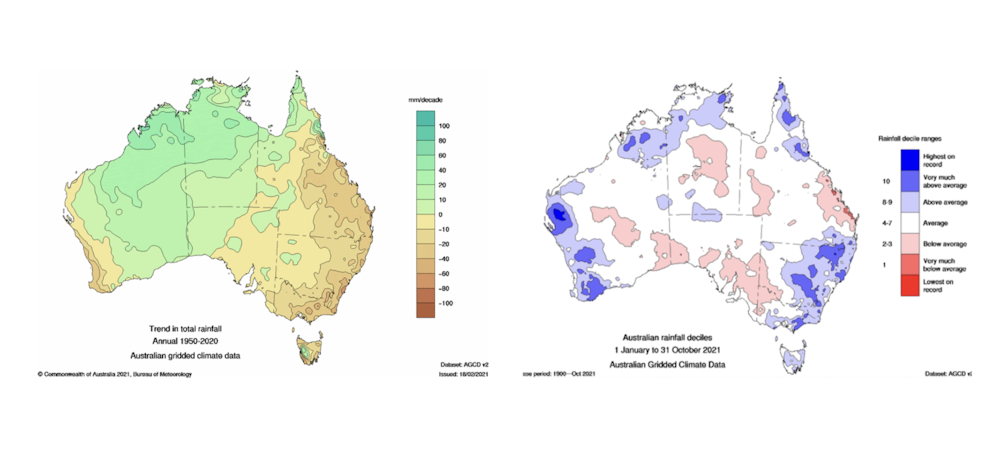
Rainfall has been declining in much of southern Australia in recent decades (see below). The Intergovernmental Panel on Climate Change’s Sixth Assessment report – which draws on the latest climate research – found the recent drying trend in southern Australia is likely to continue, particularly during the cool season.

Cool-season rainfall in southwest Western Australia has already decreased, and ongoing drying in this area is assessed to be very likely. There’s strong evidence this trend contains a “signal” of climate change, otherwise known as a climate change “fingerprint”.

We understand the drying has been driven by changes in dominant weather patterns. And future projections of drying in the southwest are among the strongest in the world.

The situation in the southeast of Australia is not as clear, but there’s strong evidence for an ongoing decrease in rainfall here, too.

Yet, we find it has been wet in many southwest and southeast regions this year – including in the cool season. In fact, some areas received “very much above average” rainfall in the ten months to the end of October, seemingly defying the drying trend.

Left: trend in annual rainfall since 1950. Right: rainfall deciles for Jan-Oct 2021.
LARGE IMAGE


Variability is king in Australia

Australia has always been the land of droughts and flooding rains. It’s normal to be beset by a multi-year drought, before experiencing major floods. Year-to-year variability here is large compared with most of the world’s other land regions.

In 2021, we’ve seen a wet swing of the climate needle due to several global climate drivers. Alongside the Pacific now being in the La Niña phase, the Indian Ocean Dipole is in a negative phase.

When we see these drivers line up, we know the deck is stacked for a wetter season. This is what we’ve always found, and we can count on Australia’s climate variability to remain, through this century and beyond.

So does a wet year cast doubt on our assessment of climate change? No.

In the 2020 State of the Climate report, released by the CSIRO and the Bureau of Meteorology, we noted recent rainfall trends are tracking within projections.

Left: projected change in average precipitation at 3°C of global warming. Brown indicates decrease and green indicates increase. Right: projected change in heavy rainfall days (average heaviest daily rainfall of the year). Results show the average of all climate models (a central estimate) from the latest round of global modelling performed. Note there is a range of results around this model average. IPCC Interactive Atlas

In fact, we showed rainfall trends since the baseline of 1986-2005 to 2020 are tracking in the dry end of projections for the southwest and Victoria. This suggests that if anything, the projections are likely conservative.
Of course there are wet years, such as this year and also Victoria in 2010. But the longer-term trend has been downward. This is consistent with what we expect from climate change, after drawing on multiple lines of evidence and climate modelling.

2021 is not extraordinary in the long-term context. Even if the whole of 2021 ends up being very wet, it won’t shift the long-term trend by much. Only a persistent wet trend over decades or longer would raise questions about our assessment of climate change and current projections.

What does a ‘drier’ climate look like?

As the global climate warms, global average rainfall is increasing – and we expect most regions of the world will actually become wetter.

But there are some regions which will get drier, including southern Australia, the Mediterranean and southern Africa. So what will this look like?

A trend towards a drier climate will come with a lot of ups and downs. For example, between 1900 and 2020 southwest Western Australia’s annual rainfall varied between about 393mm and 1035mm (-40% and +55% from the average). This is a huge range.

Climate projections suggest a persistent rainfall reduction of up to 15% in the southwest of Australia is plausible over the first part of this century. Change later in the century will depend on whether we limit further climate warming.

If we do limit it, we can expect the rainfall to decrease by up to 20%. If we don’t, it will decrease by up to 35% – with larger reductions very plausible in the cool season. In either case, these projected average changes are still smaller than the year-to-year variability recorded in Australia over many decades.

But this doesn’t mean the trends and projections aren’t important. A persistent and ongoing shifting towards drier conditions, with drier (and hotter) dry spells is a huge challenge for Australia’s water managers and primary producers. And with a lower rainfall average, the chances of unprecedented dry periods are higher.

Wet extremes expected

But not every year will be a drought. There will still be wet days, months and years.

In fact, wet extremes are likely to increase despite the drying trend. Even in regions where the average rainfall is expected to decrease, there is a projected increase in intense rainfall bursts and rainfall extremes.

This includes intense hourly rainfalls that can lead to flash floods, as well as major rainfalls from “atmospheric rivers”, which are strong channels of concentrated moisture that stream through the atmosphere above us, delivering water for extreme rainfalls.

So for parts of southern Australia, a likely outcome is lower rainfall on average, but an increase in extreme rainfall events. With lower water availability overall, punctuated by intense flood risk, we can anticipate significant challenges ahead.

Links

(AU ABC) What Is The La Niña And What Does It Mean For Australian Weather?

ABC Weather - Kate Doyle

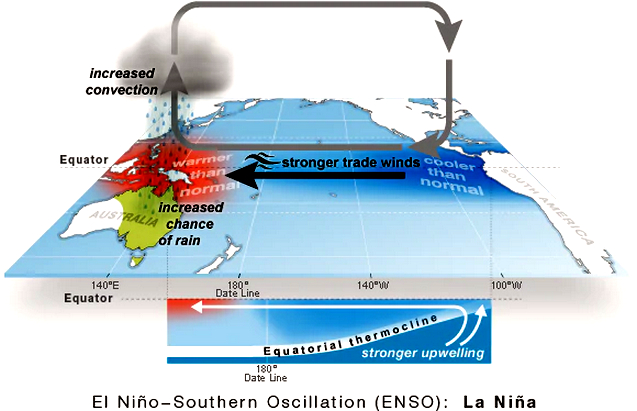
During a La Niña there are warmer than average waters in the western Pacific near Australia and cooler than average in the east. (Supplied: NOAA October 2021)

Invisible to us mere mortals on the ground, the atmosphere is full of giant circulations which transport, mix and disperse air and energy around the world.

One of these giant eddies is called the Walker Circulation.

The Walker Circulation strides the Pacific Ocean, rising in the west in the warm waters near Australia, pushing up and over the Pacific and descending near South America before racing back across the Pacific Ocean to form the trade winds.

Under normal conditions the Walker Circulation drives the trade winds across from the east to the west of the Pacific. (Supplied: Bureau of Meteorology)

La Niña is the term used to describe when the Walker Circulation is on steroids.

The western Pacific is even warmer than usual, the trade winds are stronger and all this moist energetic air is pushed onto Australia.

When there is a La Nina the Walker Circulation intensifies bringing wet and warm conditions to Australia. (Supplied: Bureau of Meteorology)


La Niña is therefore typically associated with wetter than average conditions for northern and eastern Australia, particularly in winter, spring and early summer.

La Niña events are typically associated with above average rainfall for northern and eastern Australia. (Supplied: Adobe Stock)

When the Walker Circulation is weakened, or even reversed, it is called the El Niño.

With the air now rising near South America and falling over the cooler-than-average oceans near Australia, less moisture is available and lift is discouraged, often resulting in drier than average conditions for northern and eastern Australia.

When there is an El Nino the Walker Circulation is reversed and downward pushing air brings dry conditions to Australia.(Supplied: Bureau of Meteorology)

What's in a name?

Together La Niña and El Niño are often referred to as the El Niño Southern Oscillation or ENSO.

The name El Niño was coined by South American fishermen in the 1600's who noticed unusually warm waters that often peaked around Christmas time.

They named the phenomena after 'El Niño de Navidad' after the Christ Child.

This evolved into just El Niño, 'the boy' and La Niña, 'the girl' to describe the opposite phase.

'La Niña' is the the girl child of the Pacific who brings flooding rains. (Supplied: Jenita Enevoldsen)

For any real keen weather watchers out there, there is another ENSO phase called El Niño Modoki. Where Modoki means 'same but different' in Japanese.

Or more boringly referred to as a Central Pacific El Niño.

This phase is when the air rises in the centre of the Pacific descending on both sides and discouraging rain.

What does La Niña mean for Australia?

Straight off the bat, no two La Niña events are exactly the same.

La Niña conditions don't cause any one individual downpour, rather they stack the underlying conditions full of moisture for when any individual weather event does come along.

La Niña's impact on summer rainfall is, in general, relatively less than it is in winter and spring but as it combines with the typical wet season for much of the north it can still help make things pretty wet. (Supplied: Bureau of Meteorology)

La Niña summers are therefore typically wetter than average and the warmer oceans also favour tropical cyclones.

The increased rainfall also results in increases in mosquito-borne diseases.

Big La Niña events of the past include the 1973 to 1976 La Niña, which was the longest sustained period of La Niña on record.

1974 still stands as Australia's wettest year on record and 1973 and 1975 also made the top five.

Brisbane's CBD was inundated in January 1974. (Royal Historical Society of Queensland)

Perhaps the most memorable event from these years was when Cyclone Wanda flooded Brisbane in the January of 1974.

More recently, 2010 to 2012 is notable for having two big La Niña summers in a row.

2010 and 2011 combined, resulted in the wettest 24 months on record.

Flooding was widespread from spring 2010 through to the end of summer 2011 — up and down the east coast.

Horror flash flooding washed away Grantham in South East Queensland's Lockyer Valley and Brisbane again went under water.

Lang Park under water during the 2011 floods. (Nearmap.com)

As these examples demonstrate, having two La Niña years in a row is fairly common.

This year's La Niña is again following on from one last year.

But thankfully this combination is not expected to be as extreme as these big events of the past.

How does La Niña impact the world?

La Niña typically also brings wetter than average conditions to the nations north of Australia in our summer.

La Niña has flow-on effects that impact rainfall in many regions around the world. (Supplied: International Research Institute for Climate and Society Columbia University)

A La Niña will typically lead to drier than average conditions for the southern US over their winter.

A study published in Nature found ENSO may have had a role in 21 per cent of all civil conflicts between 1950 and 2004, and that new civil conflicts in the tropics were twice as likely to arise during El Niño years than La Niña.

La Niña and El Niño are not the only drivers

ENSO is only one of a set of climate systems that affect Australia.

The Indian Ocean Dipole (IOD) is the other main year-to-year driver that influences Australia.

It gained household notoriety recently after its persistent positive phase took most of the blame for the drought that culminated in the 2019/2020 fires.

But other drivers like the Southern Annular Mode (SAM), and the Madden Julian Oscillation (MJO), also play a part.

These are just some of the climate influences on Australia as explained by the Bureau of Meteorology. (Supplied: Bureau of Meteorology)
These drivers can work to counter each other out or enhance the overall impact, as has been the case this spring as the developing La Niña and the decaying negative IOD have combined to encourage rain.

These drivers are happening on top of the backdrop of climate change, with seasonal changes and individual systems in the foreground.

It is a wonderfully complex world out there.

Links

24/11/2021

(The Conversation) The Seas Are Coming For Us In Kiribati. Will Australia Rehome Us?

The Conversation | 

Getty Images

Authors
  •  is a PhD Student, Australian National University
  •  is Distinguished Global Leader-in-Residence, University of Pennsylvania     
Our atoll nation is barely two metres above sea level, and the waters are coming for us.

Despite the progress and momentum of the COP26 climate conference in Glasgow, we are still not moving fast enough to avoid the worst of climate change.

It is heartening that more than 190 countries and organisations agreed to rapidly phase out coal power and end support for new coal power stations.

More than 100 countries signed a pledge to cut methane emissions 30% by the end of the decade, and about the same number agreed to stop deforestation on an industrial scale in the same timeframe.

But even with these agreements, we in Kiribati face the death of our homeland. Co-author Anote Tong led our country as president for 15 years, alongside lead author Akka Rimon, who was foreign secretary between 2014 and 2016.

Author Anote Tong, when he was Kiribati president, at the Pacific Islands Forum in 2015. Mick Tsikas/AAP


The problem is speed. Our land is disappearing faster than global action can stem climate change. Delays and a lack of global leadership mean the existence of small island states like Kiribati is now in the balance.

That means we must urgently find ways to rehome our people. It is very difficult to leave our homes, but there is no choice. Time is not on our side. We must prepare for a difficult future.

What we need is a model where displaced people can migrate to host nations when their homes become uninhabitable. Countries like Australia need workers – and we will soon need homes.

This is, increasingly, a question of justice. Australia’s actions, in particular, raise questions over how sincere it is in honouring its recent commitments at COP26.

As the world’s largest exporter of fossil gas and the second largest exporter of coal, Australia’s reluctance to change is putting its neighbours in the Pacific at risk of literally disappearing. It is the only developed nation not committed to cut emissions at least in half by 2030.

In Glasgow, Fiji urged Australia to take real action by halving emissions by 2030. Did it work? No. Australia also refused to sign the agreements on ending coal’s reign, with prominent politicians undermining the COP26 agreement as soon as the conference was over.

We desperately hope the commitments Australia did make at COP26 are not just words on paper. But if they are, that makes our need for certainty even more urgent.

Let us speak plainly: If Australia really does plan to sell as much of its fossil fuel reserves as possible and drag its feet on climate action, the least it can do is help us survive the rising seas caused by the burning of its coal and gas.

Kiribati’s Tarawa Atoll is home to more than half of the island nation’s far-flung population. European Space Agency, FlickrCC BY-SA

To migrate with dignity

Eighteen years ago, the Kiribati government – then headed by Anote Tong – introduced a “migration with dignity” policy as a way for I-Kiribati people to adapt to climate change.

We gave our I-Kiribati workers international qualifications tailored for jobs in demand overseas. After this, Kiribati, Tuvalu, Fiji, Tonga and New Zealand set up a scheme to allow workers to migrate to New Zealand if they had an offer of a job. Each year prior to COVID, 75 people from Kiribati were able to migrate through the scheme.

New Zealand is the first and only country currently offering a permanent labour migration program from Kiribati. While welcome, we will need more places for I-Kiribati as climate change intensifies.

Like New Zealand, Australia has expanded its seasonal worker schemes for Pacific workers, and is now moving towards a longer stay, multi-visa arrangement under its Pacific Labour Scheme. We expect this scheme will evolve into a permanent migration scheme similar to New Zealand.

While we wait in hope for a true safe haven for our people, our diaspora is growing. I-Kiribati are moving now to Pacific countries higher above the water level such as Fiji, the Cook Islands, Niue, Samoa and Tonga.

Are we scared? Of course. We are on the front line of this crisis, despite having done amongst the least to cause it. It is difficult to leave the only home we have known. But science does not lie. And we can see the water coming.

Labour migration will not solve climate change, but it offers hope to those of us who will be displaced first.

This is a vital question of climate justice. This upheaval is caused by high-emitting economic powerhouses like the US, China, and the European Union. But the vulnerable are paying the full cost. That is not fair.

As climate change worsens, other global leaders must consider how best to support adaptation through labour mobility. Far better to plan for this now than to let climate change rage unchecked and trigger ever-larger waves of refugees.

The question of climate justice

Consider this: in 2018, each person in Kiribati was responsible for 0.95 tonnes of carbon dioxide equivalent. By contrast, each person in the United States was responsible for 17.7 tonnes. Despite this imbalance, the US has taken little responsibility for what is happening to Kiribati and other low-lying nations.

We are hopeful this may change, given US President Joe Biden recently pledged to make his nation a leader in climate finance by supporting nations worst hit by climate change and with the least resources to cope.

It’s also encouraging that new laws have been proposed to allow people displaced by climate change to live in America.

We must work to slash emissions and devise solutions for the problems caused by the warming.

The highest point in Kiribati is 3 metres above sea level, with the average less than 2 metres. Erin Magee, Wikimedia CommonsCC BY

International law must recognise climate displaced populations and create ways we can be rehoused.

While other solutions such as climate-proofing infrastructure or even floating islands have been proposed for Kiribati, these cannot happen overnight and are very expensive. By contrast, labour mobility is fast and advantageous to the host country.

Kiribati’s current government is working to increase skills and employability in our workforce. We are doing our part to get ready for the great dislocation.

When I-Kiribati have to migrate, we want them to be able to do so as first class citizens with access to secure futures rather than as climate refugees.

We are doing all we can to stay afloat in the years of ever angrier climate change. But it will take the global village to save our small village and keep alive our culture, language, heritage, spirits, land, waters and above all, our people.

Links

(The Guardian) Revealed: The Places Humanity Must Not Destroy To Avoid Climate Chaos

The Guardian

Tiny proportion of world’s land surface hosts carbon-rich forests and peatlands that would not recover before 2050 if lost

Greenpeace and local activists extinguish a peat fire near Novosibirsk, Siberia. Russia hosts 23% of irrecoverable carbon and has been hit by wildfires in recent years. Photograph: Alexander Nemenov/AFP/Getty Images

Detailed new mapping has pinpointed the carbon-rich forests and peatlands that humanity cannot afford to destroy if climate catastrophe is to be avoided.

The vast forests and peatlands of Russia, Canada and the US are vital, researchers found, as are tropical forests in the Amazon, Congo and south-east Asia. Peat bogs in the UK and mangrove swamps and eucalyptus forests in Australia are also on the list.

The scientists identified 139bn tonnes (139Gt) of carbon in trees, plants and soils as “irrecoverable”, meaning that natural regeneration could not replace its loss by 2050, the date by which the net global carbon emissions must end to avoid the worst impacts of global heating.

In the last decade alone, farming, logging and wildfires have caused the release of at least 4Gt of irrecoverable carbon, the researchers said.

New mapping shows the carbon-rich areas
humanity cannot afford to destroy if climate catastrophe is to be avoided

*to 30cm depth for forests and grasslands and to 100cm depth for peat and wetlands (reflecting the different depths of typical disturbance for different ecosystems). Guardian graphic. Source: Nature Sustainability.

Slashing fossil fuel burning is key to ending the climate crisis but ending the razing of forests is also crucial.

Major nations including Brazil, China and the US agreed to do this by 2030 at the Cop26 climate summit, although a similar pledge made in 2014 failed.

The Earth’s irrecoverable carbon is highly concentrated, the researchers showed. Half of it is found on just 3.3% of the world’s land, making focused conservation projects highly effective. Only half the irrecoverable carbon is currently in protected areas but adding 5.4% of the world’s land to these would secure 75% of irrecoverable carbon, they found.

Indigenous peoples are the best protectors of land but only a third of irrecoverable carbon is stored on their recognised territories. Irrecoverable carbon stores overlap strongly with areas of rich wildlife, so protecting them would also tackle the looming mass extinction of wildlife.

“We absolutely must protect this irrecoverable carbon to avert climate catastrophe – we must keep it in the ground,” said Monica Noon at Conservation International, the lead author of the study.

“These are the areas that really cannot be recovered in our generation – it is our generation’s carbon to protect. But with irrecoverable carbon concentrated in a relatively small area of land, the world could protect the majority of these climate-essential places by 2030.”

Prof Pete Smith, at the University of Aberdeen in the UK, said: “This research makes a convincing case for where, and how, to focus efforts for the ‘30 by 30’ initiatives already in existence” to protect 30% of land by 2030.

Note: maps are not shown to the same scale. *to 30cm depth for forests and grasslands and to 100cm depth for peat and wetlands (reflecting the different depths of typical disturbance for different ecosystems). Guardian graphic. Source: Nature Sustainability. 

The research, published in the journal Nature Sustainability, found that 57% of irrecoverable carbon was in trees and plants and 43% was in soils, especially peat.

Global peatlands store more carbon than tropical and subtropical forests, it concluded.

The tropical forests and peatlands of the Amazon are the biggest store of irrecoverable carbon. These were recently reported as emitting more carbon than they absorb.

The boreal peatlands and forests of eastern Canada and western Siberia, and the rainforests islands of south-east Asia, are the next largest.

The temperate rainforest of north-west North America, mangroves and tidal wetlands around the world, and the Congo basin are also major stores.

Russia hosts the biggest store of irrecoverable carbon – 23% – and has been hit by wildfires in recent years.

Brazil is second, where Jair Bolsonaro’s government has allowed a sharp rise in deforestation.

Canada is third and the US fifth: together these two countries have 14% of the world’s irrecoverable carbon, but they have also lost forests to wildfires, pests and logging.

The wetlands of southern Florida are another important store of irrecoverable carbon.

Australia is home to 2.5% of the world’s irrecoverable carbon, in its coastal mangroves and seagrasses as well as forests in the south-east and south-west, which were hit by megafires in 2019-20.

In the UK, peat bogs cover 2m hectares and have stored 230m tonnes of irrecoverable carbon for millennia, but most are in poor condition.

The scientists calculated the amount and location of irrecoverable carbon by first identifying at high resolution those areas where direct human activity could damage natural ecosystems.

These included forests and peat wetlands, but excluded permafrost regions and commercial tree plantations.

Next the scientists assessed the total amount of carbon stored in the trees, plants and soils in the included areas. Finally, they estimated how much carbon could be recovered by natural regeneration over 30 years if the forests or wetlands were destroyed.

The difference between the total carbon and recoverable carbon gave the amount of irrecoverable carbon. Losing this irrecoverable carbon would blow the carbon budget needed to have a two-thirds chance of staying under 1.5C of global heating.

Peatlands and mangroves are hotspots of irrecoverable carbon, due to their high carbon density and long recovery times of centuries or more. Tropical forests are less dense in carbon and regrow relatively fast, but remain critical because of the very large areas they cover.

The scientists said protecting irrecoverable carbon must involve strengthening the rights of indigenous peoples, ending the policies that enable destruction and expanding protected areas.

Rob Field, a conservation scientist at the RSPB in the UK, said: “Protection of irrecoverable carbon, coupled with widespread decarbonisation of the world’s economies, will make a safe climate more likely, at the same time as conserving important areas for biodiversity.”

Links

(AU AFR) Court Gives Student OK To Sue Government Over Climate Disclosure

AFR - Hannah Wootton

The Commonwealth has lost an attempt to have a landmark case alleging it misled or deceived sovereign bonds investors by failing to disclose climate change risk thrown out, with a judge slamming its claims as “exaggerated” and having “little force”.

The ruling allows 24-year-old student and bondholder Katta O’Donnell to proceed with her case – one of several sweeping Australian courts in a tidal wave of climate litigation – in which she is pushing for the government to declare climate change risk associated with bonds and for it to be banned from promoting or selling them until it does so.

The Commonwealth has lost its attempt to have Katta O’Donnell’s climate change case struck out. Josh Robenstone

It also paves the way for future cases by effectively ruling that investors can make a claim for misleading conduct before corrective disclosure or harm had occurred, which is at the core of climate change actions in which applicants try to improve the conduct of those they are suing before the alleged harm occurs.

The government was attempting to have the case struck out despite the Australian Office of Financial Management conceding that ratings houses will likely force greater climate disclosure from the state and Treasurer Josh Frydenberg admitting financial markets and lenders may sanction Australia if it does not move faster on cutting emissions.

The Commonwealth argued Ms O’Donnell had not sufficiently established what harm climate change would cause to the state’s finances, when that damage would occur or what the link between the loss and the planet warming was.

But Federal Court judge Bernard Murphy slammed the Commonwealth’s complaints as “exaggerated”, saying it was “straightforward to understand the basis of [Ms O’Donnell’s] claim ... that, in the likely event that the consequences of climate change have material adverse impacts on the Commonwealth’s financial position, the bond market is likely to factor that into the value of [bonds] on the ASX”.

He said that misleading and deceptive conduct was a “relatively straightforward” claim, especially as Ms O’Donnell was not claiming that there had been insufficient disclosure but rather that there had been “nothing at all”.

Justice Murphy also threw out the government’s claim that the case should be struck out because Ms O’Donnell had not explained what information about climate change risk it should have disclosed, saying the onus was on the government to provide this information as it was “uniquely placed ... to assess” it.

He ordered that Ms O’Donnell get access to internal government documents regarding these risks before filing a revised claim, citing a “substantial asymmetry of information” between the parties.

He rejected the government’s claim that requiring climate change risk disclosure would be the thin end of the wedge in requiring disclosure of “every possible event, economic change, or government policy that could ever occur over the space of 30 years” and influence bond prices, saying “that was not the applicant’s case”.

“Disclosure of a risk that the price [of bonds] ... may change for reasons which are unstated, is not the same thing as disclosing a risk that the market price might be materially reduced as a result of a particular identified risk, here, climate change,” he said.

Representative proceeding to go ahead

The Commonwealth also lost its challenge to stop the case being a representative proceeding – meaning Ms O’Donnell is suing on behalf of other bondholders – on the basis that climate change disclosure actually risked loss to investors in the future.

It said there was “no legitimate purpose” behind bringing the matter as a representative proceeding, suggesting Ms O’Donnell was trying to run a “pseudo climate change class action” to garner public attention even though she could have just sued the Commonwealth in a personal capacity.

But Justice Murphy also dismissed this as having “little force” and media attention was “neither here nor there”.

“These days, it is common place for the parties to large litigation to consider, and attempt to influence, the way the litigation is seen in the eyes of the public,” he said.

“There is little or no evidence as to how the applicant has sought to garner media attention regarding the proceeding. But to the extent that she may have done so, it carries little weight in deciding whether to order that the proceeding not continue as a representative proceeding.”

But he rejected Ms O’Donnell’s allegations that the Commonwealth, federal Treasury Secretary and the CEO of the Australian Office of Financial Management owed her a fiduciary duty, meaning the individuals are off the hook as only the misleading and deceptive claim against the state remains.

Links

23/11/2021

(CNN) Senior Pentagon Official Warns The US Military Is 'Not Ready' For Climate Change

CNNOren Liebermann | Ellie Kaufman

US Marines take part in an exercise with Norwegian troops in subzero temperatures above the Arctic Circle.

A senior Pentagon official warned the US military is "not ready" to handle climate change, a national security issue that touches nearly every aspect of Defense Department planning.

"We are not where we should be, and now is beyond the time when we need to get in front of that challenge," Deputy Defense Secretary Kathleen Hicks told CNN.

Beyond rising sea levels and extreme weather, climate change has opened up new areas of strategic competition like the Arctic and intensified the competition for scarce resources, such as the raw materials required to make the lithium-ion batteries crucial to electric vehicles.

"It's something like $750 billion of investment worldwide going on in lithium-ion batteries," Hicks said. "The challenge is most of that is happening in China. They dominate that supply chain. It's a significant national security challenge for us."

Hicks, the first woman to hold the Pentagon's number two position, leads the military's different efforts on climate change. On a recent two-day trip to Michigan, Connecticut and Rhode Island, Hicks saw work on the first generation of electric military vehicles, including an electric light reconnaissance vehicle at GM Defense.

As the civilian automotive industry goes green, the Pentagon will follow.

"If we don't follow and be part of the solution, we will be left behind," Hicks said, "and our vehicle fleets won't be able to be supported."

But electric military vehicles pose their own set of challenges. Although an electric vehicle can be much quieter and emit less of a heat signature -- critical advantages on a battlefield -- it also needs to be recharged somehow.

Refueling a gas vehicle requires supply lines to bring in the fuel, but it is still faster and more efficient than recharging an electric vehicle on a battlefield.

The temporary solution, Hicks says, is hybrid tactical vehicles. It's an interim solution to bridge the current gas vehicle fleet and the future electric fleet.

"I do see that future. It's not right around the corner, but we are definitely moving in that direction," said Hicks. "We have to."

The fight against climate change has been a cornerstone of the Biden administration's agenda.

In his first week in office, President Joe Biden signed an executive order that put the climate crisis at the center of foreign policy and national security.

"There is little time left to avoid setting the world on a dangerous, potentially catastrophic, climate trajectory," Biden wrote in the order.

Huge challenge

The number of personnel days for National Guard members fighting wildfires in the Western United States has increased more than tenfold, from about 14,000 five years ago to 176,000 this year.

Climate change will be folded into the updated National Defense Strategy, due next year. In last year's budget, the Defense Department devoted $617 million to preparing for climate change and mitigating its effects. But this pales in comparison with the damage from extreme weather events.

Two hurricanes -- Michael in 2018 and Sally in 2020 -- caused $4 billion in damage at Tyndall Air Force Base and Pensacola Naval Air Station in Florida, according to a Department of Defense report.

Hurricane Florence in 2018 caused about $3.5 billion in damages and repairs at Camp Lejeune, North Carolina, and flooding at Offutt Air Force Base in Nebraska caused about $500 million in damages in 2019, the report said.

But the Defense Department still lacks a thorough understanding of the threat to its roughly 5,000 military facilities around the world.

Last year, the department released its DoD Climate Assessment Tool to better comprehend the hazards of climate change based on historical data and future assessments. The department will use the tool to look at 1,400 facilities worldwide.

"Once we start to understand that we can't opt out of climate change in anything that we do - it's just a fact, a reality of how we think about the future -- then we can start to really get in front of and be productive" on climate change, said Hicks.

For all of the Defense Department's efforts related to climate change, Hicks knows it can play only a small part in addressing the huge challenge.

The Defense Department did not send a top representative to the recent COP26 conference on climate in Glasgow, Scotland. But Hicks welcomed the conference as an opportunity for key players to work together on an issue bigger than any one nation.

"The United States can do a lot to help this world problem,"she said, "but it can't do it alone."

Links

Lethal Heating is a citizens' initiative