Monday, December 27, 2021

(The Australian) Shocking Statistics Reveal Australians Expected To Waste 30 Per Cent More Food Over Christmas Period

The Australian -

Food Rescue: The ingenious way to stop food waste

Australians are throwing away more than $36 billion worth of food every year and that problem accelerates over Christmas.

For most, Christmas is about eating and drinking and it’s easy to not only consume too much, but buy too much.

During the festive period food waste increases by about 30 per cent and contributes to the about 2.5 million tonnes of food gets tossed in the bin across Australian homes each year.

Not only does food waste contribute to the global hunger crisis, it also negatively impacts climate change.

Speaking to NCA NewsWire, Annika Scott, who is the sustainability strategist at OzHarvest, said the most immediate way people can take action on climate change is by reducing food waste in their homes.

“The Christmas season is a time of abundance, indulgence and celebration, but it's also a time of huge, huge amounts of waste,” she said.

LEFT: Annika Scott, OzHarvest Sustainability Strategist at the food distribution warehouse in Alexandria.
RIGHT: Australians are throwing away more than $36 billion worth of food every year and that problem accelerates over Christmas.
Pictures: NCA NewsWire / Jeremy Piper


“A lot of the waste happens when there is overabundance and overindulgence.” Australian households waste 11 per cent of the food they buy which is about $1038 a year, another study by Rabobank found.

The average grocery bill is also up by $20 a week, meaning Aussies are spending an average of $178 on food.

For those trying to reduce their food waste Ms Scott said the best thing people can do is plan ahead.

“In the weeks leading up to Christmas start to think about who you’re cooking for and what people will be eating,” she said.

“But also look at what you already have in your fridge and freezer, that you can either use at the time of the festivity or start to eat what’s in your fridge and freezer now so when Christmas time comes there’s lots of space for leftover goodies.”

One in six Australians suffer from food insecurity.

Ms Scott recommended investing in airtight containers and enough to ensure people can store all their leftovers safely.

OzHarvest also developed a product called ‘Use It Up’ tape deigned to label containers in order of what needs to be eaten first.

“So really good at Christmas time because you can whack it on containers with the lamb or some Christmas treats and everyone knows when that needs to be eaten,” she said.

While many Australians are throwing away food, one in six suffer from food insecurity every year.

“It’s absolutely appalling,” Ms Scott said.

“We know Christmas is a really hard time for a lot of people. Loneliness and of lack of connection spikes at Christmas time.”

She also suggested finding recipes designed to use leftover Christmas food, like using surplus meat for dumplings, or chocolate to make rocky road.

Links

(AU SMH) Critics Pan A Plan For The Barrier Reef As Bleaching Threat Rises

Sydney Morning Herald - Nick O'Malley

An updated plan to protect the Great Barrier Reef drafted by the Queensland and Commonwealth governments responding to a recommendation by UNESCO that the reef be placed on an “in danger” list recognises that climate change is its greatest threat.

But the updated Reef 2050 Plan is undermined by both governments’ 2030 emissions-reduction targets, critics say.

A UNESCO team is expected to inspect the reef next year before voting on its future status. The Australian government has been lobbying for it to be kept off the endangered list.

A UN body has recommended adding the Great Barrier Reef to its “in danger list”. Credit: Eddie Jim

The plan recognises global warming is the most significant threat to the reef, but also includes both governments’ 2030 emissions targets of 26-28 per cent and 30 per cent.

If adopted globally, these targets would not put the world on track to arresting climate change before the reef was largely killed.

“It’s like your house is on fire, and you recognise your house is on fire, and you say your house is on fire, but you don’t pick up a fire extinguisher,” said Richard Leck, WWF’s head of oceans and sustainable development.

Great Barrier Reef
“Expert scientific advice is that at 2 degrees, we have 95 to 99 per cent loss of coral cover. Even at 1.5 degrees, we see a catastrophic loss of around 70 per cent.”

He said while it was clear Australia could not alone arrest global warming even if it met targets in line with 1.5 degrees, it could not lobby the rest of the world to help it protect the reef while its own targets did not measure up.

A spokesman for federal Environment Minister Sussan Ley said the updated plan was the result of significant work and scientific advice.

She said its release had been supported by the Reef 2050 independent expert panel chaired by former Australian chief scientist Ian Chubb, and had an increased focus on climate change as the biggest threat to the reef.

The updated plan included commitments to limit the impacts of climate change on the reef, with three new goals relating to climate mitigation and adaptation, he said.

Extreme weather 
The plan is part of both governments’ response to the recommendation by UNESCO earlier this year that the reef be listed as endangered. Australia lobbied against that decision, but it will be revisited next year after a UNESCO team visits the reef.

Professor Terry Hughes, a global expert on coral reefs and bleaching and a member of the expert committee that helped draft the report, said the reef was considered at risk not only due to heating but also the impacts of industrialisation along the Queensland coast and damage caused by poor water quality.

Report cards on water quality had been produced late and suggested Australia was not on track to meet improvement targets, he said.

As the world considers the level of threat to the reef, scientists are becoming increasingly concerned about the prospect of another bleaching event by January, even though the region is experiencing a typically cooler La Nina weather pattern.

Climate policy
Professor Hughes said a Bureau of Meteorology update on Wednesday morning suggested bleaching could occur by the end of January or in February.

The Coral Sea ocean temperature was about 1 degree hotter than average and the region had experienced its hottest November ocean temperatures since records began 100 years ago, he said.

“And obviously, we’re still in the early stages of summer, so NOAA [the US National Oceanic and Atmospheric Administration] and the Bureau of Meteorology are now predicting a strong chance of bleaching in January or February,” Professor Hughes said.

“If that happens, it would be unusually early sea temperatures normally peak at the beginning of March.”

But Professor Hughes said predictions made early in the season were not locked in. A heatwave could cause a bleaching and a cyclone could still cool temperatures enough to prevent one.

He said the potential for a bleaching event during an El Nino cycle was scary, but no longer surprising.

“So we don’t need an El Nino anymore to trigger mass bleaching because the temperature keeps going up and up through cycles,” Professor Hughes said.

Links

(WIRED) Can You Solve Climate Change Better Than World Leaders?

WIRED -

What even happened at the UN climate summit—and could you do a better job? These online and in-person simulators let you take a swing at saving the world.

Photograph: Christoph Soeder/Getty Images

Author
Heather Higinbotham Davies is a writer, poet, TEDx speaker, and eco-warrior. She is literally writing the book on being an environmental hypocrite. She holds an MS in Environmental Science and MBA in Sustainable Systems, and works in sustainability education and climate action.
From October 31 to November 12, all eyes were on Glasgow for the 26th United Nations Conference of the Parties (COP26).

Humanity waited with collective bated breath, hoping world governments would commit to sufficient emissions reduction targets to keep warming below 1.5 degrees Celsius and imploring developed countries to make good on climate finance promises to help developing countries manage disproportional climate impacts.

World leaders negotiated, peacocked, blamed, pleaded, and threatened in attempts to come together to avert catastrophic climate change. UN Secretary-General Antonio Guterres opened COP26 with an urgent warning: “We are digging our own graves … recent climate action announcements might give the impression that we are on track to turn things around. This is an illusion. Even in the best-case scenario, temperatures will rise well above 2 degrees Celsius.” He added emphatically, “We are still heading for climate disaster … Failure is not an option. Failure is a death sentence.”

The cost of our inaction and procrastination has drastically upped the stakes in our fight against climate change: To keep warming below 1.5 degrees Celsius, the world must reduce annual greenhouse gas emissions by 45 percent over the next eight years.

As the week wore on, I got the sinking feeling we’d seen this movie before, and we knew how it would end. Guterres confirmed these fears in his closing remarks: “The collective political will was not enough to overcome such deep contradictions … our fragile planet is hanging by a thread. We are still knocking on the door of climate catastrophe. It’s time to go into emergency mode or our chance of reaching net-zero will itself be zero.”

What Happened, Exactly?

There were some successful outcomes from COP26, both inside and outside of the formal negotiations: bold commitments to reduce methane emissions and halt/reverse deforestation, commitments to end support for international fossil fuel development, and an agreement to phase out domestic coal (the US was not a signatory on this agreement).

For the first time, the conference addressed “loss and damage,” the phrase used for impacts that climate-vulnerable nations have already experienced and can no longer adapt to (for example land lost to sea-level rise or forced climate migration due to drought).

Still, the commitments are not even close to what is needed to stave off devastating impacts from climate change. According to the World Resources Institute, plans and commitments coming out of COP26 would limit warming to 2.5 degrees Celsius by 2100, a far cry from what scientists agree is a safe target. Many countries made net-zero pledges, but most don’t even have policies in place to achieve their updated 2030 pledges, much less net-zero commitments.

In all, 197 nations signed on to the Glasgow Climate Pact, the final agreement of COP26. The pact “requests” that signatories reconvene in 2022 (breaking from the precedent of meeting every five years), with strengthened 2030 emissions reduction targets to align with the Paris Agreement goal of limiting temperature increases to 1.5 degrees Celsius.

It also requests that countries commit more resources to provide aid to vulnerable countries saddled with the most devastating impacts of climate change. Several countries (including high emitters like Australia) have already stated that their targets are fixed and that they have no intention of submitting strengthened targets in 2022.

Last-minute pressure from China and India resulted in heavily watered-down language in the final agreement: Rather than calling on countries to accelerate the “phasing out of coal and subsidies for fossil fuels,” the agreement’s final language states the goal of “accelerating efforts toward the phase-down of unabated coal power and inefficient fossil fuel subsidies.”

This is not simply a matter of semantics. The text is littered with phrases like “requests” and “calls upon” and “invites” and “encourages,” starkly reminding us that the pact is not binding.

See Clearly What's At Stake

It’s infuriating to watch world leaders fail to deliver the necessary commitments and action on climate change. If you’re feeling frustrated by the lack of meaningful outcomes from COP26, why not try your hand at saving humanity from itself and host your own international climate negotiations? Or try figuring out the right combination of emissions reduction strategies to prevent the end of life as we know it?

Thanks to nonprofit think tank Climate Interactive, you can role-play the UN Climate Negotiations or calculate the emissions reduction potential of your favorite “save the planet” policies and climate-friendly actions. Climate Interactive, in partnership with the MIT Sloan Sustainability Initiative, created two tools to make climate science and climate action more accessible and less science-y:
  • En-ROADS (Energy Rapid Overview and Decision Support) is a free, online simulation tool that models warming based on input climate actions and policies focused on things like taxes, subsidies, economic growth, fuel mix, energy efficiency, technical innovation, and other factors.
  • C-ROADS (Climate Rapid Overview and Decision Support) is a climate change policy simulator that tests countries’ emissions reduction pledges to determine whether they are sufficient to stay within the planetary limitations scientists agree on.
Ellie Johnston, climate and energy program coordinator for Climate Interactive, shares more about Climate Interactive’s goals and the science behind these simulation models:

“Our goal is to help people understand the vast scope of possible actions we might take on climate,” Johnston says. “We synthesized the best available science from reports and institutions like the IEA (International Energy Agency), IPCC (Intergovernmental Panel on Climate Change), and the World Bank to create a free and easy-to-use model so people can quickly distill insights that would be incredibly difficult to glean from reading the reports.”

“En-ROADS and C-ROADS are tools to test out our mental models—does planting trees or implementing a carbon tax have as much impact as I think it will? I can plug in various scenarios and see which actions make a difference in temperature or sea-level rise, or species loss, or ocean acidification. They are like flight simulators,” Johnston explains.

“Just as pilots use a simulator when training to fly an airplane, we can simulate different climate and policy actions, get feedback, and explore why some actions are more impactful than others. We only have one planet. We need to test theories to see what has the highest impacts.”

En-ROADS is fun (and depressing) to explore. Spoiler alert: The massive scale of combined actions needed to keep warming below 1.5 degrees Celsius quickly becomes obvious. There is no single solution. Users can input any combination of scenarios, from carbon pricing to reducing deforestation to electric vehicles to ending fossil fuel subsidies, and instantly visualize how those solutions impact outcomes like future warming and sea-level rise.

Didn’t quite keep temperature increase below 1.5 degrees Celsius, or even 2 degrees Celsius? Try again, except swap out EVs for highly subsidized renewable energy, or reduce economic or population growth. En-ROADS exposes which policies and strategies are likely to have the biggest impact.

Run the simulation on your own, tweaking climate strategies, or have a party and invite your friends over to debate which strategies global leaders should prioritize while you yell at the real-world negotiations on the news broadcasts.

With En-ROADS, you can visualize land area lost to sea-level rise and explore global flood risk maps. You can identify which species are losing range due to climate change, and where. You can calculate estimated decreases in crop yield or increased deaths resulting from higher temperatures. This is significant in areas that historically never needed air conditioning and are seeing record heat-related deaths, like the Pacific Northwest and British Columbia.

Role-Play Your Own UN Climate Summit

If you’re more interested in the nuances of high-stakes negotiations and climate justice, check out C-ROADS. Individuals can run the simulation online, but it’s more fun to role-play a simulated United Nations climate summit.

Climate Interactive provides facilitator resources and materials for hosting. Groups can represent developed and developing countries in broad categories, or if you have more players, you can play a six-region game and represent the United States, the European Union, China, India, other developed nations, and other developing nations. You can also add representation for climate activists, fossil fuel lobbyists, the press corps, and the United States Climate Alliance.

My college-level students participate in mock-UN climate negotiations to help them understand the complexities of real-world negotiations and gain a more tangible understanding of the impacts of possible climate actions. Student groups are provided with guidelines of actual climate or financial impacts their represented country or stakeholder group is facing and what they need out of the negotiations, and tasked with proposing climate solutions their group is willing to take.

To make the role-play more realistic, students who represent low-lying island nations are required to sit on the floor at the back of the room while students representing wealthy business groups or developed countries are given superior placement with fancy chairs, snacks, and special treatment at the front of the class.

It’s inspiring to see my students embrace their assigned country or stakeholder group. They would have secret conversations in the hallways, bribe other groups, passionately plead their case to the entire class, do whatever they could to defend their proposals or the urgency of their situation. Some chose to walk out of negotiations.

I entered their proposals into the C-ROADS climate simulator, and the tool immediately calculated whether the proposals were sufficient to keep warming below 1.5 degrees or 2 degrees Celsius. When cumulative commitments failed to keep warming below 2 degrees Celsius (which they always did), students representing the island nations were covered with a tarp to represent their islands no longer being habitable due to sea-level rise.

Sometimes, classes would renegotiate and drop all political infighting to find a way to stay under a 1.5 degree-Celsius rise. Mostly, students would stare at the screen, deers in the headlights, and I would feel (moderately) guilty for crushing their hope that my and older generations would somehow figure it out and not saddle them with the enormous disaster we’ve created.

There is contagious energy from getting people into a room to geek out on the dynamics of climate change. Nobody needs to be a scientist or a politician.

You can play negotiator, debate who’s responsible for what, and at the end, recognize the scale of the challenges and what’s needed to address them. C-ROADS is awesome because it helps clarify who’s responsible for the bulk of historical and current emissions, what we must do globally to reduce emissions, and how to equitably determine who should pay for what.

“People are hungry for that one silver bullet that’s going to fix climate change, whether it’s driving an electric car or changing their diets. But it takes more than one seed to plant a garden,” Johnston said.

“Those things are helpful, but En-ROADS shows the role they play and where there is leverage. It shows the whole picture and the required suite of actions. We can do everything to promote good actions, but above all, we must stop extracting fossil fuels. There aren’t any scenarios that keep us below 1.5 degrees Celsius that involve expansion of fossil fuel use. Even the IEA is saying there is no other option but to keep fossil fuels in the ground.”

The urgency of this crisis demands that we push our own governments for ambitious and necessary climate action. These tools can be used to influence decision-makers and members of Congress, to help them understand the impacts and solutions. Climate Interactive made these tools freely available to everyone to build the necessary climate ambition we need to create a livable future for all.

“We can think about how difficult and challenging this will be, or we can look at all the amazing benefits that come with climate action,” Johnston said. “Shutting down coal plants reduces air pollution and saves lives. Future generations will be able to breathe cleaner air than any of us have ever experienced.”

Links

Sunday, December 26, 2021

(TIME) Don't Look Up Is More Than Your Standard Climate Cautionary Tale

TIME - Justin Worland

Leonardo DiCaprio and Jennifer Lawrence in Don't Look Up. NIKO TAVERNISE/NETFLIX—© 2021 Netflix, Inc.

If you follow the public conversation around climate change, you have probably heard about Don’t Look Up. The Netflix disaster movie, which stars Leonardo DiCaprio and Jennifer Lawrence as ignored scientists Randall Mindy and Kate Dibiasky, uses an impending comet strike as a cautionary tale for climate change. When the scientists deliver news of the potentially civilization-ending comet, leaders in government, media and business fail to meet the moment.

For anyone who follows the push to act on climate change, it all sounds very familiar. But what I found interesting about Don’t Look Up was less the big picture allegory—using a comet as a metaphor for climate isn’t exactly subtle—but the myriad ways the film highlighted the frustrations, debates and controversies that have defined very real discussions around climate change in recent years. It leaves the reader with a looming sense of dread and offers some pointed takes along the way. (Beware: there are spoilers ahead).

One of dynamics the movie hits hardest is in its absolute skewering of the mainstream media’s approach to covering climate change, which for years has been a frustration of climate activists and scientists. In the movie, the New York Herald—a stand-in for the New York Times down to the font in its logo—is well intentioned and set on breaking the news of the impending disaster. But, when the story turns out to be a web traffic snooze and the White House denies some of the story’s particulars, the Herald abandons it.

Worse still is the portrayal of The Daily Rip, a morning show that appears to channel Morning Joe, again relying on a similar logo. The hosts, played by Cate Blanchett and Tyler Perry, are vapid and uninterested. After the scientists are advised to keep it light during their appearance on the show, Lawrence declares on camera that “no one said the end of the world is supposed to be fun.” It’s a frustration shared by climate scientists—and journalists—who have been told at various points to make the grim facts of climate change light and accessible.

Don’t Look Up offers an equally harsh portrayal of private sector initiatives targeting climate change. As leaders in the federal government in the U.S. have struggled to implement big climate change programs, these same officials have turned to the private sector and touted climate-programs pushed by companies as a sign of success. This was the case in the Obama Administration and is once again the case as the Biden White House struggles to pass ambitious climate legislation.

In the film, President Janie Orlean, played by Meryl Streep, abandons plans for the government to address the fast-approaching comet to instead work in partnership with a political donor’s company. The goal is to both avert catastrophe while making money, an approach to tackling climate change that has become standard on Wall Street and in Washington.

I could go on and on with these examples—the portrayal of space travel as a potential savior for humanity and the depiction of science deniers, to name a few—but I want to end with the scene that I kept thinking about for days after seeing the movie. At a quiet dinner with the scientists’ family and friends, moments before the planet faces certain destruction, DiCaprio’s character offers a simple yet cutting statement: “We really did have everything didn’t we, when you think about it.”

The truth is that climate change is unlikely to totally end human civilization like the comet does, but the line—and the movie more broadly—nonetheless offers a critical reminder that our civilization cannot be taken for granted. Right now, we may “have everything” but there are no guarantees about the future, and we may look back one day and say the same.

Scientists, academics and journalists make this point over and over: to inspire action on climate change people need to understand that a different world—for better or worse—is both possible and possibly imminent. It’s an idea that has until recently been largely absent from popular culture. In that sense, Don’t Look Up is a valuable corrective: proof that climate change can be woven into the cultural narrative in an entertaining way while also saying something smart.

Links

(ABC America) Melting Arctic Ice Will Have Catastrophic Effects On The World, Experts Say. Here's How.

ABC America -

The Arctic is the "frontline" for climate change, scientists said.

ABC News Chief Meteorologist Ginger Zee discusses the global impact of climate change. Sergio Pitamitz/VWPics via AP Images, FILE. 1min 39sec

If there is any doubt about climate change, look no further than the coldest regions of the planet for proof that the planet is warming at unprecedented rates, experts say.

The Arctic, is heating up twice as fast as the rest of the world, according to this year's Arctic Report Card, released last week by the National Oceanic and Atmospheric Administration. The phenomenon, known as Arctic amplification, occurs when the sea ice, which is white, thins or disappears, allowing dark ocean or land surfaces to absorb more heat from the sun and release that energy back into the atmosphere.

Widely considered by polar scientists as Earth's refrigerator due to its role in regulating global temperatures, the mass melting of sea ice, permafrost and ice caps in the Arctic is hard evidence of global warming, according to experts.

"The Arctic is the frontline for climate change," climate scientist Jessica Moerman, vice president of science and policy at the Evangelical Environmental Network, a faith-based environmental group, told ABC News. "We should be paying careful attention to what is happening in the Arctic. It may seem like it's far away, but the impacts come knocking on our front door."

Here is how melting in the Arctic could have detrimental effects around the globe, according to experts:

Coastal communities will eventually need to move inland

The biggest long-term effect of warming in the Arctic will be sea level rise, Oscar Schofield, a professor of biological oceanography at Rutgers University, told ABC News.

Melting from he Arctic -- and the Greenland ice sheet in particular -- is the largest contributor to sea level rise in the world. Although the contribution from the Greenland ice sheet is less than a millimeter per year of rising sea level, those small increments add up to between 6 inches to a foot since the Industrial Revolution -- sea levels that infrastructure near oceans was not built to withstand, Schofield said.

A bit "counterintuitively," the loss from the Greenland ice sheet will have its greatest impact on places far away from the Arctic, in low latitudes such as South America due to changes in the global ocean currents, Twila Moon, an Arctic scientist with the National Snow and Ice Data Center and one of the authors of the Arctic Report Card, told ABC News.

A drop of water falls off an iceberg melting in the Nuup Kangerlua Fjord near Nuuk in southwestern Greenland, Aug. 1, 2017. David Goldman/AP, FILE

Sea level rise from melting and continued climate change will exacerbate coastal erosion, flood areas that had previously never seen flooding and even increase inland flooding as the salty ocean waters change groundwater tables and inundate freshwater resources, Moon said.

"If you look at where humanity lives, a great proportion of humanity lives right at the coastlines around the world," he said. "And if you look at where most of the big, mega cities are, they're right along coastlines: New York, Los Angeles, San Francisco."

Global weather systems will shift drastically

The environmental conditions in the Arctic affect weather systems across the world. The North and South poles act as the "freezers of the global system," helping to circulate ocean waters around the planet in a way that helps to maintain the climates felt on land, Moon said.

"What happens in the Arctic doesn't stay in the Arctic," Moerman said.

The jet stream, a band of strong winds moving west to east created by cold air meeting warmer air, helps to regulate weather around the globe. In the continental U.S., the jet stream forms where generally colder and drier Arctic air meets warmer and more humid air from the Gulf.

But as temperatures in the Arctic warm, the jet stream, which is fueled by the temperature differences, weakens, Moerman said. Rather than a steady stream of winds, the jet stream has become more "wavy," allowing very warm temperatures to extend usually far into the Arctic and very cold temperatures further south than usual, Moon said.

"These cold air outbreaks are really severe," Moerman said.

The variability in the climate in the Arctic, specifically the weakening of the polar vortex, which keeps cold air closer to the poles, likely led to the Texas freeze in February that led to millions without power and hundreds of deaths, a study published in Science in September found.

The study cited an "increasingly frequent number of episodes of extremely cold winter weather over the past four decades" in the U.S., despite temperatures rising overall.

Icebergs and the edge of the ice sheet are seen at the west coast close to Tasiilaq, Greenland, Sept. 17, 2021. Hannibal Hanschke/Reuters, FILE

Scientists are also looking into whether the phenomenon of atmospheric blocking, is potentially linked with extreme summer or winter weather that occurs when the jet stream ebbs and causes weather patterns to stagnate over a period of time, Moon said.

That stagnation was likely the cause of the extreme flooding that occurred in 2017 in Houston, when the system from Hurricane Harvey remained over the region for days, dumping more than 50 inches of rain, and the multiple heatwaves that blanketed much of the Pacific Northwest this past summer, Moerman added.

"These have real-world impacts, whenever extreme cold air leaks out of the Arctic, because of that weakening polar vortex," Moerman said. "And it goes into areas that are not prepared for that extreme weather."

However, despite the existing evidence, more research needs to be done to further establish the link between the weakening polar vortex and extreme weather, Moerman said.

Shipping lanes will open

Melting sea ice in the Arctic is opening up lanes in the ocean for the global trade route -- lanes that were previously blocked.

In the near future, the melting will have a big impacts on major shipping laws, Schofield said.

"They're no longer going to be sending ships all the way down to the Panama Canal," he said. "They're going to go directly through the Arctic. And so it's going to change commerce, and have very large economic impacts."

The Russian "50 Years of Victory" nuclear-powered icebreaker is seen at the North Pole on Aug. 18, 2021. Ekaterina Anisimova/AFP via Getty Images, FILE

But access has the potential to become a "hotbed for new conflict" as nations fight for control over the newly emerged routes, Moerman said.

"There's a lot of effort by countries to really try to claim as much territory as they can right now, because there's likely going to be a huge host of economic incentives to go to this new area and harvest what you can," Schofield said.

Some national security implications could occur as a result of the warming as well, as ice melts and opens up previously blocked landmasses, Moerman added. The U.S. Department of Defense will likely need to restructure its defense profile in the Arctic when there is no longer an ice cap for much of the year, Schofield said.

The pristine ecosystem will likely be ruined

As the woes from a stalled supply chain continue, the ability for shipping containers to utilize more routes in the absence of ice could appear to be beneficial for the world economy.

But it would spell disaster for the regional environment.

Right now, the ecosystem in the Arctic is pristine and untouched, and there are several unique species and ecosystems that have acclimated to the presence of ice, Schofield said.

But as more ships come in and out of the region, the chances that large-scale environmental degradation will occur is high, Moerman said.

"We're definitely seeing changes in animal populations," Moon said. "Certainly animals that depend on sea ice as a primary habitat, as we've lost the vast majority of our thicker sea ice."

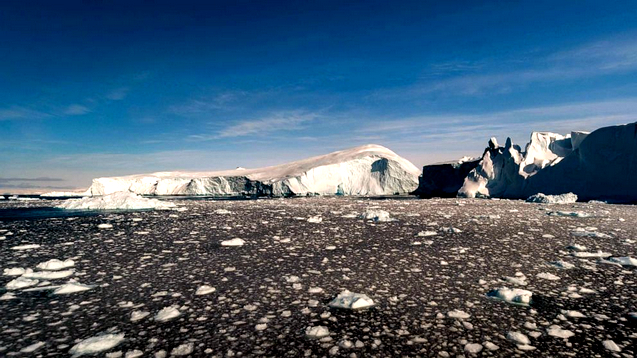
A view of icebergs and melting pack ice in Ilulissat icefjord, an UNESCO World Heritage Site, in Ilulissat, Greenland. Sergio Pitamitz/VWPics via AP Images, FILE

The "poster child" for the effects of the loss of sea ice on species is the polar bear, Schofield said. Polar bear populations have dwindled so low, and the habitats have become so fragmented, that the animals are inbreeding, which could have disastrous effects on the survival of the species within generations.

In Alaska, the number of beaver ponds has doubled since 2000, likely due to the warming trend that has resulted in widespread greening in what was previously tundra, the Arctic Report Card found. The rapid acidification of the warming ocean waters is likely affecting the marine food chain, Moon said. And the increased marine traffic for both fishing and shipping is also likely affecting stress levels and behavior of species, including how they communicate, Moon added.

In addition to an increased chance of oil spills from increased commercial activity is the possibility of new oil and gas fields opening up in Russian territory could further amplify global warming as those natural gases are extracted, Moerman said.

"The question is, is can we get those policies and strategies set up now before there's this massive sort of gold rush on the Arctic Ocean?" Schofield said.

Melting permafrost in the Arctic also poses natural environmental risks, Moon said. The majority of the ground in the Arctic is frozen, and as it thaws, microbes and other living organisms within the organic carbon in the permafrost begin to wake up, releasing carbon dioxide and methane into the atmosphere.

Temperatures need to be below 0 degrees Celsius to grow and maintain ice, Schofield said. But we will likely never regain that ice, as it took thousands of years of snow layers accumulating on top of each other to create the massive ice sheet, which is several miles thick.

"At some point, we're likely to cross the line where, you know, there'll be almost no winter to speak up," Schofield said. "And we see these kinds of effects in these polar regions, like the Arctic and the Antarctic."

Links

(UK The Conversation) Antarctica’s ‘Doomsday’ Glacier: How Its Collapse Could Trigger Global Floods And Swallow Islands

The Conversation - 

Glaciers like Antarctica’s Byrd Glacier are showing cracks and movement. United States Geological Survey , CC BY-SA

Author
 is a Postdoctoral Research Associate in Climate Science, University of Reading     
The massive Thwaites glacier in West Antarctica contains enough ice to raise global sea levels by 65cm if it were to completely collapse. And, worryingly, recent research suggests that its long-term stability is doubtful as the glacier haemorrhages more and more ice.

Adding 65cm to global sea levels would be coastline-changing amounts. For context, there’s been around 20cm of sea-level rise since 1900, an amount that is already forcing coastal communities out of their homes and exacerbating environmental problems such as flooding, saltwater contamination and habitat loss.

But the worry is that Thwaites, sometimes called the “doomsday glacier” because of its keystone role in the region, might not be the only glacier to go. Were it to empty into the ocean, it could trigger a regional chain reaction and drag other nearby glaciers in with it, which would mean several metres of sea-level rise. That’s because the glaciers in West Antarctica are thought to be vulnerable to a mechanism called Marine Ice Cliff Instability or MICI, where retreating ice exposes increasingly tall, unstable ice cliffs that collapse into the ocean.

A sea level rise of several metres would inundate many of the world’s major cities – including Shanghai, New York, Miami, Tokyo and Mumbai. It would also cover huge swathes of land in coastal regions and largely swallow up low-lying island nations like Kiribati, Tuvalu and the Maldives.

As big as Britain

Thwaites is a frozen river of ice approximately the size of Great Britain. It already contributes around 4% of the global sea-level rise. Since 2000, the glacier has had a net loss of more than 1000 billion tons of ice and this has increased steadily over the last three decades. The speed of its flow has doubled in 30 years, meaning twice as much ice is being spewed into the ocean as in the 1990s.

Map of the Amundsen Sea Basin including the Thwaites glacier. European Geosciences Union, CC BY

Thwaites glacier, the widest in the world at 80 miles wide, is held back by a floating platform of ice called an ice shelf, which restrains the glacier and makes it flow less quickly. But scientists have just confirmed that this ice shelf is becoming rapidly destabilised. The eastern ice shelf now has cracks criss-crossing its surface, and could collapse within ten years, according to Erin Pettit, a glaciologist at Oregon State University.

This work supports research published in 2020 which also noted the development of cracks and crevasses on the Thwaites ice shelf. These indicate that it is being structurally weakened. This damage can have a reinforcing feedback effect because cracking and fracturing can promote further weakening, priming the ice shelf for disintegration.

If Thwaites’ ice shelf did collapse, it would spell the beginning of the end for the glacier. Without its ice shelf, Thwaites glacier would discharge all its ice into the ocean over the following decades to centuries.

New research on Thwaites glacier and its future.

Other unstable glaciers

The ice shelf – which can be thought of as the floating extension of Thwaites glacier – is one of several that scientists are watching closely in the Amundsen Sea Basin, West Antarctica. Several ice shelves that hold back glaciers there, including Thwaites and its next-door neighbour, the Pine Island glacier, are being eroded by rising ocean temperatures.

Warmer ocean water is able to undercut these floating ice shelves, driving melting from below that can thin the ice and weaken it, allowing the cracks and fractures that have been observed at the surface to develop. This ocean-driven melting at the bottom of the ice shelf also pushes the anchoring point where the ice meets the seabed backwards. Because the seabed slopes downwards in the Amundsen Sea, that could eventually trigger a shift as the glaciers lose their footing and retreat rapidly.

Ultimately, if the ice shelves retreat, it means there is less holding the West Antarctic glaciers back – allowing them to accelerate and add more to global sea levels.

However, scientists are still getting to grips with MICI and questions remain about the future of West Antarctic glaciers. While the collapse of Thwaites certainly could trigger a wholesale collapse event, not everyone believes this will happen.

Other work suggests that the destabilisation of the Thwaites ice shelf and glacier may not lead to the kind of catastrophic outcomes that some fear. Sea ice and chunks of ice that break away from the collapsing ice shelf and glacier might have a similar restraining effect to the intact ice shelf, nipping the chain-reaction in the bud and preventing the sustained collapse of the entire West Antarctic ice sheet.

But while uncertainty remains about exactly what will happen in West Antarctica, one thing is for sure – the retreating Thwaites glacier will continue to add to global sea levels for many years to come.

Links

Saturday, December 25, 2021

(US MIT) The Rare Spots Of Good News On Climate Change

MIT Technology Review -  (Review Senior Editor)

It looks increasingly clear that we'll at least sidestep the worst-case scenarios.

Getty

The deadly consequences of climate change only grew clearer this year, as record-shattering heat waves, floods, and wildfires killed thousands and strained the limits of our disaster responders.

In the closing days of 2021, scientists warned that the eastern ledge of a Florida-size glacier is about to snap off of Antarctica and US legislators found they may have flubbed their best chance in a decade to enact sweeping climate policies.

But amid these stark signs, there were also indications that momentum is beginning to build behind climate action. Indeed, there’s good reason now to believe that the world could at least sidestep the worst dangers of global warming.

Princeton energy researcher Jesse Jenkins accurately, and colorfully, pinpointed the weird moment we’ve arrived at in a recent tweet: “We’re no longer totally f$%@ed. But we’re also far from totally unf$@%*ed!”

To be sure, the limited progress isn’t nearly enough. We’ve taken far too long to begin making real changes. World events and politics could still slow or reverse the trends. And we can’t allow a tiny bit of progress in the face of a generational challenge to ease the pressures for greater action.

But it’s worth highlighting and reflecting on the advances the world has made, because it demonstrates that it can be done—and could provide a template for achieving more.

Momentum

So what are the signs of progress amid the climate gloom?

The grimmest scenarios that many fretted about just a few years ago look increasingly unlikely. That includes the 4 or 5 °C of warming this century that I and others previously highlighted as a possibility.

The UN climate panel’s earlier high-end emissions scenario, known as RCP 8.5, had found that global temperatures could rise more than 5 °C by 2100. Those assumptions have been frequently included in studies assessing the risks of climate change, delivering the eye-catching top-end results often cited in the press. (Guilty.)

Some argue that it wasn’t all that plausible in the first place. And the scenario seems increasingly far-fetched given the rapid shift away from coal-fired power plants, initially to lower-emitting natural gas but increasingly toward carbon-free wind and solar.

Global emissions may have already flattened when taking into account recent revisions to land-use changes, meaning updated tallies of the forests, farmlands, and grasslands the world is gaining and losing.

Today, if you layer in all the climate policies already in place around the world, we’re now on track for 2.7 °C of warming this century as a middle estimate, according to Climate Action Tracker. (Similarly, the UN’s latest report found that the planet is likely to warm between 2.1 and 3.5 °C under its “intermediate” emissions scenario.)

If you assume that nations will meet their emissions pledges under the Paris agreement, including the new commitments timed around the recent UN summit in Glasgow, the figure goes down to 2.4 °C. And if every country pulls off its net-zero emissions targets by around the middle of the century, it drops to 1.8 °C.

Given the increasingly strict climate policies and the plummeting costs of solar and wind, we’re about to witness an absolute boom in renewables development. The International Energy Agency, well known for underestimating the growth of renewables in the past, now says that global capacity will rise more than 60% by 2026. At that point, solar, wind, hydroelectric dams, and other renewables facilities will rival the worldwide capacity of fossil-fuel and nuclear plants.

Sales of new electric vehicles, bumping along in the low single digits for years, are also taking off. They’ll reach around 5.6 million this year, leaping more than 80% over 2020 figures, as automakers release more models and governments enact increasingly aggressive policies, according to BloombergNEF.

Electric vehicles climbed from 2.8% of new sales in the first half of 2019 to 7% during the first half of 2021, with particularly large gains in China and Europe. Zero-emissions vehicles will make up nearly 30% of all new purchases by 2030, the research firm projects.

Progress

Meanwhile, there are plenty of signs of technological progress. Researchers and companies are figuring out ways to produce carbon-free steel and cement. Plant-based meat alternatives are getting tastier and more popular faster than anyone expected. Businesses are building increasingly large plants to suck carbon dioxide out of the air. Venture capital investments into climate and clean-tech startups have risen to levels never before seen, totaling more than $30 billion through the third quarter, according to PitchBook.

And here’s an important and counterintuitive finding: While dangerous, extreme weather events are becoming increasingly common or severe, the world seems to be getting a lot better at keeping people safer from them. The average number of deaths from natural disasters has generally dropped sharply in recent decades.

“We have better technologies to predict storms, wildfires, and floods; infrastructure to protect ourselves; and networks to cooperate and recover when a disaster does strike,” noted Hannah Ritchie, head of research at Our World of Data, in an recent Wired UK essay, citing her own research.

This provides additional hope that with the right investments into climate adaption measures like seawalls and community cooling centers, we’ll be able to manage some of the increased risks we’ll face. Rich nations that have emitted the most greenhouse gases, however, must provide financial assistance to help poor countries bolster their defenses.

A realistic baseline

Some folks have seized on these improving signs to argue that climate change isn’t going to be all that bad. That’s nonsense. The world is, by any measure, still dramatically underreacting to the rising risks.

A planet that’s nearly 3 °C hotter would be a far more dangerous and unpredictable place. Those temperatures threaten to wipe out coral reefs, sink major parts of our coastal cities and low-lying islands, and subject millions of people to far greater risks of extreme heat waves, droughts, famines, and floods.

In addition, we could still be underestimating how sensitive the atmosphere is to greenhouse gases, as well as the spiraling impacts of climate tipping points and the dangers that these higher temperatures bring. And there’s no guarantee that nations won’t backtrack on their policies and commitments amid economic shocks, conflicts, and other unpredictable events.

But to be sure, a 3 °C warmer world is a much more livable place than a 5 °C warmer one, and a far more promising starting line for getting to 2 °C.

“The point isn’t to say that that’s a good outcome,” says Zeke Hausfather, director of climate and energy at the Breakthrough Institute. “The point is, that’s the baseline we’re working with now. And it’s easier to imagine much more rapid declines from there.”

In some ways, it’s especially notable that the world has made this much progress without sweeping climate policies in many nations, and despite all the poisoned, partisan politics surrounding climate change.

The shifts to natural gas, then solar and wind, and increasingly EVs were all aided by government support, including loans, subsidies, and other policies that pushed the underlying technologies into the marketplace. And the business-driven scale-up process rapidly cut the costs of those technologies, helping them become ever more attractive.

Increasingly competitive and business-friendly clean alternatives promise to simplify the politics of further climate action. If more and more nations enact increasingly aggressive policies—carbon taxes, clean-energy standards, or far more funding for research and demonstration projects—we’ll drive down emissions ever faster.

The world isn’t ending

There are other reasons to take note of the modest progress we are making.

Progressive US politicians now casually repeat the claim that climate change is an “existential threat,” suggesting it will wipe out all of humanity. After a 2018 UN report noted that global warming could reach 1.5 °C between 2030 and 2052, climate activists and media outlets contorted that finding into versions of “We have 12 years to save the planet!”

If so, it would now be down to nine. But 1.5 °C isn’t some scientifically determined threshold of societal collapse. Though the world will miss that goal, it remains crucial to fight for every additional half-degree of warming beyond it, each of which brings steadily higher risks.

Meanwhile, climate research does not suggest that the 3 °C of warming we’re now roughly on target for would transform the entire planet into some uninhabitable hellscape.

So no, climate change is not an existential threat.

But that sentiment has certainly taken hold. Earlier this year, researchers at the University of Bath surveyed 10,000 young people, aged 16 to 25, in 10 countries to assess the levels of “climate anxiety.” More than half, 56%, agreed with the statement “Humanity is doomed.”

It’s standard stuff for politicians and activists to overstate dangers and demands, in the hopes of pushing toward some compromise solution. And the growing climate fears and the increasingly influential climate activist movement have undoubtedly put greater pressures on politicians and business to take these issues more seriously, helping to drive some the policy changes we’ve seen. They deserve real credit for that.

But insisting that the world is at the edge of collapse, when it’s not, is a terrible message for young people and carries some real risks as well. It clearly undermines credibility. It could lead some people to simply lose hope. And it could compel others to demand extreme and often counterproductive responses.

“It’s time to stop telling our children that they’re going to die from climate change,” Ritchie wrote. “It’s not only cruel, it might actually make it more likely to come true.”

When people don’t see a “reasonable path forward,” they begin to rationalize unreasonable ones.

Among those I hear with surprising frequency: We must shut down all fossil-fuel infrastructure, and end oil and gas extraction now. We must fix everything with today’s technologies and reject the “predatory delay” tactic of continued investment in clean-energy innovation. We have to halt consumption, construction, and economic development. Or even: We must smash the global capitalist system that caused all the problems!

Balancing the trade-offs

None of that strikes me as somehow more politically feasible than fixing our energy systems.

We do have to shut down fossil-fuel plants, replace vehicles, and switch to new methods of producing food, cement, steel, and other goods—and relatively quickly. But we have to do it by developing alternatives that don’t pump greenhouse gases into the atmosphere.

If we adjust the goalpost back to 2 °C, which is regrettable but only realistic at this point, we have several decades yet to carry out the transformation required. Under a modest emissions scenario, the world won’t exceed that threshold until around 2052 as a middle estimate, Hausfather’s analysis of latest UN climate report suggests.

What we can’t do is just shut down the infrastructure that drives the global economy—not without massive damage to jobs, food, health care, and safety. We’d sacrifice the economic resources we need to develop a more sustainable economy, as well as to make our communities more resilient to the coming climate dangers.

Those in rich countries, especially, have no business telling poor countries that they must halt development, perpetually locking billions of people in economic and energy poverty.

If we’re worried about climate change because of the suffering it will impose on people, then we have to care about the human trade-offs entailed in how we address it as well. Weighting those properly requires dealing honestly what with the science does and doesn’t say, recognizing the limited progress we are making, and not resorting to hyperbole simply because we think it will spur the actions we hope to see.

It’s a cruel and dangerous fantasy that we’ll ever halt climate change by counting on or forcing people to live impoverished lives, forgoing food, medicine, heating, or air conditioning in an increasingly erratic and menacing world.

We need more activist pressure and more aggressive climate policies to confront the threats of climate change. But ultimately, we must invent and build our way out of the problem. And the rare bright spot of good news is that we’re beginning to see evidence that we can.

Links - Recent articles by James Temple

Lethal Heating is a citizens' initiative