04/02/2016

Measuring Ocean Heating Is Key To Tracking Global Warming

The Guardian - John Abraham

Taking the Earth's temperature is a challenge, but a critically important one if we are to better understand the nature of climate change
Sun shining over the sea. Photograph: Alamy Stock Photo


Human emissions of greenhouse gases such as carbon dioxide are causing the Earth to warm. We know this, and we have known about the heat-trapping nature of these gases for over 100 years. But scientists want to know how fast the Earth is warming and how much extra energy is being added to the climate because of human activities.
If you want to know about global warming and its future effects, you really need to answer these questions. Whether this year was hotter than last year or whether next year breaks a new record are merely one symptom of a warming world. Sure, we expect records to be broken, but they are not the most compelling evidence.
The most compelling evidence we have that global warming is happening is that we can measure how much extra heat comes in to the Earth's climate system each year. Think of it like a bank account. Money comes in and money goes out each month. At the end of the month, do you have more funds than at the beginning? That is the global warming analogy. Each year, do we have more or less energy in the system compared to the prior year?
The answer to this question is clear, unassailable and unequivocal: the Earth is warming because the energy is increasing. We know this because the heat shows up in our measurements, mainly in the oceans. Indeed the oceans take up more than 92% of the extra heat. The rest goes into melting Arctic sea ice, land ice, and warming the land and atmosphere. Accordingly, to measure global warming, we have to measure ocean warming. Results for 2015 were recently published by Noaa and are available here.
Advancing our capability to monitor the Earth's Energy Imbalance means increasing our knowledge on the status of global climate change - and the global ocean plays a crucial role. A concerted multi-disciplinary and international effort is needed to improve our ability to monitor this fundamental metric defining global warming.
A recent paper by Karina von Schuckmann and her colleagues appeared in Nature Climate Change, and provides an excellent summary of our knowledge of the energy balance of the Earth and recent advances that have been made. The article describes the complexity of the situation. The Earth is continuously gaining energy from greenhouse gases, but there are also natural fluctuations that cause both increases and decreases to the energy flows.
For instance, volcanic eruptions may temporarily reflect some solar energy back to space. Natural variability like the El Niño/La Niña cycle can change heat flows and how deep the heat is buried in the ocean. The energy from the sun isn't constant either; it varies on an 11-year cycle, but by less than 0.01%. With all of this and more happening, how do we know if an energy imbalance is natural or human caused? How do we separate these effects?
The effort to separate human from natural effects is seen to be possible when one considers how the imbalance is measured in the first place. There are multiple complementary ways to make these measurements. Each technique has advantages and disadvantages and they have to be considered together.
One way is through satellites that orbit the Earth. These satellites can measure the heat entering the atmosphere and the heat leaving the system. The difference between them is the imbalance. Currently, the longest operating satellite measurement for this is from Nasa and is named Ceres (Clouds and Earth's Radiation Energy System). The difficulty is that the energy imbalance is only about 0.1% of the actual energy flows in and out, and while the changes can be tracked, their exact values are uncertain.
Another way to measure the imbalance is to actually take the ocean's temperature. Temperature tells us how much heat a system has. If the temperature is increasing, it means the energy within the system is increasing as well – the system is out of balance. Not only do we have to measure the ocean temperatures accurately, but there is a need to measure the temperatures year after year after year exceedingly accurately to much better than a 0.1°C margin. What really matters is how the temperature is changing over long periods of time.
While it may sound easy to measure the oceans, it is actually quite challenging. The oceans are huge (and deep) and difficult to access. The need is for enough measurement locations at enough depths and with enough precision to get an accurate temperature.
In recent years, we have relied upon a system of automated ocean measurement devices called the Argo fleet. These devices are scattered across the globe and they autonomously rise and sink (down to 2,000 meters) and record temperatures and salinity during their travels. Because of the Argo fleet, we know a lot more about our oceans, and this new knowledge helps us ask better questions. But the fleet could be made even better. They do not measure the bottom half of the ocean (below 2,000m depth) and they do not fully cover regions near or under ice or near shores.
Furthermore, a 10-year trend is much too short to make long-term climate conclusions. We have to stitch Argo temperatures to other instruments, which have been measuring the oceans for decades. That stitching process has to be done carefully so that a false cooling or warming trend is not introduced.
Another way is through ocean levels. As the oceans warm, the water expands and sea levels rise. So, just by measuring the changing water levels, it is possible to assess how much heat the oceans are absorbing. The drawback to this method is that oceans are also rising because ice around with world is melting, particularly in Greenland and Antarctica. As this melted ice water flows into the oceans, it too causes sea levels to rise. So, it's important to separate how much of ocean level rise is from heat-expansion and how much is from ice melting.
And another way is through the use of climate models, which are computer simulations of the environment. Very powerful computers are used to calculate the state of the climate at millions of locations across the globe, in both the oceans and in the atmosphere. The calculations use basic physics and thermodynamics equations to track the thermal energy at each of the locations.
So, there are many ways to measure the Earth's energy imbalance. While all methods are telling us the Earth has a fever, they differ in details and better synthesis of all the information is essential to improve the knowledge of what Earth's energy imbalance is. Right now, the Earth is gaining perhaps as much as 1 Watt of heat (a Joule per second) for every square meter of surface area. Considering how large the Earth is, this is an incredible amount of heat being gained day and night year after year. This is over 1 zettaJoules (sextillion Joules) per year.
What I like about this new paper is the recommendations for the future. Perhaps the most important recommendation is that we need to continue to make accurate measurements of the Earth's temperatures, especially in the oceans. We need to extend those temperate measurements to deeper locations (below 2,000 m) and make measurements near shores, in the Polar Regions, underneath ice, etc. This will require a sustained funding of our measurement systems and a long-term view of the Earth's changing climate.
Fully understanding where the excess heat is going in the Earth system is a first step to making good predictions as to what its consequences are for the future climate and the oceans. It is an essential activity to enable planning for the future. Dr von Schuckmann summarized her work nicely when she told me,

Links

03/02/2016

“State Of Transition” Oil Oversupply, Shale Bankruptcies, Gas Leaks, And A Whiff Of Securities Fraud

Renew Economy - Jeremy Leggett


A Shell veteran of 35 years requests the company pension fund he depends on to divest from fossil fuels and reinvest in clean energy. A geoscientist currently working for an oil and gas major quits to take qualifications in renewable energy. These are the stories the latest two commenters on my website tell. The great global energy transition will play out in countless small dramas like this. But reminders of the over-arching global narrative, that we are in a race against time, are remorseless. And setbacks in the post-Paris world can be expected in parallel with steps forward, as the last fortnight illustrates all too well.
The oil price has fallen below $30 now: lower than it has been since 2013. The International Energy Agency warns that the oil market may “drown in oversupply” in 2016. The Saudis keep pumping, the warm weather is depressing demand, Iran is re-entering the global market now that nuclear sanctions are over, and so on.
Carbon Tracker has exhorted fossil fuel companies to come clean on climate risks, whatever the oil price, in a short report to the World Economic Forum in Davos. We are far from alone in professing that the post-Paris world requires this. PWC leads the list of those also warning in January of stranded-asset risk in the oil and gas sector. The full disclosures that investors need in order to weight risk of stranded assets and other climate-related downsides should not be long coming. Michael Bloomberg has announced the membership of his elite Climate Risk Disclosure Task Force, which will include Unilever, Axa, Blackrock and JPMorgan. Anyone who reads the last few chapters of The Winning of The Carbon War can have little doubt about the likely tenor of their recommendations, due in March.
All of which should auger well for the progressive diversion of capital from fossil fuels to clean energy that is hard-wired into the Paris Agreement. Standard & Poor’s estimates that $16.5 trillion of new investment in renewables, clean technology and green finance will be triggered by the terms of the treaty. The International Renewable Energy Agency estimates that global GDP will rise roughly 1.1% if renewables account for 36% of the world’s energy mix by 2030, as they should if we are to be on track for the Paris goal of well under 2˚C of global warming.
Progress reports in late January encourage faith in this trajectory. Solar power costs have dropped to a record low of 6 cents per kilowatt hour in Rajasthan, a price that matches electricity from coal and gas. Cost-down in storage is also looking encouraging, with the 3 gigawatts in operation or under development around the world prompting analysts IHS to predict a significant imminent rise in deployment. More than 50 major corporations have pledged 100% renewable energy use, and in Davos they announced they are half way to their collective target.
Meanwhile, however, threats to progress on the Paris agenda pile up. The low oil price has pushed many stock markets into bear market territory – a fall of 20% or more from their most recent peak. This, plus the stuttering global economy, and fears of a Chinese financial meltdown, caused a degree of pessimism in Davos. Some analysts voiced fears of a slide into global recession of the kind seen in 2008.
Fresh from their triumph in Paris, the French government is urging fellow governments to keep the momentum going on climate change, with the next target being signature of the treaty by world leaders in April. “Everything is done, yet nothing is done”, said Laurence Tubiana, France’s chief climate diplomat. She admits to being unsure what impact current fears about the global economy will have.
Some incumbency corporations and many investors barrel on as though nothing has changed. Shell’s takeover of BG has received a green light from investors, with 83% of Shell shareholders voting for the deal. In order to do this, they would have had to to persuade themselves that they can afford to ignore both climate risk and the risk of a prolonged low oil price. Mark Van Baal, who leads a group of 1,000 small shareholders who voted against the deal, said: “There are a lot of better ways to spend €50bn. We are afraid of Shell being the new Kodak.”
The Shell retiree who commented on my website appreciates both points. He was Shell’s first head of renewable energy.
There is bad news everywhere for the oil and gas industry. 42 American shale drillers have now gone bankrupt. Some can’t even give their assets away, Bloomberg reports. Harold Hamm, a pioneer of shale drilling, told the FT that companies are simply going to stop producing, so US oil production must fall steeply this year. People may be surprised by how fast, he says.
Shell and the other majors endlessly repeat their mantra that gas is much better than coal, in global warming terms. But who can easily believe this any more? A massive gas leak, cause unknown, was discovered in a Californian storage well on October 23rd. It is still leaking unchecked, having become California’s single biggest contributor to global warming. The Governor has declared a state of emergency over it. This is an extreme example, but the more scientists scrutinise gas leakage, right across the gas value-chain from wellhead to consumer end-use, the more worrying a picture they are finding, as my book chronicles. There is scant oversight of storage wells, and until recently very little monitoring of US fracking either. When the monitoring is finally done properly gas could yet end up worse than coal in greenhouse terms.
And even if it doesn’t, aiming to hit a 1.5˚C global warming ceiling with “highest possible ambition”, as the Paris Agreement requires, means large-scale bypassing of gas en route direct from coal to renewables. Climate scientists are very clear on this.
Consistent with his desire for climate change to be a meaningful legacy of his administration, President Obama is now launched a regulatory crackdown on methane emissions from oil and gas drilling on federal land. Energy industry groups have condemned the “avalanche” of regulations now descending on them, but the President seems to be on a roll with his climate mission. A US appeals court declined to block his carbon-constraint plan from power plants. States led by West Virginia “have not satisfied stringent requirements” to put a judicial stay on regulation, a judge has ruled. And in California, legislators have voted in a raft of measures expanding the solar market.
Clearly the number two greenhouse-gas emitter is making some progress post-Paris. So is the number one emitter. China’s carbon dioxide emissions likely fell 3% in 2015, a trend analysts say looks set to continue. Among other positive developments, the Chinese government has announced that it will allocate $4.6bn to shut 4,300 coal mines over the next three years.
Some countries are pursuing energy policies totally inconsistent with the commitments they made in adopting the Paris Agreement. The UK leads this list. Bloomberg reports that British renewable energy industries are set to “fall off a cliff” as a result of the Conservatives’ active effort to boost support forfracked shale gas and nuclear meanwhile withdrawing support from renewables and energy efficiency. Cuts to wind subsidies will mean the UK will lose at least one gigawatt of renewable energy generation over the next five years. To make the point, RWE has cancelled £1 billion of onshore wind investments, blaming policy setbacks.
David Cameron’s government is showering the energy incumbency with money. He announced a £250 million bailout to prop up the North Sea oil and gas industry, is intent on major giveaways to promote fracking, and has essentially written an open cheque in the multiple billions needed to force the Hinkley Point C reactor through.
Like Shell and its investors, the government seems incapable of reading some very clear writing on walls. A Conservative MP was forced by his constituents to resign from a Parliamentary shale gas group because it is funded by the oil and gas industry. This gives a clear feeling for the opposition shale drillers will encounter in the Tory shires, never mind the leakage rates of methane from their operations.
As for Hinkley Point C, the drama is akin to watching a train wreck in slow motion. EDF, the aspiring operator, was supposed to finalise funding this month at a board meeting. The decision was delayed, amid fears that the company cannot afford the billions required. EDF’s own workforce has begged it not to go ahead, openly voicing fears that this, the most expensive power plant in the world, will bankrupt the company notwithstanding the billions invested by the British and Chinese governments.
Meanwhile, as the UK government flogs the doomed horses of shale and nuclear, and sabotages clean energy in an effort to give investors no choice but to join them, the CBI warns that the threat of a national power crisis is growing.
All the while, the planetary thermostat reminds us of the clock ticking. 2015 shattered the global temperature record by a wide margin, the Met Office reported. The world’s oceans warmed at an increasingly fast rate, the US National Oceanic and Atmospheric Administration warned. Sea level rise from ocean warming has been underestimated, German scientists professed.
The science of climate change has become a matter of legal liability risk for oil and gas companies in recent months. Investigative journalists have uncovered evidence that they lied about the impacts of global warming in public whilst planning to adapt their infrastructure to its effects in private, as I describe in my book. In January, California’s Attorney General launched an investigation into whether Exxon Mobil repeatedly lied to the public and its shareholders about the risk to its business from climate change. At issue is whether such actions could amount to securities fraud. California joins New York, whose Attorney General began investigating Exxon Mobil last November with a view to to possible criminal charges.
Shell is under suspicion too. In 1989, the company redesigned a $3-billion North Sea natural gas platform, fearing sea levels would rise as a result of global warming. In the 1990s, it joined the Global Climate Coalition, an oil, gas and coal lobby group dedicated to defusing concern about climate change and stalling the climate negotiations.
Retirees in oil industry pension funds will be watching closely, no doubt, as their former employers wrestle with climate risk in 2016. Risk of all sorts. Even if Shell’s €50 billion acquisition of BG turns out to make shareholders money in the short term – an increasingly unlikely prospect in the post-Paris world – there is surely risk now that any profit will be wiped out by court fines and brand damage in a world looking back in anger.

Links

Queensland Gives Adani Environmental Permit For Carmichael Coalmine

The Guardian

Huge project clears one more hurdle, but financial uncertainty still hovers over the mine and related rail and port construction at Abbot Point
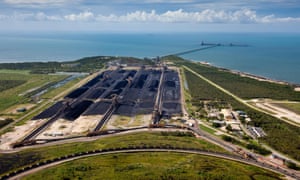
Abbot Point coal terminal
The Abbot Point coal terminal is due for huge expansion if Adani's Carmichael coalmine goes ahead. Photograph: Tom Jefferson/Tom Jefferson / Greenpeace
Adani has secured an environmental permit from the Queensland government to build Australia's largest coal mine.
The Indian conglomerate was issued an environmental authority for its Carmichael mine, west of Bowen in north Queensland, by the department of environment and heritage on Tuesday.
It is one less hurdle for Adani's highly contested plans, after its Australian chief complained last week that delays in government approvals were "incentivising" green activists to plot further legal challenges to stymie the company's progress.
Adani still needs to obtain significant bank funding to realise its $16.5bn mine, rail and port project.
It must convince the Queensland government it has obtained "financial closure" before it will be allowed to begin dredging near Great Barrier Reef waters to expand the Abbot Point export facility.
A lull in world coal demand and moves in India to rely less on imported thermal coal have cast doubt on the future of the mine.
Adani still has to obtain a mining lease from the Queensland government.
The state land court last year recommended resources minister Anthony Lynham approve the lease after a legal challenge by conservation group Coast and Country failed to persuade the judge that the mine would have any impact on Asian coal consumption.
One of the mine site's traditional owners has challenged native title tribunal approval of the project in the federal court, but Lynham's office has conceded it is able to issue the mining lease before the outcome of that challenge, after earlier expressing reluctance to preempt it.
Adrian Burragubba from the Wangan and Jagalingou clan has argued the tribunal denied natural justice by favouring Adani without properly investigating its claims, including that the mine would create 4,000 jobs, when the actual figure was closer to 400.
The Australian Conservation Foundation has also lodged a federal court challenge to commonwealth approval of the project under the Environmental Protection and biodiversity Conservation Act.
The mine, which alone would cost about $4.1bn to build, would produce up to 60m tonnes of thermal coal a year for sale in Asian electricity markets, notably to Adani's own generators in India.
The ACF alleges federal environment minister Greg Hunt failed to account for the impact of emissions from Carmichael coal, which some analysts have argued could blow the world's "carbon budget" to keep temperature rises below the 2C limit recently agreed at the Paris climate conference.
Adani still also has to reach compensation agreements with a number of remaining stakeholders, including local governments over the project's use of their roads.
It must also finalise Indigenous land use agreements with traditional owners of the sites for associated works including an airstrip and workers' accommodation.

Links

No One Gets Out Alive

Collapse Of Industrial Civilization

tumblr_n6k2x951T71ts2oqko1_500 As China's appetite for resources wanes with the bursting of its real estate bubble and America's shale oil boom fueled by easy credit comes to an end, floundering petrostates are beginning to queue up for bail-outs. Financialization appears to have exacerbated the collapse in oil prices. Of course none of this capitalist boom-bust cycle negates the fundamentals of peak oil; prices will swing upwards again in a few years as marginal producers get weeded out. After all, the world still consumes nearly three million gallons of oil per minute, and only a relatively thin margin separates surplus from a shortage. Most of our energy usage does not involve electricity which is what alternative energies like wind and solar produce. Electricity comprises just 18% of the total global energy consumption of which alternatives make up a tiny sliver. 250 new human beings are added to the planet every minute; each born into a world of depleting resources and mounting pollution; each scrambling to secure the necessities of life. The black stuff will remain the primary fuel supporting this growing population of a globalized technological civilization.
A recent study estimates that if we are serious about implementing alternative energies to satisfy the goals of the Paris climate accord, then upwards of 12 trillion dollars will have to be spent over the next 25 years. This price tag is an investment that is 75% more than current growth projections. At a time when governments have spent their last ammo pumping more electronic money into the economy to try to stimulate economic growth, the prospects of decarbonizing the entire global energy system appears daunting, especially considering the many shortcomings of alternative energies. Time constraints on a planet indifferent to our energy needs are also bearing down on us:
CO2 levels must now be kept below 405ppm (where we'll be in under 3 years at current emission rate) to avoid 2C warming.
As the Keeling curve creeps irreversibly higher and the gap between rhetoric and reality widens, pipe dreams like geoengineering and carbon sequestration will become desperate Hail Marys for a species whose time is running out. The New York Times editorial by Piers Sellers, a NASA Earth Sciences director who has terminal cancer, perfectly sums up this techno-fix mindset: "…it will be up to the engineers and industrialists of the world to save us." Keep calm, keep shopping, and await further instructions; the elites have it all under control. Jeb Bush's recent comment that we should pin our hopes on "someone in a garage" fixing climate change illustrates the widespread delusional that technological innovation, good ol' entrepreneurial spirit, and capitalist market-based solutions will be our saviours. Ironically, Jeb belongs to the political party hell-bent on defunding public education, a policy that would seem to make those plucky garage inventors even more implausible.
We cannot possibly rely on a system that profits from the very disaster it has helped to create, yet that is the dead-end feedback loop we are locked into. Mexico is a good example of how landscapes and communities are being carved up for alternative energy farms and carbon trading schemes that benefit only large corporations. Even philanthrocapitalism promotes the convenient myth that market forces and the whims of billionaires will solve systemic problems. The precautionary principle has been thrown out the window in the pursuit of short-term profits and power. We have only a vague inkling of nature's rich complexity and interdependence. The scale of our ignorance is frightening considering our oversized impact.
tumblr_n6scpfSLcT1qln2e2o1_500
The truth of our predicament has been criminally concealed since the 1970s by the fossil fuel industry which all the while knew that an overheated Arctic would melt away, exposing fresh deposits of carbon for them to exploit. Unfortunately the bonanza they planned for has not materialized; melting permafrost wreaks havoc on infrastructure and exploration. The cryospheric regions of earth, key geographic features regulating the planet's climate, were systematically dismantled within the geologic blink of an eye; such environmental changes are imperceptible to the real-time cognitive processing of humans, but in geological 'deep time' these events are cataclysmic and portend a dire future for humans. There are more signs that the Atlantic Meridional Overturning Circulation (AMOC) is slowing down.
"We're sitting on these planetary boundaries right now, argues Rockstrom, and if these systems flip from one stable state to another — if the Amazon tips into a savannah, if the Arctic loses its ice cover and instead of reflecting the sun's rays starts absorbing them in water, if the glaciers all melt and cannot feed the rivers — nature will be fine, but we will not be." ~ Johan Rockstrom, director of the Stockholm Resilience Center
4311422140_653193fe43_b
The time to avoid critical tipping points in those decades has passed. The projections from the IPCC were downplayed and underestimated in order to continue the destructive business-as-usual:
"…new scientific findings were more than twenty times as likely to support the ASC perspective [that disruption through AGW may be far worse than the IPCC has suggested] than the usual framing of the issue in the U.S. mass media. The findings indicate that…if reporters wish to discuss ''both sides'' of the climate issue, the scientifically legitimate ''other side'' is that, if anything, global climate disruption may prove to be significantly worse than has been suggested in scientific consensus estimates to date".
We're in the early throes of economic and ecological system failure; headlines grow more alarming each year:
"…history tells us that civilizations experiencing dramatic declines in their net energy uptake usually develop authoritarian political systems in an effort to stave off collapse, but then crash and disappear anyway." ~Eric Zencey
Historically speaking, the elite are last to feel the effects of their hubristic decision-making, insulated as they are in their positions of wealth and power. Modern ideals and virtues of human rights, social justice, and a strong American middle class have all been aberrations of a civilization built atop a surfeit of energy.
political-graffiti-athens-greece1-e1451738094409-1024x355
The disparity between MSM news and real world problems like climate change, pollution, growing wealth inequality, the unraveling food chain, etc. are breathtaking. Wrecking the biosphere and bringing on a mass extinction leaves no one unscathed or in any position to survive long-term. Secret plans of survival by the "elite" are simply another myth. The wealthy may be buying up tracts of land in remote areas, but they are perhaps more delusional than anyone else because of how their wealth insulates them from hard realities. Without all those just-in-time supply chains operating seamlessly across a stable planet, no one gets out alive.

Links

02/02/2016

Climate Change In Charts: From Record Global Temperatures To Science Denial

The Guardian

The world's hottest year on record has prompted much media coverage. But there haven't been enough charts and graphs
The year 2015 was the hottest on the modern record. Photograph: Peter Macdiarmid/Getty Images


Much has been written about climate change in recent months, what with that record-breaking hot year we just had and the qualified success of the Paris climate talks.
But if there's one criticism I'd have of the media coverage, it's this.
Not enough graphs.
So here are six that you might have missed, but that tell us a few things about the state of the climate and the state of the public's thinking on global warming.
Chart showing average global temperatures from 1850 to 2015 according to three major datasets Photograph: Met Office, UK


So how have global temperatures been recently? You know, while human-caused global warming has been on that pause that didn't happen.
Above is a chart from the UK's MetOffice showing the three main global temperature data sets. These, for the hardcore among you, are known as HadCrut4 (MetOffice), GISTEMP (NASA) and MLOST (NOAA).
Pretty clear, right? All three show 2015 was the hottest year on record.
The chart shows "anomalies" (that's the temperatures above or below a long-term average), in this case, against the average temperature between 1961 and 1990.
So for the MetOffice data, 2015 was 0.75C above the long-term average.
In December 2014, the MetOffice guessed (and when I say guess, I mean they used some powerful, skilful and sophisticated modelling) that 2015 would be between 0.52 and 0.76C above average. So they were right. Just.
Chart showing the MetOffice estimate of global temperatures in the upcoming five years to 2020 Photograph: Met Office


And while we're talking about forecasts from the MetOffice, here's another one of theirs from a few days ago.
The MetOffice now makes "decadal" forecasts – that is, another of their guesses (same caveats apply as before with the term "guess") on "near term" conditions globally over the next five years.
The black line shows actual temperature measurements. The red band are previous predictions and the green band shows the expected range according to climate models.
In short, according to the MetOffice, the forecast is "for continued global warming largely driven by continued high levels of greenhouse gases".
Chart showing the rising heat content of the world's oceans Photograph: NOAA


You can't really talk about global warming without talking about the oceans, given that this is where the vast majority of the extra heat and the extra carbon dioxide ends up.
The above chart, from the National Oceanic and Atmospheric Administration, shows the latest temperature readings from ships and from a network of almost 4,000 floats – known as the Argo array.
A study published a couple of weeks ago found heating of the oceans was accelerating, particularly in the deeper ocean.
Chart showing how often thinktanks that oppose climate action argue that CO2 is good and how those funded by Exxon or the Koch brothers make that argument more often. Photograph: Proceedings of the National Academy of Sciences


One of the most popular talking points among climate science denialists is that CO2 is just great and the more of it that we pump out, the better things will be.
This goes against the advice of every science organisation of repute on the planet. But who needs science when rapper BoB can apparently just nudge us off the edge of the Earth?
Anyway, as I've written here before, there's an industry that has grown up around climate science denial and its epicentre is the network of US-based "free market" conservative thinktanks.
The chart above is from a paper by Yale University's Dr Justin Farrell in the journal Proceedings of the National Academy of Sciences published in October 2015.
Farrell examined the output of 164 thinktanks – mostly based in the US – that form a "climate counter-movement" by attacking science and working against policies to cut greenhouse gas emissions.
After writing a program to analyse some 39m words worth of reports, letters, blog posts and the like, Farrell found something interesting (actually, he found lots of interesting things).
As the chart above shows, thinktanks that had taken funding from either oil giant Exxon or groups linked to the oil billionaire Koch brothers were far more likely to say that "CO2 is good" than those that didn't.
Chart showing the views of Australians on the causes of climate change. The dashed line shows each group's opinion and the bars show how many people they think agree with them. Photograph: Nature Climate Change


While most people accept that climate change is happening, there continues to be a roughly even split among the public about its causes.
Some think it's mostly natural, some think it's mostly human-caused. This split is in no small way thanks to the misinformation campaigns run by the groups mentioned above.
In Australia the public is still split on the causes of global warming, according to a CSIRO survey of about 5,000 people.
But one fascinating aspect of a CSIRO survey on public attitudes to climate change isn't what people think, but what people think other people think – if you follow me.
The chart above is taken from a 2013 study published in Nature Climate Change and illustrates how fabulously crap most people are at gauging the climate opinions of others.
For example, 7% of Australians think climate change is "not happening" – as shown by the dotted line on that bar. But that group thinks that about half of Australians think the same. Wildly wrong.
Chart showing global CO2 emissions from fossil-fuel use and industry since 1990 and emissions intensity CO2 /GDP. The red symbols are projections for 2015. Photograph: Nature Climate Change


Rising CO2 emissions and economic growth have been like two kids who met as childhood sweethearts and just never broke up. It has always seemed like the two were made for each other.
But if you want to keep an economy growing but tackle the critical issue of rising emissions, then there has to be a break-up. Decoupling economic growth from rising emissions is the big challenge.
This chart comes from a December 2015 paper, also in the journal Nature Climate Change.
The black squares show the amount of greenhouse gases being emitted for every unit of GDP. Clearly, that's been dropping. The white circles are carbon dioxide emissions, and clearly they've been going up.
Success would mean both those lines heading rapidly south. The study showed that for the first time, emissions had dropped slightly while the world's economy grew.
So is there a break-up on the cards?
Commenting on the finding, Myles Allen, professor of geosystem science at the University of Oxford said: "Is this the beginning of the end of global warming? Probably not. But let's hope it is the end of the beginning."

Links

Renewables Agency Stripped Of Members And Run By Bureaucrat

The Guardian - Michael Slezak

Board terms expire, leaving body tasked with investing in emerging technology in hands of department secretary for second time in two years
Heliostats at the world's largest solar thermal power plant in California.
Heliostats at the world's largest solar thermal power plant in California. The Australian government agency responsible for investing in emerging technologies has no remaining board members. Photograph: Alamy
All appointed board members of the Australian Renewable Energy Agency have had their terms expire and have not been replaced, leaving it governed by the secretary of the Department of the Environment, Guardian Australia has learned.
The same thing happened in 2014 while Tony Abbott was prime minister, and the move has now been criticised as an attempt by the Turnbull government to remove the independence of the agency.
According to legislation, the board must consist of the secretary of the Department of the Environment and up to six others appointed by the minister. The agency can operate with the secretary being the only board member, since it reaches quorum when a majority of the board members are present, which now occurs with one.
Parliament sits for the first time in 2016 on Tuesday, with bills abolishing both the renewable energy agency (Arena) and the Clean Energy Finance Corporation still before parliament, despite having been rejected by the Senate. Signs indicate the Turnbull government intends to keep them.
Arena is tasked with investing in emerging renewable energy technologies, while the CEFC invests in commercially viable renewable energy technologies. Disruption in the government's handling of renewables has been blamed for a huge drop in clean energy investment in Australia.
If Arena is not abolished before July, it is set to receive almost $57m from the commonwealth and then almost $500m the following year.
The agency would not answer any questions about the matter and instead referred Guardian Australia to the Australian government boards website, which shows all positions are vacant.
The last three directors had their terms expire on 16 January.
Screengrabs from the Australian Government Boards website showing the term dates for the recent board members of the Australian Renewable Energy Agency (Arena). Photograph: Australian Government Boards


"Everyone has been assuming with the change of leader, and a Senate that wouldn't repeal it, that they were going to hang on to Arena," said Tom Swann from the Australia Institute. "So given that, it's pretty strange that they've let the board lapse and it raises questions about the future of Arena."
The Greens environment spokeswoman, Larissa Waters, told Guardian Australia the move was an attempt to remove the agency's independence. "The Senate won't let the Liberals destroy this innovative, job-creating organisation, and so the Liberals are arrogantly trying to cut off its independence and expertise," she said.
"Major proposals come to Arena's board for decision and having only a time-poor department secretary on the board is bad due diligence and a wasted opportunity for injecting high-level, diverse expertise," Waters said.
Swann said the agency's empty board and the bills abolishing it and the CEFC still being before parliament continue to discourage the renewable energy industry. "Given that we've had such a huge drop-off of renewable energy [investment] in Australia, the last thing we need is confusing signals," he said.
The chief executive of the Solar Council, John Grimes agreed the bills were bad for his industry and called on the government to remove them. "If Malcolm Turnbull doesn't act on this then people will start to think he's just another Tony Abbott," Grimes said.
Waters said the bills were unlikely to be debated by parliament, but were being kept to keep peace within the Liberal party. "It's duplicitous for the prime minister to talk up innovation, economic diversification and the achievements of Arena and CEFC, while keeping both of these cutting-edge agencies on the chopping block, presumably to placate climate-sceptic colleagues and donors," she said.
"Given the Senate's opposition to passing either abolition bill, listing them for debate sends an unnecessary and damaging investment message to the clean energy sector," Waters said.
Labor environment spokesperson, Mark Butler told Guardian Australia: "The fact that Arena and the CEFC are still on the chopping block shows that the Liberals' attacks on renewables hasn't stopped under Malcolm Turnbull. Greg Hunt has confirmed that these two agencies will remain in the Turnbull Liberal government's sites."
A spokesman for the environment minister, Greg Hunt, said the government's policy was still to abolish the two bodies, but said "there is little prospect of support in the Senate". He said the new Office of Climate Change and Renewables Innovation, which was being established inside the Department of the Environment, "will bring a fresh focus to the role of innovation in supporting emerging renewable and low emissions technologies that will drive down emissions".

Links
Australia's carbon emissions are increasing, government report shows
Malcolm Turnbull lifts Abbott ban on government finance for wind power

Who Politicized The Environment And Climate Change?

The Conversation - Brian C. Black

Protector in chief: Theodore Roosevelt with conservationist John Muir at Yosemite in 1906. U.S. Library of Congress

An environmental activist friend of mine recently shook her head and marveled at the extraordinary accomplishments of the last several months. "Still lots of work to be done," she said. "But wow! This has been an epic period for environmentalists!"
From the rejection of the Keystone pipeline to the Paris Agreement on Climate Change (COP21), "epic" may be an apt descriptor for someone who is an environmentalist.
However, nothing galvanizes opposing forces to action better than significant wins by their foes. And 2016 appears to promise that environmental issues – particularly climate change – will be more politicized than ever before.
It wasn't always this way.
By and large, environmental action since the 1960s proceeded in the U.S. in a bipartisan fashion, emphasizing issues of human health and resource conservation. That's no longer true: almost by default, the Democratic Party stands largely alone, rather than together with the Republican Party, to uphold the ethic that environmental protection is a united, American common interest.
How have we gotten to a point where the environment has become such a partisan issue?

From Teddy R. to Reagan
The intellectual roots of American environmentalism are most often traced back to the 19th-century ideas of Romanticism and Transcendentalism from thinkers such as Henry David Thoreau. These philosophical and aesthetic ideas grew into initiatives for preserving the first national parks and monuments, an effort closely associated with Theodore Roosevelt. By the close of the 19th century, a combination of resource exploitation and increasing leisure led to a series of conservation efforts, such as protection of birds from feather hunters, which were often led by wealthy women.
Today's environmentalism clearly harks back to these origins with aspects of being a social movement that seeks clear political outcomes, including regulation and government action. But much of what became known as the "modern environmental movement" originally coalesced around groups that formed under the influence of 1960s radicalism.
The large oil spill in Santa Barbara, California in 1969 provided some of the impetus for landmark environmental laws signed by Nixon, including the Clean Air Act, which he signed December 31, 1970. National Archives


The biggest impact of these organizations, though, came during the later 1960s and 1970s, when their membership skyrocketed with large numbers of the concerned, but not-so-radical, middle class. Through the formation of "nongovernment organizations" (NGOs), ranging widely from the Audubon Society to the Sierra Club, Americans found a mechanism through which they could demand a political response to environmental problems from lawmakers.
During the 1970s and 1980s, NGOs often initiated the call for specific policies and then lobbied members of Congress to create legislation. Such bipartisan action included clean water laws that restored Lake Erie and Ohio's Cuyahoga River or responded to dramatic events such as the Santa Barbara Oil Spill in 1969.
The nuclear power accident at Three Mile Island in 1979 fueled an antinuclear protest, a major concern of many environmentalists. National Archives and Records Administration (NARA)
Republican and Democratic presidents of this era signed laws that had begun with grassroots demands for environmental action. Environmental issues, whether they were the effects of acid rain or the ozone hole, had become a prime concern in the political arena. Indeed, by the 1980s, NGOs had created a new political and legal battlefield as each side of environmental arguments sought to lobby lawmakers.
These gains by environmentalists had a ripple effect politically. In "A Climate of Crisis," historian Patrick Allitt describes the opposition to environmentalism that emerged as a result of the bipartisan action on environment in the 1970s.
In particular, he describes the "anti-environmental" response manifested in policies of President Ronald Reagan, who slowed efforts to limit private development on public lands and set out to shrink the responsibilities of the federal government.

Antiregulation
Today, portions of this backlash appear to inform the views of candidates in the 2016 Republican presidential primary who reiterate the libertarian belief that it's best to severely limit government regulation of the environment.
And compared to the cooperative vision of past leaders including President Teddy Roosevelt and Congressman John Saylor, who fought in the 1960s for wilderness and scenic river legislation, the Republican environmental mandate of the past appears today to be stymied.
Climate change and environmental issues have barely come up in presidential debates, with candidates typically complaining that environment regulations will harm the economy. Mario Anzuoni/Reuters


Republican presidential candidate Senator Ted Cruz, for example, tapped into this spirit when in December 2015 he held a three-hour "hearing" titled "Data or Dogma? Promoting Open Inquiry in the Debate over the Magnitude of Human Impact on Climate Change" (which technically was convened by the science panel of the Committee on Commerce, Science, and Transportation that he chairs).
Prior to his hearing on the topic, climate change had been little discussed at the party's presidential debates; however, Cruz proclaimed that the "accepted science" proving climate change was actually a "religion" being forced on the American public by "monied interests."
By contrast, Democrats stress the term "common sense" and appear more than content to allow their party to become the primary bastion for environmental concern. Hillary Clinton, as the likely Democratic presidential candidate, has often been publicly ahead of the Obama administration on environmental issues.
For instance, when in early 2015 Obama approved the expansion of Arctic drilling, Clinton openly opposed it. Also, Clinton was openly against the Keystone pipeline project long before Obama definitively rejected it.
In both Keystone and Arctic drilling, Obama allowed the issues a long and very public vetting process that has revealed a powerful, broad-based environmental lobby. NGOs such as 350.org and others have demonstrated a willingness for activist demonstrations, particularly due to a deep base of support for issues such as climate change and sustainable energy.
Republican candidates seem prepared to relent possible compromise on environmental questions in order to appeal to a special interest faction of their party. Overall, though, Gallup polling demonstrates broad-based support for environmental issues, including a solid 46 percent favoring protecting the environment over economic development.

Climate change worsens the political divide
Going forward, the most revealing flashpoint on issues related to the environment is likely to be climate change, particularly after the historic Paris Agreement of December 2015.
Global warming first made front page news in the 1980s when NASA scientist James Hansen testified to the Senate. Then in 2007, the International Panel on Climate Change (IPCC) made history by specifying the connection between temperature rise and human activity with "very high confidence."
An emerging political force: activists for action on climate change and sustainable energy. Steve Rhodes/flickrCC BY-NC-ND


In its relation to environmentalism, climate change represents a clear expansion of thinking. While local issues such as oil spills and toxic waste remain concerns, climate change clarified the possible planet-changing extent of the human impact. As a concept, it has had time to percolate through human culture so that today we are most concerned with issues of "mitigation" and "adaptation" – managing or dealing with implications.
In each case, these responses to climate change involve plans for regulations to, for example, limit carbon emissions. In response to the increasing call for structural changes to our economy and society, contrary voices (such as that of Cruz) have found traction by saying mitigation efforts will undercut economic development and, in general, disrupt our everyday lives.
Not surprisingly, concrete mitigation efforts, such as discussions of "cap and trade" legislation to curb greenhouse gas emissions and international pacts such as COP21, have also spurred panicked responses among those destined to be impacted by the new thinking. For instance, coal companies and a number of states openly fight efforts by the EPA to monitor and regulate CO2 as a pollutant.
So who politicized the environment? Ultimately, voters have.
By tying environmental issues such as climate change to our system of laws and regulations at the end of the 1960s, Americans permanently chained these concerns to political vagaries in the future. Politics is now an integral part of the process of regulating the nation's environment and health.
Therefore, a better question might be: "Who exploits the issue of environmental protection for political gain?" That answer, it appears, unfolds today for American voters.

Links

Lethal Heating is a citizens' initiative