Judge orders state Department of Ecology to create new rules to cap emissions by end of 2016
Friday's ruling is "the first time [that] a U.S. court not only
recognized the extraordinary harms young people are facing due to
climate change, but ordered an agency to do something about it." (Photo:
Joe Brusky/flickr/cc)
The young activists suing the U.S. government over its role in climate change scored another victory in court on Friday, as a judge in Seattle ordered the Washington Department of Ecology (DOE) to announce an emissions reduction rule by the end of the year and make recommendations to reach those targets to the state legislature in 2017.
King County Superior Court Judge Hollis Hill also ordered the department to consult with the young plaintiffs on crafting those recommendations.
"This is an urgent situation," Hill said in issuing the order. "These kids can't wait."
The DOE in February withdrew its proposal to cap emissions, following a landmark ruling in November 2015 which found that the state's current standards fail to "preserve, protect, and enhance the air quality for the current and future generations."
Friday's ruling is "the first time [that] a U.S. court not only recognized the extraordinary harms young people are facing due to climate change, but ordered an agency to do something about it," said Andrea Rodgers, an attorney with the Western Environmental Law Center who represents the young plaintiffs. The DOE "is now court-ordered to issue a rule that fulfills its constitutional and public trust duty to ensure Washington does its part to reduce greenhouse gas emissions and protect the planet."
"This is an urgent situation ... these kids can't wait." Judge Hollis R. Hill, Seattle, Washington
The case in Washington is one of several similar legal battles underway in the U.S., all supported by the environmental advocacy group Our Children's Trust, as youth activists take U.S. agencies to court to demand action over climate change. An Oregon judge ruled earlier this month that a complaint filed by more than a dozen young plaintiffs against the federal government—referred to by advocates as "the most important lawsuit on the planet right now"—can go to trial.
"It was absurd for [the DOE] to withdraw its proposed rule to reduce carbon emissions," petitioner Aji Piper, 15, who is taking part in both the state and federal lawsuits, said in a statement on Friday. "Especially after Judge Hill declared last fall that our 'very survival depends upon the will of [our] elders to act now…to stem the tide of global warming.'"
Julia Olson, executive director and chief legal counsel at Our Children's Trust, added, "This case explains why youth around this country, and in several other countries, are forced to bring their governments to court to secure a healthy atmosphere and stable climate. Despite clear scientific evidence and judicial recognition of the urgency of the climate crisis, Washington and most governments across the U.S. and other countries are failing to take correspondingly urgent, science-based action."
"That failure unfairly consigns youth to a disproportionately bleak future against which they can only reasonably ask the courts to step in to address this most sensitive issue of our time," Olson said.
World's highest efficiency rating achieved for CZTS thin-film solar cells
Dr Xiaojing Hao of UNSW's Australian Centre for Advanced Photovoltaics holding the new CZTS solar cells. Credit: Quentin Jones/UNSW
Summary 'Zero-energy' buildings -- which generate as much power as they consume -- are now much closer after engineers have achieved the world's highest efficiency using flexible solar cells that are non-toxic and cheap to make.
Zero-energy' buildings -- which generate as much power as they consume -- are now much closer after a team at Australia's University of New South Wales achieved the world's highest efficiency using flexible solar cells that are non-toxic and cheap to make.
Until now, the promise of 'zero-energy' buildings been held back by two hurdles: the cost of the thin-film solar cells (used in façades, roofs and windows), and the fact they're made from scarce, and highly toxic, materials.
That's about to change: the UNSW team, led by Dr Xiaojing Hao of the Australian Centre for Advanced Photovoltaics at the UNSW School of Photovoltaic and Renewable Energy Engineering, have achieved the world's highest efficiency rating for a full-sized thin-film solar cell using a competing thin-film technology, known as CZTS.
NREL, the USA's National Renewable Energy Laboratory, confirmed this world leading 7.6% efficiency in a 1cm2 area CZTS cell this month.
Unlike its thin-film competitors, CZTS cells are made from abundant materials: copper, zinc, tin and sulphur.
And CZTS has none of the toxicity problems of its two thin-film rivals, known as CdTe (cadmium-telluride) and CIGS (copper-indium-gallium-selenide). Cadmium and selenium are toxic at even tiny doses, while tellurium and indium are extremely rare.
"This is the first step on CZTS's road to beyond 20% efficiency, and marks a milestone in its journey from the lab to commercial product," said Hao, named one of UNSW's 20 rising stars last year. "There is still a lot of work needed to catch up with CdTe and CIGS, in both efficiency and cell size, but we are well on the way."
"In addition to its elements being more commonplace and environmentally benign, we're interested in these higher bandgap CZTS cells for two reasons," said Professor Martin Green, a mentor of Dr Hao and a global pioneer of photovoltaic research stretching back 40 years.
"They can be deposited directly onto materials as thin layers that are 50 times thinner than a human hair, so there's no need to manufacture silicon 'wafer' cells and interconnect them separately," he added. "They also respond better than silicon to blue wavelengths of light, and can be stacked as a thin-film on top of silicon cells to ultimately improve the overall performance."
By being able to deposit CZTS solar cells on various surfaces, Hao's team believe this puts them firmly on the road to making thin-film photovoltaic cells that can be rigid or flexible, and durable and cheap enough to be widely integrated into buildings to generate electricity from the sunlight that strikes structures such as glazing, façades, roof tiles and windows.
However, because CZTS is cheaper -- and easier to bring from lab to commercialisation than other thin-film solar cells, given already available commercialised manufacturing method -- applications are likely even sooner. UNSW is collaborating with a number of large companies keen to develop applications well before it reaches 20% efficiency -- probably, Hao says, within the next few years.
"I'm quietly confident we can overcome the technical challenges to further boosting the efficiency of CZTS cells, because there are a lot of tricks we've learned over the past 30 years in boosting CdTe and CIGS and even silicon cells, but which haven't been applied to CZTS," said Hao.
Currently, thin-film photovoltaic cells like CdTe are used mainly in large solar power farms, as the cadmium toxicity makes them unsuitable for residential systems, while CIGS cells is more commonly used in Japan on rooftops.
First Solar, a US$5 billion behemoth that specialises in large-scale photovoltaic systems, relies entirely on CdTe; while CIGS is the preferred technology of China's Hanergy, the world's largest thin-film solar power company.
Thin-film technologies such as CdTe and CIGS are also attractive because they are physically flexible, which increases the number of potential applications, such as curved surfaces, roofing membranes, or transparent and translucent structures like windows and skylights.
But their toxicity has made the construction industry -- mindful of its history with asbestos -- wary of using them. Scarcity of the elements also renders them unattractive, as price spikes are likely as demand rises. Despite this, the global market for so-called Building-Integrated Photovoltaics (BIPV) is already valued at US$1.6 billion.
Hao believes CZTS's cheapness, benign environmental profile and abundant elements may be the trigger that finally brings architects and builders onboard to using thin-film solar panels more widely in buildings.
Until now, most architects have used conventional solar panels made from crystalline silicon. While these are even cheaper than CZTS cells, they don't offer the same flexibility for curved surfaces and other awkward geometries needed to easily integrate into building designs.
In a year of startling data pointing to a warming world, the thin blue line in the chart below of Greenland's ice melt was initially dismissed as just too outlandish to be accurate.
Greenland is home to the world's second largest ice mass, containing enough water to lift average sea levels about seven metres if it all melted.
The early-season melting of Greenland ice has scientists worried. Photo: Daniel Beltra, via Catherine Edelman Gallery (Chicago)
So in early April, signs that the giant ice sheets were melting at least a month earlier than typical during the three decades-plus of reliable records stunned scientists at the Danish Meteorological Institute.
"We had to check that our models were still working properly" Peter Langen, a climate scientist at DMI, told Polar Portal earlier this month.
Water lies on part of the glacial ice sheet that covers about 80 per cent of Greenland. Photo: Getty Images
And they were.
Warm air sweeping in from the south-west of Greenland had prompted more than 12 per cent of the ice sheet to register melting.
Weather stations 1840 metres above sea-level reported temperatures of above 3 degrees, conditions that would be considered a warm day in July, let alone April.
Meltwater flows along a glacial river on the Greenland ice sheet last July. Photo: New York Times
"Everything is melting", said Aqqaluk Petersen, a resident of Nuuk, Greenland's capital.
The heatwave, Greenland style, added to other evidence that the top of the world continues to warm about twice as fast as the rest of the planet.
'The big show'
"Greenland is really the big show when it comes to ice melt," said Matt King, Professor of Polar Geodesy and an ARC Future Fellow at the University of Tasmania. "It's probably losing as much ice as all the small glaciers around the world combined, and probably more than Antarctica.
"Greenland is being eaten away from away from above and from the edges."
Arctic air temperatures have risen about two degrees since the 1960s. Ocean temperatures are also warming, thawing Greenland glaciers in contact with surrounding seas.
Since satellite records date only from the 1970s, some natural fluctuations may be in play, he said. Still, Greenland's early April warmth was consistent with other signals of a warming planet.
"Such a big spike in melting so early is in complete agreement with what you'd expect when we heat the atmosphere so much," Professor King said, referring to the impact from humans burning fossil fuels and releasing other greenhouse gases.
The Arctic sea ice, for instance, also set a record low maximum range this year, setting up a shorter-than-usual melt season in spring and summer, according to the US National Snow and Ice Data Center. Less ice also fosters more warming since there is less reflection of solar radiation back into space, with more of the warmth absorbed by the now ice-free waters.
Warmer conditions mean there are more days when polar temperatures are positive, meaning that they is more melting of surface ice.
Sea-level impact
While April's early warm spurt in Greenland eased back, the loss of ice mass has continued, running at about two months ahead of the average for the period since 1990, according to the DMI.
The loss of a gigatonne of ice per day amounts to about one cubic kilometre, or one billion tonnes, of water.
For the 2003-2011 period, Greenland net annual ice loss was 234 cubic km of water. That's enough to lift global sea levels by an average of 0.65 mm, the DMI said.
"This process of mass loss started around 1990 and has accelerated since the year 2000," the Polar Portal said. "The mass loss in recent years is approximately four times greater than it was before 2000."
Professor King said that one effect of early melting is that the surface snow turns to water, exposing the darker glacial ice below. That ice has a lower albedo effect, trapping in more warmth and adding to the melting trend.
The warm start to April, meanwhile, has continued for much of the month, leaving Greenland on course for a month well-above normal temperatures:
Updated April surface temperature anomalies show nearly all of #Greenland averaging at least 4°C above normal
Australia faces a "perilous" water security future from climate change even as the Turnbull government eyes budget cuts to water programs and CSIRO halves climate investment, Rob Vertessy, the outgoing head of the Bureau of Meteorology, says.
Reservoirs in the Murray-Darling basin are now close to their lowest levels since the Millennium Drought and Tasmania is also facing "serious" issues", Dr Vertessy told Fairfax Media on Friday, his final day as the bureau's chief.
"Water shortage is a problem and climate change is going to be intensifying the drought and flood cycle," he said, noting that water demand is increasing. "Australia faces a really perilous water security challenge in the future."
The bureau's boss bows out just days before the federal budget on Tuesday will reveal whether the government axes funding for programs set up under the National Plan for Water Security. Begun in 2007 by then prime minister John Howard, the 10-year, $10 billion program funded a range of water policies, with almost $450m going to the bureau.
Weathering BoM: Rob Vertessy steps down as chief executive of the Bureau of Meteorology. Photo: Andrew Meares
The bureau now had "the world's best water information service", including precise stream-flow forecasting, that boasts a return on investments of between twofold and ninefold, despite the early stage of many projects, Dr Vertessy, a hydrologist by training, said. A drop in funding would result in a sharp reduction of services.
Funding constraints also hindered the bureau's ability to win its case to house climate researchers facing the chop at the CSIRO.
Facing criticism at home and abroad, CSIRO last week announced that it would instead form a special climate science centre of 40 staff under its Oceans and Atmosphere division. About 45 of the remaining 100 scientists in two key programs will lose their jobs and the future of those remaining is uncertain.
Dr Vertessy welcomed the centre's creation as an advance: "We were looking at the complete elimination of [the climate program] at one stage.
"Let's not sugar-coat it – CSIRO are diminishing their investments overall, they are probably halving them," Dr Vertessy said. "So it's really up to the rest of us now to work with them to build up the national capability to what it should be."
Droughts are likely to get worse as the climate changes, climate scientists say. Photo: Simon_O'Dwyer
The need to boost global warming research was only going to increase. In Australia's case, the threats included lengthening and intensifying fire seasons, worse heatwaves and more intense storms.
"Unless we start slowing down our [greenhouse gas] emissions and really mitigating them completely in the next few decades, there's going to be a lot of environmental shocks to the planet," Dr Vertessy said.
Human societies and ecosystems "are being pushed to the edge of sustainability".
Facing criticism at home and abroad, CSIRO last week announced that it would instead form a special climate science centre of 40 staff under its Oceans and Atmosphere division.
About 45 of the remaining 100 scientists in two key programs will lose their jobs and the future of those remaining is uncertain.
Dr Vertessy welcomed the centre's creation as an advance: "We were looking at the complete elimination of [the climate program] at one stage.
"Let's not sugar-coat it – CSIRO are diminishing their investments
overall, they are probably halving them," Dr Vertessy said. "So it's
really up to the rest of us now to work with them to build up the
national capability to what it should be."
East coast lows are likely to trigger more intense rain storms in the future. Photo: Daniel Munoz, Getty Images
The need to boost global warming research was only going to increase. In Australia's case, the threats included lengthening and intensifying fire seasons, worse heatwaves and more intense storms.
"Unless we start slowing down our [greenhouse gas] emissions and
really mitigating them completely in the next few decades, there's going
to be a lot of environmental shocks to the planet," Dr Vertessy said.
Human societies and ecosystems "are being pushed to the edge of
sustainability".
The outgoing boss added that he "never fell
hobbled" despite attacks on the bureau from some members of the
Coalition, particularly during the Abbott government, and from climate
change deniers who claimed the agency revised temperature data higher.
The Erickson Aircrane fire bomber works on a fire near Melbourne. Photo: Jason South
The bureau routinely used peer-reviewed processes to account for
changes, such as shifts in locations of weather monitoring sites, to
ensure data remained accurate.
"It's not too hard to imagine for
conspiracy theorists that we're somehow rigging our data," he said. "The
climate change trends we are reporting are absolutely robust."
The
advance of technology promises ever more accurate weather prediction.
The bureau will soon begin using a new supercomputer that promises 18
times faster data processing, and within three years, a 30-fold
increase.
The resulting higher resolution capability would allow
the bureau to scale forecasts down to 1.5 kilometres from 4 kilometres
now, allowing an improvement in severe weather warnings.
Four
cities, Sydney, Melbourne, Brisbane and Adelaide will also get more
powerful radars over the next year, improving the ability to discern
hail from rain, also providing improved warnings for the public.
Dr
Vertessy, 55, said he would take a holiday after retiring before
considering his next role after "running very hard for 14 years".
Labor has released a six point climate plan, which features a proposed phased emissions trading scheme.
Lukas Coch/AAP
Labor has announced a six point climate change strategy,
aimed at increasing renewable energy use, improving energy efficiency
and transitioning away from old and inefficient coal power stations.
The policy includes a plan to reintroduce an emissions trading scheme for large emitters (over 25,000 tonnes annually), introduced over two phases.
How would it work?
Labor's policy documents says that:
Phase one of the ETS will operate for two years, from 1 July 2018 until 30 June 2020 to align with the second (and final) commitment period of the Kyoto Protocol;
Phase two of the ETS will operate from 1 July 2020. Pollution levels will be capped and reduced over the course of the decade in line with Australia's international commitments under the Paris agreement;
The scheme will allow business to work out the cheapest and most effective way to operate and will not involve taxpayers handing over billions of dollars to Australia's large polluters.
The cost up until 2020 would be about 3 cents per tonne of carbon for those industries exposed to foreign competition. For other firms, that cost will be about 30 cents a tonne.
The scheme design beyond 2020 would be worked out in the future, but
would focus on meeting Australia's international commitments.
A separate scheme for energy generators would start from 2018.
What's the history behind the proposed scheme?
Climate policy has been a hot topic in Australian politics for over 25 years.
The Hawke government made a conditional commitment
in 1992 to cut carbon emissions. In the mid-1990s, industry staved off a
carbon pricing scheme under the Keating government by committing to a
voluntary Greenhouse Challenge program.
John Howard's 1997 pre-Kyoto Protocol statement, Safeguarding the Future,
mapped out a number of response measures, intended to underpin
Australia's efforts to gain an easy target under the Kyoto Protocol.
Indeed, Australia got a Kyoto target of 8% above its 1990 emissions
level, while the overall developed country goal was a 5% cut.
The Australian Greenhouse Office,
set up after the Kyoto meeting, produced numerous reports and
discussion papers exploring climate policy options, including various
options for pricing emissions.
Former Prime Minister John Howard grudgingly proposed a cap and trade plan in 2007 on advice from senior bureaucrat Peter Shergold.
That scheme was meant to be up and running by about 2011, but plans
were cut short by election of Labor's Kevin Rudd as prime minister in
2007.
Rudd promised a strong commitment to climate action, and under his
leadership, the Carbon Pollution Reduction Scheme was developed (it was
basically an ETS). In 2010, today's prime minister Malcolm Turnbull also
preferred an ETS, even crossing the floor to support it.
This scheme was eventually rejected by the parliament because the
Greens and many others considered it was too compromised to be
effective. This was the beginning of the shambles that has surrounded Australian climate policy in recent years.
Julia Gillard replaced Rudd as Labor leader in the mid-2010 and
worked closely with the Greens and other cross-benchers to develop the Clean Energy Future package. Part of that package was a plan to put a price on carbon.
The plan
was to transition into a market-based emissions trading scheme in 2015,
but the so-called carbon tax was axed by the Abbott government in 2014
(despite evidence it was effective in reducing emissions).
Australia's present Direct Action
policy has as its centrepiece the Emission Reduction Fund, which uses
taxpayer funds to support a very limited number of emission reduction
actions through an auction process.
The associated "safeguards" mechanism is yet to be finalised, but provides a possible basis for a future emissions trading scheme.
How is Labor's "phased" ETS different to what they previously proposed?
Separating the electricity industry from the broader ETS allows
transition to be managed more delicately, and reduces risk of criticism
over the impact on electricity prices.
It will involve much lower carbon prices that will be more closely
linked to international carbon prices. This leaves Labor open to
criticism from many economists and advocates, who take the view that a
much higher carbon price is an essential element of an effective climate
response.
The low carbon price expected, and the heavy reliance on
international permits will severely limit the amount of revenue from
carbon pricing for some years. This denies the government a potential
revenue source to fund other climate action.
Why has this issue been so fraught in the past?
Climate policy has been controversial
in Australia since the early 1990s. Powerful industry groups have
lobbied since then to limit climate action, and the issue has been
framed as the economy versus a future, uncertain environmental impact.
This conflict was amplified by the Coalition under Tony Abbott, both in opposition and in government.
The government has warned that Labor's proposed plan will drastically
increase electricity prices. However, such dire warnings rely on old
modelling that has not factored in recent reductions in renewable
electricity prices and improvements in energy efficiency.
The end of the resources boom has led many to realise that we need to
diversify our economy. Conflicts over coal mining and coal seam gas, as
well as big increases in electricity prices, have also challenged past
acceptance of the benefits of fossil fuel industries.
Meanwhile, more frequent extreme climate events, coral bleaching and
unusual weather patterns have reinforced concerns that climate is
actually changing faster than expected.
What will happen to Labor's policy?
The Labor proposal seems to address many of the political
vulnerabilities of its previous policy. At the same time, it captures
some of the present government's agenda.
However, it will be seen as weak by many climate response advocates.
After the anti carbon tax campaign that helped bring Tony Abbott to
power in 2013, it remains to be seen whether or not voters are ready to
rein in emissions by making pollution a costly business.
The most carbon-dependent nation on earth, Saudi Arabia, this week
announced a plan for a post-oil economy. "We have an addiction to oil,"
said the kingdom's de facto ruler, Deputy Crown Prince Mohammed bin
Salman. "This is dangerous. It has delayed development of other
sectors."
The superpower of the oil world has decided that the
most prized commodity of the 20th century is a big risk in the 21st.
It's attempting a decisive break under a plan called Vision 2030.
Saudi Arabia is not an admirable country and it's not any kind of model for Australia.
But
in demonstrating the risks of fossil fuel addiction, it is more than
the proverbial canary in the proverbial coal mine. It is the coal mine,
and the coal mine is acknowledging openly that it's in terminal decline.
As the Saudis act urgently to escape the grip of fossil fuel addiction, what is Malcolm Turnbull's "agile and innovative" Australia doing? Photo: AP
Note that this has nothing to do with saving the planet from climate
change. For the Saudis, it's strictly a matter of economics.
As
the Saudis act urgently to escape the grip of fossil fuel addiction,
what is Malcolm Turnbull's "agile and innovative" Australia doing?
Australia has been one of the great powers of the energy sector in
the carboniferous era thanks to its high-quality, low-cost coal
endowments.
But it has the potential to be a superpower in the
next phase of the global energy revolution, the move into renewables.
"Australia's advantages in renewable energy are even greater than in
fossil fuels," the eminent economist and climate policy expert Ross
Garnaut has noted repeatedly, "and the sooner we start establishing the
economic and business foundations the stronger our advantages will be."
Illustration by Rocco Fazzari
The opposition took the initiative this week. Labor announced a
policy to hasten the country's slow-motion progress from carbon fuels to
renewable ones. The Turnbull government's response was a frenzied
attack and a wild scare campaign.
Malcolm Turnbull himself, who
once campaigned passionately in favour of more decisive action on
climate change, started campaigning emphatically against it.
The
Labor renewables policy will be one of the defining points of this
year's election, partly because it defines Labor. But more powerfully
because it illuminates Turnbull and what he has become as he opposes
more and more of what he once believed.
It brings his transformation from Malcolm Turnbull to Tony Abbott closer to completion.
Greg Hunt "is going around basically telling lies" about Labor's plan to drive up electricity prices by 78 per cent. John Hewson
The economist and former Liberal leader John Hewson says that
Turnbull's response is "very damning, actually". He says that if
Turnbull were serious about innovation, jobs and growth he'd support
some of Labor's plan, not oppose it.
"Bill Shorten can run a new
industry on these commitments with new jobs and a new industrial base
for the country. Labor has taken a bit of a risk and gone out in front
on this," Hewson tells me, "and it's being constructive and they are
still pretty moderate in terms of the task ahead of Australia over the
next 30 years.
"Labor's carbon emissions target, I think, is
realistic and it's getting closer to where it should be" if Australia is
serious about its commitments to the Paris climate accord.
"It's all right for Malcolm Turnbull to talk about innovation but to make it happen, it's not just designing apps.
"This
country has a poor record of commercialising new technology. You need a
broad based movement," says Hewson, who is a renewables entrepreneur
these days.
Labor's target? Its new plan has two more ambitious
aims than the government's. One is to cut Australia's carbon emissions
faster. Instead of government's current commitment to cut emissions by
26 to 28 per cent by 2030, Labor proposes cutting 45 per cent over the
same time.
That'd be bigger than the EU target of 34 per cent, identical to Germany's 45, and smaller than Britain's 49.
The other new Labor proposal is to create a new renewable energy target for the decade ending in 2030.
At
the moment, Australian law requires electricity companies to work
towards generating 23.5 per cent of their power from renewable sources
by 2020.
Labor wants to enlarge and extend this to a target of 50
per cent renewables by 2030. This goal, naturally, would help to
achieve the first goal.
To hit its carbon target, Labor's policy
also includes two emissions trading schemes. One would be a broad scheme
for major emitters that put out over 25,000 tonnes a year.
This
scheme would put a cap on total emissions but no fixed price on them.
The cap would shrink as the years passed and the price of emitting would
rise. Labor estimates that the scheme would cost big emitters about 30
cents per tonne of carbon in the initial phase. Big emitters who face
international competition would pay about 3 cents a tonne. For
reference, the Gillard government's carbon tax imposed a price of $23 a
tonne on emissions.
The other would be an emissions trading scheme
for the electricity industry only. This scheme would be designed to
make the power companies meet their proportionate share of cuts in total
national carbon emissions.
Two further elements: New emissions
limits on new cars; and limits on how much land clearing state
governments could permit farmers to conduct.
Much detail for this
plan is missing; Labor says that it would be for the next parliament to
negotiate in 2016-2019 so that it could be put in place for the decade
to follow.
Unexpectedly, the Business Council of Australia, the
biggest of the big-business lobbies, a group that thundered against
Gillard's carbon tax, embraced the Labor proposal this week as "a
platform for bipartisanship" on climate change. Business, like most
voters, is thoroughly disheartened by the way that the political system
has mangled a national solution to the problem of climate change.
Business cannot plan and cannot invest without stable and sensible
policy.
The Turnbull government's response? To oppose both targets immediately, reflexively. And to scaremonger.
While
the Greens leader, Richard di Natale, sought to ridicule the Labor plan
because the initial carbon price in its emissions trading scheme was a
risibly low 3 cents a tonne, the Coalition tried to inflate it into a
giant job-eating monster.
"This is yet another economic handbrake
that Labor is putting on our economy," said the prime minister. Labor
would have to "very significantly increase the cost of energy, the cost
of electricity and all other power." An emissions trading scheme, said
Turnbull, would be "effectively another tax."
Treasurer Scott
Morrison said it would amount to "a big, thumping electricity tax".
Environment Minister Greg Hunt said that it was "Julia Gillard's carbon
tax on steroids". He said that the wholesale price of electricity would
soar by 78 per cent by 2030.
Sound familiar? This is Tony
Abbott's scare campaign against Labor's carbon tax exhumed and sent into
electoral battle once more. Nothing agile or innovative about that.
Labor
knew it was coming - why did Bill Shorten take the risk? Because
Shorten decided months ago that he had no choice but to take risks.
He
concluded that Labor was such an underdog, that the Turnbull government
was so ascendant, that there was no point in trying to present Labor as
a "small target", avoiding criticism by avoiding action.
Labor
has instead taken the initiative and the government's responses have
exposed Turnbull. The movement in the polls has been all one-way – away
from the Turnbull government.
John Hewson observes: "Shorten is a confidence player.
He's getting a lift in the last few weeks and now he's out there punching hard again, and I'm amazed that Malcolm can't see it."
Turnbull,
he says, should have rejected some elements of Labor's plan but
embraced some – the longer and larger renewables target, for instance.
Labor's
renewables target, according to Bloomberg New Energy Finance, would
require about $48 billion in new investment in solar and wind energy,
the basis for a major source of new economic activity. Bloomberg's Kobad
Bhavnagri told The Australian newspaper that electricity prices were
unlikely to increase by much in the process because "Australia's power
fleet is aging and needs updating and one way or another prices will
have to rise to support new investment."
The difference will be
whether Australia gets a thrusting new industry in the process. Or not.
Bhavnagri again: "Without renewable policy, it is old coal that banks
the higher prices and remains dominant. With renewable policy, the money
instead goes to building new wind and solar farms."
Hewson is
stinging on the government's scaremongering. Greg Hunt "is going around
basically telling lies" about Labor's plan to drive up electricity
prices by 78 per cent, he says.
In any case, that figure has been
discredited before. It's predicated on a world where there is no policy
response except a carbon price, and the carbon price goes to $209
dollars a tonne.
The government's claims of "a massive new tax are
ridiculous" says Hewson. "There are already solutions around baseload
solar with battery storage that are cheaper than current electricity
prices."
Hewson still expects Turnbull to win the election, but
his disillusionment with Turnbull is deep: "Malcolm said he'd give us
advocacy, not slogans, and we'd get better politics.
"And here we
are with slogans already. Labor's negative gearing policy is 'Labor's
big housing tax'. Now he says Labor has 'a big new electricity tax'.
He's trying to kill off debate in areas where he's exposed. The slogans
are taking over."
While the Saudi reformists get to work on Vision 2030, Turnbull gets to work on Scares and Slogans 2016.
The
old Malcolm once said that "climate change is the ultimate long-term
problem", and that "it is always easy to argue we should do nothing, or
little or postpone action." He also said on climate change: "Because if
you believe in nothing why are you there?"
It's not that the new
Malcolm believes in nothing, necessarily. What we're learning is that,
contrary to old Malcolm, new Malcolm appears to believe in precisely
what Abbott believed.
The overarching factor in this election is
not which party runs which scare on which issue. It is the question of
who is Malcolm Turnbull? Because voters will have to decide who they
think he is before they decide whether to trust him.
US Interior Secretary Sally Jewell has painted a stark picture of
communities displaced by rising Arctic temperatures that are 'washing
away' towns
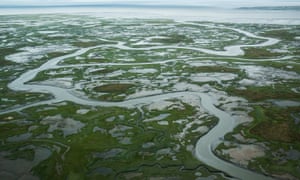
The marshy, tundra landscape surrounding Newtok, Alaska, a village threatened by the melting of permafrost. Photograph: Andrew Burton/Getty Images
The Obama administration
has warned the US will need to deal with a wave of "climate refugees"
as the Arctic continues to warm, joining with the Canadian government to
express alarm over how climate change is affecting indigenous
communities.
Sally Jewell, US secretary of the interior, painted a stark picture
of communities relocating and lives disrupted in her first official
visit to Canada. The Arctic, which is warming at twice the rate of the global average, has just recorded its lowest recorded peak ice extent after what's been called a "warm, crazy winter".
"We can't turn this around. We can stem the increase in temperature,
we can stem some of the effect, perhaps, if we act on climate. But the
changes are under way and they are very rapid."
The escalating Arctic temperatures, diminishing ice and rising sea
levels are having consequences for humans as well as other animals such as polar bears and walruses. The ability to catch fish and travel – or even to hold the famed Iditarod dog sled race in Alaska – is at risk.
Jewell said the remote town of Kivalina in Alaska
is "washing away". The coastal town, located around 80 miles above the
Arctic circle, has been visited by Barack Obama following warnings its
400-strong population will have to be moved due to thinning ice that
exposes the town to crashing waves.
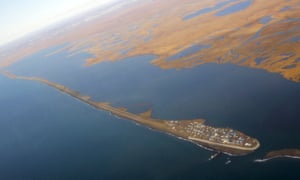
The village of Kivalina, Alaska, seen from Air Force One, the president's plane. Photograph: Jonathan Ernst/Reuters
It's a problem that is expected to be replicated elsewhere in Alaska
and in Canada. Jewell said political leaders need to "act and support"
efforts to make communities more resilient to climate change. US
Republicans have, so far, opposed any funding to protect or relocate
Alaskan towns.
"The
changing climate isn't just about melting permafrost, it's having a
huge impact upon cultures," said Catherine McKenna, Canada's environment
minister, who met with Jewell in Quebec. "When your ice highway has
gone, communities can't interact. It's having a huge impact upon food
and food insecurity."
McKenna said there is a "huge commitment to do more" from Obama and Justin Trudeau, Canada's prime minister. The two leaders met in Washington DC in March
to agree to help lead the world to a low-carbon economy and to bolster
efforts to protect the Arctic and the people who live there.
Scientists expect the Arctic to be completely ice-free for at least a
few days during the summer by the 2040s. The area of summer ice has
shrunk by around 3m sq km since 1980.
The disappearance of this ice is set to open up new opportunities for
shipping lanes through previously inaccessible areas, raising concerns
over oil spills and further disruption to indigenous livelihoods