08/05/2016

Climate Change: Five Islands In The South Pacific 'Completely Lost To Rising Seas'

The Independent - Will Worley

'The sea has started to come inland, it forced us to move up to the hilltop and rebuild our village there away from the sea'
The rising sea levels seen in the Solomon Islands are expected to eventually be replicated across the Pacific TORSTEN BLACKWOOD/AFP/Getty Images
Rising sea levels and erosion have caused five islands in the South Pacific to completely disappear, researchers have said.
A further six islands have been partially destroyed by erosion and the phenomenon is already causing human displacement, pushing people out of their coastal communities and further inland.
Researchers, writing in The Conversation, said that while rumours and speculation have abounded about problem for some time, their study had now produced the first scientific evidence for land being lost to the seas.
The lost islands ranged in size from one to five hectares and supported dense tropical vegetation that was at least 300 years old.
"They were not just little sand islands," lead study author Simon Albert told AFP news agency.
In addition, Nuatambu Island, home to 25 families, has lost more than half of its habitable area, with 11 houses washed into the sea since 2011, according to the study, which was published in Environmental Research Letters.

The researchers believe similar problems are expected across much of the Pacific after 2050 as a result of human-induced sea-level rises. In all but the most optimistic scenarios for greenhouse gas emissions, many Pacific islands will experience long-term rates of sea-level rise similar to those already experienced in the Solomon Islands.
Numerous communities have been displaced and fragmented by the threat from rising seas, and generations-old settlements have been abandoned in favour of moving further inland.
Sirilo Sutaroti, the 94-year-old chief of the Paurata tribe, recently abandoned his village in the Solomons.
“The sea has started to come inland, it forced us to move up to the hilltop and rebuild our village there away from the sea,” he told the researchers.
In addition, the 1,000-strong town of Taro, the capital of Choiseul Province, is set to become the first become the first provincial capital in the world to relocate the entirety of its population and services in response to the impact of sea-level rise.
The study comprised of analysis of the coastlines of 33 reef islands, using aerial and satellite imagery dating from 1947 to 2015. This was used in conjunction with radiocarbon dating of trees, sea-level records, wave models, and local knowledge.
Sea levels rising twice as fast as predicted. AFP/Getty

Waves were found to play a significant role in the coastal erosion which contributed the disappearance and threatens other islands in the Pacific. Islands which were more exposed and subject to ‘wave energy’ deteriorated faster than more sheltered islands, information which may be useful in the future, according to the researchers. The lost islands were among those studied which were subject to more powerful wave energy.

Chair of the Solomon Islands' National Disaster Council, Melchior Mataki, said: “This ultimately calls for support from development partners and international financial mechanisms such as the Green Climate Fund.
"This support should include nationally driven scientific studies to inform adaptation planning to address the impacts of climate change in Solomon Islands.”

Links

07/05/2016

New Report: Reef Recovery Requires Climate Action

Climate Council

 Australia's Coral Reefs Under Threat From Climate Change

Our new report found that rising global ocean temperatures, driven by climate change, has been the cause of an extremely severe bleaching event on the Great Barrier Reef.

DOWNLOAD THE REPORT
KEY FINDINGS:
1) The longest global coral bleaching event on record is underway due to record breaking ocean temperatures driven by climate change and El NiƱo.
  • Australia's iconic reefs, particularly the northern part of the Great Barrier Reef, are experiencing severe bleaching.
  • Climate change – driven mainly by the burning of coal, oil and gas – has caused extreme ocean temperatures, making the bleaching on the GBR this year at least 175 times more likely. At present rates of climate change, this level of bleaching could occur every two years by the 2030s.
  • An estimated 36% of the world's coral reefs have been affected by major bleaching and nearly all reefs have experienced some thermal stress.
  • Climate change also threatens fish, crustaceans and other species that rely on the reefs as habitat.
2) Coral reefs are among the most biologically diverse and economically valuable ecosystems on Earth, but they are under threat from climate change.
  • The Great Barrier Reef is a multi-billion dollar economic asset. Its value-added economic contribution to the Australian economy was $5.7 billion in 2011-12, supporting 69,000 jobs.
  • About 500 million people worldwide rely on coral reefs for their food and livelihoods, which represent an economic asset worth an astounding $1 trillion.
  • Recovery could be impossible for many of the reefs currently affected by severe bleaching if climate change is not arrested.
3) The future of coral reefs around the world depends on how much and how fast we reduce greenhouse gas emissions now and in the coming years and decades.
  • At the Paris UNFCCC conference on climate change (COP21) in December 2015, the world's nations pledged ambitious emission cuts in order to limit global warming to well below 2°C with a target of 1.5°C in the long-term.
  • The pledges from COP21 need to be much more ambitious as the full implementation of current commitments would still see average global temperatures rise above 3°C.
  • Australia has a critical role to play in the global effort to reduce fossil fuel emissions and protect reefs like the Great Barrier Reef.
A new report today has revealed the influence of climate change on the Great Barrier Reef and provides strong scientific evidence that future bleaching events are likely to become more frequent and severe.
The comprehensive report, reviewed by international experts, found that rising global ocean temperatures, driven by climate change, has been the cause of an extremely severe bleaching event.
This event has affected 93% of individual reefs and many reefs in the north have been bleached for the first time.
At present rates of climate change, this level of bleaching could occur every two years by the mid 2030s and the world's coral reefs are unlikely to be able to cope.
"Recently, we have seen some serious smoke and mirrors about the ability of the reef to recover," report author Professor Will Steffen said.
"The fact is, as bleaching events get closer together and more severe, reefs will struggle to survive.
"Some parts of the reef currently experiencing bleaching may be able to recover, provided that they are not repeatedly and frequently bleached in the future. This is why tackling climate change is critical to the long-term future of the reef.
"Depending on how quickly the record-breaking ocean temperatures wane, the reef may be able to partly heal in some areas in the short-term. But in the long-term, the reef's capacity to recover will depend on how much and how fast we reduce our greenhouse gas emissions in the next few years.
"Recovery could be impossible for many of the reefs currently affected if climate change is not arrested."
Professor Will Steffen
Australia's coral reefs are very unlikely to recover in the long-term if we continue to burn coal, which is driving the increasing global temperatures, the report found.
Global emissions must be trending down by 2020 at the latest to save the world's coral reefs. While countries like the US are now reducing their emissions, Australia's are rising.
"We are more than halfway through the critical decade for action to stabilise the climate and reduce the risks of climate change. Scientists have been warning the world about the risks from climate change for more than 30 years. Now it is crunch time," co-author Professor Lesley Hughes said.
"The window to limit global warming and preserve Australia's coral reefs is running out.
"The decisions made in the next federal term of government and the current term of the Queensland government will be critical to the long-term survival of the reef."
"It is vitally important that Australia plays its part in global efforts to tackle climate change."
Professor Hughes said attempts to improve water quality on the Great Barrier Reef will be in vain without action on climate change.
"The bottom line is that water quality improvements, though welcome, will not save the Great Barrier Reef. The only way to do that is to rapidly transition our energy systems away from polluting fossil fuels towards modern, clean renewables," she said.

Links

Greg Hunt: No Definite Link Between Coal From Adani Mine And Climate Change

The Guardian - 

Australia's environment minister denies he failed to consider impact of a coal mine on the Great Barrier Reef, court documents show 
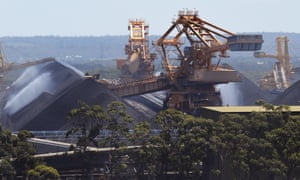
Coal at the Port of Newcastle
Coal being exported from the Port of Newcastle. The Australian Conservation Foundation is challenging Greg Hunt's approval of Adani's Carmichael mine. Photograph: William West/AFP/Getty Images
The federal environment minister has argued in court that coal from Australia's largest coalmine would have no "substantial" impact on climate change and as a result he did not need to consider whether it would affect the Great Barrier Reef.
The Australian Conservation Foundation challenged Greg Hunt's approval of Adani's Carmichael mine, alleging he failed to consider the impacts the burning of the coal from the mine would have on climate change and hence on the Great Barrier Reef.
Scientists have found the current mass bleaching event affecting 93% of the reef was made 175 times more likely by climate change and would become a biennial event within 20 years. After that point, the continued existence of the reef would be in doubt.
In federal court documents obtained by Guardian Australia, Hunt denied he failed to consider the impacts of coal on the reef.
In the outline of submissions filed on behalf of the minister, the Australian government solicitor explains that the minister did not think the burning of the coal "would be a substantial cause of climate change effects" and would have "no impact on matters of national environmental significance".
The minister's reasoning was that whether the burning of the coal would make climate change worse depended on whether it would increase the total amount of coal burned globally. But he notes there are a "raft of factors" that could affect how much coal was burned globally, including whether the coal from the mine displaced other coal and whether it was dealt with within various national emissions targets.
He concluded that there "was no requisite relationship between combustion emissions and increases in global temperature".
Further, the minister argued that since the net impact was "difficult to identify", there was no need to impose conditions on the mine, such as that climate impacts would be offset.
"Put simply, because any increase in net global greenhouse gas emissions was a matter of speculation, there was no need for or utility in the imposition of conditions."
The Australian Conservation Foundation was represented by the Environment Defenders Office Queensland. The court case was heard in the federal court in Brisbane on Tuesday and Wednesday and a decision is expected within three to six months.

Links

Great Barrier Reef: new chapter opens in the fight to save natural wonder from mining
Australia: The new coal frontier
Activists launch fresh court challenge over Carmichael coalmine
Adani's Carmichael mine approval labelled 'economic stupidity'
Adani freezes investment in Carmichael mine until world coal price recovers
Abbot Point coal terminal expansion given approval by Greg Hunt Traditional land owner tells court Adani misled tribunal over mine's benefits
Coal from Carmichael mine 'will create more annual emissions than New York'
Adani Carmichael mine in Queensland gets another green light from Coalition
Adani poised to submit third plan for dredging in Great Barrier Reef

06/05/2016

Labor Cites Climate, Solar And Storage In Budget Reply, Reopens Door For ARENA Funding

Renew Economy - 

Opposition leader Bill Shorten has put climate change and renewable energy firmly on federal Labor's economic agenda in his budget reply, while his party has re-opened the door to re-instating funds to the Australia Renewable Energy Agency, should it be elected.
Uttering those two words that were conspicuously absent from the Turnbull government's economic plan, Shorten told parliament on Thursday night that a Labor government would budget for "real action" on climate change, and help drive the new jobs and industries that would be created by renewable energy.
And he was quick to remind voters that his opposite number, Malcolm Turnbull, had seemingly abandoned his convictions on the issue, in accordance with the demands of the party's far right faction.
"Of course, advocating climate action is hard, and running a scare campaign against it is easy. Mr Turnbull should know – you've done both."
Beyond that, Labor's position on climate change and clean energy is shaping up to be in direct opposition to the Coalition's, which has consistently argued that too rapid a transition to renewables – and away from coal – would amount to economic suicide.
"Refusing to act on climate change will leave Australia isolated from the biggest economic opportunity of the next few decades," Shorten said in his speech.
"Taking real action on climate change will create new jobs, attract new international investment and power our industries and services.
"But delaying action will be a hit on Australians' cost of living, a drag on our nation's economic growth and an attack on our farmers' way of life.
"More than this – it would be a betrayal of the duty every generation owes the next – to hand down an environment in a better state than the one we inherited."
And on the subject of future funding for the Australian Renewable Energy Agency – the grant-based renewables support scheme that the Coalition wants to de-fund – the party appears to have had a rethink.
Labor, having helped set up ARENA, this week had a bizarre tantrum about continuing to support it, despite the fact that scrapping it would leave no avenue for government funding of the kind of early stage research that is vital to the development of better and cheaper renewable energy technology.
But the party has since clarified that it "will continue to support" ARENA, and was "committed to debt, equity and capital grant funding for the renewable energy sector" as crucial elements of its plan to reach 50 per cent renewable energy generation by 2030.
"ARENA's funding trajectory has been a political plaything of the Turnbull Government with the various changes over the term of this Government making it lumpy and sub optimal," shadow climate spokesman Mark Butler said in a statement.
"ARENA is fully funded for 2016/17 but we recognise that the balance of funds and programs needs further consideration to ensure that we have what is actually required to achieve our targets for the renewable revolution and deliver on the commitments in our Climate Change Action Plan.
"On winning government we will sit down with the ARENA board and work through exactly what is required.
Here is more of what Shorten said in his budget speech on climate and renewables:
"By 2030, there will be $2.5 trillion of investment in renewable energy in the Asia-Pacific. Australian workers should be collaborating with our universities and researchers to design, manufacture and export battery technology, solar panels and turbine parts.
"These are not niche markets or boutique industries. Embracing clean technology and renewable energy can revitalise advanced manufacturing in this country.
"In the last two years, the global economy added 2 million renewable energy jobs – but Australia lost 2,600. The world is powering ahead – and we are going in the wrong direction. It's time to turn things around. Which is why a Labor government will deliver 50 per cent renewable energy by 2030."

Links

Climate Change Authority Report Recommending 'A Mandatory Carbon Price' Held Back Until After Election

Fairfax - 

A report that recommends putting a price on emissions from the electricity sector has been held back by the Climate Change Authority until after the election, prompting calls from Labor and the Greens that it be made public to inform debate.
The independent authority, whose board is now dominated by appointments made last October by Environment Minister Greg Hunt, was to have released its policy options paper for the power industry by the end of April.
The board, though, decided to withhold the report - along with the large Special Review due out by June 30 - until after the election, "assuming it is called for early July," the authority said on its website.
Put a carbon price on the electricity sector, leaked report by the independent Climate Change Authority says.
Put a carbon price on the electricity sector, leaked report by the independent Climate Change Authority says. Photo: Michele Mossop

"Why would the authority not release something before the caretaker period?" a source said to Fairfax Media about the report on the power sector, which creates about one-third of Australia's carbon emissions.
Leaked details of the Climate Change Authority's electricity industry "policy options" report said "a mandatory carbon price of some form is desirable in the sector".
Mr Hunt, Prime Minister Malcolm Turnbull and other ministers have campaigned hard on Labor's plan to introduce a carbon price through an emissions trading scheme if election.
Environment Minister Greg Hunt during Question Time this week.
Environment Minister Greg Hunt during Question Time this week. Photo: Alex Ellinghausen

That campaign stepped up a notch last week, after Labor revealed its climate policies, including setting up an emissions-intensity market to drive a shift to lower-polluting power stations.
Mr Hunt's first media release after Labor's policy was announced began: "Bill Shorten has announced a massive new electricity tax. It would have a devastating impact on the Australian economy, jobs, incomes and we would see power prices skyrocket."
Fairfax Media understands that board members - who number 10 in total and include Chief Scientist Alan Finkel - held a lengthy conference call on Thursday, April 29.
While Mr Hunt and his department did not intervene, his office was "very happy" that the electricity sector report's release was delayed, another source said.
A spokesman for Mr Hunt said his office had not seen the reports. He also dismissed the possibility that the government would have withheld a report favouring a wide-ranging carbon price on the eve of an election.
The CCA electricity report assessed the relative merits of different schemes, and found the emissions-intensive version (see "EI" in the following chart from the report) favoured by Labor to be among the cheaper options.
"The overall message is that an emissions trading scheme, even with serious caps or baselines, is not going to have big impacts on the economy, both immediately, and in the long term," one of the sources said.
A spokeswoman for the authority said: "The electricity modelling report has not been finalised and the authority will not be commenting on its internal deliberations."
However, it is understood some in the authority were wary that to release the reports so close to the election would inevitably expose the authority - and the validity of the carefully researched reports - to attacks.
Those wanting to scare voters about the cost of action would exaggerate the costs of any action, they said.
"A lot of people are very much in their bunkers [on this issue]," another source said. "There's a group of people who are still open to the issue", who might still be reached by carefully researched reports.
"Costs can be high but people have to remember that the costs of not doing something [to halt climate change] may be higher," the source said.
The authority was just trying to "give it the best opportunity for the report to be considered in a calmer environment", the source said.
Labor and the Greens, however, demand that the power sector report be released.
"If the government was confident that their Direct Action policy [to pay directly for carbon abatement] was effective, they wouldn't need to hide from this report," Mark Butler, Labor's environment spokesman, said.
"But Greg Hunt and Malcolm Turnbull know their policy isn't the right policy and don't want that confirmed by the Climate Change Authority," he said.
"What else doesn't the government want the Australian public to know before going to the polls?"
Larissa Waters, the Greens deputy leader, said the authority should not "withhold information vital to Australians as they cast their votes during a climate crisis".
"It's crucial Australians have this information before the election, which falls at a tipping point for Australia to save our very way of life by embracing the clean energy revolution to create jobs and tackle global warming," Senator Waters said.
The Abbott government had tried to scrap the Climate Change Authority but was blocked in the Senate. The 2016 budget, released on Tuesday, does not include funding for the authority beyond next year.
Dr Finkel, the Chief Scientist, was not available for comment.

Links

Climate Change: United Nations' Ban Ki-Moon Says Time To Scale Up Climate Change Action

ABC News

UN chief Ban Ki-moon

UN Secretary-General Ban Ki-moon has warned action on climate change must be faster and broader in order to turn the Paris deal promises to combat global warming into concrete measures. "It is time to take climate action to the next level," he told a gathering in Washington that included the mayors of New York and Paris, environmental campaigner Al Gore, business leaders and members of the US Congress.
"We need to accelerate the speed, scope and scale of our response, locally and globally."
The meeting, dubbed Climate Action 2016, came two weeks after 175 countries signed the Paris climate deal at the United Nations, raising hopes the landmark deal would be quickly ratified.
The Paris agreement will come into force when 55 countries responsible for 55 per cent of the world's greenhouse gases have ratified it.
"We cannot afford to lose momentum because with each passing day the climate challenge grows," World Bank president Jim Yong Kim said.
"It seems that every time we look it's worse than we thought," he added, citing record hot temperatures that have now "become the new norm".
Economic growth had already been affected, with some regions seeing a 6 per cent drop because of water scarcity alone, he said.
Agreed by 195 nations, the Paris deal sets the goal of limiting global warming to "well below" 2 degrees Celsius above pre-industrial levels, by moving to clean energy.
French Environment Minister Segolene Royal sounded upbeat, saying there was a new awareness from many countries that were not fully committed to climate change.
Ms Royal said she wanted the Paris agreement to come into force before the end of this year.
China and the United States said they would ratify the Paris deal this year and are pushing for others to follow suit so the agreement becomes operational as early as the end of this year.
Mr Ban said he was convening a similar meeting to the Washington gathering in Beijing in September on the sidelines of the G20 summit to keep climate change high on the world agenda.

Links

Fort McMurray and the Fires of Climate Change

The New Yorker - 

A helicopter flies past a wildfire in Fort McMurray, Alberta, on Wednesday. The blaze has spread through an area covering more than three hundred square miles.
A helicopter flies past a wildfire in Fort McMurray, Alberta, on Wednesday. The blaze has spread through an area covering more than three hundred square miles. Credit Photograph by Jason Franson / The Canadian Press / AP
The town of Fort McMurray, some four hundred miles north of Calgary, in Canada, grew up very quickly on both sides of the Athabasca River. During the nineteen-seventies, the population of the town tripled, and since then it has nearly tripled again. All this growth has been fuelled by a single activity: extracting oil from a Florida-sized formation known as the tar sands. When the price of oil was high, there was so much currency coursing through Fort McMurray's check-cashing joints that the town was dubbed "Fort McMoney." Now Fort McMurray is burning. A forest fire that began to the southwest of the town on Sunday has forced the entire population—almost ninety thousand people—to evacuate. On Wednesday, Alberta's provincial government declared a state of emergency. By yesterday, more than fifteen hundred buildings had been destroyed and the blaze had spread through an area covering more than three hundred square miles. It was burning so hot that that it was easily able to jump major rivers. One Canadian official described the fire as "catastrophic." Another called it a "multi-headed monster."
No one knows exactly how the fire began—whether it was started by a lightning strike or by a spark provided by a person—but it's clear why the blaze, once underway, raged out of control so quickly. Alberta experienced an unusually dry and warm winter. Precipitation was low, about half of the norm, and what snow there was melted early. April was exceptionally mild, with temperatures regularly in the seventies; two days ago, the thermometer hit ninety, which is about thirty degrees higher than the region's normal May maximum. "You hate to use the ​clichĆ©, but it really was kind of a perfect storm," Mike Wotton, a research scientist with the Canadian Forest Service, told the CBC.
Though it's tough to pin any particular disaster on climate change, in the case of Fort McMurray the link is pretty compelling. In Canada, and also in the United States and much of the rest of the world, higher temperatures have been extending the wildfire season. Last year, wildfires consumed ten million acres in the U.S., which was the largest area of any year on record. All of the top five years occurred in the last decade. In some areas, "we now have year-round fire seasons," Matt Jolly, a research ecologist for the United States Forest Service, recently told the Times.
"You can say it couldn't get worse," Jolly added, but based on its own projections, the forest service expects that it will get worse. According to a Forest Service report published last April, "Climate change has led to fire seasons that are now on average 78 days longer than in 1970." Over the last three decades, the area destroyed each year by forest fires has doubled, and the service's scientists project that it's likely to "double again by midcentury." A group of scientists who analyzed lake cores from Alaska to obtain a record of forest fires over the last ten thousand years found that in recent decades, blazes were both unusually frequent and unusually severe. "This extreme combination suggests a transition to a unique regime of unprecedented fire activity," they concluded.
All of this brings us to what one commentator referred to as "the black irony" of the fire that has destroyed most of Fort McMurray.
The town exists to get at the tar sands, and the tar sands produce a particularly carbon-intensive form of fuel. (The fight over the Keystone XL pipeline is, at its heart, a fight over whether the U.S. should be encouraging —or, if you prefer, profiting from—the exploitation of the tar sands.) The more carbon that goes into the atmosphere, the warmer the world will get, and the more likely we are to see devastating fires like the one now raging.
To raise environmental concerns in the midst of human tragedy is to risk the charge of insensitivity. Prime Minister Justin Trudeau alluded to this danger at a recent news conference: "Any time we try to make a political argument out of one particular disaster, I think there's a bit of a shortcut that can sometimes not have the desired outcome." And certainly it would be wrong to blame the residents of Fort McMurray for the disaster that has befallen them. As Andrew Weaver, a Canadian climate scientist who is a Green Party member of British Columbia's provincial legislature, noted, "The reality is we are all consumers of products that come from oil."
But to fail to acknowledge the connection is to risk another kind of offense. We are all consumers of oil, not to mention coal and natural gas, which means that we've all contributed to the latest inferno. We need to own up to our responsibility and then we need to do something about it. The fire next time is one that we've been warned about, and that we've all had a hand in starting.

Links

Lethal Heating is a citizens' initiative