The realities of why we vote the way we do are actually more to do
with appearance, and less to do with policy. In the shadow of an
election, Dr Lissa Johnson explains the psychology behind the polls.
(IMAGE: Gianluca Di natale, Flickr)
The long-anticipated early election has finally been announced, as the election campaign splutters to a start.
So far, it is a world away from the vaudevillian spectacle that has
been the US presidential primaries. No impassioned unshackling from
establishment traditions here.
Words like 'boring' and 'beige' have been doing the rounds.
The treasurer Scott Morrison even sought to distance himself from
another kind of 'b' word on budget night. 'Budget' has such a nasty ring
to it. 'Plan' is much less inflammatory.
Especially when you're selling voodoo economics.
At least we aren't facing a choice between a walking reality TV
disaster and the woman-most-likely-to-start-World War III. I don't envy
those Americans.
Hillary Clinton may be more keen to pick a fight with Russia for no
good reason, but the Republican Party is so crazy that one of the most cited individuals in history, respected MIT professor Noam Chomsky, has called it a radical insurgency.
In an interview with the Huffington Post
earlier this year Chomsky said, "Today, the Republican Party has
drifted off the rails…. It's become what the respected conservative
political analysts Thomas Mann and Norman Ornstein call 'a radical
insurgency'".
We know what that's like, don't we? Remember 'Team Australia' and
'the right to be bigots'? Thank goodness those days are behind us.
The Republican insurgency is so extreme that Chomsky has called it,
"A serious danger to human survival". He qualified his position by
adding, "literally".
Renowned intellectual Noam Chomsky.
Malcolm Turnbull may not have dazzled us with innovation, but at least he doesn't beat the xenophobic drums of War On Terror, shouting "Death Cult" at every opportunity. Plus he's less embarrassing than Donald Trump.
However, Trump and his nationalism are not the danger to which Chomsky refers.
The singular threat to humanity posed by the Republican Party has to do with their climate policies.
In a subsequent interview,
Chomsky was asked why the Republican party frightened him more than the
far right in Europe (or Hilary Clinton for that matter). Chomsky
replied, "The extreme right in Europe is indeed tremendous, but it does
not have the support necessary to accelerate the destruction of life on
the planet…. Today's Republican Party, I would add, is one of the most
dangerous organizations in human history."
Chomsky had earlier "cited 'Republicans' rejection of measures to
deal with climate change, which he called a 'looming environmental
catastrophe.' All of the top Republican presidential candidates are either outright deniers, doubt its seriousness or insist no action should be taken — 'dooming our grandchildren,' Chomsky said."
Despite the obvious significance of this issue, it has been dwarfed
by the media circus surrounding the US presidential primaries. During
the presidential debates, climate change featured in less than two percent of questions to candidates on most news networks.
As is the convention in mainstream election coverage, focus has been
on the race, the spectacle, the candidates' tactics, their gaffes, their
polling, and their reactions to one another. And on providing them with
a megaphone for their postures and pronouncements, ultimately allowing
the candidates to set the agenda in the policy 'debate', as if the
issues they choose to ignore magically disappear.
Meanwhile, back in Australia, our own media circus of sorts is
underway, with our very own Threat-To-Human-Survival Party on the
campaign trail.
The Liberal National Coalition may look and sound different to the
Republicans (with the possible exception of Cori Bernardi, George
Christensen, Peter Dutton, Simon Birmingham, Luke Simpkins, Brett
Whiteley, Barry O'Sullivan, Andrew Hastie, George Brandis… oh never
mind. The list is too long).
Turnbull may look and sound different to Trump. But, like the
Republican Party, the Coalition in Australia is forged from a hard core
of climate nihilism and denialism, elemental to the party's very being.
And, like the Republican Party, the Coalition's policies are in "abject service to private wealth and power."
From the Government's first actions in the earliest days of office
under Abbott – axing the Climate Commission and the carbon tax – to cutting climate research and funding a new fossil fuel industry 'growth centre' under Turnbull, the Coalition has been swinging a wrecking ball through environmental policy from beginning to end.
The latest in this long line of carnage has been the Turnbull Government's first budget, with no mention of climate change and $1.3 billion in cuts to the Australian Renewable Energy Agency.
The beneficiaries, of course, have been the Coalition's financial backers, the fossil fuel industry.
At this "completely unprecedented" time of "climate emergency", were voting a rational endeavour, this would be all anyone needed to know about the Coalition.
Fancy human survival? Like to avoid mass extinction?
Change governments.
As Chomsky notes, "What they are saying is, let's destroy the world. Is that worth voting against? Yeah."
For a country with a small population, we Australians are particularly well poised to destroy the world. As the world's largest exporter of coal, 90 per cent of our current coal reserves must stay in the ground to avoid catastrophic warming. Our Coalition Government, however, is bent on exporting as much as possible while it still can.
This during the second half of the critical decade in which to
prevent planetary meltdown. A matter of importance to the 7 billion
people of the world's population.
At the next federal election, Australian voters will stand at an
unusual moment in human history. They will hold power over life on Earth
in their hands.
Literally. In the form of a pencil.
It is a rare and precious opportunity.
But will Australian voters take it?
Although almost 80 per cent of Australians polled
believe in anthropogenic global warming, almost half (48 -49 per cent
two-party preferred) intend on returning the Coalition to office.
Yes, that's less than it was a few months ago, but still, almost half.
This being the party that has made Australia the worst performing country in the OECD on climate change.
Why would so many people vote them back in? This corporate insurgency that endangers human survival.
Seriously.
Why?
Voting behaviour
In their 2015 book 'The Rationalising Voter',
Professors of Political Science Milton Lodge and Charles S Taber
summarised the psychological literature on voting behaviour, including
their own 20-years worth of research on the subject.
Their book sets out to empirically answer the question, "What
determines how citizens evaluate political leaders, groups and issues?"
Lodge and Taber note that dominant models in political science view
this question from the perspective of an Enlightenment "Rational Man"
("Rational Woman" wasn't yet a thing), in which "the conscious
construction of arguments and reasoning [form]the foundations of pubic
opinion and political behaviour".
Such Enlightenment assumptions inform every aspect of our approach to
elections, electorates and electioneering, overtly at least. Between
now and July we will experience an extended period of argument and
reasoning in pursuit of our opinions and votes.
But will all that argument and reasoning really matter? Do arguments win elections in the end?
Based on the empirical data to 2015, what did Lodge and Taber find
was among the most consistently decisive factors in election outcomes
the world over, apart from money?
Communication strategy? Economic forecasts? Political vision?
Looks.
Across numerous studies in numerous countries, glancing briefly at
photos of electoral candidates is enough to predict election outcomes
with around 70 per cent accuracy.
Prime Minister of Australia Malcolm Turnbull, pictured in parliament delivering the 8th annual Close the Gap report.
In one study, for instance, the average rating of (previously
unknown) Senate candidates' competence, based on one-second glimpses of
their headshots, predicted the outcomes of 70 per cent of the Senate
races held across 2000, 2002 and 2004.
In another study, when people in the US and India rated headshots of
candidates for various public offices in Brazil, judging photos for
"suitability to office", the headshot ratings predicted election
outcomes 75 per cent of the time.
In yet another study, entitled "Predicting Elections: Child's Play",
Swiss children aged 5-13 were asked to select a ship's captain from
photos of two French parliamentary candidates. The children's choices
predicted actual election outcomes with a correlation of 0.71. The
predictive correlation for adults in the study was 0.72.
The researchers posited that voters, whom they note are performing
"one of democracy's most important civic duties… might still be using
the same cues that children do to categorize individuals on competency".
That would explain a lot.
This effect is robust, and holds even when people glimpse photos for as little as one tenth of a second.
Little wonder, then, that a change of face following the leadership
spill last year lifted the Coalition's fortunes without any real change
in policy.
Interestingly, in times of war people prefer 'facial dominance' in
their leaders (rectangular face, strong brow, square jaw). During health
scares they prefer facial attractiveness, presumably for its allusions
to health.
Lodge and Taber note, "All this predictive power without party
identification, ideological proximity, or any of the traditional
predictors of vote choice!" (exclamation mark original).
The Coalition must be hoping that during times of economic transition, people prefer the face of a wealthy businessman.
Needless to say, not everyone casts their vote based on looks.
The authors of the Brazilian election study, "Looking Like a Winner",
observed, "These are strong relationships, large enough to alter the
outcome of all but a handful of the races in our sample."
Gulp.
The looking-like-a-winner effect, however, runs deeper than face value.
Voting and human cognition
As Lodge and Taber explain at length in their book, voters'
susceptibility to appearance reflects fundamental realities of human
cognition. These realities are uncontroversial in cognitive psychology
and neuroscience, but, the authors say, "have gone largely unnoticed in
political science".
In a nutshell, human information processing occurs primarily outside
conscious awareness, and emotion, rather than reason, directs the
unconscious information flow.
This view is supported by "three decades of research, backed by
hundreds of well crafted behavioural studies in social psychology and
now evidence from the neurosciences".
Advanced though our capacity for conscious awareness, our brains can
only handle so much of it. Lodge and Taber point out, for example, that
we can process about 11 million pieces of sensory information per
second. 10 million of those pieces are visual, but we are only
consciously aware of 40. In other words, we notice 1/250,000th of what we see.
Of 1 million pieces of tactile information, we consciously experience 5.
In working memory – the information we hold in conscious awareness –
our brains can manage 7 plus or minus 2 chunks of information at any one
time.
Overall, according to Lodge and Taber, around 98 per cent of what we experience occurs outside our conscious awareness.
Most importantly, the unconsciously processed material influences our
opinions and behaviour. Countless studies have shown that subliminal
stimuli (or "unconscious primes") shape our beliefs and actions without
our realising.
For instance, in one study, people were subliminally exposed to
cartoon smiley-faces, or cartoon frowny-faces (for 39 milliseconds), and
then asked to generate a number of opinion statements on illegal
immigration and energy security. When exposed to smiley-faces people
generated more positive opinions, and when exposed to frowny-faces their
opinions were more negative.
Remarkably, the effect of the unnoticed cartoon faces was stronger
than that of prior attitudes towards immigration and energy security.
Similarly, subliminal priming with positive or negative words (such
as rainbow, paradise, syphilis or vomit) results in more positive or
negative evaluations of political candidates.
Studies such as these form part of a larger empirical literature
demonstrating that unconscious influences shape people's conscious
decision making and reasoning via their emotions.
Tony Abbott eats an onion. Just because.
Lodge and Taber say that "Feelings enter the decision stream before
cognitive considerations, and immediately influence what thoughts and
preferences will enter the decision stream.… Much of the thinking that
we perceive as causally prior to our policy positions are in fact
rationalisations of our feelings".
In other words, we feel first and think later.
This is not a new or radical notion in psychology. Back in 2001, writing on Emotion as Virtue and Vice in the book Citizens and Politics, Professors of psychology Gerald Clore and Linda Isbell described reason as a "gun for hire" in the service of motives and emotions.
Experimentally primed feelings exert their power over reason and
opinion when presented for as little as 15 milliseconds. Conscious
recognition begins to arise after around 100 milliseconds and conscious
decision-making does not begin to unfold until after around 1000
milliseconds.
Lodge and Taber note "conventional models [in political science]…
fail to appreciate the significance of information processes that occur
on a millisecond timescale… Conscious deliberation is in the wake behind
the boat."
As well as subliminal or implicit influences on our political
cognition, there are those we notice consciously, but whose impact on
our thoughts and actions goes undetected. These are known as
"supraliminal", "unappreciated" or "unrecognised primes".
For instance, voters are more likely to support increased taxes to
fund education when casting their vote in a school rather than a church
or fire station. This effect overrides that of postcode partisanship.
In another example, "business paraphernalia" (briefcases, boardrooms,
fancy pens) cause people to be more competitive and less generous in
their allocations of money.
Perhaps our leaders should devise budgets wearing jeans and T-shirts, in student digs.
Relatedly, people report stronger belief in global warming on hotter
days and in warmer rooms, and when seeing images of deserts rather than
snow (using ice imagery to communicate about climate change to sceptical
audiences may need rethinking, then).
Strikingly, ambient temperature has been found to predict belief in
anthropogenic global warming as strongly as political ideology.
Like cartoon smiley-faces, this temperature-effect wields its
unconscious power via our feelings. When people feel hot, or imagine
feeling hot, global warming feels viscerally more real, and belief and
opinion follow.
One can't help but muse that the world may have been a different place if more menopausal women held positions of power.
Lodge and Taber's main thesis is that when people feel good, or bad,
about an issue or party or leader they engage in arguments and reasoning
to rationalise their feelings. The 'rationalising voter'.
Importantly for understanding political cognition, this emotionality
does not reflect the weaknesses of an irrational voting minority. It
reflects the workings of the human mind. It describes us all.
If you are sceptical, consider people with damage to brain areas
governing the experience of emotion, but whose memory, attention,
learning and intelligence remain intact. Such damage removes emotion
from the cognitive equation, yet causes marked deficits in problem solving, not advantages, even for problems based purely on probability.
In other words, feelings not only precede conscious deliberation and
analysis, they are integral to it. We need emotions to reason well.
Lodge and Taber note that this is "In direct contradiction to much
Western thought, which treats affect, feelings and emotion as irrational
intrusions that befuddle decision making."
But what is the point of all this emotional reasoning? Why should
brains so complex be so silly? Why isn't logic the master, and emotion
the slave?
If it were, the Coalition wouldn't stand a chance.
The former Abbott Government Ministry.
To function, human beings must process vast quantities of information
efficiently and effectively. Conscious processes are slow, deliberative
and effortful. Unconscious processes are fast, spontaneous and
effortless.
So that we can manage our enormous information load, the unconscious
system bears the brunt of the information processing, and takes
shortcuts. One such shortcut is to unconsciously tag things "good" or
"bad" (known as affective – or emotional – tags). This triggers
automatic feelings of like or dislike, causing us to approach or avoid
accordingly.
It is a "quick and dirty" pathway, prone to false positives and
negatives, but without it our information processing systems would
overload.
When affective tags line up with reality and our values, they work
well. In these instances "Emotions can provide indispensible guides for
making sensible choices," say Clore and Isbell.
Think empathy and human rights, for instance.
Equally, a thorn in the Coalition's side has been that 'universal
healthcare', 'education' and 'jobs' are positively affectively tagged in
most Australians' minds, making it more difficult to swing the same
wrecking ball through these policy areas as through environmental
policy.
The costs of affective tagging arise when our unconscious minds take
inaccurate and counterproductive shortcuts, such as stereotyping and
prejudice, or judging political candidates based on looks.
Unfortunately, the nature of election campaigns is that they provide
precisely the conditions in which our minds become susceptible to quick
and dirty processing. Our unconscious system is wired to take over, and
take shortcuts, when we are bombarded with information (particularly
conflicting, complicated or confusing information), overwhelmed with
detail, overstimulated with distractions and/or when the consequences of
our actions are delayed.
Under these conditions, political reasoning becomes "a bobbing cork
on the currents of unconscious processes", susceptible to the tidal pull
of unseen psychological forces.
Lodge and Taber say that the failure of traditional Political Science
to account for these implicit processes "goes to the heart of our
discipline's problems in accounting for how, when and why citizens think
and act as they do".
All of this is not to say that our consciously constructed,
well-crafted, carefully considered opinions and arguments are redundant.
When affective tags are reality-based (eg. climate-change-bad, climate-action-good), they lead to logical and productive thought. And argument and reasoning can create affective tags in the first place.
The point is that when our affective tags are divorced from reality, our rationality comes unstuck.
The media and human cognition
In terms of the real-world political ramifications of human cognitive
architecture, Lodge and Taber say, "The most worrisome implication of
our research program, we believe, is the ubiquity of consciously unnoticed and unappreciated
priming events in the media (italics original)… Our conservative
estimate is that implicit cues are embedded in virtually all political
communications".
One such implicit cue, pertinent at election time, is subtleties in media disposition towards political candidates.
In a study of US presidential campaign coverage, for instance, the
facial expression of media presenters varied when they uttered different
candidates' names. Candidates whose names were paired with more
positive facial expressions received greater support from viewers.
I seem to recall an experiment about smiley-faces….
A similar effect has been found for media interviews. When
interviewers' nonverbal behaviour is friendly towards interviewees,
viewers perceive the interviewee more favourably, or unfavourably if the
interviewer is hostile.
Amy McGuire deconstructed the significance of this phenomenon very eloquently last year in respect to the ABCs sugar-coating of Scott Morrison and human rights abuse, during a 'Kitchen Cabinet' interview.
Federal Treasurer Scott Morrison delivers his first budget in Canberra.
Given the opinion-shaping power of media halo effects, the media
infatuation with Turnbull in the early months of his leadership carried
significant opinion-shaping force. This halo-effect, moreover, would
have been intensified by the power of first impressions.
A great deal of research shows that people tend to form snap
impressions of one another, and that first impressions persist, even
despite later contrary information.
In the political realm, the authors of Predicting Elections: Child's Play
note, "Unfortunately, voters anchored in an initial impression do not
appropriately correct the initial inferences; additional information on
the candidates does not change choices by much".
No wonder Turnbull still leads by almost 20 percentage points as
preferred PM, despite his widely acknowledged failures of 'agility',
'innovation' and 'mature government' as leader. And his government's
antagonism to life on Earth.
Another potentially powerful and pervasive mind-bending media force is the ranking and placement of stories.
Experiments led by psychologist Dr Robert Epstein have found that subtly altering the order of search results
in search engines changes the voting intentions of undecided voters by
20 per cent or more, without their realising. Ratings of candidate trust
and liking change along with votes.
Given the power of position, a valuable opportunity to build trust
and liking in climate science was recently missed by the Australian
press. The tragic news of widespread coral bleaching in the Great
Barrier Reef was ranked 9th most reported news topic in the first week of the story breaking, and 10th in the second week, out-ranked by the Tewnty20 World Cup and the Socceroos.
Not the kind of ranking that influences votes.
But do all these media influences really matter? Laboratory
experiments are one thing, but is there any impact on real-life voting
at the end of the day?
If not, what's the harm? Perhaps it's all passing perturbations, like a swell in the sea, leaving no meaningful trace.
I will examine this issue more fully in part II, but suffice to say
that implicit media processes not only influence reality, they create
it.
With respect to voting behaviour, newscasters' facial expressions
have been linked not only to viewers' evaluations of political
candidates but to their votes. During the 1984 US presidential election
coverage, of the newscasters studied, facial bias
(smiley-face/frowny-face) was detected in favour of Ronald Reagan.
Viewers who watched the facially-biased coverage were more likely to
vote for Reagan.
Reagan brought us neoliberalism. Neoliberalism brought us corporate
takeover of everything, the GFC, austerity, unbridled climate change….
You get the idea.
Oh, and the fossil-fuelled Coalition.
Former US president Ronald Reagan. (IMAGE: Gage Skidmore, Flickr)
The Reagan study is not alone. In more recent research, coding of
newspaper content during election campaigns revealed differences across
papers in percentages of negative, neutral and positive mentions for
candidates. Readers' real-world voting patterns followed suit.
The authors concluded that their "results raise serious questions about the media's place in democratic processes."
Serious questions, for instance, about the impact of newspaper coverage of the mining super-profits tax in 2010, 76 per cent of which was negative.
Had anyone tracked the real-world implications of this, the empirical
trail would no doubt have led, along with other trails, to mining's
privileged and protected status in Australia today.
More protected than the Great Barrier Reef.
Professor of Media and Communications Simon Cottle
says, "Journalism has become the principal platform for the
communication and conduct of politics… [and]structures the wider play of
power " in a way that is "consequential for democracy".
This is not simply Professor Cottle's opinion. Journalism has been
shown repeatedly in research to be an active, agenda-setting player in
politics and world affairs.
To pretend otherwise, by claiming that journalism is and can be an objective observer,
serves mainly to disguise this fact, lending already unseen media
influences the added camouflage of 'impartiality'. Biases that favour
the status quo become as good as invisible under cover of 'mere
reporting'.
Moreover, the 'objective observer' is based on a fictitious account
of human information processing, as old as the Enlightenment 'Rational
Man'. Truth is a far more psychologically viable standard, and more
defensible, as John Pilger argues powerfully here.
Needless to say, there are exceptional journalists in the mainstream
media doing outstanding work, with truthful transparency rather than
grandiose delusions of objectivity.
However, the media ecology in which they operate works against them.
During the coming election coverage, for instance – with all the
detail and distraction, numbers and counter-numbers, under cover of
'mere reporting' – will climate change, a faceless entity, get lost in
the face-value fray? In the noisy political personality pageant, and the
commentary on the race, will the quiet realities of climate change get
the top billing they deserve? The billing they need to influence votes?
Or will editors hand politicians a bullhorn, allowing their
priorities and scare-campaigns to dominate, drowning reality out, and
tugging on voters' most visceral and simplistic cognitive impulses?
At the end of it all, will Australians vote for the headshot of
whoever won the popularity contest of the day, or for life on Earth?
In Lodge and Taber's words, "Where, when, how and for whom conscious
processing will successfully override the automatic intuitive response
is the critical unanswered question that goes to the heart of all
discussions of human rationality, and the meaning of a responsible
electorate".
In part II of this series I will look at one journalistic convention
that renders minds particularly psychologically pliable, and runs riot
at election time. With reference to case examples, I will examine how
this convention has closed minds to information on climate change over
decades.
Lastly, I will offer educated guesses as to remedies for this and
other varieties of mass media mind control, drawing on lessons from Psy
Ops, information warfare and the US presidential primaries.
The Guardian - Vicki Arroyo* Louisiana’s sinking Isle de Jean Charles shows the urgent need for measures to combat climate change
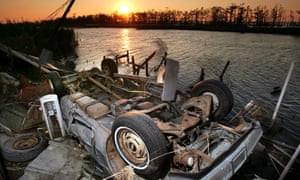
A car lies upside down at the edge of a marsh amid other storm debris from Hurricane Katrina. Photograph: Robert F. Bukaty/AP
As seas rise, as floods and droughts become more extreme, as crops
fail and as storms intensify, the world will increasingly face a new
challenge – climate refugees.
In the US, witness the recent plan by the federal government to resettle a Native American tribe before their Isle de Jean Charles home in Louisiana vanishes underwater
– an example that hits close to home. I have deep family roots in south
Louisiana: my mother, sister and brother-in-law, aunt and uncle were
refugees from a weather disaster exacerbated by climate change, losing
their homes in New Orleans during Hurricane Katrina in 2005. A year before, a heart condition killed my father in the aftermath of a stressful evacuation from Hurricane Ivan.
Some scientists already argue that the hundreds of thousands of
Syrians fleeing their war-torn country are as much refugees from climate
change as from conflict, because of years of climate-related drought.
Others predict the world will see hundreds of millions more climate
refugees by mid-century, at a staggering human, financial and political
cost.
And sadly, this looming problem is not a surprise. Way back in 1988, I
represented Louisiana on a global warming task force of the National
Governors' Association. Even then, the sobering effects of increasing
concentrations of carbon dioxide were clear. We didn't miss the irony
that oil-producing coastal states like Louisiana
and Alaska would be hit hard by climate change. Many years later, in
2004, while serving on a federal climate-change task force, I saw the
simulated devastation wreaked by computer-generated storm "Pam" along
the Gulf coast. I was shaken, and prayed it would never actually come to
pass. But it did in Katrina and, just three weeks later, the
record-setting Hurricane Rita.
And we can expect far more extreme weather. Over my decades of work
on climate change, what has been a surprise is that these impacts are
coming faster than we once thought, as the rate and extent of changes –
such as climbing temperatures, increased heat waves and floods, and
rising seas – outstrip projections. The massive ice sheets covering
Greenland and west Antarctica are disintegrating far more quickly than
scientists calculated even in the last IPCC report in 2014.
Earlier this year, on a trip to Antarctica, I saw enormous icebergs
calving off the continent – a stark reminder of the immense changes
under way on the planet we all call home.
As a result, seas are now expected to rise by feet rather than inches
this century, and other changes are accelerating. The first three
months of 2016 have already shattered historical temperature records,
with soaring heat in the Arctic speeding the rate of sea ice loss. With
no ice to protect their coastal villages from storm-tossed waves, Native
American communities in Alaska are also becoming climate refugees, with
a price tag to move just one Inuit village, Shishmaref, estimated at $180m.
Like
many other subsistence cultures living near the water, the people of
Isle de Jean Charles or Shishmaref did little to contribute to climate
change. Neither have many other coastal communities around the world
that will suffer similar fates. It may be that the Louisiana climate
refugees will be among the luckier ones—in the sense that they are
getting help to move away from their sinking island. Countless others
will have to leave their homes with an uncertain future and no place to
welcome them.
I witnessed the heartbreak of losing home and community at first
hand. After Katrina flooded 80% of New Orleans, my relatives, a friend
and their five cats relocated to Arlington, Virginia and lived with me
for several months. I saw the pain of being away from a home that you
did not choose to leave. My sister said that losing her cherished New
Orleans life and being thrown into mine in the Washington, DC area was
like being in the witness protection programme. When it was unclear if
the city would survive, she worried if the culture, food, music,
neighbourhoods and people that made New Orleans unique and irreplaceable
would be lost forever.
My family was able to return to New Orleans, working to make it
stronger. The Isle de Jean Charles tribe doesn't have that option. But
thanks to support from the National Disaster Resilience Competition and
the state, it does have a chance to rebuild elsewhere, though
maintaining their cultural bonds in a new environment could be a
challenge.
It's not that we are leaving home, but that home is leaving us
It's unlikely that millions of others will be given the same
opportunity. From Bangladesh to Boston, from London to Vietnam,
low-lying areas near coasts are endangered. Meanwhile, prolonged
droughts will continue to fuel migration and conflicts in the Middle
East, central and eastern Africa and other regions.
Is there hope in his bleak picture? The Paris Agreement to curb emissions
that cause climate change was a huge, historic step. Now, every nation
must live up to its pledges in that agreement – and go beyond them – if
we are to keep the planet's temperature from rising more than 2C, the
level that scientists believe will prevent catastrophic consequences.
However, we are already in a warming world and we must prepare for
the changes happening today and in the future. We need to use the best
available science to identify and reduce our vulnerabilities to rising
seas, droughts, floods and other impacts. We need not only to invest
more in resilient infrastructure – roads, railways, bridges, ports and
subways; water, wastewater and electricity systems – but also to change
how we invest and rebuild, taking future climate conditions into account
instead of building for historic norms.
We also need to update our laws and policies to make it easier to get
permits for protective measures, including green solutions such as
living shorelines, or for retreating from encroaching water. And at a
time when one major political party in the US denies the very reality of
climate change, we need to find the political will and the economic
resources to do this and to help the most vulnerable. We need to support
not just those displaced, but also those communities that accept
climate refugees.
Perhaps most difficult is the need to engage in wrenching but
necessary conversations about what it means to leave the only home
you've known, and the home where your ancestors are buried, to try to
create a more stable future. These must be conversations for all of us,
not just those in Louisiana or Alaska. The economic, political and
psychological toll of the coming droughts, famines, wars, storms and
rising seas is difficult to fathom. Yet remarkably, even in this active
political season, the need to adapt to climate change has hardly been
mentioned.
For Louisiana, my home state, the stakes couldn't be higher. We've
lost the equivalent of Delaware's entire landmass over the past century,
and the familiar outline of the state is being eaten away. The wetlands
that once provided bountiful resources while serving as a buffer
against storms and floods are continuing to vanish at an alarming rate.
Watching the Louisiana coast sink faster than any other shoreline on the
planet while being buffeted by ever-rising seas and storms, one thing
is clear. It's not that we are leaving home, but that home is leaving
us.
*Vicki Arroyo is executive director of the Georgetown Climate Center and Professor from Practice at Georgetown Law.
Coastal communities around Australia are facing the rising threat of coastal erosion.
AAP/Dave Hunt
Representatives of Australian coastal communities have gathered
this week to discuss the major challenges they face. Delegates at the conference in Rockingham,
Western Australia, represent 40 councils around Australia, some falling
within the 24 federal electorates held by a margin of 5% or less. In contrast to the federal budget, climate change is at the top of their agenda.
At the coming federal election, 24 coastal electorates are held by a margin of 5% or less. Compiled with NATSEM, University of Canberra and the Australian Coastal Councils. Author provided
Coastal councils and their communities call on the Australian Government to play a leadership role in developing a co-ordinated national approach to coastal management by adopting a set of policy initiatives based on the recommendations of the bipartisan Australian Parliamentary Coastal Inquiry.
Challenges of growth and change
Australia's population is set to grow from 24 million to 40 million people by 2050. On present trends, this growth is likely to be concentrated in coastal regions, mostly along the eastern seaboard.
Australian Coastal Councils Association chair Barry Sammels, the mayor of Rockingham, observed:
Coastal seats are among the most vulnerable at the forthcoming election. Some of them are growing very rapidly, and others are changing demographically as 'sea-changers' migrate to coastal areas and people with young families are relocating from the cities in search of a better quality of life. This invariably means these regional coastal electorates, which have traditionally elected conservative political candidates, are becoming politically more volatile.
Coastal communities, in particular those which are changing in character, are demanding these risks be taken seriously. … They currently feel there is a lack of commitment from both major parties to deal with these threats.
Lack of urgency at the top
While bipartisan interest in cities policies is growing, this needs to be extended to coastal regions experiencing big changes on several fronts – demographic, economic and environmental.
The lack of long-term strategic coastal planning puts both communities and environments at risk. The bleaching of the Great Barrier Reef illustrates the impacts of environmental change on tourism, jobs and long-term economic security.
We need a national plan to support local councils to better manage coastal urban development, climate change and the consequences for their communities. We have had over 25 national reports leading to largely no action.
In the communique, coastal councils reasonably call for action on key recommendations of the comprehensive 2009 parliamentary inquiry:
We propose that the following recommendations of the coastal inquiry be adopted: That the Australian Government, in co-operation with state, territory and local governments, and in consultation with coastal stakeholders, develop an Intergovernmental Agreement on the Coastal Zone to be endorsed by the Council of Australian Governments.
And that:
The Australian Government ensure that [the agreement] forms the basis for a National Coastal Zone Policy and Strategy, which should set out the principles, objectives and actions that must be taken to address the challenges of integrated coastal zone management for Australia.
Mandurah, WA, epitomises both the pace of growth of coastal communities and their vulnerability to climate change.Rexness/flickr, CC BY-SA
Action has begun locally Finally, not all coastal planning and management is achieved through law and policy. A great deal of activity occurs locally through goodwill and collaboration. To highlight three examples:
in the west, the Peron Naturaliste Partnership involving nine local councils in the south-west, which won the 2016 Australian Coastal Award for Climate Adaptation
Such collaboration and innovation deserves long-term funding from higher levels of government.
We may have got this far without an integrated approach to coastal planning and management, but without it there is no way we will be able to manage coastal growth with the projected demographic, economic and climate changes.
That's why local councils are demanding immediate action on a national coastal policy to meet the needs of our coastal communities and environment. To ignore their call is a very significant political risk indeed.
Experts call for greater action on climate change, and warn that opening
up huge new coalmines in Queensland could cause permanent damage to the
reef
Lady Musgrave Island in the Unesco-listed Great Barrier Reef marine
park. Unesco will decide in June whether to list the reef as 'in
danger'.
Photograph: Parer-Cook/Auscape/Minden Pictures/Corbis
The federal government's plan to reverse the decline of the Great Barrier Reef is "weak" and requires greater action in six key areas, including climate change, according to a new report.
The set of recommendations, compiled by three of the reef's most
experienced scientists, warn that opening up huge new coalmines in Queensland
is "too risky" for the Great Barrier Reef. They also say that it "will
not be possible to develop and operate the largest coal ports in the
world along the edge of the Great Barrier Reef world heritage area over
the next 60 years without causing permanent damage to the region".
The report, published in Nature Climate Change, calls for a shift
towards better conservation values, Australia playing a "more active
role in transitioning away from fossil fuels" and advocates a bans on
the dredging and dumping of seabed spoil within the world heritage area.
It also recommends a revamp of the environmental assessment process for new developments, greater powers for the Great Barrier Reef Marine Park Authority over fishing and ports and a 50-year plan to reduce greenhouse gas emissions and slash chemical run-off.
The federal and Queensland governments have devised a long-term plan to arrest the decline of the reef, which is considered to be in poor and worsening health having lost half of its coral cover over the past 30 years.
However, scientists have attacked the plan for failing to confront
the issue of climate change, which is the leading long-term threat to
the reef. The opening up of the Galilee Basin coalfields, to export
resources via the reef, could result in the release of an additional 705m tonnes of greenhouse gases – more than Australia's annual total.
Unesco's world heritage committee will decide in June whether to list
the reef as "in danger." The Nature Climate Change report notes that
more than half of the 41 outstanding universal values ascribed to the
reef by Unesco are in decline due to pollution, coastal development, dredging, overfishing and climate change.
"We know what we need to do to help the reef, the problem is that the
government's plan is pretty weak," said Jon Brodie, a marine scientist
at James Cook University. Brodie authored the paper alongside Jon Day, a
fellow former director at the Great Barrier Reef Marine Park Authority,
and Terry Hughes, director of coral reef studies at James Cook
University.
"The plan doesn't address climate change at all, the water quality
improvement part is better but it isn't funded properly and the plan
doesn't set out good governance around ports, which is something Unesco
wants.
"We can't really stop exporting coking coal because we need to make
steel. But we need to stop the expansion of thermal coal exports from
the Galilee Basin."
Brodie said the expansion of the Abbot Point coal port near Bowen, which has seen a lengthy battle over where to dump seabed excavated for the development, has been "a farce."
"They had five options to expand the port and they picked the
cheapest, dirtiest one," he said. "And when enough people complained
about dumping it at sea, they picked the next worst option, which was
putting it in the wetlands. We are now on to another option."
Day said that while ports could continue to operate next to the reef,
all development needed to occur at a more sustainable level.
"If
that means less dredging, less coalmining and more sustainable fishing,
then that's what Australia has to do," he said. "Business as usual is
not an option because the values for which the reef was listed as world
heritage are already deteriorating, and will only get worse unless a
change in policy occurs."
Between them, the Australian and Queensland governments have pledged
to ban the dumping of dredged spoil within the world heritage area and
have set targets to reduce the amount of nitrogen and other chemicals
flowing on to the reef from farming.
However, conservationists have said the funding for pollution reduction is insufficient
and that even if the world keeps to an internationally agreed limit of a
2C increase in temperatures from pre-industrial times, ocean warming
and acidification will further reduce coral cover to perilously low levels.
Microbe populations make up 11-31% of living matter in the ocean seabed, but decline significantly as oceans warm
A giant scale worm is seen on the Antarctic seabed at 645 meters (2116
feet) below the surface in Antarctic waters in January 2008.
Photograph: Martin Riddle/AP
Microbes are hardly the poster-children of climate change, but they
have far more impact than polar bears on Earth's carbon cycle – and
therefore on our climate. A new study published Friday in Science Advances
finds that seabed bacteria and archaea (which look like bacteria but
have very different genetics and biochemistry) are sensitive to climate.
Because their habitat covers 65% of the entire globe, they form a huge
part of the biosphere and are important in the regulation of carbon in
the deep ocean, which affects long-term climate change.
The microbes in question are packed together in the top 15
centimeters of the deep ocean seabed, like rush hour commuters in a city
metro, up to a million times more abundant than in the sunless ocean
water, or buried in deeper layers of seabed sediments. Their city-like
crowding is fueled by a sparse sordid snow of excrement and microscopic
dead bodies from life in the upper ocean, far above them.
The scientists, led by Professor Roberto Danovaro of Polytechnic
University of Marche in Ancona, Italy, collected 228 samples from
various locations in the North Atlantic and Mediterranean, from a range
of ocean depths (400 to 5570 meters deep) and a wide variety of ocean
bottom temperatures. They measured the microbe populations using two
independent DNA profiling techniques: "catalyzed reporter deposition
fluorescence in situ hybridization" (thankfully abbreviated to
"CARD-FISH") and "quantitative polymerase chain reaction" (qPCR).
They discovered that the seabed microbes thrive where water temperatures are cold, but their populations decline significantly as deep ocean waters warm. Professor Antonio Dell'Anno, one of the paper's authors, told me:
That is also linked to the fact that warmer deep-sea ecosystems have a low input of organic carbon supplied from the surface waters.
In other words, their population is limited because their food is
limited. Moreover, as the microbes warm so does their metabolic rate,
requiring more food to survive, so the meagre food supports fewer
individual microbes.
The study also discovered that archaea make up a far larger
proportion (11% to 31%) of the living matter in the ocean seabed than
previously thought (less than 6%), and most of that population is made
up of a temperature-sensitive group known as "Marine Group I
Thaumarchaeota."
Professor David Archer of the University of Chicago calculated some
years ago that there was an unexplained temperature-sensitive CO2
feedback that amplified the warm and cold cycles of the ice ages.
He narrowed it down to the oceans, but it remains unsolved. I asked
Professor Dell'Anno if deep seabed archaea might be the answer, but It's
too early to say:
We do not know yet how temperature shifts can influence the biological interactions within food webs. We cannot yet predict whether prokaryotes will exacerbate or attenuate the magnitude of climate change on marine ecosystems, but they are expected to be a key component that is able to influence the oceans' feedback on climate change.
To move closer to an answer, the team is now looking to incorporate
their results into new climate models, but it may be years before we
fully appreciate the global impact of these tiniest of creatures.
*Howard Lee is a geologist and science writer who focuses on past climate changes. Links
'The sea has started to come inland, it forced us to move up to the hilltop and rebuild our village there away from the sea'
The rising sea levels seen in the Solomon Islands are expected to eventually be replicated across the Pacific TORSTEN BLACKWOOD/AFP/Getty Images
Rising sea levels and erosion have caused five islands in the South Pacific to completely disappear, researchers have said.
A further six islands have been partially destroyed by erosion and
the phenomenon is already causing human displacement, pushing people out
of their coastal communities and further inland.
Researchers, writing in The Conversation,
said that while rumours and speculation have abounded about problem for
some time, their study had now produced the first scientific evidence
for land being lost to the seas.
The lost islands ranged in size from one to five hectares and
supported dense tropical vegetation that was at least 300 years old.
"They were not just little sand islands," lead study author Simon Albert told AFP news agency.
In addition, Nuatambu Island, home to 25 families, has lost more than
half of its habitable area, with 11 houses washed into the sea since
2011, according to the study, which was published in Environmental Research Letters.
The researchers believe similar problems are expected across much of
the Pacific after 2050 as a result of human-induced sea-level rises. In
all but the most optimistic scenarios for greenhouse gas emissions, many
Pacific islands will experience long-term rates of sea-level rise
similar to those already experienced in the Solomon Islands.
Numerous communities have been displaced and fragmented by the threat
from rising seas, and generations-old settlements have been abandoned
in favour of moving further inland.
Sirilo Sutaroti, the 94-year-old chief of the Paurata tribe, recently abandoned his village in the Solomons.
“The sea has started to come inland, it forced us to move up to the
hilltop and rebuild our village there away from the sea,” he told the
researchers.
In addition, the 1,000-strong town of Taro, the capital of Choiseul
Province, is set to become the first become the first provincial capital
in the world to relocate the entirety of its population and services in
response to the impact of sea-level rise.
The study comprised of analysis of the coastlines of 33 reef islands,
using aerial and satellite imagery dating from 1947 to 2015. This was
used in conjunction with radiocarbon dating of trees, sea-level records,
wave models, and local knowledge.
Sea levels rising twice as fast as predicted. AFP/Getty
Waves were found to play a significant role in the coastal erosion
which contributed the disappearance and threatens other islands in the
Pacific. Islands which were more exposed and subject to ‘wave energy’
deteriorated faster than more sheltered islands, information which may
be useful in the future, according to the researchers. The lost islands
were among those studied which were subject to more powerful wave
energy.
Chair of the Solomon Islands' National Disaster Council, Melchior
Mataki, said: “This ultimately calls for support from development
partners and international financial mechanisms such as the Green
Climate Fund.
"This support should include nationally driven scientific studies to
inform adaptation planning to address the impacts of climate change in
Solomon Islands.”