17/05/2016

Climate Change Puts 1.3bn People And $158tn At Risk, Says World Bank

The Guardian

Organisation urges better city planning and defensive measures to defend against rapid rise in climate change-linked disasters 
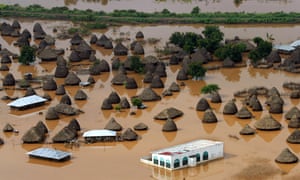
Submerged huts after flooding in Nigeria village
Flooding and drought will affect more people but few countries are planning for it, warns the World Bank. Photograph: Tony Karumba/AFP/Getty Images
The global community is badly prepared for a rapid increase in climate change-related natural disasters that by 2050 will put 1.3 billion people at risk, according to the World Bank.
Urging better planning of cities before it was too late, a report published on Monday from a Bank-run body that focuses on disaster mitigation, said assets worth $158tn – double the total annual output of the global economy – would be in jeopardy by 2050 without preventative action.
The Global Facility for Disaster Reduction and Recovery said total damages from disasters had ballooned in recent decades but warned that worse could be in store as a result of a combination of global warming, an expanding population and the vulnerability of people crammed into slums in low-lying, fast-growing cities that are already overcrowded.
"With climate change and rising numbers of people in urban areas rapidly driving up future risks, there's a real danger the world is woefully unprepared for what lies ahead," said John Roome, the World Bank Group's senior director for climate change.
"Unless we change our approach to future planning for cities and coastal areas that takes into account potential disasters, we run the real risk of locking in decisions that will lead to drastic increases in future losses."
The facility's report cited case studies showing that densely populated coastal cities are sinking at a time when sea levels are rising. It added that the annual cost of natural disasters in 136 coastal cities could increase from $6bn in 2010 to $1tn in 2070.
The report said that the number of deaths and the monetary losses from natural disasters varied from year to year, but the upward trend was pronounced.
Total annual damage – averaged over a 10-year period – had risen tenfold from 1976–1985 to 2005–2014, from $14bn to more than $140bn. The average number of people affected each year had risen over the same period from around 60 million people to more than 170 million.
Although developed countries have been responsible for the bulk of historic global emissions, poorer countries are more vulnerable to the impact of climate change and they demanded financial help from the west as part of last December's breakthrough global deal to reduce emissions.
Oxfam this week called on rich countries to make good on the pledges made at the Paris conference to provide the funding to help developing countries adapt to the effects of global warming.
"Climate change is a brutal reality confronting millions of the world's most vulnerable people. Their need for financial support to adapt to climate extremes is urgent and rising," Oxfam said in its Unfinished Business report.
"International support for adaptation falls well short of what is needed. Latest estimates indicate that only 16% of international climate finance is currently dedicated to adaptation – a mere $4bn–$6bn per year of which is public finance."
According to the the facility, disaster risk is affected by three factors. It said these were: hazard – the frequency of potentially dangerous naturally occurring events, such as earthquakes or tropical cyclones; exposure – the size of the population and the economic assets located in hazard-prone areas; and vulnerability – the susceptibility of the exposed elements to the natural hazard.
It added that hazard was increasing due to climate change; exposure was going up because more people were living in hazardous areas and that vulnerability was on the rise because of badly designed and poorly planned housing.
The World Bank-run body said the population was expected to rise by at least 40% in 14 of the 20 most populated cities in the world between 2015 and 2030, with some cities growing by 10 million people in that period. "Many of the largest cities are located in deltas and are highly prone to floods and other hazards, and as these cities grow, an ever greater number of people and more assets are at risk of disaster."
Francis Ghesquiere, head of the secretariat at the The Global Facility for Disaster Reduction and Recovery, said: "By promoting policies that reduce risk and avoiding actions to drive up risk, we can positively influence the risk environment of the future. The drivers of future risk are within the control of decision makers today. They must seize the moment."

Links

Confirmed: Southern Hemisphere CO2 Level Rises Above Symbolic 400ppm Milestone

Fairfax

A significant marker of rising global greenhouse gas emissions has been passed, with a key monitoring site on Tasmania's north-west tip recording atmospheric carbon-dioxide exceeding 400 parts per million for the first time.
As foreshadowed by Fairfax Media last week, a baseline reading at the Cape Grim station that exceeded the 400-ppm mark of the primary gas driving global warming was imminent.
Cape Grim, one of the world's most important monitoring stations for gauging changes in the atmosphere.
Cape Grim, one of the world's most important monitoring stations for gauging changes in the atmosphere. Photo: Auscape
As it turned out, "the unfortunate milestone" was reached on Tuesday May 10 at 8am, local time, said Paul Krummel, who heads the CSIRO team analysing data from the most important site in the southern hemisphere. (See chart below.)

"It's a bit sooner than we expected," Mr Krummel told Fairfax Media. "It just rocketed up there."
Australian emissions are on the increase, particularly in the electricity sector.
Australian emissions are on the increase, particularly in the electricity sector. Photo: Michele Mossop 
Atmospheric readings from Cape Grim, along with two stations in Hawaii and Alaska, are closely watched as they date back decades and closely track a range of pollutants from ozone-depleting chemicals to the various greenhouse gases resulting from burning fossil fuels and clearing forests.
Mr Krummel said that while mostly symbolic, the 400-ppm reading "highlights the problem of rising emissions, which are increasing more rapidly than they used to be".
A report out earlier this year from the World Meteorological Organization noted atmospheric readings of CO2 at the Mauna Loa site in Hawaii rose 3.05 ppm in 2015 alone – the biggest increase in the 56 years of research.
Melting moments: A polar bear off the coast of Svalbard, Norway.
Melting moments: A polar bear off the coast of Svalbard, Norway. Photo: Steven Kazlowski

Sun-Herald editorial illustration from May 15.
Sun-Herald editorial illustration from May 15. Photo: David Rowe
The recent surge in CO2 levels was not unexpected because of the giant El Nino event now breaking up in the Pacific. In El Nino years, global temperatures get a kick higher and droughts tend to be worse. As a result, vegetation take out less CO2 from the atmosphere.
CSIRO's Mr Krummel said the El Nino influence was evident in Cape Grim's reading with barely a dip in the past year as might otherwise be expected in spring.
"This year, it's just plateaued and now it's taken off again," he said, adding the site was "probably one of the last places on earth" to remain below 400 ppm.
Sites in the northern hemisphere exceeded 400 ppm from 2012 onwards. But as the region has greater seasonal variation – mostly because there is more terrestrial vegetation – CO2 concentrations dropped back below that mark each spring.
Once Cape Grim gets past a short period with CO2 levels gyrating around 400 ppm, it will need a huge global effort to curb greenhouse gas emissions to push the level back down.
"It's not going to go back below 400 ppm for a very long time unless we get very good at mitigation," Mr Krummel said.Global CO2 levels were running at roughly 280 ppm up until about 1850 when they started to take off. (See chart below).
Climate scientists, such as David Karoly at Melbourne University, note that when other greenhouse gases, such as methane, are included, the situation is even bleaker.
The so-called carbon dioxide-equivalent level that takes in the full global warming impact is now about 485 ppm.
Both 2014 and 2015 were record hot years globally in data going back about 130 years. With the effect of a strong El Nino overlaying long-term trends, this year is likely to be even hotter after a scorching start.
Ed Hawkins, a climate scientist at the UK's University of Reading, has constructed the following animation showing how the world has warmed in the past 166 years.
Many regions of the world are experiencing unusual warmth for May, with parts of Alaska expected to be 15 degrees warmer than average.
Even Sydney is running about 5 degrees above average so far for May and Australia on the whole is headed for close to its warmest autumn on record.
The Cape Grim site, meanwhile, celebrated its 40th anniversary in March with a cloud over its future because of the CSIRO job cuts.
While management has promised to maintain the facility that it runs in cooperation with the Bureau of Meteorology, the number of CSIRO staff analysing the gases collected at the site is expected to be cut by about one-third from the current tally of about 30 researchers.

Links

16/05/2016

April Breaks Global Temperature Record, Marking Seven Months Of New Highs

The Guardian - Michael Slezak

Latest monthly figures add to string of recent temperature records and all but assure 2016 will be hottest year on record
Global land and sea temperature was 1.11C warmer in April 2016 than the average temperature for April during the period 1951-1980. Photograph: Stephane Mahe/Reuters
April 2016 was the hottest April on record globally – and the seventh month in a row to have broken global temperature records.
The latest figures smashed the previous record for April by the largest margin ever recorded.
It makes three months in a row that the monthly record has been broken by the largest margin ever, and seven months in a row that are at least 1C above the 1951-80 mean for that month. When the string of record-smashing months started in February, scientists began talking about a "climate emergency".
Figures released by Nasa over the weekend show the global temperature of land and sea was 1.11C warmer in April than the average temperature for April during the period 1951-1980.
It all but assures that 2016 will be the hottest year on record, and probably by the largest margin ever.

The new record broke the previous one by 0.24C, which was set in 2010, at 0.87C above the baseline average for April. That record itself broke one set three years earlier at 0.75C above the baseline average for April.
NASA records the warmest April on record.

The current blast of hot air around the globe is being spurred by a massive El Niño, which is a release of warm water across the Pacific Ocean. But it's not the biggest El Niño on record and that spike in temperatures is occurring over a background of rapid global warming, pushing temperatures to all-time highs.
"The interesting thing is the scale at which we're breaking records," said Andy Pitman, director of the ARC Centre of Excellence for Climate System Science at the University of New South Wales in Australia. "It's clearly all heading in the wrong direction.
"Climate scientists have been warning about this since at least the 1980s. And it's been bloody obvious since the 2000s. So where's the surprise?" said Pitman.
Pitmans said the recent figures put the recent goal agreed in Paris of just 1.5C warming in doubt. "The 1.5C target, it's wishful thinking. I don't know if you'd get 1.5C if you stopped emissions today. There's inertia in the system. It's putting intense pressure on 2C," he said.
The record temperatures were wreaking havoc with ecosystems around the world. They've triggered the third recorded global coral bleaching, and in Australia 93% of the reefs have been affected by bleaching along the 2,300km Great Barrier Reef. In the northern parts of the reef, it's expected the majority of coral is dead, and on some reefs over 90% of the coral is dying.
A recent analysis showed the bleaching on the Great Barrier Reef was made 175 times more likely because of climate change, and the conditions that caused it would be average in fewer than 20 years.
The April figures come as the symbolic milestone of CO2 concentrations of 400 parts per million (ppm) have been broken at the important Cape Grim measuring station in Tasmania, Australia.
Reflecting on the CO2 concentrations, Pitman said: "The thing that's causing that warming, is going up and up and up. So the cool ocean temperatures we will get with a La Niña are warmer than we'd ever seen more than a few decades ago … This is a full-scale punching of the reef system on an ongoing basis with some occasionally really nasty kicks and it isn't going to recover."
Spiralling global temperatures from 1850-2016.


Links

Direct Action Not Giving Us Bang For Our Buck On Climate Change

The Conversation

Energy efficiency projects could receive more subsidies if Direct Action is continued. David González Romero/Flickr, CC BY


Direct Action is the centrepiece of Australia's current greenhouse gas reduction efforts. To date, A$1.7 billion in subsidies has been committed from the government's Emissions Reduction Fund to projects offering to reduce emissions.
The scheme replaced Australia's two-year-old carbon price in 2014 and is a key part of the government's plan to reduce emissions by 5% below 2000 levels by 2020, and 26–28% below 2005 levels by 2030.
Environment Minister Greg Hunt has called Direct Action a "stunning success" and "one of the most effective systems in the world for significantly reducing emissions".
In a new article in Economic Papers, I look into the economics of Direct Action and how it is working. I conclude that the scheme is exposed to funding projects that would have happened without government funding.
This issue has long been known as a threat to schemes of this type, and means that the scheme is likely to be less useful in reducing emissions than the government is claiming.
Commonwealth Procurement Rules require value for money in government purchases. It is not clear we are getting that with Direct Action.

Information problems
The key challenge for schemes like Direct Action is information. What exactly is the scheme buying, and would that have happened without it?
Direct Action works by inviting voluntary project proposals and then allocating funds to the lowest bidders in reverse auctions.
Unfortunately, projects that would have gone ahead even without a subsidy – call them "anyway projects" – have a cost advantage that makes them well placed to win the auctions. It is often difficult for the government to identify such projects. When projects of this type receive funding, taxpayers' money is being used ineffectively.
Economists call this adverse selection, or the "lemons problem".

All about that baseline
The government has developed a set of methods for defining projects and measuring the emission reductions provided by each project against estimated baselines. It is an economy-wide scheme, and there are methods covering everything from energy efficiency to aviation.
As is, the methods leave opportunities for anyway projects to qualify. The Emission Reduction Fund White Paper states that a "flexible approach" is being pursued so as to encourage participation.
One rule is that projects be new. But across the Australian economy, new projects are launched every year. Some happen to reduce emissions. These projects are being attracted into the Direct Action auctions.
Carry-overs from the former Carbon Farming Initiative have also been allowed to side-step the newness requirement.

The experience so far
Three Direct Action auctions have been held to date, with the most recent in late April 2016.
Some of the funded projects are likely to be providing genuine reductions in emissions. Unfortunately, however, some project categories are rather questionable.
Landfill operators have been awarded Direct Action subsidies in each of the auctions. Their projects are often already generating revenues from electricity sales and renewable energy certificates.
Other projects to win subsidies include upgrades to lighting in supermarkets and to the fuel efficiency of vehicles. These are activities that are supposed to happen anyway.
The biggest winner to date has been vegetation projects. Among these are projects to reduce tree clearing, including of invasive native species near Cobar and Bourke in New South Wales. The large payments for these projects are likely to have preserved some vegetation. But some farmers appear to have not actually been planning to clear. If so, funding is going to anyway projects.
This vegetation could be protected under the avoided deforestation category of Direct Action. But was it going to be cleared, and is a taxpayer-funded subsidy the best way to save it? Paul BurkeAuthor provided
Projects potentially in line for the next auction include boiler upgrades and modifications to aircraft. If Direct Action were to continue for years to come, the bill could become very big.
Journalists such as Lenore Taylor and Tristan Edis are among those who have raised concerns about the quality of Direct Action projects. The government has yet to properly engage with this issue.

This problem could be avoided
There are far better policy approaches than Direct Action subsidies.
A key advantage of either an emissions tax or an emissions trading scheme is that the government does not need to evaluate individual projects from covered enterprises.
These schemes instead introduce a price per unit of emissions and leave the private sector to decide which projects to implement. Large emitters are already required to report their emissions, so implementation is comparatively straightforward. Any revenue raised could be used to reduce other taxes or Australia's budget deficit.
Regulations could also be put to more use. Strengthened restrictions on vegetation clearing and on the release of coal mine gas are examples.
Eligibility to generate offset credits should be tightened to cover only credibly genuine emission reductions that are difficult to achieve using other policies. Some carbon farming activities can meet this criterion, and could generate revenue from private-sector buyers. Public expenditure on new offset projects could be ended.

Better off going back to what was working
There are many other downsides to Direct Action. These include its administrative complexity, the issue of emissions reappearing elsewhere in the economy, and the subsidy culture it inculcates.
The scheme is yet to induce emissions reductions in key sectors of the economy. Emissions from electricity generation are rising again.
Australia has a big challenge ahead in decarbonising our economy. There are many opportunities, but we need to get our policy settings right. It would be better to move on from Direct Action subsidies. An approach centred on pricing emissions makes more sense.

An open-access version of Paul's paper can be downloaded here.

Links

Election 2016: Climate Change Policy A Vote Winner For Majority Of Australians

Fairfax

Strong climate change policy is a vote-changing matter for a majority of Australians, a new poll shows, establishing the issue as an important battleground one week into the election campaign.
According to the ReachTEL survey of 2400 people, conducted for a coalition of environmental groups, 64 per cent of respondents said they would be more likely to vote for a party seeking 100 per cent renewable energy in 20 years and 48 per cent said they would be more likely to support a party reducing Australia's net carbon emissions to zero by 2050.
A diver checking out the Barrier Reef coral bleaching at Heron Island in February.
56.4 per cent of people want the government to do more on climate change while 27.8 per cent think the current settings are right and 9.9 per cent want less action.
The figures contrast with the Turnbull government's avoidance of the topic. The Prime Minister did not mention climate change in his speech when kicking off the election campaign.
The Coalition's policy is a 26-28 per cent cut on 2005 emission levels by 2030 through its multi-billion dollar emissions reduction fund and 23 per cent clean energy production by 2020.
Recently unveiled is Labor's proposed 45 per cent cut on 2005 levels through emissions trading and restrictions on land clearing.
The Greens want a 63-82 per cent equivalent cut to emissions and 90 per cent renewable energy by 2030.
"The Prime Minister has spoken about the need to transition the economy from one dependent on mining. It is clear from this poll that an increasing number of Australians support that goal on climate change grounds," Lyndon Schneiders, national director of the Wilderness Society, said.
"It is also clear that the vast majority of Australians recognise that we need new and powerful laws to manage that transition and to protect the places we love from the impacts of climate change."
The poll also found:
  • 56.1 per cent of people would be more likely to support a party phasing out coal-fired power, compared to 27.2 per cent unchanged and 16.6 per cent who would be less supportive.
  • 66.9 per cent would be more likely to vote for a party that strengthens environmental laws protecting sites like the Great Barrier Reef, while 23.1 per cent are unaffected and 10 per cent would be less likely to support them.
  • 61.9 per cent of people agree that the burning of fossil fuels causes global warming and is destroying the Great Barrier Reef, while 23.2 per cent disagree and 14.9 per cent don't know.
A squad of environment groups, including the Australian Youth Climate Coalition, the Australian Conservation Foundation, GetUp! and Environment Victoria, are using the election to target 25 marginal seats with a doorknocking and publicity campaign on climate policy.
AYCC national director Kirsty Albion said the organisation is encouraging young people at universities and schools to enrol to vote "so that politicians start taking our future seriously and act on global warming".

Links

15/05/2016

UK Energy From Coal Hits Zero For First Time In Over 100 Years

The Guardian - Press Association

Coal-generation hit historic low several times last week in what experts say are the only occasions since the first coal-fired generator opened in London in 1882
Record low in UK coal production can as warm weather helped lower demand. Photograph: Christopher Furlong/Getty Images
The amount of electricity generated from coal in the UK has fallen to zero several times in the past week, grid data shows.
In what green energy supporters have described as a “historic turning point” for the UK’s power system, coal-fired electricity first fell to zero late on Monday night and for the early hours of Tuesday morning, according to data from BM Reports.
On Thursday, there was no electricity from coal for more than 12 and a half hours, more than half the day, with it making no contribution to the UK’s power supplies late at night when demand was low and for a period in the day, the data shows.
It is thought to be the first time the UK has been without electricity from coal since the world’s first centralised public coal-fired generator opened at Holborn Viaduct in London, in 1882, according to the Carbon Brief website which reports on climate science and energy policy.

The record lows in coal power generation come as the UK enters the summer months, which sees lower demand for electricity, and with more than half of the country’s coal capacity out of action, for example for planned maintenance.
But there have also been a series of recent closures of coal-fired power plants as they become less economic, while plants such as Drax in North Yorkshire have partially switched to burning “biomass”.
The government has said it wants to see coal phased out by 2025, as it is the most polluting way of generating electricity.
There has also been an increase in the amount of renewables on the system, with a record 27% of the UK’s power coming from sources such as wind power in the last quarter of 2015.Estimates of the power now being generated from solar panels, from household arrays to large scale farms, also show it is regularly outstripping coal during the day, reaching 6.8 gigawatts (GW) at a midday peak this week compared to a high of 3GW output from coal.
Solar is limited to generating power during the day, but analysis from Carbon Brief found that over the course of a week, the clean technology produced more power last week than coal.
Juliet Davenport, chief executive of renewable electricity supplier Good Energy said: “This week marks an historic turning point for energy in the UK.
“Coal formed the backbone of the industrial revolution and was the fuel that powered Britain into the 21st century. But it’s time to begin to say farewell.
“Our energy is becoming cleaner and greener, with wind, solar and other renewables generating more of our electricity than ever before. We are celebrating this news as it shows that our future can be fossil fuel-free.”

Links

Global Sea-Level Expert John Church Made To Walk The Plank By CSIRO

Fairfax

For John Church, a leading authority on sea-level rise caused by global warming, there was much that was fitting – and yet callous – about being sacked at sea.
The veteran scientist was well into one of dozens of research voyages he had taken since joining CSIRO as a post doctoral student in 1979.
His vessel, the RV Investigator, was midway between Antarctica and New Zealand and steaming north on the 170 degree longitude when he received Thursday's call to tell him he was "potentially redundant". (See map below.)
John Church speaks to the media about proposed cuts to the CSIRO.
John Church speaks to the media about proposed cuts to the CSIRO. Photo: Penny Stephens
Sitting with a supporter in the ship's conference room, Dr Church was told his services were no longer needed. "I was OK during the call but it is certainly not a nice feeling to have what you have worked for - for so many years - thrown on the scrapheap," the 64 year-old told Fairfax Media after finishing a 12-hour stint on watch.
CSIRO's RV Investigator on one of its research voyages.
CSIRO's RV Investigator on one of its research voyages. Photo: Pete Harmsen
Accelerating sea-level rises
Dr Church's achievements include developing sophisticated models linking sparse tidal gauge information around the world with satellite data to reveal how much sea levels are rising.
The current mission is retracing previous journeys along the 170 W longitude line to measure precisely how key parameters such as temperature, salinity and acidity are changing.
No thought bubble: Deploying weather balloons from RV Investigator. Photo: Stewart Wilde
As Dr Church notes, including in a Nature paper published last month, sea-level increases are accelerating as a warming planet melts glaciers and swells oceans.
From increases of a few tenths of a millimetre annually in the 1000 years before about 1850, the rate jumped 1.7 mm on average in the 20th century. Since 1993, the rise has quickened to about 3 mm a year, he says.
Despite this trend, CSIRO will slash about half the climate staff – about 70 scientists - in its Oceans & Atmosphere division. New hires will be made in climate adaptation and mitigation, the agency promises but numbers cited so far are much smaller.
As with other CSIRO staff, Dr Church will get a chance to save his job. The sole scientist on board to be told of a pending redundancy, he was granted until June 16 – or three weeks after the voyage ends in Wellington, New Zealand – to argue his case.

Letter of support
Scientists from leading research agencies, such as NASA of the US and France's CNES, have called for Dr Church's group to be retained.
In a letter sent to Prime Minister Malcolm Turnbull and Science Minister Christopher Pyne obtained by Fairfax Media, the scientists said the team was key for global efforts to collect and analyse climate change processes.
 "Breaking up the long-term research program of this world-famous CSIRO Oceans and Atmosphere unit is a catastrophic short-sighted management decision,"  the letter said.
"In addition to the detrimental effect on research and accuracy of predictions for the Australian region, this decision will also impact on the international collaboration programmes, built up progressively over the last 20 years."
Fairfax Media sought comment from Minister Pyne, and the PM's office.
Kim, Carr, Labor's shadow science minister, said "the actions of the CSIRO will only see Australia's best and brightest leave our shores for other countries who are in demand for their talent and expertise".
"Malcolm Turnbull says he wants to create an ideas boom but all he is creating is the largest brain drain in Australia's history."
Greens Senator Peter Whish-Wilson said CSIRO executives had shown "monumental disrespect" to Dr Church by effectively issuing him his redundancy notice while at sea.
"John Church won the CSIRO Medal for Research Achievement in 2006 and is the world leader in sea-level rise research," Senator Whish-Wilson said.
"If CSIRO aren't holding onto John, then they aren't serious about continuing to engage in sea-level rise and I urge the board of CSIRO to stop this process immediately."
A CSIRO spokesman said it would not comment on discussions with staff: "All of the talks and negotiations at present have the same goal of ensuring the excellent science and the long-term future of CSIRO is maintained".

'Inconceivable to the world'
Rosemary Morrow, one of the letter's authors, said CSIRO's undermining of its oceans expertise "is just inconceivable to the rest of the world. Especially for a country at the crossroads of so many evolving climate modes - of droughts and driving rains."
Dr Morrow added a personal touch, saying Dr Church had been the ideal mentor when she studied in Hobart.
"John was a great PhD supervisor - interested, curious, with a wide oceanographic knowledge and a patient teacher," she said. "I was very lucky to have him…it was a very motivating start to my professional life."
Andy Pitman, head of the ARC Centre of Excellence for Climate System Science based at the University of NSW, said Dr Church was "the world's premier scientist" in sea-level research.
"Sacking John risks 30 years of accumulated science knowledge and the capability of transferring that knowledge to the next generation of scientists," Professor Pitman said.
"If you have a batsman averaging over 100 in cricket it's a cause for national celebration. In science, the accumulation of runs over time provides insight and understanding that is irreplaceable," said Professor Pitman. "CSIRO has just sacked its Bradman of sea-level science."

Outspoken
Dr Church, who has been among the most outspoken scientists criticising the current round of CSIRO job cuts, was told one reason for his firing was the need to consolidate sea-level change into regional impacts.
"This is essentially a repetition of [chief executive] Larry Marshall's incomplete, naive and misleading statements, except for a focus on my area of science," he said.
"Any reading of the literature or of the most recent [Intergovernmental Panel on Climate Change] reports would clearly indicate that the overriding uncertainty in sea level remains the amount and distribution of sea level rise," he said.
Also mentioned was the cutback of external funds, including the Abbott government's ending of the Australian Climate Change Science Program that had been funded from 1990 until June this year.
Various clashes in recent years with management "probably did not earn me any favours but I do not know if I was targeted because I was prepared to think for myself and to speak out," Dr Church said. "Personally, that is what I think the taxpayer expects from their scientists."
Dr Church says he will take a short break after a stressful few months finishing research and confronting "the CSIRO disaster".
But he's unlikely to be marooned for long, with fellowships and other roles in the offing.
"Sea-level rise is a long term issue," he says, noting that without emissions reductions, the world is committed to seas rising several metres over coming centuries.
"These will become critical issues without major and urgent greenhouse gas mitigation for the many millions of people living near the coast," he says.

Video

Major CO2 milestone reached
Carbon dioxide continues to increase in the atmosphere with a major milestone of 400 parts per million of CO2 recorded in the Southern Hemisphere according CSIRO's Dr David Etheridge

Links

Lethal Heating is a citizens' initiative