02/09/2016

The Climate Change Authority’s Gamble On Political Pragmatism

The Conversation - Frank Jotzo

The suggested new scheme aims to cut emissions from the electricity sector while sidestepping the political poison of increased power prices. AAP Image/Julian Smith
The Climate Change Authority's latest report outlining a recommended climate policy "toolkit" is a reflection of what is seen by many as politically feasible in Australia now. But it is piecemeal and lacks a vision for the longer-term policy framework needed to get Australia on track to a low-carbon economy.
After years of political fighting over carbon pricing, a conventional emissions trading scheme - the instrument of choice in many other countries - is widely seen as politically impossible in Australia. And both major parties are scared of any policy that is seen as raising electricity prices.
The CCA seems to take this political situation as a starting point, and makes a series of judgements about specific policy options. The intent clearly is to help policy progress in the medium term. But it risks locking in a policy suite that will not deliver much, or may cost too much.
If the CCA's recommendations are misconstrued as being ambitious, we could end up with policy that falls far short of these recommendations. And if its political judgements are off the mark, the CCA's specific recommendations could become an obstacle for the government's 2017 policy review.

Electricity intensity scheme
The CCA's "toolkit" suggests a mix of different policy instruments for different sectors of the economy, with quite specific suggestions in some areas and less detail in others.
For the power sector, the recommendation is for an "emissions intensity scheme", designed to create a carbon price signal in electricity production while limiting the effect on power prices. This is its main selling-point: it would result in less price uplift than a standard emissions trading scheme or carbon tax.
The flipside is that this does not encourage households and businesses to save energy, and so without other interventions it will be less efficient.
Another serious downside is that the government earns no money from the scheme because all permits are given out for free to industry. So there is no source of income to cut other taxes and help low-income households, as there was under the Gillard government's carbon price.
Such a power sector scheme is in line with what Labor took to July's election, so there may be hope for bipartisanship. It is a scheme you choose if you are afraid of political backlash over power prices, and if you are prepared to forego fiscal revenue.
Its effectiveness will depend on its credibility and ambition. The CCA envisages it as a stand-alone scheme without trading links (except possibly sales of "white certificates" from energy efficiency schemes). The CCA recommends baselines going linearly to zero before 2050, which could drive significant change in power generation. But whatever trajectory is mandated is certain to be economically less efficient than a standard emissions trading scheme with flexibility between sectors and over time.

Renewables, innovation and coal exit
The report notes that uncertainty over the future of an emissions intensity scheme "could affect investor confidence" and cause cost increases and delays, and that this is an argument for continued support for renewable energy deployment policies. However it recommends that the Renewable Energy Target not be continued beyond the present commitment to new investments until 2020 and support for existing plants until 2030.
On innovation for low-emissions technologies, the CCA calls for government support both through debt and equity funding, as well as public funding for research, development and demonstration. The former is currently done through the Clean Energy Finance Corporation, the latter by the Australian Renewable Energy Agency (ARENA). This recommendation runs counter the government's present plan – possibly supported by Labor – to withdraw A$1.3 billion in funding from ARENA.
Mechanisms to facilitate closure of high emissions power stations have received much support in the debate over the last year. The idea of a regulated closure scheme is rejected by the CCA, on the basis of modelling of a version of the proposal that would not allow any flexibility. The proposal for a market-based scheme to help shut down the highest-emitting power stations is mentioned only in the CCA's accompanying electricity report, where it is dismissed without analysis.

Emissions Reduction Fund and more complexity
Outside the power sector the CCA proposes evolving the existing Emissions Reduction Fund (ERF), a patchy scheme of subsidies paid to businesses for projects presumed to cut emissions.
It suggests that industries that burn fossil fuels or otherwise release greenhouse gases should be covered by an ERF with "enhanced safeguards". Companies that exceed a specific benchmark emissions intensity (falling over time) would have to buy emissions credits, while companies can earn credits for projects that meet the ERF's criteria. But companies that remain below the benchmark and do not engage in projects would not be involved at all and have no incentive to cut emissions.
The government would continue to buy credits from land sector projects. This means continued payments of taxpayer dollars to businesses, and continued doubts over whether the emissions reductions are real.
For energy efficiency, yet another approach is recommended, by harmonising existing state-based "white certificate" schemes that award credits for energy savings, and then feeding those credits back into the electricity supply scheme. Selective efficiency standards are also supported, along with emissions standards for cars and perhaps trucks.

Setting our sights higher
The CCA's report focuses heavily on Australia's existing emissions target, of a 26-28% reduction on 2005 levels by 2030. But in reality, Australia will have to do more as part of the Paris Agreement ratcheting process. The existing target is too weak to meet the Paris deal's global warming limit of below 2℃. The goal must be a net zero-emission economy around mid-century.
The more hodge-podge our climate policy regime, the weaker the signals to promote investment in modern, clean technologies. The incrementalism of the CCA's proposed approach contrasts starkly with the need to drive a fundamental transformation to a low-carbon economy, and is at odds with the Authority's own recommended carbon budget.
An apt comparison is with Australia's economic reforms of the 1980s. The road to success was fundamental change such as floating the dollar and dismantling tariffs, not timid tinkering. Today, neither side of politics shows such vision or determination. So it is all the more important that independent bodies raise everyone's sights to the larger possibilities.

The CCA's judgements
The "policy toolkit" report is not supported by two of the CCA's board members, Clive Hamilton and David Karoly, who have made it known that they will issue a dissenting minority report.
Under its previous board the CCA provided strongly principled advice for ambitious climate policy, such as its recommendations for emissions targets and a carbon budget. A report on climate policy instruments that put principle over political circumstance would almost inevitably recommend a comprehensive carbon pricing scheme as its core.
The hope for this week's report is that it might help achieve some convergence on climate policy, albeit at a lower denominator, and encourage the government to embark on reform.
The initial signals from the government are not positive. Environment and Energy Minister Josh Frydenberg was quick to distance the government from the report. He said that there are no plans to change baselines for the "safeguards", which would be required for the main aspects of the CCA plan.
Meanwhile the CCA has ruled out a number of options, making it harder for the government to pick up these options if it wanted to.
The pragmatic gamble could backfire.

Links

01/09/2016

Climate Change Authority Cops Out – Just When We Need It Most

Renew Economy - 

Following his gutting of CSIRO and ARENA, Malcolm Turnbull has ransacked the Climate Change Authority. Once an institution at the heart of politics charged with prioritising science and depoliticising climate policy, it has been turned into an instrument which ducks its mandate, suppresses climate science and is politically partisan. Its latest report is a cop out.
It is a sad end. I am personally deeply distressed to see the era of credible science based advice from the Climate Change Authority come to an end and with it the respect that it had garnered from the wider community.
With its reputation in tatters, it will drag on as another impediment to the radical action that addressing climate change requires but its days as an agreed and respected arbiter of what the science requires is over. I pay tribute to Dr Clive Hamilton and Professor David Karoly for their passionate adherence to what the science requires and for having stayed the course.
The Climate Change Authority was an important new institution in determining climate policy on Australia. The Greens argued for its establishment during the negotiation of the Clean Energy Package with the Gillard Government.
We had observed the role the Climate Council had played in the UK in recommending targets to Government. It served two critical roles. First it recommended to Parliament greenhouse gas emission reduction targets consistent with what the science required to keep global warming to less than 2'degrees. Secondly, by doing so it depoliticised the targets allowing all parties on every side of politics to embrace them in the face of opposition from vested interests whether they be unions or big business.
In the Australian context, the Labor Party and the Australian Greens had not been able to agree on an appropriate emission reduction target. At the UNFCCC COP meeting in Bali in 2007, the world agreed developed countries should reduce their emissions by between 25-40% by 2020. Australia under the Rudd Government disagreed and forced the removal of the 25-40% target from the agreed text to a footnote.
PM Rudd then declared Australia's target to be 5%. The Australian Greens determined that Australia as a developed nation should adopt the 40% target and begin a serious transition to a low carbon economy arguing that this would be less costly or as disruptive as a forced rapid transition later.
In the Multi Party Climate Change Committee established under the Minority Gillard Government, both parties and independents Tony Windsor and Rob Oakeshott, together with experts like Ross Garnaut, all agreed a mechanism was required to break the impasse between what the science required and what the politics would allow. The Climate Change Authority was that mechanism.
It was agreed that an emissions trading scheme would be legislated with a fixed price period of three years transitioning to a floating price by 2015. That would enable serious emissions reduction to begin while a new institution, The Climate Change Authority got on with the job of determining what that target should be and to recommend that to Government in time to be legislated to enable the transition to a floating price.
It was essential that the work of the Authority be scientifically credible and politically independent or else its recommendations and target would not depoliticise climate as is required for the parliament and nation to progress realistic, timely, climate policy.
By stacking the Climate Change Authority Board, Malcolm Turnbull has ransacked the independent arbiter and politicised the formal advice given to Parliament. He has destroyed yet another critical policy institution when we need it most. Who will now credibly advise the Australian Parliament on what action the science demands?

Links

Josh Frydenberg Plays Down Climate Change Authority Call For Tougher Emissions Limits

The Guardian - 

Environment minister says government has no plans to introduce emissions trading schemes and claims Australia is on track to meet target
Josh Frydenberg, right, and the finance minister, Mathias Cormann. Frydenberg has attacked a Climate Change Authority report calling for tougher climate policies. Photograph: Mick Tsikas/AAP
The Coalition's energy and environment minister, Josh Frydenberg, has hit back at a report from the Climate Change Authority calling for Australia to toughen its climate policies.
Frydenberg said the government had no plans to tighten limits on emissions by the biggest polluters and the Climate Change Authority's advice to introduce two emissions trading schemes was a "report to, not by, government" and committed only to a review of its policies in 2017.
On Wednesday the Climate Change Authority advised the Australian government to institute two emissions trading schemes and strengthen regulations in order to meet Australia's 2030 emission reduction targets and to allow it to lift those targets in line with international climate change obligations.
The review, commissioned by the former environment minister Greg Hunt, recommended the government strengthen its "safeguards" policy, which sets limits on how much greenhouse gas Australia's biggest polluters can emit but is now so generous it doesn't act to reduce emissions.
Speaking with Radio National on Thursday, Frydenberg noted the report was commissioned as part of a deal with the Palmer United party to scrap the carbon tax.
"This report does underline the fact the world needs to work together to reduce emissions to meet the challenge of climate change," he said.
Frydenberg said Australia was on track to beat its 2020 emissions target by 78m tonnes. He said the government would review its climate policies in 2017.
Although Australia is on track to meet its 2020 target of a 5% cut by 2000, the government's emissions reduction fund has been criticised as insufficient to the task of cutting emissions by between 26% and 28% by 2030.
Asked how Australia would achieve the "hard work" of more dramatic cuts to emissions after 2020, Frydenberg said: "The hard work is going on now, to be honest, and there will continue to be hard work going forward."
On Sky News, asked about the CCA's recommendation for an intensity-based emissions trading scheme for the electricity sector, Frydenberg said electricity generation was one third of Australia's emissions.
He said the government had "no plans to change the baselines on the safeguard mechanism".
"We'll see where the [2017] review goes, we're a long way from that, it's next year."
On Radio National he said his job as environment and energy minister required him to get "affordable energy, because households and businesses are very vulnerable to higher electricity prices".
He noted that coal is falling as a proportion of Australia's electricity mix, being replaced by gas and renewables.
Frydenberg defended the government's decision to cut $1.3bn from the Australian Renewable Energy Agency. The move is supported by Labor but opposed by the Greens.
"We'll continue to support Arena and the Clean Energy Finance Corporation," Frydenberg said.
He said, "We have transitioned the grant program to a loan program", although he conceded this included a $1.3bn saving to the budget bottom line.

Links

Adani Should Bow Out Gracefully From Its Carmichael Coal Mine

The Conversation - 

It may not be coal for Christmas for Adani, unless it gets its foot in the ground. Coal image from www.shutterstock.com
The rejection by the Federal Court of the most serious remaining legal challenges to the proposed Carmichael mine in Queensland's Galilee Basin means it is finally time for the project's proponent, Adani Mining, to put its money where its mouth has been.
For several years, Adani has been blaming its failure to proceed with the mine on legal obstacles. Most of these obstacles were cleared by 2015. A report in February cited a "top Adani Group executive" saying that operations should start in August 2016.
By the time of the final approval from the Queensland government in April, the group was talking about unspecified "secondary approvals" and saying "we hope that construction would start any time in 2017".
This timetable was repeated after the most recent court decisions. While some court challenges to government approvals remain, it does not appear that any of these would prevent a start to construction, given that the approvals are now in place.

Coal price waning
At the same time, the incentives for an early start are stronger than they have been for some time. The price of thermal coal has risen by 30%, primarily as a result of action by the Chinese government to close uneconomic mines and support the profitability of those that remain.
Few analysts expect this rise to be sustained indefinitely. China has signalled its intention to limit its reliance on coal-fired electricity. This is both because of its contribution to global warming and because of the health effects of burning coal in urban areas, which causes tens of thousands of deaths every year.
The same is true of the Indian market, for which Adani's exports are supposed to be destined. India's coal imports have grown rapidly but are now being squeezed on both the supply and demand sides of the market.
On the supply side, the publicly owned monopoly Coal India is expanding production and private firms are being allowed access to coal reserves.
On the demand side, coal-fired electricity is facing increasingly stiff competition from renewables, most notably solar PV.
Adani Enterprises, from which Adani Mining was spun off last year, is among the major investors in renewables. And, a little later than in China, the Indian government and people are waking up to the disastrous health effects of burning coal. Several "ultra mega power projects" (massive coal-fired power plants) were cancelled recently. More are likely to follow.
So the long-term trend for coal demand and coal prices can only be down from the current peak, itself far below the A$120 per tonne that prevailed when the Galilee Basin project was first put forward in 2010. It follows that there is no time to lose in developing the Carmichael mine, if it is ever to be profitable.

Woes for Galilee coal
But before construction can begin, Adani needs to undertake substantial engineering design work, hire contractors and secure billions of dollars in financing. There is no sign that this is happening.
The engineering team from Worsley Parsons and the construction group from Korean steelmaker Posco (also a supposed equity partner) were sacked in 2015. A A$2 billion announcement of work for Downer EDI seems to have vanished into thin air.
The situation with finance is even worse. A long list of banks and other funding sources have announced they won't finance the project, or have pulled out of announced and existing finance arrangements.
The list includes the Commonwealth Bank of Australia (formerly a big lender to Adani), NAB, the Queensland Treasury and global banks, including Standard Chartered (another former big lender), Citigroup, JP Morgan Chase, Goldman Sachs, Deutsche Bank, Royal Bank of Scotland, HSBC and Barclays, as well as BNP Paribas, Credit Agricole and Societe Generale. The US and Korean Export-Import banks and the State Bank of India have been touted as possible sources, but appear to have backed away.
It gets worse. The Carmichael mine is part of a larger plan to develop five megamines in the Galilee Basin. The economics of the rail line and port expansion needed to transport coal from Carmichael depend on the assumption that the costs will be shared across these mines.
But these projects are in far worse straits than Adani's. GVK, the Indian conglomerate that owns the Alpha, Kevin's Corner and Alpha West deposits, is in deep financial trouble. Its Australian partners, Aurizon (the privatised Queensland Rail) and Hancock Prospecting (owned by Gina Rinehart), have written off their investments. GVK's March 2016 financial statements did not even mention the Galilee Basin assets.
GVK looks healthy compared to the other major owner of Galilee Basin assets, Clive Palmer. In a desperate attempt to stave off the bankruptcy of his Queensland Nickel corporation, he tried to offload the coal deposits owned by his Waratah Coal company onto Adani, and use the mooted sale proceeds to secure credit from Aurizon. Neither party was interested.
Until now, Adani has blamed the endless delays in its project on legal challenges. But the time for excuses has run out. Adani should admit that this economically and environmentally disastrous project will never go ahead, and focus its attention completely on the renewable energy technologies in which it is already a major player.

Links

Can Humanity Survive The 21st Century?

Springer

Humanity's Ten Great Challenges and How We Can Overcome Them

Humanity and our civilisation are facing the greatest challenge in the million-year ascent of our species. It consists of the coming-together of ten huge, man-made threats, which are now combining to imperil our future.
Surviving the 21st Century: humanity's ten great challenges and how we can overcome them (Springer 2017) is a powerful new book exploring these risks – ecological collapse, resource depletion, weapons of mass destruction, climate change, global poisoning, food crises, population and urban overexpansion, pandemic disease, dangerous new technologies and self-delusion – and what can and should be done to limit them.
Citing the world's latest and most authoritative science, author Julian Cribb explains clearly and in plain English the focal issue of human existence in our time – and what humanity as a whole and we, as individuals, can do about it.
"Over recent years I've encountered many well-educated, well-informed people – scientists, parents and grandparents and millennials especially – who expressed the fear that we may be entering the end game of human history. That civilisation, and maybe even our species, will not survive the compound dangers we are building for ourselves," the Australian science writer explains.
"Surviving the 21st Century assesses whether they are right or wrong. It surveys the objective evidence for these ten mega-issues – and what we can and should do as a species and as individual citizens to overcome them," he says.
"Existential risk is not a cheerful topic – but with ten or eleven billion people crowded onto a heating, resource-depleted and over-weaponised planet, it is something that all of us now face. Ignoring it will not make it go away."
The third volume in Cribb's scientific trilogy about the human future, Surviving the 21st Century explores in detail the scientific evidence for the ten intersecting existential threats, and the importance of developing cross-cutting solutions that do not make matters worse in other areas.
"To take one example, many of the solutions now being adopted by industry and governments to sustain the world food supply also involve making the climate worse for agriculture, create water scarcity, ruin more landscapes, extinguish more species, throw small farmers off their land and spawn a worldwide consumer health crisis. In other words, they mostly defeat their very purpose.
"However the good news is that there are ways to produce food that involve ameliorating the climate, repairing landscapes, saving water and endangered species, raising farmers' incomes and improving consumer health. It is these cross-cutting solutions the world needs to discuss and pursue."
The book also probes two controversial themes. The first is whether our cherished beliefs in areas such as money, politics, religion and the human narrative now hinder our recognising the real risks we face and prevent us solving them together – and how these powerful human artefacts can be reinvented to focus on our survival.
The second questions whether our species, Homo sapiens (wise man) is fit to bear the title and whether or not our collective behaviour can be described as 'wise'.
Surviving the 21st Century also identifies uplifting and positive solutions, being developed around the world, to our most pressing problems. And it explores two paradigm-shattering developments in society – the evolution of our ability to 'think as a species' through global connections made at lightspeed on the internet, and the emergence of women as world leaders to a safer, more sustainable future.
Finally, it sets out a 'report card' which will enable the whole world to judge how well we are progressing towards a safer, more sustainable future.

The author: Julian Cribb FTSE is an Australian science writer and former newspaper editor, with over thirty awards for journalism to his credit. The author of 9 books and 8000 media articles, his other works in this series include The Coming Famine (UCP 2010), chosen as a 'Book of the Times' by the NY Times, and Poisoned Planet (Allen&Unwin 2014).

The book: Surviving the 21st Century: humanity's ten great challenges and how we can overcome them by Julian Cribb is published by Springer NY, 2017. ISBN 978-3-319-41269-6. DOI 10.1007/978-3-319-41270-2 is available online in softback and e-book formats from the following suppliers and from quality book shops.

Links

31/08/2016

India Ganges Floods 'Break Previous Records'

BBC News - Navin Singh Khadka

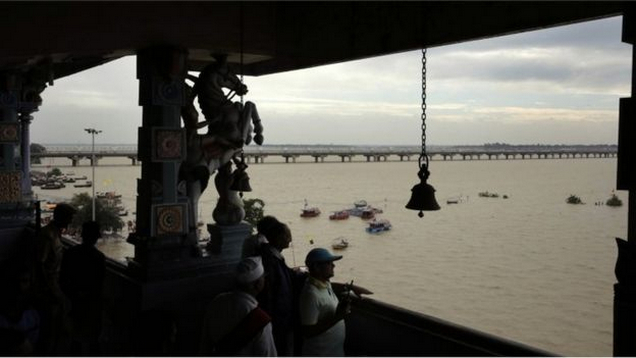
An aerial view of the flooded Ganges river in Allahabad city. AP
The monsoon floods in India's Ganges river this year have broken previous records, officials have told the BBC.
They said water levels reached unprecedented levels at four locations in northern India.
The highest record was in Patna, the state capital of Bihar where flood waters reached 50.52m (166ft) on 26 August, up from 50.27m in 1994.
Floods across India this year have killed more than 150 people and displaced thousands.

'Unprecedented'
"We have also recorded unprecedented flood levels at Hathidah and Bhagalpur of Bihar state and Balliya of Uttar Pradesh," chief of India's Central Water Commission GS Jha said.
"In all these four places, the floods crossed the previous highest flood level and they all were unprecedented."
Bihar is one of the worst flood-hit states in India with at least 150 deaths and nearly half a million people evacuated.
Neighbouring Uttar Pradesh has also been severely affected by floods in the Ganges.
The holy city of Varanasi has been submerged by the swollen Ganges. AP 
The Ganges has inundated large swathes of Uttar Pradesh state. AP
The third largest river in the world flows through these north Indian states meeting its tributaries before emptying into the Bay of Bengal.
The Indian Meteorological Department, however, has recorded deficient rainfall in these states past week and average rains since the monsoon started in June.

Breaking embankments
Some experts have blamed the silt the river carries for the floods. The Ganges is one of the highest sediment load carrying rivers.
The silt deposition is said to have raised the river's bed-level causing it to break embankments and flood the adjoining human settlements and farmlands.
Officials in Bihar have demanded that an artificial barrier in neighbouring West Bengal state bordering Bangladesh be dismantled to solve the silt problem.
They argue that the deposition of silt has obstructed several passages through the Farakka barrage.
As a result, they say, the Ganges' water flows back to Bihar and causes floods.
Silt deposition has also significantly raised the water level of Kosi river, one of the major tributaries of the Ganges.
The Ganges is flowing above the danger mark in Uttar Pradesh. AP
"The silt has so much accumulated in the river that we fear it might cause the water to damage the Kosi barrage and embankments," said Dev Narayan Yadav, a river expert pointing at the barrage built in the early 1960s.
"The silt has raised the river level higher to our villages' grounds, so you can imagine what risks we face."

Chronic problem
The BBC saw silt piling up and threatening to block many of the gates of the barrage on Kosi river, which is built and operated by India in Nepalese territory.
Some geologists say increased incidents of landslides in the Himalayan region have resulted in increased silt in the rivers flowing down to meet the Ganges.
"Since these are alluvial rivers carrying sediment loads, if we can control the silt then we will be able to manage the floods that have become chronic problems in the Ganges basin," said Mr Jha.
Bihar is one of the worst-affected states. AFP 
Floods across India have displaced thousands. AP
The Wadia Institute of Himalayan Geology in Uttarakhand state has also identified silting as the major flooding problem.
"Therefore de-silting of the rivers is the need of the hour and it needs to be done scientifically, from the middle of the rivers," said Professor Anil Kumar Gupta who heads the institute helping the government in geological issues.

Sand mining
Following uncontrolled sand mining from rivers across India for commercial purposes, India's Supreme Court in 2014 ordered a ban on extraction without a licence.
"Such sand mining was mainly done at riversides disturbing the flow of the rivers, therefore the silt will now have to be removed from the middle of the rivers."
India's central water resource authorities, however, believe construction of dams will deal with the problem effectively.
"Non-structural measures like moving people to safe areas have not been effective enough," says Mr Jha.
The silt deposition is said to have raised the river's bed-level causing it to break embankments. AP
The Ganges is the third largest river in the world. AP 
"The dams we plan to build will store flood waters to prevent flooding and they will also have the technology to take care of the silt."
He said the Central Water Commission aimed to build three major dams - two in upstream Nepal and one in Arunachal Pradesh.
"They have been planned for quite sometime and we are certain that we will be able to build them and solve the chronic problem of floods."

Links

NASA: Earth is warming at a pace 'unprecedented in 1,000 years'

The Guardian - 

Records of temperature that go back far further than 1800s suggest warming of recent decades is out of step with any period over the past millennium
The sun sets beyond visitors to Liberty Memorial as the temperature hovers around 100F in Kansas City, Missouri, last month. Photograph: Charlie Riedel/AP
The planet is warming at a pace not experienced within the past 1,000 years, at least, making it "very unlikely" that the world will stay within a crucial temperature limit agreed by nations just last year, according to NASA's top climate scientist.
This year has already seen scorching heat around the world, with the average global temperature peaking at 1.38C above levels experienced in the 19th century, perilously close to the 1.5C limit agreed in the landmark Paris climate accord. July was the warmest month since modern record keeping began in 1880, with each month since October 2015 setting a new high mark for heat.
But NASA said that records of temperature that go back far further, taken via analysis of ice cores and sediments, suggest that the warming of recent decades is out of step with any period over the past millennium.
Proxy-based temperature reconstruction. Photograph: NASA Earth Observatory
"In the last 30 years we've really moved into exceptional territory," Gavin Schmidt, director of NASA's Goddard Institute for Space Studies, said. "It's unprecedented in 1,000 years. There's no period that has the trend seen in the 20th century in terms of the inclination (of temperatures)."
"Maintaining temperatures below the 1.5C guardrail requires significant and very rapid cuts in carbon dioxide emissions or co-ordinated geo-engineering. That is very unlikely. We are not even yet making emissions cuts commensurate with keeping warming below 2C."
Schmidt repeated his previous prediction that there is a 99% chance that 2016 will be the warmest year on record, with around 20% of the heat attributed to a strong El Niño climatic event. Last year is currently the warmest year on record, itself beating a landmark set in 2014.
"It's the long-term trend we have to worry about though and there's no evidence it's going away and lots of reasons to think it's here to stay," Schmidt said. "There's no pause or hiatus in temperature increase. People who think this is over are viewing the world through rose-tinted spectacles. This is a chronic problem for society for the next 100 years."
Schmidt is the highest-profile scientist to effectively write-off the 1.5C target, which was adopted at December's UN summit after heavy lobbying from island nations that risk being inundated by rising seas if temperatures exceed this level. Recent research found that just five more years of carbon dioxide emissions at current levels will virtually wipe out any chance of restraining temperatures to a 1.5C increase and avoid runaway climate change.

Temperature reconstructions by NASA, using work from its sister agency the National Oceanic and Atmospheric Administration, found that the global temperature typically rose by between 4-7C over a period of 5,000 years as the world moved out of ice ages. The temperature rise clocked up over the past century is around 10 times faster than this previous rate of warming.
The increasing pace of warming means that the world will heat up at a rate "at least" 20 times faster than the historical average over the coming 100 years, according to NASA. The comparison of recent temperatures to the paleoclimate isn't exact, as it matches modern record-keeping to proxies taken from ancient layers of glacier ice, ocean sediments and rock.
Scientists are able to gauge greenhouse gas levels stretching back more than 800,000 years but the certainty around the composition of previous climates is stronger within the past 1,000 years. While it's still difficult to compare a single year to another prior to the 19th century, a NASA reconstruction shows that the pace of temperature increase over recent decades outstrips anything that has occurred since the year 500.
Lingering carbon dioxide already emitted from power generation, transport and agriculture is already likely to raise sea levels by around three feet by the end of the century, and potentially by 70 feet in the centuries to come. Increasing temperatures will shrink the polar ice caps, make large areas of the Middle East and North Africa unbearable to live in and accelerate what's known as Earth's "sixth mass extinction" of animal species.

Links

Lethal Heating is a citizens' initiative