31/10/2016

Australia's Climate Change Challenge To Make Clean Energy Work

The Age - Editorial

So much of what we read and hear about climate change is bad news. Recent days brought a welcome update on how far we have come as a global community in starting to address this epoch defining problem, but also a reminder of how far we have to go in Australia.
In a market analysis last week, the Paris-based International Energy Agency found across the globe there is now more renewable energy capacity installed than coal. This is an extraordinary shift, hastened by a dramatic fall in the cost of clean electricity that few predicted just a handful of years ago. Over the past five years, the price of wind energy has decreased by about a third and solar by two-thirds.
The question Australia faces is not whether to embrace clean energy, but how to make sure it works. Photo: Paul Rovere
Coal and other fossil fuels continue to be the largest source of power and the shift to emissions-free technology is still much slower than necessary, but agency executive director Fatih Birol was right to describe the change under way as nothing short of a transformation of global electricity markets. His team predicts a further 15 per cent drop in the cost of wind and 25 per cent for solar by 2021.
Despite this, the story in Australia is otherwise not as positive as elsewhere. The scale of the problem the country faces was described in detail last week by Australian Industry Group chief executive Innes Willox in a speech to the Re-powering NSW Conference. While some media coverage has focused on Mr Willox's concern about state renewable energy targets in Victoria, South Australia and Queensland that are out of step with the national goal, in truth his speech was much broader in scope.
We  hope our leaders were listening to his full message. It included taking it as a given that the climate agreement reached in Paris last year means the world has set itself the challenge of global net zero greenhouse gas emissions, and that we need to take that goal seriously. It means that we are going to have to replace most of our electricity system, and will need to do that while ensuring supply and keeping price rises down as much as possible.
Mr Willox stressed that Australians need to re-think their expectations about the cost of electricity. Australia has historically enjoyed cheap power, but prices are rising and are likely to continue to increase due to the cost of building new generation.
That cost is coming regardless of what sort of electricity plants we build to replace today's ageing infrastructure, but no business is going to build traditional coal power in Australia again given they reasonably assume at some point there will be policies in place to put the country on a trajectory to meet that zero emissions goal. They are not viable commercially.
As Mr Willox also pointed out, the projected cost of building new electricity generation appears significantly cheaper overseas compared with Australia. It is possible it has been overestimated and that cleaner energy will be cheaper than previously thought. There is already evidence that costs in Australia have been less than expected. Alternatively, it is possible projections that Australia will pay more are correct, but not inevitable. Mr Willox raised the prospect that construction costs were inflated and could be reduced, but also that finance costs were higher here than they need to be, in significant part because energy and climate policies have been so unstable.
We agree with the growing call from leaders across business, labour, welfare, science and the environmental movement that policy stability is key. The question Australia faces is not whether to embrace clean energy, but how to make sure it works across a vast but lightly populated continent. The country urgently needs enduring cross-party policies that can be scaled up to meet increasingly ambitious climate targets at lowest cost. It also needs new electricity market rules to ensure a rapidly changing system delivers reliable supply across the grid. This may not be easy, but is achievable. Overwhelmingly, politics is the major barrier. We urge the government to listen and take the lead.

Links

30/10/2016

Global Mass Extinction Of Wildlife By 2020 Warning Issued In Living Planet Index

Huffington Post - Kathryn Snowdon

The global wildlife population is expected to drop 67% by 2020.


Nature is facing a global "mass extinction" for the first time since the demise of the dinosaurs as global wildlife populations are expected to drop by more than two thirds by the end of the decade.
A landmark report of 14,152 populations of 3,706 species of mammals, birds, fish, amphibians and reptiles from around the world reveals a 58% fall between 1970 and 2012 - with no sign the average 2% drop in numbers each year will slow.
By 2020, populations of vertebrate species could have fallen by 67% over a 50-year period unless action is taken to reverse the damaging impacts of human activity, the Living Planet Index from WWF and the Zoological Society of London (ZSL) said.
African elephants, orcas, tigers, mountain gorillas, amphibians and leatherback turtles are just some of the species most under threat of extinction.
African elephants in Tanzania have seen numbers crash due to poaching, maned wolves in Brazil are threatened by grasslands being turned into farmland and European eels have declined due to disease, over-fishing and changes to their river habitats.
Species are being increasingly affected by unsustainable agriculture and fishing, as well as mining and other human activities that cause habitats to be lost or become degraded.
Wildlife is also being hit by over-exploitation, climate change and pollution, the report warned.

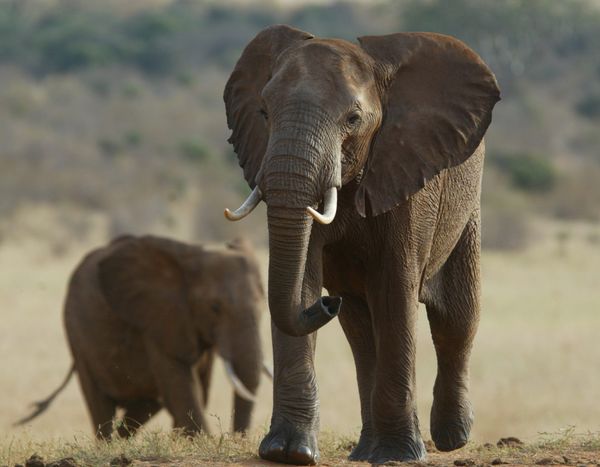
African elephant
Africa's elephant population has crashed by an estimated 111,000 in the past decade primarily due to poaching.  2016 estimates suggest there are 415,000 elephants across the 37 range states in Africa. Karel Prinsloo/AP
Maned wolf
The maned wolf, along with other large mammals including the giant anteater, is threatened by the increasing conversion of grasslands into farmland for grazing and growing crops in the Brazilian Cerrado. Auscape via Getty Images
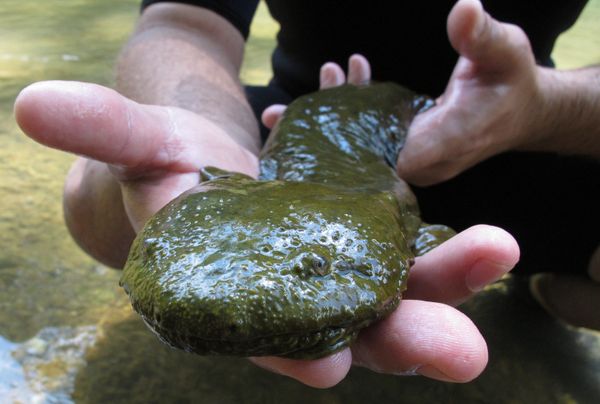
Hellbender salamander
The hellbender salamander underwent population declines of 77 per cent across five locations in Missouri between 1975 and 1995. Degradation of habitat from the effects of agriculture and the recreational use of rivers is believed to be the main cause of the decline. Rick Callahan/AP
Orca
Orca populations in European waters are under threat from persistent organic pollutants (POPs). Despite legislative restrictions on their use, these pollutants are still present in orcas' blubber at levels that exceed all known marine mammal toxicity thresholds. ASSOCIATED PRESS
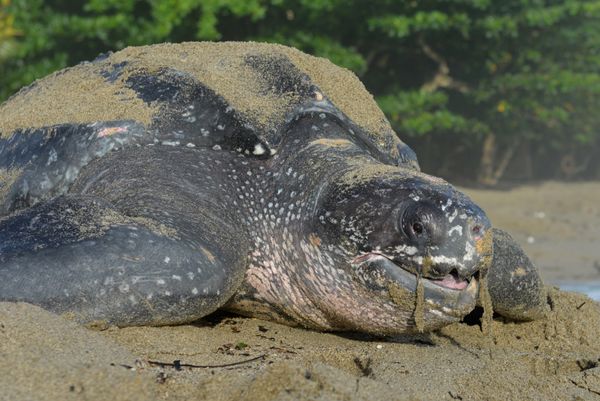
The leatherback turtle
The leatherback turtle has become increasingly rare in both the tropical Atlantic and Pacific. For example, it declined by 95 per cent between 1989 and 2002 in Las Baulas National Park in Costa Rica. This decline was caused mainly by mortality at sea due to individuals being caught as by-catch and by development around nesting beaches. Similar trends have been observed throughout the species range. David McFadden/AP
The European eel
The European eel is declining due to disease, overfishing and changes to its freshwater habitat that impede its migration to the sea to breed. Yannis Behrakis / Reuters
Himalayan griffon, White-backed vulture, long-billed vulture and slender-billed vulture
The White-backed vulture, long-billed vulture, slender-billed vulture and the Himalayan griffon (pictured) have been decimated throughout South East Asia over the past 20 years due to the widespread use of the anti-inflammatory cattle drug diclofenac. The drug causes kidney failure in birds that eat the carcasses of recently-treated cattle. AP PhotoWichai Taprieu
Yangtze river dolphin
The Yangtze river dolphin has declined largely due to incidental mortality by collisions with fishing vessels and entanglement in fishing gear An intensive survey carried out in China in 2006 failed to find any evidence that the species survives. Stephen Leatherwood/PA Archive
Gharial
India and Nepal: degradation of its habitat, accidental bycatch in fishing nets and harvesting of eggs have led to declines of this critically endangered species of crocodile. PRAKASH MATHEMA via Getty Images
Amphibians
A species of fungus that causes chytridiomycosis, a disease of amphibians, is implicated in the steep decline or extinction of more than 200 species. ASSOCIATED PRESS
Major Mitchell's cockatoo
Major Mitchell's cockatoo underwent a precipitous population crash in Australia, largely due to the illegal taking of eggs for the pet trade. The population is now slowly recovering due to better enforcement of the law, but the species remains at risk from the clearing of woodland habitat and the destruction of nesting trees. slpu9945 via Getty Images
Asian tiger
About 3,900 tigers are left in the wild facing threats of habitat destruction, climate change, and human wildlife conflict. The species is critically endangered. Ratnakorn Piyasirisorost via Getty Images
Amur leopards
As few as 70 Amur leopards are left in the wild, facing  threats of habitat destruction and human wildlife conflict. The species is critically endangered. ASSOCIATED PRESS
Giant Panda
1,864 giant pandas remain in the wild. Threats include human wildlife conflict and climate change. The species is listed as vulnerable. ASSOCIATED PRESS
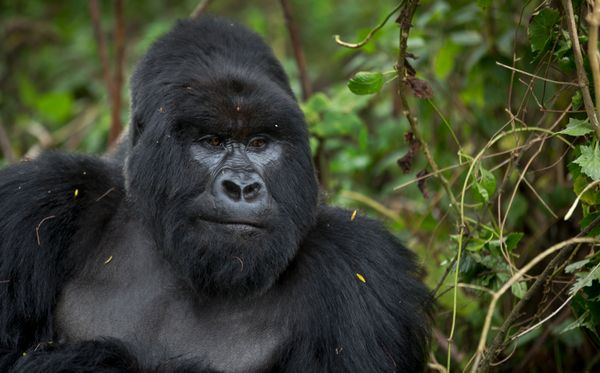
Mountain gorilla
880 of the critically endangered mountain gorilla remain in the wild facing threats of habitat destruction and human wildlife conflict.  Ben Curtis/AP
It  is not just wildlife that is being affected, with humans also the "victims" of the deteriorating state of nature, as they depend on breathable air, drinkable water and nutritious food, the report said.
While wildlife continues to decline on average, species that depend on certain habitats have seen some improvements in recent years, the report revealed.
Grassland species have increased slightly since 2004, which the report puts down to conservation efforts for some mammals in Africa, though bird populations continued to decline.
Overall terrestrial species, which are found in habitats ranging from grasslands to forests, have seen populations drop by two-fifths (38%) since 1970.
Freshwater species are faring even worse, with declines of four-fifths (81%) between 1970 and 2012.
Wetland wildlife has seen an increase since 2005, and marine species have been stable since 1988 - although the majority of stocks that contribute most to global fish catches are now either fully fished or overfished, the report warned.
Mike Barrett, director of science and policy at WWF-UK, said: "For the first time since the demise of the dinosaurs 65 million years ago, we face a global mass extinction of wildlife.
"We ignore the decline of other species at our peril – for they are the barometer that reveals our impact on the world that sustains us.
"Humanity's misuse of natural resources is threatening habitats, pushing irreplaceable species to the brink and threatening the stability of our climate."
But he added: "We know how to stop this. It requires governments, businesses and citizens to rethink how we produce, consume, measure success and value the natural environment.
"In the UK, this demands a serious plan to strengthen protection for habitats and species and new measures to fast-track low-carbon growth."
Professor Ken Norris, director of science at ZSL said: "Human behaviour continues to drive the decline of wildlife populations globally, with particular impact on freshwater habitats.
"Importantly, however, these are declines – they are not yet extinctions – and this should be a wake-up call to marshal efforts to promote the recovery of these populations."
The report highlights the success of habitat protection and strict controls on hunting in Europe to help restore populations of wildlife including bears, lynx, wolverines and wolves.

Links

Rapidly Warming Mediterranean Headed for Desertification, Study Warns

InsideClimate News - Sabrina Shankman

Even with 2 degrees of global warming, the current global goal, desertification would overtake parts of this lush and vibrant region.
People rush to the beach during heat waves in the Mediterranean region, which will get more extreme as the globe warms. Credit: Getty Images
If the Earth warms much more than it already has, the climate and ecosystems of the Mediterranean region might suddenly become unrecognizable, according to a new study.
The study, published Thursday in the journal Science, found that even if warming is constrained to 2 degrees Celsius above preindustrial times—which is the central goal of the Paris climate agreement—the Mediterranean region would see changes never experienced during recorded history.
With 2 degrees of warming, Morocco, for instance, would see increased temperatures and drought that would drive the southern deserts further north, displacing forests. Deserts would expand in the Middle East, too, pushing temperate forests higher into the mountains.
If warming continues unabated, the results would be significantly worse. The study found that all of southern Spain would become desert and most of the deciduous forests in the region would be replaced by shrubs and bushes.
These changes are already close at hand.
The Mediterranean is already warming faster than much of the rest of the world. Globally, temperatures have risen an average of .85 degrees Celsius since 1880-1920, while the Mediterranean basin has seen 1.3 degrees Celsius of warming. Historically, the Mediterranean has been characterized by mild, wet winters and warm, dry summers. The area is home to roughly 466 million people, and, in addition to its rich biodiversity, its ecosystems provide clean water, flood protection and carbon storage.
The study's authors—Joel Guiot and Wolfgang Cramer, both directors of research at France's National Center of Scientific Research—analyzed pollen locked in layers in sediment over the past 10,000 years. They then compared the ancient conditions with projections about climate and vegetation from the Intergovernmental Panel on Climate Change.
Is the looming change "close to what we have known before or is it very far?" said Guiot. "It's really to put the future in the context of the past."
Calling the study's findings "highly significant," Stephen Jackson, the director of the Department of the Interior's Southwest Climate Science Center, said the past 10,000 years are a critical comparison point. "Western civilization developed in and around the Mediterranean Basin within that period, and we risk going into new climatic territory within a very short time in the absence of emission reductions," said Jackson, who is not affiliated with the study.
The past 10,000 years have seen some periods of extended drought, according to the study. Roughly 3,000 years ago, a drought lasted several centuries, which researchers have cited as a possible factor in the fall of ancient Bronze Age societies before the rise of Classical Greece. The Science study points to two other extended periods of drought, both also associated with declines or collapses of civilizations in the region.
Those droughts were different from the region's current state, and what is projected in the future, in one significant way: They were not accompanied by extended rises in temperature.
A more recent example is the widespread crop failures in Syria in 1998 and 2010 that were attributed to extreme heat and drought. That is widely cited as a reason for that country's political upheaval and civil war.
"It's not just climate—political organization is important as well," said Guiot. "But if you amplify a problem of war with the problem of climate, the consequence can be more important."
The study is one of many these days emphasizing the importance of keeping temperatures well below 2 degrees of warming.
When the Paris Agreement was signed in December 2015, its primary goal read:
"To hold the increase in the global average temperature to below 2°C above preindustrial levels and pursue efforts to limit the temperature increase to 1.5°C."
That would mean reducing net emissions of carbon dioxide to zero some time in the mid to late century.
Guiot and Cramer found that holding warming to 1.5 degrees Celsius is the only way to keep a recognizable Mediterranean ecosystem.
"The difference is really important," said Guiot. "With 2 degrees of warming, for the Mediterranean we will have a change in the vegetation which has never been known in the past 10,000 years. 1.5 degrees corresponds to the variability of 10,000 years."

Links

Veteran UK Banker Paul Fisher On Climate Change And The Financial Sector

Saturday Paper - Mike Seccombe

A veteran of Britain’s central bank, Paul Fisher says climate change will have a massive impact on the global financial sector. He talks about managing the risks.
British economist Paul Fisher. CHRIS RATCLIFFE / BLOOMBERG
Paul Fisher recently retired as deputy head of the Bank of England’s Prudential Regulation Authority, after a long career in financial markets, financial stability and monetary policy. In September 2015 the bank released a report on the risks to the financial system of dealing with climate change.

Mike Seccombe First, tell us why you’re here.
Paul Fisher I’m here at the request of the Climate Alliance, who approached me in the UK when I was still at the Bank of England. I retired my full-time role at the bank this [northern] summer. I’d been there 26 years. One of the jobs I had in my last couple of years there was co-ordinating the bank’s work on climate change. And in those couple of years, I saw this go from being an issue that was sociopolitical, ethical, moral if you like, to being front and centre as a hard commercial issue. It’s now about what are the risks to financial sector firms that need to be taken into account. So I come at this not from the point of view of a campaigner or a politician or anything like that but as a policymaker and regulator.

MS
So what are the risks?
PF Anybody who is a long-term asset-holder potentially is exposed to climate risk. You can divide the risks two ways; there’s physical risk if the climate does change, or as it does change, and that’s fairly easy to think about – floods or whatever. But more interestingly you’ve got the transition risk, and two things are going to happen. [First] the economy will need to restructure in order to try to minimise climate change and that will present both new opportunities for new businesses to grow, and it will be a threat to some existing business models. So you’ve got that structural change. But perhaps even more importantly you’ve got the policy change. Governments have committed to reducing climate change to below 2 degrees Celsius [and] that will evolve a whole series of policies of which we don’t know the full details yet. As those policies come through you could see the repricing of financial assets. People investing in infrastructure will find that is vulnerable to policy [change] risks. We saw a big utility company in Germany, RWE [hit by a share price plunge after Germany changed its energy policy away from coal and nuclear to more renewables]. We see the coal industry in the United States, for various reasons, collapsing. Peabody, for example.

MS
It seems to me that the insurance industry, because it has a long-time horizon and takes a very actuarial approach, would be well ahead of the game on this. Is that an accurate reading?
PF In the UK that’s certainly true. The UK is one of the world’s largest insurance markets. Lloyd’s of London writes a lot of catastrophe, risk insurance, so they’ve been on this case for some time. They are experts and certainly helped the Bank of England in doing its work. The other insurers and pension funds, and savings managers generally, are also picking up on it. You are starting to see more of the bigger firms announcing investment policies to reflect climate risk. Banking, I would say, is a bit further behind, but coming along. In some countries now – China for example – if you lend to a polluting company, then you as the lender can be held to account, not just the polluter. China is one of the major forces in the world trying to get this on the agenda, which is relevant to Australia, of course, as a big exporter. Here you have big superannuation companies looking at long-term asset issues.

MS
This goes to a question of fiduciary duty then, doesn’t it?
PF Absolutely. Up to now people have said, “Oh, you can’t take account of these things.” Opinions on this are now changing in various ways. First, lawyers point out that what fiduciary duty means is a duty [of company managers and directors] to the corporate entity. That means you have a duty to future shareholders, not just existing shareholders. We’re coming to a point where people say actually it is legitimate to take account of climate risk in any sort of business strategy that is long term. Indeed, in most jurisdictions you have to take account of all material risks. Climate change is … becoming a material risk for more and more firms. If you could have taken it into account and you didn’t and the risks crystallise, you will be held to account for failing in your duties. This is the way the interpretation is going. The law is never static on this sort of thing and it will be interpreted by the courts as time goes on and more evidence mounts that if you didn’t take climate risk into account and it crystallises, you can’t expect the courts to be very sympathetic.

MS
Is there sufficient transparency around these long-term risks?
PF What we were most interested in as central bankers was financial stability. And the risk is that you get a sudden repricing of financial assets. The way you mitigate that is disclosure. If we make these firms provide more information about what their exposures and risks are, then investors start to take account of that straight away, so you are less likely to get shocks. When you do get a shock there’s more information out there to reprice accurately. You’re less likely to have … overshooting. The move is to make disclosure more comprehensive and more standardised. This is being done at the moment through the G20’s Financial Stability Board where [Bank of England governor and current FSB chairman] Mark Carney set up this taskforce on climate disclosure, which is due to report by the end of the year. It’s chaired by Michael Bloomberg and is private sector-led, and will hopefully come up with a set of recommendations. You can’t insist on global legislation, but I will be surprised if some jurisdictions don’t take this and translate it into requirements rather than [it being] voluntary.

MS
And to what extent has the Australian government been involved?
PF Well, they signed up to the Paris agreement and they are part of the G20. [When the] G20 and the FSB get together they can help put a bit of backbone into each other about what we need to do. Translating that into national actions is going to be interesting. But the Australian government is committed to the Paris agreement.

MS
However, Australia’s economy is particularly tied to the fossil fuel industry.
PF This isn’t about stopping the economy from growing. It’s about how we get the maximum sustainable growth rate. It’s about making people more fuel efficient. It’s about making sure energy prices properly reflect the costs that are imposed on society, not just whatever the market price would otherwise be. This isn’t anti-Australia or anti-Australian industry, it’s about what you have to do to get Australian business working on a sustainable basis … given what’s happening to the planet. A lot of people are working behind the scenes quietly with firms to try to get the right position.

MS
Nonetheless, we will see a lot of stranded assets here, won’t we?
PF Possibly, but the longer it’s left and the less is done, the more of those stranded assets you get. Even the Saudi Arabians are waking up to the fact that they need to do something else, to diversify their economy, otherwise they’re going to be a bit sunk.

MS
Other countries… You mentioned China and the UK…
PF I wouldn’t hold the UK as the gold standard. We are leading in the analysis, more than we are the action. Earlier this year I was part of a study group, co-chaired by the Bank of England and Bank of China, on green finance. China needs something like $600 billion a year to finance their green investment program, for quite some years ahead. They know they’ve got a huge pollution problem, and it goes beyond climate change [to] air and especially water. Green finance was the only thing the Chinese added to the G20 agenda. That shows you how seriously they are taking this. Their potential for expansion of living standards is massive, but if they don’t get a lot better on carbon emissions and [energy] intensity, it’s just not going to be reachable. You will destroy the planet.

MS
How long do you think we have to address the financial risk?
PF There is not a fixed interval. It would be much better to be ahead of the curve. The thing about risk is, you can often see the risk is there, but you just don’t know when. That’s what happened with the global financial crisis. People saw the risk, but it didn’t happen and didn’t happen and didn’t happen and when it did, the impact was much bigger. The longer we leave it without doing anything, the bigger it’s likely to be.

MS
How did a scientific and economic issue become an ideological one?
PF Once it moves to the financial sector, as it has now, ideology’s out the window. This is a financial risk if you’ve got a long-term asset portfolio. Forget the ideology, do the risk analysis, otherwise you’re not meeting your responsibilities. We need to sweep the politics to one side and say this is just a commercial business risk, like any other, that we need to take into account. It’s coming, and ignoring it or pretending it isn’t there is not going to help.

Links

29/10/2016

The Carbon Bubble: Why Investors Can No Longer Ignore Climate Risks

The Guardian - Carol J Clouse

The financial risks posed by climate change and bad investments could make an ugly dent in your retirement savings, a new report warns
Due to the ubiquity of climate risk, investors can’t simply diversify away from it; instead they must focus on managing it. Photograph: Lucas Jackson/Reuters 
When Sandy Emerson sat down in her portfolio manager’s office two years ago and announced she wanted to divest from fossil fuels, the latter furrowed her brow and said: “Why would you want to do that?” Emerson, a 68-year-old Berkeley, California resident, explained her unease about owning shares in companies that contribute to climate change and began selling her stock.
As a result, Emerson has been paying closer attention to the ups and downs in the oil industry and the growing public discussions about the future of fossil fuel use. “I’ve become aware of the financial implications it has for me,” she says.
Emerson is among a growing number of investors who see global warming not only as a looming environmental problem but also an investment risk. Some fund managers are ringing alarm bells as well. BlackRock, the world’s largest asset manager with almost $5tn in assets, issued a report last month recommending investors include climate risks in their decisions.
“Investors can no longer ignore climate change. Some may question the science behind it, but all are faced with a swelling tide of climate-related regulations and technological disruption,” the 16-page report said.
Even before BlackRock’s report, evidence was mounting that investing in companies with a low carbon footprint pays off. The MSCI Low Carbon Target Index, for example, has modestly outperformed its traditional counterpart since 2010, data from the index provider shows. Earlier this year, Morningstar issued a rating system to help investors evaluate the environmental, social and governance factors of funds.
The bottom line: the financial risks posed by climate change could make an ugly dent in your retirement savings if you don’t pay attention.
For middle-class investors, the office worker in Illinois with a company 401k or the teacher in Oklahoma with a state-sponsored pension, the risk could be particularly acute because they don’t oversee their own investments. And attitudes and expertise regarding climate risk vary widely among those charged with investing average folks’ money.
In a survey of portfolio managers and analysts done by the London-based CFA Institute last year, 73% said they consider environmental, social and governance (ESG) risk factors in their analysis – but only 40% of those regarded climate change as important. Moreover, only half of those who consider ESG risks said their firm provided training in this area, with most of that training done via miscellaneous sources such as research papers and conferences.
Efforts have begun to create industry-specific standards for companies to disclose climate change risks, most notably by the Sustainability Accounting Standards Board (SASB), a nonprofit group chaired by former New York Mayor Michael Bloomberg. The board estimates that significant climate risks – things like how severe weather events can impact businesses, regulations imposing a cost on carbon and economic development that is less reliant on fossil fuels – exist for most of the companies it tracks, which represent $27.5tn, or 93%, of US stocks as measured by market value.
“Due to the ubiquity of climate risk, investors can’t simply diversify away from it; instead they must focus on managing it – and on encouraging portfolio companies to manage it – in all its forms,” the SASB writes.
The future of fossil fuel companies is at risk as more investors move their money elsewhere. By some estimates, the industry could face a “carbon bubble” that will leave it stuck with trillions of dollars in stranded assets – unburnable oil, coal and gas reserves – as nations move to limit the planet’s warming trend to 2C, the target of the Paris climate agreement, which takes effect 4 November.
But climate risk doesn’t only affect the big oil. Industries ranging from automobiles to agriculture to steel to utilities could also face climate-related challenges such as sea level rise and drought, tightening emissions standards, changing consumer preferences and the growing divestment movement, the BlackRock report notes.
New technology that emerges as a response to climate change could also force changes within industries with a heavy carbon footprint, the report says. For example, advancements and falling prices in lithium batteries are poised to impact both the oil and gas and automotive industries because they are making electric vehicles and battery storage for solar or wind energy more practical and affordable. Earlier this year, Bloomberg New Energy Finance reported that battery prices have declined by 65% since 2010, with 35% of that in 2015. The market research firm projects another 35% decline for 2016, a spokeswoman says.
“You can lose a lot of money by having exposure to losing strategies, losses that could be hard to make up,” says Ewen Watt, senior director of the BlackRock Investment Institute. “If you’re saving money for your long term future, the risk for you is there won’t be enough money when you retire to meet your retirement needs.”
While the financial industry is recognizing climate risks, its actions sometimes don’t reflect that. Banks have continued to fund the dirtiest fossil fuel projects and big fund managers have voted against shareholder proposals forcing companies to disclose their climate risks.
BlackRock, along with peers Invesco, BNY Mellon and Vanguard, voted against such shareholder proposals at Exxon Mobile and Chevron earlier this year. BlackRock argues that global warming has yet to harm these oil companies, so it prefers to continue putting money in them and pushing for change from within rather than getting involved in a confrontation. Sandy Emerson’s wealth management firm also advocated this strategy.
The federal government has taken conflicting approaches to hold oil companies accountable for disclosing climate risks. Earlier this summer, the House of Representatives passed legislation that would block the Securities and Exchange Commission from implementing climate disclosure guidance. Proposed by Representative Bill Posey, a Republican from Florida, the measure now awaits a vote by the Senate.
Regular folks might end up being the biggest losers in this fight among regulators, fund managers and fossil fuel companies over their roles in addressing global warming. Consumers who depend on investment professionals to protect their retirement savings may not entrust their hard-earned money with the right people.
“If what you read about stranded assets is true, it’s a potentially serious problem for regular, middle-class people who aren’t necessarily paying attention,” says Cari Rudd, a Washington DC-based communications consultant, who does social media work for Divest-Invest and sits on the board of As You Sow, an Oakland, California-based nonprofit that promotes environmental and social corporate responsibility through shareholder advocacy.
“Now that I have become involved, I’m much more concerned about Joe in Cleveland who has a little 401k and how he’s already been screwed on a lot of fronts,” Rudd says.
The emergence of divestment advocacy groups is providing more information to help individuals navigate what can be a daunting process of moving their investments to, say, environmentally friendly technology such as renewable energy. Some investment companies offer fossil-free mutual funds.
For example, As You Sow’s Fossil Free Funds, which uses data from Morningstar, is a free online tool that allows investors to type in the name or ticker of a fund and see what percentage is invested in fossil fuels. Earlier this month, the organization expanded Fossil Free Funds to include a feature that shows each fund’s carbon footprint and which companies are the main contributors. For 401k participants who don’t have direct control of selecting the funds offered in their retirement plan, As You Sow also provides advice on how to speak to their employers about expanding their company’s plan to include low-carbon options.
Looking ahead, Sandy Emerson says she’s been impressed with the handful of largely European oil producers developing small renewable energy divisions.
“I’m watching the oil companies that are starting to make moves in renewables and I’m thinking that they’re pretty smart,” she says.

Links

We Don't Have To Choose Between Jobs And Clean Energy

Huffington Post - Kelly O’Shanassy | Ged Kearney

"Australia can create a million extra jobs by 2040 by pursuing credible, enduring policies on climate change." Getty Images
With the imminent closure of Hazelwood in the Latrobe Valley and the shutdown of the Port Augusta power station in South Australia earlier this year -- both citing old, heavily polluting infrastructure and outdated technology -- it is becoming clear many of Australia's fired power stations will be replaced with renewable alternatives in the coming decades.
This will need to occur with the least disruption to workers' lives and to the communities in which they live. However, it's not only about the lifespan of the facilities.
Serious investment in clean energy, public transport, energy efficiency and battery storage is urgently needed to ensure a transition that cuts pollution and provides meaningful jobs for Australian workers. The earlier a planned transition starts, the less disruption communities and workers will be subject to.
The Australian Conservation Foundation and the Australian Council of Trade Unions have joined forces to produce Jobs in a clean energy future -- because it is important to remember Australians should not have to choose between jobs and cutting pollution.
This report shows the idea that Australia has to pick between jobs and cutting pollution is a false and destructive choice. We can make positive economic decisions that support life and community in Australia. The evidence is clear that action on climate change can be directed in a way that is beneficial for the Australian economy. We can grow the economy and make Australia a cleaner and healthier place to live.
The report finds Australia can create a million extra jobs by 2040 by pursuing credible, enduring policies on climate change and energy. This can happen through direct government investment and encouraging private investment in clean energy and battery storage, energy efficiency, public transport, electric vehicle and other mechanisms.
The technology and investment is leaping ahead. Since 2010 -- the last time ACTU and ACF collaborated on a research report -- the cost of clean energy technology has dramatically fallen. For example, the cost of solar cells has dropped by 75 percent. Hundreds of billions in private investment is being mobilised in the global transition.
The Australian government made a commitment in Paris with 174 other countries. The Paris commitment means the way Australia produces and uses energy is going to have to change. This transition will require government and private investment.
The Federal Government has an important role to play by directly investing and creating policies that encourage private investment in infrastructure. This is vital in order to meet the commitments Australia and many other countries signed onto in Paris in December – and that come into effect next week when the Paris climate Agreement takes effect.
A 'just transition' will see communities and workers in areas such as Victoria's Latrobe Valley empowered well ahead of time to determine the future direction for their communities before coal fired power stations begin closing.
This needs the support of all levels of government to help workers retrain and build up existing industries and attract new industries.
The alternative is what we have currently: Australia failing to reduce its emissions while coal fired power stations close on short notice with workers and communities left in the lurch and unsure about what their future holds.
Just look at what happened in South Australia earlier this year when 400 people lost their jobs when the Northern Power Station closed after less than a year's notice. Currently residents of Victoria's Latrobe Valley are in a tense state of waiting to hear news from Europe confirming the closure of the Hazelwood Power Station.
Unions and environmentalists are not alone in calling for a planned transition. Energy companies, policy analysts, economists and industry groups are all also calling for better planning. Our report maps out a better future for Australia -- one with a cleaner environment and more jobs.
With government leadership through policy, investment and planning, Australia's cities, towns and regions can be more liveable, smarter and healthier places to live.

Links

Million New Jobs In Prospect By 2040 Even As Emissions Dive, Study Finds

Fairfax - Peter Hannam

Cutting carbon emissions in line with the Paris climate goals could generate more than 1 million extra jobs by 2040 as Australia transforms its energy and other sectors provided policy settings are right, a new study has found.
The Jobs in a Clean Energy Future report, using modelling by the National Institute of Economic and Industry Research, found the policies needed to reduce 2005 levels of carbon pollution by 80 per cent by 2040 would generate far more jobs than were lost.
The study, funded by the Australian Conservation Foundation and the Australian Council of Trade Unions, estimated the cost across the economy would be $20 billion annually for 20 years. That sum, though, included investments that would have to be spent anyway to replace aging coal-fired power plants.
The "strong action" path would see the current renewable energy target of supplying 33 terawatt-hours (TWh) of clean power by 2020 raised to 120 TWh by 2040. A carbon price rising to the equivalent to $US44 ($58) per tonne by 2040 is also assumed.The result would still see net employment rise by 442,400 jobs by 2030 and 1.057 millon a decade later.
Leading growth areas include the electricity, gas and water sector — adding 171,900 jobs by 2040 — and construction 190,000 jobs. (See chart below.)

The "medium action" scenario would involve a carbon dioxide abatement budget of $10 billion a year funded by "a modest carbon price". Emissions by 2040 would be 63 per cent below 2005 levels under this plan.
Victoria's Hazelwood power station may close by next year - but what will fill the gap? Photo: Jason South
Driving the jobs growth would be the massive outlay required to replace combustion-engine vehicles with electric ones, and all the infrastructure such as charging stations required to power them, the report said.
ACF chief executive Kelly O'Shanassy, said falling technology costs particularly for batteries would spur the change, as would Australia's international commitment to curb emissions and keep global warming to between 1.5-2 degrees above pre-industrial levels agreed last December in Paris.
Renewable energy's share of the power sector is expected to continue to rise. Photo: Bloomberg
"This transition's underway, there's no way we can stop it," Ms O'Shanassy said.
"By signing the Paris agreement, we actually have to get pollution out of our economy by mid-century, or earlier, and as this report is showing, that will create jobs."
The expected surge in electric cars will create new jobs. Photo: Tore Meek, via AP
The International Energy Agency on Tuesday underscored the momentum of renewables, predicting solar PV costs would drop by a quarter between 2015 and 2021, and those for onshore wind energy 15 per cent.
The IEA also lifted its clean energy growth forecast for the period by 13 per cent, noting that the world in 2015 added solar panels at the rate of half a million per day. China alone built a new wind turbine every half hour.

Blackout lesson
The recent blackout in South Australia, in which both wind farms and gas-fired power plants failed to respond as expected to transmission faults, showed the potential risks if governments don't take the lead.
'It's either a future that can be quite positive and prosperous, if we plan for it," Ms O'Shanassy said. "Or a future that's very chaotic, if we let it plan us."
As Fairfax Media reported last month, Victoria's Hazelwood brown coal-fired power station could close by early next year, triggering large local job losses and higher electricity prices in the short term at least.
Prime Minister Malcolm Turnbull has cautioned states such as Victoria setting ambitious renewable energy targets before 2020 when the current targets ends.
On Tuesday, he also backed coal's future, telling ABC radio in Brisbane: "[C]oal is going to be an important part of our energy mix, there's no question about that for many, many, many decades to come, on any view."
Louisa de Vries, whose electric bus project was featured in the ACF/ACTU future jobs report, said clean energy jobs offered opportunities to industries such as car making that were facing demise in Australia.
The project, based at Swinburne University of Technology, is helping Gold Coast-based Bustech start building fully electric buses by the middle of next year.
"It's important for our auto parts suppliers — a number of which are hanging in there," said Ms de Vries, a research engineer who worked for 18 years in the auto industry, including Holden. "If they can diversify, they can have a long-term future in Australia."
Ms de Vries said nations such as Norway were offering aid to speed the take-up of electric vehicles, and Australia provided little if any support.

Links

Lethal Heating is a citizens' initiative