07/01/2017

New Study Confirms NOAA Finding Of Faster Global Warming

The Guardian

Thomas Karl and colleagues were harassed by Republicans for publishing inconvenient science. A new study proves them right.
House Science Committee Chairman Lamar Smith, R-Texas. Photograph: Scott J. Ferrell/Congressional Quarterly/Getty Image
A new study has shown that a 2015 NOAA paper finding that the Earth is warming more rapidly than previously thought was correct.

Lead author Zeke Hausfather explains the paper.

Once again, science is shown to work. The laborious process in which scientists check and recheck their work and subject their ideas to peer review has led to another success. An independent test of global warming data has confirmed a groundbreaking 2015 study that showed warming was faster than prior estimates.
Because of its inconvenient findings, the study’s lead author Thomas Karl was subjected to harassment by Lamar Smith (R-TX), chair of the House Science Committee, in an effort to impugn his credibility. But now Karl and his co-authors have been vindicated.
Let’s take a step back and discuss the science. Measuring the temperature of the Earth is hard. There are many locations to measure and many choices to make. Should we measure the temperature of the ground? Of the ocean waters? How deep in the water? If we measure air temperatures, what height should the measurements be taken? How many locations should we make measurements at? What happens if the instruments change over time or if the location changes? What happens if a city grows near a measurement location and the so-called urban heat-island effect grows? How do we estimate the temperatures in areas where no measurements exist?
These and many other questions make measuring global warming challenge. Different groups of scientists make different decisions so that depending on the institution, they will get a slightly different temperature result.
But this diversity is also a good thing. It turns out that it doesn’t matter whose results you use – NASA, NOAA, The Hadley Centre in the UK, the Japanese Meteorological Agency, or the Berkeley Earth group – they all report a warming world. However, the rates are slightly different. So, one persistent question is, which group is most accurate? Whose methods are best?
The new study looks into just this question. The group focused on perhaps the biggest differences among the groups – how they handle ocean temperatures. Specifically, global temperature values typically use a combination of near-surface air temperatures in land regions and sea surface temperatures in ocean regions. Since oceans cover approximately 70% of our planet, the way ocean temperatures are dealt with can separate the warming rates between these groups.
Ocean temperatures can be measured by ship-based temperature sensors, by special floating measuring instruments, or by satellites. Prior to the advent of satellites and floating sensors, ships were the main temperature sensing platforms. Ship sensors, which measure engine intake water, are known to be slightly warmer than the actual water. So using them introduces a warm bias in the measurements.
Also, as ships have gotten larger, the depth of the engine intakes have increased – meaning the tested water was further from the actual ocean surface. Since the temperature results from buoys differs from ship measurements, the various scientific groups have tended to try to perform corrections between the different sensors. The way the correction is done affects the reported warming rate.
The authors recognized that one of the biggest questions is how to stitch together different temperature results from different sensors. Therefore, they broke the temperature data up into groups according to the measurement device (buoys, satellites, ARGO floats, ships, etc.) and they evaluated warming rates separately for each group. The authors also used advanced statistics to handle areas where no data were recorded.
After applying their tests, the authors found that the results promoted by Karl at NOAA are the best, and other groups, in particular the Hadley Centre in the UK and the Japanese agency, are too cold.
So what does this all mean? A few things. First, this study is a nice reminder that the proper way for science to work is for publications to be scrutinized and checked by others. This process leads the entire scientific community to a deeper understanding of the science.
Second, this validates the scientists who were originally attacked by political non-scientists and in some cases by contrarian scientists. For instance, Judith Curry, a well-known critic of mainstream climate science was quoted as saying:
The new NOAA dataset disagrees with a UK dataset, which is generally regarded as the gold standard for global sea surface temperature datasets … The new dataset also disagrees with ARGO buoys and satellite analyses ... Color me unconvinced.
I actually study ocean temperatures so I knew this statement by Judith Curry was complete nonsense. It is nice to see a team actually take the time to prove it. Perhaps she and others will finally admit they were wrong.
This paper is another reminder why it is so important to invest in the temperature measurements that are needed to create long-term climate records. We really need uninterrupted measurements that span many years/decades if we want to truly understand the Earth’s changing climate. Even though the costs of making these measurements are very small compared to what we spend on other less important activities, I am concerned that the new US administration will decide to pull the plug on these projects. If that happens, we will be flying blind.
Finally, and for those who read my posts regularly, I am sounding like a broken record. Global warming is happening, it never stopped, it never paused, and the models have gotten it right.
It reminds me of a debate between creationists and scientists. One scientist whose name I cannot remember stated, “we have the fossil record, we win.” Well, a similar quote works here. “We have the data, we win.” Now let’s move on to solving the problem.

Links

06/01/2017

Battle Lines Drawn Over Indian Mega Mine

Inter Press Service News Agency - Stephen de Tarczynski

Murrawah Johnson, 21, of the Wangan and Jagalingou Family Council, is among those standing in the way of the huge Carmichael coal mine project in Australia's Queensland state. Photo courtesy of Murrawah Johnson.
Among those leading the fight against the massive Indian-owned Carmichael coal project in Australia’s Queensland state is 21-year-old Murrawah Johnson of the Wangan and Jagalingou aboriginal people, the traditional owners of the land where the proposed mine is to be located.
“Our people are the unique people from that country,” says Murrawah, whose name means ‘rainbow’ in the indigenous Gubbi Gubbi language. “That is who we are in our identity, in our culture, in our song and in our dance,” she adds.
The mine’s estimated average annual carbon emissions of 79 million tonnes are three times those of New Delhi, six times those of Amsterdam and double Tokyo’s average annual emissions.
The Wangan and Jagalingou, numbering up to 500 people, regard the Carmichael coal mine as a threat to their very existence and have repeatedly rejected the advances of Adani Mining, the company behind the project. The traditional owners argue the mine would destroy their land, which “means that our story is then destroyed. And we as a people and our identity, as well,” Murrawah, a spokesperson for her people’s Family Council, told IPS.
Adani Mining is a subsidiary of the Adani Group, an Indian multinational with operations in India, Indonesia and Australia cutting across resources, logistics, energy, agribusiness and real estate. In March, the company announced its first foray into the defence industry.
Adani’s Carmichael project envisions a 40km long, 10km wide mine consisting of six open-cut pits and five underground operating for up to sixty years. The company intends to transport the coal to India to aid in that country’s electricity needs. According to the International Energy Agency, 244 million Indians – 19 percent of the population – are without access to electricity.
Should the project go ahead, it would be the largest coal operation here – Australia is already a major coal producing and exporting nation – and among the biggest in the world, producing some 60 million tonnes of thermal coal annually at peak capacity.
But at a time when global warming is a significant threat to humanity, the Carmichael mine is generating substantial opposition. Since the project was announced in 2010, there have been more than ten appeals and judicial processes against the mine.
Shani Tager, a campaigner at Greenpeace Australia Pacific, is adamant that the coal that Adani wants to dig up must remain in the ground. “It’s a massive amount of coal that they’re talking about exporting, which will be burnt and used and make the problem of global warming even worse,” she says.
Coal-fired power plants emit large amounts of carbon dioxide, a gas that traps heat within the Earth’s atmosphere and which plays an important role in the phenomenon of human-induced climate change.
According to a 2015 report by The Australia Institute, a local think tank, Adani’s project would release more carbon into the atmosphere than many major cities and even countries.
The report states that the mine’s estimated average annual carbon emissions of 79 million tonnes are three times those of New Delhi, six times those of Amsterdam and double Tokyo’s average annual emissions. It would surpass Sri Lanka’s annual emissions and be similar to both Austria’s and Malaysia’s.
Despite these alarming figures, both the Australian and Queensland state governments are backing Adani’s Carmichael mine. There has been widespread speculation here that the federal government will provide support via a AUD one- billion loan (722 million U.S. dollars).
The Queensland government, anticipating a boost to jobs, the regional economy and to its own coffers as a result of royalties, announced in October that it was giving the project “critical infrastructure” status in order to fast-track its approvals.
“This Government is serious about having the Adani mine in operation. We want this to happen,” Anthony Lynham, state minister for mines, told local media at the time.
In early December, Adani received what the state government describes as the project’s “final major” approval: Adani’s rail line to the port of Abbot Point, from where the coal will be shipped to India.
In 2011, Adani signed a 99-year lease on the Abbot Point coal terminal, which sits immediately adjacent to the Great Barrier Reef Marine Park. Australia’s iconic reef is the world’s largest coral reef ecosystem and among the most diverse and richest natural ecosystems on Earth.
In November, scientists from Queensland’s James Cook University confirmed the worst-ever die-off of corals in the reef, following a mass coral bleaching event earlier in the year. Heat stress due to high sea temperatures is the main cause of coral bleaching, with bleaching events expected to be more frequent and severe as the world’s climate warms up.
Adani plans to significantly expand the Abbot Point terminal in order to ship larger amounts of coal. This means dredging up the sea floor right next to the Great Barrier Reef.
“The Carmichael coal mine will have a domino effect of bad impacts on the reef, from driving the need for port expansion and more dredging and dumping to increasing the risk of shipping accidents on the reef,” says Cherry Muddle from the Australian Marine Conservation Society.
The reef’s tourism industry provides some 65,000 jobs, with numerous operators also speaking out against both the Carmichael mine and the Abbot Point expansion in recent times.
Despite Minister Lynham’s assurances that “200 stringent conditions placed on this project through its court processes” will protect the reef, others remain extremely concerned.
“Adani has a really worrying track record of environmental destruction, human rights abuses, corruption and tax evasion,” says Adam Black from GetUp, a movement which campaigns on a range of progressive issues.
Among the accusations leveled at Adani operations in India in a 2015 report by Environmental Justice Australia are the destruction of mangroves; failure to prevent salt water intrusion into groundwater; bribery and illegal iron ore exports; using political connections to purchase land cheaply; and obtaining illegal tax deductions.
Adani’s CEO in Australia, Jeyakumar Janakaraj, was in charge of a Zambian copper mine owned by Konkola Copper Mines (KCM) when, in 2010, the mine discharged dangerous contaminants into the Kafue River. Found guilty, the company was fined around AUD 4,000 (2,900 U.S. dollars).
Some 1800 Zambians have since taken KCM and its UK-based parent company, Vedanta Resources, to the High Court in London, alleging they were made sick and their farmland destroyed over a ten-year period from 2004. Janakaraj was with KCM from 2008 to 2013.
Now, with Adani hoping to break ground on its Carmichael coal project in mid-2017, opponents are prepared to continue their hitherto successful campaign of dissuading potential financiers from backing the AUD 16-22 billion project (11.5-15.8 billion U.S.).
“If they can’t get the money, they can’t build the mine,” says Murrawah Johnson.
The Wangan and Jagalingou recently set up what they call a “legal line of defence” against Adani and the Queensland government, consisting of four more legal challenges, with plans to take the matter to the High Court if needs be.
They have also been in contact with the United Nations for some time.
For Murrawah, this battle is about maintaining connection with both the past and the future. “I refuse to be the broken link in that chain,” she says.

Links

Coalition Backs $100bn Growth Plan For Coal Industry

The Australian - David Crowe

Minister for Northern Australia Matt Canavan.
The federal government is backing a $100 billion investment target to expand the Australian coal industry as it blasts the "hypocrisy" of environmentalists who want to halt new mines, escalating a fight over attempts to mandate more solar and wind power.
Aiming to open up vast new deposits for export, the government is mobilising against warnings about the "end of coal" as it considers a $1bn loan for the Adani mine in central Queensland on the condition the cash will help further projects.
Resources Minister Matt Canavan told The Australian it would be hypocritical to stop coal production or exports on the grounds that developing nations should not use fossil fuels to drive their economic growth.
"We can't deny people the same benefits that we accrue from permanent and reliable electricity — that would be immoral," Senator Canavan said.
"For the foreseeable future, coal will remain one of the core parts of the energy supply mix to provide people with electricity."
Senator Canavan dismissed claims from Greenpeace and the Greens that demand for coal would shrink over the decades ahead, pointing instead to growing demand from Asia to justify opening up new mines in the Galilee Basin in central Queensland.
In a test of strength over coal exports, environmental campaigners have fired a volley of legal challenges at Adani's $16.5bn project in the hope of blocking all new mines, but the government is urging support for the Indian company and its ­customers.
Senator Canavan said Australians who used fossil fuels to fly around the world or used coal power to light their homes were in no position to deny the same power to Indian consumers who wanted cheap power.
"In the broader global context, it's also mean-spirited because this is life and death for people in other parts of the world," he said.
"They still use a lot less coal than we do.
"We can't deny them the same resource we use to lead our relatively rich and prosperous lives.
"Given that the developing part of the population is about 80 per cent of the world and will grow as a share of the world over the next 20 or 30 years, coal use will increase."


Despite fierce campaigns against coal projects in Australia, the latest world outlook from the International Energy Agency tips annual Australian coal production to rise from 408 million tonnes two years ago to 467 million tonnes in 2040.
Overseas coverage of the IEA report has emphasised the slowing demand for coal in Europe, the Americas and China over several decades, but it shows an ­expansion for Australia even when assuming a global agreement on climate change.
The IEA forecasts a $104bn investment in coal supply in Australia over the period to 2040 because of demand from Asian customers.
Senator Canavan said the forecasts countered claims about the end of coal.
"In the Asia-Pacific … ­coal ­demand has increased substantially this century and all of the major economies of the region are planning for coal to be a major part of their future development," he said.
Even so, the IEA warns that Australian government plans to tap new deposits in the Surat and Galilee basins will depend on demand from India — the same point made by critics of the Adani project, who believe it will not be commercially viable.
"A tapering of India's imports would make the economics of remote (Australian) projects that require infrastructure development increasingly questionable," the IEA said in its global review.
While the IEA says 500 million people will remain without electricity at all by 2040, the Overseas Development Institute warns against using coal to provide cheap power to the developing world on the grounds that air pollution from coal causes 770,000 premature deaths a year in China and India. It also says solar power is cheaper for local communities that lack connections to transmission grids.
Bloomberg New Energy ­Finance reported this week that solar power prices had fallen 62 per cent since 2009 and put it on track to become cheaper than coal-fired power in some parts of the world.
The cost of solar power would fall below coal by 2030, it said.
Adani is seeking a concessional loan worth $1bn from the Northern Australia Infrastructure Facility to help fund a rail line from the Carmichael mine to a coal-loading terminal at Abbot Point, near Bowen.
Senator Canavan said no ­decision had been made on the request but the "only reason" the funding could be justified was to open up more mines after Adani's project.
"There are three other mining companies with multiple tenements in the Galilee Basin that are not at the same developed stages — some of them are more ­advanced than others," he said.
"The rationale for the ­government being partners in building the coal line is that it opens up the first new coal basin in Australia for 40 years, that it can then help spur development of these other projects."

Links

2016 Was The Hottest Year Ever On Australia’s East Coast, Confirms Bureau Of Meteorology

NEWS.com.au - Benedict Brook

A RECORD breaking year of scorching heat and driving rain on Australia's east coast meant that climate-wise, many of us have "shifted a few hundred kilometres north," a weather expert has said. Australia's average national mean temperature rose 0.87C above average to make 2016 the fourth-warmest year on record, according the Bureau of Meteorology's Annual Climate Statement, released on Thursday.
But the residents of Sydney, Brisbane, Darwin and Hobart sweltered through their hottest year ever.
Bureau of Meteorology: Annual Climate Statement 2016

The report comes as a heatwave punishing south eastern Australia shows no sign of ending.
Melbourne and Sydney will have highs in the mid-thirties in the coming days but it's South Australians really in the firing line with a string of 39C days heading into the weekend.
Blair Trewin, a senior climatologist at the weather bureau, told news.com.au the El Niño weather system and climate change combined to send the mercury soaring.
"Australia's climate in 2016 was certainly consistent with long term trends over the last century which has seen Australia warm to the same degree as the rest of the world and all the indications are these warming trends will continue into the future."
Australia's east coast saw its highest temperatures ever in 2016. Source: Supplied
The only years in Australia that were warmer than the past 12 months were 2013 followed by 2005 and then 2014. The past four years have all been in the top six hottest years in Australia.
Globally, 2016 is likely to be confirmed as the world's hottest year ever.
"It was a year of two halves with a relatively dry first four months and then from May onwards it became very wet with late autumn to early spring the wettest such period on record," said Mr Trewin.
"The contrast was especially clear in Tasmania with drought conditions earlier in year and then they had so much rain is was the sixth wettest year on record."
The higher than normal temperatures and increased rain along much of the east coast led to weather conditions more usual for cities much further north.
Sydney verged on the tropical with highs in the city more like coastal towns on the NSW mid-north coast, such as Nelson Bay and Forster.
Burgess Beach in Forster. Picture: Todd French Source: News Corp Australia
Climate wise, Brisbane was effectively pushed even further into the tropics experiencing rain and heat more standard for towns like Gympie and Maryborough beyond the Sunshine Coast.
"Along the east coast it was about a degree above normal and while that doesn't equate to the whole difference between Sydney and Brisbane, that level of warming is equivalent to shifting a few hundred kilometres north," said Mr Trewin.
Some of the notable climatic events in Australia last year were bushfires in Victoria, Tasmania and Western Australia and a nationwide heatwave from late February to mid-March. That added up to the warmest Australian autumn on record.
Then in May, drought-breaking rains led to flooding in multiple states and the wettest ever late autumn to early spring period.
For the country as a whole, annual rainfall was 17 per cent above average.
Sea surface temperatures around Australia were the warmest on record in 2016, and were 0.77°C above average.
The warmest year on record for the east coast contrasted with South Australia which pretty much hit the average in terms of temperature.
Inland parts of south west Western Australia was one of the few places globally to come in cooler than usual.
Some of 2016's main climactic events in Australia. Source: Supplied
Across the globe, climate change has seen temperatures continue to rise over the long term.
However, this is exacerbated in El Niño years such as 2016. The El Nino weather system is caused by warmer sea temperatures in the Pacific sucking warm air over North America while leaving Australia hot and dry.
The opposing La Nina system usually brings wetter conditions across the continent.
"El Niño years tend to be warmer and La Nina tend to be cooler so if you look at handful of years in last 30 that have come in below average they are La Nina years."
Looking ahead, Mr Trewin said the lack of El Niño would mean 2017 would probably be a cooler year overall than 2016. But it certainly won't be cold.
La Nina never really got started depriving the east coast of the wet weather it brings.
"Our outlook for the early part of this year is relatively dry conditions in Eastern Australia, particularly NSW and southern Queensland, but conversely relatively wet conditions in much of Western Australia.
"It's unlikely 2017 will be as warm as 2016 globally but it's likely to be warmer than all years prior to 2015."
Sea surface temperatures around Australia were the warmest on record in 2016, and were 0.77°C above average. Source: Supplied
The major weather events of 2016
  • Very large fires in northwest Tasmania during January and February followed an extended dry period; about 123,800 ha burnt, mostly in remote areas
  • There was significant flooding in Tasmania in January
  • Significant fires at the start of the year near Wye River on the Great Ocean Road in Victoria, and in southwest Western Australia affecting Yarloop and Waroona
  • An East Coast Low caused major coastal flooding and erosion in New South Wales in early June, with flooding also affecting Victoria and large areas of Tasmania
  • Flooding occurred from June to September in western, central and southern Queensland following the State's second-wettest winter on record
  • Periods of flooding in inland New South Wales and northern and western Victoria during September and October
  • Supercell thunderstorms caused extensive damage across southeast Australia and parts of southeast Queensland during early November, with widespread reports of golf-ball sized hail
  • Severe thunderstorms and a tornado outbreak caused widespread damage in South Australia during late September
  • On 21 November, lightning storms associated with a strong and gusty change ignited grassfires across northern Victoria, caused damage across parts of Victoria, and along with a high pollen count, triggered thousands of incidents of thunderstorm asthma.
  • A tropical low at the end of the year brought exceptional December rainfall to a number of regions between the northwest of Australia and the southeast, with some flooding and flash flooding resulting in the Kimberley, around Uluru in Central Australia, and around Adelaide, Melbourne and Hobart.
Links

05/01/2017

Our Cars Are Choking Us

Sydney Morning Herald - Editorial

Motorists sitting in the lines of traffic as they return from holidays or just try to get back to work this week will probably be irritated to learn about the federal government's draft plan to improve the quality of fuel and the efficiency of vehicles on Australia's roads. The reason: the cost of motoring may rise.
Certainly the motoring lobby would like them to get angry. Its representatives have reacted predictably to the draft proposals. As we have reported, the Australian Automobile Association, the peak body for state-based organisations such as the NRMA and RACV, is already making warning noises about costs. The motoring lobby's confidence it can block any change has some justification. On the environment, this government is an easy mark. When denialist critics savaged Canberra's plan to review (not even to alter) Australia's current inadequate response to climate change, the idea was quickly dumped.
The draft proposals cover three things: higher fuel-efficiency standards for vehicles, higher air-pollution standards, and better-quality fuel. Photo: Glenn Hunt 
That review had been announced less than 48 hours earlier by Environment Minister Josh Frydenberg who, along with the Urban Infrastructure Minister, Paul Fletcher, announced the present draft proposals. Perhaps the latter is there to give the former some backbone this time. Let us hope he succeeds, because this is a worthwhile project.
The proposals, for which the government is seeking reaction from industry and the public, cover three things: higher fuel-efficiency standards for vehicles, higher air-pollution standards, and better-quality fuel. Although they have been described as "new" standards, in fact none are new. They already apply in Europe, the United States and elsewhere – major sources of new vehicles on our roads now that the government is allowing the local motor industry to die.
Why, many will ask, should Australians accept cars, trucks and buses that are dirtier and operate to lower standards than those sold where they are made?
The same Australian Automobile Association has done both motorists and environmentalists a service by setting up real-world tests of fuel efficiency and emissions from motor vehicles. Preliminary results show cars emit noxious gases at up to four times the rate current regulations allow, and greenhouse gases 35 per cent higher, while using 35 per cent more fuel than is measured by government-mandated tests carried out in laboratories. The present testing regime, in other words, leaves a lot to be desired. It appears Volkswagen may not be the only car maker building cars deliberately to pass the test in the laboratory, but not on the road. However, even if current laboratory-based measures of vehicle performance are flawed, that is no argument against stricter standards. Clearly, if even existing standards are not being met, future standards will have to be all the stricter to bring emissions down, and to boost fuel efficiency.
Transport is a significant source of greenhouse gas emissions, which Australia is bound to reduce under its commitments to the Paris climate change agreement that it signed and ratified last year. The latest available figures from Australia's Department of the Environment show that in 2014 the services, construction and transport sector generated 11.5 per cent of Australia's 525 million tonnes of carbon dioxide-equivalent gases. If Australia can reduce this output by improving the efficiency of its vehicles and raising the standard of the fuel it uses, it obviously must do so.
Other critics of the proposals have also emerged – on the other side of the argument.
For health experts, the proposed changes do not go nearly far enough. Air pollution is a major cause of deaths from respiratory diseases, and about half of these are attributable to the effects of vehicle exhaust. A federal government study estimated that in 2015, 2266 deaths in Sydney and Melbourne could be attributed to air pollution. That combined total is projected to rise to 2500 by 2030 – even if the strictest fuel standards are introduced, and even higher if they are not.
We hear much about the road toll, which is shocking enough: 384 deaths in NSW. Compare that with the number – nearly twice as great – that the study suggests were poisoned or choked by fumes from motor vehicles. The price of our national obsession with petrol- and diesel-driven vehicles is written in those figures. It is far too high. The federal government is right to seek ways to stop our cars from choking us.

Links

Thinking Globally, Suing Locally: Chelsea Activists Join Fight Against Exxon Mobil

Boston Globe - Stephanie Ebbert

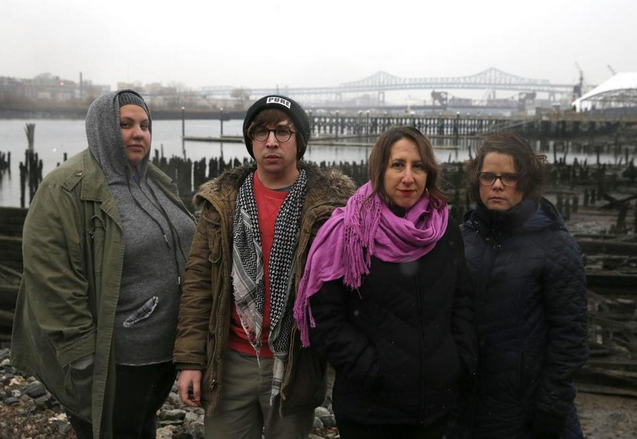
Plaintiffs in the suit against Exxon Mobil include Damali Vidot, at-large city councilor in Chelsea; John Valinch; and Roseann Bongiovanni and Maria Belen Power, both from the leadership ranks of GreenRoots, an environmental organization. Jessica Rinaldi/Globe Staff
CHELSEA — Roseann Bongiovanni was on an early morning training run for the Boston Marathon a decade ago when a stench from the Mystic River made it difficult to breathe. A Chelsea native accustomed to the industrial waterfront's malodorous scents, she recognized this whiff as different: It was diesel.
The cause turned out to be 15,000 gallons of fuel spilling from an oil terminal across the river in Everett, where tankers deliver petroleum products. Exxon Mobil, the world's largest publicly traded oil company, had failed to replace a $2 metal coupling, contributing to the spill, which resulted in criminal charges of negligence and a $6 million settlement for polluting the Island End and Mystic rivers.
The lingering memory led her to sign on to a new lawsuit alleging Exxon Mobil is neglecting to protect her community against the effects of climate change.
The first-of-its-kind lawsuit is drawing new attention as Exxon Mobil's longtime chief executive, Rex Tillerson, faces scrutiny as President-elect Donald Trump's nominee for secretary of state.
The suit's allegations shift the climate change debate from the distant domains of polar bears and the fate of future generations to the here and now. The suit claims that along the Island End River, which separates Everett and Chelsea, rising sea levels will make it more likely that Exxon's oil terminal could disgorge a toxic stew of carcinogens into residents' basements and streets. "Exxon Mobil's failure to adapt the Everett Terminal to increased precipitation, rising sea levels, and storm surges of increasing frequency and magnitude puts the facility, the public health, and the environment at great risk because a significant storm surge, rise in sea level, and/or extreme rainfall event may flood the facility and release solid and hazardous wastes into the Island End River, Mystic River, and directly onto the city streets of Everett," the suit says.
Local activists — including Bongiovanni, executive director of GreenRoots Inc., an environmental justice group — have testified about the terminal's effect on their lives, in an attempt to shore up the suit.
"What people in the national press are talking about, we feel this every single day," said Bongiovanni. "It's not just about climate change and saving polar ice caps. This is about sea levels rising and people being forced out of their houses."
The suit was filed in US District Court in Boston in September by the Boston-based Conservation Law Foundation, the environmental advocacy group responsible for forcing the cleanup of Boston Harbor.
Exxon Mobil has filed a motion to dismiss it, saying the organization does not have standing to sue and has no personal interest in the terminal.
A spokesman for the company declined to speak about the allegations, calling the suit "yet another attempt to use the courts to promote a political agenda."
Exxon Mobil's tanks, seen in this photo from a residential street in Everett, are a prominent part of the landscape for many residents of Chelsea and Everett. Jessica Rinaldi/Globe Staff
Exxon Mobil is also the target of investigations by the attorneys general of Massachusetts and New York, who are seeking documents on the company's decades of research on climate change.
The inquiries follow last year's reports by InsideClimate News and the Los Angeles Times that the petroleum company had studied the effects its products could have on climate as early as the 1970s but spent subsequent decades casting doubt on the certainty and legitimacy of such research.
The Senate Foreign Relations Committee has scheduled a Jan. 11 confirmation hearing for Tillerson, at which allegations about an Exxon climate coverup could emerge.
Unlike the law enforcement probes, though, Conservation Law Foundation's suit focuses on existing environmental laws and permits, claiming Exxon Mobil is violating them daily. Any violations would be exacerbated by the rising sea levels and stronger storms associated with climate change, which Exxon has failed to make adaptations to guard against, the suit asserts.
'We're not asking them to prepare for a meteor strike. We're asking them to prepare for the conditions that their own scientists affirm are certain to come.'
Bradley Campbell, Conservation Law Foundation
"What it means, in simple terms, is that Exxon is using the Mystic River as an open sewer, rather than invest in the controls and treatment and preventive measures that this facility needs," said Bradley Campbell, the group's president.
"We're not asking them to prepare for a meteor strike," Campbell added. "We're asking them to prepare for the conditions that their own scientists affirm are certain to come, some of which are already here.
"Just as when they're operating an oil tanker, that vessel has to be prepared for sea conditions that may arise, this has to be ready for the weather conditions they know are coming."
A Environmental Protection Agency spokeswoman did not directly address allegations that Exxon Mobil is violating its permits and not facing enforcement penalties. The EPA, she said, "focuses its resources on the most significant pollution problems that pose the greatest threats to public health and the environment."
In its court response so far, Exxon Mobil has said the Conservation Law Foundation's lawsuit is improperly aimed at trying to persuade the EPA to tighten regulations that do not currently require permit holders to consider "alleged climate change impacts."
In a memo supporting its motion to dismiss the case, filed in December, Exxon Mobil noted that in its EPA permit, "Nowhere does that permit mandate consideration of the speculative risks of climate change."
The Conservation Law Foundation has also seized on the company's plans to respond to an oil spill or other emergency. As it was gathering documents for the suit, the group was unable to obtain Exxon Mobil's emergency response plans, from either the company or the government, Campbell noted.
As a result, more than 160 activists descended on Exxon Mobil's Everett Terminal last month with a letter seeking the response plans. They were unsuccessful — the terminal manager wouldn't accept their letter and called the police — but they captured the awkward exchange on video.
"We wanted to send a message," said City Councilor Damali Vidot. "If a Category 1 hurricane does come, what does that mean for our community?"
Part of their message is that they're not getting the respect that another, wealthier municipality might demand from a multinational corporation.
Chelsea is a congested, low-income city of immigrants and people of color. Exxon Mobil's Everett Terminal, which runs up against an Everett neighborhood, is at the Island End River, which flows into the Mystic River. While other stretches of the Mystic are being revitalized by development — think Assembly Row in Somerville and the Wynn Resorts casino in Everett — this stretch of the waterfront is dotted with oil tanks and other industrial structures, and its few parks are disconnected. Canoes are few and far between.
"I believe that the industries in Chelsea and other neighboring communities profit off of the use of our water resources, including the Mystic and Island End rivers," Vidot said in her affidavit in support of the Conservation Law Foundation's suit, "while residents pay the price of living with and around polluted waters."

Links

Government Accused Of Policy Paralysis While Uncertainty Reigns Over Renewable Energy Targets

ABC RuralBabs McHugh

The full moon sets behind a wind farm in the Mojave Desert in California, Januray 8, 2004. (Toby Melville: Reuters)
The bickering between state and federal governments on renewable energy targets is creating massive uncertainty, according to climate change and energy specialists.
David Blowers from the Grattan Institute says investors, utilities, industry and householders are in the dark about what to expect in 2017.
Mr Blowers said the only certainty was that electricity prices would rise for everyone.
"Electricity prices have already been factored into next year and they're going to be higher," he said.
"Tackling a new energy system makes that inevitable.
"Replacing a lot of generation stock and infrastructure with a whole lot of new stuff is expensive, so prices will rise.
"What we'll see, if there's no agreement around Australia's climate change policy, is that for the foreseeable future, price increases will be greater than they need to be."
Mr Blowers said it might be unpalatable, but there must be give and take on both sides if politicians are to reach consensus and enable investment.
"At the moment, on the federal level, we have two sides of politics, both arguing two separate things," he said.
"It's a battle between the Federal Government and the Opposition on what they want policy to be, and at the end of the day both parties are going to have to give a little.
"Then there's the situation where state governments have introduced their own renewable energy targets, so it's hard to see [consensus] happening and I guess you'll see more of the same going forward.
"But if we have certainty and clarity around climate policy, that will give those involved in the electricity sector the confidence to make the investment that we need to have a reliable and reasonably affordable electricity sector.
"At the moment all we have is stagnation."
CSIRO stresses urgent need to have carbon change policy consensus
The CSIRO and Energy Networks Australia have submitted research called the Electricity Network Transformational Roadmap to the Finkel Review on electricity, which is scheduled to be handed down by April this year.
Paul Graham, CSIRO's chief energy economist, said policy certainty, including a price on carbon, was needed urgently.
"The reason it is so urgent is because by 2030 we want to have meet our Paris climate target, [which] will involve shifting to using a lot of low emissions electricity, he said.
"But low emissions electricity costs more. Electricity bills will rise because of the deep decarbonisation trend.
"And we want to make sure we don't spend any more than we have to. We've got to have a clear, stable carbon policy."

Electricity only one third of emissions
Mr Blowers is concerned that there is too much focus on electricity as a means of reducing emissions and decarbonising.
"I think this is a major problem," he said.
"We're spending a long time focusing on electricity generator sector, which only accounts for 30 per cent of our emissions.
"It's the biggest, but we've still got two-thirds of your emissions to deal with.
"I'm yet to see someone come up with a method of making steel or cement without burning carbon or how to stop methane gas coming off cows, pigs and sheep."

Links

Lethal Heating is a citizens' initiative