10/01/2017

The People Taking Trump’s Secretary Of State Pick To Court Aren’t Who You’d Expect

Mashable Australia - Andrew Freedman

Julia Olson, center, executive director of Our Children's Trust, holds a copy of U.S. District Judge Ann Aiken's decision on Nov. 10, 2016, in Eugene, Oregon. Image: Chris Pietsch/The Register-Guard via AP
Alex Loznak is about to head into the second semester of his sophomore year at Columbia University, but he's not your typical student. He's one of 21 people, ages nine to 20, suing the federal government for failing to protect them from the damaging effects of climate change.
Loznak, 19, and his fellow plaintiffs are hoping to advance their case, which is set to go to trial as early as this summer, by deposing current ExxonMobil CEO and Trump administration secretary of state nominee Rex Tillerson.
According to Loznak and the legal team fighting the case, Tillerson is in the best position to speak to the "collusion" between fossil fuel companies and the government to maintain a fossil fuel-centric economy despite well-known evidence that burning fuels like coal and oil cause global warming.
Tillerson served on the board of the American Petroleum Institute and other trade groups that have long opposed policies to reduce emissions, although he says he is in favor of the Paris Climate Agreement.
Secretary of State-designate Rex Tillerson pauses during a meeting with Senate Majority Leader Mitch McConnell of Ky. on Capitol Hill in Washington, Wednesday, Jan. 4, 2017. Image: AP/EVAN vucci
Tillerson's deposition is scheduled for Jan. 19, just one day before Trump's inauguration. The notice requesting the deposition asks for all documents relating to Tillerson's participation with a group known as the Global Climate Coalition, a fossil fuel industry-backed group which conducted an effective climate science disinformation campaign during the 1990s through 2001.
It also seeks information on his role in particular decisions the George W. Bush administration made, such as walking away from the Kyoto Protocol in 2001.
The case, brought by the nonprofit group Our Children's Trust, has already established a landmark precedent when a U.S. District Court Judge, Ann Aiken, ruled that the case can proceed to trial sometime this year.
Her ruling stated that the federal government and fossil fuel industry's failure to stem global warming may violate the defendant's constitutional rights.
"This action is of a different order than the typical environmental case," she wrote in her ruling.
Global surface temperature departures from average during Nov. 2016. Image: nasa giss
"It alleges that defendants' actions and inactions — whether or not they violate any specific statutory duty — have so profoundly damaged our home planet that they threaten plaintiffs' fundamental constitutional rights to life and liberty."
The court said that the plaintiffs had asserted a right "to a climate system capable of sustaining human life," and that the defendants may be endangering that.
The effects of climate change are becoming more evident each year, with 2016 almost certain to set the record for the warmest calendar year on record. The year was marked with a devastating global coral bleaching event that killed parts of the Great Barrier Reef in Australia, along with record low sea ice and unusually high temperatures in the Arctic.
Loznak and his fellow plaintiffs are seeking to hold the federal government, fossil fuel companies and their trade associations accountable for failing to act swiftly and effectively to curb the emissions of greenhouse gases causing human-caused global warming, despite their knowledge of the science of climate change.
Five of the 21 youth plaintiffs in a federal climate change lawsuit against the federal government, seen on Thursday, Nov. 10, 2016, in Eugene, Ore. Image: Chris Pietsch/The Register-Guard via AP
The fact that the case is likely to proceed to trial is a surprise to many legal scholars, who thought the case would have been dismissed like many other climate lawsuits.
"The fact that we're going to trial has surprised a lot of people," Loznak said in an interview with Mashable.
Loznak, along with his legal team, see Tillerson's testimony as key to their case.
"Nobody knows better than Rex Tillerson, I think, how much collusion has gone on between the fossil fuel industry and the government in this country," Loznak said.
Investigative reporting during the past two years from the Los Angeles Times, Columbia Journalism School and InsideClimate News has shown that Exxon researched climate change as early as the 1970s, yet chose to ignore the dangers of its fossil fuel products, and instead funded disinformation campaigns to confuse the public and politicians about the issue.
The implications of a victory in this case could be unusually far-reaching.
"If we win at trial that means the court is going to order the government to reduce emissions [at rates] consistent with science," Loznak said, which means about 6 percent reductions per year, far faster than what is currently planned.
Exxon Mobil's Billings Refinery in Billings, Mont., seen in Sept. 2016. Image: AP
The case, known officially as Juliana v. United States, takes a different approach than previous climate change litigation in the U.S., which have mainly focused on violations of specific legal statutes, such as the Clean Air Act.
Tillerson could try to change the date or avoid giving a deposition entirely, but so far his lawyers have not requested either of those outcomes, according to Julia Olson, executive director and chief counsel of Our Children's Trust.
Michael Gerrard, who directs the Sabin Center for Climate Change Law at Columbia University Law School, said it's unlikely Tillerson will end up testifying, given his position at the company.
"It would be common procedure in such a case for a corporation to resist the deposition of its CEO," he told Mashable. "And often such motions are granted."
Mashable reached out to Exxon for comment but did not hear back by deadline.
"Mr. Tillerson needs to show up for the deposition on the 19th absent a court order allowing him not to be deposed," Olson told Mashable. "We have every expectation we will be deposing him on Jan. 19th and we look forward to it."
"All of this evidence is going to come out in ways that will shock people"
Environmental groups are vehemently opposed to Tillerson's nomination to lead the State Department, although most of the media attention so far has focused on his ties to Russian President Vladimir Putin, rather than his history dealing with climate change.
Olson said the discovery process has produced documents detailing the extent of the influence that the fossil fuel industry and its trade groups have had over government decisions on energy policy.
"All of this evidence is going to come out in ways that will shock people," she said. "It is beyond what has already been published."
For his part, Loznak sees the court case as a way to fight back against the political environment which has suddenly turned hostile to climate action.
"All hope is not lost. It may seem like it, especially with some of the president-elect's cabinet picks, but I think this is the worst possible time to be apathetic," he said.
"This is the time to really get involved, to get organized."

Links

09/01/2017

Worst Year In NSW For Salmonella, E. Coli As Global Temperatures Increase

Fairfax - Harriet Alexander

NSW recorded its worst figures in at least five years for diseases caused by food poisoning and mosquito bites, as doctors warn climate change is looming as a public health emergency.
Statistics released last week show 2016 was the worst year on record for diseases including legionnaires' disease, salmonellosis, listeriosis, E. coli and dengue fever, which flourish in warmer conditions.
The Royal Australasian College of Physicians has warned that climate change will lead to more disease. Photo: Nicolas Walker
The figures come in an unusual summer for health threats, with months of wet weather causing a fivefold increase in Ross River virus notifications in the Riverina and the migration of the Irukandji jellyfish as far south as Fraser Island.
The Royal Australasian College of Physicians [RACP] has released a position paper that described climate change as a "global public health emergency".
Although Australia was not the most vulnerable nation, its population was already experiencing higher rates of respiratory illness, diarrhoea and morbidity requiring hospital admission during hot days, and higher rates of suicide in rural areas during drought years, it said.
The RACP called for a national climate and health strategy and reduced emissions of greenhouse gases.
The World Health Organisation estimates that global warming will cause an extra 250,000 deaths annually between 2030 and 2050.
Labor's health spokesman Walt Secord said the government should conduct surveillance and monitoring of air cooling systems, consider spraying after flooding and institute a public health campaign alerting families to symptoms.
Legionnaires' disease is spread by contaminated cooling towers for air conditioning units, and health authorities have indicated their extended use in warmer weather might have contributed to the number of outbreaks last year.
Mr Secord said there had been more outbreaks of gastroenteritis in child care centres and nursing homes, including 50 separate outbreaks in June and July, with the protracted warm weather.
Salmonella was rampant in NSW in 2016. Photo: Rocky Mountain Laboratories,NIAID,NIH
"We have air cooling systems pushed to the limits with bacteria thriving in them – and mosquitoes outside carrying tropical diseases previously unknown to NSW," Mr Secord said.
"Unfortunately, we are seeing diseases associated with the tropics being reported further south, such as the State's North Coast – and mosquitoes carrying tropical diseases being found in the State's Central West and in coastal areas.
"It is mind-boggling that the Liberals and Nationals are still denying the impact of climate change on our health."
All the dengue fever cases would have been imported from interstate or overseas as NSW does not have any of the vector mosquitoes.
NSW Director of Health Protection Jeremy McAnulty said there was not enough long term data to draw a definitive link between certain diseases and climate change, and even when a trend was detected it was difficult to isolate warm weather as the cause.
Gastro diseases such as salmonella were more prevalent in summer when the warmer weather made better conditions for bacteria to thrive in food.
"It might be logical that [salmonella] will increase in general over longer periods, but we don't really know," Dr McAnulty said.
"Similarly with mosquito-borne disease it's really unclear what the long term impact will be.
"We're always worried about these things. We talk about what impact climate change might have internationally with various diseases but we're not able to say what that might mean for the coming year."
The RACP's David Harley said it was likely that the risk of certain diseases would increase with global warming.
"Iti's illogical to suggest that the risk won't change and it's illogical to suggest that for some diseases the risk won't increase, but it's a complicated equation," he said.
His own modelling showed dengue fever was likely to become less of a threat in North Queensland as the temperature warmed, but it was possible the optimum conditions for the mosquito would just move south, he said.
2016 was also the worst year for cryptosporidiosis, gonorrhoea, meningococcal, pneumococcal, tuberculosis, influenza A and shigellosis, which have no obvious link to climate change.
It was the best year for chicken pox, which falls under the immunisation program, and Barmah Forest virus, which typically has few cases immediately following a spike because infection gives immunity.
The Climate Council reported last year that there had been a steady increase in the number of deaths in summer over the last four decades, indicating that climate change might already be affecting mortality rates.

Links

Seeking Shelter From The Storm

The Age - Editorial

It seems 2016 was the year of extremes.
Yes, populism punished the body politic, but we had to seek shelter from more literal storms.
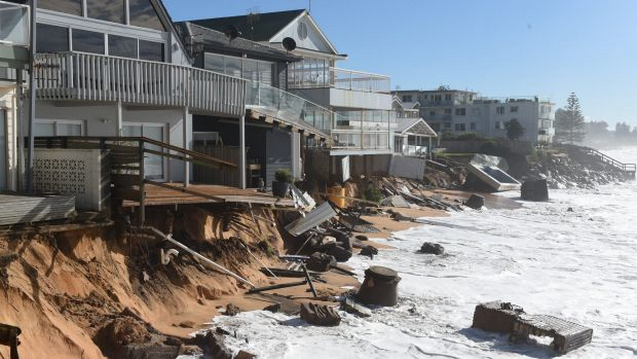
High tide begins to impact on damaged homes at Collaroy on the northern beaches of Sydney. Photo: DEAN LEWINS
The most recent, on December 29, lashed Victoria. The deluge in Melbourne alone turned domesticated creeks decidedly angry. And the roads, well, as the gutters disappeared they conspired against pedestrians and vehicles alike.
Way up north, just a few days before, the Bureau of Meteorology described a Christmas Day storm as a "once-in-a-half-century" weather event. The flooding flashed its way through the Northern Territory.  Uluru  wept unforgettably – majestic cascading streams.
Waterfalls stream down Uluru after record rains. Photo: Parks Australia
In retrospect, we shouldn't have been surprised that 2016 had more mad weather to throw our way.
There were the massive storms and king tides that swept along the east coast of Australia in June, washing away sand, beaches and property, including a swimming pool yanked from its bed and left dangling. As one Sydney local, Craig Graham, said: "I have never seen it come up this high with this amount of storm surge and I've been living here about 40 years."
Meanwhile, out west, the lights went out in South Australia in September when a "once-in-a-generation storm" turned transmission towers into tinsel.
Then, in the same month, another "once-in-a-generation" flood in Forbes in NSW. (Never mind that the same town had been inundated in 2012 by flood waters.)
2016 had indeed turned barking mad. But why? The Bureau of Meteorology provides some context and background to our year of extremes with its annual climate statement. Here are the facts:
  • Last year was the world's warmest year on record. The planet's three hottest years are 2016, 2015 and 2014.
  • 2016 was Australia's 4th hottest year on record.
  • Around Australia  ocean temperatures were the warmest on record.
  • We experienced our warmest autumn on record for Australia.
  • The 2015/16 El Nino was one of the strongest on record. It brought the warmest wet season on record for northern Australia.
  • It was also Australia's wettest May to September on record.
Almost 30 years ago the Intergovernmental Panel on Climate Change was established, and in 1990, in its first report, it warned  future warming was likely. Five years later, in its second report, it raised the likely increase of extreme events – heatwaves, landslides due to flooding and so on. With each subsequent  report, the modelling became more sophisticated, the case more compelling. We have had at least two decades of warnings – as the planet's temperature increases, so too will the extreme weather events.
In October this year, the CSIRO and the Bureau of Meteorology released their fourth biennial State of the Climate report. One of the trends it revealed was a shift in the odds towards extreme heat conditions – dubbed the five-fold factor.
From 1951 to 1980, extreme warm months would have occurred about 2 per cent of the time. Now – in the past 15 years – that has increased to more than 10 per cent. As The Age's environment editor Peter Hannam explains, in 2013 alone, there were 28 days of extreme heat. By way of comparison – it took from 1910 to 1941 to tally up 28 such days.
Unfortunately, the Coalition government seems more intent on ignoring climate change. The Prime Minister, who believes in global warming, has played to his sceptics.
While the post-truth phenomenon wreaked havoc through electoral landscapes in 2016, its precursor can be found in the decades-old campaign to undermine the science of climate change.  Lie, obfuscate, accuse. The overwhelming body of evidence is then willfully ignored – or attacked. But it doesn't change the facts: Greenhouse gas emissions are causing global warming. The world is getting hotter and the weather is changing.
Unless emissions are contained, our future will be littered with what we now refer to as "once-in-a-generation" events. Unfortunately, they may come almost every year.

Links

Indian Firm Makes Carbon Capture Breakthrough

The Guardian - 

Carbonclean is turning planet-heating emissions into profit by converting CO2 into baking powder – and could lock up 60,000 tonnes of CO2 a year
Tuticorin thermal power station near the port of Thoothukudi on the Bay of Bengal, southern India. The plant is said to be the first industrial-scale example of carbon capture and utilisation (CCU). Photograph: Roger Harrabin
A breakthrough in the race to make useful products out of planet-heating CO2 emissions has been made in southern India.
A plant at the industrial port of Tuticorin is capturing CO2 from its own coal-powered boiler and using it to make soda ash – aka baking powder.
Crucially, the technology is running without subsidy, which is a major advance for carbon capture technology as for decades it has languished under high costs and lukewarm government support.
The firm behind the Tuticorin process says its chemicals will lock up 60,000 tonnes of CO2 a year and the technology is attracting interest from around the world.
Debate over carbon capture has mostly focused until now on carbon capture and storage (CCS), in which emissions are forced into underground rocks at great cost and no economic benefit. The Tuticorin plant is said to be the first industrial scale example of carbon capture and utilisation (CCU).
There is already a global market for CO2 as a chemical raw material. It comes mainly from industries such as brewing where it is cheap and easy to capture.
Until now it has been too expensive without subsidy to strip out CO2 from the relatively low concentrations in which it appears in flue gas. The Indian plant has overcome the problem by using a new CO2-stripping chemical.
It is just slightly more efficient than the current CCS chemical amine, but its inventors, Carbonclean, say it also needs less energy, is less corrosive, and requires much smaller equipment meaning the build cost is much lower than for conventional carbon capture.
The new kit has been installed at Tuticorin Alkali Chemicals. The firm is now using the CO2 from its own boiler to make soda ash – a base chemical with a wide range of uses including glass manufacture, sweeteners, detergents and paper products.
The firm’s managing director, Ramachandran Gopalan, told BBC Radio 4: “I am a businessman. I never thought about saving the planet. I needed a reliable stream of CO2, and this was the best way of getting it.” He says the plant now has virtually zero emissions to air or water.
Carbonclean believes capturing usable CO2 can deal with perhaps 5-10% of the world’s emissions from coal. It’s no panacea, but it would be a valuable contribution because industrial steam-making boilers are hard to run on renewable energy.
The inventors of the new process are two young chemists at the Indian Institute of Technology in Kharagpur. They failed to find Indian finance and were welcomed instead by the UK government, which offered grants and the special entrepreneur status that whisks them through the British border.
The firm’s headquarters are now based in London’s Paddington district. Its CEO, Aniruddha Sharma, said: “So far the ideas for carbon capture have mostly looked at big projects, and the risk is so high they are very expensive to finance. We want to set up small-scale plants that de-risk the technology by making it a completely normal commercial option.”
By producing a subsidy-free carbon utilisation project, Carbonclean appears to have something of a global lead. But it is by no means alone. Carbon8 near Bristol is buying in CO2 to make aggregates, and other researchers are working on making plastics and fuels from waste CO2.
At last, it seems, the race to turn CO2 into profit is really on.

Links

08/01/2017

‘Earth On The Edge’: EU Agency Confirms 2016 As Hottest Year On Record

Huffington Post - Chris D’Angelo

CC: Donald J. Trump.
Severe weather events like drought and flood have been attributed to global temperature rises. (Supplied: Helen Kidd)
In the words of Bob Dylan, “You don’t need a weatherman to know which way the wind blows.” And you almost certainly didn’t need a thermometer to tell 2016 was a scorcher.
The first global analysis of 2016 climate data is out, confirming what many scientists had predicted: Last year was the hottest on record, surpassing the 2015 record by 0.2 degrees Celsius (0.36 degrees Fahrenheit), the European Union’s Copernicus Climate Change Service announced Thursday. 
Earth, the agency concluded, is “on the edge.”
IMAGE
In 2016, the average global surface temperature soared to around 14.8 degrees Celsius (58.6 degrees Fahrenheit), approximately 1.3 degrees Celsius (2.3 degrees Fahrenheit) above pre-industrial times, the earth observation program said.
Copernicus found that temperatures, fueled by climate change and a strong El Nino, peaked in February at about 1.5 degrees Celsius above pre-industrial times ― a warming benchmark that nearly 200 countries are striving to hold temperatures below as part of last year’s historic Paris climate pact. 
In a statement accompanying the findings, Copernicus Director Juan Garcés de Marcilla said the effects of climate change are being felt around the world. 
“Land and sea temperatures are rising along with sea levels, while the world’s sea-ice extent, glacier volume and snow cover are decreasing; rainfall patterns are changing and climate-related extremes such as heat waves, floods and droughts are increasing in frequency and intensity for many regions,” Marcilla said. “The future impact of climate change will depend on the effort we make now, in part achieved by better sharing of climate knowledge and information.”
In October, Gavin Schmidt, director of NASA’s Goddard Institute for Space Studies, predicted 2016 would go down as the hottest year on record. One month later, the United Nations World Meteorological Organization made the same dire forecast.
In a post Thursday on Twitter, Patricia Espinosa, executive secretary of the U.N.’s Framework Convention on Climate Change, called the Copernicus analysis “another wake-up call.” 
IMAGE
NASA and the National Oceanic and Atmospheric Administration are scheduled to release their own annual global temperature reports later this month. If projections hold, both agencies will confirm 2016 as the third consecutive record-setting year, after 2014 and 2015 both topped the charts for global temperatures.

As Donald Trump Denies Climate Change, These Kids Die Of It

New York Times - 


The incoming U.S. president, Donald Trump, has denied manmade climate change. The Times’s Nicholas Kristof travels to drought-stricken Madagascar to see the unfolding crisis for himself.

TSIHOMBE, Madagascar — She is just a frightened mom, worrying if her son will survive, and certainly not fretting about American politics — for she has never heard of either President Obama or Donald Trump.
What about America itself? Ranomasy, who lives in an isolated village on this island of Madagascar off southern Africa, shakes her head. It doesn’t ring any bells.
Yet we Americans may be inadvertently killing her infant son. Climate change, disproportionately caused by carbon emissions from America, seems to be behind a severe drought that has led crops to wilt across seven countries in southern Africa. The result is acute malnutrition for 1.3 million children in the region, the United Nations says.
Trump has repeatedly mocked climate change, once even calling it a hoax fabricated by China. But climate change here is as tangible as its victims. Trump should come and feel these children’s ribs and watch them struggle for life. It’s true that the links between our carbon emissions and any particular drought are convoluted, but over all, climate change is as palpable as a wizened, glassy-eyed child dying of starvation. Like Ranomasy’s 18-month-old son, Tsapasoa.
Southern Africa’s drought and food crisis have gone largely unnoticed around the world. The situation has been particularly severe in Madagascar, a lovely island nation known for deserted sandy beaches and playful long-tailed primates called lemurs.
But the southern part of the island doesn’t look anything like the animated movie “Madagascar”: Families are slowly starving because rains and crops have failed for the last few years. They are reduced to eating cactus and even rocks or ashes. The United Nations estimates that nearly one million people in Madagascar alone need emergency food assistance.
Ranomasy walked 12 hours to get her 18-month-old son, Tsapasoa, to an emergency feeding station. Credit Nicholas Kristof/The New York Times
I met Ranomasy at an emergency feeding station run by Catholic nuns who were trying to save her baby. Ranomasy had carried Tsapasoa 12 hours on a trek through the desert to get to the nuns, walking barefoot because most villagers have already sold everything from shoes to spoons to survive.
“I feel so powerless as a mother, because I know how much I love my child,” she said. “But whatever I do just doesn’t work.”
The drought is also severe in Lesotho, Malawi, Mozambique, Swaziland, Zambia and Zimbabwe, and a related drought has devastated East Africa and the Horn of Africa and is expected to continue this year. The U.N. World Food Program has urgently appealed for assistance, but only half the money needed has been donated.
The immediate cause of the droughts was an extremely warm El Niño event, which came on top of a larger drying trend in the last few decades in parts of Africa. New research, just published in the bulletin of the American Meteorological Society, concludes that human-caused climate change exacerbated El Niño’s intensity and significantly reduced rainfall in parts of Ethiopia and southern Africa.
The researchers calculated that human contributions to global warming reduced water runoff in southern Africa by 48 percent and concluded that these human contributions “have contributed to substantial food crises.”
Many rivers and wells have dried up in southern Madagascar, forcing people to buy water that is trucked in. Credit Nicholas Kristof/The New York Times
As an American, I’m proud to see U.S. assistance saving lives here. If it weren’t for U.S.A.I.D., the American aid agency, and nonprofit groups like Catholic Relief Services that work in these villages, far more cadavers would be piling up. But my pride is mixed with guilt: The United States single-handedly accounts for more than one-quarter of the world’s carbon dioxide emissions over the last 150 years, more than twice as much as any other country.
The basic injustice is that we rich countries produced the carbon that is devastating impoverished people from Madagascar to Bangladesh. In America, climate change costs families beach homes; in poor countries, parents lose their children.
In one Madagascar hamlet I visited, villagers used to get water from a well a three-hour walk away, but then it went dry. Now they hike the three hours and then buy water from a man who trucks it in. But they have almost no money. Not one of the children in the village has ever had a bath.
Families in this region traditionally raised cattle, but many have sold their herds to buy food to survive. Selling pressure has sent the price of a cow tumbling from $300 to less than $100.
Families are also pulling their children out of school, to send them foraging for edible plants. In one village I visited, fewer than 15 percent of the children are attending primary school this year.
One of the children who dropped out is Fombasoa, who should be in the third grade but now spends her days scouring the desert for a wild red cactus fruit. Fombasoa’s family is also ready to marry her off, even though she is just 10, because then her husband would be responsible for feeding her.
“If I can find her a husband, I would marry her,” said her father, Sonjona, who, like many villagers, has just one name. “But these days there is no man who wants her” — because no one can afford the bride price of about $32.
Fombasoa, 10, at left. Her father would like to marry her off, because then her husband would be responsible for feeding her. Credit Nicholas Kristof/The New York Times
Sonjona realizes that it is wrong to marry off a 10-year-old, but he also knows it is wrong to see his daughter starve. “I feel despair,” he said. “I don’t feel a man any more. I used to have muscles; now I have only bones. I feel guilty, because my job was to care for my children, and now they have only red cactus fruit.”
Other families showed me how they pick rocks of chalk from the ground, break them into dust and cook the dust into soup. “It fills our stomachs at least,” explained Limbiaza, a 20-year-old woman in one remote village. As it becomes more difficult to find the chalk rocks, some families make soup from ashes from old cooking fires.
Scientists used to think that the horror of starvation was principally the dying children. Now they understand there is a far broader toll: When children in utero and in the first few years of life are malnourished, their brains don’t develop properly. As a result, they may suffer permanently impaired brain function.
“If children are stunted and do not receive the nutrition and attention in these first 1,000 days, it is very difficult to catch back up,” noted Joshua Poole, the Madagascar director of Catholic Relief Services. “Nutritional neglect during this critical period prevents children from reaching their full mental potential.”
For the next half century or so, we will see students learning less in school and economies held back, because in 2017 we allowed more than a million kids to be malnourished just here in southern Africa, collateral damage from our carbon-intensive way of life.
The struggling people of Madagascar are caught between their own corrupt, ineffective government, which denies the scale of the crisis, and overseas governments that don’t want to curb carbon emissions.
Whatever we do to limit the growth of carbon, climate problems will worsen for decades to come. Those of us in the rich world who have emitted most of the carbon bear a special responsibility to help people like these Madagascar villagers who are simultaneously least responsible for climate change and most vulnerable to it.
The challenges are not hopeless, and I saw programs here that worked. The World Food Program runs school feeding programs that use local volunteers and, at a cost of 25 cents per child per day, give children a free daily meal that staves off starvation and creates an incentive to keep children in school.
We need these emergency relief efforts — and constant vigilance to intervene early to avert famines — but we can also do far more to help local people help themselves.
Catholic Relief Services provides emergency food aid, but it also promotes drought-resistant seed varieties and is showing farmers near the coast how to fish. It is also working with American scientists on new technologies to supply water in Madagascar, using condensation or small-scale desalination.
American technology helped create the problem, and it would be nice to see American technology used more aggressively to mitigate the burden on the victims.
For me, the most wrenching sight of this trip was of two starving boys near the southern tip of Madagascar. Their parents are climate refugees who fled their village to try to find a way to survive, leaving the boys in the care of an aunt, even though she doesn’t have enough food for her own two daughters.
I met the boys, Fokondraza, 5, and Voriavy, 3, in the evening, and they said that so far that day they hadn’t eaten or drunk anything (the closest well, producing somewhat salty water, is several hours away by foot, and fetching a pail of water becomes more burdensome when everyone is malnourished and anemic). Their aunt, Fideline, began to prepare the day’s meal.
Voriavy, left, and Fokondraza stood behind their aunt, Fideline, as she prepared cactus pads for their day’s meal. Credit Ben C. Solomon/The New York Times
She broke off cactus pads, scraped off the thorns and boiled them briefly, and the boys ate them — even though they provide little nutrition. “My heart is breaking because I have nothing to give them,” Fideline said. “I have no choice.”
At night, the boys sometimes cry from hunger, she said. But that is a good sign. When a person is near starvation, the body shuts down emotion, becoming zombielike as every calorie goes to keeping the heart and lungs working. It is the children who don’t cry, those quiet and expressionless, who are at greatest risk — and the two boys are becoming more like that.
I don’t pretend that the links between climate change and this food crisis are simple, or that the solutions are straightforward. I flew halfway around the world and then drove for two days to get to these villages, pumping out carbon the whole way.
Yet we do know what will help in the long run: sticking with the Paris agreement to limit global warming, as well as with President Obama’s Clean Power Plan. We must also put a price on carbon and invest much more heavily in research on renewable energy.
In the short and medium term, we must step up assistance to climate refugees and sufferers, both to provide relief and to assist with new livelihoods that adjust to new climate realities. (For individuals who want to help, the organization most active in the areas I visited was Catholic Relief Services, which accepts donations for southern Madagascar.)
The most basic starting point is for the American president-elect to acknowledge what even illiterate Madagascar villagers understand: Climate change is real.
As the sun set, I told Fideline that there was a powerful man named Trump half a world away, in a country she had never heard of, who just might be able to have some impact, over many years, on the climate here. I asked her what she would tell him.
“I would ask him to do what he can, so that once more I can grow cassava, corn, black-eyed peas and sorghum,” she said. “We’re desperate.”
Mr. President-elect, are you listening?

Links

Vast Iceberg 'The Size Of Delaware' Poised To Crack Off Antarctica, Scientists Say

ABC News - Reuters

Several ice shelves have cracked up around northern parts of Antarctica in recent years. (Supplied: NASA)
A vast iceberg, expected to be one of the biggest ever recorded with an area almost the size of the US state of Delaware or the Caribbean island state of Trinidad and Tobago, is poised to break off Antarctica.
A rift, slowly developing across the Larsen C ice shelf on the Antarctic Peninsula in recent years, expanded abruptly last month, growing by about 18 kilometres.
It is now more than 80 kilometres long with just 20 kilometres left before it snaps, scientists said.
"The Larsen C Ice Shelf in Antarctica is primed to shed an area of more than 5,000 square kilometres following further substantial rift growth," scientists at Project Midas at the University of Swansea in Wales said in a statement.
The iceberg "will fundamentally change the landscape of the Antarctic Peninsula" and could herald a wider break-up of the Larsen C ice shelf, the statement said.
Scientists on NASA's IceBridge mission photographed the massive rift on Larson C in November last year.

Iceberg break up 'imminent', scientist says (ABC News)

Ice shelves are areas of ice floating on the sea, several hundred metres thick, at the end of glaciers.
Scientists fear the loss of ice shelves around the frozen continent will allow glaciers inland to slide faster towards the sea as temperatures rise because of global warming, raising world sea levels.
Several ice shelves have cracked up around northern parts of Antarctica in recent years, including the Larsen B that disintegrated in 2002.

Links

Lethal Heating is a citizens' initiative