11/01/2017

Without action on climate change, say goodbye to polar bears

Washington Post - Darryl Fears

More than two-thirds of the world’s polar bears will be killed off by 2050 — the species completely gone from Alaska — because of thinning sea ice from global warming in the Arctic, government scientists forecast. (Subhankar Banerjee/Associated Press)
As the Arctic warms faster than any other place on the planet and sea ice declines, there is only one sure way to save polar bears from extinction, the government announced Monday: decisive action on climate change.
In a final plan to save an animal that greatly depends on ice to catch prey and survive, the U.S. Fish and Wildlife Service identified the rapid decline of sea ice as “the primary threat to polar bears” and said “the single most important achievement for polar bear conservation is decisive action to address Arctic warming” driven by the human emission of greenhouse gases into the atmosphere.
“Short of action that effectively addresses the primary cause of diminishing sea ice,” the agency’s plan said, “it is unlikely that polar bears will be recovered.”
That determination puts the plan itself on thin ice. Global climate change, of course, is completely out of the control of Fish and Wildlife, a division of the Interior Department. An international effort to address the issue was signed about a year ago in Paris, but President-elect Donald Trump has questioned U.S. participation in a treaty that nearly 190 governments signed.
Trump has waffled in his perspective on climate change. When asked about the human link to climate change following his election, he said, “I think there is some connectivity. . . . It depends on how much.” He also said he would keep an open mind about the international climate accord and whether his administration will withdraw from it.
But the president-elect has also openly doubted the findings of more than 95 percent of climate scientists who say climate change is driven by human activity. In 2012, he tweeted that “the concept of global warming was created for and by the Chinese in order to make U.S. manufacturing non-competitive.”
Fish and Wildlife officials declined to speculate on whether the next president will follow the guidance of its new plan. But the scientists had doubts about the survival of bears before Trump’s election.
“Even when we started the planning process, that was the discussion we were having … are we wasting our time here,” said Jenifer Kohout, deputy assistant director for Fish and Wildlife’s Alaska region, and a co-chair of the group that wrote the plan.
The extent of sea ice in September 2014 was the sixth lowest since satellite observations began in 1979. (Courtesy of Kathy Crane/NOAA)
“We wanted this plan to partially tell that story,” she said, but to also show that there were other steps that could save bears, such as adjusting the number that can be harvested by Alaska’s native people depending on the rise and fall of the animal’s population. Indigenous people and state officials participated in forming the plan. Another step was to find ways to deter hungry bears drawn to human garbage, so that fewer of them are destroyed.
Polar bears were listed as threatened by Fish and Wildlife under the Endangered Species Act in 2008, which automatically qualified it as a depleted species under the Marine Mammals Protection Act. Under both acts, Fish and Wildlife is required to develop a plan for their recovery with an analysis of why their threatened, the cost of restoring their populations and the time it will take to do it.
For eight years, federal scientists have tried to figure that all out. Monday’s recovery plan reflects earlier science that foresaw the extinction of polar bears in a warming world. Fish and Wildlife took the further step of establishing a Polar Bear Recovery Team of representatives from federal agencies, Alaska, the North Slope Borough, Alaska Native organizations, industry, non-profit organizations and the Canadian Wildlife Service.
Together they are showing Alaskans how starving polar bears are attracted to their garbage, which brings them closer to humans, which leads to their slaughter, hastening their decline. With Native organizations that rely on bear meat for nutrition, they came up with a system where the numbers of bears that can be hunted rises and falls depending on the population.
For many observers, the concern about polar bears is odd because more of the animals exist now than 40 years ago, when protections against hunting were minimal. Scientists say about 19 populations make up an estimated 25,000 to 31,000 bears, including a subpopulation of about 3,000 that roam Alaska. Estimates of their increases and declines go up and down depending on which population is being counted.
But researchers say 80 percent of the populations will almost certainly collapse if sea ice continues to decline. Air temperatures at the top of the world are rising twice as fast as temperatures in lower latitudes, resulting in significant ice melt, according to a report by the National Oceanic and Atmospheric Administration.
Under the effects of global warming, Alaska recorded temperatures nearly 20 degrees higher than the January average as warm air flowed north, NOAA said in an Arctic Report Card.
“We’re quite confident that absent action to address climate change, there would be very significant reduction in the range of polar bears,” said Michael Runge, a U.S. Geological Survey research ecologist who served as the plan’s other co-chairman.
But even if the vast majority of bears die, the species can be saved if the ice stabilizes decades into the future, so that they can hunt, find mates and find dens that allow them to survive, Runge said. Polar bears, which are listed as threatened under the Endangered Species Act, could be delisted if an improved climate and stronger ice increase their likelihood of survival.
An estimated 35,000 walrus gather on shore north of Point Lay, Alaska. A decline in sea ice in the Arctic region of the Chukchi Sea is forcing female walruses and their young to “haul out” to land. (NOAA via Agence France-Presse)
The plan said the outlook is grim for bears only if international governments do absolutely nothing to address climate change, said David Douglas, another USGS researcher. But if they limit some greenhouse gases, even if Trump withdraws the United States from the Paris climate agreement, polar bears will have a slightly better chance of survival.
“There are two ends of a spectrum. One is not hopeless,” he said.
Without an aggressive call to address climate change, the plan is toothless, said Shaye Wolf, climate science director for the Center for Biological Diversity. Allowing for massive reductions in polar populations, including the possible extinction of bears in Alaska, Wolf said, is unacceptable.
“This recovery plan is too risky for the polar bear. Recovery plans work, but only if they truly address the threats to the species,” she said. “Sadly, that simply isn’t the case with this polar bear plan.”

Links

10/01/2017

Climate Change Could Shrink Australia's Ski Season By 80 Days A Year By 2050, CSIRO Says

ABC News - James Thomas | Alison Branley

The CSIRO has found there has been significant decline in snow depth in the past 60 years. (AAP: Perisher, file photo)
Key points:
  • CSIRO predicts average snow season will shorten by at least 20-55 days
  • CSIRO warns if greenhouse gas emissions continue at the current rate, snow cover and duration will rapidly decline
  • Popular ski resorts at high altitudes are not immune to the reduction in snow falls
Australia's ski season could shrink by up to 80 days a year by 2050 under worst-case predictions for climate change — but there are no plans to restrict ski resorts in national parks.
The CSIRO's climate change modelling predicts, under a low-risk scenario, the average snow season across Victoria and some of New South Wales will become 20 to 55 days shorter and, under a worst-case scenario, 30 to 80 days shorter — all but obliterating the 112-day ski season.
The CSIRO has found significant decline in the past 60 years in the southern slopes and Murray-Basin areas and current predictions are for continued decline in snow depth and duration of snow cover.
However, it also notes snow dumps vary season to season and can be unpredictable.
"Snowfall is projected to experience a reduction that increases with time, with the magnitude dependent on the emission scenarios and the altitude," its 2015 report predicted.
A graph shows estimated snow fall in Cabramurra in the Kosciuszko National Park. (Source: CSIRO Climate Change in Australia 2015)
Kosciuszko ski resorts 'should be phased out'
Despite that, there is a standing concept plan approval for an 800-bed resort at Perisher.
The Colong Foundation for Wilderness's Keith Muir said he was concerned it could become a "stranded asset".
His organisation was considering a legal challenge against the proposed development inside the national park.
The foundation argues it should be reconsidered in the context of climate change and resorts are better placed in nearby Jindabyne.
"We think the ski resorts in Kosciuszko should be phased out by 2030, when there will be no snow that's viable for the commercial operation of snow resorts, even with snow making," Mr Muir said.
"We say the resorts will not have a moral licence to operate when the snow is gone, because that's why they're there.
"It really is going to end."


CSIRO climate projections scientist Michael Grose speaks to the ABC. (ABC News)

There is a standing concept plan approval for an 800-bed resort at Perisher. (Supplied)
It comes as the NSW Government considers two key reports on the future of Kosciuszko National Park, including a review of bed limits as a measure of impact and potential head lease for Perisher.
CSIRO Climate Science Centre research director Kevin Hennessy said snow dumps depended on the rate of climate change, which in turn depended on the rate at which greenhouse gas emissions increased.
"If we continue to increase greenhouse gas house emissions at the current rate there will be a relatively rapid decline in snow cover and snow duration," he said.
"We are looking at a committed warming of at least one or two degrees over the next decade so an amount of change is unavoidable.
"But beyond about the 2030s, it does depend on how our greenhouse gas house emissions are managed."
The Irvine family on the road between Sponars and Smiggin Holes in 1969. Supplied: Perisher Historical Society
GALLERY: PERISHER THROUGH THE YEARS 10 IMAGES
Higher ski resorts 'not immune'
Mr Hennessy said higher ski resorts such as Perisher would stay open longer, but would not be immune to reductions in snow falls.
"In future we expect a reduction in the number of snow days, the depth of that snow across that season and the duration of the ski season, so we expect a later start to the ski season and an earlier finish," he said.
"In the Kosciuszko region, which has fairly high elevation, we expect there to be good years and bad years right through this century and not until the end of this century might we see really, really low snow levels."
But Mr Hennessy said snow making would become very difficult by 2030, because it would be too warm.
"To make snow you require wet bulb temperature below minus 1 or minus 2 degrees Celsius," he said.
"We anticipate by 2030, the opportunities for snow making might be halved with the exception of some of the high resorts where opportunities might be halved by 2040s.
"The ski industries both in Victoria and New South Wales are factoring in climate change into their projections. The question is how long is that financially viable?"
Kevin Hennessy said higher ski resorts would stay open longer, but would not be immune. (ABC News: Gregory Nelson )
National Parks and Wildlife Service acting deputy chief executive Robert Quirk said the organisation was focused on making use of the existing infrastructure in the park to draw people year-round.
"We are going to see less snow," Mr Quirk said.
"We have been seeing that for 20 years, and there is a little bit of an interest in how the business runs through the whole calendar year, not just for four months of the year.
"We do want people to get out and understand environmental values, they're not going to get that in their lounge room."
He said the organisation was cognisant of climate change.
"We talk to the resorts about it all the time and we're watching and waiting to see how it shapes up over the next 50 years," he said.
"The practical reality is we have a lot of businesses based there now which are focused on the snow still falling, and our principal responsibility is to make sure that we manage those sites for the benefit of the park and the community."
Vail Resorts did not respond to questions put to it about the impact of climate change in the park, but said it was committed to preserving the natural environments in which it operated.
There is a standing concept plan approval for an 800-bed resort at Perisher. (Supplied: The Colong Foundation for Wilderness)
Links

Science Loses Out To Uninformed Opinion On Climate Change – Yet Again

The Conversation - 


Ocean acidification is an inevitable consequence of increasing carbon dioxide in the atmosphere. That’s a matter of fact. We don’t know exactly what will happen to complex marine ecosystems when faced with the additional stress of falling pH, but we do know those changes are happening and that they won’t be good news.
The journalist James Delingpole disagrees. In an article for The Spectator in April 2016, he took the sceptical position that all concerns over ocean acidification are unjustified “alarmism” and that the scientific study of this non-problem is a waste of money. He concluded that the only reason that the study of ocean acidification was ever funded at all was because there was insufficient (and decreasing) evidence for global warming and it acted as a “fallback position”.
Having had the role of science coordinator for the UK Ocean Acidification research programme and being involved in relevant national and international projects for around ten years previously, I know such claims – which Delingpole presented as facts – to be false. I also spotted a range of other errors and inaccuracies in his piece.
Having first gone to The Spectator with my concerns, in late August I submitted a formal complaint to the Independent Press Standards Organisation (IPSO). The key issues were whether or not due care had been taken to avoid publication of inaccurate information, and whether comment and conjecture had been clearly distinguished from fact.
At the end of a long and frustrating process IPSO’s final ruling was published on January 5 and it doesn’t seem we are much further forward. My complaint was rejected on the basis that the article was “clearly a comment piece” and that it was not IPSO’s role to resolve conflicting evidence for contentious issues.

Facts are sacred
Freedom of speech, and of the press, is, of course, extremely precious. Yet that freedom also brings responsibility. The Editors’ Code of Practice – which IPSO claims to uphold – requires the “highest professional standards”. Let’s remind ourselves of what this means when it comes to accuracy:
i) The press must take care not to publish inaccurate, misleading or distorted information or images, including headlines not supported by the text.
ii) A significant inaccuracy, misleading statement or distortion must be corrected, promptly and with due prominence, and – where appropriate – an apology published.
That would seem clear enough. So let’s look at just one of Delingpole’s paragraphs and judge for ourselves whether these standards were met:
Ocean acidification theory appears to have been fatally flawed almost from the start. In 2004, two NOAA scientists, Richard Feely and Christopher Sabine, produced a chart showing a strong correlation between rising atmospheric CO2 levels and falling oceanic pH levels. But then, just over a year ago, Mike Wallace, a hydrologist with 30 years’ experience, noticed while researching his PhD that they had omitted some key information. Their chart only started in 1988 but, as Wallace knew, there were records dating back to at least 100 years before. So why had they ignored the real-world evidence in favour of computer-modelled projections? When Wallace plotted a chart of his own, incorporating all the available data, covering the period from 1910 to the present, his results were surprising: there has been no reduction in oceanic pH levels in the last century.
That might look like a plausible argument based on fact. But the Feely/Sabine chart which was of concern to Wallace was published in 2006, not 2004; the chart didn’t start in 1988, but covered the period 1850-2100; and no data had been omitted, since it showed an idealised, theory-based relationship between atmospheric CO2 and ocean pH. Meanwhile the “real-world evidence” was from extremely unreliable early measurements, uncorrected for natural variability, that when combined gave physically impossible year-on-year changes in global pH. And Wallace’s analyses have not been published in a peer-reviewed scientific journal. Delingpole did not contact any of the individuals mentioned to obtain first-hand accounts of the issues of concern.
How ocean acidification works according to the experts. UK Ocean Acidification Programme
To be fair, several of Delingpole’s inaccuracies, such as NERC (the Natural Environment Research Council) rather than Defra being the main funder of the UK Ocean Acidification research programme, were acknowledged by IPSO – but the regulator ruled that they were not “significantly” misleading, neither cumulatively nor individually. It didn’t seem to matter to IPSO that calling science’s approach to acidification “alarmism” – and implying that researchers have said that everything in the sea will die – is rather different from the well-established scientific knowledge that ocean acidification really does affect sensitive species, such as corals, and will therefore disrupt ecosystems.

Fair comment?
The Editor’s Code of Practice has this to say about opinion and comment:
The press, while free to editorialise and campaign, must distinguish clearly between comment, conjecture and fact.
So read this statement from Delingpole:
Ocean acidification – the evidence increasingly suggests – is a trivial, misleadingly named, and not remotely worrying phenomenon which has been hyped up beyond all measure for political, ideological and financial reasons.
Is this just an honest opinion, a statement of fact, or wilfully misleading and clever rhetoric? That depends on what is meant by “evidence”. If it means quality research carried out by scientists with expertise in the field, the statement is factually incorrect. But if evidence includes anything said by non-experts, such as Delingpole, then that’s an increase, right?
All these issues may seem technical or unimportant to anyone but scientists or most of the public. But IPSO’s overall message is that ocean acidification is just a matter of opinion – not a hard-won, testable understanding of the likely effects of human-driven changes on the marine environment. This view of science is pernicious and has serious policy consequences. Why support any research if 250 peer-reviewed papers produced by the UK Ocean Acidification research programme can all be summarily dismissed as worthless?

IPSO: a watchdog with few teeth?

From a back of the envelope analysis of IPSO’s published statistics on its adjudications on complaints it appears that about 18% of those investigated are upheld. I can’t pretend to be an expert on the nature of complaints about the press and don’t know what proportion is vexatious or can be dismissed out of hand, but it’s important to note that the overwhelming majority of complaints received by IPSO – at least 95% by my calculation – are not investigated or taken further, since they come under the heading complaints IPSO could not deal with. This might be good news for publishers, but seems a very depressing statistic for those who feel wronged by the press.
IPSO annual report 2015. Author provided
Does this really mean that anything goes if it is presented, however tenuously, as “comment” or “opinion”? Doesn’t “care taken” involve basic fact-checking and making a proper effort to contact quoted or maligned individuals before publication? Are political blogs, disputed newspaper coverage and think-tank reports reliable information sources, while properly peer-reviewed scientific literature can be disregarded?
IPSO annual report 2015. Author provided
There’s a passionate debate going on in journalism at the moment about regulation – and most journalists believe, probably correctly – that the industry should be its own watchdog. But these sorts of decisions make you wonder whether they are up to the task. All this is in my opinion, of course.

Links

The People Taking Trump’s Secretary Of State Pick To Court Aren’t Who You’d Expect

Mashable Australia - Andrew Freedman

Julia Olson, center, executive director of Our Children's Trust, holds a copy of U.S. District Judge Ann Aiken's decision on Nov. 10, 2016, in Eugene, Oregon. Image: Chris Pietsch/The Register-Guard via AP
Alex Loznak is about to head into the second semester of his sophomore year at Columbia University, but he's not your typical student. He's one of 21 people, ages nine to 20, suing the federal government for failing to protect them from the damaging effects of climate change.
Loznak, 19, and his fellow plaintiffs are hoping to advance their case, which is set to go to trial as early as this summer, by deposing current ExxonMobil CEO and Trump administration secretary of state nominee Rex Tillerson.
According to Loznak and the legal team fighting the case, Tillerson is in the best position to speak to the "collusion" between fossil fuel companies and the government to maintain a fossil fuel-centric economy despite well-known evidence that burning fuels like coal and oil cause global warming.
Tillerson served on the board of the American Petroleum Institute and other trade groups that have long opposed policies to reduce emissions, although he says he is in favor of the Paris Climate Agreement.
Secretary of State-designate Rex Tillerson pauses during a meeting with Senate Majority Leader Mitch McConnell of Ky. on Capitol Hill in Washington, Wednesday, Jan. 4, 2017. Image: AP/EVAN vucci
Tillerson's deposition is scheduled for Jan. 19, just one day before Trump's inauguration. The notice requesting the deposition asks for all documents relating to Tillerson's participation with a group known as the Global Climate Coalition, a fossil fuel industry-backed group which conducted an effective climate science disinformation campaign during the 1990s through 2001.
It also seeks information on his role in particular decisions the George W. Bush administration made, such as walking away from the Kyoto Protocol in 2001.
The case, brought by the nonprofit group Our Children's Trust, has already established a landmark precedent when a U.S. District Court Judge, Ann Aiken, ruled that the case can proceed to trial sometime this year.
Her ruling stated that the federal government and fossil fuel industry's failure to stem global warming may violate the defendant's constitutional rights.
"This action is of a different order than the typical environmental case," she wrote in her ruling.
Global surface temperature departures from average during Nov. 2016. Image: nasa giss
"It alleges that defendants' actions and inactions — whether or not they violate any specific statutory duty — have so profoundly damaged our home planet that they threaten plaintiffs' fundamental constitutional rights to life and liberty."
The court said that the plaintiffs had asserted a right "to a climate system capable of sustaining human life," and that the defendants may be endangering that.
The effects of climate change are becoming more evident each year, with 2016 almost certain to set the record for the warmest calendar year on record. The year was marked with a devastating global coral bleaching event that killed parts of the Great Barrier Reef in Australia, along with record low sea ice and unusually high temperatures in the Arctic.
Loznak and his fellow plaintiffs are seeking to hold the federal government, fossil fuel companies and their trade associations accountable for failing to act swiftly and effectively to curb the emissions of greenhouse gases causing human-caused global warming, despite their knowledge of the science of climate change.
Five of the 21 youth plaintiffs in a federal climate change lawsuit against the federal government, seen on Thursday, Nov. 10, 2016, in Eugene, Ore. Image: Chris Pietsch/The Register-Guard via AP
The fact that the case is likely to proceed to trial is a surprise to many legal scholars, who thought the case would have been dismissed like many other climate lawsuits.
"The fact that we're going to trial has surprised a lot of people," Loznak said in an interview with Mashable.
Loznak, along with his legal team, see Tillerson's testimony as key to their case.
"Nobody knows better than Rex Tillerson, I think, how much collusion has gone on between the fossil fuel industry and the government in this country," Loznak said.
Investigative reporting during the past two years from the Los Angeles Times, Columbia Journalism School and InsideClimate News has shown that Exxon researched climate change as early as the 1970s, yet chose to ignore the dangers of its fossil fuel products, and instead funded disinformation campaigns to confuse the public and politicians about the issue.
The implications of a victory in this case could be unusually far-reaching.
"If we win at trial that means the court is going to order the government to reduce emissions [at rates] consistent with science," Loznak said, which means about 6 percent reductions per year, far faster than what is currently planned.
Exxon Mobil's Billings Refinery in Billings, Mont., seen in Sept. 2016. Image: AP
The case, known officially as Juliana v. United States, takes a different approach than previous climate change litigation in the U.S., which have mainly focused on violations of specific legal statutes, such as the Clean Air Act.
Tillerson could try to change the date or avoid giving a deposition entirely, but so far his lawyers have not requested either of those outcomes, according to Julia Olson, executive director and chief counsel of Our Children's Trust.
Michael Gerrard, who directs the Sabin Center for Climate Change Law at Columbia University Law School, said it's unlikely Tillerson will end up testifying, given his position at the company.
"It would be common procedure in such a case for a corporation to resist the deposition of its CEO," he told Mashable. "And often such motions are granted."
Mashable reached out to Exxon for comment but did not hear back by deadline.
"Mr. Tillerson needs to show up for the deposition on the 19th absent a court order allowing him not to be deposed," Olson told Mashable. "We have every expectation we will be deposing him on Jan. 19th and we look forward to it."
"All of this evidence is going to come out in ways that will shock people"
Environmental groups are vehemently opposed to Tillerson's nomination to lead the State Department, although most of the media attention so far has focused on his ties to Russian President Vladimir Putin, rather than his history dealing with climate change.
Olson said the discovery process has produced documents detailing the extent of the influence that the fossil fuel industry and its trade groups have had over government decisions on energy policy.
"All of this evidence is going to come out in ways that will shock people," she said. "It is beyond what has already been published."
For his part, Loznak sees the court case as a way to fight back against the political environment which has suddenly turned hostile to climate action.
"All hope is not lost. It may seem like it, especially with some of the president-elect's cabinet picks, but I think this is the worst possible time to be apathetic," he said.
"This is the time to really get involved, to get organized."

Links

09/01/2017

Worst Year In NSW For Salmonella, E. Coli As Global Temperatures Increase

Fairfax - Harriet Alexander

NSW recorded its worst figures in at least five years for diseases caused by food poisoning and mosquito bites, as doctors warn climate change is looming as a public health emergency.
Statistics released last week show 2016 was the worst year on record for diseases including legionnaires' disease, salmonellosis, listeriosis, E. coli and dengue fever, which flourish in warmer conditions.
The Royal Australasian College of Physicians has warned that climate change will lead to more disease. Photo: Nicolas Walker
The figures come in an unusual summer for health threats, with months of wet weather causing a fivefold increase in Ross River virus notifications in the Riverina and the migration of the Irukandji jellyfish as far south as Fraser Island.
The Royal Australasian College of Physicians [RACP] has released a position paper that described climate change as a "global public health emergency".
Although Australia was not the most vulnerable nation, its population was already experiencing higher rates of respiratory illness, diarrhoea and morbidity requiring hospital admission during hot days, and higher rates of suicide in rural areas during drought years, it said.
The RACP called for a national climate and health strategy and reduced emissions of greenhouse gases.
The World Health Organisation estimates that global warming will cause an extra 250,000 deaths annually between 2030 and 2050.
Labor's health spokesman Walt Secord said the government should conduct surveillance and monitoring of air cooling systems, consider spraying after flooding and institute a public health campaign alerting families to symptoms.
Legionnaires' disease is spread by contaminated cooling towers for air conditioning units, and health authorities have indicated their extended use in warmer weather might have contributed to the number of outbreaks last year.
Mr Secord said there had been more outbreaks of gastroenteritis in child care centres and nursing homes, including 50 separate outbreaks in June and July, with the protracted warm weather.
Salmonella was rampant in NSW in 2016. Photo: Rocky Mountain Laboratories,NIAID,NIH
"We have air cooling systems pushed to the limits with bacteria thriving in them – and mosquitoes outside carrying tropical diseases previously unknown to NSW," Mr Secord said.
"Unfortunately, we are seeing diseases associated with the tropics being reported further south, such as the State's North Coast – and mosquitoes carrying tropical diseases being found in the State's Central West and in coastal areas.
"It is mind-boggling that the Liberals and Nationals are still denying the impact of climate change on our health."
All the dengue fever cases would have been imported from interstate or overseas as NSW does not have any of the vector mosquitoes.
NSW Director of Health Protection Jeremy McAnulty said there was not enough long term data to draw a definitive link between certain diseases and climate change, and even when a trend was detected it was difficult to isolate warm weather as the cause.
Gastro diseases such as salmonella were more prevalent in summer when the warmer weather made better conditions for bacteria to thrive in food.
"It might be logical that [salmonella] will increase in general over longer periods, but we don't really know," Dr McAnulty said.
"Similarly with mosquito-borne disease it's really unclear what the long term impact will be.
"We're always worried about these things. We talk about what impact climate change might have internationally with various diseases but we're not able to say what that might mean for the coming year."
The RACP's David Harley said it was likely that the risk of certain diseases would increase with global warming.
"Iti's illogical to suggest that the risk won't change and it's illogical to suggest that for some diseases the risk won't increase, but it's a complicated equation," he said.
His own modelling showed dengue fever was likely to become less of a threat in North Queensland as the temperature warmed, but it was possible the optimum conditions for the mosquito would just move south, he said.
2016 was also the worst year for cryptosporidiosis, gonorrhoea, meningococcal, pneumococcal, tuberculosis, influenza A and shigellosis, which have no obvious link to climate change.
It was the best year for chicken pox, which falls under the immunisation program, and Barmah Forest virus, which typically has few cases immediately following a spike because infection gives immunity.
The Climate Council reported last year that there had been a steady increase in the number of deaths in summer over the last four decades, indicating that climate change might already be affecting mortality rates.

Links

Seeking Shelter From The Storm

The Age - Editorial

It seems 2016 was the year of extremes.
Yes, populism punished the body politic, but we had to seek shelter from more literal storms.
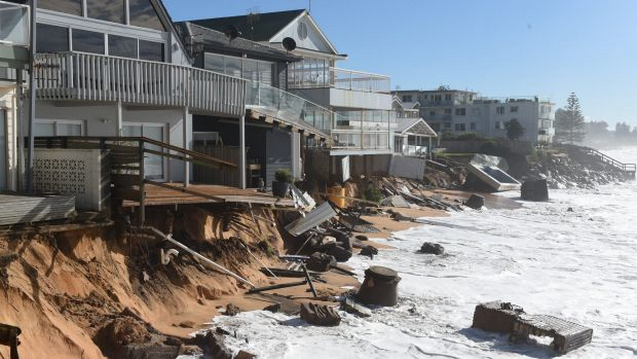
High tide begins to impact on damaged homes at Collaroy on the northern beaches of Sydney. Photo: DEAN LEWINS
The most recent, on December 29, lashed Victoria. The deluge in Melbourne alone turned domesticated creeks decidedly angry. And the roads, well, as the gutters disappeared they conspired against pedestrians and vehicles alike.
Way up north, just a few days before, the Bureau of Meteorology described a Christmas Day storm as a "once-in-a-half-century" weather event. The flooding flashed its way through the Northern Territory.  Uluru  wept unforgettably – majestic cascading streams.
Waterfalls stream down Uluru after record rains. Photo: Parks Australia
In retrospect, we shouldn't have been surprised that 2016 had more mad weather to throw our way.
There were the massive storms and king tides that swept along the east coast of Australia in June, washing away sand, beaches and property, including a swimming pool yanked from its bed and left dangling. As one Sydney local, Craig Graham, said: "I have never seen it come up this high with this amount of storm surge and I've been living here about 40 years."
Meanwhile, out west, the lights went out in South Australia in September when a "once-in-a-generation storm" turned transmission towers into tinsel.
Then, in the same month, another "once-in-a-generation" flood in Forbes in NSW. (Never mind that the same town had been inundated in 2012 by flood waters.)
2016 had indeed turned barking mad. But why? The Bureau of Meteorology provides some context and background to our year of extremes with its annual climate statement. Here are the facts:
  • Last year was the world's warmest year on record. The planet's three hottest years are 2016, 2015 and 2014.
  • 2016 was Australia's 4th hottest year on record.
  • Around Australia  ocean temperatures were the warmest on record.
  • We experienced our warmest autumn on record for Australia.
  • The 2015/16 El Nino was one of the strongest on record. It brought the warmest wet season on record for northern Australia.
  • It was also Australia's wettest May to September on record.
Almost 30 years ago the Intergovernmental Panel on Climate Change was established, and in 1990, in its first report, it warned  future warming was likely. Five years later, in its second report, it raised the likely increase of extreme events – heatwaves, landslides due to flooding and so on. With each subsequent  report, the modelling became more sophisticated, the case more compelling. We have had at least two decades of warnings – as the planet's temperature increases, so too will the extreme weather events.
In October this year, the CSIRO and the Bureau of Meteorology released their fourth biennial State of the Climate report. One of the trends it revealed was a shift in the odds towards extreme heat conditions – dubbed the five-fold factor.
From 1951 to 1980, extreme warm months would have occurred about 2 per cent of the time. Now – in the past 15 years – that has increased to more than 10 per cent. As The Age's environment editor Peter Hannam explains, in 2013 alone, there were 28 days of extreme heat. By way of comparison – it took from 1910 to 1941 to tally up 28 such days.
Unfortunately, the Coalition government seems more intent on ignoring climate change. The Prime Minister, who believes in global warming, has played to his sceptics.
While the post-truth phenomenon wreaked havoc through electoral landscapes in 2016, its precursor can be found in the decades-old campaign to undermine the science of climate change.  Lie, obfuscate, accuse. The overwhelming body of evidence is then willfully ignored – or attacked. But it doesn't change the facts: Greenhouse gas emissions are causing global warming. The world is getting hotter and the weather is changing.
Unless emissions are contained, our future will be littered with what we now refer to as "once-in-a-generation" events. Unfortunately, they may come almost every year.

Links

Indian Firm Makes Carbon Capture Breakthrough

The Guardian - 

Carbonclean is turning planet-heating emissions into profit by converting CO2 into baking powder – and could lock up 60,000 tonnes of CO2 a year
Tuticorin thermal power station near the port of Thoothukudi on the Bay of Bengal, southern India. The plant is said to be the first industrial-scale example of carbon capture and utilisation (CCU). Photograph: Roger Harrabin
A breakthrough in the race to make useful products out of planet-heating CO2 emissions has been made in southern India.
A plant at the industrial port of Tuticorin is capturing CO2 from its own coal-powered boiler and using it to make soda ash – aka baking powder.
Crucially, the technology is running without subsidy, which is a major advance for carbon capture technology as for decades it has languished under high costs and lukewarm government support.
The firm behind the Tuticorin process says its chemicals will lock up 60,000 tonnes of CO2 a year and the technology is attracting interest from around the world.
Debate over carbon capture has mostly focused until now on carbon capture and storage (CCS), in which emissions are forced into underground rocks at great cost and no economic benefit. The Tuticorin plant is said to be the first industrial scale example of carbon capture and utilisation (CCU).
There is already a global market for CO2 as a chemical raw material. It comes mainly from industries such as brewing where it is cheap and easy to capture.
Until now it has been too expensive without subsidy to strip out CO2 from the relatively low concentrations in which it appears in flue gas. The Indian plant has overcome the problem by using a new CO2-stripping chemical.
It is just slightly more efficient than the current CCS chemical amine, but its inventors, Carbonclean, say it also needs less energy, is less corrosive, and requires much smaller equipment meaning the build cost is much lower than for conventional carbon capture.
The new kit has been installed at Tuticorin Alkali Chemicals. The firm is now using the CO2 from its own boiler to make soda ash – a base chemical with a wide range of uses including glass manufacture, sweeteners, detergents and paper products.
The firm’s managing director, Ramachandran Gopalan, told BBC Radio 4: “I am a businessman. I never thought about saving the planet. I needed a reliable stream of CO2, and this was the best way of getting it.” He says the plant now has virtually zero emissions to air or water.
Carbonclean believes capturing usable CO2 can deal with perhaps 5-10% of the world’s emissions from coal. It’s no panacea, but it would be a valuable contribution because industrial steam-making boilers are hard to run on renewable energy.
The inventors of the new process are two young chemists at the Indian Institute of Technology in Kharagpur. They failed to find Indian finance and were welcomed instead by the UK government, which offered grants and the special entrepreneur status that whisks them through the British border.
The firm’s headquarters are now based in London’s Paddington district. Its CEO, Aniruddha Sharma, said: “So far the ideas for carbon capture have mostly looked at big projects, and the risk is so high they are very expensive to finance. We want to set up small-scale plants that de-risk the technology by making it a completely normal commercial option.”
By producing a subsidy-free carbon utilisation project, Carbonclean appears to have something of a global lead. But it is by no means alone. Carbon8 near Bristol is buying in CO2 to make aggregates, and other researchers are working on making plastics and fuels from waste CO2.
At last, it seems, the race to turn CO2 into profit is really on.

Links

Lethal Heating is a citizens' initiative