24/01/2017

WA's South West A 'Canary In The Coalmine' For Climate Change

ABC RN Science Show - Bill Bunbury

Land clearing may have had the unintended effect of lowering rainfall in South West WA. (Getty Images: Australian Scenics)
After 200 years of changing the landscape of the world's most distinctive continent we are only just beginning to understand how European settlers and their successors have vitally affected its ecology, its diversity and its climate.
And while those effects pervade much of our island continent, they are singularly visible in Western Australia's South West.
Recording social history for RN's Hindsight program in the 1980s, an interview with an observant old forester, Jack Thompson, offered me an early lesson.
Jack worked for most of his life in the jarrah and karri forests of the South West, initially as a tree feller and ultimately as a conservationist.


Audio: Listen to Bill Bunbury's report (Science Show)

One vivid recollection was his daily journey to work from the forest camp.
"I remember once, we were camped on the Balingup Brook and we couldn't find a place to cross this brook," he told me. "It was in flood, about 30 feet across and waist deep.
"Every man cut his own crib [lunch] and you hung it on the back of your belt. So to get across we'd lift the crib up and just wade through this icy water up to your waist. But after you'd walked for half a mile, you'd walked yourself warm again. You took that all in your stride."
It's a story that stayed with me. Not so much that the redoubtable Jack took it all in his stride, but because the Balingup Brook no longer floods the way it did in his day.
Rainfall has declined significantly in this part of Australia. Anecdotes are sometimes evocative reminders of change.
The climate of South West WA has changed appreciably in the last century. (Getty Images: Dazman)

More recently, writing a book for the WA Department of Water, Till the Stream Runs Dry, I talked to those now responsible for measuring the considerable decline in rainfall: men like hydrographer Bernie Hawkins, whose career began in the 1960s.
"The winters then were massively wetter," he said. "We were in waterproofs, wellington boots and sou'westers most of the winter."
But even 10 years later, things had changed: "We were quite aware that there had been a change in rainfall. The winters weren't the same. We kept on saying it all the time as the years went by."
Large areas of the South West had been cleared, most heavily in the last century. Forests fell to make way for wheat, which had a direct effect on rainfall. The old settler saying "rain follows the axe" could easily be re-stated as "rain heads for the woods".
It has recently been shown that where rain meets woodland, trees attract rainfall. As rainclouds cross a landscape and encounter higher ground and/or wooded areas they are much more likely to shed their contents. By contrast, where rain sweeps across a largely un-treed landscape, not much reaches the ground.
Map of rabbit proof fence near Lake King, WA
The most graphic illustration of this is aerial photography of the Rabbit Proof Fence, which runs parallel to farmland in the eastern WA Wheatbelt. East of the fence vegetation is thick and pervasive. West of it is largely treeless; the result of clearing to achieve maximum crop yield.
Woodland, farmland and scarce water sources are all vitally interconnected in ways we are only beginning to understand. But uncertainty and unpredictability also complicate our understanding of climate change. We are still learning surprising lessons.
For instance, frost is now more frequent on winter nights, especially in the far south of WA, and affects both farm and forest. But there is a logical explanation. Cloudless, non-rain-bearing skies are colder.
CO2 has the potential to encourage plant growth and perhaps increase forest cover, minimising the risk of further drying. But it doesn't. CO2 is best absorbed by the lighter hued deciduous trees that dominate much of the northern hemisphere. Much of our antipodean vegetation is too dark to permit effective CO2 absorption.
Despite the end of the mining boom, Perth and its suburbs continue to grow. (Getty Images: David Messent)
Water issues apply equally to city dwellers and rural communities. Perth residents are the highest water-users in Australia, and declining supply now demands a big rethink to meet the demands of a still-growing city.
Changing silviculture practices may well assist. Our forest clearing has often resulted in thirsty, younger, denser forest, which might benefit from thinning to allow more groundwater to sink into the water table.
Regardless of where we live, the South West has lessons it can share with the rest of us.
As environmental scientist Joe Fontaine points out, this corner of the continent, with its Mediterranean climate, offers "many sometimes cautionary tales to the rest of the world".
"Areas throughout the world with this type of climate are warming and drying. So south-west Australia is a case of a 'canary in a coalmine' for understanding what climate change impacts may mean in in the future."
It's not the only "canary" in the world, but it's ours.

Links

How Climate Change Will Shape Environmental Law

Murdoch University


Environmental Law Conference
Murdoch University
7th February 2017
8:30am – 5:30pm
  • A Climate Change Model Statute
  • Sustainable Development Law
  • How a Modern Environmental Appeals Jurisdiction would work
How can climate change be accommodated within environmental law?
This one day conference will consider:
  • how environmental laws can be reformed to accommodate climate change and sustainable development
  • concepts, internationally and in Western Australia.
A panel of eminent speakers has been assembled to address these important issues.
Environmental protection statutes around the world generally have limited capacity to deal with climate change and sustainable development.
Traditional models of causation and remoteness of damage, for example, do not relate easily to climate change related events, with the consequence that governments may look to innovative models to transfer climate risk to the private sector.
Recognising the international nature of these issues, the International Bar Association (IBA), as the global voice of the legal profession, established in 2014 an expert Working Group to draft a model climate law statute.
The model statute is designed to be a resource for legislatures, government departments and judiciaries, with potential statutory provisions to assist in addressing climate change, in particular to enhance mitigation and adaptation measures.

The Speakers
  • Professor Jürgen Bröhmer, Dean of Law, Murdoch University
    Professor Bröhmer is an eminent international lawyer whose expertise includes climate change law.
  • Justice Brian Preston, Chief Judge, New South Wales Land and Environment Court
    Justice Preston is an eminent international authority on climate law and is widely recognized as an innovative environmental Judge who has published many leading judgements and articles in that field. He Co-Chairs the International Bar Association panel responsible for developing a model statute on climate change law.
  • Judge David Parry, District Court and former Deputy President of the State Administrative Tribunal
    Judge Parry's distinguished 11year tenure at the State Administrative Tribunal included substantive contributions to the jurisprudence on sustainable development in the town planning jurisdiction.
  • Glen McLeod, Principal, Glen McLeod Legal, Adjunct Professor Murdoch University Law School and a member of the Dean's Advisory Group at Murdoch School of Law
    Professor McLeod is the Chair of IBA's Environment, Health and Safety Committee and the Law Society of WA's 2016 Lawyer of the Year. He has been an environmental and planning lawyer for 39 years and a partner in major Australian and international law firms.
  • Dr Tom Hatton, Chair of the WA Environmental Protection Authority
    Dr Hatton is a former senior executive of the CSIRO who has since becoming Chair of the State Environmental Protection Authority in 2015, overseen important policy reform in the wake of significant litigation involving the EPA.
  • The Hon. Cheryl Edwardes AM
    Mrs Edwardes is a former Liberal State Attorney General and Environment Minister who Chairs a mining company and practises in environmental and mining law. She is the Deputy Chair designate of the IBA's Environment Health and Safety Committee and is a member of the Dean's Advisory Group at the Murdoch School of Law.
  • The Hon. Alannah MacTiernan
    Ms MacTiernan is a Labor member designate of the State's Legislative Council, having previously been a highly regarded State Planning and Infrastructure Minister and then the Federal Member for Perth, before stepping down in 2016. She was the Minister responsible for ending Ministerial Planning Appeals in favour of the former Town Planning Appeal Tribunal, a precursor to the creation of the State Administrative Tribunal in 2005. She has also served as Mayor of the City of Vincent and is a member of the Dean's Advisory Group at the Murdoch School of Law. She is a former partner of a WA law firm and has a strong interest in climate change issues.
The Programme
8:30-8:45 Registration
8:45-9:00 Introduction
Professor Jürgen Bröhmer, Dean of Law, Murdoch University
9:00-10:00 The International Bar Association's Climate Change Model Statute
Justice Brian Preston, Chief Judge, New South Wales Land and Environment Court
10-10:30 Panel Q&A on the Model Climate Change Law Statute
10:30-11:00 Morning Refreshments
11:00-11:45 Sustainable Development Principles recognized and applied in Western Australian Planning Cases
Judge David Parry, District Court and former Deputy President of the State Administrative Tribunal
11:45-12:15 Sustainable Development Principles - Environmental Protection Act 1986 (WA)
Glen McLeod, Principal, Glen McLeod Legal, Chair of IBA's Environmental, Health and Safety Committee
12:15-1:00 The WA Environmental Protection Authority's Climate Change Policy
Dr Tom Hatton, Chair of the WA Environmental Protection Authority
1:00-2:15 Lunch
2:15-3:00 Climate Change and the Mining Industry in Western Australia
The Hon. Cheryl Edwardes AM
3:00-3:30 Panel Q&A on Sustainable Development Law and Policy in Western Australia
3:30-4:00 Afternoon refreshments
4:00-4:45 Lessons from Ending Ministerial Planning Appeals and the Creation of a New Tribunal
The Hon. Alannah MacTiernan
4:45-5:15 Panel Discussion on how an Environmental Jurisdiction for the State Administrative Tribunal would work in WA
5:15-5:30 Closing Remarks
Professor Jürgen Bröhmer, Dean of Law, Murdoch University

Registration
The cost of the course includes attendance at the sessions, lunch, refreshments on arrival and morning and afternoon tea. 6 CPD points for lawyers (C2-1pt; C3-1pt; C4-4pt) will be available if requested for full day attendance.
Please register at: http://goto.murdoch.edu.au/CCERC

Links

23/01/2017

Australian High School Scores International Green Technology Gong

Fairfax -

It's not every day an Australian high school student from Australia gets to share a stage with Abu Dhabi's Crown Prince, Sheikh Mohamed Bin Zayed and the President of Kazakhstan Nursultan Nazarbayev – and walks away with a $US100,000 ($132,000) prize.
But for 15 year-old Toby Thorpe, this week's award ceremony in Abu Dhabi was merely the end of the beginning for a two-year plan to spur interest in renewable energy and energy savings among students and his local community south-west of Hobart.

World temperatures hit a new high
World temperatures hit a record high for the third year in a row in 2016, creeping closer to a ceiling set for global warming, US government agencies said on Wednesday.

"It's been a long time coming … now we can actually put our plan into action," Mr Thorpe said. "It's quite exciting." So far, about 20 students have helped design and install a pellet mill, bio digester, a bicycle-powered mobile cinema, and started work on a greenhouse made from 2500 recycled bottles.
The main venture, though, will now proceed with the funding from the Zayed Future Energy Prize. That venture will transform a decrepit former dental clinic at the school into a six-star energy rated training site on campus.
"It will be a research centre for students and an example for community members and other schools to learn what we're doing so they can take it back and do it themselves," Mr Thorpe said.
Those other schools may include fellow finalists for the Oceania category of the prize scooped by Huonville.
"[It's] a lighthouse school for the region," Geoff Williamson, the school's principal said. "We're already having conversations with Samoans and the Fijians – a lot of their projects are similar."
Facing the future: Toby Thorpe ventures out from Huonville High. Photo: Peter Hannam
And for Mr Thorpe, the adventure may be just beginning. His long-held plan to become a civil engineer with the Australian airforce may get a makeover after a visit to Abu Dhabi's main renewable energy research centre, the Masdar Institute.
Toby Thorpe, shares the stage with Sheikh Mohamed bin Zayed Al Nahyan, Crown Prince of Abu Dhabi (left) and Nursultan Nazarbayev, President of Kazakhstan. Photo: Supplied
Links

This Is A Call To Arms On Climate Change. And By Arms I Mean Flippers!

The Guardian

On Penguin Awareness Day Brenda the Civil Disobedience Penguin issues a rallying cry to fight climate change. It's so easy to fall into despair

From Asia To Outback Australia, Farmers Are On The Climate Change Frontline

The Guardian

Not a day goes by that I don’t stand in awe at under-resourced and vulnerable farmers committed to moving mountains despite the odds against them
Australian farmer Anika Molesworth working with farmers in Cambodia on sustainable farming practices. Photograph: CARDI (Cambodian Agricultural Research and Development Institute)
For those standing on the precipice of life the impacts of climate change are an ever present reality. The rural poor in Southeast Asia are some of the most vulnerable to climate extremes and seasonal vagaries. For these farmers, many who live at subsistence level and survive on less that $1US a day, life is a high-wire act with no safety net.
One stroke of bad luck – a drought, flood or pest outbreak – and they tumble further into hardship. Yet, here in Cambodia I work at an agricultural research centre with the most humbling and inspiring people. Not a day goes by that I don’t stand in awe at an under-resourced team committed to moving mountains despite the odds lined up against them.
It perhaps follows that those who stare so closely at the face of climate change talk only of pertinent matters. The health of their family and community, having enough food to feed them, the quality of their water sources and the condition of their natural environment.
In remote villages where farmers have never had the opportunity of formal education and remain largely cut off from the developed world, you will meet the most thoughtful, funny and stimulating people. What strikes me most forcibly however, is their descriptions of the new insects eating their crops that they had never seen before, or their knowledge of how the dry season is extending each year with exhausting heat sucking their soils dry. They know exactly how their climate – and their world – is changing.
Just over 6,000 kms away is my family’s farm. Located in far western NSW, Broken Hill is known for mining, good pub meals and drag queens. My family purchased our outback sheep station in the year 2000. The start of the decade long Millennium Drought. Tipped head first into volatility of agriculture, it was immediately apparent how interconnected individual components of a farming system are. As we all know, when the rain doesn’t come, less vegetation grows, livestock are sold at reduced weights, crop yields are not achieved, less money in the farmer’s pocket means off-farm employment is sought, and shops in rural towns close.
The far west is an ancient environment. A challenging environment. And an extremely fragile one. Acacias stunted and twisted by the harsh scorch of the desert offer the cool reprieve of shade to lonely sheep. I find this landscape hauntingly beautiful, and impossible not to fall in love with.
Yet, it is projected that this region will become hotter, drier and experience more frequent dust storms that choke and darken the sky. Species that evolved over millennia face uncertain futures, and the guardians of these precious habitats are concerned. The viability of farming in this region hangs on tenterhooks, and as someone who dreams of taking on the family farm one day – that’s terribly sobering for me.
Australian farmer Anika Molesworth
Farmers live and work so closely with the environment. When they speak about the natural world – gnarled River Red gums on the creek bank or the wedgetail eagle sentry that perches near the front gate – it is with easy intimacy, as if talking about an old friend. Recent studies have found nine in 10 farmers are concerned about damage to the climate. They are experiencing rapid alteration to their land and regional weather patterns. Two-thirds of farmers say they have observed changes in rainfall patterns in their life-time or time of farming.
One of the defining challenges of our time is meeting the needs of a growing global population, amidst increasingly challenging climatic conditions whilst reducing our environmental footprint.
How can we feed everyone without harming the planet we are intending to sustain? It is by no means an easy task. And we cannot tackle the challenges of the 21st century and beyond with 20th century thinking and technology. We need to continually seek new information, a better understanding of how our world works, and improve our human interaction with it.
Continued research, development and extension is essential. Support and investment in agricultural and environmental sciences is pivotal. Farmers need new and innovative pathways to be identified and the support structures put in place to ensure they are made accessible and affordable, so they can be adopted on a large scale. This means good science and access to information, encouraging creative and critical perspectives to disrupt the status quo, financial backing and investment security.
With collaboration and coordination among policy makers, industry, consumers, farmers, researchers and supporting agencies we will be able to find and implement practical solutions to the threats climate change presents the agricultural industry.
We do not have the luxury of time for merry-go-round debate or the patience for political apathy. Farmers around the world – from subsistence rice farmers in Southeast Asia to arid outback sheep graziers in Australia – are feeling the heat.
Despite the diversity of this industry and medley of cultures and technologies shaped by unique environments, there is commonality in the challenges facing farmers exposed to climate change and plentiful opportunity that can be reaped if the right platforms are put in place. The other similarity I see between farmers around the world – is the glint in their eyes that they are not about to give up.

Links

22/01/2017

Australia’s Conservative Government Fiddles On Climate Policy While The Country Burns

The Guardian

When Malcolm Turnbull deposed Tony Abbott as prime minister, serious action on global warming was hoped for – but almost nothing has changed
Malcolm Turnbull is given a jersey by Brisbane Heat cricket captain Kirby Short. The PM says Australia will ‘meet and beat’ carbon emissions targets. Photograph: David Kapernick/AAP
Australia’s January news has been full of official reports of record-breaking extreme weather devastating our ecosystems on land and in the sea and government ministers suggesting we build new coal-fired power stations, provide billion-dollar subsidised loans to rail lines for new coal mega-mines, increase coal exports to reduce temperature rises and reduce our ambitions for renewable power.
The disconnect is glaring but perhaps dimmed in the eyes of some readers because Australian politicians have been dissembling on climate change for decades, pretending it will be possible to do what we must without any impact on our position as the world’s largest coal exporter or our domestic reliance on brown coal-fired power, or without incurring any costs.
The Coalition government – which boasts as one of its proudest achievements the repeal of the former government’s emissions trading scheme – has a particular need for doublespeak.
Having run two election campaigns on the pledge of “axing the tax” with hyperbolic assertions that it would strangle the economy and impoverish households, it found it convenient to claim the discovery of the climate policy equivalent of a free lunch.
The Coalition has never resolved the bitter internal divisions with conservative climate doubters that saw Malcolm Turnbull overthrown as leader in 2009 owing to his support for carbon pricing, to be replaced by Tony Abbott, who had declared the settled science of climate change to be “crap” and believed coal was “good for humanity”.
In September 2015 Turnbull overthrew Abbott but, since then, climate change has barely rated a mention and the new prime minister has surprised many by apparently falling into line with the mineral industry’s argument that our coal exports are really doing the world a big favour.
Trump’s victory has emboldened the doubters – the resources minister, Matt Canavan, for example, enthused that “Donald Trump is good for fossil fuels, good for steel and good for Australia”.
But it has also coincided with more conflicting responses from the government.
Less than a day after the US election, the Turnbull government ratified the Paris agreement – the same agreement the new US president has vowed to “tear up” and that calls for zero net emissions by the second half of the century – describing it was a “watershed … that has galvanised global action”.
But then it promptly abandoned a domestic policy idea that represented its last credible chance of meeting its promised targets or galvanising any real action here.
With the world recording its third year in a row of record temperatures and the Great Barrier Reef bleaching, any objective assessment would suggest the time for prevarication and obfuscation is long since past.
We’ll soon see. On 1 February, in his first major speech for the year, Turnbull will stand before the National Press Club to explain his policy on energy and the greenhouse gases it produces.
Experts from business, industry and the environment movement are wondering what he can possibly say.
For years the former environment minister had privately reassured stakeholders that a 2017 review would quietly morph the Direct Action policy into a so-called emissions intensity trading scheme and business and environment groups alike were clinging to those promises as the last hope for a credible climate policy and an end to the investment drought caused by years of mindless “climate wars” and policy uncertainty.
But late last year, despite advice that such a scheme would lead to lower household power prices, despite having bipartisan support and just hours after the current environment minister said the review would look at it, the government ruled it out.
Turnbull will announce new vehicle emissions standards and a new energy efficiency scheme. He and his office are looking at “technological solutions” – bright new ideas in solar thermal, or battery or carbon storage technology that might fill the policy void. But all those technologies need government policies to provide investors with incentives and certainty, and without actually confronting the climate doubters no one can imagine what that policy might be.
Turnbull will also reassure voters, who repeatedly tell pollsters they are worried about global warming, that Australia will “meet and beat” its international targets, as it has in the past.
But again complexity hides the underwhelming truth.
Australia got not one but two special deals in the original Kyoto protocol – an allowance to increase its emissions in absolute terms – unlike almost all other developed countries, on account of our reliance on fossil fuels – and another special deal so particular to our circumstances it was called “the Australia clause”. It allowed the inclusion of land-use changes in emission calculations in a way that meant restrictions that had already been imposed on large-scale land clearing – especially in Queensland – allowed Australia to rest assured it had achieved its new target before it even signed up to it. The deal was so good we did “meet and beat” the target and, unlike almost all other developed countries, we are using that overshoot to help us also meet our very low 2020 target.
But now state governments are overturning land-clearing restrictions and the federal government is arguing that states should abandon their regional renewable energy targets, which were only ever necessary because the federal scheme is effectively winding down.
In short, we have done very little and we have no effective federal policies to shift to a low emissions economy, and everyone knows it.
Trump gives the Australian sceptics the chance to run the same old arguments – if the US does nothing, then why should we? His victory has increased the prospect that some of them could split to form a new conservative party.
The energy market remains so complex that all kinds of wild claims can be made to justify a do-nothing end. And international climate negotiations remain so byzantine that countries can claim hero status while doing very little.
But the reality of global warming cannot be disguised by political obfuscation and the Turnbull government has run out of excuses. It has to have an honest internal reckoning – is it serious about climate policy or does it run with the sceptics? Trump’s election makes it more urgent that we finally have an honest debate.

Links

Donald Trump Inauguration: White House Website Removes Obama Climate Change Initiatives

Fairfax - Ashley Parker*

Just moments after President Donald Trump took the oath of office on Friday, the official White House website was transformed to remove all traces of former president Barack Obama's climate change initiatives and to reinforce border protection policies.
The new-look website carried a set of policy pledges that offered the broad contours of the Trump administration's top priorities. It's a list that includes fierce support for law enforcement bordering on vigilantism, an immediate elimination of the White House's policy page on climate change and the notable absence of any directives involving President Obama's Affordable Care Act.
Donald Trump arrives for his inauguration. Photo: AP
"Our job is not to make life more comfortable for the rioter, the looter, or the violent disrupter," reads the law and order section, which calls for "more law enforcement" and "more effective policing."
"Our job is to make life more comfortable for parents who want their kids to be able to walk the streets safely. Or the senior citizen waiting for a bus. Or the young child walking home from school."
The issues page of Mr Trump's White House offers no new plans or policies but rather a rehash of many of his most prominent campaign promises – a signal to the nation that Mr Trump, more pragmatic than ideological, plans to implement at least the key guideposts of his campaign vision.
His policies include plans to both withdraw from and renegotiate major trade deals, grow the nation's military and increase cyber-security capabilities, build a wall at the nation's southern border and deport undocumented immigrants who have committed violent crimes.
Strikingly absent from the six issues the website highlights – and from his first speech as president – is anything on repealing or replacing Obamacare. The issue was a defining feature of his campaign, and aides have signalled he may begin the process of undoing the law in a series of executive actions he hopes to sign in the early days of his presidency.
Similarly, the climate change web page that existed under Mr Obama was immediately scrubbed, with no mention of climate change under Mr Trump's energy plan.
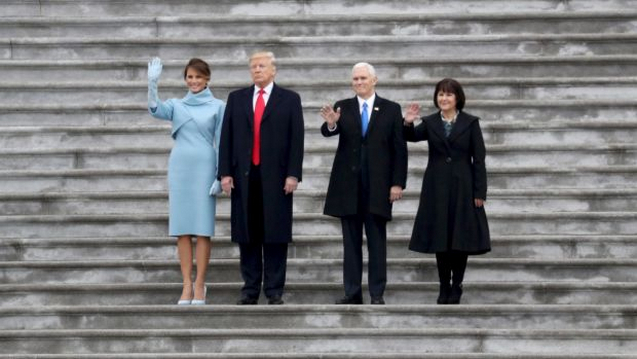
First lady Melania Trump, President Donald Trump, Vice-President Mike Pence and his wife, Karen Pence, farewell the Obamas. Photo: AP
Instead, he vowed to eliminate "harmful and unnecessary policies" such as the Climate Action Plan and the Waters of the United States rule.
The first represents a variety of efforts Mr Obama pursued to reduce US greenhouse gas emissions while the second is a rule issued by the Environmental Protection Agency to protect not only the largest waterways but smaller tributaries that others believe should fall under the jurisdiction of states rather than the federal government.
Mr Trump plans to boost the oil and gas industries to help fund his infrastructure initiatives.
The Trump White House website does not devote a separate section to immigration, another central tenant of his candidacy, though it mentions immigration under the law enforcement section. Despite rumours among the immigration advocacy community that one of Mr Trump's initial executive actions could be to revoke Mr Obama's protections for the so-called 'Dreamers', those undocumented immigrants brought to the country as young children, his website so far focuses only on big-picture enforcement and security goals.
Former President Barack Obama and his wife Michelle leave Washington. Photo: AP
"He is dedicated to enforcing our border laws, ending sanctuary cities, and stemming the tide of lawlessness associated with illegal immigration," reads part on the immigration section.
The new administration's language echoes Trump's tough rhetoric on the campaign trail, including his promises to strengthen the law enforcement community, crack down on he views as a broad range of trade violations, and potentially forge alliances with countries long considered dangerous rivals, like Russia.
"Finally, in pursuing a foreign policy based on American interests, we will embrace diplomacy," reads part of Trump's policy vision. "The world must know that we do not go abroad in search of enemies, that we are always happy when old enemies become friends, and when old friends become allies."
Also shortly after the official transition, the Trump administration overturned a mortgage fee cut under a government program that's popular with first-time home buyers and low-income borrowers.
The Department of Housing and Urban Development said it would cancel a reduction announced last week while Mr Obama was still in office.
The Federal Housing Administration had planned to cut its annual fee for most borrowers by a quarter of a percentage point to 0.60 per cent, effective on January 27.

*The Washington Post

Links

Lethal Heating is a citizens' initiative